1 Copyright 2013Craig Paxson
Process Innovation Framework
Definition: A BusinessProcessisasetof relatedactivitiesthatturninputsintooutputsandprovide value to
a customer. A BusinessProcessModel isthe logicbywhichSupplierssuccessfullyprovide valuetoprocess
customers.
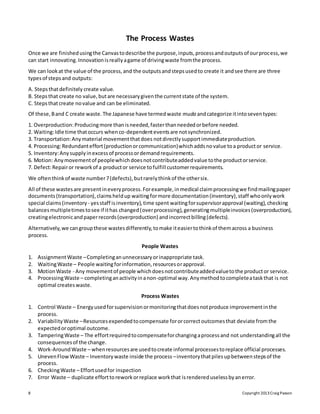
The ProcessInnovation Frameworkcombinesthe ProcessInnovationCanvas,the SevenWastesof Lean,
Momentsof Truthand Pointsof Failure withthe revolutionarySCAMPER/ProcessInnovationMatrix to
accelerate the improvementof businessprocesses.
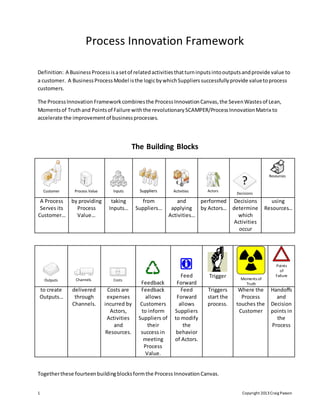
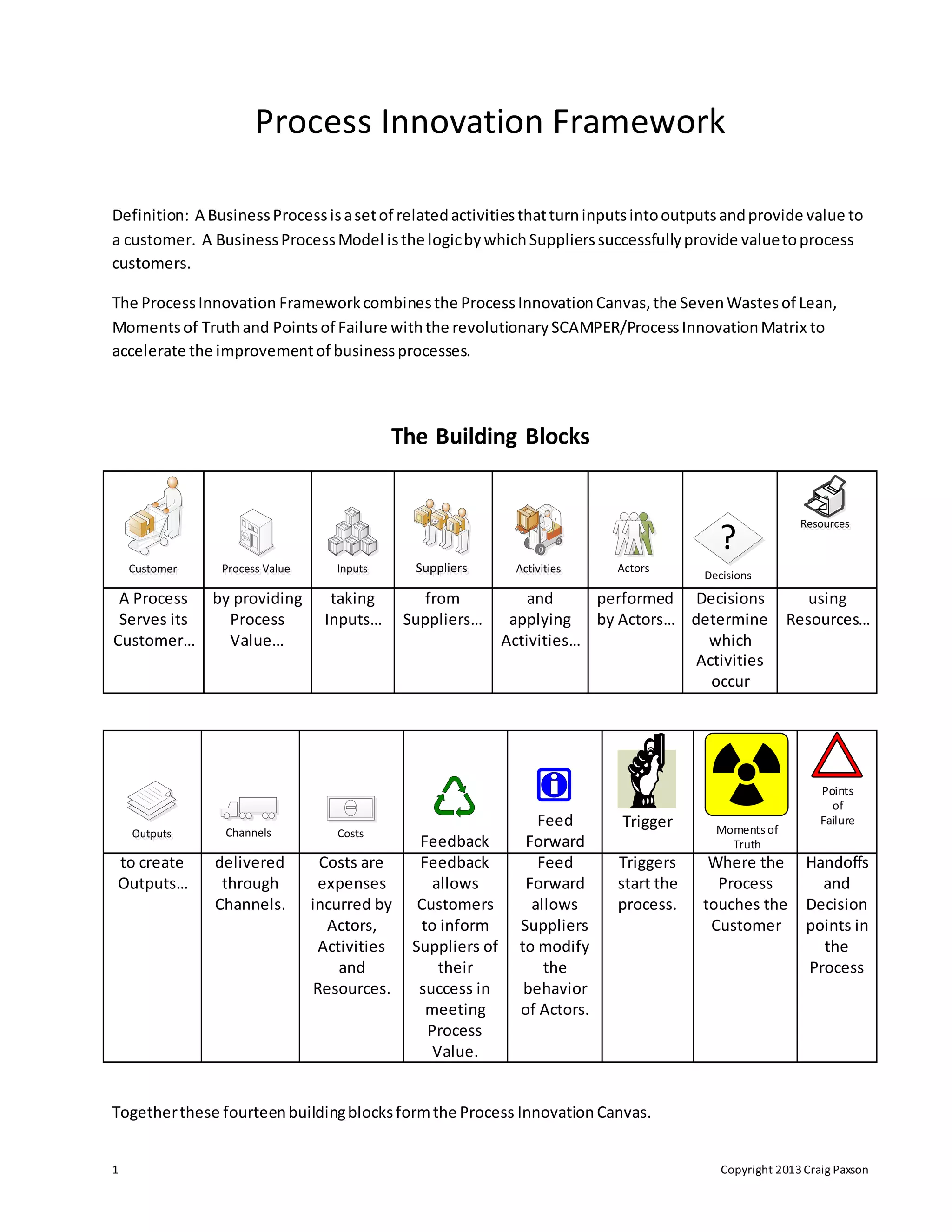
The Building Blocks
CustomerCustomer Process ValueProcess Value InputsInputs SuppliersSuppliers ActivitiesActivities Actors
?
Decisions
ResourcesResources
A Process
Serves its
Customer…
by providing
Process
Value…
taking
Inputs…
from
Suppliers…
and
applying
Activities…
performed
by Actors…
Decisions
determine
which
Activities
occur
using
Resources…
OutputsOutputs Channels Costs
Feedback
Feed
Forward
Trigger Moments of
Truth
Points
of
Failure
to create
Outputs…
delivered
through
Channels.
Costs are
expenses
incurred by
Actors,
Activities
and
Resources.
Feedback
allows
Customers
to inform
Suppliers of
their
success in
meeting
Process
Value.
Feed
Forward
allows
Suppliers
to modify
the
behavior
of Actors.
Triggers
start the
process.
Where the
Process
touches the
Customer
Handoffs
and
Decision
points in
the
Process
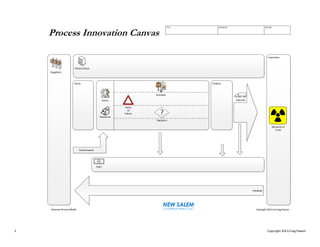
Togetherthese fourteenbuildingblocksformthe Process Innovation Canvas.
2 Copyright 2013Craig Paxson
Customers
Inputs Outputs
Feedback
Feed Forward
TITLE DRAWN BY REVISED
Business Process Model
Actors Channels
Costs
Process Innovation Canvas
Process Value
Suppliers
Activities
Resources
Copyright 2012 by Craig Paxson
Points
of
Failure
Moments of
Truth
3 Copyright 2013Craig Paxson
Customer
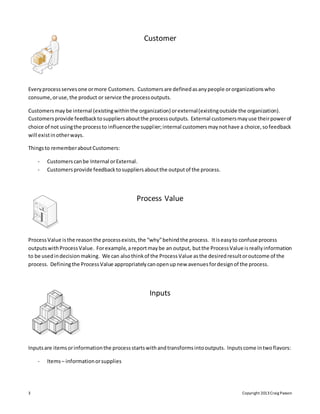
Everyprocessservesone ormore Customers. Customersare definedasanypeople ororganizationswho
consume,oruse,the product or service the processoutputs.
Customersmaybe internal (existingwithinthe organization) orexternal(existingoutside the organization).
Customersprovide feedbacktosuppliersaboutthe processoutputs. External customersmayuse theirpowerof
choice of not usingthe processto influencethe supplier;internal customersmaynothave a choice,sofeedback
will existinotherways.
Thingsto rememberaboutCustomers:
- Customerscanbe Internal orExternal.
- Customersprovide feedbacktosuppliersaboutthe outputof the process.
Process Value
ProcessValue isthe reasonthe processexists,the “why”behindthe process. Itiseasyto confuse process
outputswithProcessValue. Forexample,areportmaybe an output, butthe ProcessValue isreallyinformation
to be usedindecisionmaking. We can alsothinkof the ProcessValue asthe desiredresultoroutcome of the
process. Definingthe ProcessValue appropriatelycanopenupnew avenuesfordesignof the process.
Inputs
Inputsare itemsorinformationthe processstartswithandtransformsintooutputs. Inputscome intwoflavors:
- Items– informationorsupplies
4 Copyright 2013Craig Paxson
?
Decisions
Triggers
Triggers– Triggers“start” the process. For instance,inputstoanaccounts receivableprocessmayinclude
purchase ordersand invoices. Itisthe receiptof the invoice that“triggers”the processtostart.
Suppliers
Suppliersprovide the Inputs(materials,suppliesandinformation)foraprocessto work onand alsoprovide the
triggerthat tellsthe processwhentostart.
Activities
Activitiesare generallyeasytoidentifyusingtraditional processmappingorflowcharttechniques. Activities
may include value-addworkand non-value-addwork.
Decisions
Decisionsare made byActors andgovernwhichActivitiesoccur. A Decisionspecifieswhatneedstobe done,as
opposedtoan Activity,whichspecifieshowsomethingistobe done.
Actors
Actors are the people orsystems inaprocessthat performthe Activitiesof the process. Actorsuse resourcesto
performthe Activities.
5 Copyright 2013Craig Paxson
Resources
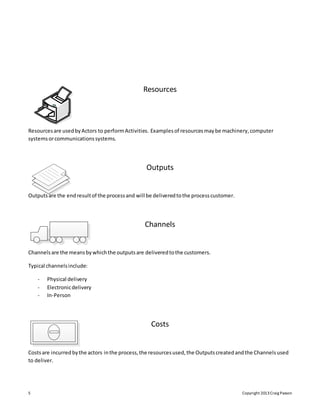
Resourcesare usedbyActors to performActivities. Examplesof resourcesmaybe machinery,computer
systemsorcommunicationssystems.
Outputs
Outputsare the endresultof the processand will be deliveredtothe processcustomer.
Channels
Channelsare the meansbywhichthe outputsare deliveredtothe customers.
Typical channelsinclude:
- Physical delivery
- Electronicdelivery
- In-Person
Costs
Costsare incurredbythe actors inthe process,the resourcesused,the Outputscreatedandthe Channelsused
to deliver.
6 Copyright 2013Craig Paxson
Feedback
Feedbackprovidesthe Customerwiththe abilitytomodifythe process. Feedbackcomesfromthe Customerto
the Supplierandcontainsinformationabouthow well the Outputsare meetingthe definedProcess Value.
Feed Forward
FeedForwardprovidesthe Supplierwiththe abilitytomodifythe behaviorsof the Actorsina process. Feed
Forwardmay include CustomerFeedback,informationabout future events(volume changes,forexample).
7 Copyright 2013Craig Paxson
Moments of Truth and Points of Failure
Moments of
Truth
Moments of Truth – the points at which activities or outputs touch the customer.
Points
of
Failure
Pointsof Failure –pointsin the processwhere twothe processinteractswiththe Customer,twoActorsinteract,
an Actor uses a resource, or a Decision is taken.
Points of Failure are the most likely points in the process where things can go wrong, and therefore the most
likely places for improvement.
The total numberof Pointsof Failure isa good indicator of how efficient a process is. The fewer the number of
PoF, the more efficient. We can track how much a process has improved by monitoring the number of PoFs
reduced during process improvement activities.
After diagramming the process, we should list the MoTs, PoFs, the actors involved or the decision taken.
8 Copyright 2013Craig Paxson
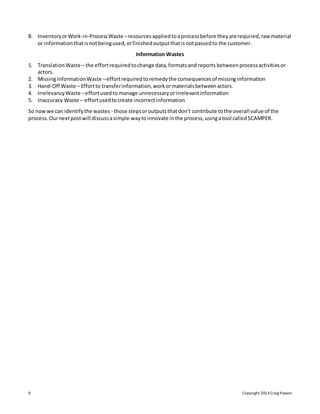
The Process Wastes
Once we are finishedusingthe Canvastodescribe the purpose,inputs,processandoutputsof ourprocess,we
can start innovating.Innovationisreallyagame of drivingwaste fromthe process.
We can lookat the value of the process,and the outputsandstepsusedto create it andsee there are three
typesof stepsand outputs:
A. Stepsthatdefinitely create value.
B. Stepsthat create no value,butare necessarygiventhe currentstate of the system.
C. Stepsthatcreate novalue and can be eliminated.
Of these,Band C create waste.The Japanese have termedwaste muda andcategorize itintoseventypes:
1. Overproduction:Producingmore thanisneeded,fasterthanneededorbefore needed.
2. Waiting:Idle time thatoccurs whenco-dependenteventsare notsynchronized.
3. Transportation:Anymaterial movementthatdoes notdirectlysupportimmediateproduction.
4. Processing:Redundanteffort(productionorcommunication)whichaddsnovalue toa productor service.
5. Inventory:Anysupplyinexcessof processordemandrequirements.
6. Motion: Anymovementof peoplewhichdoesnotcontributeaddedvalue tothe productorservice.
7. Defect:Repairor reworkof a productor service tofulfill customerrequirements.
We oftenthinkof waste number7(defects),butrarelythinkof the othersix.
All of these wastesare presentineveryprocess.Forexample,inmedical claimprocessingwe findmailingpaper
documents(transportation),claimsheldup waitingformore documentation(inventory),staff whoonlywork
special claims(inventory - yesstaff isinventory),time spent waitingforsupervisorapproval (waiting),checking
balancesmultipletimestosee if ithas changed(overprocessing),generatingmultipleinvoices(overproduction),
creatingelectronicandpaperrecords(overproduction) andincorrectbilling(defects).
Alternatively,we cangroupthese wastesdifferently,tomake iteasiertothinkof themacross a business
process.
People Wastes
1. AssignmentWaste –Completinganunnecessaryorinappropriate task.
2. WaitingWaste – People waitingforinformation,resourcesorapproval.
3. MotionWaste - Any movementof people whichdoesnotcontributeaddedvaluetothe productor service.
4. ProcessingWaste – completinganactivityinanon-optimal way.Anymethodtocompleteataskthat is not
optimal createswaste.
Process Wastes
1. Control Waste – Energyusedforsupervisionormonitoringthatdoesnotproduce improvementinthe
process.
2. VariabilityWaste –Resourcesexpendedtocompensate fororcorrectoutcomesthat deviate fromthe
expectedoroptimal outcome.
3. TamperingWaste – The effortrequiredtocompensateforchangingaprocessand not understandingall the
consequencesof the change.
4. Work-AroundWaste – whenresourcesare usedtocreate informal processestoreplace official processes.
5. UnevenFlowWaste – Inventorywaste inside the process –inventorythatpilesupbetweenstepsof the
process.
6. CheckingWaste – Effortusedfor inspection
7. Error Waste – duplicate efforttoreworkorreplace workthat isrendereduselessbyanerror.
9 Copyright 2013Craig Paxson
8. InventoryorWork-in-ProcessWaste –resourcesappliedtoaprocessbefore theyare required,rawmaterial
or informationthatisnotbeingused,orfinishedoutputthatisnotpassedto the customer.
Information Wastes
1. TranslationWaste – the effortrequiredtochange data,formatsand reports betweenprocessactivitiesor
actors.
2. MissingInformationWaste –effortrequiredtoremedythe consequencesof missinginformation
3. Hand-Off Waste – Effortto transferinformation,workormaterialsbetweenactors.
4. IrrelevancyWaste –effortusedto manage unnecessaryorirrelevantinformation
5. Inaccuracy Waste – effortusedtocreate incorrectinformation
So nowwe can identifythe wastes - those stepsoroutputsthatdon't contribute tothe overall value of the
process.Ournextpostwill discussasimple waytoinnovate inthe process,usingatool calledSCAMPER.
10 Copyright 2013Craig Paxson
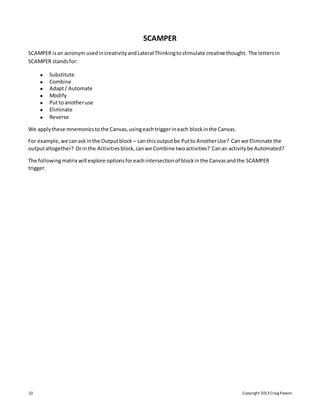
SCAMPER
SCAMPER isan acronym usedincreativityandLateral Thinkingtostimulate creative thought. The lettersin
SCAMPER standsfor:
 Substitute
 Combine
 Adapt/ Automate
 Modify
 Put toanotheruse
 Eliminate
 Reverse
We applythese mnemonicstothe Canvas,usingeachtriggerineach blockinthe Canvas.
For example,we canaskinthe Outputblock – can thisoutputbe Putto AnotherUse? Can we Eliminate the
outputaltogether? Orinthe Activitiesblock,canwe Combine twoactivities? Canan activitybe Automated?
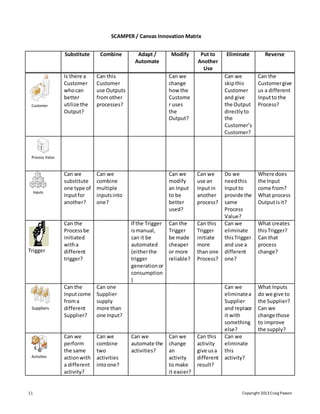
The followingmatrix will explore optionsforeachintersectionof blockinthe Canvasandthe SCAMPER
trigger.
11 Copyright 2013Craig Paxson
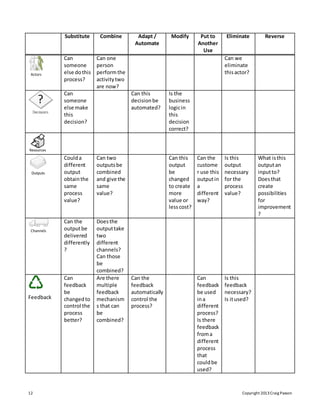
SCAMPER / Canvas Innovation Matrix
Substitute Combine Adapt /
Automate
Modify Put to
Another
Use
Eliminate Reverse
CustomerCustomer
Is there a
Customer
whocan
better
utilize the
Output?
Can this
Customer
use Outputs
fromother
processes?
Can we
change
how the
Custome
r uses
the
Output?
Can we
skipthis
Customer
and give
the Output
directlyto
the
Customer’s
Customer?
Can the
Customergive
us a different
Inputto the
Process?
Process ValueProcess Value
InputsInputs
Can we
substitute
one type of
Inputfor
another?
Can we
combine
multiple
inputsinto
one?
Can we
modify
an Input
to be
better
used?
Can we
use an
Inputin
another
process?
Do we
needthis
Inputto
provide the
same
Process
Value?
Where does
the Input
come from?
What process
Outputisit?
Trigger
Can the
Processbe
initiated
witha
different
trigger?
If the Trigger
ismanual,
can it be
automated
(eitherthe
trigger
generationor
consumption
)
Can the
Trigger
be made
cheaper
or more
reliable?
Can this
Trigger
initiate
more
than one
Process?
Can we
eliminate
thisTrigger
and use a
different
one?
What creates
thisTrigger?
Can that
process
change?
SuppliersSuppliers
Can the
Inputcome
froma
different
Supplier?
Can one
Supplier
supply
more than
one Input?
Can we
eliminatea
Supplier
and replace
it with
something
else?
What Inputs
do we give to
the Supplier?
Can we
change those
to improve
the supply?
ActivitiesActivities
Can we
perform
the same
actionwith
a different
activity?
Can we
combine
two
activities
intoone?
Can we
automate the
activities?
Can we
change
an
activity
to make
it easier?
Can this
activity
give usa
different
result?
Can we
eliminate
this
activity?
12 Copyright 2013Craig Paxson
Substitute Combine Adapt /
Automate
Modify Put to
Another
Use
Eliminate Reverse
Actors
Can
someone
else dothis
process?
Can one
person
performthe
activitytwo
are now?
Can we
eliminate
thisactor?
Can
someone
else make
this
decision?
Can this
decisionbe
automated?
Is the
business
logicin
this
decision
correct?
ResourcesResources
OutputsOutputs
Coulda
different
output
obtainthe
same
process
value?
Can two
outputsbe
combined
and give the
same
value?
Can this
output
be
changed
to create
more
value or
lesscost?
Can the
custome
r use this
outputin
a
different
way?
Is this
output
necessary
for the
process
value?
What isthis
outputan
inputto?
Doesthat
create
possibilities
for
improvement
?
Channels
Can the
outputbe
delivered
differently
?
Doesthe
outputtake
two
different
channels?
Can those
be
combined?
Feedback
Can
feedback
be
changedto
control the
process
better?
Are there
multiple
feedback
mechanism
s that can
be
combined?
Can the
feedback
automatically
control the
process?
Can
feedback
be used
ina
different
process?
Is there
feedback
froma
different
process
that
couldbe
used?
Is this
feedback
necessary?
Is itused?
13 Copyright 2013Craig Paxson
Substitute Combine Adapt /
Automate
Modify Put to
Another
Use
Eliminate Reverse
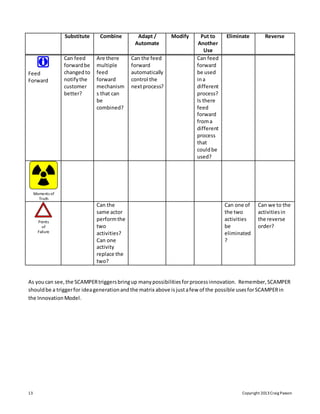
Feed
Forward
Can feed
forwardbe
changedto
notifythe
customer
better?
Are there
multiple
feed
forward
mechanism
s that can
be
combined?
Can the feed
forward
automatically
control the
nextprocess?
Can feed
forward
be used
ina
different
process?
Is there
feed
forward
froma
different
process
that
couldbe
used?
Moments of
Truth
Points
of
Failure
Can the
same actor
performthe
two
activities?
Can one
activity
replace the
two?
Can one of
the two
activities
be
eliminated
?
Can we to the
activitiesin
the reverse
order?
As youcan see,the SCAMPERtriggersbringup manypossibilitiesforprocessinnovation. Remember,SCAMPER
shouldbe a triggerfor ideagenerationandthe matrix above isjustafew of the possible usesforSCAMPERin
the InnovationModel.
14 Copyright 2013Craig Paxson
What is the Problem?
Accordingto Masaaki Imai inhisbook“Gemba Kaizen,”everyprocessvalueisbuiltonacombinationof quality,
cost and delivery.These threecharacteristicsare notseparate,butcloselyinterrelated.Quality inourprocess
model meansthe abilityof the outputtodeliverthe processvalue. Costisthe amountof effortandresources
usedto create the processoutputand deliverittothe customer. Delivery refersto the deliveryof the correct
amountof processoutputto the customerat the righttime.
All processproblemsare relatedtoone ormore of these factors.Solvinga problemrelatedtodelivery,suchas
howlongit takesto create the output,may notbe the properapproachif the outputdoesn’tdeliverthe value
the customerneeds.
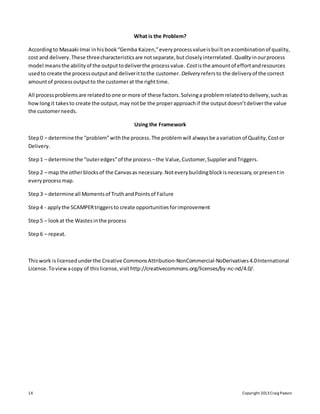
Using the Framework
Step0 – determine the “problem”withthe process.The problemwill alwaysbe avariationof Quality,Costor
Delivery.
Step1 – determine the “outeredges”of the process –the Value,Customer,SupplierandTriggers.
Step2 – map the otherblocksof the Canvasas necessary.Noteverybuildingblockisnecessary,orpresentin
everyprocessmap.
Step3 – determine all Momentsof TruthandPointsof Failure
Step4 - applythe SCAMPERtriggersto create opportunitiesforimprovement
Step5 – lookat the Wastesinthe process
Step6 – repeat.
Thiswork islicensedunderthe Creative CommonsAttribution-NonCommercial-NoDerivatives4.0International
License.Toviewacopy of thislicense,visithttp://creativecommons.org/licenses/by-nc-nd/4.0/.

Process innovation framework

  • 1.
    1 Copyright 2013CraigPaxson Process Innovation Framework Definition: A BusinessProcessisasetof relatedactivitiesthatturninputsintooutputsandprovide value to a customer. A BusinessProcessModel isthe logicbywhichSupplierssuccessfullyprovide valuetoprocess customers. The ProcessInnovation Frameworkcombinesthe ProcessInnovationCanvas,the SevenWastesof Lean, Momentsof Truthand Pointsof Failure withthe revolutionarySCAMPER/ProcessInnovationMatrix to accelerate the improvementof businessprocesses. The Building Blocks CustomerCustomer Process ValueProcess Value InputsInputs SuppliersSuppliers ActivitiesActivities Actors ? Decisions ResourcesResources A Process Serves its Customer… by providing Process Value… taking Inputs… from Suppliers… and applying Activities… performed by Actors… Decisions determine which Activities occur using Resources… OutputsOutputs Channels Costs Feedback Feed Forward Trigger Moments of Truth Points of Failure to create Outputs… delivered through Channels. Costs are expenses incurred by Actors, Activities and Resources. Feedback allows Customers to inform Suppliers of their success in meeting Process Value. Feed Forward allows Suppliers to modify the behavior of Actors. Triggers start the process. Where the Process touches the Customer Handoffs and Decision points in the Process Togetherthese fourteenbuildingblocksformthe Process Innovation Canvas.
  • 2.
    2 Copyright 2013CraigPaxson Customers Inputs Outputs Feedback Feed Forward TITLE DRAWN BY REVISED Business Process Model Actors Channels Costs Process Innovation Canvas Process Value Suppliers Activities Resources Copyright 2012 by Craig Paxson Points of Failure Moments of Truth
  • 3.
    3 Copyright 2013CraigPaxson Customer Everyprocessservesone ormore Customers. Customersare definedasanypeople ororganizationswho consume,oruse,the product or service the processoutputs. Customersmaybe internal (existingwithinthe organization) orexternal(existingoutside the organization). Customersprovide feedbacktosuppliersaboutthe processoutputs. External customersmayuse theirpowerof choice of not usingthe processto influencethe supplier;internal customersmaynothave a choice,sofeedback will existinotherways. Thingsto rememberaboutCustomers: - Customerscanbe Internal orExternal. - Customersprovide feedbacktosuppliersaboutthe outputof the process. Process Value ProcessValue isthe reasonthe processexists,the “why”behindthe process. Itiseasyto confuse process outputswithProcessValue. Forexample,areportmaybe an output, butthe ProcessValue isreallyinformation to be usedindecisionmaking. We can alsothinkof the ProcessValue asthe desiredresultoroutcome of the process. Definingthe ProcessValue appropriatelycanopenupnew avenuesfordesignof the process. Inputs Inputsare itemsorinformationthe processstartswithandtransformsintooutputs. Inputscome intwoflavors: - Items– informationorsupplies
  • 4.
    4 Copyright 2013CraigPaxson ? Decisions Triggers Triggers– Triggers“start” the process. For instance,inputstoanaccounts receivableprocessmayinclude purchase ordersand invoices. Itisthe receiptof the invoice that“triggers”the processtostart. Suppliers Suppliersprovide the Inputs(materials,suppliesandinformation)foraprocessto work onand alsoprovide the triggerthat tellsthe processwhentostart. Activities Activitiesare generallyeasytoidentifyusingtraditional processmappingorflowcharttechniques. Activities may include value-addworkand non-value-addwork. Decisions Decisionsare made byActors andgovernwhichActivitiesoccur. A Decisionspecifieswhatneedstobe done,as opposedtoan Activity,whichspecifieshowsomethingistobe done. Actors Actors are the people orsystems inaprocessthat performthe Activitiesof the process. Actorsuse resourcesto performthe Activities.
  • 5.
    5 Copyright 2013CraigPaxson Resources Resourcesare usedbyActors to performActivities. Examplesof resourcesmaybe machinery,computer systemsorcommunicationssystems. Outputs Outputsare the endresultof the processand will be deliveredtothe processcustomer. Channels Channelsare the meansbywhichthe outputsare deliveredtothe customers. Typical channelsinclude: - Physical delivery - Electronicdelivery - In-Person Costs Costsare incurredbythe actors inthe process,the resourcesused,the Outputscreatedandthe Channelsused to deliver.
  • 6.
    6 Copyright 2013CraigPaxson Feedback Feedbackprovidesthe Customerwiththe abilitytomodifythe process. Feedbackcomesfromthe Customerto the Supplierandcontainsinformationabouthow well the Outputsare meetingthe definedProcess Value. Feed Forward FeedForwardprovidesthe Supplierwiththe abilitytomodifythe behaviorsof the Actorsina process. Feed Forwardmay include CustomerFeedback,informationabout future events(volume changes,forexample).
  • 7.
    7 Copyright 2013CraigPaxson Moments of Truth and Points of Failure Moments of Truth Moments of Truth – the points at which activities or outputs touch the customer. Points of Failure Pointsof Failure –pointsin the processwhere twothe processinteractswiththe Customer,twoActorsinteract, an Actor uses a resource, or a Decision is taken. Points of Failure are the most likely points in the process where things can go wrong, and therefore the most likely places for improvement. The total numberof Pointsof Failure isa good indicator of how efficient a process is. The fewer the number of PoF, the more efficient. We can track how much a process has improved by monitoring the number of PoFs reduced during process improvement activities. After diagramming the process, we should list the MoTs, PoFs, the actors involved or the decision taken.
  • 8.
    8 Copyright 2013CraigPaxson The Process Wastes Once we are finishedusingthe Canvastodescribe the purpose,inputs,processandoutputsof ourprocess,we can start innovating.Innovationisreallyagame of drivingwaste fromthe process. We can lookat the value of the process,and the outputsandstepsusedto create it andsee there are three typesof stepsand outputs: A. Stepsthatdefinitely create value. B. Stepsthat create no value,butare necessarygiventhe currentstate of the system. C. Stepsthatcreate novalue and can be eliminated. Of these,Band C create waste.The Japanese have termedwaste muda andcategorize itintoseventypes: 1. Overproduction:Producingmore thanisneeded,fasterthanneededorbefore needed. 2. Waiting:Idle time thatoccurs whenco-dependenteventsare notsynchronized. 3. Transportation:Anymaterial movementthatdoes notdirectlysupportimmediateproduction. 4. Processing:Redundanteffort(productionorcommunication)whichaddsnovalue toa productor service. 5. Inventory:Anysupplyinexcessof processordemandrequirements. 6. Motion: Anymovementof peoplewhichdoesnotcontributeaddedvalue tothe productorservice. 7. Defect:Repairor reworkof a productor service tofulfill customerrequirements. We oftenthinkof waste number7(defects),butrarelythinkof the othersix. All of these wastesare presentineveryprocess.Forexample,inmedical claimprocessingwe findmailingpaper documents(transportation),claimsheldup waitingformore documentation(inventory),staff whoonlywork special claims(inventory - yesstaff isinventory),time spent waitingforsupervisorapproval (waiting),checking balancesmultipletimestosee if ithas changed(overprocessing),generatingmultipleinvoices(overproduction), creatingelectronicandpaperrecords(overproduction) andincorrectbilling(defects). Alternatively,we cangroupthese wastesdifferently,tomake iteasiertothinkof themacross a business process. People Wastes 1. AssignmentWaste –Completinganunnecessaryorinappropriate task. 2. WaitingWaste – People waitingforinformation,resourcesorapproval. 3. MotionWaste - Any movementof people whichdoesnotcontributeaddedvaluetothe productor service. 4. ProcessingWaste – completinganactivityinanon-optimal way.Anymethodtocompleteataskthat is not optimal createswaste. Process Wastes 1. Control Waste – Energyusedforsupervisionormonitoringthatdoesnotproduce improvementinthe process. 2. VariabilityWaste –Resourcesexpendedtocompensate fororcorrectoutcomesthat deviate fromthe expectedoroptimal outcome. 3. TamperingWaste – The effortrequiredtocompensateforchangingaprocessand not understandingall the consequencesof the change. 4. Work-AroundWaste – whenresourcesare usedtocreate informal processestoreplace official processes. 5. UnevenFlowWaste – Inventorywaste inside the process –inventorythatpilesupbetweenstepsof the process. 6. CheckingWaste – Effortusedfor inspection 7. Error Waste – duplicate efforttoreworkorreplace workthat isrendereduselessbyanerror.
  • 9.
    9 Copyright 2013CraigPaxson 8. InventoryorWork-in-ProcessWaste –resourcesappliedtoaprocessbefore theyare required,rawmaterial or informationthatisnotbeingused,orfinishedoutputthatisnotpassedto the customer. Information Wastes 1. TranslationWaste – the effortrequiredtochange data,formatsand reports betweenprocessactivitiesor actors. 2. MissingInformationWaste –effortrequiredtoremedythe consequencesof missinginformation 3. Hand-Off Waste – Effortto transferinformation,workormaterialsbetweenactors. 4. IrrelevancyWaste –effortusedto manage unnecessaryorirrelevantinformation 5. Inaccuracy Waste – effortusedtocreate incorrectinformation So nowwe can identifythe wastes - those stepsoroutputsthatdon't contribute tothe overall value of the process.Ournextpostwill discussasimple waytoinnovate inthe process,usingatool calledSCAMPER.
  • 10.
    10 Copyright 2013CraigPaxson SCAMPER SCAMPER isan acronym usedincreativityandLateral Thinkingtostimulate creative thought. The lettersin SCAMPER standsfor:  Substitute  Combine  Adapt/ Automate  Modify  Put toanotheruse  Eliminate  Reverse We applythese mnemonicstothe Canvas,usingeachtriggerineach blockinthe Canvas. For example,we canaskinthe Outputblock – can thisoutputbe Putto AnotherUse? Can we Eliminate the outputaltogether? Orinthe Activitiesblock,canwe Combine twoactivities? Canan activitybe Automated? The followingmatrix will explore optionsforeachintersectionof blockinthe Canvasandthe SCAMPER trigger.
  • 11.
    11 Copyright 2013CraigPaxson SCAMPER / Canvas Innovation Matrix Substitute Combine Adapt / Automate Modify Put to Another Use Eliminate Reverse CustomerCustomer Is there a Customer whocan better utilize the Output? Can this Customer use Outputs fromother processes? Can we change how the Custome r uses the Output? Can we skipthis Customer and give the Output directlyto the Customer’s Customer? Can the Customergive us a different Inputto the Process? Process ValueProcess Value InputsInputs Can we substitute one type of Inputfor another? Can we combine multiple inputsinto one? Can we modify an Input to be better used? Can we use an Inputin another process? Do we needthis Inputto provide the same Process Value? Where does the Input come from? What process Outputisit? Trigger Can the Processbe initiated witha different trigger? If the Trigger ismanual, can it be automated (eitherthe trigger generationor consumption ) Can the Trigger be made cheaper or more reliable? Can this Trigger initiate more than one Process? Can we eliminate thisTrigger and use a different one? What creates thisTrigger? Can that process change? SuppliersSuppliers Can the Inputcome froma different Supplier? Can one Supplier supply more than one Input? Can we eliminatea Supplier and replace it with something else? What Inputs do we give to the Supplier? Can we change those to improve the supply? ActivitiesActivities Can we perform the same actionwith a different activity? Can we combine two activities intoone? Can we automate the activities? Can we change an activity to make it easier? Can this activity give usa different result? Can we eliminate this activity?
  • 12.
    12 Copyright 2013CraigPaxson Substitute Combine Adapt / Automate Modify Put to Another Use Eliminate Reverse Actors Can someone else dothis process? Can one person performthe activitytwo are now? Can we eliminate thisactor? Can someone else make this decision? Can this decisionbe automated? Is the business logicin this decision correct? ResourcesResources OutputsOutputs Coulda different output obtainthe same process value? Can two outputsbe combined and give the same value? Can this output be changed to create more value or lesscost? Can the custome r use this outputin a different way? Is this output necessary for the process value? What isthis outputan inputto? Doesthat create possibilities for improvement ? Channels Can the outputbe delivered differently ? Doesthe outputtake two different channels? Can those be combined? Feedback Can feedback be changedto control the process better? Are there multiple feedback mechanism s that can be combined? Can the feedback automatically control the process? Can feedback be used ina different process? Is there feedback froma different process that couldbe used? Is this feedback necessary? Is itused?
  • 13.
    13 Copyright 2013CraigPaxson Substitute Combine Adapt / Automate Modify Put to Another Use Eliminate Reverse Feed Forward Can feed forwardbe changedto notifythe customer better? Are there multiple feed forward mechanism s that can be combined? Can the feed forward automatically control the nextprocess? Can feed forward be used ina different process? Is there feed forward froma different process that couldbe used? Moments of Truth Points of Failure Can the same actor performthe two activities? Can one activity replace the two? Can one of the two activities be eliminated ? Can we to the activitiesin the reverse order? As youcan see,the SCAMPERtriggersbringup manypossibilitiesforprocessinnovation. Remember,SCAMPER shouldbe a triggerfor ideagenerationandthe matrix above isjustafew of the possible usesforSCAMPERin the InnovationModel.
  • 14.
    14 Copyright 2013CraigPaxson What is the Problem? Accordingto Masaaki Imai inhisbook“Gemba Kaizen,”everyprocessvalueisbuiltonacombinationof quality, cost and delivery.These threecharacteristicsare notseparate,butcloselyinterrelated.Quality inourprocess model meansthe abilityof the outputtodeliverthe processvalue. Costisthe amountof effortandresources usedto create the processoutputand deliverittothe customer. Delivery refersto the deliveryof the correct amountof processoutputto the customerat the righttime. All processproblemsare relatedtoone ormore of these factors.Solvinga problemrelatedtodelivery,suchas howlongit takesto create the output,may notbe the properapproachif the outputdoesn’tdeliverthe value the customerneeds. Using the Framework Step0 – determine the “problem”withthe process.The problemwill alwaysbe avariationof Quality,Costor Delivery. Step1 – determine the “outeredges”of the process –the Value,Customer,SupplierandTriggers. Step2 – map the otherblocksof the Canvasas necessary.Noteverybuildingblockisnecessary,orpresentin everyprocessmap. Step3 – determine all Momentsof TruthandPointsof Failure Step4 - applythe SCAMPERtriggersto create opportunitiesforimprovement Step5 – lookat the Wastesinthe process Step6 – repeat. Thiswork islicensedunderthe Creative CommonsAttribution-NonCommercial-NoDerivatives4.0International License.Toviewacopy of thislicense,visithttp://creativecommons.org/licenses/by-nc-nd/4.0/.