
Process Improvement for Operations vs Projects - What's the Difference? (NYBPP Meetup)
The document discusses the differences between operations and project processes. Operations are permanent initiatives that produce repetitive results, while projects are temporary endeavors that create unique outputs. Separating operations and project management functions is important for success. Project managers should focus only on project processes and not engage with operations, while business analysts focus only on operations processes and not project management. While one person can potentially handle both project manager and business analyst roles, it is important they understand the different motivations and accountabilities of each function.
Process Improvement for Operations vs Projects - What's the Difference? (NYBPP Meetup)
1.
Process Improvement forOperations vs
Projects - What's the Difference?
NYBPP Meetup (11/29)
Highlights and Q&A
2.
Agenda
I. Processes forOperations vs Projects
– Operations
– Projects
– Operations vs Projects
– Separating for Success
– Business Analyst vs Project Manager
– Summary
II. Q&A
– Does the separation of project management and business analysis change
depending on the size of the organization or project?
– Will some functions or departments always be project or operation processes?
– Does Agile project management make it more appropriate for a project manager
to become involved with the operations processes?
– Is it acceptable for a resource to play the PM/BA role simultaneously?
3.
Process Improvement forOperations vs
Projects - What's the Difference?
Meetup Highlights
Identifying different kinds of processes for
success
4.
Operations
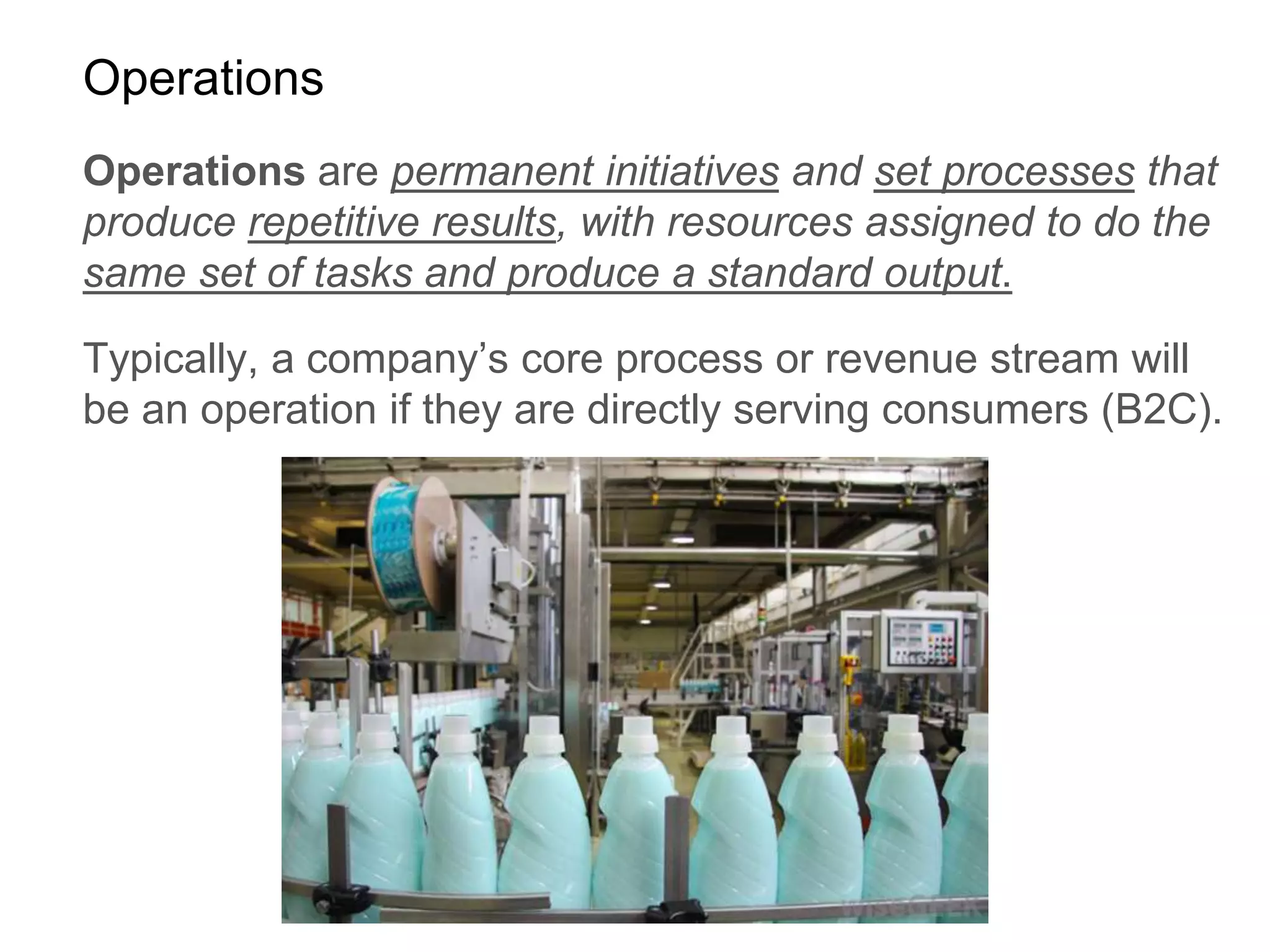
Operations are permanentinitiatives and set processes that
produce repetitive results, with resources assigned to do the
same set of tasks and produce a standard output.
Typically, a company’s core process or revenue stream will
be an operation if they are directly serving consumers (B2C).
5.
Projects
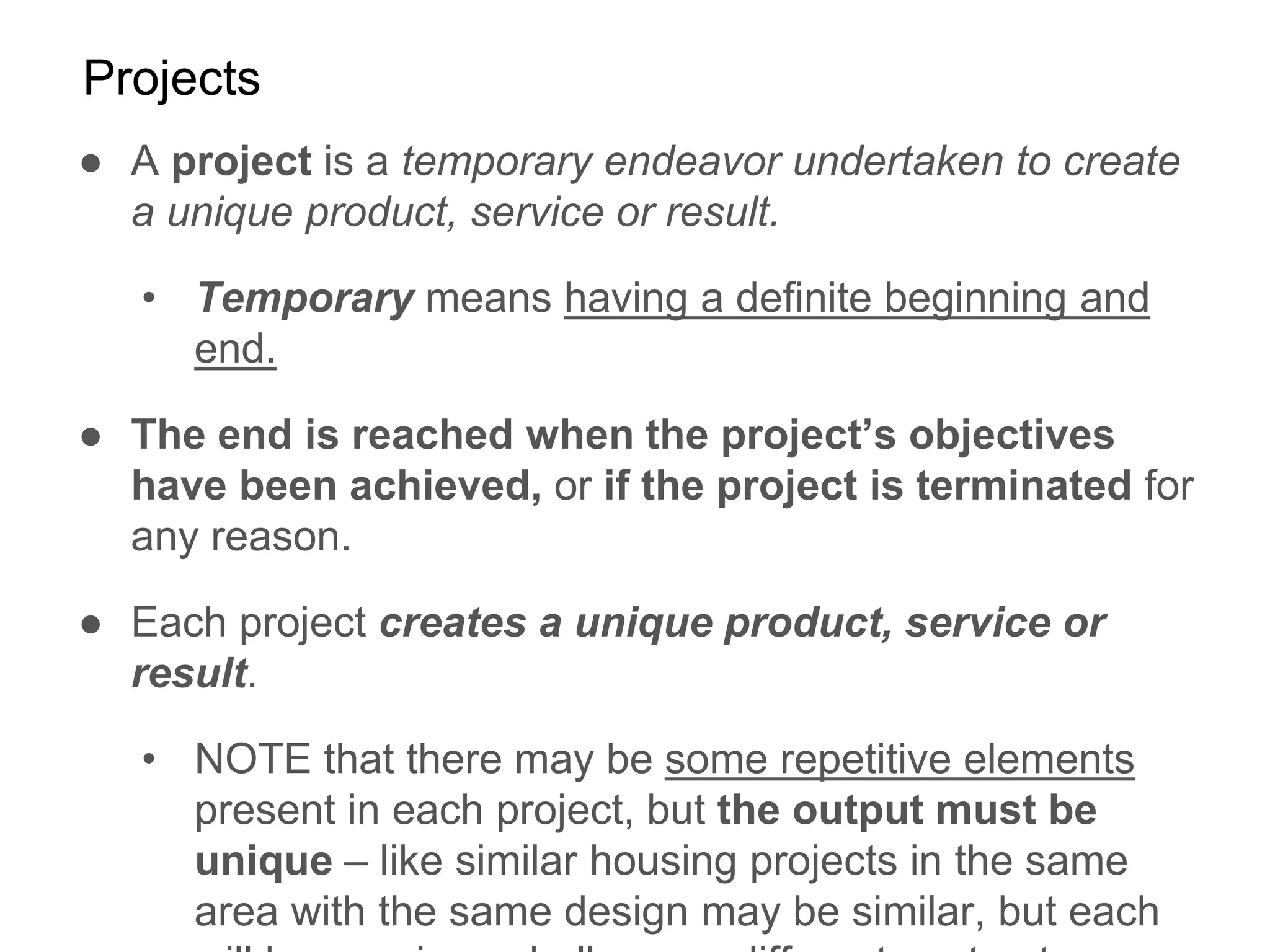
● A projectis a temporary endeavor undertaken to create
a unique product, service or result.
• Temporary means having a definite beginning and
end.
● The end is reached when the project’s objectives
have been achieved, or if the project is terminated for
any reason.
● Each project creates a unique product, service or
result.
• NOTE that there may be some repetitive elements
present in each project, but the output must be
unique – like similar housing projects in the same
area with the same design may be similar, but each
6.
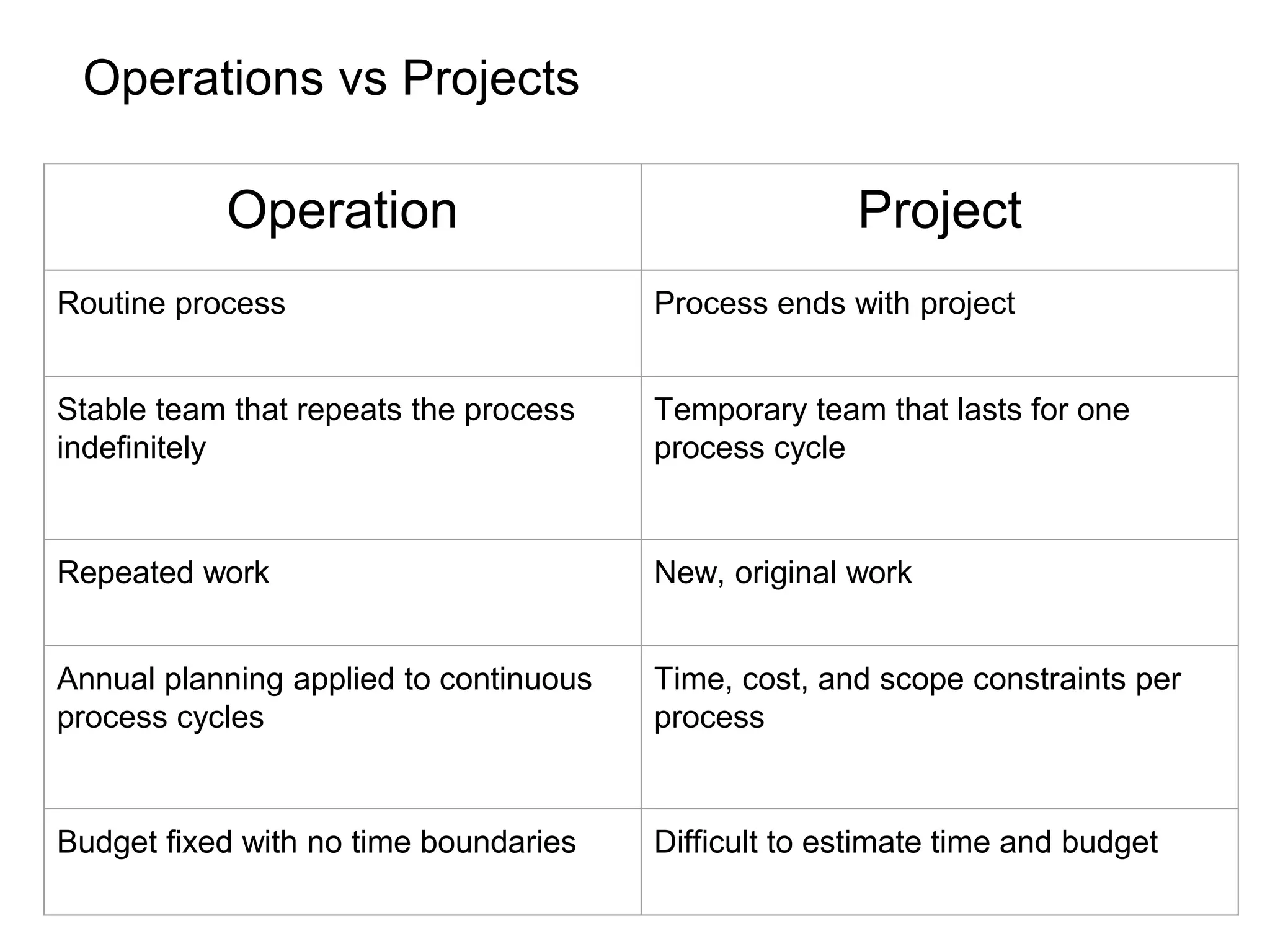
Operations vs Projects
OperationProject
Routine process Process ends with project
Stable team that repeats the process
indefinitely
Temporary team that lasts for one
process cycle
Repeated work New, original work
Annual planning applied to continuous
process cycles
Time, cost, and scope constraints per
process
Budget fixed with no time boundaries Difficult to estimate time and budget
7.
Operations vs Projects
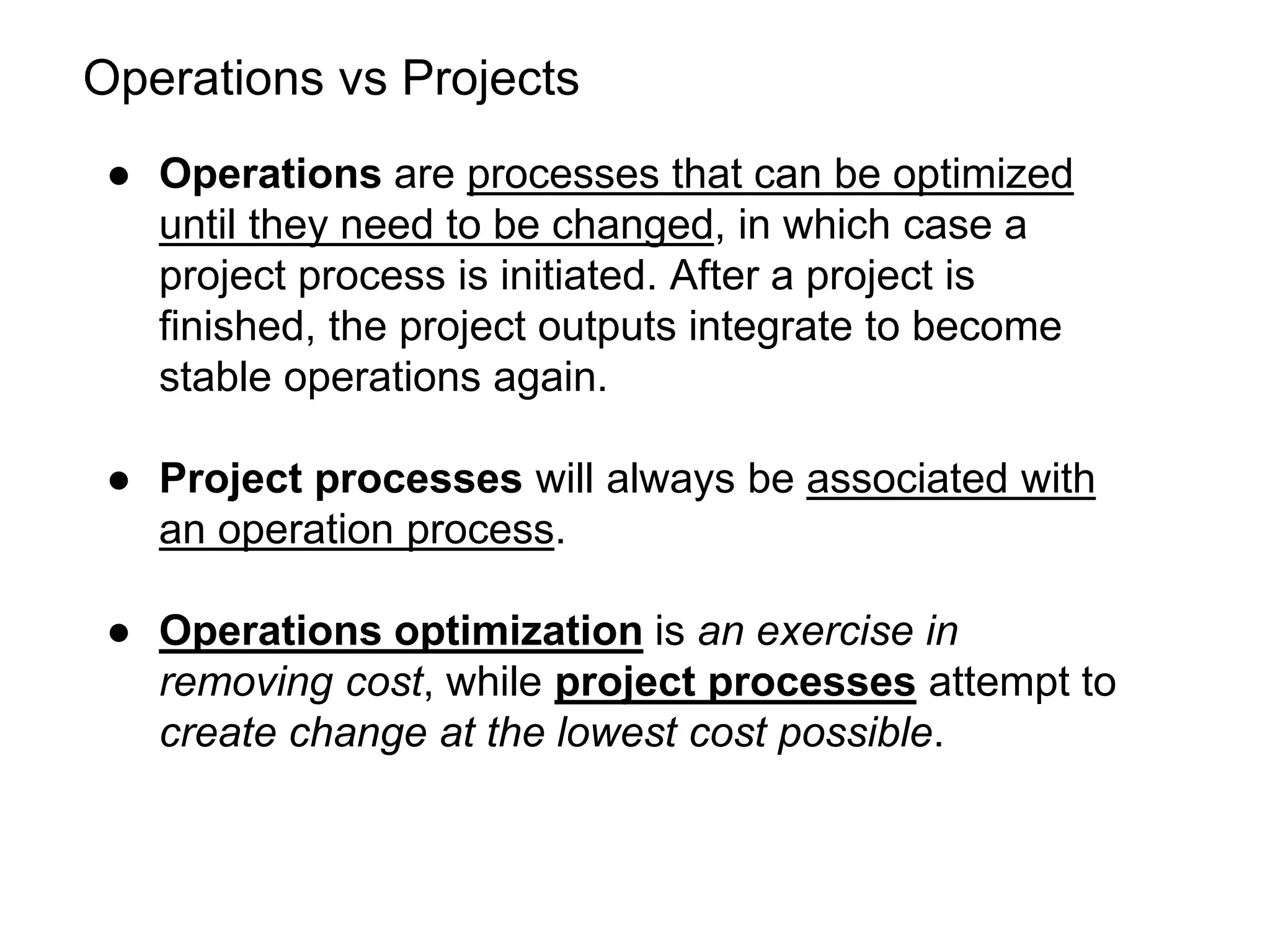
●Operations are processes that can be optimized
until they need to be changed, in which case a
project process is initiated. After a project is
finished, the project outputs integrate to become
stable operations again.
● Project processes will always be associated with
an operation process.
● Operations optimization is an exercise in
removing cost, while project processes attempt to
create change at the lowest cost possible.
8.
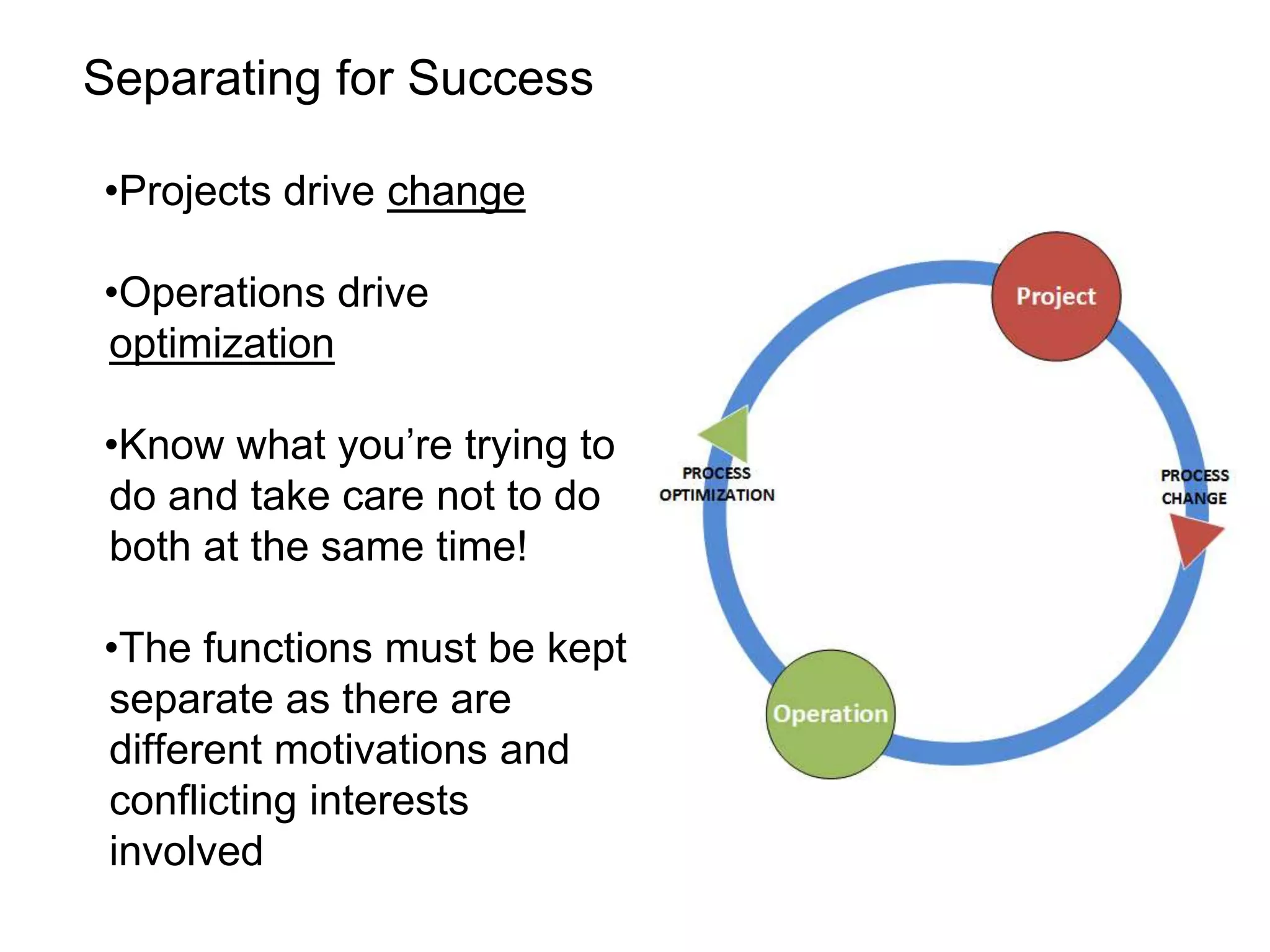
Separating for Success
•Projectsdrive change
•Operations drive
optimization
•Know what you’re trying to
do and take care not to do
both at the same time!
•The functions must be kept
separate as there are
different motivations and
conflicting interests
involved
9.
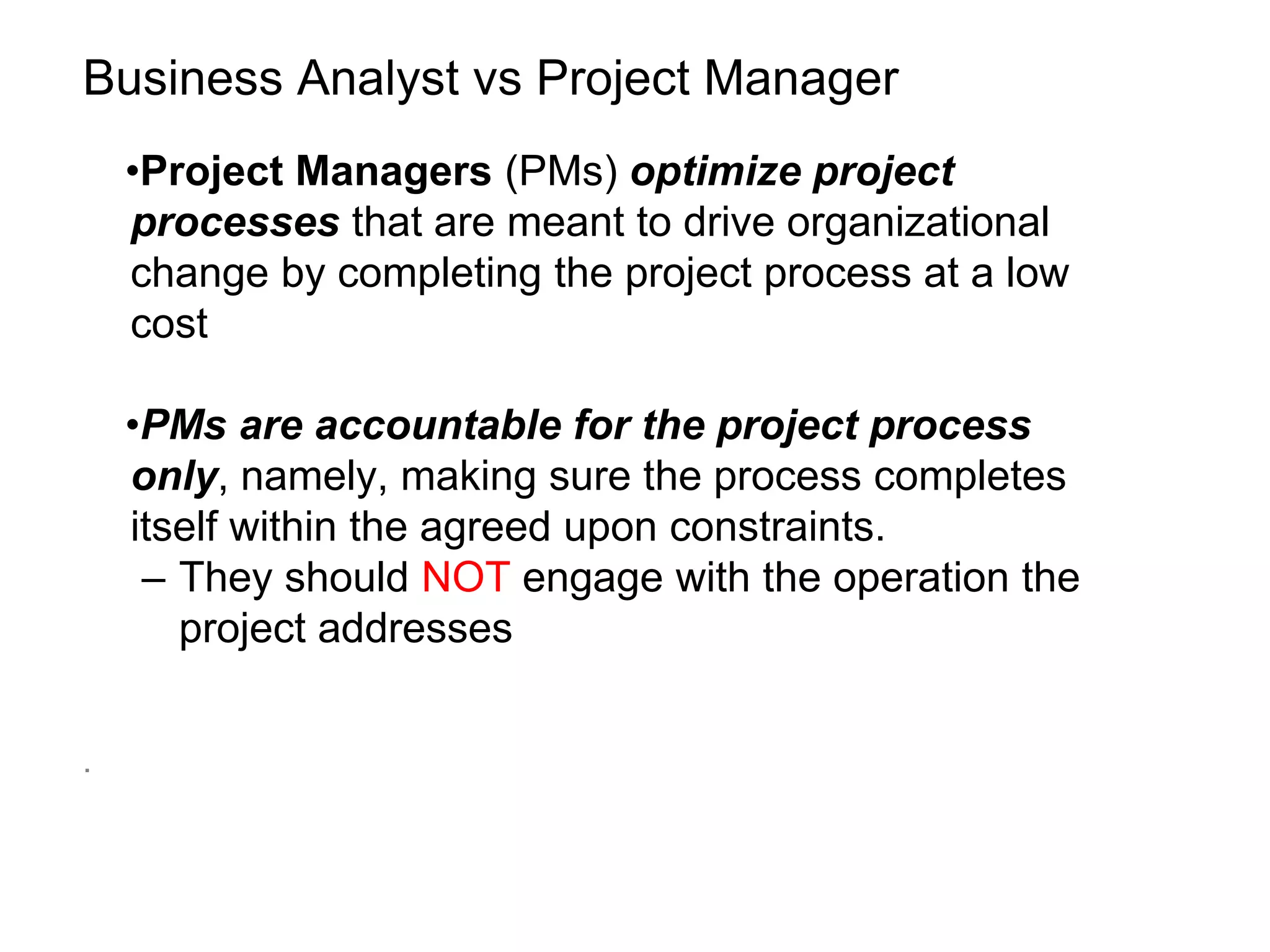
Business Analyst vsProject Manager
•Project Managers (PMs) optimize project
processes that are meant to drive organizational
change by completing the project process at a low
cost
•PMs are accountable for the project process
only, namely, making sure the process completes
itself within the agreed upon constraints.
– They should NOT engage with the operation the
project addresses
.
10.
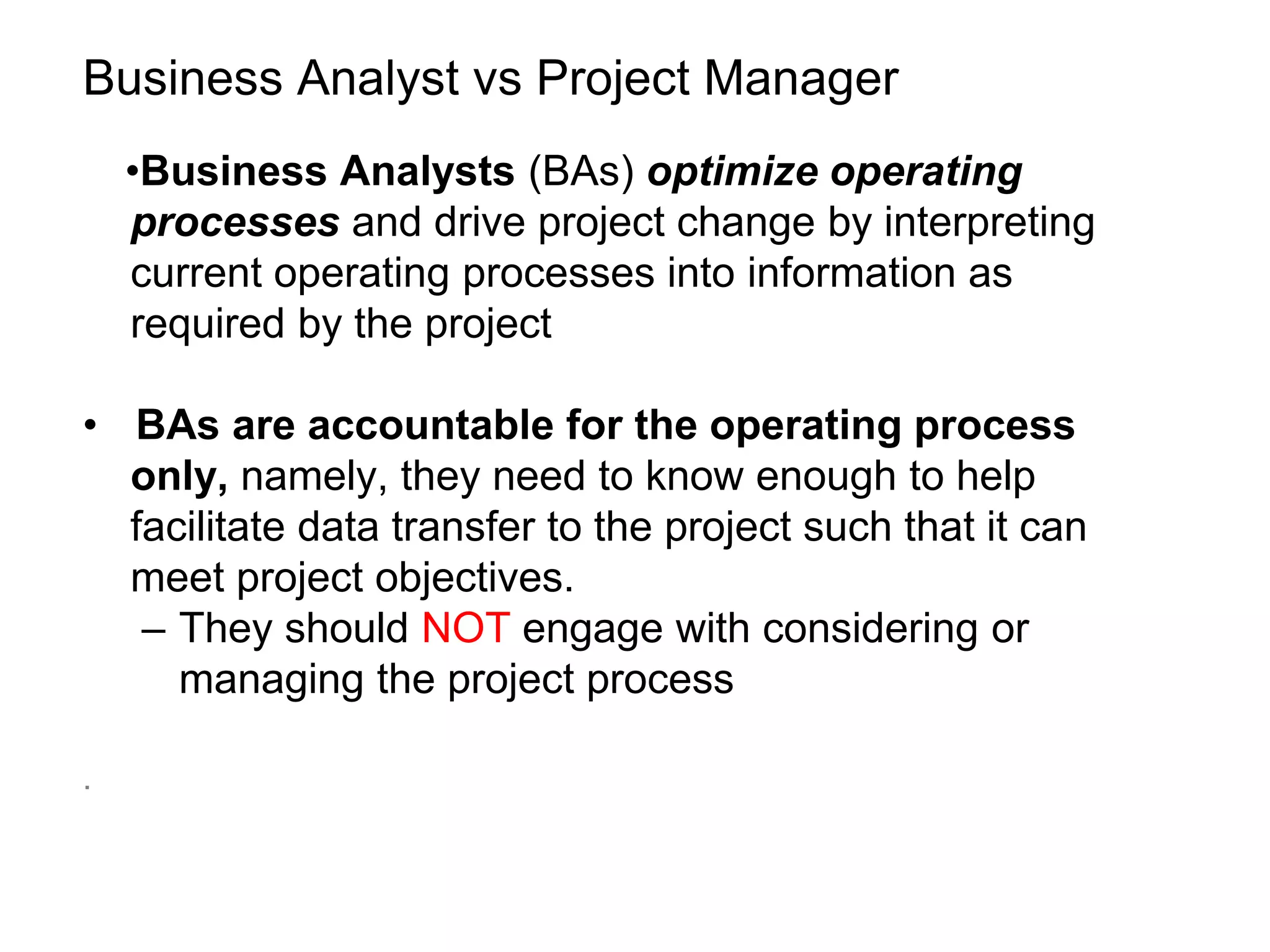
Business Analyst vsProject Manager
•Business Analysts (BAs) optimize operating
processes and drive project change by interpreting
current operating processes into information as
required by the project
• BAs are accountable for the operating process
only, namely, they need to know enough to help
facilitate data transfer to the project such that it can
meet project objectives.
– They should NOT engage with considering or
managing the project process
.
11.
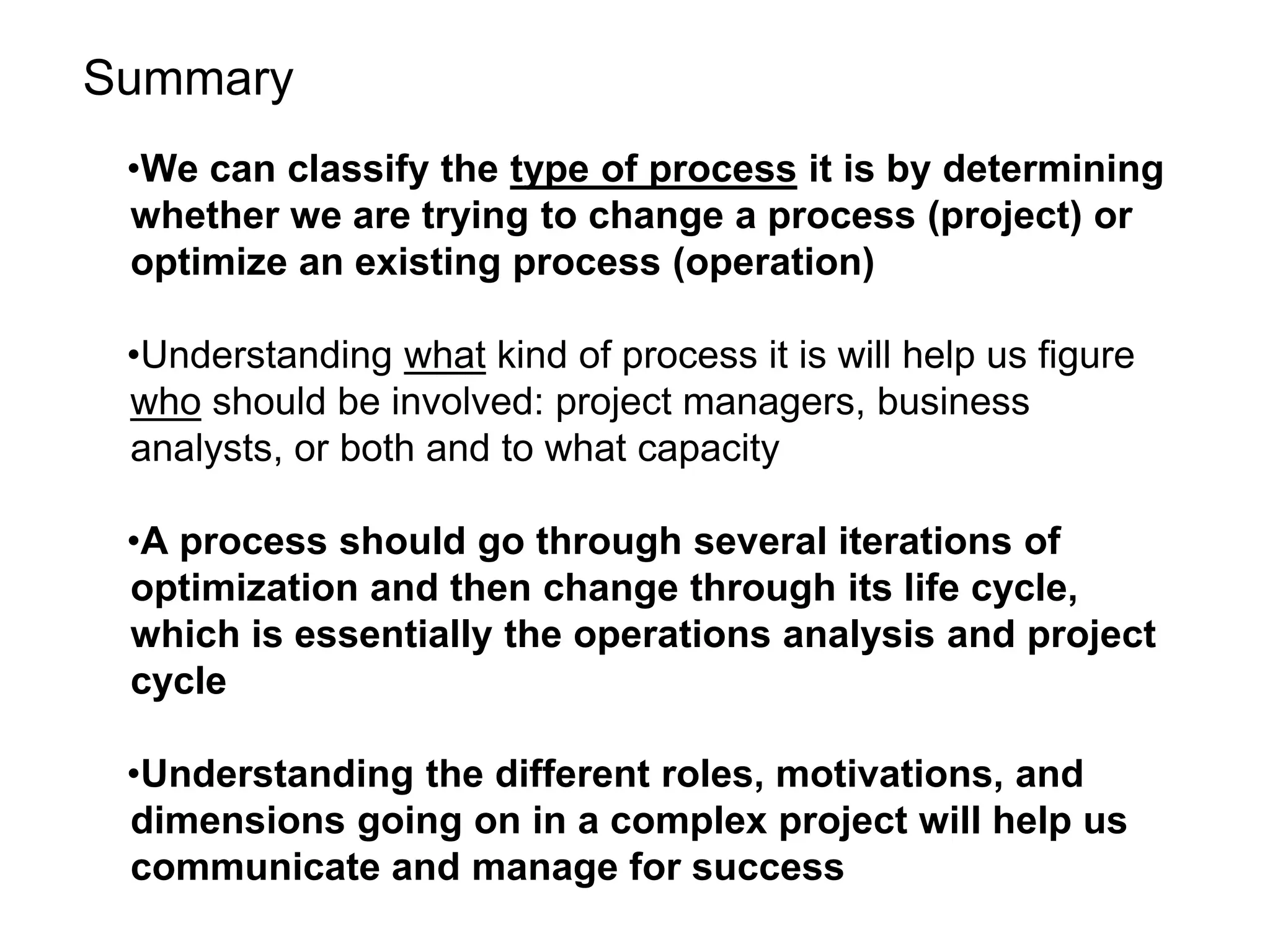
Summary
•We can classifythe type of process it is by determining
whether we are trying to change a process (project) or
optimize an existing process (operation)
•Understanding what kind of process it is will help us figure
who should be involved: project managers, business
analysts, or both and to what capacity
•A process should go through several iterations of
optimization and then change through its life cycle,
which is essentially the operations analysis and project
cycle
•Understanding the different roles, motivations, and
dimensions going on in a complex project will help us
communicate and manage for success
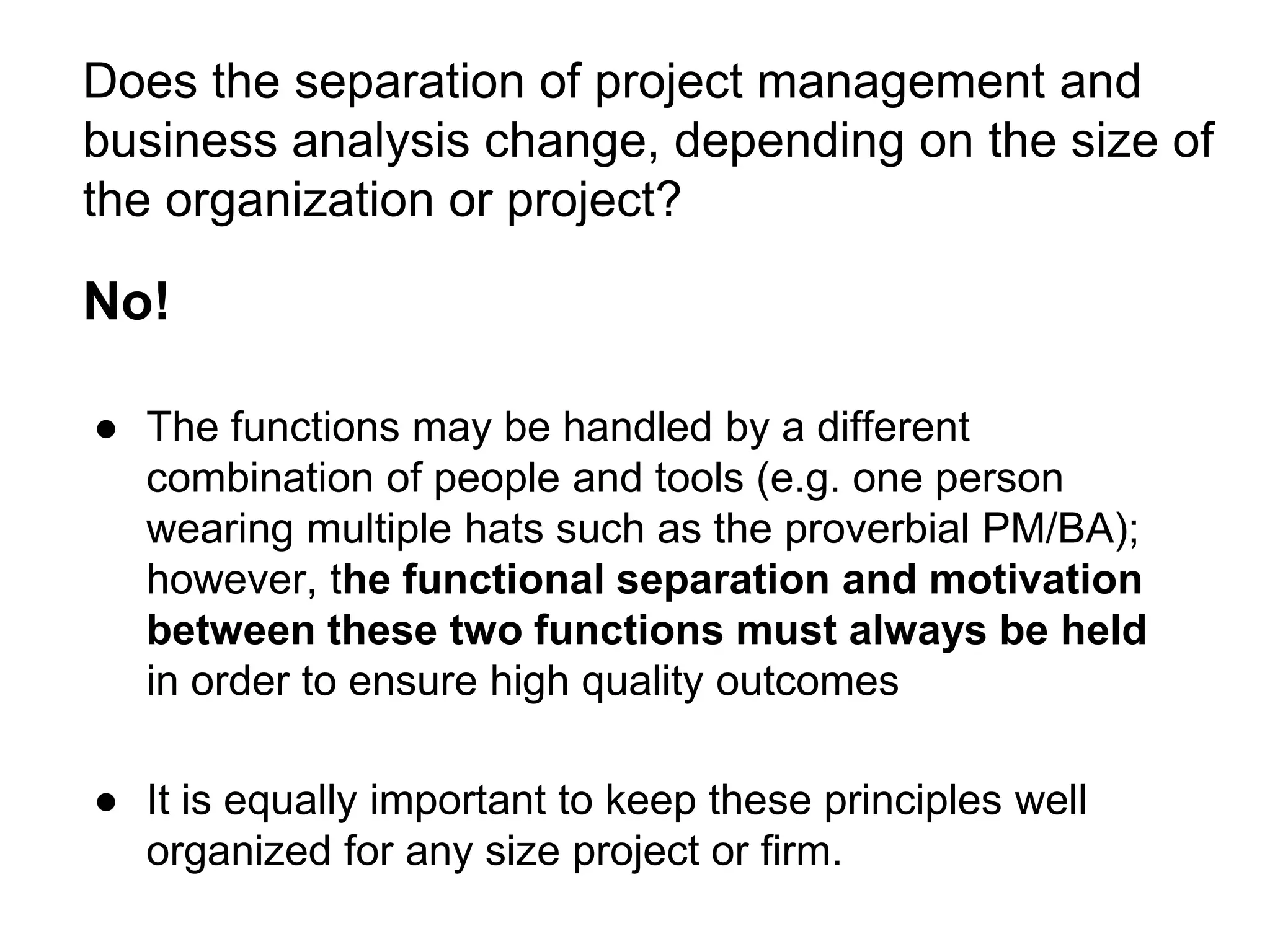
Does the separationof project management and
business analysis change, depending on the size of
the organization or project?
No!
● The functions may be handled by a different
combination of people and tools (e.g. one person
wearing multiple hats such as the proverbial PM/BA);
however, the functional separation and motivation
between these two functions must always be held
in order to ensure high quality outcomes
● It is equally important to keep these principles well
organized for any size project or firm.
14.
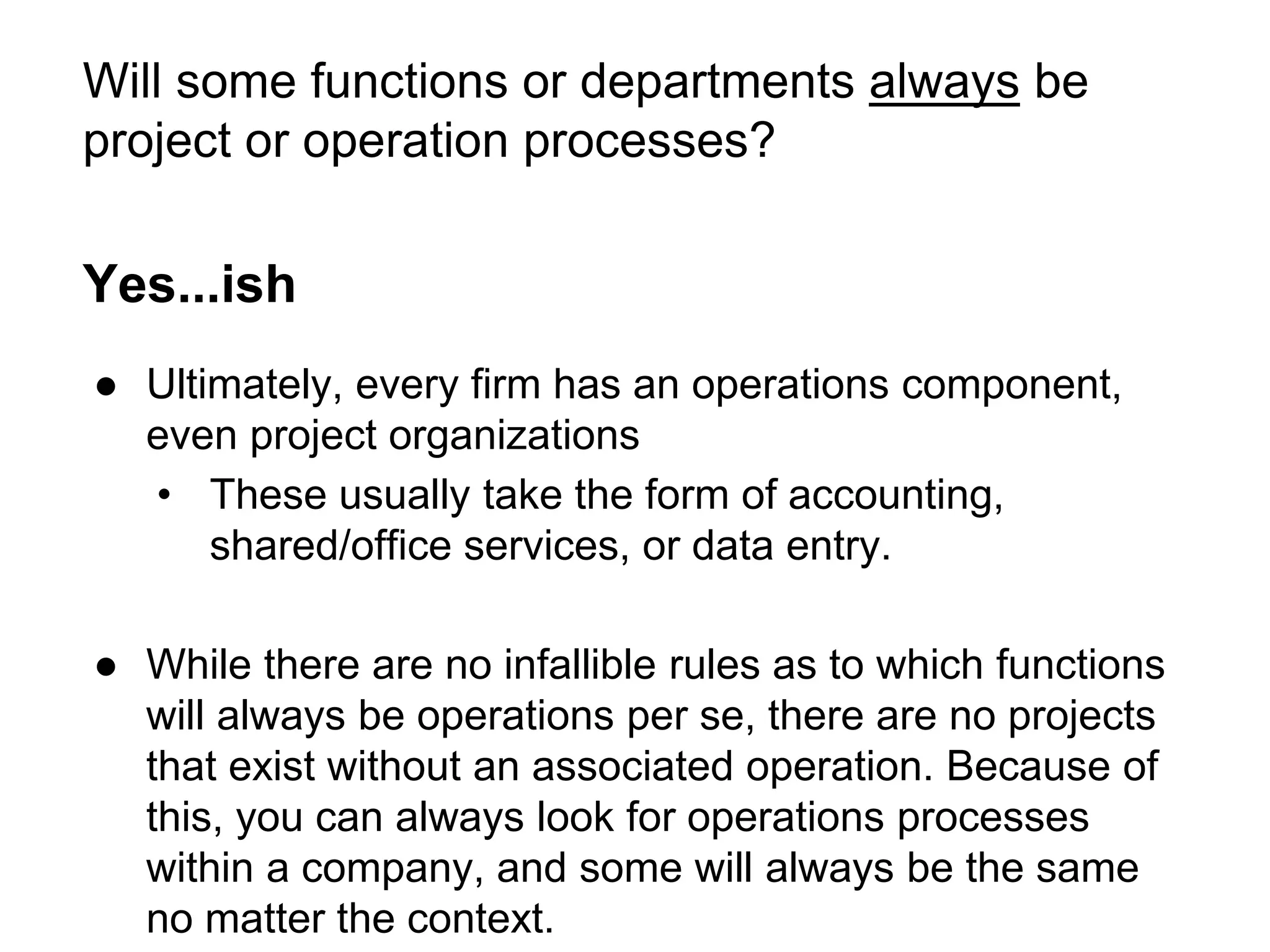
Will some functionsor departments always be
project or operation processes?
Yes...ish
● Ultimately, every firm has an operations component,
even project organizations
• These usually take the form of accounting,
shared/office services, or data entry.
● While there are no infallible rules as to which functions
will always be operations per se, there are no projects
that exist without an associated operation. Because of
this, you can always look for operations processes
within a company, and some will always be the same
no matter the context.
15.
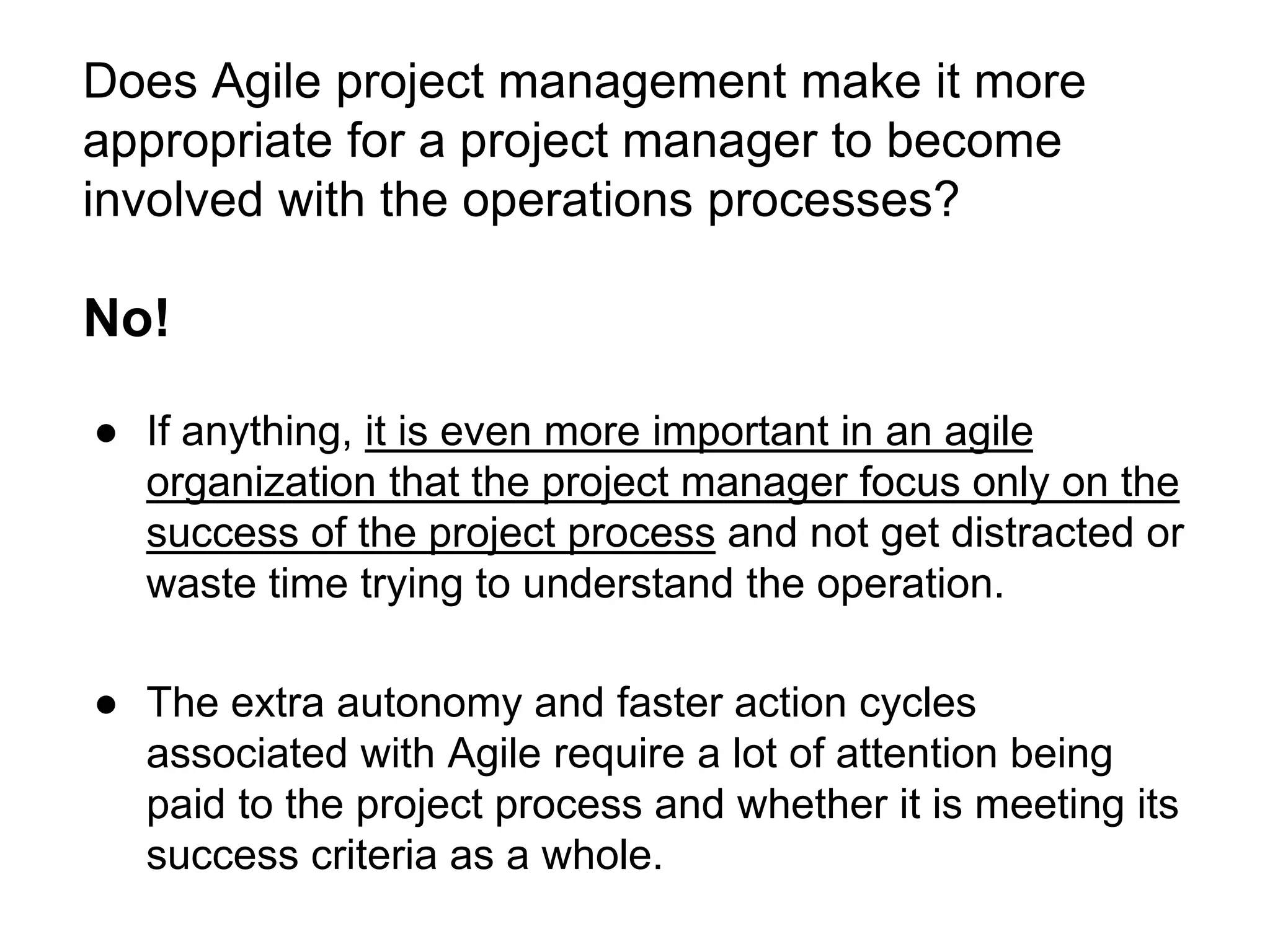
Does Agile projectmanagement make it more
appropriate for a project manager to become
involved with the operations processes?
No!
● If anything, it is even more important in an agile
organization that the project manager focus only on the
success of the project process and not get distracted or
waste time trying to understand the operation.
● The extra autonomy and faster action cycles
associated with Agile require a lot of attention being
paid to the project process and whether it is meeting its
success criteria as a whole.
16.
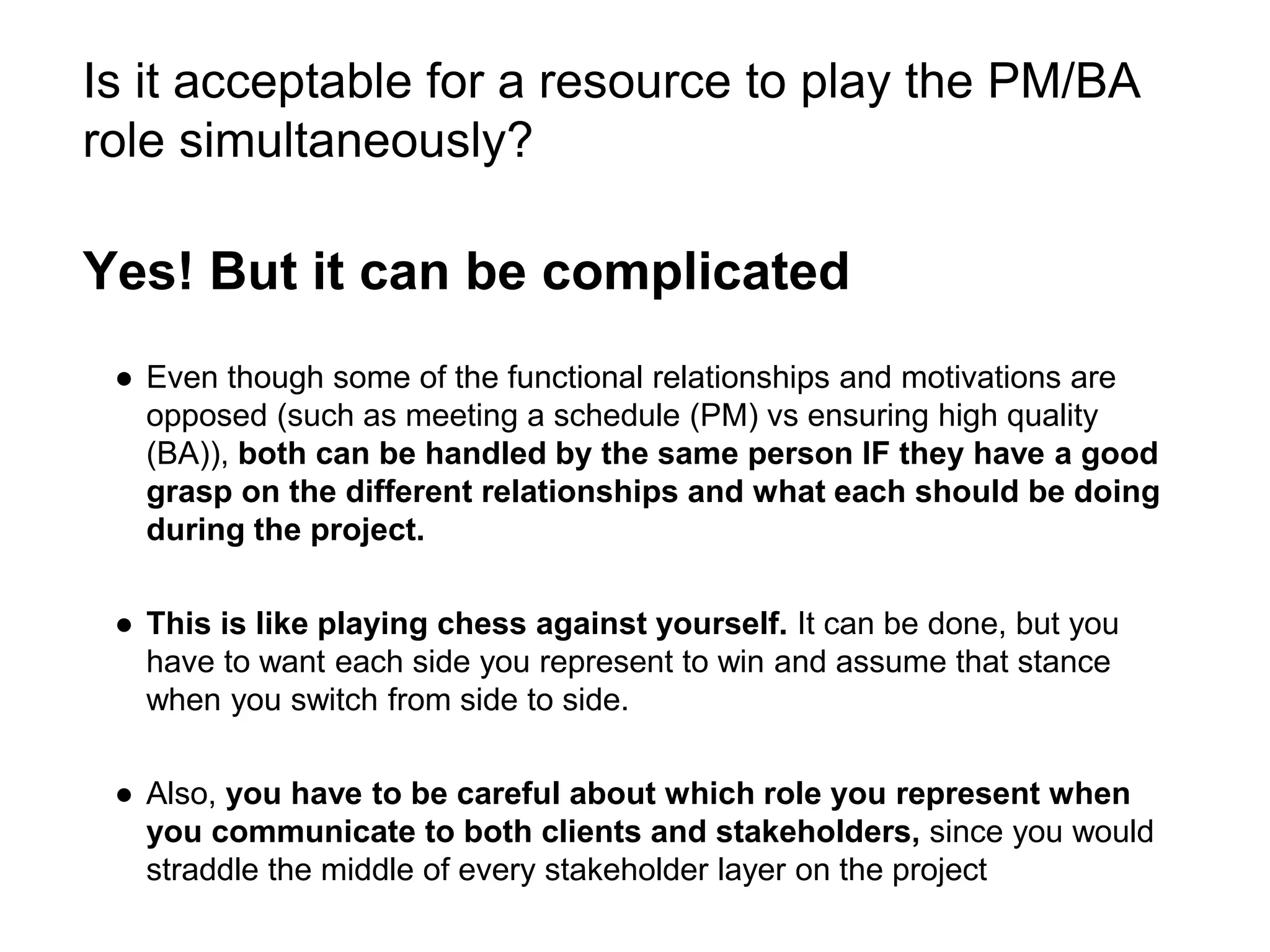
Is it acceptablefor a resource to play the PM/BA
role simultaneously?
Yes! But it can be complicated
● Even though some of the functional relationships and motivations are
opposed (such as meeting a schedule (PM) vs ensuring high quality
(BA)), both can be handled by the same person IF they have a good
grasp on the different relationships and what each should be doing
during the project.
● This is like playing chess against yourself. It can be done, but you
have to want each side you represent to win and assume that stance
when you switch from side to side.
● Also, you have to be careful about which role you represent when
you communicate to both clients and stakeholders, since you would
straddle the middle of every stakeholder layer on the project
17.
THANK YOU FORCOMING!
•Thank you so much for coming to our meetup – we hope to see you again
in future sessions and please don’t hesitate to post additional questions on
the group discussion board.
NYBPP Meetup
•Also, join our Facebook Group!
https://NYBPP Meetup Facebook Group