Operations Management Processes and Supply Chains 11th Edition Krajewski Test Bank
Operations Management Processes and Supply Chains 11th Edition Krajewski Test Bank
Operations Management Processes and Supply Chains 11th Edition Krajewski Test Bank
Operations Management Processes and Supply Chains 11th Edition Krajewski Test Bank
Operations Management Processes and Supply Chains 11th Edition Krajewski Test Bank
1.
Download the fullversion and explore a variety of test banks
or solution manuals at https://testbankfan.com
Operations Management Processes and Supply Chains
11th Edition Krajewski Test Bank
_____ Follow the link below to get your download now _____
https://testbankfan.com/product/operations-management-
processes-and-supply-chains-11th-edition-krajewski-test-
bank/
Access testbankfan.com now to download high-quality
test banks or solution manuals
2.
Here are somerecommended products for you. Click the link to
download, or explore more at testbankfan.com
Operations Management Processes and Supply Chains 11th
Edition Krajewski Solutions Manual
https://testbankfan.com/product/operations-management-processes-and-
supply-chains-11th-edition-krajewski-solutions-manual/
Operations Management Processes and Supply Chains Global
11th Edition Krajewski Solutions Manual
https://testbankfan.com/product/operations-management-processes-and-
supply-chains-global-11th-edition-krajewski-solutions-manual/
Operations Management Processes and Supply Chains 10th
Edition Krajewski Test Bank
https://testbankfan.com/product/operations-management-processes-and-
supply-chains-10th-edition-krajewski-test-bank/
Mechanics of Fluids 5th Edition Potter Solutions Manual
https://testbankfan.com/product/mechanics-of-fluids-5th-edition-
potter-solutions-manual/
3.
Strategic Human ResourceManagement Canadian 2nd Edition
Noe Test Bank
https://testbankfan.com/product/strategic-human-resource-management-
canadian-2nd-edition-noe-test-bank/
Leadership Experience 6th Edition Daft Solutions Manual
https://testbankfan.com/product/leadership-experience-6th-edition-
daft-solutions-manual/
Financial Accounting Canadian 5th Edition Harrison Test
Bank
https://testbankfan.com/product/financial-accounting-canadian-5th-
edition-harrison-test-bank/
Health Psychology A Cultural Approach 3rd Edition Gurung
Test Bank
https://testbankfan.com/product/health-psychology-a-cultural-
approach-3rd-edition-gurung-test-bank/
Management A Practical Introduction 7th Edition Kinicki
Solutions Manual
https://testbankfan.com/product/management-a-practical-
introduction-7th-edition-kinicki-solutions-manual/
4.
History Of MathematicsBrief Version 1st Edition Katz
Solutions Manual
https://testbankfan.com/product/history-of-mathematics-brief-
version-1st-edition-katz-solutions-manual/
Mixo-lydian b -b ¼ ¼ 2 ¼ ¼ 2 1
Lydian b*- b* ¼ 2 ¼ ¼ 2 1 ¼
Phrygian c - c 2 ¼ ¼ 2 1 ¼ ¼
Dorian e - e ¼ ¼ 2 1 ¼ ¼ 2
Hypo-lydian e*- e* ¼ 2 1 ¼ ¼ 2 ¼
Hypo-phrygian f - f 2 1 ¼ ¼ 2 ¼ ¼
Hypo-dorian a - a 1 ¼ ¼ 2 ¼ ¼ 2
On the Diatonic scale, according to the same writer, the species of an
Octave is distinguished by the places of the two semitones. Thus in
the first species, b-b, the semitones are the first and fourth intervals
(b-c and e-f): in the second, c-c, they are the third and the seventh,
and so on. He does not however say, as he does in the case of the
Enharmonic scale, that these species were known by the names of
the Keys. This statement is first made by Gaudentius (p. 20 Meib.), a
writer of unknown date. If we adopt it provisionally, the species of
the Diatonic octave will be as follows:
[Mixo-lydian] b - b ½ 1 1 ½ 1 1 1
[Lydian] c - c 1 1 ½ 1 1 1 ½
[Phrygian] d - d 1 ½ 1 1 1 ½ 1
[Dorian] e - e ½ 1 1 1 ½ 1 1
[Hypo-lydian] f - f 1 1 1 ½ 1 1 ½
[Hypo-phrygian] g - g 1 1 ½ 1 1 ½ 1
[Hypo-dorian] a - a 1 ½ 1 1 ½ 1 1
27.
§ 24. Relationof the Species to the
Keys.
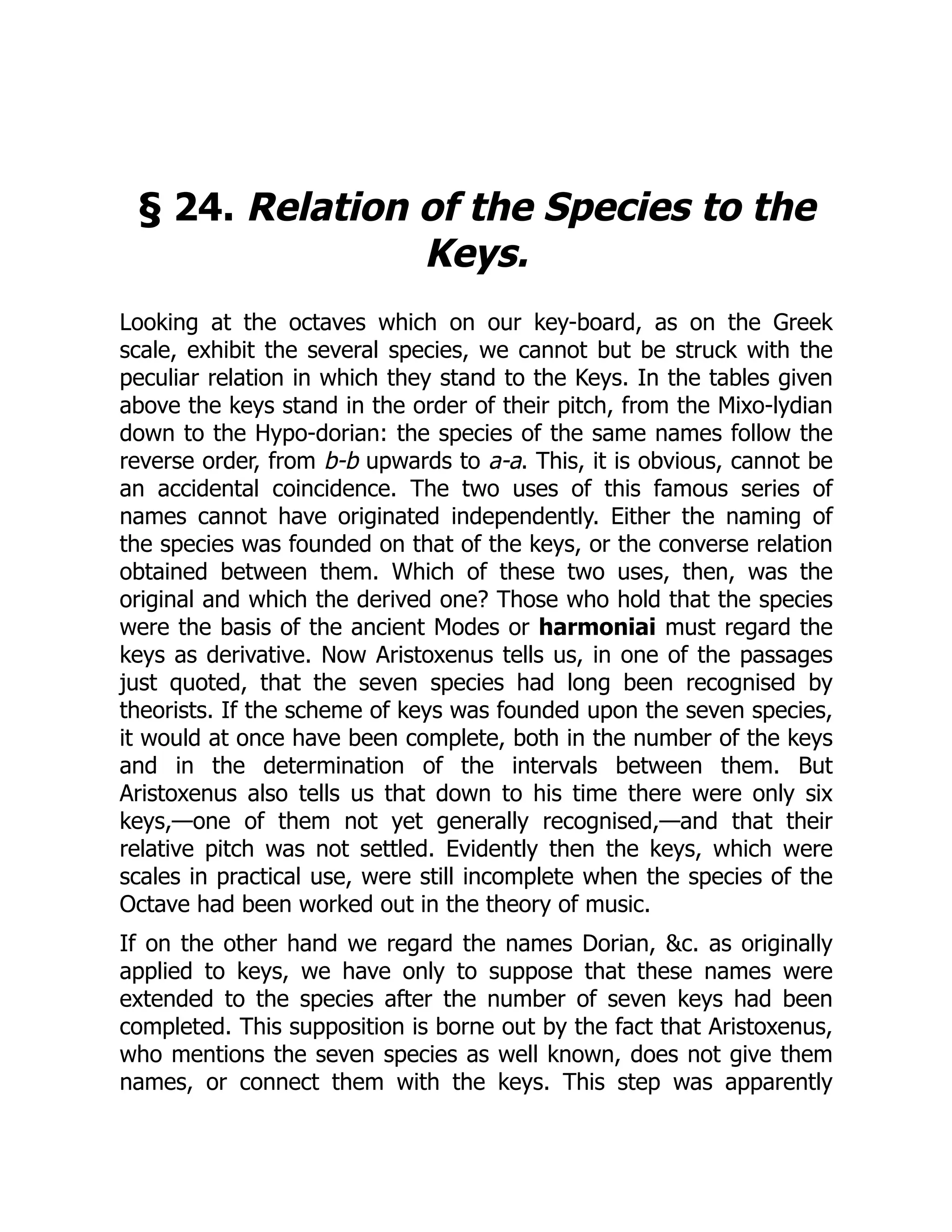
Looking at the octaves which on our key-board, as on the Greek
scale, exhibit the several species, we cannot but be struck with the
peculiar relation in which they stand to the Keys. In the tables given
above the keys stand in the order of their pitch, from the Mixo-lydian
down to the Hypo-dorian: the species of the same names follow the
reverse order, from b-b upwards to a-a. This, it is obvious, cannot be
an accidental coincidence. The two uses of this famous series of
names cannot have originated independently. Either the naming of
the species was founded on that of the keys, or the converse relation
obtained between them. Which of these two uses, then, was the
original and which the derived one? Those who hold that the species
were the basis of the ancient Modes or harmoniai must regard the
keys as derivative. Now Aristoxenus tells us, in one of the passages
just quoted, that the seven species had long been recognised by
theorists. If the scheme of keys was founded upon the seven species,
it would at once have been complete, both in the number of the keys
and in the determination of the intervals between them. But
Aristoxenus also tells us that down to his time there were only six
keys,—one of them not yet generally recognised,—and that their
relative pitch was not settled. Evidently then the keys, which were
scales in practical use, were still incomplete when the species of the
Octave had been worked out in the theory of music.
If on the other hand we regard the names Dorian, &c. as originally
applied to keys, we have only to suppose that these names were
extended to the species after the number of seven keys had been
completed. This supposition is borne out by the fact that Aristoxenus,
who mentions the seven species as well known, does not give them
names, or connect them with the keys. This step was apparently
28.
taken by somefollower of Aristoxenus, who wished to connect the
species of the older theorists with the system of keys which
Aristoxenus had perfected.
The view now taken of the seven species is supported by the whole
treatment of musical scales (systêmata) as we find it in Aristoxenus.
That treatment from first to last is purely abstract and theoretical.
The rules which Aristoxenus lays down serve to determine the
sequence of intervals, but are not confined to scales of any particular
compass. His Systems, accordingly, are not scales in practical use:
they are parts taken anywhere on an ideal unlimited scale. And the
seven species of the Octave are regarded by Aristoxenus as a scheme
of the same abstract order. They represent the earlier teaching on
which he had improved. He condemned that teaching for its want of
generality, because it was confined to the compass of the Octave and
to the Enharmonic genus, and also because it rested on no principles
that would necessarily limit the species of the Octave to seven. On
the other hand the diagrams of the earlier musicians were
unscientific, in the opinion of Aristoxenus, on the ground that they
divided the scale into a succession of quarter-tones. Such a division,
he urged, is impossible in practice and musically wrong (ekmeles).
All this goes to show that the earlier treatment of Systems, including
the seven Species, had the same theoretical character as his own
exposition. The only System which he recognises for practical
purposes is the old standard octave, from Hypatê to Nêtê: and that
System, with the enlargements which turned it into the Perfect
System, kept its ground with all writers of the Aristoxenean school.
Even in the accounts of the pseudo-Euclid and the later writers, who
treat of the Species of the Octave under the names of the Keys, there
is much to show that the species existed chiefly or wholly in musical
theory. The seven species of the Octave are given along with the
three species of the Fourth and the four species of the Fifth, neither
of which appear to have had any practical application. Another
indication of this may be seen in the seventh or Hypo-dorian species,
which was also called Locrian and Common (ps. Eucl. p. 16 Meib.).
Why should this species have more than one name? In the Perfect
29.
System it issingular in being exemplified by two different octaves,
viz. that from Proslambanomenos to Mesê, and that from Mesê to
Nêtê Hyperbolaiôn. Now we have seen that the higher the octave
which represents a species, the lower the key of the same name. In
this case, then, the upper of the two octaves answers to the Hypo-
dorian key, and the lower to the Locrian. But if the species has its
two names from these two keys, it follows that the names of the
species are derived from the keys. The fact that the Hypo-dorian or
Locrian species was also called Common is a further argument to the
same purpose. It was doubtless 'common' in the sense that it
characterised the two octaves which made up the Perfect System.
Thus the Perfect System was recognised as the really important
scale.
Another consideration, which has been overlooked by Westphal and
those who follow him, is the difference between the species of the
Octave in the several genera, especially the difference between the
Diatonic and the Enharmonic. This is not felt as a difficulty with all
the species. Thus the so-called Dorian octave e-e is in the
Enharmonic genus e e* f a b b* c e, a scale which may be regarded
as the Diatonic with g and d omitted, and the semitones divided. But
the Phrygian d-d cannot pass in any such way into the Enharmonic
Phrygian c e e* f a b b* c, which answers rather to the Diatonic scale
of the species c-c (the Lydian). The scholars who connect the ancient
Modes with the species generally confine themselves to octaves of
the Diatonic genus. In this they are supported by later Greek writers
—notably, as we shall see, by Ptolemy—and by the analogy of the
mediaeval Modes or Tones. But on the other side we have the
repeated complaints of Aristoxenus that the earlier theorists confined
themselves to Enharmonic octave scales. We have also the
circumstance that the writer or compiler of the pseudo-Euclidean
treatise, who is our earliest authority for the names of the species,
gives these names for the Enharmonic genus only. Here, once more,
we feel the difference between theory and practice. To a theorist
there is no great difficulty in the terms Diatonic Phrygian and
Enharmonic Phrygian meaning essentially different things. But the
30.
'Phrygian Mode' inpractical music must have been a tolerably definite
musical form.
31.
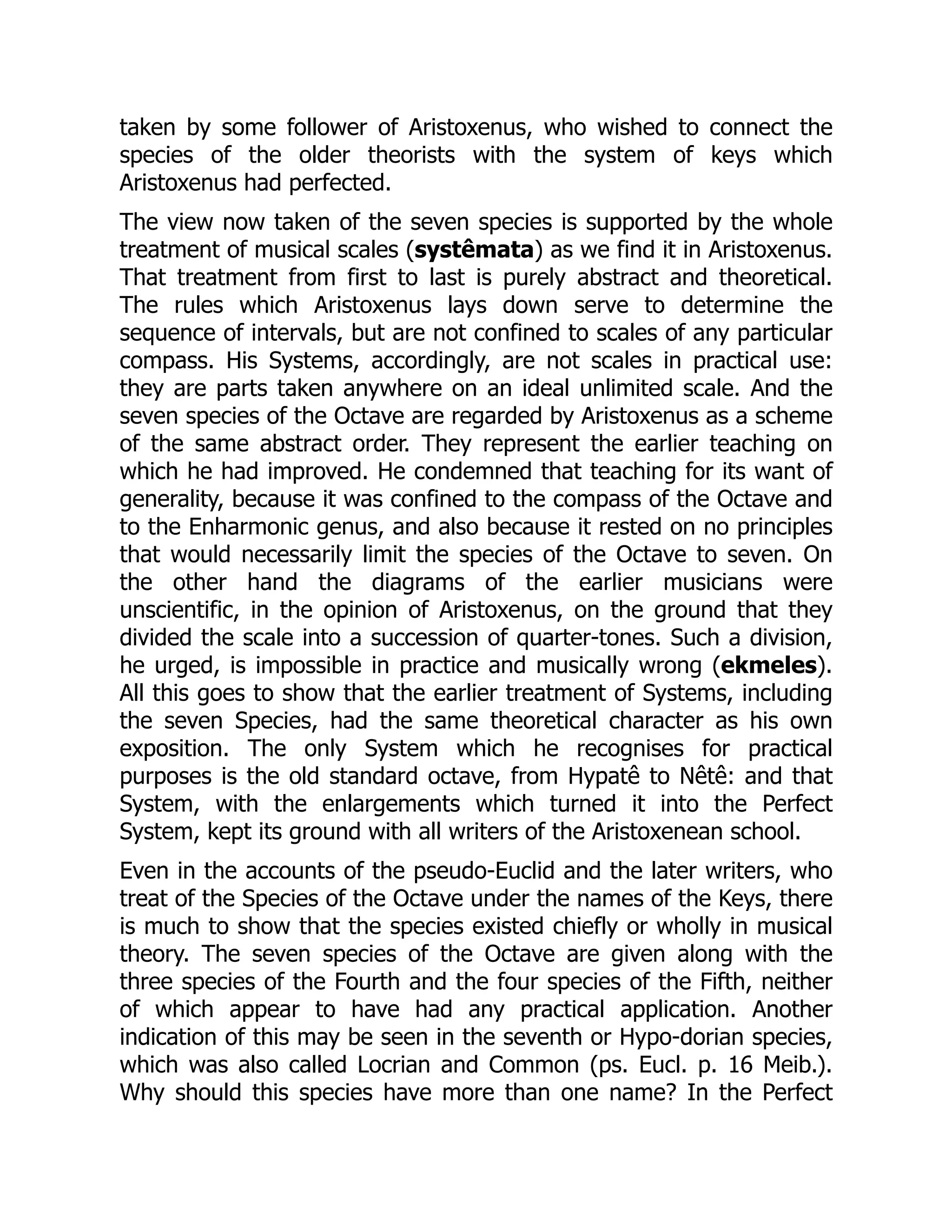
§ 25. TheEthos of Music.
From Plato and Aristotle we have learned some elements of what
may be called the gamut of sensibility. Between the higher keys
which in Greece, as in Oriental countries generally, were the familiar
vehicle of passion, especially of the passion of grief, and the lower
keys which were regarded, by Plato at least, as the natural language
of ease and license, there were keys expressive of calm and balanced
states of mind, free from the violent extremes of pain and pleasure.
In some later writers on music we find this classification reduced to a
more regular form, and clothed in technical language. We find also,
what is still more to our purpose, an attempt to define more precisely
the musical forms which answered to the several states of temper or
emotion.
Among the writers in question the most instructive is Aristides
Quintilianus. He discusses the subject of musical ethos under the first
of the usual seven heads, that which deals with sounds or notes
(peri phthongôn). Among the distinctions to be drawn in regard to
notes he reckons that of ethos: the ethos of notes, he says, is
different as they are higher or lower, and also as they are in the place
of a Parhypatê or in the place of a Lichanos (p. 13 Meib. hetera gar
êthê tois oxyterois, hetera tois baryterois epitrechei, kai
hetera men parypatoeidesin, hetera de lichanoeidesin). Again,
under the seventh head, that of melopoiia or composition, he treats
of the 'regions of the voice' (topoi tês phônês). There are three
kinds of composition, he tells us (p. 28), viz. that which is akin to
Hypatê (hypatoeidês), that which is akin to Mesê (mesoeidês),
and that which is akin to Nêtê (nêtoeidês). The first part of the art
of composition is the choice (lêpsis) which the musician is able to
make of the region of the voice to be employed (lêpsis men di' hês
heuriskein tô mousikô perigignetai apo poiou tês phônês to
systêma topou poiêteon, poteron hypatoeidous ê tôn loipôn
32.
tinos). He thenproceeds to connect these regions, or different parts
of the musical scale, with different branches of lyrical poetry. 'There
are three styles of musical composition (tropoi tês melopoiias),
viz. the Nomic, the Dithyrambic, and the Tragic; and of these the
Nomic is netoid, the Dithyrambic is mesoid, and the Tragic is
hypatoid.... They are called styles (tropoi) because according to the
melody adopted they express the ethos of the mind. Thus it happens
that composition (melopoiia) may differ in genus, as Enharmonic,
Chromatic: in System, as Hypatoid, Mesoid, Netoid: in key, as Dorian,
Phrygian: in style, as Nomic, Dithyrambic: in ethos, as we call one
kind of composition "contracting" (systaltikê), viz. that by which we
move painful feelings; another "expanding" (diastaltikê), that by
which we arouse the spirit (thymos); and another "middle" (mesê),
that by which we bring round the soul to calmness.'
This passage does not quite explicitly connect the three kinds of
ethos—the diastaltic, the systaltic, the intermediate—with the three
regions of the voice; but the connexion was evidently implied, and is
laid down in express terms in the pseudo-Euclidean Introductio (p. 21
Meib.). According to this Aristoxenean writer, 'the diastaltic ethos of
musical composition is that which expresses grandeur and manly
elevation of soul (megaloprepeia kai diarma psychês
andrôdes), and heroic actions; and these are employed by tragedy
and all poetry that approaches the tragic type. The systaltic ethos is
that by which the soul is brought down into a humble and unmanly
frame; and such a disposition will be fitting for amatory effusions and
dirges and lamentations and the like. And the hesychastic or
tranquilly disposed ethos (hêsychastikon êthos) of musical
composition is that which is followed by calmness of soul and a liberal
and peaceful disposition: and this temper will fit hymns, paeans,
laudations, didactic poetry and the like.' It appears then that
difference in the 'place' (topos) of the notes employed in a
composition—difference, that is to say, of pitch—was the element
which chiefly determined its ethos, and (by consequence) which
distinguished the music appropriate to the several kinds of lyrical
poetry.
33.
A slightly differentversion of this piece of theory is preserved in the
anonymous treatise edited by Bellermann (§§ 63, 64), where the
'regions of the voice' are said to be four in number, viz. the three
already mentioned, and a fourth which takes its name from the
tetrachord Hyperbolaiôn (topos hyperboloeidês). In the same
passage the boundaries of the several regions are laid down by
reference to the keys. 'The lowest or hypatoid region reaches from
the Hypo-dorian Hypatê Mesôn to the Dorian Mesê; the intermediate
or mesoid region from the Phrygian Hypatê Mesôn to the Lydian
Mesê; the netoid region from the Lydian Mesê to the Nêtê
Synemmenôn; the hyperboloid region embracing all above the last
point.' The text of this passage is uncertain; but the general character
of the topoi or regions of the voice is clearly enough indicated.
The three regions are mentioned in the catechism of Bacchius (p. 11
Meib.): topous (MSS. tropous) de tês phônês posous legomen
einai? treis. tinas? toutous; oxyn, meson, baryn. The varieties
of ethos also appear (p. 14 Meib.): hê de metabolê kata êthos?
hotan ek tapeinou eis megaloprepes; ê ex hêsychou kai
synnou eis parakekinêkos. 'What is change of ethos? when a
change is made from the humble to the magnificent; or from the
tranquil and sober to violent emotion.'
When we compare the doctrine of musical ethos as we find it in these
later writers with the indications to be gathered from Plato and
Aristotle, the chief difference appears to be that we no longer hear of
the ethos of particular modes, but only of that of three or (at the
most) four portions of the scale. The principle of the division, it is
evident, is simply difference of pitch. But if that was the basis of the
ethical effect of music in later times, the circumstance goes far to
confirm us in the conclusion that it was the pitch of the music, rather
than any difference in the succession of the intervals, that principally
determined the ethical character of the older modes.
34.
§ 26. TheEthos of the Genera and
Species.
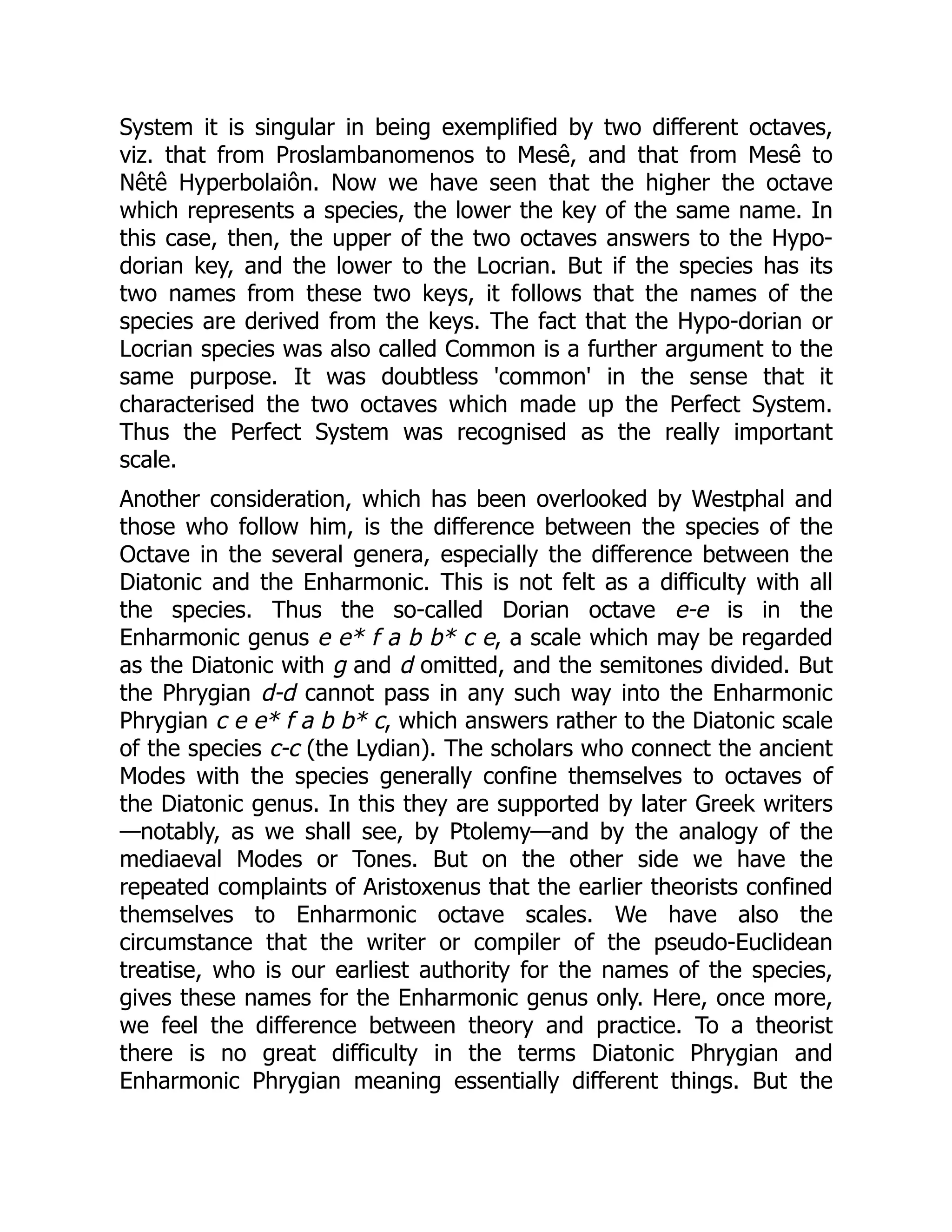
Although the pitch of a musical composition—as these passages
confirm us in believing—was the chief ground of its ethical character,
it cannot be said that no other element entered into the case.
In the passage quoted above from Aristides Quintilianus (p. 13 Meib.)
it is said that ethos depends first on pitch (hetera êthê tois
oxyterois, hetera tois baryterois), and secondly on the moveable
notes, that is to say, on the genus. For that is evidently involved in
the words that follow: kai hetera men parypatoeidesin, hetera
de lichanoeidesin. By parypatoeideis and lichanoeideis he
means all the moveable notes (phthongoi pheromenoi): the first
are those which hold the place of Parhypatê in their tetrachord, viz.
the notes called Parhypatê or Tritê: the second are similarly the notes
called Lichanos or Paranêtê. These moveable notes, then, give an
ethos to the music because they determine the genus of the scale.
Regarding the particular ethos belonging to the different genera,
there is a statement of the same author (p. 111) to the effect that
the Diatonic is masculine and austere (arrhenôpon d' esti kai
austêroteron), the Chromatic sweet and plaintive (hêdiston te kai
goeron), the Enharmonic stirring and pleasing (diegertikon d' esti
touto kai êpion). The criticism doubtless came from some earlier
source.
Do we ever find ethos attributed to this or that species of the
Octave? I can find no passage in which this source of ethos is
indicated. Even Ptolemy, who is the chief authority (as we shall see)
for the value of the species, and who makes least of mere difference
of pitch, recognises only two forms of modulation in the course of a
melody, viz. change of genus and change of pitch [25].
36.
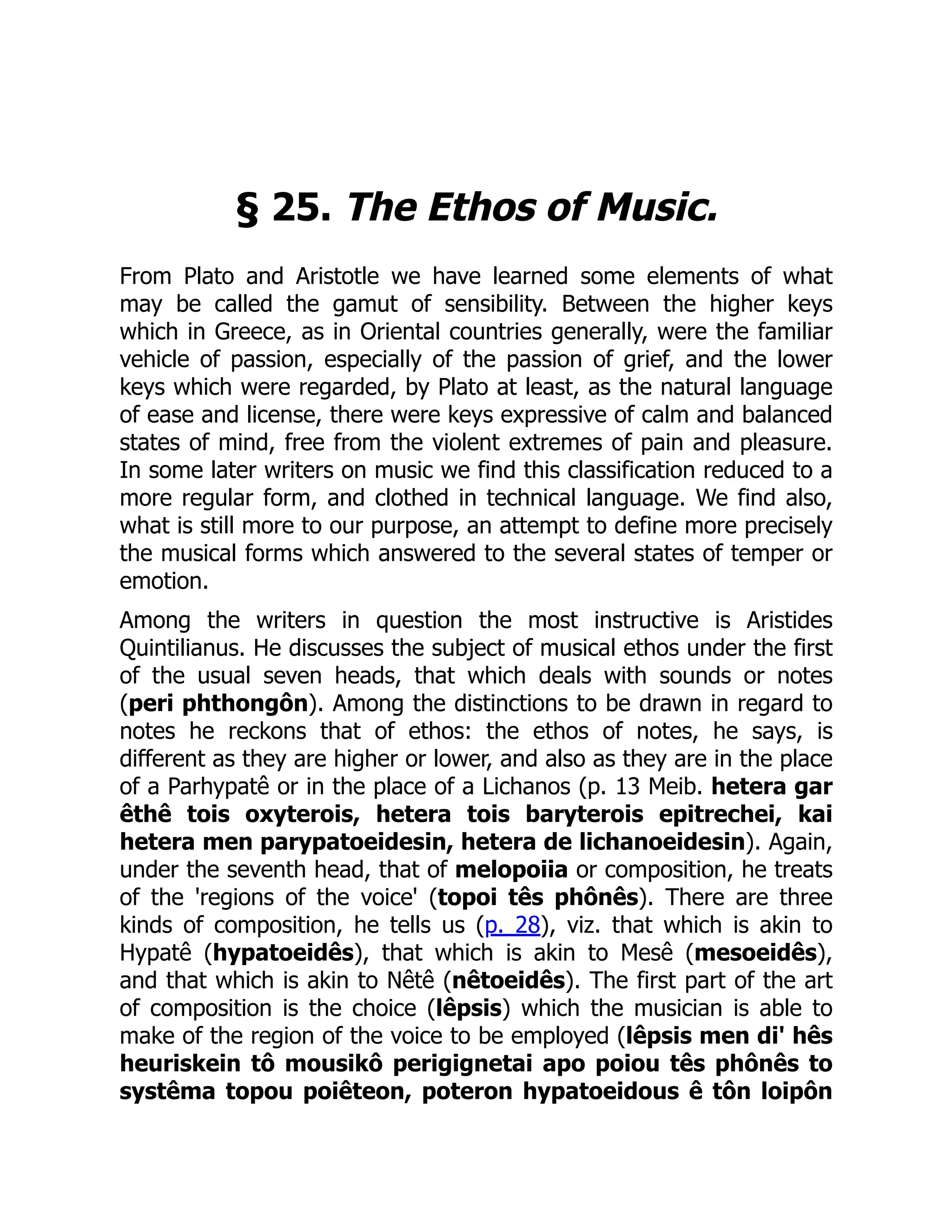
§ 27. TheMusical Notation.
As the preceding argument turns very much upon the practical
importance of the scale which we have been discussing, first as the
single octave from the original Hypatê to Nêtê, then in its enlarged
form as the Perfect System, it may be worth while to show that some
such scale is implied in the history of the Greek musical notation.
The use of written characters (sêmeia) to represent the sounds of
music appears to date from a comparatively early period in Greece.
In the time of Aristoxenus the art of writing down a melody
(parasêmantikê) had come to be considered by some persons
identical with the science of music (harmonikê),—an error which
Aristoxenus is at some pains to refute. It is true that the authorities
from whom we derive our knowledge of the Greek notation are post-
classical. But the characters themselves, as we shall presently see,
furnish sufficient evidence of their antiquity.
The Greek musical notation is curiously complicated. There is a
double set of characters, one for the note assigned to the singer, the
other for those of the lyre or other instrument. The notes for the
voice are obviously derived from the letters of the ordinary Ionic
alphabet, multiplied by the use of accents and other diacritical marks.
The instrumental notes were first explained less than thirty years ago
by Westphal. In his work Harmonik und Melopöie der Griechen (c. viii
Die Semantik) he showed, in a manner as conclusive as it is
ingenious, that they were originally taken from the first fourteen
letters of an alphabet of archaic type, akin to the alphabets found in
certain parts of Peloponnesus. Among the letters which he traces,
and which point to this conclusion, the most-significant are the
digamma, the primitive crooked iota , and two forms of lambda,
and , the latter of which is peculiar to the alphabet of Argos. Of
the other characters , which stands for alpha, is best derived from
the archaic form . For beta we find , which may come from an
37.
archaic form ofthe letter[26]. The character , as Westphal shows, is
for , or delta with part of one side left out. Similarly the ancient ,
when the circle was incomplete, yielded the character C . The
crooked iota ( ) appears as . The two forms of lambda serve for
different notes, thus bringing the number of symbols up to fifteen.
Besides these there are two characters, and , which cannot be
derived in the same way from any alphabet. As they stand for the
lowest notes of the scale, they are probably an addition, later than
the rest of the system. At the upper end, again, the scale is extended
by the simple device of using the same characters for notes an
octave higher, distinguishing them in this use by an accent. The
original fifteen characters, with the letters from which they are
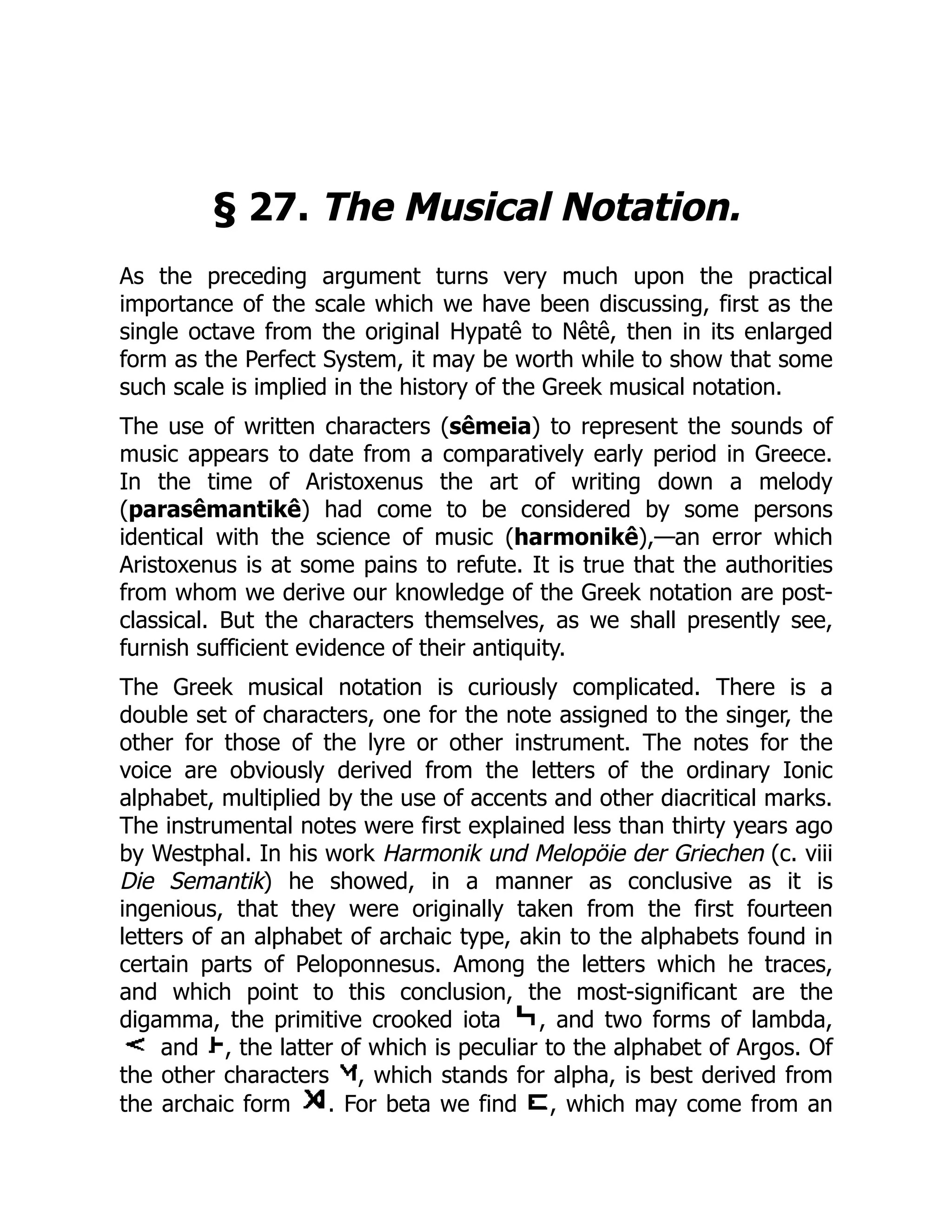
derived, and the corresponding notes in the modern musical scale,
are as follows:
These notes, it will be seen, compose two octaves of the Diatonic
scale, identical with the two octaves of the Greater Perfect System.
They may be regarded as answering to the white notes of the
modern keyboard,—those which form the complete scale in the so-
called 'natural' key.
The other notes, viz. those which are required not only in different
keys of the Diatonic scale, but also in all Enharmonic and Chromatic
scales, are represented by the same characters modified in some
simple way. Usually a character is turned half round backwards to
raise it by one small interval (as from Hypatê to Parhypatê), and
reversed to raise it by both (Hypatê to Lichanos). Thus the letter
epsilon, , stands for our c: and accordingly (
anestrammenon or hyption) stands for c*, and (
apestrammenon) for c ♯ . The Enharmonic scale c-c*-c ♯ -f is
38.
therefore written ,the two modifications of the letter
representing the two 'moveable' notes of the tetrachord. Similarly we
have the triads , , , ,
, , . As some letters do not admit of this kind
of differentiation, other methods are employed. Thus Δ is made to
yield the forms (for ) Δ: from H (or B) are obtained the forms
and : and from Z (or I]) the forms and . The
modifications of N are / and : those of are and .
The method of writing a Chromatic tetrachord is the same, except
that the higher of the two moveable notes is marked by a bar or
accent. Thus the tetrachord c c♯ d f is written .
In the Diatonic genus we should have expected that the original
characters would have been used for the tetrachords b c d e and e f
g a; and that in other tetrachords the second note, being a semitone
above the first, would have been represented by a reversed letter
(gramma apestrammenon). In fact, however, the Diatonic
Parhypatê and Tritê are written with the same character as the
Enharmonic. That is to say, the tetrachord b c d e is not written
, but : and d e ♭ f g is not , but
.
Let us now consider how this scheme of symbols is related to the
Systems already described and the Keys in which those Systems may
be set (tonoi eph' hôn tithemena ta systêmata melôdeitai).
The fifteen characters, it has been noticed, form two diatonic
octaves. It will appear on a little further examination that the scheme
must have been constructed with a view to these two octaves. The
successive notes are not expressed by the letters of the alphabet in
their usual order (as is done in the case of the vocal notes). The
highest note is represented by the first letter, A: and then the
remaining fourteen notes are taken in pairs, each with its octave: and
39.
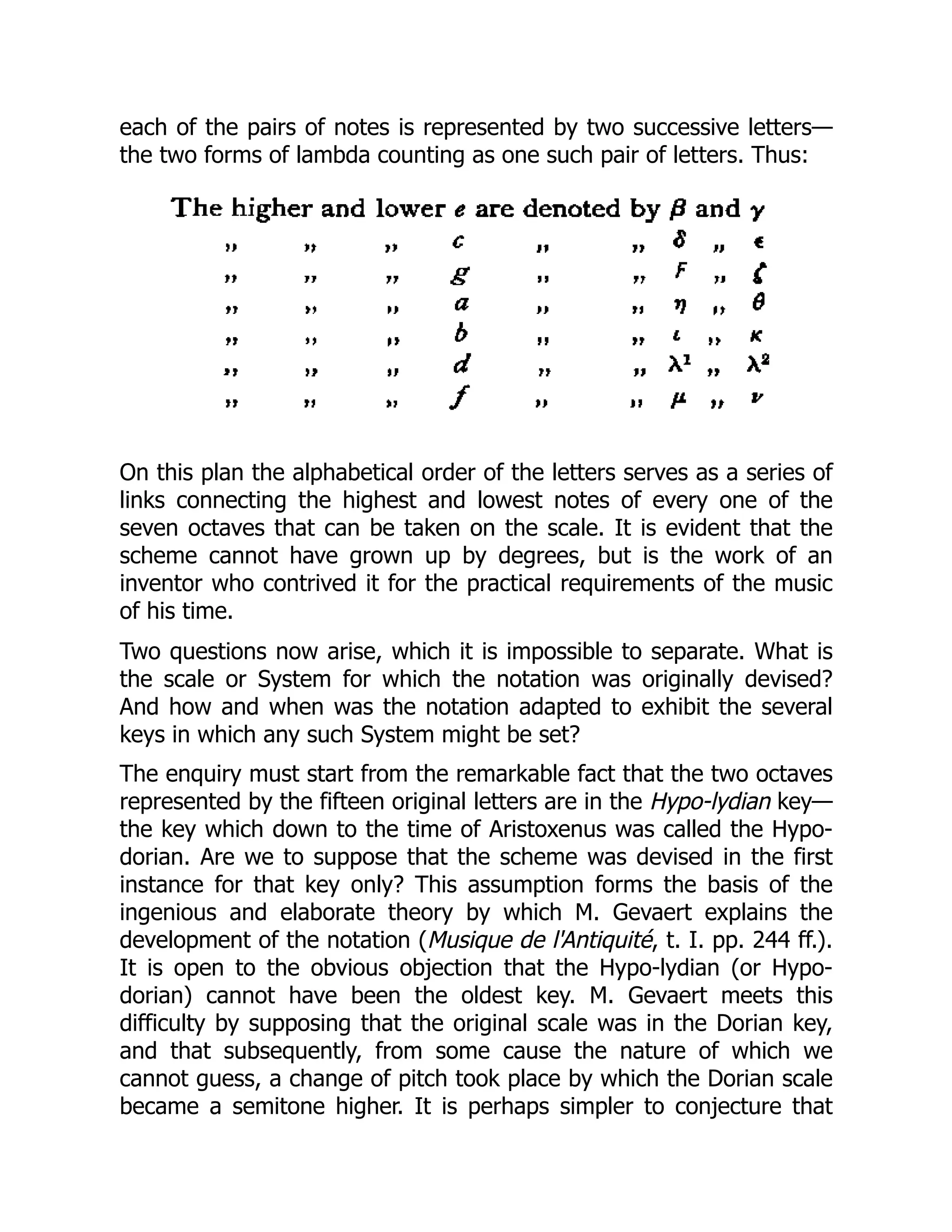
each of thepairs of notes is represented by two successive letters—
the two forms of lambda counting as one such pair of letters. Thus:
On this plan the alphabetical order of the letters serves as a series of
links connecting the highest and lowest notes of every one of the
seven octaves that can be taken on the scale. It is evident that the
scheme cannot have grown up by degrees, but is the work of an
inventor who contrived it for the practical requirements of the music
of his time.
Two questions now arise, which it is impossible to separate. What is
the scale or System for which the notation was originally devised?
And how and when was the notation adapted to exhibit the several
keys in which any such System might be set?
The enquiry must start from the remarkable fact that the two octaves
represented by the fifteen original letters are in the Hypo-lydian key—
the key which down to the time of Aristoxenus was called the Hypo-
dorian. Are we to suppose that the scheme was devised in the first
instance for that key only? This assumption forms the basis of the
ingenious and elaborate theory by which M. Gevaert explains the
development of the notation (Musique de l'Antiquité, t. I. pp. 244 ff.).
It is open to the obvious objection that the Hypo-lydian (or Hypo-
dorian) cannot have been the oldest key. M. Gevaert meets this
difficulty by supposing that the original scale was in the Dorian key,
and that subsequently, from some cause the nature of which we
cannot guess, a change of pitch took place by which the Dorian scale
became a semitone higher. It is perhaps simpler to conjecture that
40.
the original Dorianbecame split up, so to speak, into two keys by
difference of local usage, and that the lower of the two came to be
called Hypo-dorian, but kept the original notation. A more serious
difficulty is raised by the high antiquity which M. Gevaert assigns to
the Perfect System. He supposes that the inventor of the notation
made use of an instrument (the magadis) which 'magadised' or
repeated the notes an octave higher. But this would give us a
repetition of the primitive octave e-e, rather than an enlargement by
the addition of tetrachords at both ends.
M. Gevaert regards the adaptation of the scheme to the other keys as
the result of a gradual process of extension. Here we may distinguish
between the recourse to the modified characters—which served
essentially the same purpose as the 'sharps' and 'flats' in the
signature of a modern key—and the additional notes obtained either
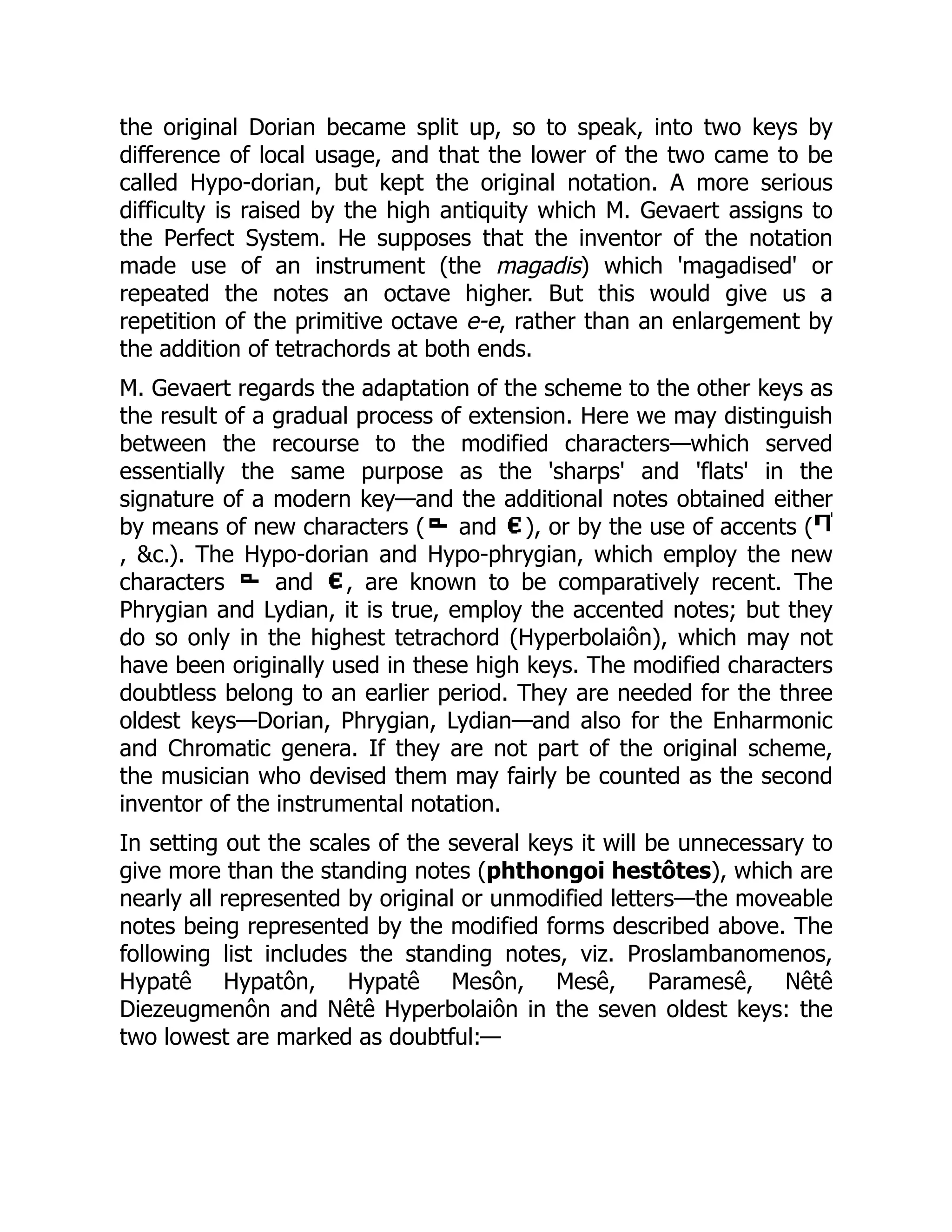
by means of new characters ( and ), or by the use of accents (
, &c.). The Hypo-dorian and Hypo-phrygian, which employ the new
characters and , are known to be comparatively recent. The
Phrygian and Lydian, it is true, employ the accented notes; but they
do so only in the highest tetrachord (Hyperbolaiôn), which may not
have been originally used in these high keys. The modified characters
doubtless belong to an earlier period. They are needed for the three
oldest keys—Dorian, Phrygian, Lydian—and also for the Enharmonic
and Chromatic genera. If they are not part of the original scheme,
the musician who devised them may fairly be counted as the second
inventor of the instrumental notation.
In setting out the scales of the several keys it will be unnecessary to
give more than the standing notes (phthongoi hestôtes), which are
nearly all represented by original or unmodified letters—the moveable
notes being represented by the modified forms described above. The
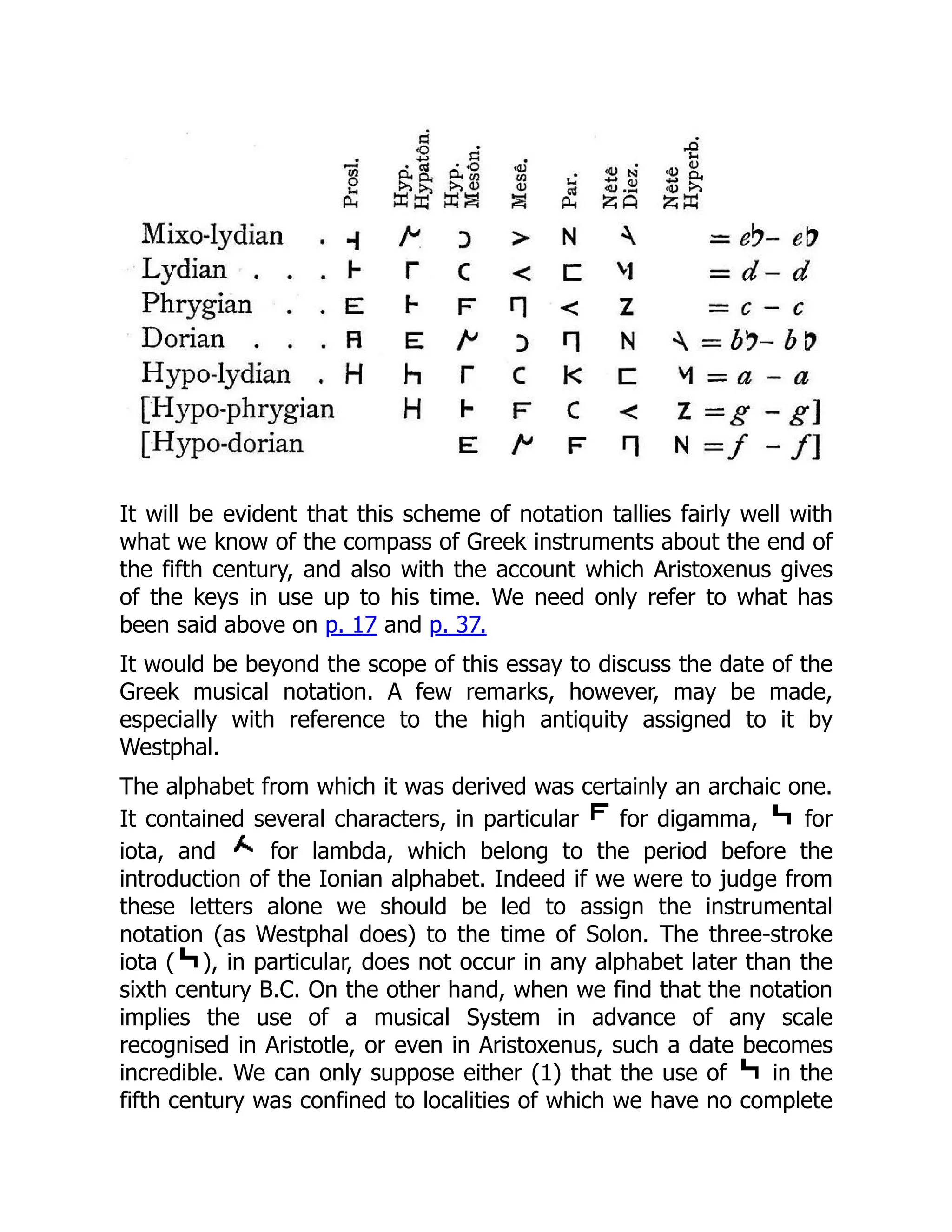
following list includes the standing notes, viz. Proslambanomenos,
Hypatê Hypatôn, Hypatê Mesôn, Mesê, Paramesê, Nêtê
Diezeugmenôn and Nêtê Hyperbolaiôn in the seven oldest keys: the
two lowest are marked as doubtful:—
41.
It will beevident that this scheme of notation tallies fairly well with
what we know of the compass of Greek instruments about the end of
the fifth century, and also with the account which Aristoxenus gives
of the keys in use up to his time. We need only refer to what has
been said above on p. 17 and p. 37.
It would be beyond the scope of this essay to discuss the date of the
Greek musical notation. A few remarks, however, may be made,
especially with reference to the high antiquity assigned to it by
Westphal.
The alphabet from which it was derived was certainly an archaic one.
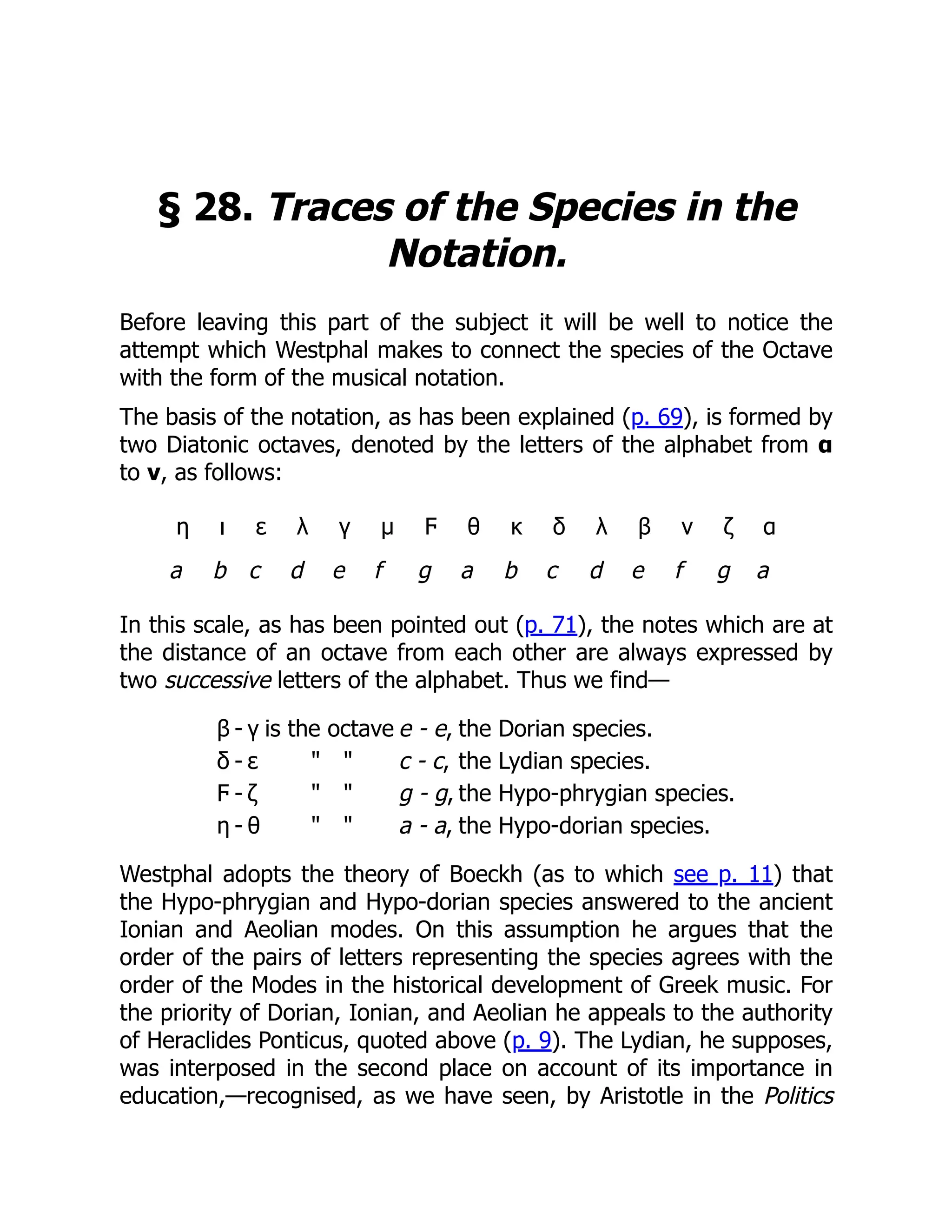
It contained several characters, in particular for digamma, for
iota, and for lambda, which belong to the period before the
introduction of the Ionian alphabet. Indeed if we were to judge from
these letters alone we should be led to assign the instrumental
notation (as Westphal does) to the time of Solon. The three-stroke
iota ( ), in particular, does not occur in any alphabet later than the
sixth century B.C. On the other hand, when we find that the notation
implies the use of a musical System in advance of any scale
recognised in Aristotle, or even in Aristoxenus, such a date becomes
incredible. We can only suppose either (1) that the use of in the
fifth century was confined to localities of which we have no complete
42.
epigraphic record, or(2) that as a form of iota was still known—as
archaic forms must have been—from the older public inscriptions,
and was adopted by the inventor of the notation as being better
suited to his purpose than .
With regard to the place of origin of the notation the chief fact which
we have to deal with is the use of the character for lambda, which
is distinctive of the alphabet of Argos, along with the commoner form
. Westphal indeed asserts that both these forms are found in the
Argive alphabet. But the inscription (C. I. 1) which he quotes [27] for
really contains only in a slightly different form. We cannot
therefore say that the inventor of the notation derived it entirely from
the alphabet of Argos, but only that he shows an acquaintance with
that alphabet. This is confirmed by the fact that the form for iota
is not found at Argos. Probably therefore the inventor drew upon
more than one alphabet for his purpose, the Argive alphabet being
one.
The special fitness of the notation for the scales of the Enharmonic
genus may be regarded as a further indication of its date. We shall
see presently that that genus held a peculiar predominance in the
earliest period of musical theory—that, namely, which was brought to
an end by Aristoxenus.
If the author of the notation—or the second author, inventor of the
modified characters—was one of the musicians whose names have
come down to us, it would be difficult to find a more probable one
than that of Pronomus of Thebes. One of the most striking features
of the notation, at the time when it was framed, must have been the
adjustment of the keys. Even in the time of Aristoxenus, as we know
from the passage so often quoted, that adjustment was not universal.
But it is precisely what Pronomus of Thebes is said to have done for
the music of the flute (supra, p. 38). The circumstance that the
system was only used for instrumental music is at least in harmony
with this conjecture. If it is thought that Thebes is too far from Argos,
we may fall back upon the notice that Sacadas of Argos was the chief
composer for the flute before the time of Pronomus, [28] and
43.
doubtless Argos wasone of the first cities to share in the advance
which Pronomus made in the technique of his art.
44.
§ 28. Tracesof the Species in the
Notation.
Before leaving this part of the subject it will be well to notice the
attempt which Westphal makes to connect the species of the Octave
with the form of the musical notation.
The basis of the notation, as has been explained (p. 69), is formed by
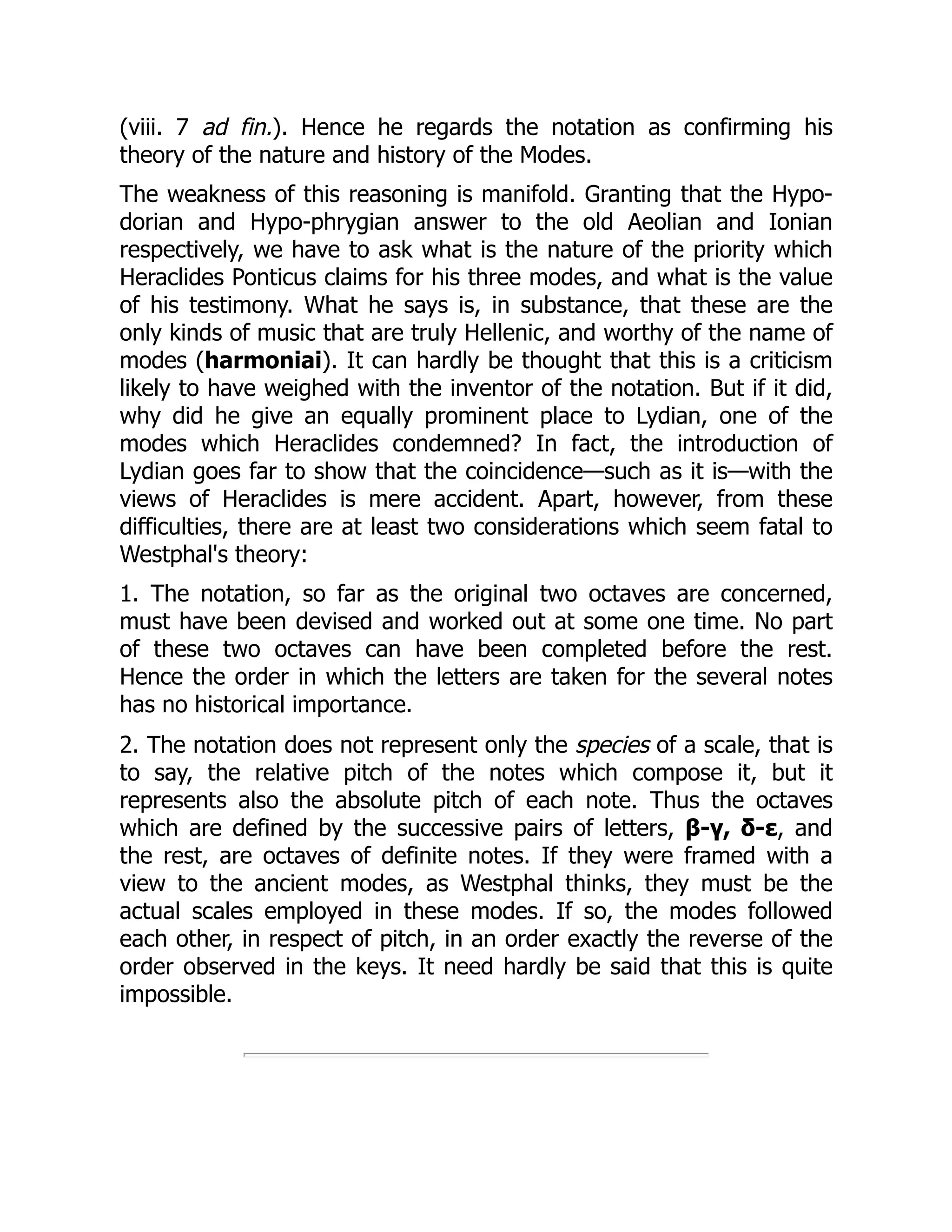
two Diatonic octaves, denoted by the letters of the alphabet from α
to ν, as follows:
η ι ε λ γ μ Ϝ θ κ δ λ β ν ζ α
a b c d e f g a b c d e f g a
In this scale, as has been pointed out (p. 71), the notes which are at
the distance of an octave from each other are always expressed by
two successive letters of the alphabet. Thus we find—
β - γ is the octave e - e, the Dorian species.
δ - ε " " c - c, the Lydian species.
Ϝ - ζ " " g - g, the Hypo-phrygian species.
η - θ " " a - a, the Hypo-dorian species.
Westphal adopts the theory of Boeckh (as to which see p. 11) that
the Hypo-phrygian and Hypo-dorian species answered to the ancient
Ionian and Aeolian modes. On this assumption he argues that the
order of the pairs of letters representing the species agrees with the
order of the Modes in the historical development of Greek music. For
the priority of Dorian, Ionian, and Aeolian he appeals to the authority
of Heraclides Ponticus, quoted above (p. 9). The Lydian, he supposes,
was interposed in the second place on account of its importance in
education,—recognised, as we have seen, by Aristotle in the Politics
45.
(viii. 7 adfin.). Hence he regards the notation as confirming his
theory of the nature and history of the Modes.
The weakness of this reasoning is manifold. Granting that the Hypo-
dorian and Hypo-phrygian answer to the old Aeolian and Ionian
respectively, we have to ask what is the nature of the priority which
Heraclides Ponticus claims for his three modes, and what is the value
of his testimony. What he says is, in substance, that these are the
only kinds of music that are truly Hellenic, and worthy of the name of
modes (harmoniai). It can hardly be thought that this is a criticism
likely to have weighed with the inventor of the notation. But if it did,
why did he give an equally prominent place to Lydian, one of the
modes which Heraclides condemned? In fact, the introduction of
Lydian goes far to show that the coincidence—such as it is—with the
views of Heraclides is mere accident. Apart, however, from these
difficulties, there are at least two considerations which seem fatal to
Westphal's theory:
1. The notation, so far as the original two octaves are concerned,
must have been devised and worked out at some one time. No part
of these two octaves can have been completed before the rest.
Hence the order in which the letters are taken for the several notes
has no historical importance.
2. The notation does not represent only the species of a scale, that is
to say, the relative pitch of the notes which compose it, but it
represents also the absolute pitch of each note. Thus the octaves
which are defined by the successive pairs of letters, β-γ, δ-ε, and
the rest, are octaves of definite notes. If they were framed with a
view to the ancient modes, as Westphal thinks, they must be the
actual scales employed in these modes. If so, the modes followed
each other, in respect of pitch, in an order exactly the reverse of the
order observed in the keys. It need hardly be said that this is quite
impossible.
46.
§ 29. Ptolemy'sScheme of Modes.
The first writer who takes the Species of the Octave as the basis of
the musical scales is the mathematician Claudius Ptolemaeus (fl. 140-
160 A.D.). In his Harmonics he virtually sets aside the scheme of
keys elaborated by Aristoxenus and his school, and adopts in their
place a system of scales answering in their main features to the
mediaeval Tones or Modes. The object of difference of key, he says,
is not that the music as a whole may be of a higher or lower pitch,
but that a melody may be brought within a certain compass. For this
purpose it is necessary to vary the succession of intervals (as a
modern musician does by changing the signature of the clef). If, for
example, we take the Perfect System (systêma ametabolon) in the
key of a minor—which is its natural key,—and transpose it to the key
of d minor, we do so, according to Ptolemy, not in order to raise the
general pitch of our music by a Fourth, but because we wish to have
a scale with b flat instead of b natural. The flattening of this note,
however, means that the two octaves change their species. They are
now of the species e-e. Thus, instead of transposing the Perfect
System into different keys, we arrive more directly at the desired
result by changing the species of its octaves. And as there are seven
possible species of the Octave, we obtain seven different Systems or
scales. From these assumptions it follows, as Ptolemy shows in some
detail, that any greater number of keys is useless. If a key is an
octave higher than another, it is superfluous because it gives us a
mere repetition of the same intervals [29].
If we interpose a key between (e.g.) the Hypo-dorian and the Hypo-
phrygian, it must give us over again either the Hypo-dorian or the
Hypo-phrygian scale [30]. Thus the fifteen keys of the Aristoxeneans
are reduced to seven, and these seven are not transpositions of a
single scale, but are all of the same pitch. See the table at the end of
the book.
47.
With this schemeof Keys Ptolemy combined a new method of naming
the individual notes. The old method, by which a note was named
from its relative place in the Perfect System, must evidently have
become inconvenient. The Lydian Mesê, for example, was two tones
higher than the Dorian Mesê, because the Lydian scale as a whole
was two tones higher than the Dorian. But when the two scales were
reduced to the same compass, the old Lydian Mesê was no longer in
the middle of the scale, and the name ceased to have a meaning. It
is as though the term 'dominant' when applied to a Minor key were
made to mean the dominant of the relative Major key. On Ptolemy's
method the notes of each scale were named from their places in it.
The old names were used, Proslambanomenos for the lowest, Hypatê
Hypatôn for the next, and so on, but without regard to the intervals
between the notes. Thus there were two methods of naming, that
which had been in use hitherto, termed 'nomenclature according to
value' (onomasia kata dynamin), and the new method of naming
from the various scales, termed 'nomenclature according to position'
(onomasia kata thesin). The former was in effect a retention of
the Perfect System and the Keys: the latter put in their place a
scheme of seven different standard Systems.
In illustration of his theory Ptolemy gives tables showing in numbers
the intervals of the octaves used in the different keys and genera. He
shows two octaves in each key, viz. that from Hypatê Mesôn (kata
thesin) to Nêtê Diezeugmenôn (called the octave apo nêtês), and
that from Proslambanomenos to Mesê (the octave apo mesês). As
he also gives the divisions of five different 'colours' or varieties of
genus, the whole number of octaves is no less than seventy.
Ptolemy does not exclude difference of pitch altogether. The whole
instrument, he says, may be tuned higher or lower at pleasure [31].
Thus the pitch is treated by him as modern notation treats the
tempo, viz. as something which is not absolutely given, but has to be
supplied by the individual performer.
Although the language of Ptolemy's exposition is studiously
impersonal, it may be gathered that his reduction of the number of
48.
keys from fifteento seven was an innovation proposed by himself
[32]. If this is so, the rest of the scheme,—the elimination of the
element of pitch, and the 'nomenclature by position,'—must also be
due to him. Here, however, we find ourselves at issue with Westphal
and those who agree with him on the main question of the Modes.
According to Westphal the nomenclature by position is mentioned by
Aristoxenus, and is implied in at least one important passage of the
Aristotelian Problems. We have now to examine the evidence which
he adduces to support his contention.
49.
Welcome to ourwebsite – the perfect destination for book lovers and
knowledge seekers. We believe that every book holds a new world,
offering opportunities for learning, discovery, and personal growth.
That’s why we are dedicated to bringing you a diverse collection of
books, ranging from classic literature and specialized publications to
self-development guides and children's books.
More than just a book-buying platform, we strive to be a bridge
connecting you with timeless cultural and intellectual values. With an
elegant, user-friendly interface and a smart search system, you can
quickly find the books that best suit your interests. Additionally,
our special promotions and home delivery services help you save time
and fully enjoy the joy of reading.
Join us on a journey of knowledge exploration, passion nurturing, and
personal growth every day!
testbankfan.com









![Mixo-lydian b - b ¼ ¼ 2 ¼ ¼ 2 1
Lydian b*- b* ¼ 2 ¼ ¼ 2 1 ¼
Phrygian c - c 2 ¼ ¼ 2 1 ¼ ¼
Dorian e - e ¼ ¼ 2 1 ¼ ¼ 2
Hypo-lydian e*- e* ¼ 2 1 ¼ ¼ 2 ¼
Hypo-phrygian f - f 2 1 ¼ ¼ 2 ¼ ¼
Hypo-dorian a - a 1 ¼ ¼ 2 ¼ ¼ 2
On the Diatonic scale, according to the same writer, the species of an
Octave is distinguished by the places of the two semitones. Thus in
the first species, b-b, the semitones are the first and fourth intervals
(b-c and e-f): in the second, c-c, they are the third and the seventh,
and so on. He does not however say, as he does in the case of the
Enharmonic scale, that these species were known by the names of
the Keys. This statement is first made by Gaudentius (p. 20 Meib.), a
writer of unknown date. If we adopt it provisionally, the species of
the Diatonic octave will be as follows:
[Mixo-lydian] b - b ½ 1 1 ½ 1 1 1
[Lydian] c - c 1 1 ½ 1 1 1 ½
[Phrygian] d - d 1 ½ 1 1 1 ½ 1
[Dorian] e - e ½ 1 1 1 ½ 1 1
[Hypo-lydian] f - f 1 1 1 ½ 1 1 ½
[Hypo-phrygian] g - g 1 1 ½ 1 1 ½ 1
[Hypo-dorian] a - a 1 ½ 1 1 ½ 1 1](https://image.slidesharecdn.com/18225-250318084828-316cb52e/75/Operations-Management-Processes-and-Supply-Chains-11th-Edition-Krajewski-Test-Bank-26-2048.jpg)

![§ 26. The Ethos of the Genera and
Species.
Although the pitch of a musical composition—as these passages
confirm us in believing—was the chief ground of its ethical character,
it cannot be said that no other element entered into the case.
In the passage quoted above from Aristides Quintilianus (p. 13 Meib.)
it is said that ethos depends first on pitch (hetera êthê tois
oxyterois, hetera tois baryterois), and secondly on the moveable
notes, that is to say, on the genus. For that is evidently involved in
the words that follow: kai hetera men parypatoeidesin, hetera
de lichanoeidesin. By parypatoeideis and lichanoeideis he
means all the moveable notes (phthongoi pheromenoi): the first
are those which hold the place of Parhypatê in their tetrachord, viz.
the notes called Parhypatê or Tritê: the second are similarly the notes
called Lichanos or Paranêtê. These moveable notes, then, give an
ethos to the music because they determine the genus of the scale.
Regarding the particular ethos belonging to the different genera,
there is a statement of the same author (p. 111) to the effect that
the Diatonic is masculine and austere (arrhenôpon d' esti kai
austêroteron), the Chromatic sweet and plaintive (hêdiston te kai
goeron), the Enharmonic stirring and pleasing (diegertikon d' esti
touto kai êpion). The criticism doubtless came from some earlier
source.
Do we ever find ethos attributed to this or that species of the
Octave? I can find no passage in which this source of ethos is
indicated. Even Ptolemy, who is the chief authority (as we shall see)
for the value of the species, and who makes least of mere difference
of pitch, recognises only two forms of modulation in the course of a
melody, viz. change of genus and change of pitch [25].](https://image.slidesharecdn.com/18225-250318084828-316cb52e/75/Operations-Management-Processes-and-Supply-Chains-11th-Edition-Krajewski-Test-Bank-34-2048.jpg)

![archaic form of the letter[26]. The character , as Westphal shows, is
for , or delta with part of one side left out. Similarly the ancient ,
when the circle was incomplete, yielded the character C . The
crooked iota ( ) appears as . The two forms of lambda serve for
different notes, thus bringing the number of symbols up to fifteen.
Besides these there are two characters, and , which cannot be
derived in the same way from any alphabet. As they stand for the
lowest notes of the scale, they are probably an addition, later than
the rest of the system. At the upper end, again, the scale is extended
by the simple device of using the same characters for notes an
octave higher, distinguishing them in this use by an accent. The
original fifteen characters, with the letters from which they are
derived, and the corresponding notes in the modern musical scale,
are as follows:
These notes, it will be seen, compose two octaves of the Diatonic
scale, identical with the two octaves of the Greater Perfect System.
They may be regarded as answering to the white notes of the
modern keyboard,—those which form the complete scale in the so-
called 'natural' key.
The other notes, viz. those which are required not only in different
keys of the Diatonic scale, but also in all Enharmonic and Chromatic
scales, are represented by the same characters modified in some
simple way. Usually a character is turned half round backwards to
raise it by one small interval (as from Hypatê to Parhypatê), and
reversed to raise it by both (Hypatê to Lichanos). Thus the letter
epsilon, , stands for our c: and accordingly (
anestrammenon or hyption) stands for c*, and (
apestrammenon) for c ♯ . The Enharmonic scale c-c*-c ♯ -f is](https://image.slidesharecdn.com/18225-250318084828-316cb52e/75/Operations-Management-Processes-and-Supply-Chains-11th-Edition-Krajewski-Test-Bank-37-2048.jpg)
![therefore written , the two modifications of the letter
representing the two 'moveable' notes of the tetrachord. Similarly we
have the triads , , , ,
, , . As some letters do not admit of this kind
of differentiation, other methods are employed. Thus Δ is made to
yield the forms (for ) Δ: from H (or B) are obtained the forms
and : and from Z (or I]) the forms and . The
modifications of N are / and : those of are and .
The method of writing a Chromatic tetrachord is the same, except
that the higher of the two moveable notes is marked by a bar or
accent. Thus the tetrachord c c♯ d f is written .
In the Diatonic genus we should have expected that the original
characters would have been used for the tetrachords b c d e and e f
g a; and that in other tetrachords the second note, being a semitone
above the first, would have been represented by a reversed letter
(gramma apestrammenon). In fact, however, the Diatonic
Parhypatê and Tritê are written with the same character as the
Enharmonic. That is to say, the tetrachord b c d e is not written
, but : and d e ♭ f g is not , but
.
Let us now consider how this scheme of symbols is related to the
Systems already described and the Keys in which those Systems may
be set (tonoi eph' hôn tithemena ta systêmata melôdeitai).
The fifteen characters, it has been noticed, form two diatonic
octaves. It will appear on a little further examination that the scheme
must have been constructed with a view to these two octaves. The
successive notes are not expressed by the letters of the alphabet in
their usual order (as is done in the case of the vocal notes). The
highest note is represented by the first letter, A: and then the
remaining fourteen notes are taken in pairs, each with its octave: and](https://image.slidesharecdn.com/18225-250318084828-316cb52e/75/Operations-Management-Processes-and-Supply-Chains-11th-Edition-Krajewski-Test-Bank-38-2048.jpg)
![epigraphic record, or (2) that as a form of iota was still known—as
archaic forms must have been—from the older public inscriptions,
and was adopted by the inventor of the notation as being better
suited to his purpose than .
With regard to the place of origin of the notation the chief fact which
we have to deal with is the use of the character for lambda, which
is distinctive of the alphabet of Argos, along with the commoner form
. Westphal indeed asserts that both these forms are found in the
Argive alphabet. But the inscription (C. I. 1) which he quotes [27] for
really contains only in a slightly different form. We cannot
therefore say that the inventor of the notation derived it entirely from
the alphabet of Argos, but only that he shows an acquaintance with
that alphabet. This is confirmed by the fact that the form for iota
is not found at Argos. Probably therefore the inventor drew upon
more than one alphabet for his purpose, the Argive alphabet being
one.
The special fitness of the notation for the scales of the Enharmonic
genus may be regarded as a further indication of its date. We shall
see presently that that genus held a peculiar predominance in the
earliest period of musical theory—that, namely, which was brought to
an end by Aristoxenus.
If the author of the notation—or the second author, inventor of the
modified characters—was one of the musicians whose names have
come down to us, it would be difficult to find a more probable one
than that of Pronomus of Thebes. One of the most striking features
of the notation, at the time when it was framed, must have been the
adjustment of the keys. Even in the time of Aristoxenus, as we know
from the passage so often quoted, that adjustment was not universal.
But it is precisely what Pronomus of Thebes is said to have done for
the music of the flute (supra, p. 38). The circumstance that the
system was only used for instrumental music is at least in harmony
with this conjecture. If it is thought that Thebes is too far from Argos,
we may fall back upon the notice that Sacadas of Argos was the chief
composer for the flute before the time of Pronomus, [28] and](https://image.slidesharecdn.com/18225-250318084828-316cb52e/75/Operations-Management-Processes-and-Supply-Chains-11th-Edition-Krajewski-Test-Bank-42-2048.jpg)

![§ 29. Ptolemy's Scheme of Modes.
The first writer who takes the Species of the Octave as the basis of
the musical scales is the mathematician Claudius Ptolemaeus (fl. 140-
160 A.D.). In his Harmonics he virtually sets aside the scheme of
keys elaborated by Aristoxenus and his school, and adopts in their
place a system of scales answering in their main features to the
mediaeval Tones or Modes. The object of difference of key, he says,
is not that the music as a whole may be of a higher or lower pitch,
but that a melody may be brought within a certain compass. For this
purpose it is necessary to vary the succession of intervals (as a
modern musician does by changing the signature of the clef). If, for
example, we take the Perfect System (systêma ametabolon) in the
key of a minor—which is its natural key,—and transpose it to the key
of d minor, we do so, according to Ptolemy, not in order to raise the
general pitch of our music by a Fourth, but because we wish to have
a scale with b flat instead of b natural. The flattening of this note,
however, means that the two octaves change their species. They are
now of the species e-e. Thus, instead of transposing the Perfect
System into different keys, we arrive more directly at the desired
result by changing the species of its octaves. And as there are seven
possible species of the Octave, we obtain seven different Systems or
scales. From these assumptions it follows, as Ptolemy shows in some
detail, that any greater number of keys is useless. If a key is an
octave higher than another, it is superfluous because it gives us a
mere repetition of the same intervals [29].
If we interpose a key between (e.g.) the Hypo-dorian and the Hypo-
phrygian, it must give us over again either the Hypo-dorian or the
Hypo-phrygian scale [30]. Thus the fifteen keys of the Aristoxeneans
are reduced to seven, and these seven are not transpositions of a
single scale, but are all of the same pitch. See the table at the end of
the book.](https://image.slidesharecdn.com/18225-250318084828-316cb52e/75/Operations-Management-Processes-and-Supply-Chains-11th-Edition-Krajewski-Test-Bank-46-2048.jpg)
![With this scheme of Keys Ptolemy combined a new method of naming
the individual notes. The old method, by which a note was named
from its relative place in the Perfect System, must evidently have
become inconvenient. The Lydian Mesê, for example, was two tones
higher than the Dorian Mesê, because the Lydian scale as a whole
was two tones higher than the Dorian. But when the two scales were
reduced to the same compass, the old Lydian Mesê was no longer in
the middle of the scale, and the name ceased to have a meaning. It
is as though the term 'dominant' when applied to a Minor key were
made to mean the dominant of the relative Major key. On Ptolemy's
method the notes of each scale were named from their places in it.
The old names were used, Proslambanomenos for the lowest, Hypatê
Hypatôn for the next, and so on, but without regard to the intervals
between the notes. Thus there were two methods of naming, that
which had been in use hitherto, termed 'nomenclature according to
value' (onomasia kata dynamin), and the new method of naming
from the various scales, termed 'nomenclature according to position'
(onomasia kata thesin). The former was in effect a retention of
the Perfect System and the Keys: the latter put in their place a
scheme of seven different standard Systems.
In illustration of his theory Ptolemy gives tables showing in numbers
the intervals of the octaves used in the different keys and genera. He
shows two octaves in each key, viz. that from Hypatê Mesôn (kata
thesin) to Nêtê Diezeugmenôn (called the octave apo nêtês), and
that from Proslambanomenos to Mesê (the octave apo mesês). As
he also gives the divisions of five different 'colours' or varieties of
genus, the whole number of octaves is no less than seventy.
Ptolemy does not exclude difference of pitch altogether. The whole
instrument, he says, may be tuned higher or lower at pleasure [31].
Thus the pitch is treated by him as modern notation treats the
tempo, viz. as something which is not absolutely given, but has to be
supplied by the individual performer.
Although the language of Ptolemy's exposition is studiously
impersonal, it may be gathered that his reduction of the number of](https://image.slidesharecdn.com/18225-250318084828-316cb52e/75/Operations-Management-Processes-and-Supply-Chains-11th-Edition-Krajewski-Test-Bank-47-2048.jpg)
![keys from fifteen to seven was an innovation proposed by himself
[32]. If this is so, the rest of the scheme,—the elimination of the
element of pitch, and the 'nomenclature by position,'—must also be
due to him. Here, however, we find ourselves at issue with Westphal
and those who agree with him on the main question of the Modes.
According to Westphal the nomenclature by position is mentioned by
Aristoxenus, and is implied in at least one important passage of the
Aristotelian Problems. We have now to examine the evidence which
he adduces to support his contention.](https://image.slidesharecdn.com/18225-250318084828-316cb52e/75/Operations-Management-Processes-and-Supply-Chains-11th-Edition-Krajewski-Test-Bank-48-2048.jpg)