Introduction
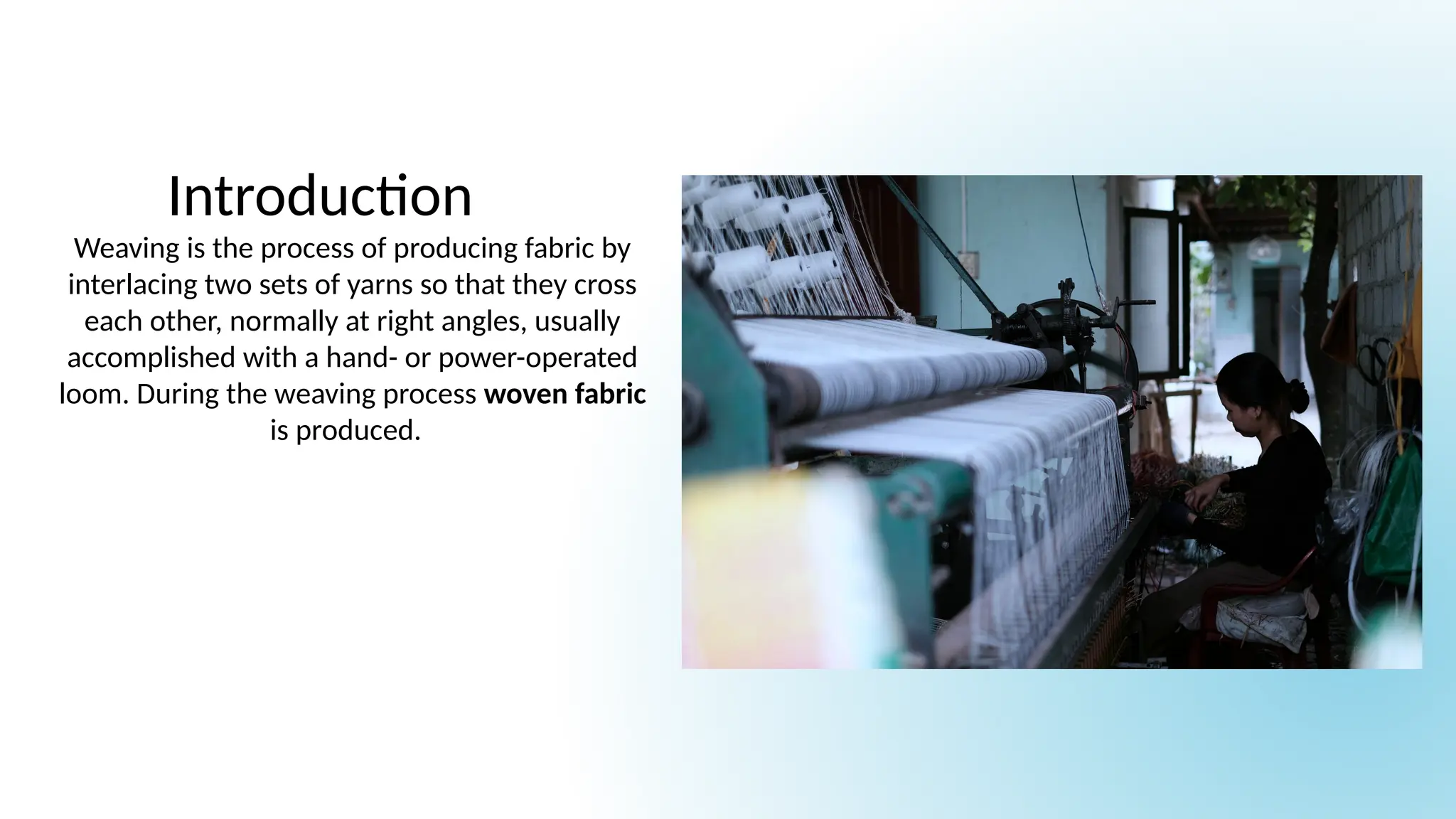
Weaving is the process of producing fabric by
interlacing two sets of yarns so that they cross
each other, normally at right angles, usually
accomplished with a hand- or power-operated
loom. During the weaving process woven fabric
is produced.
Origin Ancient Egypt Industrial Revolution
Chinese Silk Modern Weaving
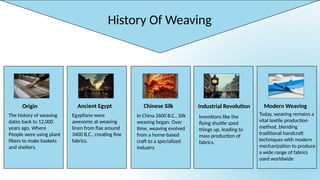
History Of Weaving
The history of weaving
dates back to 12,000
years ago. Where
People were using plant
fibers to make baskets
and shelters.
Egyptians were
awesome at weaving
linen from flax around
3400 B.C., creating fine
fabrics.
In China 2600 B.C., Silk
weaving began. Over
time, weaving evolved
from a home-based
craft to a specialized
industry
Inventions like the
flying shuttle sped
things up, leading to
mass production of
fabrics.
Today, weaving remains a
vital textile production
method, blending
traditional handcraft
techniques with modern
mechanization to produce
a wide range of fabrics
used worldwide
Woven Fabric Structure
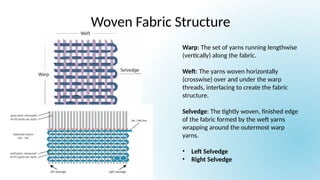
Warp: The set of yarns running lengthwise
(vertically) along the fabric.
Weft: The yarns woven horizontally
(crosswise) over and under the warp
threads, interlacing to create the fabric
structure.
Selvedge: The tightly woven, finished edge
of the fabric formed by the weft yarns
wrapping around the outermost warp
yarns.
• Left Selvedge
• Right Selvedge
Types of Loom
Loom is the mechanical device which produce woven fabric by the interlacement of two set of
yarns at right angles. There are many different types of looms. They can be categorized into two types such as
• Hand loom : A manually operated loom used for slow, small-scale fabric weaving
• Power loom : A machine-driven loom that weaves fabric quickly and in large quantities.
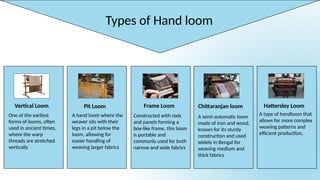
Vertical Loom Pit Loom Chittaranjan loom
Frame Loom Hattersley Loom
Types of Hand loom
One of the earliest
forms of looms, often
used in ancient times,
where the warp
threads are stretched
vertically
A hand loom where the
weaver sits with their
legs in a pit below the
loom, allowing for
easier handling of
weaving larger fabrics
Constructed with rods
and panels forming a
box-like frame, this loom
is portable and
commonly used for both
narrow and wide fabrics
A semi-automatic loom
made of iron and wood,
known for its sturdy
construction and used
widely in Bengal for
weaving medium and
thick fabrics
A type of handloom that
allows for more complex
weaving patterns and
efficient production,
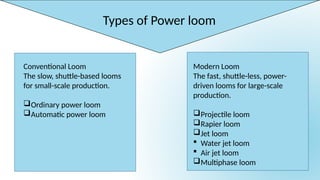
Types of Power loom
Conventional Loom
The slow, shuttle-based looms
for small-scale production.
Ordinary power loom
Automatic power loom
Modern Loom
The fast, shuttle-less, power-
driven looms for large-scale
production.
Projectile loom
Rapier loom
Jet loom
 Water jet loom
 Air jet loom
Multiphase loom
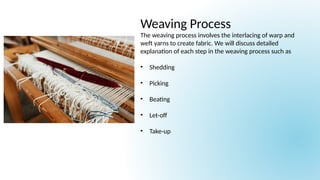
Weaving Process
The weaving process involves the interlacing of warp and
weft yarns to create fabric. We will discuss detailed
explanation of each step in the weaving process such as
• Shedding
• Picking
• Beating
• Let-off
• Take-up
Weaving Process
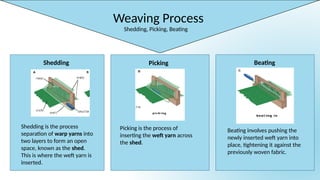
Shedding, Picking, Beating
Shedding Picking Beating
Shedding is the process
separation of warp yarns into
two layers to form an open
space, known as the shed.
This is where the weft yarn is
inserted.
Picking is the process of
inserting the weft yarn across
the shed.
Beating involves pushing the
newly inserted weft yarn into
place, tightening it against the
previously woven fabric.
Weaving Process
Shedding, Picking, Beating
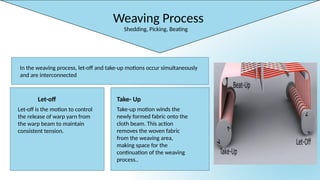
Let-off Take- Up
Let-off is the motion to control
the release of warp yarn from
the warp beam to maintain
consistent tension.
Take-up motion winds the
newly formed fabric onto the
cloth beam. This action
removes the woven fabric
from the weaving area,
making space for the
continuation of the weaving
process..
In the weaving process, let-off and take-up motions occur simultaneously
and are interconnected
Innovations in Weaving Technology
• Shuttle-less Weaving: Technologies like projectile, rapier, air, and water jet looms enable
faster weaving, wider fabric production.
• Automation: Electronic control systems enhance precision, improve fabric quality, and
minimize downtime in weaving operations.
• Automatic Threading: Automated threading mechanisms ensure faster loom setup and
reduce the need for manual labor.
• Advanced Weaving: Multi-phase and 3D weaving technologies allow for higher production
rates and the creation of complex fabric structures.
• Sustainability: Energy-efficient looms help reduce energy consumption and support eco-
friendly manufacturing practices.
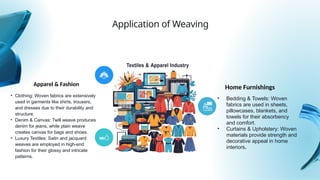
Apparel & Fashion
• Clothing: Woven fabrics are extensively
used in garments like shirts, trousers,
and dresses due to their durability and
structure.
• Denim & Canvas: Twill weave produces
denim for jeans, while plain weave
creates canvas for bags and shoes.
• Luxury Textiles: Satin and jacquard
weaves are employed in high-end
fashion for their glossy and intricate
patterns.
Home Furnishings
• Bedding & Towels: Woven
fabrics are used in sheets,
pillowcases, blankets, and
towels for their absorbency
and comfort.
• Curtains & Upholstery: Woven
materials provide strength and
decorative appeal in home
interiors.
Application of Weaving
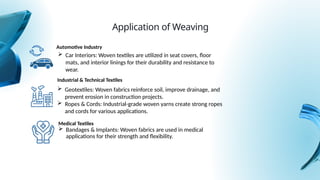
Automotive Industry
Medical Textiles
 Bandages & Implants: Woven fabrics are used in medical
applications for their strength and flexibility.
Application of Weaving
 Car Interiors: Woven textiles are utilized in seat covers, floor
mats, and interior linings for their durability and resistance to
wear.
Industrial & Technical Textiles
 Geotextiles: Woven fabrics reinforce soil, improve drainage, and
prevent erosion in construction projects.
 Ropes & Cords: Industrial-grade woven yarns create strong ropes
and cords for various applications.
 Motors and friction in looms release waste heat, increasing
ambient temperatures and energy needed for cooling systems.
Environmental Impacts of Weaving
 Continuous operation of industrial looms drives substantial
electricity use and associated CO₂ emissions.
 Preparation of warp yarn with starch or polymers generates
wastewater rich in organic and chemical residues.
 Routine lubrication of loom components produces spent oils
that, if untreated, contaminate soil and water.
 Old, broken weaving machines can pollute trash with metals
and electronics if we don't recycle them properly.
 Use special fans and filters to catch tiny bits of thread in the air
before they spread around. Keep the rooms clean so dust
doesn't get out.
Sustainable Solutions for Weaving
 Change old parts in the machines to newer, energy-saving ones.
Use sunlight or wind to help power them so we don't need as
much electricity and won't put as much bad stuff in the air.
 Put plant-based or special safe oils in the machine parts. Clean
and reuse this oil to make it last longer.
 Instead of using glue made from starch or oil, use a natural kind
that can break down easily. Also, reuse the water we use for this
glue.
 Collect the extra bits of thread and turn them back into new
thread or other materials instead of throwing them away.
Conclusion
Weaving is an essential process in fabric production, but it poses
notable environmental challenges, including energy consumption,
wastewater production, and material waste. By adopting sustainable
practices such as energy-efficient machinery, biodegradable warp
sizing, improved dust control, and recycling waste materials, the
weaving industry can significantly reduce its environmental issues.
Doing these things is really important for making sure we can make
clothes and also take care of the environment.
Any Question ?

Weaving in Fabric Manufacturing Technology

  • 1.
    Introduction Weaving is theprocess of producing fabric by interlacing two sets of yarns so that they cross each other, normally at right angles, usually accomplished with a hand- or power-operated loom. During the weaving process woven fabric is produced.
  • 2.
    Origin Ancient EgyptIndustrial Revolution Chinese Silk Modern Weaving History Of Weaving The history of weaving dates back to 12,000 years ago. Where People were using plant fibers to make baskets and shelters. Egyptians were awesome at weaving linen from flax around 3400 B.C., creating fine fabrics. In China 2600 B.C., Silk weaving began. Over time, weaving evolved from a home-based craft to a specialized industry Inventions like the flying shuttle sped things up, leading to mass production of fabrics. Today, weaving remains a vital textile production method, blending traditional handcraft techniques with modern mechanization to produce a wide range of fabrics used worldwide
  • 3.
    Woven Fabric Structure Warp:The set of yarns running lengthwise (vertically) along the fabric. Weft: The yarns woven horizontally (crosswise) over and under the warp threads, interlacing to create the fabric structure. Selvedge: The tightly woven, finished edge of the fabric formed by the weft yarns wrapping around the outermost warp yarns. • Left Selvedge • Right Selvedge
  • 4.
    Types of Loom Loomis the mechanical device which produce woven fabric by the interlacement of two set of yarns at right angles. There are many different types of looms. They can be categorized into two types such as • Hand loom : A manually operated loom used for slow, small-scale fabric weaving • Power loom : A machine-driven loom that weaves fabric quickly and in large quantities.
  • 5.
    Vertical Loom PitLoom Chittaranjan loom Frame Loom Hattersley Loom Types of Hand loom One of the earliest forms of looms, often used in ancient times, where the warp threads are stretched vertically A hand loom where the weaver sits with their legs in a pit below the loom, allowing for easier handling of weaving larger fabrics Constructed with rods and panels forming a box-like frame, this loom is portable and commonly used for both narrow and wide fabrics A semi-automatic loom made of iron and wood, known for its sturdy construction and used widely in Bengal for weaving medium and thick fabrics A type of handloom that allows for more complex weaving patterns and efficient production,
  • 6.
    Types of Powerloom Conventional Loom The slow, shuttle-based looms for small-scale production. Ordinary power loom Automatic power loom Modern Loom The fast, shuttle-less, power- driven looms for large-scale production. Projectile loom Rapier loom Jet loom  Water jet loom  Air jet loom Multiphase loom
  • 7.
    Weaving Process The weavingprocess involves the interlacing of warp and weft yarns to create fabric. We will discuss detailed explanation of each step in the weaving process such as • Shedding • Picking • Beating • Let-off • Take-up
  • 8.
    Weaving Process Shedding, Picking,Beating Shedding Picking Beating Shedding is the process separation of warp yarns into two layers to form an open space, known as the shed. This is where the weft yarn is inserted. Picking is the process of inserting the weft yarn across the shed. Beating involves pushing the newly inserted weft yarn into place, tightening it against the previously woven fabric.
  • 9.
    Weaving Process Shedding, Picking,Beating Let-off Take- Up Let-off is the motion to control the release of warp yarn from the warp beam to maintain consistent tension. Take-up motion winds the newly formed fabric onto the cloth beam. This action removes the woven fabric from the weaving area, making space for the continuation of the weaving process.. In the weaving process, let-off and take-up motions occur simultaneously and are interconnected
  • 10.
    Innovations in WeavingTechnology • Shuttle-less Weaving: Technologies like projectile, rapier, air, and water jet looms enable faster weaving, wider fabric production. • Automation: Electronic control systems enhance precision, improve fabric quality, and minimize downtime in weaving operations. • Automatic Threading: Automated threading mechanisms ensure faster loom setup and reduce the need for manual labor. • Advanced Weaving: Multi-phase and 3D weaving technologies allow for higher production rates and the creation of complex fabric structures. • Sustainability: Energy-efficient looms help reduce energy consumption and support eco- friendly manufacturing practices.
  • 11.
    Apparel & Fashion •Clothing: Woven fabrics are extensively used in garments like shirts, trousers, and dresses due to their durability and structure. • Denim & Canvas: Twill weave produces denim for jeans, while plain weave creates canvas for bags and shoes. • Luxury Textiles: Satin and jacquard weaves are employed in high-end fashion for their glossy and intricate patterns. Home Furnishings • Bedding & Towels: Woven fabrics are used in sheets, pillowcases, blankets, and towels for their absorbency and comfort. • Curtains & Upholstery: Woven materials provide strength and decorative appeal in home interiors. Application of Weaving
  • 12.
    Automotive Industry Medical Textiles Bandages & Implants: Woven fabrics are used in medical applications for their strength and flexibility. Application of Weaving  Car Interiors: Woven textiles are utilized in seat covers, floor mats, and interior linings for their durability and resistance to wear. Industrial & Technical Textiles  Geotextiles: Woven fabrics reinforce soil, improve drainage, and prevent erosion in construction projects.  Ropes & Cords: Industrial-grade woven yarns create strong ropes and cords for various applications.
  • 13.
     Motors andfriction in looms release waste heat, increasing ambient temperatures and energy needed for cooling systems. Environmental Impacts of Weaving  Continuous operation of industrial looms drives substantial electricity use and associated CO₂ emissions.  Preparation of warp yarn with starch or polymers generates wastewater rich in organic and chemical residues.  Routine lubrication of loom components produces spent oils that, if untreated, contaminate soil and water.  Old, broken weaving machines can pollute trash with metals and electronics if we don't recycle them properly.
  • 14.
     Use specialfans and filters to catch tiny bits of thread in the air before they spread around. Keep the rooms clean so dust doesn't get out. Sustainable Solutions for Weaving  Change old parts in the machines to newer, energy-saving ones. Use sunlight or wind to help power them so we don't need as much electricity and won't put as much bad stuff in the air.  Put plant-based or special safe oils in the machine parts. Clean and reuse this oil to make it last longer.  Instead of using glue made from starch or oil, use a natural kind that can break down easily. Also, reuse the water we use for this glue.  Collect the extra bits of thread and turn them back into new thread or other materials instead of throwing them away.
  • 15.
    Conclusion Weaving is anessential process in fabric production, but it poses notable environmental challenges, including energy consumption, wastewater production, and material waste. By adopting sustainable practices such as energy-efficient machinery, biodegradable warp sizing, improved dust control, and recycling waste materials, the weaving industry can significantly reduce its environmental issues. Doing these things is really important for making sure we can make clothes and also take care of the environment.
  • 16.