Textile Engineering
Introduction of Weaving (FME-1)
2
Presented by:
Mazharul Islam.
B.Sc. in Textile Engineering.
Dept. of Wet Process Engineering (WPE).
PTEC _ Session 2015-16 (10th Batch).
Email: tex.mazharul@gmail.com
Introduction of Weaving
The types of fabric :
There are three types of fabric. They are
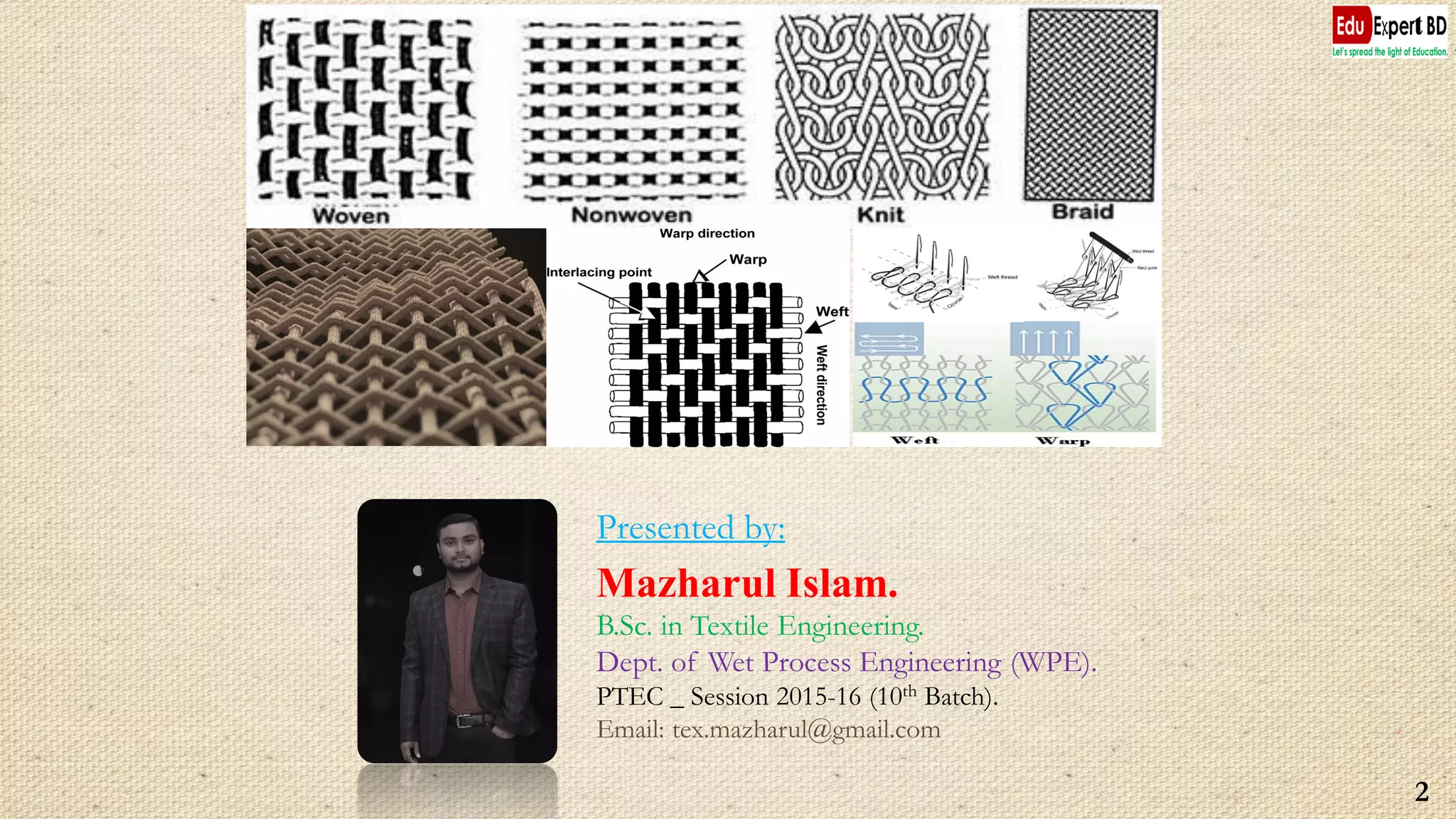
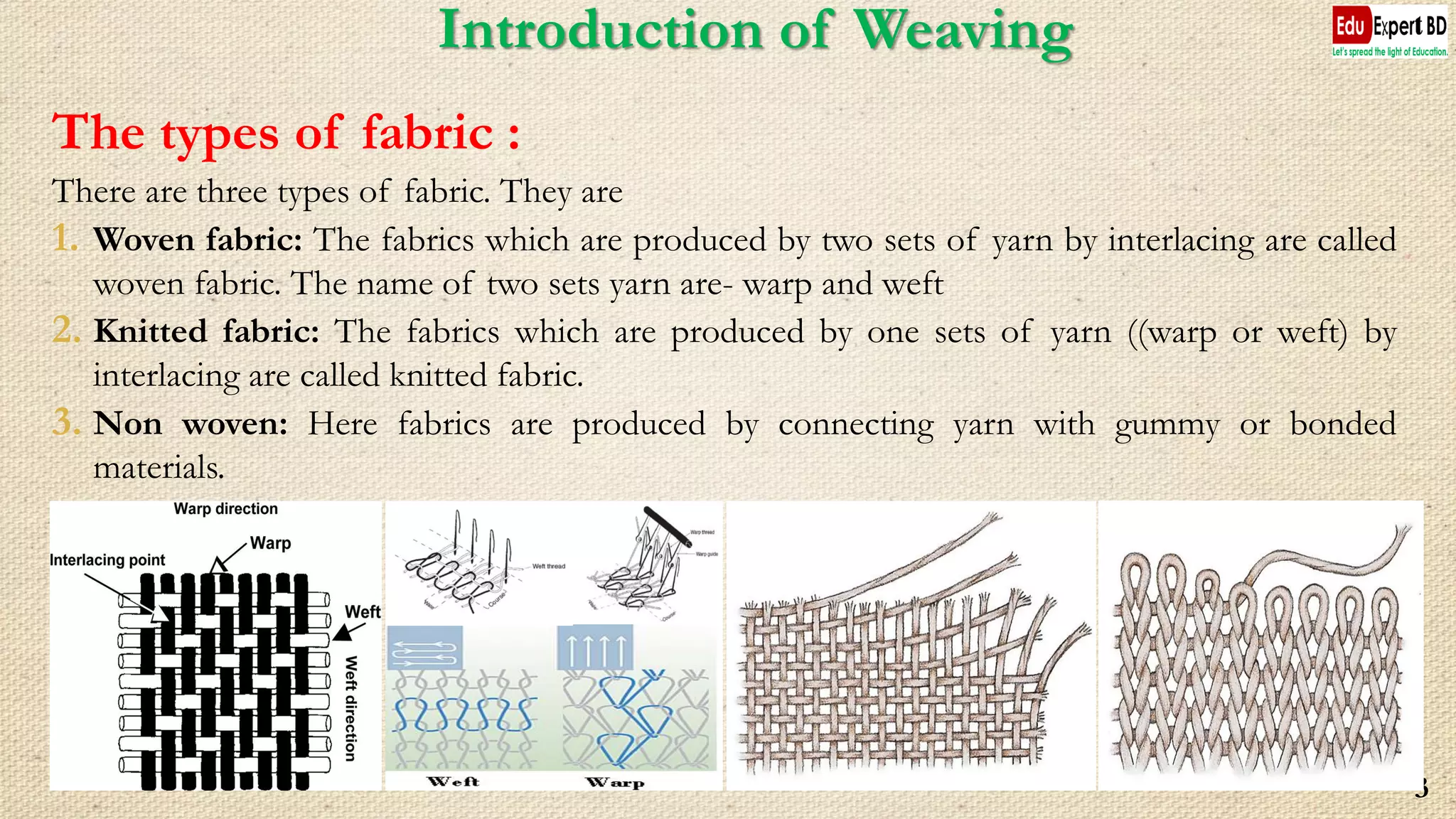
1. Woven fabric: The fabrics which are produced by two sets of yarn by interlacing are called
woven fabric. The name of two sets yarn are- warp and weft
2. Knitted fabric: The fabrics which are produced by one sets of yarn ((warp or weft) by
interlacing are called knitted fabric.
3. Non woven: Here fabrics are produced by connecting yarn with gummy or bonded
materials.
3
Introduction of Weaving
The flow chart of fabric manufacturing or weaving process :
4
Cone/cheese winding
↓
Warping
↓
Sizing
↓
Drawing-in
↓
Denting
↓
Yarn from sag department
Pirn winding
weaving
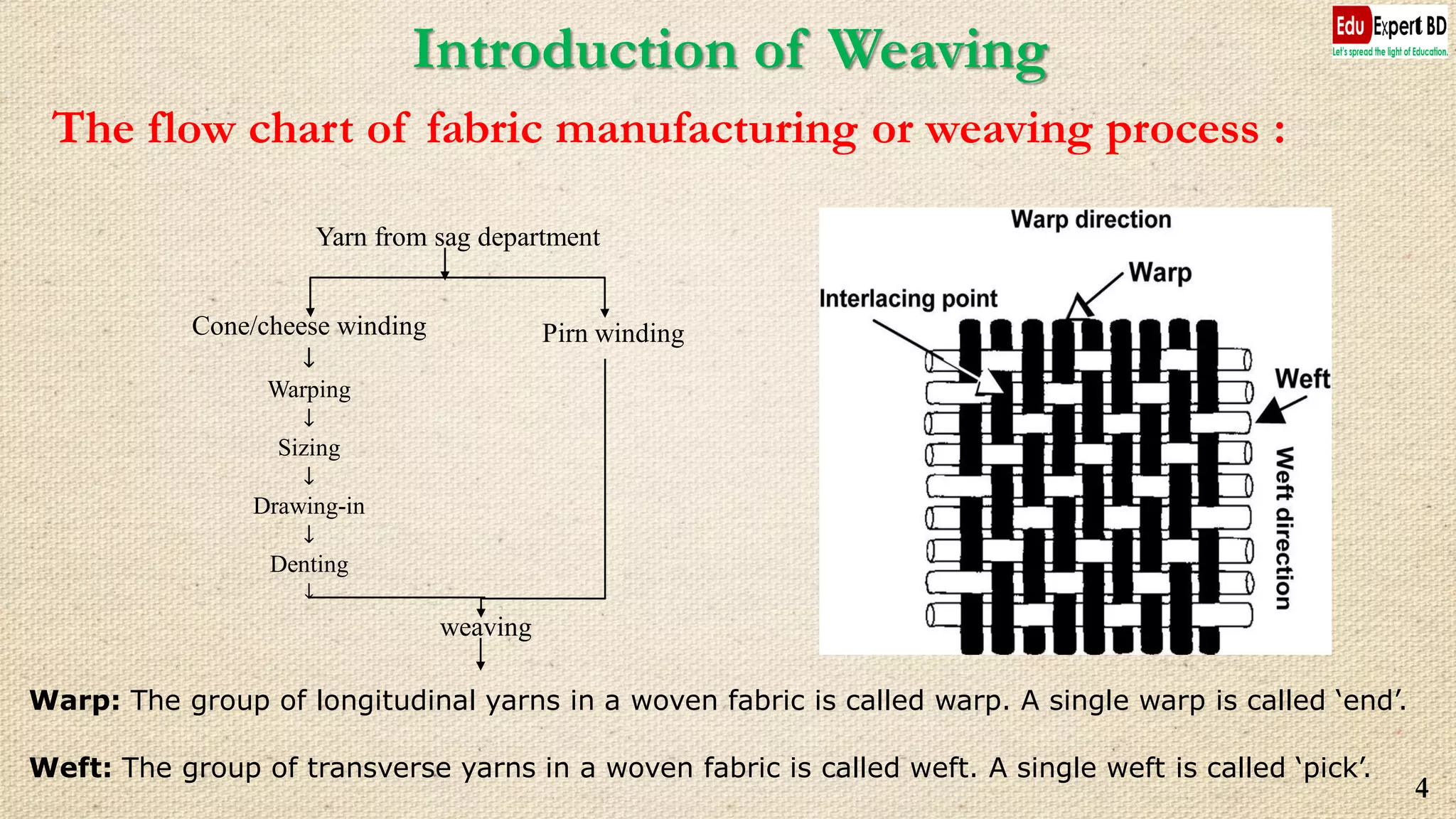
Warp: The group of longitudinal yarns in a woven fabric is called warp. A single warp is called ‘end’.
Weft: The group of transverse yarns in a woven fabric is called weft. A single weft is called ‘pick’.
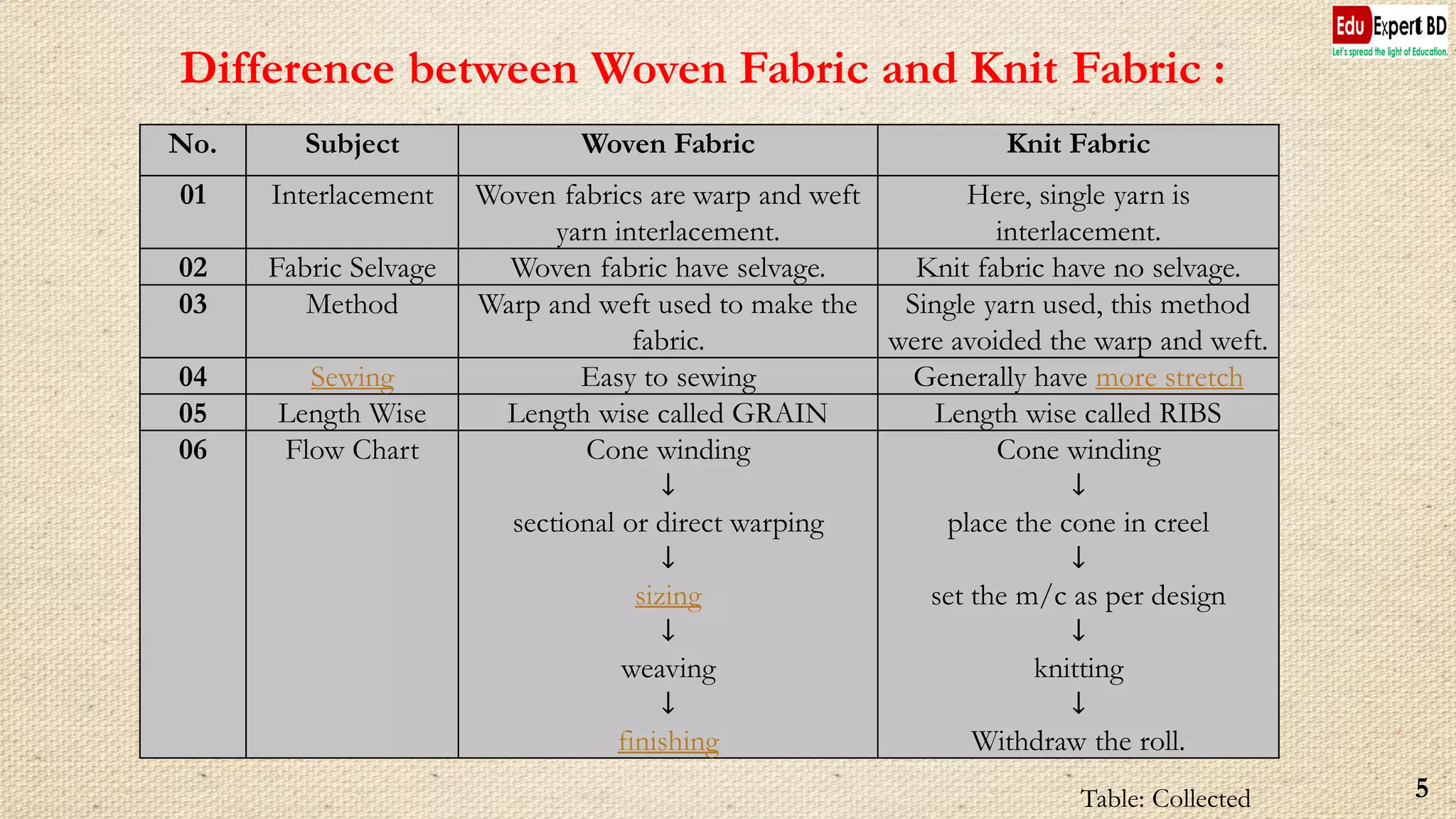
Difference between Woven Fabric and Knit Fabric :
5
No. Subject Woven Fabric Knit Fabric
01 Interlacement Woven fabrics are warp and weft
yarn interlacement.
Here, single yarn is
interlacement.
02 Fabric Selvage Woven fabric have selvage. Knit fabric have no selvage.
03 Method Warp and weft used to make the
fabric.
Single yarn used, this method
were avoided the warp and weft.
04 Sewing Easy to sewing Generally have more stretch
05 Length Wise Length wise called GRAIN Length wise called RIBS
06 Flow Chart Cone winding
↓
sectional or direct warping
↓
sizing
↓
weaving
↓
finishing
Cone winding
↓
place the cone in creel
↓
set the m/c as per design
↓
knitting
↓
Withdraw the roll.
Table: Collected
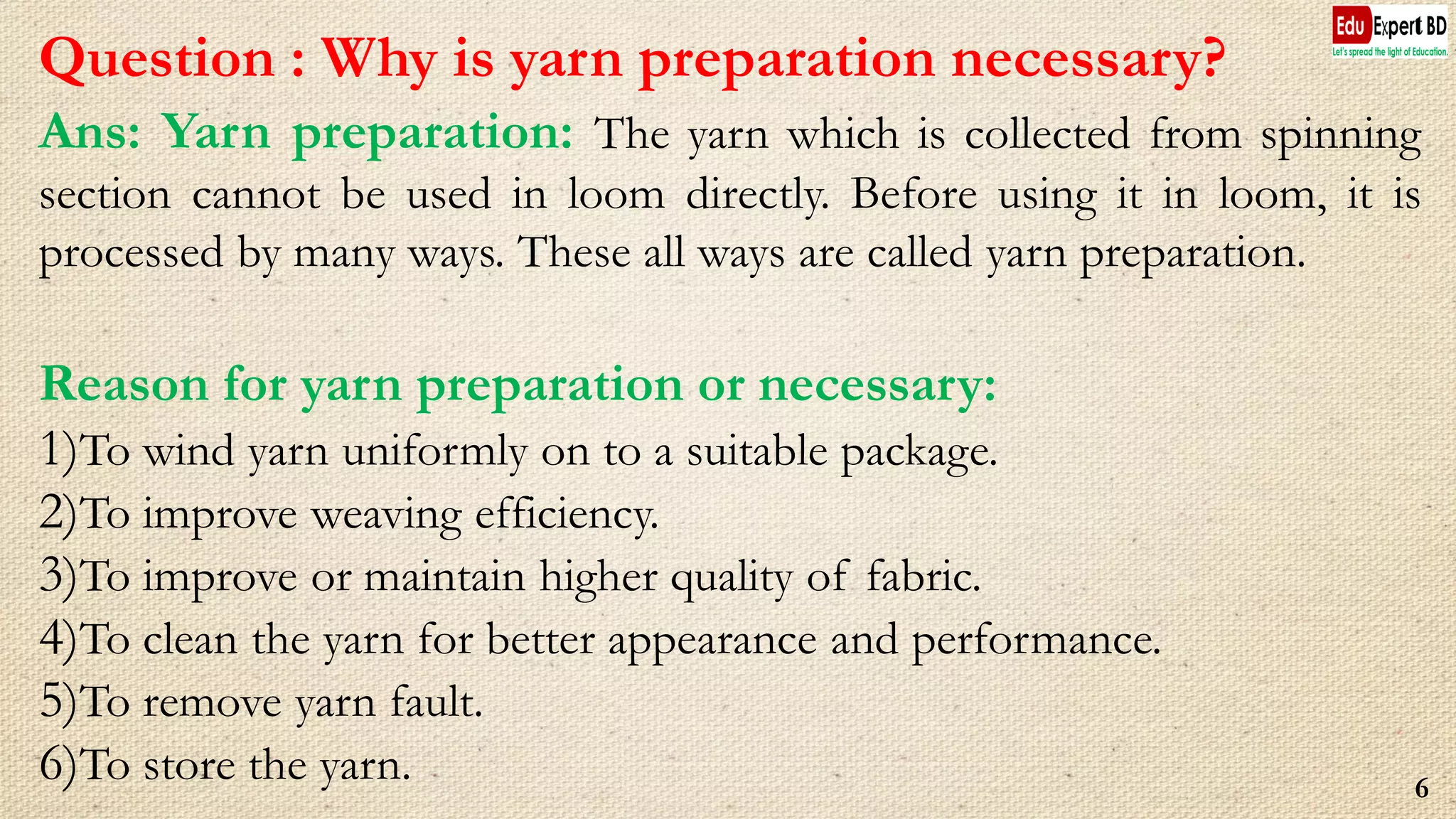
Question : Why is yarn preparation necessary?
Ans: Yarn preparation: The yarn which is collected from spinning
section cannot be used in loom directly. Before using it in loom, it is
processed by many ways. These all ways are called yarn preparation.
Reason for yarn preparation or necessary:
1)To wind yarn uniformly on to a suitable package.
2)To improve weaving efficiency.
3)To improve or maintain higher quality of fabric.
4)To clean the yarn for better appearance and performance.
5)To remove yarn fault.
6)To store the yarn. 6
7
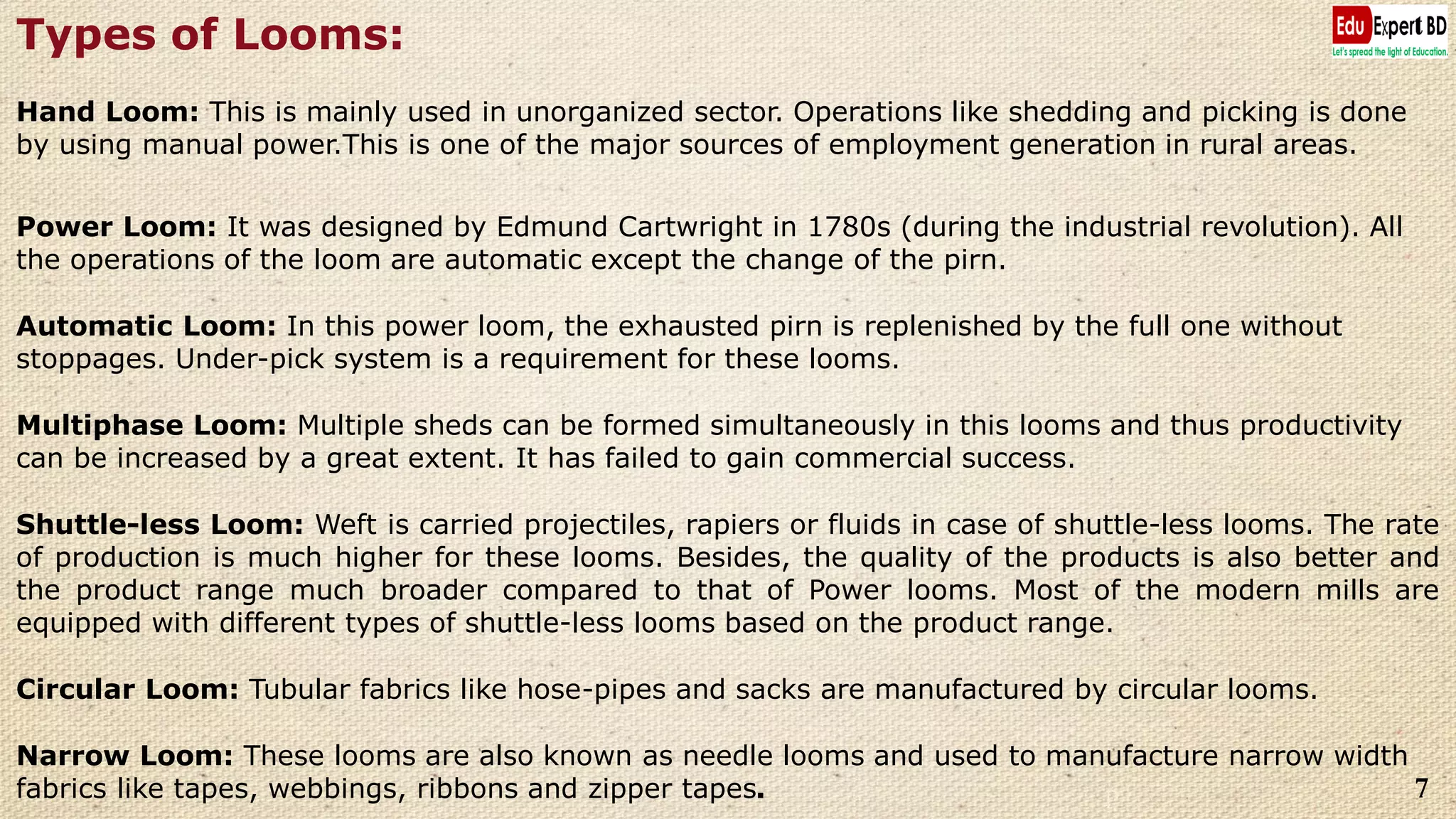
Types of Looms:
Hand Loom: This is mainly used in unorganized sector. Operations like shedding and picking is done
by using manual power.This is one of the major sources of employment generation in rural areas.
Power Loom: It was designed by Edmund Cartwright in 1780s (during the industrial revolution). All
the operations of the loom are automatic except the change of the pirn.
Automatic Loom: In this power loom, the exhausted pirn is replenished by the full one without
stoppages. Under-pick system is a requirement for these looms.
Multiphase Loom: Multiple sheds can be formed simultaneously in this looms and thus productivity
can be increased by a great extent. It has failed to gain commercial success.
Shuttle-less Loom: Weft is carried projectiles, rapiers or fluids in case of shuttle-less looms. The rate
of production is much higher for these looms. Besides, the quality of the products is also better and
the product range much broader compared to that of Power looms. Most of the modern mills are
equipped with different types of shuttle-less looms based on the product range.
Circular Loom: Tubular fabrics like hose-pipes and sacks are manufactured by circular looms.
Narrow Loom: These looms are also known as needle looms and used to manufacture narrow width
fabrics like tapes, webbings, ribbons and zipper tapes. p
8
Shedding
It is the process by which the warp sheet is divided into two groups so that
a clear passage is created for the weft yarn or weft carrying device to pass
through it. One group of yarns (red yarns) either moves in the upward
direction or stay in the up position (if they are already in up position) as
shown in Figure. Thus they form the top shed line. Another group of yarns
(green yarns) either moves in the downward direction or stay in the down
position (if they are already in down position). Thus they form the bottom
shed line.
9
Picking
The insertion of weft or weft carrying device (shuttle, projectile
or rapier) through the shed is known as picking. Based on picking
system, looms can be classified as follows.
• Shuttle loom: weft package is carried by the wooden shuttle
• Projectile loom: weft is carried by metallic or composite
projectile
• Airjet loom: weft is inserted by jet of compressed air
• Waterjet loom: weft is inserted by water jet
• Rapier loom: weft is inserted by flexible or rigid rapiers
p
10
Beat-up
Beat up is the action by which the newly inserted
weft yarn is pushed up to the cloth fell (Figure)
Figure 1.8: Beat up
Thank You !
11
<Md Mazharul Islam> WPE dept. 10th Batch, PTEC.

Weaving (FME-1)

  • 1.
  • 2.
    2 Presented by: Mazharul Islam. B.Sc.in Textile Engineering. Dept. of Wet Process Engineering (WPE). PTEC _ Session 2015-16 (10th Batch). Email: tex.mazharul@gmail.com
  • 3.
    Introduction of Weaving Thetypes of fabric : There are three types of fabric. They are 1. Woven fabric: The fabrics which are produced by two sets of yarn by interlacing are called woven fabric. The name of two sets yarn are- warp and weft 2. Knitted fabric: The fabrics which are produced by one sets of yarn ((warp or weft) by interlacing are called knitted fabric. 3. Non woven: Here fabrics are produced by connecting yarn with gummy or bonded materials. 3
  • 4.
    Introduction of Weaving Theflow chart of fabric manufacturing or weaving process : 4 Cone/cheese winding ↓ Warping ↓ Sizing ↓ Drawing-in ↓ Denting ↓ Yarn from sag department Pirn winding weaving Warp: The group of longitudinal yarns in a woven fabric is called warp. A single warp is called ‘end’. Weft: The group of transverse yarns in a woven fabric is called weft. A single weft is called ‘pick’.
  • 5.
    Difference between WovenFabric and Knit Fabric : 5 No. Subject Woven Fabric Knit Fabric 01 Interlacement Woven fabrics are warp and weft yarn interlacement. Here, single yarn is interlacement. 02 Fabric Selvage Woven fabric have selvage. Knit fabric have no selvage. 03 Method Warp and weft used to make the fabric. Single yarn used, this method were avoided the warp and weft. 04 Sewing Easy to sewing Generally have more stretch 05 Length Wise Length wise called GRAIN Length wise called RIBS 06 Flow Chart Cone winding ↓ sectional or direct warping ↓ sizing ↓ weaving ↓ finishing Cone winding ↓ place the cone in creel ↓ set the m/c as per design ↓ knitting ↓ Withdraw the roll. Table: Collected
  • 6.
    Question : Whyis yarn preparation necessary? Ans: Yarn preparation: The yarn which is collected from spinning section cannot be used in loom directly. Before using it in loom, it is processed by many ways. These all ways are called yarn preparation. Reason for yarn preparation or necessary: 1)To wind yarn uniformly on to a suitable package. 2)To improve weaving efficiency. 3)To improve or maintain higher quality of fabric. 4)To clean the yarn for better appearance and performance. 5)To remove yarn fault. 6)To store the yarn. 6
  • 7.
    7 Types of Looms: HandLoom: This is mainly used in unorganized sector. Operations like shedding and picking is done by using manual power.This is one of the major sources of employment generation in rural areas. Power Loom: It was designed by Edmund Cartwright in 1780s (during the industrial revolution). All the operations of the loom are automatic except the change of the pirn. Automatic Loom: In this power loom, the exhausted pirn is replenished by the full one without stoppages. Under-pick system is a requirement for these looms. Multiphase Loom: Multiple sheds can be formed simultaneously in this looms and thus productivity can be increased by a great extent. It has failed to gain commercial success. Shuttle-less Loom: Weft is carried projectiles, rapiers or fluids in case of shuttle-less looms. The rate of production is much higher for these looms. Besides, the quality of the products is also better and the product range much broader compared to that of Power looms. Most of the modern mills are equipped with different types of shuttle-less looms based on the product range. Circular Loom: Tubular fabrics like hose-pipes and sacks are manufactured by circular looms. Narrow Loom: These looms are also known as needle looms and used to manufacture narrow width fabrics like tapes, webbings, ribbons and zipper tapes. p
  • 8.
    8 Shedding It is theprocess by which the warp sheet is divided into two groups so that a clear passage is created for the weft yarn or weft carrying device to pass through it. One group of yarns (red yarns) either moves in the upward direction or stay in the up position (if they are already in up position) as shown in Figure. Thus they form the top shed line. Another group of yarns (green yarns) either moves in the downward direction or stay in the down position (if they are already in down position). Thus they form the bottom shed line.
  • 9.
    9 Picking The insertion ofweft or weft carrying device (shuttle, projectile or rapier) through the shed is known as picking. Based on picking system, looms can be classified as follows. • Shuttle loom: weft package is carried by the wooden shuttle • Projectile loom: weft is carried by metallic or composite projectile • Airjet loom: weft is inserted by jet of compressed air • Waterjet loom: weft is inserted by water jet • Rapier loom: weft is inserted by flexible or rigid rapiers p
  • 10.
    10 Beat-up Beat up isthe action by which the newly inserted weft yarn is pushed up to the cloth fell (Figure) Figure 1.8: Beat up
  • 11.
    Thank You ! 11 <MdMazharul Islam> WPE dept. 10th Batch, PTEC.