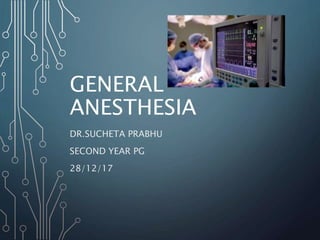
GENERAL
ANESTHESIA
DR.SUCHETA PRABHU
SECOND YEAR PG
28/12/17
QUESTIONS ASKED PREVIOUSLY
• 100 marks : Hospital dentistry
DEFINITION
A medically induced
coma,with a loss of
protective reflexes ,
resulting from the
administration of
one or more general
anesthetic agents.
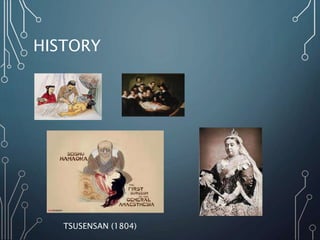
HISTORY
TSUSENSAN (1804)
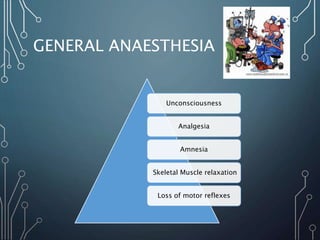
GENERAL ANAESTHESIA
Unconsciousness
Analgesia
Amnesia
Skeletal Muscle relaxation
Loss of motor reflexes
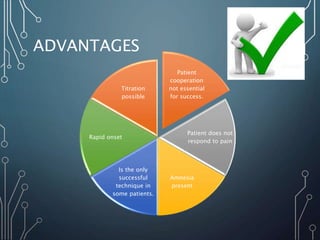
ADVANTAGES
Patient
cooperation
not essential
for success.
Patient does not
respond to pain
Amnesia
present
Is the only
successful
technique in
some patients.
Rapid onset
Titration
possible
DISADVANTAGES
Patient is unconscious
Protective reflexes &Vital signs depressed
Advanced training required
Anesthesia team required
Special equipment, recovery room required
More post anesthetic complications
INDICATIONS
Certain physical, mental or medically
compromised condition.
Patients that do not respond to local
anesthetics or are allergic to it.
Trauma patients
Fearful , uncooperative anxious patient
whose behaviour is not expected to improve.
CONTRAINDICATIONS
Lack of adequate training by doctor,personnel
Lack of adequate equipment , facility
ASA IV And certain ASA III medically compromised
patients
OTHER PATIENTS MAY NOT BE
CANDIDATES(RELATIVE)
Significantly
decreased
cardiac/pulmonary
reserve
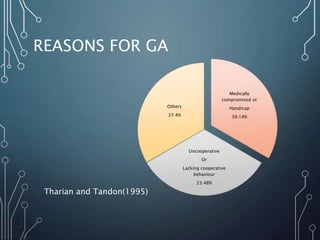
REASONS FOR GA
Medically
compromised or
Handicap
39.14%
Uncooperative
Or
Lacking cooperative
behaviour
23.48%
Others
37.4%
Tharian and Tandon(1995)
PRE ANESTHETIC EVALUATION
MALLAMPATTI TEST
Patient upright
Maximal jaw opening
Tongue protrusion without
phonation
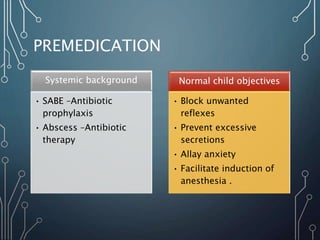
PREMEDICATION
Systemic background
• SABE –Antibiotic
prophylaxis
• Abscess –Antibiotic
therapy
Normal child objectives
• Block unwanted
reflexes
• Prevent excessive
secretions
• Allay anxiety
• Facilitate induction of
anesthesia .
PREANESTHETIC MEDICATION
• It is the use of drugs prior to anesthesia to
make it more safe and pleasant.
• To relieve anxiety – Benzodiazepines
• To prevent allergic reactions – Antihistaminics
• To prevent nausea and vomiting – Antiemetics
• To provide analgesia – Opioids
• To prevent acidity – Proton Pump Inhibitor
• To prevent bradycardia and secretion –
Atropine
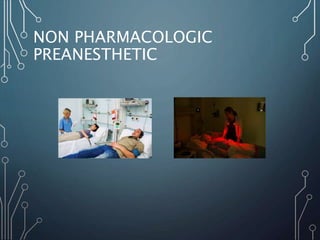
NON PHARMACOLOGIC
PREANESTHETIC
EQUIPMENT
S=Scope
T=Tube
A=Airway
T=Tape to fix tube
I=Introducer stilet
C= Connecto mask apparatus
S=Suction
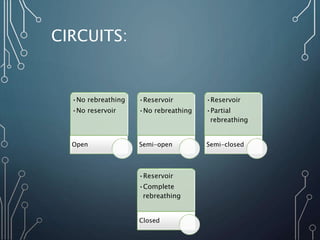
CIRCUITS:
•No rebreathing
•No reservoir
Open
•Reservoir
•No rebreathing
Semi-open
•Reservoir
•Partial
rebreathing
Semi-closed
•Reservoir
•Complete
rebreathing
Closed
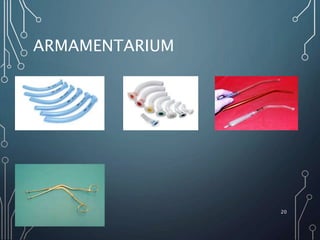
ARMAMENTARIUM
ARMAMENTARIUM
20
LARYNGOSCOPE
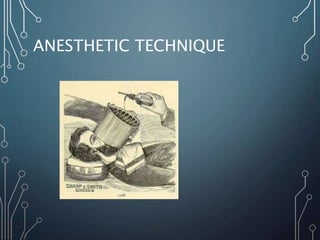
ANESTHETIC TECHNIQUE
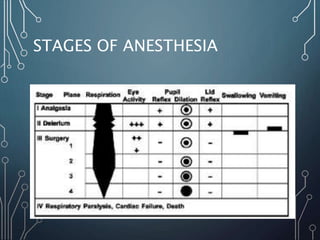
STAGES OF ANESTHESIA
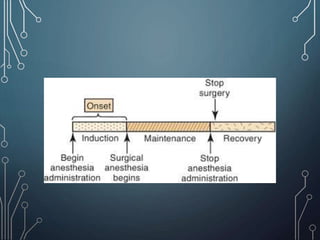
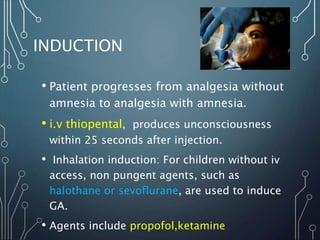
INDUCTION
• Patient progresses from analgesia without
amnesia to analgesia with amnesia.
• i.v thiopental, produces unconsciousness
within 25 seconds after injection.
• Inhalation induction: For children without iv
access, non pungent agents, such as
halothane or sevoflurane, are used to induce
GA.
• Agents include propofol,ketamine
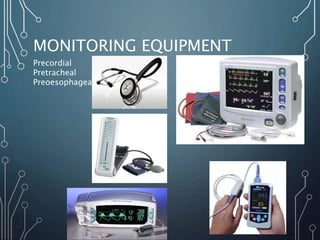
MONITORING EQUIPMENT
Precordial
Pretracheal
Preoesophageal
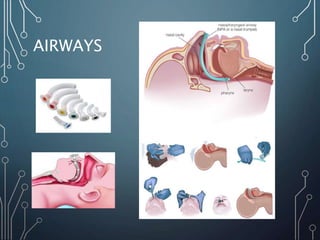
AIRWAYS
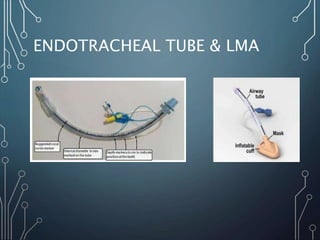
ENDOTRACHEAL TUBE & LMA
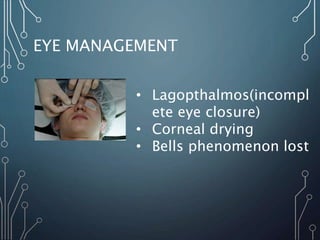
EYE MANAGEMENT
• Lagopthalmos(incompl
ete eye closure)
• Corneal drying
• Bells phenomenon lost
MAINTENANCE
• Volatile anesthetics administered because these
agents offer good minute-to-minute control over
the depth of anesthesia.
• Opioids such as fentanyl are often used for pain
along with inhalation agents, because the latter are
not good analgesics.
• Usually: N2O + volatile agent (halothane,
isoflurane)
• Less often : N2O + iv Opioid analgesic (fentanyl,
morphine, pethidine + N.M blocking agents
TARGET CONTROLLED
INFUSION(TCI)
• Glasgow,Scotland
• 1990s
• Advantages
RECOVERY
• The time from discontinuation of
administration of the anesthesia until
consciousness and protective physiologic
reflexes are regained.
• It depends on how fast the anesthetic drug
diffuses from the brain.
• May be accompanied by acute mental
confusion, aphasia, shivering
POST OPERATIVE CARE
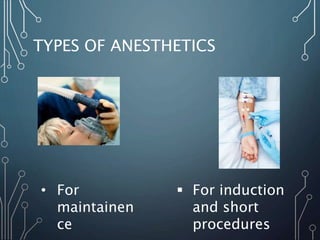
TYPES OF ANESTHETICS
• For
maintainen
ce
 For induction
and short
procedures
INHALATIONAL ANESTHETICS
Advantage of controlling the depth of
anesthesia Metabolism is very minimal
Excreted on exhalation
Nonhalogenated
Nitrous oxide
Halogenated
Halothane
Enflurane
Desflurane
Sevoflurane
Isoflurane
Methoxyflurane
HALOTHANE
• Potent anesthetic
• Poor analgesic, poor muscle relaxant
• Induction is pleasant
• It sensitizes the heart to catecholamines.
• It dilates bronchus (preferred in asthmatics)
• A/E : Halothane hepatitis and malignant
hyperthermia
NITROUS OXIDE
• Safest inhalational anesthetic
• Noninflammable, nonirritating
• Low potency anesthetic, poor muscle relaxant
but a good analgesic.
• No toxic effect on the heart, liver and kidney
• A/E: Diffusional hypoxia, megaloblastic
anemia
PARENTERAL ADMINISTRATION
• Used for induction of anesthesia.
• Rapid onset of action
• Recovery is mainly by redistribution.
• Also reduce the amount of inhalation
anesthetic for maintenance.
• Drugs are Thiopental, Midazolam, Propofol,
Etomidate & Ketamine
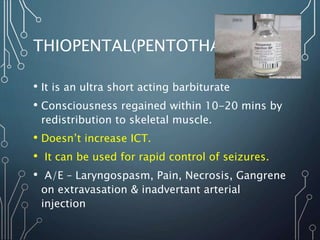
THIOPENTAL(PENTOTHAL)
• It is an ultra short acting barbiturate
• Consciousness regained within 10-20 mins by
redistribution to skeletal muscle.
• Doesn’t increase ICT.
• It can be used for rapid control of seizures.
• A/E – Laryngospasm, Pain, Necrosis, Gangrene
on extravasation & inadvertant arterial
injection
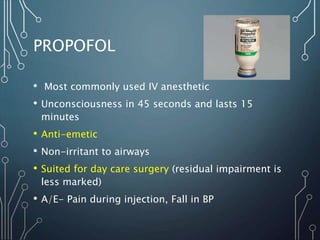
PROPOFOL
• Most commonly used IV anesthetic
• Unconsciousness in 45 seconds and lasts 15
minutes
• Anti-emetic
• Non-irritant to airways
• Suited for day care surgery (residual impairment is
less marked)
• A/E- Pain during injection, Fall in BP
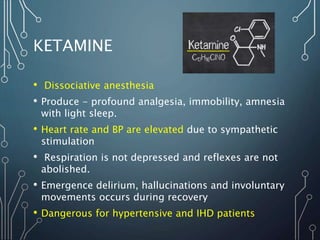
KETAMINE
• Dissociative anesthesia
• Produce - profound analgesia, immobility, amnesia
with light sleep.
• Heart rate and BP are elevated due to sympathetic
stimulation
• Respiration is not depressed and reflexes are not
abolished.
• Emergence delirium, hallucinations and involuntary
movements occurs during recovery
• Dangerous for hypertensive and IHD patients
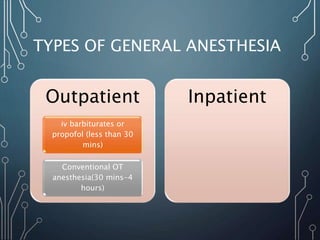
TYPES OF GENERAL ANESTHESIA
Outpatient
iv barbiturates or
propofol (less than 30
mins)
Conventional OT
anesthesia(30 mins-4
hours)
Inpatient
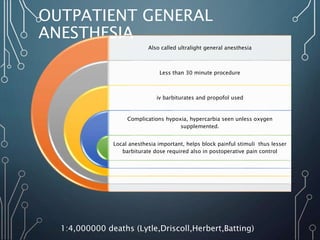
OUTPATIENT GENERAL
ANESTHESIA
Also called ultralight general anesthesia
Less than 30 minute procedure
iv barbiturates and propofol used
Complications hypoxia, hypercarbia seen unless oxygen
supplemented.
Local anesthesia important, helps block painful stimuli thus lesser
barbiturate dose required also in postoperative pain control
1:4,000000 deaths (Lytle,Driscoll,Herbert,Batting)
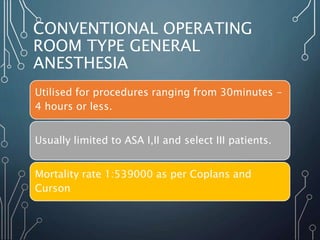
CONVENTIONAL OPERATING
ROOM TYPE GENERAL
ANESTHESIA
Utilised for procedures ranging from 30minutes -
4 hours or less.
Usually limited to ASA I,II and select III patients.
Mortality rate 1:539000 as per Coplans and
Curson
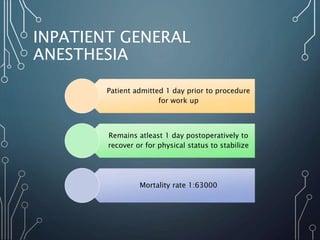
INPATIENT GENERAL
ANESTHESIA
Patient admitted 1 day prior to procedure
for work up
Remains atleast 1 day postoperatively to
recover or for physical status to stabilize
Mortality rate 1:63000
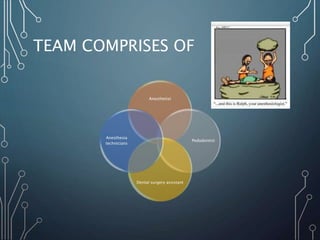
TEAM COMPRISES OF
Anesthetist
Pedodontist
Dental surgery assistant
Anesthesia
technicians
PRE PROCEDURE
Observing & recording child’s behavior ,
history
Informing parents and obtaining a verbal
consent.
Asking for anesthetists clearance regarding
fitness .
Parents instructed to report 1 day prior to
surgery for admission.
ON THE DAY PRIOR TO SURGERY
Child reports for admission.
Preanesthetic check up (PAC).
Preoperative orders.
NIL BY MOUTH
• Lantham(1999): The goal of
preoperative fasting is to decrease
gastric acid volume and minimise the
pneumonitis that may result in the
event that a patient aspirates gastric
contents.
• NPO after midnight 6-8 hours preop
(solids) and 2-3 hours perop (liquids).
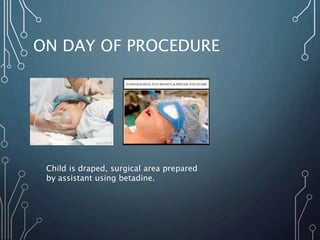
ON DAY OF PROCEDURE
Child is draped, surgical area prepared
by assistant using betadine.
4 handed dentistry followed.
Treatment is carried out from oral prophylaxis, endodontics , restorative, crown
placement, PFS, Impressions for space maintainers, extractions.
Operating dentist to inform anesthetist 30 mins prior to completion.
Adequate control of haemorrhage done .
Throat pack removed
Patient extubated, shifted to recovery room.
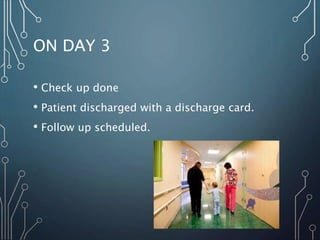
ON DAY 3
• Check up done
• Patient discharged with a discharge card.
• Follow up scheduled.
SPECIAL CONDITIONS
• Diabetes & NBM consideration.
• ADHD difficult preoperative period, medications like
methyl phenidate and clonidine may have
interaction.
• Down’s syndrome: Macroglossia and airway
management.
• Congestive heart disease: Minimise oxygen
consumption and demand on cardiovascular system
during induction.
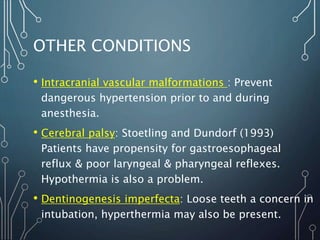
OTHER CONDITIONS
• Intracranial vascular malformations : Prevent
dangerous hypertension prior to and during
anesthesia.
• Cerebral palsy: Stoetling and Dundorf (1993)
Patients have propensity for gastroesophageal
reflux & poor laryngeal & pharyngeal reflexes.
Hypothermia is also a problem.
• Dentinogenesis imperfecta: Loose teeth a concern in
intubation, hyperthermia may also be present.
EMERGENCY EQUIPMENT
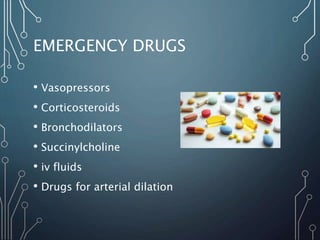
EMERGENCY DRUGS
• Vasopressors
• Corticosteroids
• Bronchodilators
• Succinylcholine
• iv fluids
• Drugs for arterial dilation
REFERENCES
• 1.Marwah N. Textbook of pediatric
dentistry.3rd edn.
• 2.Tandon S. Textbook of Pedodontics. 2nd edn.
Paras medical publishers 2009
• 3.Malamed S. Sedation :A guide to patient
management.4th edn.Mosby
58
General Anesthesia

General Anesthesia

  • 1.
  • 2.
    QUESTIONS ASKED PREVIOUSLY •100 marks : Hospital dentistry
  • 3.
    DEFINITION A medically induced coma,witha loss of protective reflexes , resulting from the administration of one or more general anesthetic agents.
  • 4.
  • 5.
  • 6.
    ADVANTAGES Patient cooperation not essential for success. Patientdoes not respond to pain Amnesia present Is the only successful technique in some patients. Rapid onset Titration possible
  • 7.
    DISADVANTAGES Patient is unconscious Protectivereflexes &Vital signs depressed Advanced training required Anesthesia team required Special equipment, recovery room required More post anesthetic complications
  • 8.
    INDICATIONS Certain physical, mentalor medically compromised condition. Patients that do not respond to local anesthetics or are allergic to it. Trauma patients Fearful , uncooperative anxious patient whose behaviour is not expected to improve.
  • 9.
    CONTRAINDICATIONS Lack of adequatetraining by doctor,personnel Lack of adequate equipment , facility ASA IV And certain ASA III medically compromised patients
  • 10.
    OTHER PATIENTS MAYNOT BE CANDIDATES(RELATIVE) Significantly decreased cardiac/pulmonary reserve
  • 11.
    REASONS FOR GA Medically compromisedor Handicap 39.14% Uncooperative Or Lacking cooperative behaviour 23.48% Others 37.4% Tharian and Tandon(1995)
  • 12.
  • 13.
    MALLAMPATTI TEST Patient upright Maximaljaw opening Tongue protrusion without phonation
  • 14.
    PREMEDICATION Systemic background • SABE–Antibiotic prophylaxis • Abscess –Antibiotic therapy Normal child objectives • Block unwanted reflexes • Prevent excessive secretions • Allay anxiety • Facilitate induction of anesthesia .
  • 15.
    PREANESTHETIC MEDICATION • Itis the use of drugs prior to anesthesia to make it more safe and pleasant. • To relieve anxiety – Benzodiazepines • To prevent allergic reactions – Antihistaminics • To prevent nausea and vomiting – Antiemetics • To provide analgesia – Opioids • To prevent acidity – Proton Pump Inhibitor • To prevent bradycardia and secretion – Atropine
  • 16.
  • 17.
    EQUIPMENT S=Scope T=Tube A=Airway T=Tape to fixtube I=Introducer stilet C= Connecto mask apparatus S=Suction
  • 18.
    CIRCUITS: •No rebreathing •No reservoir Open •Reservoir •Norebreathing Semi-open •Reservoir •Partial rebreathing Semi-closed •Reservoir •Complete rebreathing Closed
  • 19.
  • 20.
  • 21.
  • 22.
  • 24.
  • 26.
    INDUCTION • Patient progressesfrom analgesia without amnesia to analgesia with amnesia. • i.v thiopental, produces unconsciousness within 25 seconds after injection. • Inhalation induction: For children without iv access, non pungent agents, such as halothane or sevoflurane, are used to induce GA. • Agents include propofol,ketamine
  • 27.
  • 28.
  • 29.
  • 30.
    EYE MANAGEMENT • Lagopthalmos(incompl eteeye closure) • Corneal drying • Bells phenomenon lost
  • 31.
    MAINTENANCE • Volatile anestheticsadministered because these agents offer good minute-to-minute control over the depth of anesthesia. • Opioids such as fentanyl are often used for pain along with inhalation agents, because the latter are not good analgesics. • Usually: N2O + volatile agent (halothane, isoflurane) • Less often : N2O + iv Opioid analgesic (fentanyl, morphine, pethidine + N.M blocking agents
  • 32.
  • 33.
    RECOVERY • The timefrom discontinuation of administration of the anesthesia until consciousness and protective physiologic reflexes are regained. • It depends on how fast the anesthetic drug diffuses from the brain. • May be accompanied by acute mental confusion, aphasia, shivering
  • 34.
  • 35.
    TYPES OF ANESTHETICS •For maintainen ce  For induction and short procedures
  • 36.
    INHALATIONAL ANESTHETICS Advantage ofcontrolling the depth of anesthesia Metabolism is very minimal Excreted on exhalation Nonhalogenated Nitrous oxide Halogenated Halothane Enflurane Desflurane Sevoflurane Isoflurane Methoxyflurane
  • 37.
    HALOTHANE • Potent anesthetic •Poor analgesic, poor muscle relaxant • Induction is pleasant • It sensitizes the heart to catecholamines. • It dilates bronchus (preferred in asthmatics) • A/E : Halothane hepatitis and malignant hyperthermia
  • 38.
    NITROUS OXIDE • Safestinhalational anesthetic • Noninflammable, nonirritating • Low potency anesthetic, poor muscle relaxant but a good analgesic. • No toxic effect on the heart, liver and kidney • A/E: Diffusional hypoxia, megaloblastic anemia
  • 39.
    PARENTERAL ADMINISTRATION • Usedfor induction of anesthesia. • Rapid onset of action • Recovery is mainly by redistribution. • Also reduce the amount of inhalation anesthetic for maintenance. • Drugs are Thiopental, Midazolam, Propofol, Etomidate & Ketamine
  • 40.
    THIOPENTAL(PENTOTHAL) • It isan ultra short acting barbiturate • Consciousness regained within 10-20 mins by redistribution to skeletal muscle. • Doesn’t increase ICT. • It can be used for rapid control of seizures. • A/E – Laryngospasm, Pain, Necrosis, Gangrene on extravasation & inadvertant arterial injection
  • 41.
    PROPOFOL • Most commonlyused IV anesthetic • Unconsciousness in 45 seconds and lasts 15 minutes • Anti-emetic • Non-irritant to airways • Suited for day care surgery (residual impairment is less marked) • A/E- Pain during injection, Fall in BP
  • 42.
    KETAMINE • Dissociative anesthesia •Produce - profound analgesia, immobility, amnesia with light sleep. • Heart rate and BP are elevated due to sympathetic stimulation • Respiration is not depressed and reflexes are not abolished. • Emergence delirium, hallucinations and involuntary movements occurs during recovery • Dangerous for hypertensive and IHD patients
  • 43.
    TYPES OF GENERALANESTHESIA Outpatient iv barbiturates or propofol (less than 30 mins) Conventional OT anesthesia(30 mins-4 hours) Inpatient
  • 44.
    OUTPATIENT GENERAL ANESTHESIA Also calledultralight general anesthesia Less than 30 minute procedure iv barbiturates and propofol used Complications hypoxia, hypercarbia seen unless oxygen supplemented. Local anesthesia important, helps block painful stimuli thus lesser barbiturate dose required also in postoperative pain control 1:4,000000 deaths (Lytle,Driscoll,Herbert,Batting)
  • 45.
    CONVENTIONAL OPERATING ROOM TYPEGENERAL ANESTHESIA Utilised for procedures ranging from 30minutes - 4 hours or less. Usually limited to ASA I,II and select III patients. Mortality rate 1:539000 as per Coplans and Curson
  • 46.
    INPATIENT GENERAL ANESTHESIA Patient admitted1 day prior to procedure for work up Remains atleast 1 day postoperatively to recover or for physical status to stabilize Mortality rate 1:63000
  • 47.
    TEAM COMPRISES OF Anesthetist Pedodontist Dentalsurgery assistant Anesthesia technicians
  • 48.
    PRE PROCEDURE Observing &recording child’s behavior , history Informing parents and obtaining a verbal consent. Asking for anesthetists clearance regarding fitness . Parents instructed to report 1 day prior to surgery for admission.
  • 49.
    ON THE DAYPRIOR TO SURGERY Child reports for admission. Preanesthetic check up (PAC). Preoperative orders.
  • 50.
    NIL BY MOUTH •Lantham(1999): The goal of preoperative fasting is to decrease gastric acid volume and minimise the pneumonitis that may result in the event that a patient aspirates gastric contents. • NPO after midnight 6-8 hours preop (solids) and 2-3 hours perop (liquids).
  • 51.
    ON DAY OFPROCEDURE Child is draped, surgical area prepared by assistant using betadine.
  • 52.
    4 handed dentistryfollowed. Treatment is carried out from oral prophylaxis, endodontics , restorative, crown placement, PFS, Impressions for space maintainers, extractions. Operating dentist to inform anesthetist 30 mins prior to completion. Adequate control of haemorrhage done . Throat pack removed Patient extubated, shifted to recovery room.
  • 53.
    ON DAY 3 •Check up done • Patient discharged with a discharge card. • Follow up scheduled.
  • 54.
    SPECIAL CONDITIONS • Diabetes& NBM consideration. • ADHD difficult preoperative period, medications like methyl phenidate and clonidine may have interaction. • Down’s syndrome: Macroglossia and airway management. • Congestive heart disease: Minimise oxygen consumption and demand on cardiovascular system during induction.
  • 55.
    OTHER CONDITIONS • Intracranialvascular malformations : Prevent dangerous hypertension prior to and during anesthesia. • Cerebral palsy: Stoetling and Dundorf (1993) Patients have propensity for gastroesophageal reflux & poor laryngeal & pharyngeal reflexes. Hypothermia is also a problem. • Dentinogenesis imperfecta: Loose teeth a concern in intubation, hyperthermia may also be present.
  • 56.
  • 57.
    EMERGENCY DRUGS • Vasopressors •Corticosteroids • Bronchodilators • Succinylcholine • iv fluids • Drugs for arterial dilation
  • 58.
    REFERENCES • 1.Marwah N.Textbook of pediatric dentistry.3rd edn. • 2.Tandon S. Textbook of Pedodontics. 2nd edn. Paras medical publishers 2009 • 3.Malamed S. Sedation :A guide to patient management.4th edn.Mosby 58