Problem Solving teaching Awais Shuja
Change
 
When we learn best By solving problem By discovering answer By contributing to answer By defending answer
 
Problem based learning is an instructional method that challenges students to "learn to learn," working cooperatively in groups to seek solutions to real world problems.
Patterns of classroom interactions that consistently produce desirable student outcomes in the form of higher test scores, increased problem solving skills, improved attitude toward subject, etc….” Borich.  (1988).  Effective Teaching Effective Teaching
Why do I think it’s important to teach problem solving Being able to solve problems improves students lives. Working with dummies is not fun. Students who cannot problem solve will behave  like dummies.
OBJECTIVES Orient students toward meaning-making over fact-collecting  Promote independent thinking Develop group work & social skills Cultivate knowledge-forming skills Motivate and involve students
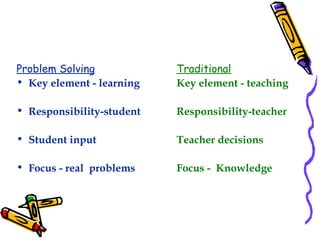
Problem Solving Traditional Key element - learning Key element - teaching Responsibility-student Responsibility-teacher Student input Teacher decisions Focus - real  problems Focus -  Knowledge
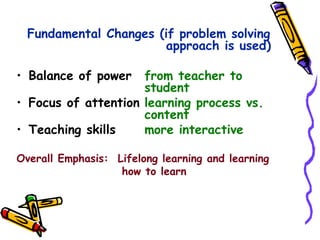
Fundamental Changes (if problem solving    approach is used) Balance of power from teacher to  student Focus of attention learning process vs.  content Teaching skills more interactive Overall Emphasis:  Lifelong learning and learning    how to learn
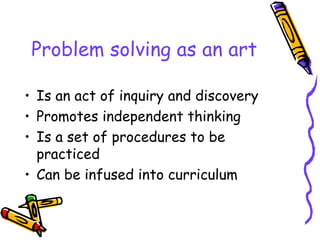
Problem solving as an art Is an act of inquiry and discovery Promotes independent thinking Is a set of procedures to be practiced Can be infused into curriculum
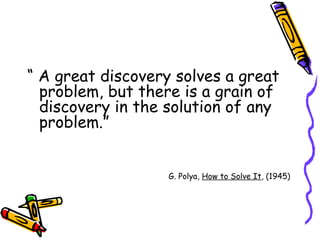
“  A great discovery solves a great problem, but there is a grain of discovery in the solution of any problem.” G. Polya,  How to Solve It , (1945)
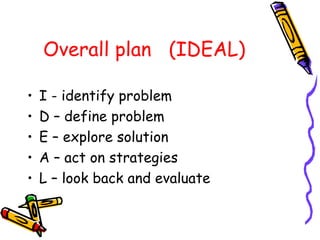
Overall plan  (IDEAL) I - identify problem D – define problem E – explore solution A – act on strategies L – look back and evaluate
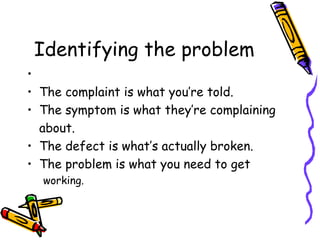
Identifying the problem The complaint is what you’re told. The symptom is what they’re complaining about. The defect is what’s actually broken. The problem is what you need to get working.
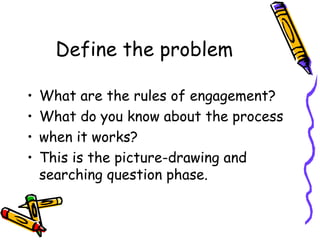
Define the problem What are the rules of engagement? What do you know about the process when it works? This is the picture-drawing and searching question phase.
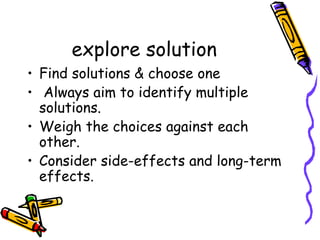
explore solution Find solutions & choose one Always aim to identify multiple solutions. Weigh the choices against each other. Consider side-effects and long-term effects.
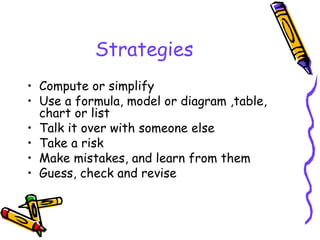
Strategies Compute or simplify Use a formula, model or diagram ,table, chart or list Talk it over with someone else Take a risk Make mistakes, and learn from them Guess, check and revise
Problem Solving as context Practice for reinforcement of skills and concepts Addresses important concepts Connects to students’ previous learning Is meaningful and relevant Accommodates diverse learning styles
A problem is . . . Something difficult to deal with or understand An exercise in a textbook or examination Oxford English Dictionary
Problem-solving environment   Ideas have potential to contribute to learning and should be respected Students have autonomy with respect to methods of solving problems Mistakes afford opportunities for examination and learning
Problem-solving as a Vacation Good planning is necessary. The journey is more important than the destination. You will make side trips and have delays or detours. It is an experience that enriches the routine.

Problem solving

  • 1.
  • 2.
  • 3.
  • 4.
    When we learnbest By solving problem By discovering answer By contributing to answer By defending answer
  • 5.
  • 6.
    Problem based learningis an instructional method that challenges students to "learn to learn," working cooperatively in groups to seek solutions to real world problems.
  • 7.
    Patterns of classroominteractions that consistently produce desirable student outcomes in the form of higher test scores, increased problem solving skills, improved attitude toward subject, etc….” Borich. (1988). Effective Teaching Effective Teaching
  • 8.
    Why do Ithink it’s important to teach problem solving Being able to solve problems improves students lives. Working with dummies is not fun. Students who cannot problem solve will behave like dummies.
  • 9.
    OBJECTIVES Orient studentstoward meaning-making over fact-collecting Promote independent thinking Develop group work & social skills Cultivate knowledge-forming skills Motivate and involve students
  • 10.
    Problem Solving TraditionalKey element - learning Key element - teaching Responsibility-student Responsibility-teacher Student input Teacher decisions Focus - real problems Focus - Knowledge
  • 11.
    Fundamental Changes (ifproblem solving approach is used) Balance of power from teacher to student Focus of attention learning process vs. content Teaching skills more interactive Overall Emphasis: Lifelong learning and learning how to learn
  • 12.
    Problem solving asan art Is an act of inquiry and discovery Promotes independent thinking Is a set of procedures to be practiced Can be infused into curriculum
  • 13.
    “ Agreat discovery solves a great problem, but there is a grain of discovery in the solution of any problem.” G. Polya, How to Solve It , (1945)
  • 14.
    Overall plan (IDEAL) I - identify problem D – define problem E – explore solution A – act on strategies L – look back and evaluate
  • 15.
    Identifying the problemThe complaint is what you’re told. The symptom is what they’re complaining about. The defect is what’s actually broken. The problem is what you need to get working.
  • 16.
    Define the problemWhat are the rules of engagement? What do you know about the process when it works? This is the picture-drawing and searching question phase.
  • 17.
    explore solution Findsolutions & choose one Always aim to identify multiple solutions. Weigh the choices against each other. Consider side-effects and long-term effects.
  • 18.
    Strategies Compute orsimplify Use a formula, model or diagram ,table, chart or list Talk it over with someone else Take a risk Make mistakes, and learn from them Guess, check and revise
  • 19.
    Problem Solving ascontext Practice for reinforcement of skills and concepts Addresses important concepts Connects to students’ previous learning Is meaningful and relevant Accommodates diverse learning styles
  • 20.
    A problem is. . . Something difficult to deal with or understand An exercise in a textbook or examination Oxford English Dictionary
  • 21.
    Problem-solving environment Ideas have potential to contribute to learning and should be respected Students have autonomy with respect to methods of solving problems Mistakes afford opportunities for examination and learning
  • 22.
    Problem-solving as aVacation Good planning is necessary. The journey is more important than the destination. You will make side trips and have delays or detours. It is an experience that enriches the routine.