1
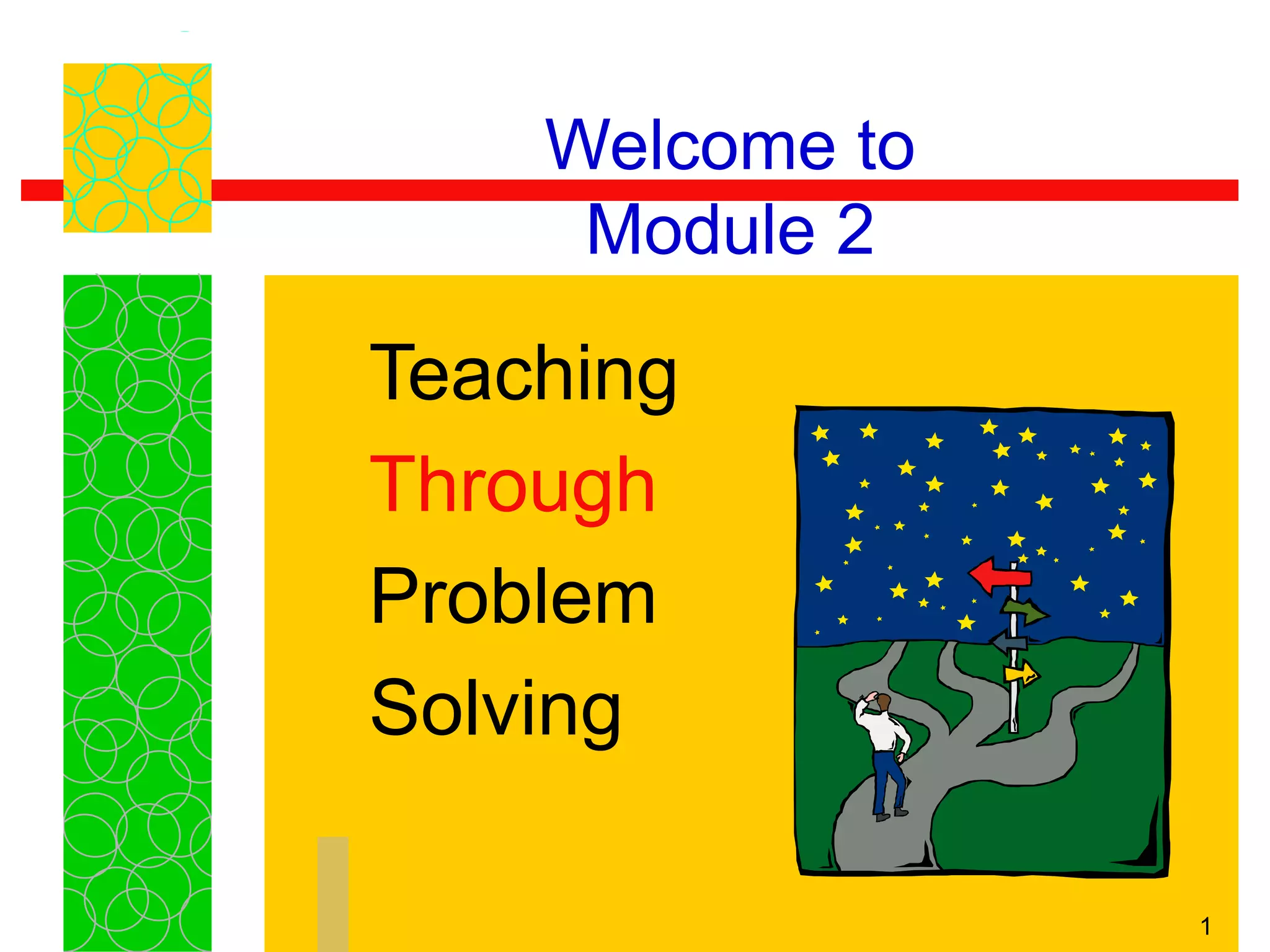
Welcome to
Module 2
Teaching
Through
Problem
Solving
2
Getting Started
Module 2 focuses on the importance of
problem solving, and on teaching through
problem solving. Module 3 will explore
teaching about problem solving.
Problem solving is a goal of learning
mathematics and also a means of doing so.
Problem solving allows students to explore,
develop, and apply their understanding of
mathematical concepts.
What do you think?
3
Key Messages
The primary goal of
problem solving is
making sense of
mathematics.
4
Key Messages
Teachers have a responsibility
to promote the experience of
problem-solving strategies in
their classrooms, and to foster
in their students a positive
attitude towards problem
solving.
5
Key Messages
Problem solving is not only a
goal of learning mathematics but
also a major means of doing so.
Problem solving should be the
mainstay of mathematical
teaching.
6
Key Messages
The problem-solving processes that
Kindergarten students will use look very
different from those that Grade 3 students
use. Initially, students will rely on intuition.
With exposure, experience, and shared
learning they will formalize an effective
approach to solving problems by
developing a repertoire of problem-solving
strategies that they can use flexibly when
faced with new problem-solving situations.
7
Key Messages
Problems serve two main purposes:
to explore, develop, and apply
conceptual understanding of a
mathematical concept (teaching
through problem solving); and
to guide students through the
development of inquiry or problem-
solving processes and strategies
(teaching about problem solving).
8
Key Messages
The teacher’s role as
facilitator is crucial in
the provision of an
effective problem-
solving experience.
9
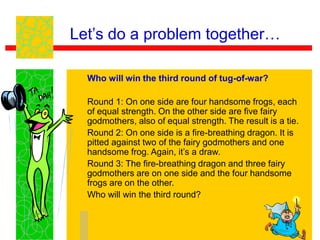
Let’s do a problem together…
Who will win the third round of tug-of-war?
Round 1: On one side are four handsome frogs, each
of equal strength. On the other side are five fairy
godmothers, also of equal strength. The result is a tie.
Round 2: On one side is a fire-breathing dragon. It is
pitted against two of the fairy godmothers and one
handsome frog. Again, it’s a draw.
Round 3: The fire-breathing dragon and three fairy
godmothers are on one side and the four handsome
frogs are on the other.
Who will win the third round?
10
Working on It
How did you feel?
Complete BLM 2.1,
then share your thoughts
with a partner.
11
Think-Pair-Share
Think-Pair-Share is a cooperative
learning strategy in which
participants think about a question
(issue, situation, idea, etc.), then
share their thoughts with a partner.
It is a simple strategy that can be
easily incorporated into almost any
form of instruction.
12
The Importance of Problem Solving
Children naturally and intuitively
solve problems in their everyday
lives. They seek solutions to sharing
toys with friends and build elaborate
structures in their play. Teachers who
use problem solving as the focus of
their mathematics class help their
students to develop and expand
these intuitive strategies.
13
The Importance of Problem Solving
With exposure, experience, and
shared learning, children will
develop a repertoire of problem-
solving strategies that they can
use flexibly when faced with new
problem-solving situations.
14
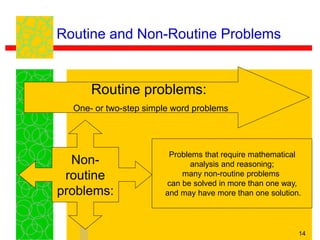
Routine and Non-Routine Problems
Routine problems:
One- or two-step simple word problems
Non-
routine
problems:
Problems that require mathematical
analysis and reasoning;
many non-routine problems
can be solved in more than one way,
and may have more than one solution.
15
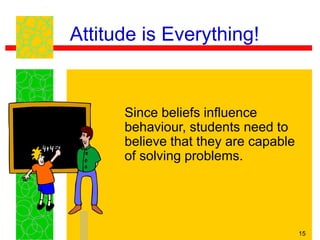
Attitude is Everything!
Since beliefs influence
behaviour, students need to
believe that they are capable
of solving problems.
16
When children become effective problem
solvers, they reap the benefits of:
 understanding and
practising skills in context;
 being able to make
hypotheses, experiment,
draw conclusions, and use
trial and error;
 using flexible
representations to help
them solve problems;
17
When children become effective problem
solvers, they reap the benefits of:
 wondering about and
questioning situations in
their world;
 persevering in tackling new
challenges;
 formulating and testing their
own explanations;
 communicating their
explanations and listening to
others’ explanations;
18
When children become effective problem
solvers, they reap the benefits of:
 participating in open-ended
experiences that have a
clear goal but a variety of
solution paths;
 developing strategies that
can be applied in new
situations;
 collaborating with others to
develop new strategies;
and…
19
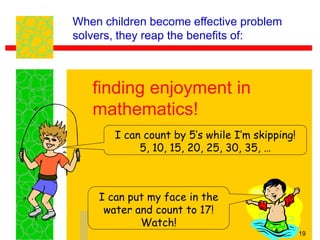
When children become effective problem
solvers, they reap the benefits of:
finding enjoyment in
mathematics!
I can count by 5’s while I’m skipping!
5, 10, 15, 20, 25, 30, 35, …
I can put my face in the
water and count to 17!
Watch!
20
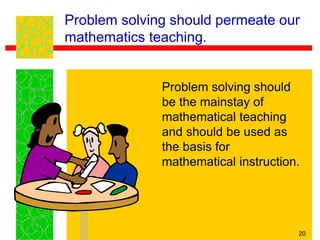
Problem solving should permeate our
mathematics teaching.
Problem solving should
be the mainstay of
mathematical teaching
and should be used as
the basis for
mathematical instruction.
21
Teaching Through Problem Solving
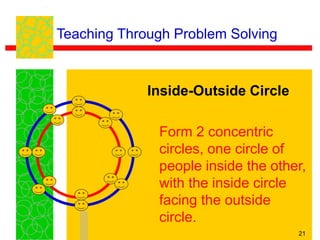
Inside-Outside Circle
Form 2 concentric
circles, one circle of
people inside the other,
with the inside circle
facing the outside
circle.
22
Teaching Through Problem Solving
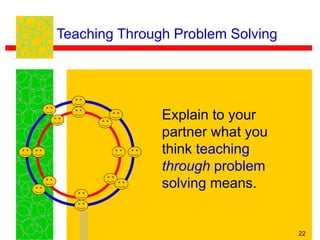
Explain to your
partner what you
think teaching
through problem
solving means.
23
Teaching Through Problem Solving
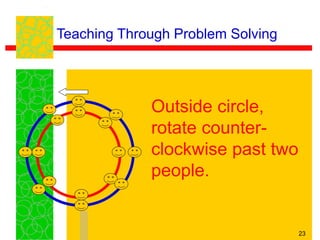
Outside circle,
rotate counter-
clockwise past two
people.
24
Teaching Through Problem Solving
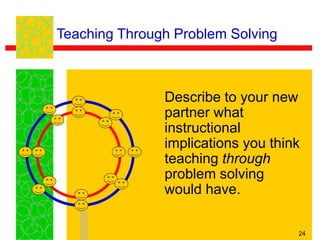
Describe to your new
partner what
instructional
implications you think
teaching through
problem solving
would have.
25
Teaching Through Problem Solving
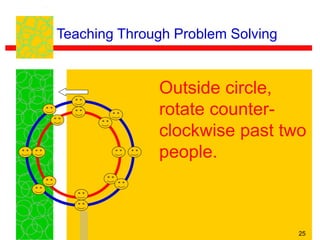
Outside circle,
rotate counter-
clockwise past two
people.
26
Teaching Through Problem Solving
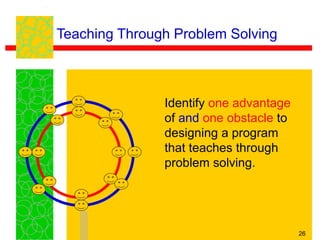
Identify one advantage
of and one obstacle to
designing a program
that teaches through
problem solving.
27
Teaching Through Problem Solving
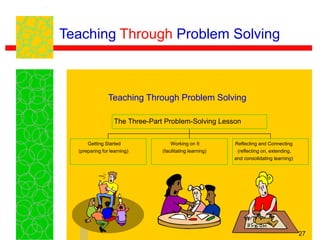
Getting Started
(preparing for learning)
Working on It
(facilitating learning)
Reflecting and Connecting
(reflecting on, extending,
and consolidating learning)
The Three-Part Problem-Solving Lesson
28
Getting Started(preparing for learning)
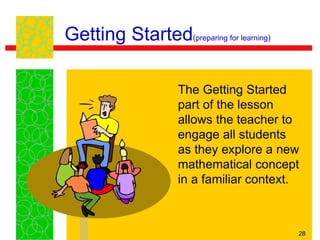
The Getting Started
part of the lesson
allows the teacher to
engage all students
as they explore a new
mathematical concept
in a familiar context.
29
Getting Started (preparing for learning)
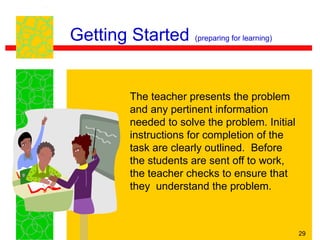
The teacher presents the problem
and any pertinent information
needed to solve the problem. Initial
instructions for completion of the
task are clearly outlined. Before
the students are sent off to work,
the teacher checks to ensure that
they understand the problem.
30
Working on It (facilitating learning)
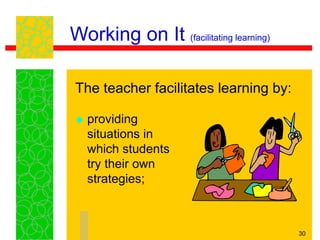
 providing
situations in
which students
try their own
strategies;
The teacher facilitates learning by:
31
Working on It (facilitating learning)
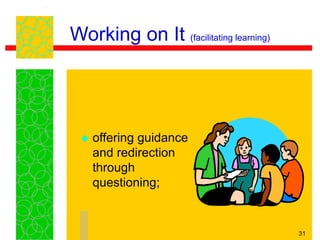
 offering guidance
and redirection
through
questioning;
32
Working on It (facilitating learning)
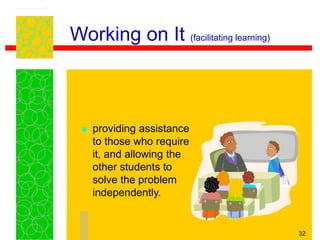
 providing assistance
to those who require
it, and allowing the
other students to
solve the problem
independently.
33
Reflecting and Connecting
(reflecting on, extending, and consolidating learning)
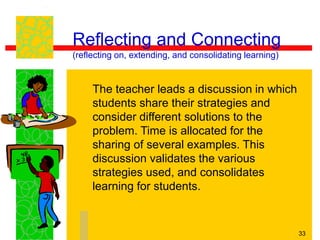
The teacher leads a discussion in which
students share their strategies and
consider different solutions to the
problem. Time is allocated for the
sharing of several examples. This
discussion validates the various
strategies used, and consolidates
learning for students.
34
Reflecting and Connecting
(reflecting on, extending, and consolidating learning)
The discussion, questioning, and
sharing that occurs allows students
to make connections with their own
thinking and to internalize a deeper
understanding of mathematical
concepts.
35
Problem-Solving Vignette
Read the vignette on pp. 5.9- 5.15
of the guide.
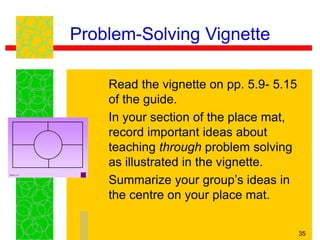
In your section of the place mat,
record important ideas about
teaching through problem solving
as illustrated in the vignette.
Summarize your group’s ideas in
the centre on your place mat.
Session 1a.34
36
The Teacher’s Role
A Jigsaw Activity
1. Providing appropriate and
challenging problems (pp.5.16–
5.19)
2. Supporting and extending learning
(pp. 5.19–5.20)
3. Encouraging and accepting students’
strategies (p. 5.21)
4. Questioning and prompting students
(pp. 5.21–5.23)
5. Using think-alouds (p. 5.23)
37
Reflecting and Connecting
Suppose…
A new teacher has recently read
the Guide to Effective Instruction
in Mathematics, Kindergarten to
Grade 3, 2004, and is eager to
begin to teach using a problem-
solving approach.
38
Reflecting and Connecting
The teacher teaches a problem-solving
lesson and comes back to discuss it with
you. She is upset and disappointed that
the lesson did not work and feels that the
more traditional approach to teaching
mathematics would be a better idea.
How would you respond?
39
In Your Classroom…
Find a closed problem from a
textbook and revise it to make it
into a richer, more open-ended
problem.
Try the problem with your class.
(Use pp. 5.16–5.19 for advice on
modifying problems.)

Module 2 Slides.ppt

  • 1.
  • 2.
    2 Getting Started Module 2focuses on the importance of problem solving, and on teaching through problem solving. Module 3 will explore teaching about problem solving. Problem solving is a goal of learning mathematics and also a means of doing so. Problem solving allows students to explore, develop, and apply their understanding of mathematical concepts. What do you think?
  • 3.
    3 Key Messages The primarygoal of problem solving is making sense of mathematics.
  • 4.
    4 Key Messages Teachers havea responsibility to promote the experience of problem-solving strategies in their classrooms, and to foster in their students a positive attitude towards problem solving.
  • 5.
    5 Key Messages Problem solvingis not only a goal of learning mathematics but also a major means of doing so. Problem solving should be the mainstay of mathematical teaching.
  • 6.
    6 Key Messages The problem-solvingprocesses that Kindergarten students will use look very different from those that Grade 3 students use. Initially, students will rely on intuition. With exposure, experience, and shared learning they will formalize an effective approach to solving problems by developing a repertoire of problem-solving strategies that they can use flexibly when faced with new problem-solving situations.
  • 7.
    7 Key Messages Problems servetwo main purposes: to explore, develop, and apply conceptual understanding of a mathematical concept (teaching through problem solving); and to guide students through the development of inquiry or problem- solving processes and strategies (teaching about problem solving).
  • 8.
    8 Key Messages The teacher’srole as facilitator is crucial in the provision of an effective problem- solving experience.
  • 9.
    9 Let’s do aproblem together… Who will win the third round of tug-of-war? Round 1: On one side are four handsome frogs, each of equal strength. On the other side are five fairy godmothers, also of equal strength. The result is a tie. Round 2: On one side is a fire-breathing dragon. It is pitted against two of the fairy godmothers and one handsome frog. Again, it’s a draw. Round 3: The fire-breathing dragon and three fairy godmothers are on one side and the four handsome frogs are on the other. Who will win the third round?
  • 10.
    10 Working on It Howdid you feel? Complete BLM 2.1, then share your thoughts with a partner.
  • 11.
    11 Think-Pair-Share Think-Pair-Share is acooperative learning strategy in which participants think about a question (issue, situation, idea, etc.), then share their thoughts with a partner. It is a simple strategy that can be easily incorporated into almost any form of instruction.
  • 12.
    12 The Importance ofProblem Solving Children naturally and intuitively solve problems in their everyday lives. They seek solutions to sharing toys with friends and build elaborate structures in their play. Teachers who use problem solving as the focus of their mathematics class help their students to develop and expand these intuitive strategies.
  • 13.
    13 The Importance ofProblem Solving With exposure, experience, and shared learning, children will develop a repertoire of problem- solving strategies that they can use flexibly when faced with new problem-solving situations.
  • 14.
    14 Routine and Non-RoutineProblems Routine problems: One- or two-step simple word problems Non- routine problems: Problems that require mathematical analysis and reasoning; many non-routine problems can be solved in more than one way, and may have more than one solution.
  • 15.
    15 Attitude is Everything! Sincebeliefs influence behaviour, students need to believe that they are capable of solving problems.
  • 16.
    16 When children becomeeffective problem solvers, they reap the benefits of:  understanding and practising skills in context;  being able to make hypotheses, experiment, draw conclusions, and use trial and error;  using flexible representations to help them solve problems;
  • 17.
    17 When children becomeeffective problem solvers, they reap the benefits of:  wondering about and questioning situations in their world;  persevering in tackling new challenges;  formulating and testing their own explanations;  communicating their explanations and listening to others’ explanations;
  • 18.
    18 When children becomeeffective problem solvers, they reap the benefits of:  participating in open-ended experiences that have a clear goal but a variety of solution paths;  developing strategies that can be applied in new situations;  collaborating with others to develop new strategies; and…
  • 19.
    19 When children becomeeffective problem solvers, they reap the benefits of: finding enjoyment in mathematics! I can count by 5’s while I’m skipping! 5, 10, 15, 20, 25, 30, 35, … I can put my face in the water and count to 17! Watch!
  • 20.
    20 Problem solving shouldpermeate our mathematics teaching. Problem solving should be the mainstay of mathematical teaching and should be used as the basis for mathematical instruction.
  • 21.
    21 Teaching Through ProblemSolving Inside-Outside Circle Form 2 concentric circles, one circle of people inside the other, with the inside circle facing the outside circle.
  • 22.
    22 Teaching Through ProblemSolving Explain to your partner what you think teaching through problem solving means.
  • 23.
    23 Teaching Through ProblemSolving Outside circle, rotate counter- clockwise past two people.
  • 24.
    24 Teaching Through ProblemSolving Describe to your new partner what instructional implications you think teaching through problem solving would have.
  • 25.
    25 Teaching Through ProblemSolving Outside circle, rotate counter- clockwise past two people.
  • 26.
    26 Teaching Through ProblemSolving Identify one advantage of and one obstacle to designing a program that teaches through problem solving.
  • 27.
    27 Teaching Through ProblemSolving Teaching Through Problem Solving Getting Started (preparing for learning) Working on It (facilitating learning) Reflecting and Connecting (reflecting on, extending, and consolidating learning) The Three-Part Problem-Solving Lesson
  • 28.
    28 Getting Started(preparing forlearning) The Getting Started part of the lesson allows the teacher to engage all students as they explore a new mathematical concept in a familiar context.
  • 29.
    29 Getting Started (preparingfor learning) The teacher presents the problem and any pertinent information needed to solve the problem. Initial instructions for completion of the task are clearly outlined. Before the students are sent off to work, the teacher checks to ensure that they understand the problem.
  • 30.
    30 Working on It(facilitating learning)  providing situations in which students try their own strategies; The teacher facilitates learning by:
  • 31.
    31 Working on It(facilitating learning)  offering guidance and redirection through questioning;
  • 32.
    32 Working on It(facilitating learning)  providing assistance to those who require it, and allowing the other students to solve the problem independently.
  • 33.
    33 Reflecting and Connecting (reflectingon, extending, and consolidating learning) The teacher leads a discussion in which students share their strategies and consider different solutions to the problem. Time is allocated for the sharing of several examples. This discussion validates the various strategies used, and consolidates learning for students.
  • 34.
    34 Reflecting and Connecting (reflectingon, extending, and consolidating learning) The discussion, questioning, and sharing that occurs allows students to make connections with their own thinking and to internalize a deeper understanding of mathematical concepts.
  • 35.
    35 Problem-Solving Vignette Read thevignette on pp. 5.9- 5.15 of the guide. In your section of the place mat, record important ideas about teaching through problem solving as illustrated in the vignette. Summarize your group’s ideas in the centre on your place mat. Session 1a.34
  • 36.
    36 The Teacher’s Role AJigsaw Activity 1. Providing appropriate and challenging problems (pp.5.16– 5.19) 2. Supporting and extending learning (pp. 5.19–5.20) 3. Encouraging and accepting students’ strategies (p. 5.21) 4. Questioning and prompting students (pp. 5.21–5.23) 5. Using think-alouds (p. 5.23)
  • 37.
    37 Reflecting and Connecting Suppose… Anew teacher has recently read the Guide to Effective Instruction in Mathematics, Kindergarten to Grade 3, 2004, and is eager to begin to teach using a problem- solving approach.
  • 38.
    38 Reflecting and Connecting Theteacher teaches a problem-solving lesson and comes back to discuss it with you. She is upset and disappointed that the lesson did not work and feels that the more traditional approach to teaching mathematics would be a better idea. How would you respond?
  • 39.
    39 In Your Classroom… Finda closed problem from a textbook and revise it to make it into a richer, more open-ended problem. Try the problem with your class. (Use pp. 5.16–5.19 for advice on modifying problems.)