Teaching Through Problem Solving  Numeracy  Barbara A. Guillory, M.A.Ed. National Board Certified Teacher
Three P’s  Purpose:  To provide a comprehensive framework for teaching mathematics through problem solving.  Process:  Discussions, reflections and small group interactions  Payoff:  Engage students thinking about and developing problems of a reflective nature
Important mathematics concepts and procedures can best be taught through problem solving, that is, tasks or problems can and should be posed that engage students in thinking about and developing the important mathematics they need to learn.   Van de Walle (2001, p.40)
Why Teach Problem Solving? Problem Solving… Focuses attention on ideas and sense making. Develops “mathematical power”. Helps students develop confidence in doing mathematics  Generates assessment data to make instructional decisions.  Is a lot of  FUN!!!
What is a Problem?  A problem is any task or activity where the students have no prescribed or memorized methods or rules for accomplishing the results.
Features of  a problem for Learning Mathematics  It must begin where the students are  It must clearly focus on the mathematics students are to learn It must require explanations for answers and methods
Problem Solving Group Dynamics Individual students  Paris  Groups  Activities  Hands-on materials  Drawings  Paper and pencil  Mental math  Calculators
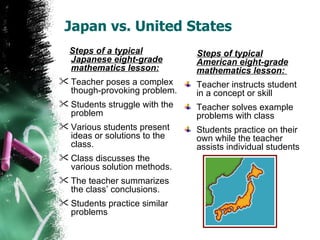
Japan vs. United States  Steps of a typical Japanese eight-grade mathematics lesson: Teacher poses a complex though-provoking problem.  Students struggle with the problem  Various students present ideas or solutions to the class.  Class discusses the various solution methods. The teacher summarizes the class’ conclusions.  Students practice similar problems  Steps of typical American eight-grade mathematics lesson:  Teacher instructs student in a concept or skill  Teacher solves example problems with class Students practice on their own while the teacher assists individual students
2 X 2 List  two  misconceptions of the teacher’s role in problem solving.  List  one  responsibility of the teacher in creating a problem solving environment.
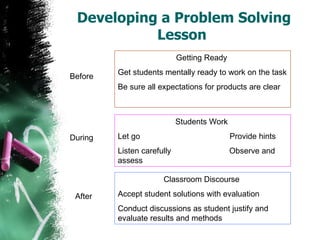
Developing a Problem Solving Lesson  Before  During  After  Getting Ready  Get students mentally ready to work on the task  Be sure all expectations for products are clear Students Work  Let go  Provide hints  Listen carefully  Observe and assess Classroom Discourse  Accept student solutions with evaluation Conduct discussions as student justify and evaluate results and methods
Locating Problem Solving Tasks Your Textbook Using Traditional Textbooks Using Reform Programs  Children’s Literature  Other Resources
Teaching Tips and Questions Four Suggestions:  Predict! Don’t hope.  Be clear in your own mind about the purpose of the task or activity.  Recognize that there is much more to a problem than the answer.  Do not confuse open-ended problem solving with encouraging creativity.
Problem Solving Steps  Understand the problem  Devise a plan  Carry out the plan  Reflecting back on the process and outcome
Understanding the Problem  Can you state the problem in your own words?  What are you trying to find or do?  What are the unknowns?  What information can you obtain from the problem?  What information is not needed or is missing?
Devising a Plan  Look for a plan  Look at a similar problem to determine if the same strategies can be used. Make a table  Make a diagram  Use guess and check  Work backward
Carrying out the Plan  Implement the strategies selected when devising a plan Check each step of your plan Write all necessary steps to your plan (keeping records)
Reflecting (Looking back)  Check the results in the original problem  Look for another method for solving the problem.  Ask does your answer make sense, is it reasonable?
Building Attitudinal Goals  Build in success Praise efforts and risk taking  Listen to all students  Provide special successes
“ When problem solving is interwoven with learning, students are learning mathematics by doing mathematics!”

Teaching Through Problem Solving[1]

  • 1.
    Teaching Through ProblemSolving Numeracy Barbara A. Guillory, M.A.Ed. National Board Certified Teacher
  • 2.
    Three P’s Purpose: To provide a comprehensive framework for teaching mathematics through problem solving. Process: Discussions, reflections and small group interactions Payoff: Engage students thinking about and developing problems of a reflective nature
  • 3.
    Important mathematics conceptsand procedures can best be taught through problem solving, that is, tasks or problems can and should be posed that engage students in thinking about and developing the important mathematics they need to learn. Van de Walle (2001, p.40)
  • 4.
    Why Teach ProblemSolving? Problem Solving… Focuses attention on ideas and sense making. Develops “mathematical power”. Helps students develop confidence in doing mathematics Generates assessment data to make instructional decisions. Is a lot of FUN!!!
  • 5.
    What is aProblem? A problem is any task or activity where the students have no prescribed or memorized methods or rules for accomplishing the results.
  • 6.
    Features of a problem for Learning Mathematics It must begin where the students are It must clearly focus on the mathematics students are to learn It must require explanations for answers and methods
  • 7.
    Problem Solving GroupDynamics Individual students Paris Groups Activities Hands-on materials Drawings Paper and pencil Mental math Calculators
  • 8.
    Japan vs. UnitedStates Steps of a typical Japanese eight-grade mathematics lesson: Teacher poses a complex though-provoking problem. Students struggle with the problem Various students present ideas or solutions to the class. Class discusses the various solution methods. The teacher summarizes the class’ conclusions. Students practice similar problems Steps of typical American eight-grade mathematics lesson: Teacher instructs student in a concept or skill Teacher solves example problems with class Students practice on their own while the teacher assists individual students
  • 9.
    2 X 2List two misconceptions of the teacher’s role in problem solving. List one responsibility of the teacher in creating a problem solving environment.
  • 10.
    Developing a ProblemSolving Lesson Before During After Getting Ready Get students mentally ready to work on the task Be sure all expectations for products are clear Students Work Let go Provide hints Listen carefully Observe and assess Classroom Discourse Accept student solutions with evaluation Conduct discussions as student justify and evaluate results and methods
  • 11.
    Locating Problem SolvingTasks Your Textbook Using Traditional Textbooks Using Reform Programs Children’s Literature Other Resources
  • 12.
    Teaching Tips andQuestions Four Suggestions: Predict! Don’t hope. Be clear in your own mind about the purpose of the task or activity. Recognize that there is much more to a problem than the answer. Do not confuse open-ended problem solving with encouraging creativity.
  • 13.
    Problem Solving Steps Understand the problem Devise a plan Carry out the plan Reflecting back on the process and outcome
  • 14.
    Understanding the Problem Can you state the problem in your own words? What are you trying to find or do? What are the unknowns? What information can you obtain from the problem? What information is not needed or is missing?
  • 15.
    Devising a Plan Look for a plan Look at a similar problem to determine if the same strategies can be used. Make a table Make a diagram Use guess and check Work backward
  • 16.
    Carrying out thePlan Implement the strategies selected when devising a plan Check each step of your plan Write all necessary steps to your plan (keeping records)
  • 17.
    Reflecting (Looking back) Check the results in the original problem Look for another method for solving the problem. Ask does your answer make sense, is it reasonable?
  • 18.
    Building Attitudinal Goals Build in success Praise efforts and risk taking Listen to all students Provide special successes
  • 19.
    “ When problemsolving is interwoven with learning, students are learning mathematics by doing mathematics!”