Problem-Based and ProjectBased Learning
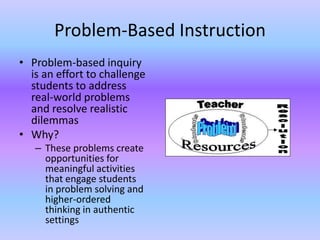
Problem-Based Instruction
• Problem-based inquiry
is an effort to challenge
students to address
real-world problems
and resolve realistic
dilemmas
• Why?
– These problems create
opportunities for
meaningful activities
that engage students
in problem solving and
higher-ordered
thinking in authentic
settings
Main Values of Problem-Based Inquiry
• Emphasizes learning as a process that involves
problem solving and critical thinking in situated
context
• It provides opportunities to address broader
learning goals that focus on preparing students
for active and responsible citizenship
• Framework: Situated cognition, constructivism,
social learning, and communities of practice are
assumed theories of learning and cognition in
problem-based inquiry enviornments
Ins and Outs of Problem-Based
Learning
CHARACTERISTICS IDENTIFIED TO DESIGN CURRICULUM
• Problems help in development of the skills themselves.
• The problems are truly ill-structured - as new
information is gathered in a reiterative process,
perception of the problem, and thus the solution,
changes
– No one answer is correct

• Students solve the problems! Why? Teachers are
facilitators!
• Students are only given guidelines for how to approach
problems so that they can go about solving in any way
they choose
• Authentic, performance-based assessment - is a
seamless part and end of the instruction.
Inquiry and Problem Based Learning
Video to inspire teachers!
http://www.youtube.com/watch?v=3MRo4c_Q7
Fs
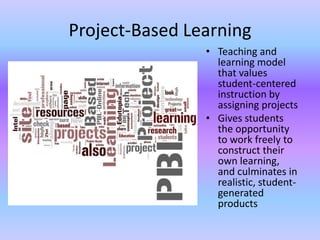
Project-Based Learning
• Teaching and
learning model
that values
student-centered
instruction by
assigning projects
• Gives students
the opportunity
to work freely to
construct their
own learning,
and culminates in
realistic, studentgenerated
products
Main Components
• Key to curriculum
• Long-term (more than a couple of class days and up to
semester)
• Interdisciplinary
• Include a driving question that is challenging and
constructive, are student-centered and are based on
collaborative or cooperative group learning
• Integrated with real world issues and practices with
productive outcomes
• Have an impact on “life skills” like self-management,
group process, and problem-solving skills,
• Use cognitive tools, mostly technology-based
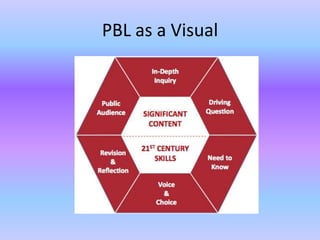
PBL as a Visual
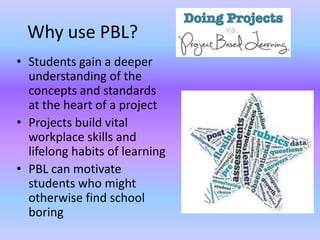
Why use PBL?
• Students gain a deeper
understanding of the
concepts and standards
at the heart of a project
• Projects build vital
workplace skills and
lifelong habits of learning
• PBL can motivate
students who might
otherwise find school
boring

Problem based and project-based learning

  • 1.
  • 2.
    Problem-Based Instruction • Problem-basedinquiry is an effort to challenge students to address real-world problems and resolve realistic dilemmas • Why? – These problems create opportunities for meaningful activities that engage students in problem solving and higher-ordered thinking in authentic settings
  • 3.
    Main Values ofProblem-Based Inquiry • Emphasizes learning as a process that involves problem solving and critical thinking in situated context • It provides opportunities to address broader learning goals that focus on preparing students for active and responsible citizenship • Framework: Situated cognition, constructivism, social learning, and communities of practice are assumed theories of learning and cognition in problem-based inquiry enviornments
  • 5.
    Ins and Outsof Problem-Based Learning CHARACTERISTICS IDENTIFIED TO DESIGN CURRICULUM • Problems help in development of the skills themselves. • The problems are truly ill-structured - as new information is gathered in a reiterative process, perception of the problem, and thus the solution, changes – No one answer is correct • Students solve the problems! Why? Teachers are facilitators! • Students are only given guidelines for how to approach problems so that they can go about solving in any way they choose • Authentic, performance-based assessment - is a seamless part and end of the instruction.
  • 6.
    Inquiry and ProblemBased Learning Video to inspire teachers! http://www.youtube.com/watch?v=3MRo4c_Q7 Fs
  • 7.
    Project-Based Learning • Teachingand learning model that values student-centered instruction by assigning projects • Gives students the opportunity to work freely to construct their own learning, and culminates in realistic, studentgenerated products
  • 8.
    Main Components • Keyto curriculum • Long-term (more than a couple of class days and up to semester) • Interdisciplinary • Include a driving question that is challenging and constructive, are student-centered and are based on collaborative or cooperative group learning • Integrated with real world issues and practices with productive outcomes • Have an impact on “life skills” like self-management, group process, and problem-solving skills, • Use cognitive tools, mostly technology-based
  • 9.
    PBL as aVisual
  • 10.
    Why use PBL? •Students gain a deeper understanding of the concepts and standards at the heart of a project • Projects build vital workplace skills and lifelong habits of learning • PBL can motivate students who might otherwise find school boring