
Problem-Based Learning
and
Project-Based Learning
PRINCIPLES OF TEACHING 2
CHAPTER 4
CHAPTER 4
PRINCIPLES OF TEACHING 2
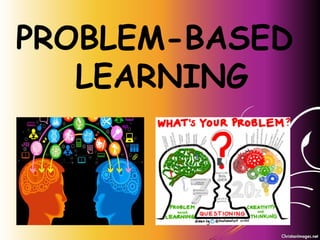
PROBLEM-BASED LEARNING
and
PROJECT-BASED LEARNING
Prepared by:
JOY JHOVALYN SABIO EMBAY
BSED - TLE - 3W5
Problem-Based Learning
and
Project-Based Learning
PRINCIPLES OF TEACHING 2
CHAPTER 4
Learning Objectives
 Describe how problem-based learning and project-
based learning are used as teaching-learning
method
 Formulate at least one sample problem and one
sample project for problem-based and project-based
learning, respectively, based on the K to 12
Curriculum Guide
 Research and critique on an implemented problem-
based learning and project-based learning using
elements of problem-based and project-based
learning
Problem-Based Learning
and
Project-Based Learning
PRINCIPLES OF TEACHING 2
CHAPTER 4
Topics
Problem-Based Learning
Examples of Problems for Use in Basic Education
Project-Based Learning (PrBL/PjBL)
Problems in Project-Based Learning or Collaborative
Project-Based Learning (PrBL/PjBL/C-PBL)
Some Reminders for PrBL/PjBL/C-PBL to work
Comparison of Problem-Based and Project-Based
Learning
PrBL/PjBL: At the Service of the K to 12 Curriculum
Assessment in PBL and PrBL and in K to 12
Problem-Based Learning
and
Project-Based Learning
PRINCIPLES OF TEACHING 2
CHAPTER 4
PROBLEM-BASED
LEARNING
Problem-Based Learning
and
Project-Based Learning
PRINCIPLES OF TEACHING 2
CHAPTER 4
Problem-Based Learning
 Uses an inquiry model or a problem-
solving model.
 Is a student-centered pedagogy in which
students learn about a subject through the
experience of solving an open-ended
problem. Students learn both thinking
strategies and domain knowledge.
Problem-Based Learning
and
Project-Based Learning
PRINCIPLES OF TEACHING 2
CHAPTER 4
STEPS IN PROBLEM-BASED
LEARNING
Problem-Based Learning
and
Project-Based Learning
PRINCIPLES OF TEACHING 2
CHAPTER 4
FEATURES
Problem-Based Learning
and
Project-Based Learning
PRINCIPLES OF TEACHING 2
CHAPTER 4
Some Reminders
for PBL to Work
Problem-Based Learning
and
Project-Based Learning
PRINCIPLES OF TEACHING 2
CHAPTER 4
1.
 The problem must be designed in such a
way that different appropriate
solutions/answers may apply. They are not
intended to generate neat answers.
 In their struggle to find the answer, the
students will gain essential problem solving
and critical thinking skills.
Problem-Based Learning
and
Project-Based Learning
PRINCIPLES OF TEACHING 2
CHAPTER 42.
 The problem must be a real world scenario.
One way would be by constructing a problem
statement, which contains the following:
a. It casts the student in a particular role.
b. It contains a problem.
c. It gives the students a task.
Problem-Based Learning
and
Project-Based Learning
PRINCIPLES OF TEACHING 2
CHAPTER 4
3.
 The problem must be relevant to the
students and must be developmentally
appropriate.
4.
 Guidelines must be set on how the
team/group will work together, expected
dates of completion and group presentation
before the class, procedures in group
presentation.
Problem-Based Learning
and
Project-Based Learning
PRINCIPLES OF TEACHING 2
CHAPTER 4
5.
 Teacher gives guidance but does not give
answers to the problem/s.
6.
 Students must be given reasonable amount of
time to do the work.
Problem-Based Learning
and
Project-Based Learning
PRINCIPLES OF TEACHING 2
CHAPTER 47.
 Teacher makes clear how performance
will be assessed. It is best that the Scoring
Rubric gets presented before work begins.
Problem-Based Learning
and
Project-Based Learning
PRINCIPLES OF TEACHING 2
CHAPTER 4
GRASPS
It is an acronym that guides teachers in the
formulation of an authentic performance task like
problem solving.
GOAL
ROLE
AUDIENCE
SITUATION
PRODUCT or PERFORMANCE
STANDARDS FOR SUCCESS
Problem-Based Learning
and
Project-Based Learning
PRINCIPLES OF TEACHING 2
CHAPTER 4
Examples of Problems for Use in
Basic Education
HEALTH CLASS
BIOLOGY CLASS
TECHNOLOGY and LIVELIHOOD
EDUCATION CLASS (HOME
ECONOMICS)
SCIENCE CLASS
Problem-Based Learning
and
Project-Based Learning
PRINCIPLES OF TEACHING 2
CHAPTER 4

PT WITH BACKGROUND