Sampling II
Presented to:
Sir Noman
Presented by;
Roll no 5; Mubeen Ahmed
Roll no 13; Rakhshanda kousar
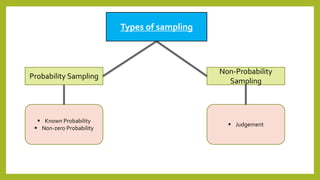
Types of sampling
Probability Sampling
Non-Probability
Sampling
 Known Probability
 Non-zero Probability
 Judgement
Probability proportional to size:
 The size measure is the value of an axillary variable (x) which is
closely associated with the study variable(y) this is called probability
proportional to size.
 PPS sampling assigns a probability to each unit in the population
based on its size and importance.
 For example, In an agricultural survey, the yield depends upon the
total area cultivated. Hence bigger areas have larger production so the
value of the area is the size of the axillary variable.
When to use PPS sampling?
 When the population is large and varies according to size and
importance.
 When to study rare events.
 Limited resources.
 Heteros groups according to size.
 When stratified random sampling and simple random sampling
are not effective and distinct according to size and importance.
Objective:
 Proportional representation.
 Efficiency.
 Simplicity.
 PPS sampling enables researchers to obtain accurate and
reliable information about the population of interest.
Efficient allocation of resources.
Improved Precision.
Flexibility in sample size.
Inclusion of rare groups.
Overall PPS advantages in terms of
efficient allocation of resources,
flexibility in sample size, improve
Precision, etc.
Additional complexity.
Dependency variable.
Limited flexibility in sampling design.
complexity in analysis.
Sensitive to outliers.
Need high cost
Advantages: Dis-Advantages:
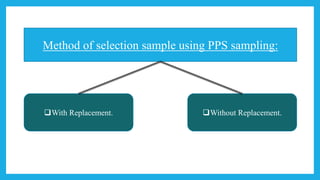
Method of selection sample using PPS sampling:
With Replacement. Without Replacement.
Selection of sample using with replacement:
 In with-replacement, the probability of selection will not
change and there is no re-distribution of the probability
after a draw.
 For the selection of sample by using PPS sampling with
replacement case there are generally two methods:
1. Cumulative total method
2. Lahiri 's method
Lehiri's method:
 Lahari in 1951 suggested an alternative procedure in which
cumulations are avoided completely.
 In this approach, a pair of random numbers say (I,j) is selected
such that (1 ≤ I ≤ N) and (1 ≤ j ≤ M) where m is the maximum
size of N units in the population. If (x ≥ j) or (j ≤ x) then ith pair
will be selected otherwise rejected and another pair of random
numbers is chosen.
This procedure is continued until n units are selected.
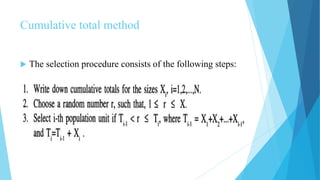
Cumulative total method
 The selection procedure consists of the following steps:
probability proportional to size.pptx.By Rc

probability proportional to size.pptx.By Rc

  • 2.
    Sampling II Presented to: SirNoman Presented by; Roll no 5; Mubeen Ahmed Roll no 13; Rakhshanda kousar
  • 3.
    Types of sampling ProbabilitySampling Non-Probability Sampling  Known Probability  Non-zero Probability  Judgement
  • 4.
    Probability proportional tosize:  The size measure is the value of an axillary variable (x) which is closely associated with the study variable(y) this is called probability proportional to size.  PPS sampling assigns a probability to each unit in the population based on its size and importance.  For example, In an agricultural survey, the yield depends upon the total area cultivated. Hence bigger areas have larger production so the value of the area is the size of the axillary variable.
  • 5.
    When to usePPS sampling?  When the population is large and varies according to size and importance.  When to study rare events.  Limited resources.  Heteros groups according to size.  When stratified random sampling and simple random sampling are not effective and distinct according to size and importance.
  • 6.
    Objective:  Proportional representation. Efficiency.  Simplicity.  PPS sampling enables researchers to obtain accurate and reliable information about the population of interest.
  • 7.
    Efficient allocation ofresources. Improved Precision. Flexibility in sample size. Inclusion of rare groups. Overall PPS advantages in terms of efficient allocation of resources, flexibility in sample size, improve Precision, etc. Additional complexity. Dependency variable. Limited flexibility in sampling design. complexity in analysis. Sensitive to outliers. Need high cost Advantages: Dis-Advantages:
  • 8.
    Method of selectionsample using PPS sampling: With Replacement. Without Replacement.
  • 9.
    Selection of sampleusing with replacement:  In with-replacement, the probability of selection will not change and there is no re-distribution of the probability after a draw.  For the selection of sample by using PPS sampling with replacement case there are generally two methods: 1. Cumulative total method 2. Lahiri 's method
  • 10.
    Lehiri's method:  Lahariin 1951 suggested an alternative procedure in which cumulations are avoided completely.  In this approach, a pair of random numbers say (I,j) is selected such that (1 ≤ I ≤ N) and (1 ≤ j ≤ M) where m is the maximum size of N units in the population. If (x ≥ j) or (j ≤ x) then ith pair will be selected otherwise rejected and another pair of random numbers is chosen. This procedure is continued until n units are selected.
  • 11.
    Cumulative total method The selection procedure consists of the following steps: