Probability theory
Probability isthe measure of chance of an event occurring or not occurring
Sample space
A sample space(s) is the set of all possible outcomes of an experiment
Example 1
When a dice is rolled once s = (1, 2, 3, 4, 5, 6)
When a coin is tossed once s = (H, T)
Events
An event (E) is a subset of a sample space.
Example2
When a coin is tossed twice, s = (HH, TT, HT, TH)
When interested in getting one head, E = (TH, HT)
Probability of an event
Given an event, E over a sample space, S
P(E) =
𝑛(𝐸)
𝑛(𝑆)
Example 3
Find the probability of getting two heed when an ordinary coin is tossed thrice
S = (HHH, HHT, HTH, HTT, THH, THT, TTH, TTT)
E= (HTH, HHT, THH)
P(E) =
𝑛(𝐸)
𝑛(𝑆)
=
3
8
Example 4
Find the probability of getting a number greater than 3 when ordinary die is tossed once
S = (1, 2, 3, 4, 5, 6)
E = (4, 5, 6)
2.
P(E) =
1
3
Intersection ofevents
For any two events A and B, the probability that A and B occur together is (A∩B)
Union of event
For any two events A and B, the probability that event A or B or both occur is P(A∪ 𝐵)
P(A∪ 𝐵) = 𝑃(𝐴) + 𝑃(𝐵) − 𝑃(𝐴 ∩ 𝐵)
P(A or B) = P(A) + P(B) – P(A and B)
Example 5
The probability that a student passes economics is
2
3
, the probability that he passes mathematics is
4
9
.
If the probability that he passes at least one of them is
4
5
. Find the probability that he passes both
subjects.
P(E∪ 𝑀) = P(E) + P(M) – P(E∩ 𝑀)
P(E∩ 𝑀) =
2
3
+
4
9
−
4
5
=
14
45
Complement of events
A’ denotes event A does not occur
For events A and B
(i) P(A) + P(A’) = 1
(ii) P(B) + P(B’) = 1
(iii) P(A∪ 𝐵) + 𝑃(𝐴 ∪ 𝐵)′ = 1
(iv) P(A∩ 𝐵) + 𝑃(𝐴 ∩ 𝐵)′ = 1
Venn diagram
(i) P(A) = P(A∩ 𝐵′) + 𝑃(𝐴 ∩ 𝐵)
(ii) P(B) = P(B∩ 𝐴′) + 𝑃(𝐴 ∩ 𝐵)
Contingency table
B B’
A P(A∩ 𝐵) P(A∩ 𝐵′) P(A)
A’ P(A’ ∩ 𝐵) P(A’∩ 𝐵′) P(A’)
P(B) P(B’) 1
(i) P(A) = P(A∩ 𝐵) + P(A∩ 𝐵′)
(ii) 𝑃(𝐴’) = 𝑃(𝐴′ ∩ 𝐵) + 𝑃(𝐴’ ∩ 𝐵′)
(iii) P(B) = P(A∩ 𝐵) + P(A′ ∩ 𝐵)
(iv) P(B’) = P(A∩ 𝐵′) + P(A′ ∩ 𝐵′)
3.
Demorgan’s rule
(i) P(A’∩ 𝐵′) = P(A∪ 𝐵)′ = 1 − P(A ∪ 𝐵)
P(neither A nor B = 1 – P(A or B)
(ii) P(A’∪ 𝐵′) = 𝑃(𝐴 ∩ 𝐵)′ = 1 − 𝑃(𝐴 ∩ 𝐵)
Types of events
- Undefined events
- Mutual events
- Independent events
- Exhaustive events
Unidentified events
For unidentified events, there is no restriction on 𝑃(𝐴 ∩ 𝐵)
Example 6
Event A and B are such that P(A) =
19
30
, P(B) =
2
5
and P(A∪ 𝐵) =
4
5
find
(i) P(A∩ 𝐵)
Using, P(A∪ 𝐵) = 𝑃(𝐴) + 𝑃(𝐵) − 𝑃(𝐴 ∩ 𝐵)
P(A∩ 𝐵) =
19
30
+
2
5
−
4
5
=
19+12−24
30
=
7
30
(ii) P(A’ ∩ 𝐵′)
Using, P(A’ ∩ 𝐵′) = P(A∪ 𝐵)′ = 1 − P(A ∪ 𝐵)
P(A’ ∩ 𝐵′)= 1 -
4
5
=
1
5
(iii) P(B∩ 𝐴′)
Using, P(B) = P(B∩ 𝐴′) + 𝑃(𝐴 ∩ 𝐵)
P(B∩ 𝐴′) =
2
5
−
7
30
=
5
30
=
1
6
(iv) P(A’∪ 𝐵)
P(A’∪ 𝐵) = 𝑃(𝐴’) + P(B) – P(A’∩ 𝐵)
= (1 −
19
30
) +
2
5
−
1
6
=
3
5
(v) P(A∩ 𝐵′)
P(A∩ 𝐵′) = P(A) – P(A∩ 𝐵)
=
19
30
−
7
30
=
12
30
=
2
5
Example 7
Event X and Y are such that P(C) = 0.3 P(Y) = 0.4 and P(X∩ 𝑌) = 0.1, find
(i) P(Y’)
P(Y’) = 1- P(Y) = 1 – 0.4 = 0.6
(ii) P(X∩ 𝑌′)
P(X∩ 𝑌′) = P(X) – P(X∩ 𝑌) = 0.3 – 0.1 = 0.2
(iii) P(X’∩ 𝑌′)
P(X’∩ 𝑌′) = P(X’) – P(X’∩ 𝑌) = (1-0.3)- 0.3 = 0.4
(iv) P(X’∪ 𝑌′)
P(X’∪ 𝑌′)= P(X∩ 𝑌)′ = 1 − 0.1 = 0.9
Example 10
The probabilitythat Anne reads the NewVision is 0.75 and the probability that she reads
NewVision and bot Daily-monitor is 0.65. The probability that she reads neither of the
papers is 0.15. Find the probability that she reads Daily-monitor.
P(N) = 0.75, P(N∩D’) = 0.65, P(N’∩D’) = 0.15
P(D’) = P(N∩D’) + P(N’∩D’)
1-P(D’) =0.65 + 0.15
P(D’) = 0.2
Example 11
Event A and B are such that P(A’∩B) = 3x, P(A∩B’) = x and P(B) =
4
7
. Use a Venn diagram
to find the value of
(i) x
(ii) P(A∩B)
Solution
(i) P(AUB) = P(A∩B’) + P(B)
1 – P(AUB)’ = 2x +
4
7
1 – x =2x +
4
7
x =
1
7
(ii) P(A∩B) = P(B) – P(A’∩B)
=
4
7
− 3 (
1
7
) =
1
7
Exercise A
1. Event C and D are such that P(C) = 0.5, P(D) = 0.7 and PCUD) = 0.8, find
(i) P(C∩D)
(ii) (ii) P(C∩D’)
2. Events A and B are such that P(A) = 0.36, P(B) = 0.25 and P(A’∩B) =0.24. Find
(i) P(A’) (ii) P(A∩B) (iii) P(AUB) (iv) P(A∩B’) (v) P(A’UB’)
3. Events C and D are such that P(C) = 0.7, P(C∩D)= 0.3 and P(CUD) = 0.9. Find
(i) P(D), (ii) P(C∩D’) (iii) P(C’∩D) (iv) P(C’∩D’)
4. Events A and B are such that P(A’) =
2
3
, P(B) =
1
2
and P(A∩B) =
1
12
. Find
(i) P(AUB) (ii) P(A∩B’)
5. Events A and B are such that P(A) =
2
3
, P(A∩B) =
5
12
and P(AUB) =
3
4
. Find
(i) P(B) (ii) P(A’∩B)
6. Events A and B are such that P(A) =P(B), P(A∩B) = 0.1 and P(AUB) = 0.7. Find
6.
(i) P(A) (ii)P(A’UB)
7. Event A and B are such that P(A) =
7
12
, P(B) =
3
4
and PA∩B) =
2
5
. Find
(i) P(AUB) (ii) P(A∩B’)
Solutions to exercise A
1. Event C and D are such that P(C) = 0.5, P(D) = 0.7 and PCUD) = 0.8, find
(i) P(C∩D)
P(C∪ 𝐷) = 𝑃(𝐶) + 𝑃(𝐷) − 𝑃(𝐶 ∩ 𝐷)
0.8 = 0.5 + 0.7 −𝑃(𝐶 ∩ 𝐷)
𝑃(𝐶 ∩ 𝐷) = 0.4
(ii) (ii) P(C∩D’)
P(C) = P(C∩ 𝐷) + P(C∩ 𝐷′)
P(C∩ 𝐷′) = 0.5 – 0.4 = 0.1
2. Events A and B are such that P(A) = 0.36, P(B) = 0.25 and P(A’∩B) =0.24. Find
(i) P(A’) = 1 – P(A) = 1 – 0.36 = 0.64
(ii) P(A∩B)
P(B) = P(A∩ 𝐵) + P(A′ ∩ 𝐵)
P(A∩ 𝐵) = 0.25 -0.24 – 0.01
(iii) P(AUB)
P(AUB) = P(A)+ P(B) – P(A∩B)
= 0.36 + 0.25 – 0.01 = 0.6
(iv) P(A∩B’)
P(A) = P(A∩B) + P(A∩B’)
P(A∩B’) = 0.36 -0.01 = 0.35
(v) P(A’UB’)
P(A’∪ 𝐵′) = 𝑃(𝐴 ∩ 𝐵)′ = 1 − 𝑃(𝐴 ∩ 𝐵)
= 1 – 0.01 = 0.99
3. Events C and D are such that P(C) = 0.7, P(C∩D)= 0.3 and P(CUD) = 0.9. Find
(i) P(D)
P(CUD)= P(C) + P(D)- P(C∩D)
0.9 = 0.7 + P(D) – 0.3
P(D) = 0.5
(ii) P(C∩D’)
P(C) = P(C∩D) + P(C∩D’)
P(C∩D’)= 0.7 – 0.3 = 0.4
(iii) P(C’∩D)
P(D) = P(C∩D) + P(C′ ∩D)
P(C′ ∩D) = 0.5 – 0.3 = 0.2
(iv) P(C’∩D’)
P(C’∩D’)= 1 - P(CUD) = 1 – 0.9 = 0.1
4. Events A and B are such that P(A’) =
2
3
, P(B) =
1
2
and P(A∩B) =
1
12
. Find
(i) P(AUB)
7.
P(A) = 1-P(A’) = 1 -
2
3
=
1
3
P(AUB) = P(A) + P(B) - P(A∩B) =
1
3
+
1
2
−
1
12
=
9
12
=
3
4
= 0.75
(ii) P(A∩B’)
P(A) = P(A∩B) + P(A∩B’)
P(A∩B’) =
1
3
−
1
12
=
3
12
=
1
4
= 0.25
5. Events A and B are such that P(A) =
2
3
, P(A∩B) =
5
12
and P(AUB) =
3
4
. Find
(i) P(B)
P(AUB) = P(A) + P(B) - P(A∩B)
P(B) =
3
4
+
5
12
−
2
3
=
6
12
=
1
2
= 0.5
(ii) (ii) P(A’∩B)
P(B) = P(A∩B) + P(A′ ∩B)
P(A′ ∩B) =
1
2
−
5
12
=
1
12
6. Events A and B are such that P(A) =P(B), P(A∩B) = 0.1 and P(AUB) = 0.7. Find
(i) P(A)
P(AUB) = P(A) + P(B) - P(A∩B)
2P(A) = 0.7 + 0.1 =0.8
P(A) = 0.4
(ii) P(A’UB)
P(A) = P(A∩B) + P(A∩B’)
P(A∩B’) = 0.4 -0.1 = 0.3
P(A∪ 𝐵′) = P(B) + P(A’) – P(A∩ 𝐵′)
= 0.4 +(1-0.4) – 0.3
= 0.57
7. Event A and B are such that P(A) =
7
12
, P(B) =
3
4
and PA∩B) =
2
5
. Find
(i) P(AUB)
P(AUB) = P(A) + P(B) - PA∩B)
=
7
12
+
3
4
-
2
5
=
56
60
=
14
15
(ii) (ii)P(A∩B’)
P(A) = PA∩B)+ P(A∩B’)
P(A∩B’) =
7
12
−
2
5
=
11
60
]
Mutually exclusive events
Two events are mutually exclusive if they do not occur together i.e. P(A∩B)=0
P(AUB) = P(A) + P(B)
Example12
Events A and B are mutually exclusive such that P(B) =
1
2
, P(A) =
2
5
, find
(i) P(AUB)
P(AUB) = P(A) + P(B) =
1
2
+
2
5
=
9
10
= 0.9
(ii) P(A’∩B)
P(A’∩B) = P(B) - P(A∩B) = 0.5 – 0 = 0.5
8.
(iii) P(A’∩B’)
P(A’∩B’) =P(AUB)’ = 1 – P(AUB) = 1- 0.9 = 0.1
Example 13
Event A and B are mutually exclusive such that P(AUB) =
7
10
, P(A) =
3
5
; find
(i) P(B)
P(B) = P(AUB) + P(A∩B) – P(A)= 0.7 + 0 – 0.6 = 0.1
(ii) P(A’∩B)
P(B) = P(A∩B) + P(A′ ∩B)
P(A′ ∩B) = 0.1 – 0 = 0.1
(iii) P(A∩B’)
P(a) = P(A∩B) + P(A∩B’)
P(A∩B’) = 0.6 – 0 = 0.6
(iv) P(A’∩B’)
P(A’∩B’) = P(AUB)’ = 1-P(AUB) = 1- 0.7 = 0.3
(v) P(A’UB’)
P(A’UB’)= P(A∩B)’ = 1 - P(A∩B) = 1- 0 = 1
(vi) P(AUB’)
P(AUB’) = P(A) + P(B’) –P(A∩B’)
= 0.6 + 1- 0.1 -0.6 = 0.9
(vii) P(A’UB)
P(A’UB) = P(B) + P(A’) –P(A′ ∩B)
= 0.1 + 1- 0.6 -0.1 = 0.4
Example 14
In an athletics competition in which there no dead heats, the probability that Kiplimo wins is 0.5, the
probability that Bekele wins is 0.2, the probability that Cheptegei wins is 0.1.
Find the probability that
(i) Bakele or Kiplmo wins
P(BUK) = P(B) + P(K) = 0.2 + 0.5 = 0.7
(ii) Neither Kiplimo nor Cheptegei wins
P(K’∩B’) = P(KUB)’ = 1-P(KUB) = 1- (0.5 + 0.1) = 0.4
Revision exercise B
1. Events A and B are mutually exclusive such that P(A) =
1
2
and P(B) =
2
5
; find
(i) P(AUB) (ii) P(A∩B’) (ii) P(A’∩B’)
2. Events A and B are mutually exclusive such that P(B) =
3
10
, P(A) =
3
5
, find
(i) P(AUB) (ii) P(A’) (iii) P(A’∩B)
3. Events A and B are mutually exclusive such that P(B) = 0.4, P(A) = 0.5, find
(i) P(A’UB) (ii) P(B’) (ii) P(A’∩B’)
9.
4. Events Aand B are mutually exclusive such that P(AUB) =
8
10
, P(A) =
2
5
, find
(i) P(B) (ii) P(A’∩B) (iii) P(A∩B’) (iv) P(A’∩B’) (v) P(AUB’) (vi) P(A’UB)
5. Events A and B are mutually exclusive such that P(A’∩B) = 0.3, P(A’UB) = 0.45, find
(i) P(B) (ii) P(A) (iii) P(A’∩B) (iv) P(A’∩B’) (v) P(AUB’) (vi) P(A’UB)
6. Event A and B are mutually exclusive such P(AUB) = 0.9, P(AUB’) = 0.6, find
(i) P(B) (ii) P(A) (iii) P(A’UB) (iv) P(A’∩B’) (v) P(A’UB’)
Solutions to exercise B
1. Events A and B are mutually exclusive such that P(A) =
1
2
and P(B) =
2
5
; find
(i) P(AUB) = P(A) + P(B) =
1
2
+
2
5
=
9
10
= 0.9
(ii) P(A∩B’) = P(A) – P(A∩B) = 0.4 – 0 = 0.4
(iii) P(A’∩B’) = P(AUB)’ = 1-P(AUB) = 1- 0.9 = 0.1
2. Events A and B are mutually exclusive such that P(B) =
3
10
, P(A) =
3
5
, find
(i) P(AUB) = P(A) + P(B) =
3
10
+
3
5
=
9
10
= 0.9
(ii) P(A’) = 1- P(A) = 1 – 0.6 = 0.4
(iii) P(A’∩B) = P(B) – P(A∩B) = 0.3- 0 = 0.3
3. Events A and B are mutually exclusive such that P(B) = 0.4, P(A) = 0.5, find
(i) P(A’UB)
P(A’UB) = P(B) + P(A’) –P(A′ ∩B)
= 0.4 + 1- 0.5 -0.4 = 0.5
(ii) P(B’) = 1- P(B) = 1 – 0.4 =0.6
(iii) P(A’∩B’) = P(AUB)’ = 1 – P(AUB) = 1- (P(A) + P(B) = 1-(0.4 + 0.5) =0.1
4. Events A and B are mutually exclusive such that P(AUB) =
8
10
, P(A) =
2
5
, find
(i) P(B) =P(AUB) – P(A) = 0.8- 0.4 = 0.4
(ii) P(A’∩B) = P(B) – P(A∩B) =0.4 – 0 =0.4
(iii) P(A∩B’) = P(A) - P(A∩B) = 0.4 – 0 = 0.4
(iv) P(A’∩B’) = P(AUB)’ = 1- P(AUB) = 1- 0.8 = 0.2
(v) P(AUB’) =P(A) + P(B’) – P(A∩B’) = 0.6 + (1-0.4) – 0.4 = 0.6
(vi) P(A’UB) = P(A’) + P(B) – P(A∩B’) = (1-0.4) + 0.4 – 0.4 = 0.6
5. Events A and B are mutually exclusive such that P(A’∩B) = 0.3, P(A’UB) = 0.45, find
(i) P(B) = P(A∩B) + P(A’∩B) = 0+ 0.3 = 0.3
10.
(ii) P(A)
P(A’UB) =P(A’) + P(B) – P(A’∩B)
0.45 = P(A’) + 0.3 – 0.3
P(A’) = 0.45
P(A) = 1- P(A’) = 1- 0.45 = 0.55
(iii) P(A’∩B) = 0.55
P(B)= P(A∩B) + P(A’∩B)
P(A’∩B) = P(B) - P(A∩B) = 0.3 – 0 = 0.3
(iv) P(A’∩B’) = P(AUB)’ = 1 – P(AUB) = 1 – (P(A) + P(B) = 1- (0.55 + 0.3) = 0.15
(v) P(A’UB’) = P(A∩B)’ = 1- P(A∩B) = 1-0 = 1
(vi) P(A’UB) = P(A’) + P(B) – P(A’∩B)
=(1 – 0.55) + 0.3 - 0.3 =0.45
6. Event A and B are mutually exclusive such P(AUB) = 0.9, P(AUB’) = 0.6, find
(i) P(B) = 0.4
P(A) + P(B’) – P(A∩B’) =0.6
P(A) + [1 – P(B)] – P(A) = 0.6
1-P(B) = 0.6
P(B) = 0.4
(ii) P(A) = 0.5
P(A) + P(B) = 0.9
P(A) = 0.9 – 0.4 = 0.9
(iii) P(A’UB) = P(A’) + P(B)– P(A’∩B)
= (1 - 0.5) + 0.4 – 0.4 = 0.5
(iv) P(A’∩B’) = P(AUB)’ = 1- P(AUB) = 1 – 09 = 0.1
(v) P(A’UB’) = P(A∩B)’ = 1 - P(A∩B) = 1 - 0 = 1
Independent event
Two events A and B are independent if the occurrence of one does not affect the other
(i) P (A∩B) = P(A) x P(B)
(ii) P (A′ ∩B) = P(A’) x P(B)
(iii) P (A∩B’) = P(A) x P(B’)
(iv) P (A′ ∩B’) = P(A’) x P(B’)
11.
Example 15
Event Aand B are independent such that P(AUB) =
8
10
, P(A) =
1
2
, 𝑓𝑖𝑛𝑑
(i) P(B)
P(AUB)= P(A) + P(B) – P(A) x P(B)
0.8 = 0.5 + x – 0.5x
0.5x = 0.3; x = 0.6.
P(B) = 0.6
(ii) P(A’∩B)
P(A’∩B) = P(A’) x P(B) = (1-P(A)) x P(B) = (1-0.5)(0.6) = 0.3
(iii) P(A∩B’)
P(A∩B’) = P(A) x P(B’) = 0.5(1-0.6) = 0.2
(iv) P(A’∩B’)
P(A’∩B’) = P(A’) x P(B’) = (1-0.5)(1-0.6) = 0.2
(v) P(A’UB)
P(A’UB) = P(A’) + P(B) – P(A∩B) = 0.5 + 0.6 – (0.5 x 0.6) = 0.8
Example 16
Events A and B are independent such that P(A∩B) =
1
12
, P(A) =
1
3
, find
(i) P(B)
P(A∩B) = P(A) x P(B)
1
12
=
1
3
𝑥 𝑃(𝐵); P(B) =
1
4
(ii) P(AUB)
P(AUB) = P(A) + P(B) – P(A∩B) =
1
3
+
1
4
−
1
12
= 0.5
(iii) Show that a’ and B are independent
P(A’∩B) = P(B) – P(A∩B)
P(B) – P(A) x P(B)
= P(B)(1-P(A)
= P(A’) x P(B)
Example 17
Events A and B are independent
(i) Show that the events A and B’ are also independent.
P(A∩B’) =P(A) – P(A∩B)
= P(A) – P(A) x P(B)
= P(A)(1-P(B)
= P(A) x P(B’)
(ii) Find P(B) given that given that P(A) = 0.4 and P(AUB) = 0.8
P(AUB) = P(A) + P(B) – P(A∩B)
0.8 = 0.4 + y – 0.4y
0.6y = 0.4
y =
0.4
0.6
=
2
3
12.
Example 17
Events Aand B are independent such that P(AUB’) =
9
10
, P(A) =
2
5
, find
(i) P(B)
P(AUB’) = P(A) + P(B’) – P(A∩B’)
0.9 = 0.4 + (1-y) – 0.4(1- y) = 0.4 + 1 –y – 0.4 + 0.4y = 1 – 0.6y
0.6y = 0.1
y =
0.1
0.6
=
1
6
(ii) P(AUB)
P(AUB) = P(A) + P(B)- P(A∩B)=
2
5
+
1
6
−
2
5
𝑥
1
6
=
12+5−2
30
=
15
30
= 0.5
(iii) Show that A’ and B’ are independent
P(A’ ∩B’) = 1 – P(AUB)
= 1- [P(A) + P(B)- P(A)x P(B)]
= 1- [P(A) + P(B) (1-P(A)]
= 1 – P(A) - P(B)x P(A’)
= P(A’) - P(B)x P(A’)
= P(A’)[1-P(B)]
= P(A’) x P(B’)
Example 18
The probability of two independent events A and B occurring together is
1
8
. The probability that
either or both events occur is
5
8
. Find
(i) P(A)
(ii) P(B)
Solution
Given P(AUB) =
5
8
and P(A∩B) =
1
8
Let P(A) = x and P(B) = y
x + y – xy =
5
8
….. (i)
xy =
1
8
x =
1
8𝑦
………… (ii)
(i) and (ii)
1
8𝑦
+ 𝑦 −
1
8
=
5
8
1
8𝑦
+ 𝑦 =
6
8
Multiplying through by 8y
1 + 8y2
= 6y
13.
8y2
– 6y +1 = 0
Using quadratic equation
𝑦 =
6±√(−6)2−4(8)(1)
2(8)
=
6±2
16
Either y =
8
16
= 0.5 𝑂𝑟 𝑦 =
4
16
=
1
4
= 0.25
When y = 0.5; x =
1
8 𝑥 0.5
= 0.25
When y = 0.25; x =
1
8 𝑥 0.25
= 0.5
Hence P(A) = 0.25 and P(B) = 0.5 or P(A) = 0.5 and P(B) = 0.25
Example 19
Abel, Bob and Charles applied for the same job in a certain company. The probability that Abel will
take the job is
3
4
, the probability that Bob takes it is
1
2
while the probability that Charles will take the
job is
2
3
; what is the probability that
(i) None of them will take the job
P(none takes it) = P(A’∩B’∩C’) = P(A’) x P(B’) x P(C’) =
1
4
𝑥
1
2
𝑥
1
3
=
1
24
(ii) (one takes)
P(one takes it) = P(A∩B’∩C’) + P(A’∩B∩C’) + P(A’∩B’∩C)
(
3
4
𝑥
1
2
𝑥
1
3
) +(
1
4
𝑥
1
2
𝑥
1
3
)+(
1
4
𝑥
1
2
𝑥
2
3
) =
1
4
Revision exercise C
1. Events A and B are independent such that P(A) = 0.4, P(B) = 0.25. Find
(i) P(A∩B) (i) P(A∩B’) (iii) P(A’∩B’)
2. Events A and B are independent such that P(A) = 0.3, P(B) = 0.5. Find
(i) P(A∩B) (ii) P(AUB) (iii) P(A’∩B’)
3. Events A and B are independent such that P(A) = 0.4, PAUB) = 0.7 Find
(i) P(B) (ii) P(A∩B) (iii) P(A’∩B)
4. Events A and B are independent such that P(A) =
1
3
, P(B) =
3
4
. Find the probability that
(i) Both occur
(ii) Only one occurs
5. The probability that two independent events A and B occur together =
2
15
and the probability
that either A or B or both occur is
3
5
. Find
(i) P(A) (ii) P(B)
6. A mother and her daughter both enter a competition. The probability that a mother wins a prize
=
1
6
and the probability that her daughter wins the prize is
2
7
. Assuming that the two events are
independent, find the probability that
(i) Either the mother of the daughter but not both wins the prize
(ii) At least one of them wins the prize
14.
7. Two athletes,Kiprotich and Chebet attempt to qualify for Olympics games. The probabilityof
Kiprotich qualifying is 0.8 and the probability that both Kiprotich and Chebet qualifying is 0.6.
given that the probability of the athletes qualifying are independent events, find the probability
that only one qualifies
8. The probability of two independent events A and B occurring together =
1
10
. The probability that
either or both events occur is
8
10
. Find
(i) P(A)
(ii) P(B)
9. The probability that a certain types of computer will break down on the first month of use = 0.1.
If the school has two such computer bought at the same time, find the probability that at the
end of the first month just one has broken. Assume that the performance of the two computers
are independent
10. Three athletes enter a marathon race. The respective probabilities of them completing the race
are 0.9, 0.7 and 0.6. assuming that their performance are independent, find the probability that
(i) they all complete the race
(ii) at least two complete the race
11. The probability that two twins pass an interview are
1
3
𝑎𝑛𝑑
2
5
. Assuming that their performance
are independent, find the probability
(i) They all pass the interview
(ii) Only one passes the interview
12. The probability that Angela can solve a certain number is 0.4 and the probability that Jane can
solve the same number is 0.5, find the probability the number will be solved if both students try
the number independently
13. Three target men take part in a shooting competition, their chances of hitting the target are
1
4
,
1
3
𝑎𝑛𝑑
1
2
. Assuming that their performance are independent, find the probability that
(i) Only one will hit the target
(ii) Target will be hit
14. Three football teams Noa, Kitende and Budo are playing in Nationals. The probability that Noa,
Kitende and Budo qualify for the finals is
2
3
,
3
5
𝑎𝑛𝑑
1
4
. Find the probability that only two teams
will qualify for the finals
15. Three Athletes Kiprop, Chebet and Aloysius are competing for a place in Olympics games. The
probability that Kiprop, Chebet and Aloysius will qualify for the Olympics games is
2
3
,
2
5
𝑎𝑛𝑑
5
6
.
Find the probability that only one athlete will qualify for the Olympics games .
16. The probability that three girls Faith, Jane and Angela will pass exams is
2
3
,
2
5
𝑎𝑛𝑑
3
4
respectively.
Find the probability that
(i) All the three will fail
(ii) All the three will pass
(iii) Only two will pass
17. The interview involves written, oral and practical tests. The probability than an interviewee
passes written = 0.8, oral is 0.6 and practical is 0.7. what is the probability that the interviewee
will pass
(i) The entire interview
(ii) Exactly two of the interview test
15.
18. The probabilitiesthat the players A, B and C score in a netball game are
1
5
,
1
4
𝑎𝑛𝑑
1
3
𝑟𝑒𝑠𝑝𝑒𝑐𝑡𝑖𝑣𝑒𝑙𝑦. If the player play together in a game, find the probability that
(i) Only one score
(ii) At least one player scores
(iii) Two and only two player score
19. Events a and B are such that P(A) =
1
5
, P(B) =
1
2
. Find P(AUB) when A and B are
(i) Independent events
(ii) Mutually exclusive events
Solutions to revision exercise C
1. Events A and B are independent such that P(A) = 0.4, P(B) = 0.25. Find
(i) P(A∩B) P(A) x P(B) = 0.4 x 0.25 = 0.1
(ii) P(A∩B’) =P(A) x P(B’) = 0.4 x 0.75 = 0.3
(iii) P(A’∩B’) = P(A’) x P(B’) = 0.6 x 0.75 =0.45
2. Events A and B are independent such that P(A) = 0.3, P(B) = 0.5. Find
(i) P(A∩B) = P(A) x P(B) = 0.3 x 0.5 = 0.15
(ii) P(AUB) =P(A0 + P(B) - P(A∩B) = 0.3 + 0.5 – 0.16 = 0.65
(iii) P(A’∩B’) = 1 – P(AUB) = 1 – 0.65 = 0.35
3. Events A and B are independent such that P(A) = 0.4, PAUB) = 0.7 Find
(i) P(B)
P(AUB) = P(A) + P(B) – P(A) x P(B)
0.7 = 0.4 + x – 0.4x
0.6x = 0.3
x = 0.5
hence P(B) = 0.5
(ii) P(A∩B) = P(A) x P(B) = 0.4 x 0.5 =0.2
(iii) P(A’∩B) = 1 – P(AUB) = 1 – 0.7 = 0.3
4. Events A and B are independent such that P(A) =
1
3
, P(B) =
3
4
. Find the probability that
(i) Both occur
P(A∩B) = P(A) x P(B)=
1
3
𝑥
3
4
=
1
4
(ii) Only one occurs
P(A∩B’) + P(A’∩B) = P(A) x P(B’) + P(A’) x P(B) =
2
3
𝑥
3
4
+
1
3
𝑥
1
4
=
7
12
5. The probability that two independent events A and B occur together =
2
15
and the probability
that either A or B or both occur is
3
5
. Find
Let the P(A) = x and P(B) = y
xy =
2
15
……. (i)
x + y - xy=
3
5
……. (ii)
Eqn (i) and eqn. (ii)
2
15𝑦
+ 𝑦 −
2
15
=
3
5
2 + 15y2
– 2y= 9y
15y2
– 11y + 2 = 0
Using quadratic equation
16.
y =
11±√(−11)2−4(15)(2)
2(15)
=
11±1
30
y =
10
30
=
1
3
𝑂𝑟𝑦 =
12
30
= 0.4
Either P(A) = 0.4 and P(B) =
1
3
or P(A) =
1
3
and P(B) =0.4
6. A mother and her daughter both enter a competition. The probability that a mother wins a prize
=
1
6
and the probability that her daughter wins the prize is
2
7
. Assuming that the two events are
independent, find the probability that
(i) Either the mother of the daughter but not both wins the prize =
5
14
P(M∩D’) + P(M’∩D) = P(M)x P(D’) + P(M’) x P(D) =
1
6
𝑥
5
7
+
5
6
𝑥
2
7
=
15
42
=
5
14
(ii) At least one of them wins the prize
P(AUB) = P(A) + P(B) – P(A∩B) =
1
6
+
2
7
−
1
6
x
2
7
=
17
42
7. Two athletes, Kiprotich and Chebet attempt to qualify for Olympics games. The probabilityof
Kiprotich qualifying is 0.8 and the probability that both Kiprotich and Chebet qualifying is 0.6.
given that the probability of the athletes qualifying are independent events, find the probability
that only one qualifies = 0.35
P(K∩B) = P(K) x P(C) = 0.8 x P(C) = 0.6
P(C) =
0.6
0.8
=
3
4
P(K∩C’) + P(K’∩C) = 0.8 x 0.25 + 0.2 x 0.75 = 0.35
8. The probability of two independent events A and B occurring together =
1
10
. The probability that
either or both events occur is
8
10
. Find
(iii) P(A)
(iv) P(B)
Solution
Let the P(A) = x and P(B) = y
xy =
1
10
……. (i)
x + y - xy=
8
10
……. (ii)
Eqn (i) and eqn. (ii)
1
10𝑦
+ 𝑦 −
1
10
=
8
10
1 + 10y2
– y= 8y
10y2
– 9y + 1 = 0
Using quadratic equation
y =
9±√(−9)2−4(10)(1)
2(10)
=
9±6.4
20
y =
2.6
20
= 0.13 𝑂𝑟 𝑦 =
12
30
= 0.77
Either P(A) = 0.13 and P(B) = 0.77 or P(A) = 0.77 and P(B) = 0.13
9. The probability that a certain types of computer will break down on the first month of use = 0.1.
If the school has two such computer bought at the same time, find the probability that at the
17.
end of thefirst month just one has broken. Assume that the performance of the two computers
are independent= 0.18
Let the computers be A and B
P(one has broken down) = P(A∩B’) + P(A’∩B)
=0.1 x 0.9 + 0.9 x 0.1
= 0.18
10. Three athletes enter a marathon race. The respective probabilities of them completing the race
are 0.9, 0.7 and 0.6. Assuming that their performance are independent, find the probability that
(i) they all complete the race
Let the athletes be A, B, C
P(all complete the race) = P(A∩B∩C) = 0.9 x 0.7 x 0.6 = 0.378
(ii) at least two complete the race
P(At least two complete the race) = P(A’∩B∩C) + P(A∩B’∩C) + P(A∩B∩C’) + P(A∩B∩C)
= 0.1 x 0.7 x 0.6 + 0.9 x 0.3 x 0.6 + 0.9 x 0.7 x 0.4 + 0.378
= 0.834
11. The probability that two twins pass an interview are
1
3
𝑎𝑛𝑑
2
5
. Assuming that their performance
are independent, find the probability
(i) They all pass the interview
Let the twins be A and B
P(all pass) =𝑃(𝐴 ∩ 𝐵) =
1
3
𝑥
2
5
=
2
15
(ii) Only one passes the interview
P(A∩B’) + P(A’∩B) =
2
3
𝑥
2
5
+
1
3
𝑥
3
5
=
7
15
12. The probability that Angela can solve a certain number is 0.4 and the probability that Jane can
solve the same number is 0.5, find the probability the number will be solved if both students try
the number independently = 0.7
P(the number solved) = P(A ∩J’) + P(A’∩J) + P(A∩J)
= 0.4 x 0.5 + 0.6 x 0.5 + 0.4 x 0.5
= 0.7
13. Three target men take part in a shooting competition, their chances of hitting the target are
1
4
,
1
3
𝑎𝑛𝑑
1
2
. Assuming that their performance are independent, find the probability that
Let the men be A, B and V
(i) Only one will hit the target =
P(one hit the target) = P(A’∩B’∩C) + P(A’∩B∩C’) + P(A∩B’∩C’)
=
3
4
𝑥
2
3
𝑥
1
2
+
3
4
𝑥
1
3
𝑥
1
2
+
1
4
𝑥
2
3
𝑥
1
2
=
11
24
(ii) Target will be hit
P(target hit)= P(A’∩B’∩C) + P(A’∩B∩C’) + P(A∩B’∩C’) + P(A’∩B∩C) + P(A∩B∩C’) +
P(A∩B’∩C) + P(A∩B∩C)
=
11
24
+
3
4
𝑥
1
3
𝑥
1
2
+
1
4
𝑥
1
3
𝑥
1
2
+
1
4
𝑥
2
3
𝑥
1
2
+
1
4
𝑥
1
3
𝑥
1
2
=
18
24
= 0.75
18.
14. Three footballteams Noa, Kitende and Budo are playing in Nationals. The probability that Noa,
Kitende and Budo qualify for the finals is
2
3
,
3
5
𝑎𝑛𝑑
1
4
. Find the probability that only two teams
will qualify for the finals
P(only two teams qualify) = P(N’∩K∩B) + P(N∩K’∩B) + P(N∩K∩B’)
=
1
3
𝑥
3
5
𝑥
1
4
+
2
3
𝑥
2
5
𝑥
1
4
+
2
3
𝑥
3
5
𝑥
3
4
=
25
60
=
5
12
15. Three Athletes Kiprop, Chebet and Aloysius are competing for a place in Olympics games. The
probability that Kiprop, Chebet and Aloysius will qualify for the Olympics games is
2
3
,
2
5
𝑎𝑛𝑑
5
6
.
Find the probability that only one athlete will qualify for the Olympics games .
P(only one qualifies) = P(K∩C’∩A’)+ P(K’∩C∩A’) + P(K’∩C’∩A)
=
2
3
𝑥
3
5
𝑥
1
6
+
1
3
𝑥
2
5
𝑥
1
6
+
1
3
𝑥
3
5
𝑥
5
6
=
23
90
16. The probability that three girls Faith, Jane and Angela will pass exams is
2
3
,
2
5
𝑎𝑛𝑑
3
4
respectively.
Find the probability that
(i) All the three will fail
P(all fail) = P(F’∩J’∩A’) =
1
3
𝑥
3
5
𝑥
1
4
=
1
20
(ii) All the three will pass
P(all pass) = P(F∩J∩A) =
2
3
𝑥
2
5
𝑥
3
4
=
1
5
(iii) Only two will pass
P(only two pass) = P(F’∩J∩A) + P(F∩J∩A’) + P(F∩J’∩A)
=
1
3
𝑥
2
5
𝑥
3
4
+
2
3
𝑥
2
5
𝑥
1
4
+
2
3
𝑥
3
5
𝑥
3
4
=
28
60
=
7
15
17. The interview involves written, oral and practical tests. The probability than an interviewee
passes written = 0.8, oral is 0.6 and practical is 0.7. what is the probability that the interviewee
will pass
(i) The entire interview
P(pass entire interview) = P(W∩O∩P) = 0.8 x 0.6 x 0.7 =0.336
(ii) Exactly two of the interview test
P(pass exactly two) = P(W’∩O∩P) + P(W∩O’∩P) + P(W∩O∩P’)
= 0.2 x 0.6 x 0.7 + 0.8 x 0.4 x 0.7 + 0.8 x 0.6 x 0.3
= 0.452
18. The probabilities that the players A, B and C score in a netball game are
1
5
,
1
4
𝑎𝑛𝑑
1
3
𝑟𝑒𝑠𝑝𝑒𝑐𝑡𝑖𝑣𝑒𝑙𝑦. If the player play together in a game, find the probability that
(i) Only one score
P(only one scores) = P(A∩B’∩C’) + P(A’∩B∩C’) + P(A’∩B’∩C)
=
1
5
𝑥
3
4
𝑥
2
3
+
4
5
𝑥
1
4
𝑥
2
3
+
4
5
𝑥
3
4
𝑥
1
3
=
26
60
=
13
30
(ii) At least one player scores
P(at least one scores) = P(A∩B’∩C’) + P(A’∩B∩C’) + P(A’∩B’∩C) + P(A∩B∩C’) +
P(A’∩B∩C) + P(A∩B’∩C) + P(A∩B∩C)
=
13
30
+
1
5
𝑥
1
4
𝑥
2
3
+
4
5
𝑥
1
4
𝑥
1
3
+
1
5
𝑥
3
4
𝑥
1
3
+
1
5
𝑥
1
4
𝑥
1
3
=
36
60
=
3
5
(iii) Two and only two player score
= P(A∩B∩C’) + P(A’∩B∩C) + P(A∩B’∩C)
19.
=
1
5
𝑥
1
4
𝑥
2
3
+
4
5
𝑥
1
4
𝑥
1
3
+
1
5
𝑥
3
4
𝑥
1
3
=
9
60
=
3
20
19. Events aand B are such that P(A) =
1
5
, P(B) =
1
2
. Find P(AUB) when A and B are
(i) Independent events
P(AUB) = P(A) + P(B) – P(A∩B) =
1
5
+
1
2
−
1
5
𝑥
1
2
=
6
10
=
3
5
(ii) Mutually exclusive events =
7
10
P(AUB) = P(A) + P(B) – P(A∩B) =
1
5
+
1
2
− 0 =
7
10
Conditional probability
If A and B are two events, then the conditional probability that A occurs given that B has already
occurred is P(A/B)
P(A/B) =
𝑃(𝐴∩𝐵)
𝑃(𝐵)
Example 20
Events A and B are such that P(A) =
1
5
, P(B) =
1
4
and P(A/B) =
2
5
. Find
(i) P(A∩B)
P(A/B) =
𝑃(𝐴∩𝐵)
𝑃(𝐵)
P(A∩B) =
2
5
𝑥
1
4
=
2
20
= 0.1
(ii) P(AUB)
P(AUB) = P(A) + P(B) - P(A∩B) =
1
5
+
1
4
− 0.1 = 0.35
(iii) P(B/A)
P(B/A) =
𝑃(𝐴∩𝐵)
𝑃(𝐴)
=
0.1
0.2
= 0.5
Example 21
Events A and B are such that P(A) =
4
7
, P(A∩B’) =
1
3
and P(A/B)=
5
14
. Find
(i) P(A∩B)
P(A∩B) = P(A) - P(A∩B’) =
4
7
−
1
3
=
12−7
21
=
5
21
(ii) P(B)
P(A/B) =
𝑃(𝐴∩𝐵)
𝑃(𝐵)
P(B) =
5
21
÷
5
14
=
5
21
𝑥
14
5
=
2
3
(iii) P(AUB)
P(AUB) = P(A) + P(B) - P(A∩B) =
4
7
+
2
3
−
5
21
= 1
Example 22
Events A and B are independent. Given that P(A∩B’) =
1
4
and P(A’/B) =
1
6
. Find
20.
(i) P(A)
P(A’/B) =
𝑃(𝐴′∩𝐵)
𝑃(𝐵)
=
𝑃(𝐴′)𝑥 𝑃(𝐵)
𝑃(𝐵)
P(A’) =
1
6
and P(A) = 1-
1
6
=
5
6
(ii) P(B)
P(A∩B’) = P(A) x P(B’) =
P(B’) = P(A∩B’)÷ 𝑃(𝐴) =
1
4
÷
5
6
=
1
4
𝑥
6
5
=
3
10
P(B) = 1 – P(B’) = 1- 0.3 = 0.7
(iii) P(A∩B) = P(A) x P(B) =
5
6
𝑥
7
10
=
7
12
(iv) P(AUB)’
P(AUB) = P(A) + P(B) - P(A∩B) =
5
6
+
7
10
−
7
12
=
19
20
P(AUB)’ =1- P(AUB) = 1 -
19
20
=
1
20
Revision exercise D
1. Events X and Y are such that P(X’) =
3
5
, P(Y/X’) =
1
3
and P(Y’/X) =
1
4
. Find
(i) P(Y) =
1
2
(ii) P(X’/Y)
2. Events A and B are such that P(A)=
2
5
, P(A/B) =
1
2
, P(B/A) =
2
3
. Find
(i) P(A∩B) =
4
15
(ii) P(B) =
8
15
(iii) P(AUB) =
2
3
3. Events A an B are such that P(A) =
1
3
, P(B/A) =
1
4
and P(B’/A’) =
4
5
. Find
(i) P(B’/A) =
3
4
(ii) P(A∩B) =
1
12
(iii) P(B) =
13
60
(iv) P(AUB) =
7
15
4. Events A and B are such that P(A) =
1
2
, P(B) =
1
3
and P(A∩B’) =
1
3
. Find
(i) P(A’UB’) =
5
6
(ii) P(A’/B’) =
1
2
5. Events A and B are such that P(A∩B) =
1
12
, P(B/A)
1
3
and P(B) =
1
6
. Find
(i) P(A) =
1
4
(ii) P(A/B) =
1
2
(iii) P(A/B’) =
1
5
6. Events A and B are such that P(AUB) = 0.8, P(A/B) = 0.2 and P(A’∩B’) = 0.4. Find
(i) P(A∩B) = 0.1 (ii) P(B) = 0.5 (ii) P(A) = 0.4 (iv) P(A/B’) = 0.6 (v) P(A’/B’) =0.4
7. Events A and B are independent. Given that P(A) = 0.2 and P(B) = 0.15. find
(i) P(A∩B) = 0.03 (ii) P(A/B) = 0.2 and P(AUB) = 0.32
8. Events A and B are such that P(A) = 0.2, P(A/B) = 0.4 and P(B) = 0.25. Find
(i) P(A∩B) = 0.1 (ii) P(B/A) = 0.5 (ii) P(AUB) = 0.35
9. Events A and B are such that P(A) =
1
3
, P(B) =
1
4
and P(A/B) =
2
5
. Find
(i) P(A∩B) = 0.1 (ii) P(B/A) = 0.3
10. Events A and B are such that P(A) =
2
3
, P(B) =
1
4
and P(A/B) =
2
3
. Find
(i) P(A∩B) =
1
6
(ii) P(B/A) =
1
4
11. Events A and B are such that P(B) =
1
3
, P(A) =
1
2
and P(A∩B’) =
1
3
. Find
(i) P(A’UB’) =
5
6
(ii)P(B’/A’) =
2
3
12. Events A and B are such that P(A) =
1
2
, P(B) =
3
8
and P(A/B) =
7
12
. Find
(i) P(A∩B) =
7
32
21.
(ii) P(B/A’) =
3
8
13.A and B are intersecting sets as shown in the Venn diagram below
Given that P(A) = 0.6, P(A’/B) =
5
7
and PAUB) = 0.85. Find
(i) the values x, y and z (x = 0.5, y = 0.1 and z = 0.25)
(ii) P(A/B) =
2
7
(iii) P(A/B’) =
10
13
14. Events A and B are independent with A twice likely to occur as B. If P(A) = 0.5, find
(i) P(AUB) =
5
8
(ii) P(
𝐴∩𝐵
𝐴
) =
1
8
15. Two events A and B are such that P(A/B) =
2
5
, P(B) =
1
4
and P(A) =
1
5
. Find
(i) P(A∩B) = 0.1 (ii) P(AUB) = 0.35
16. Two events a and B are such that P(B/A) =
1
3
, P(B) =
1
8
and P(A∩B) =
1
10
. Find
(i) P(A) = 0.3 (ii) P(AUB) = 0.325 (iii) P(A/B) = 0.8
17. Two events A and B are such that P(A/B)= 0.1, P(A) = 0.7 and P(B) = 0.2. Find
(i) P(AUB) = 0.88 (ii) P(A∩B’) = 0.68
Solutions to revision exercise D
1. Events X and Y are such that P(X’) =
3
5
, P(Y/X’) =
1
3
and P(Y’/X) =
1
4
. Find
P(Y) =
1
2
P(Y/X’) =
𝑃(𝑌∩𝑋′)
𝑃(𝑋′)
P(Y∩X’) =
1
3
𝑥
3
5
=
1
5
2. Events A and B are such that P(A)=
2
5
, P(A/B) =
1
2
, P(B/A) =
2
3
. Find
(i) P(A∩B)
P(B/A) =
𝑃(𝐴∩𝐵)
𝑃(𝐴)
P(A∩B)) =
2
3
𝑥
2
5
=
4
15
(ii) P(B)
P(A/B) =
𝑃(𝐴∩𝐵)
𝑃(𝐵)
P(B) =
4
15
÷
1
2
=
4
15
𝑥 2 =
8
15
(iii) P(AUB)
P(AUB) = P(A) + P(B) – P(A∩B) =
2
5
+
8
15
−
4
15
=
10
15
=
2
3
3. Events A an B are such that P(A) =
1
3
, P(B/A) =
1
4
and P(B’/A’) =
4
5
. Find
(i) P(B’/A) =
3
4
P(B/A) =
(ii) (ii) P(A∩B) =
1
12
(iii) P(B) =
13
60
(iv) P(AUB) =
7
15
x y z
0.15
A B
22.
4. Events Aand B are such that P(A) =
1
2
, P(B) =
1
3
and P(A∩B’) =
1
3
. Find
(i) P(A’UB’) =
5
6
(ii) P(A’/B’) =
1
2
5. Events A and B are such that P(A∩B) =
1
12
, P(B/A)
1
3
and P(B) =
1
6
. Find
(i) P(A) =
1
4
(ii) P(A/B) =
1
2
(iii) P(A/B’) =
1
5
6. Events A and B are such that P(AUB) = 0.8, P(A/B) = 0.2 and P(A’∩B’) = 0.4. Find
(i) P(A∩B)
(ii) P(B) = 0.5
(iii) P(A) = 0.4
(iv) P(A/B’) = 0.6
(v) P(A’/B’) =0.4
7. Events A and B are independent. Given that P(A) = 0.2 and P(B) = 0.15. find
(i) P(A∩B) = P(A) x P(B) = 0.2 x 0.15 = 0.03
(ii) P(A/B) =
𝑃(𝐴∩𝐵)
𝑃(𝐵)
=
0.03
0.15
= 0.2
(iii) P(AUB) = P(A) + P(B) – P(A∩B) = 0.2 + 0.15 – 0.03 = 0.32
8. Events A and B are such that P(A) = 0.2, P(A/B) = 0.4 and P(B) = 0.25. Find
(i) P(A∩B)
P(A/B) =
𝑃(𝐴∩𝐵)
𝑃(𝐵)
P(A∩B) = 0.4 x 0.25= 0.1
(ii) P(B/A)
P(B/A) =
𝑃(𝐴∩𝐵)
𝑃(𝐴)
=
0.1
0.2
= 0.5
(iii) P(AUB)
P(AUB) = P(A) + P(B) - P(A∩B) = 0.2 + 0.25 – 0.1= 0.35
9. Events A and B are such that P(A) =
1
3
, P(B) =
1
4
and P(A/B) =
2
5
. Find
(i) P(A∩B)
P(A/B) =
𝑃(𝐴∩𝐵)
𝑃(𝐵)
P(A∩B) =
2
5
𝑥
1
4
=
1
10
(ii) P(B/A) = 0.3
P(B/A) =
𝑃(𝐴∩𝐵)
𝑃(𝐴)
=
1
10
÷
1
3
=
3
10
10. Events A and B are such that P(A) =
2
3
, P(B) =
1
4
and P(A/B) =
2
3
. Find
(i) P(A∩B)
P(A/B) =
𝑃(𝐴∩𝐵)
𝑃(𝐵)
P(A∩B) =
2
3
𝑥
1
4
=
1
6
(ii) P(B/A)
P(B/A) =
𝑃(𝐴∩𝐵)
𝑃(𝐴)
=
1
6
÷
2
3
=
1
6
𝑥
3
2
=
1
4
11. Events A and B are such that P(B) =
1
3
, P(A) =
1
2
and P(A∩B’) =
1
3
. Find
(i) P(A’UB’)
P(A’UB’) = 1 – P(A∩B) = 1 -
1
2
𝑥
1
3
=
5
6
(ii) P(B’/A’)
23.
P(B’/A’) =
𝑃(𝐴′∩𝐵′)
𝑃(𝐴′)
=
2
3
𝑥
1
2
1
2
=
2
3
12. EventsA and B are such that P(A) =
1
2
, P(B) =
3
8
and P(A/B) =
7
12
. Find
(i) P(A∩B)
P(A/B) =
𝑃(𝐴∩𝐵)
𝑃(𝐵)
P(A∩B) =
7
12
𝑥
3
8
=
7
32
(ii) P(B/A’) =
𝑃(𝐵∩𝐴′)
𝑃(𝐴′)
=
3
8
𝑥
1
2
1
2
=
3
8
13. A and B are intersecting sets as shown in the Venn diagram below
Given that P(A) = 0.6, P(A’/B) =
5
7
and PAUB) = 0.85. Find
(i) the values x, y and z
from the Venn diagram
x + y + z = 0.85 …….. (i)
x + y = 0.6 ………….. (ii)
subtracting eqn. (ii) from eqn. (i)
z = 0.85 – 0.6 = 0.25
P(A’∩B) =
𝑃(𝐴′∩𝐵)
𝑃(𝐵)
=
5
7
P(A’∩B) = P(B) only = 0.25
0.25 =
5
7
𝑃(𝐵)
P(B) =
0.25 𝑥 7
5
= 0.35
But P(B) = y + z = y + 0.25 = 0.35
y = 0.1
Substituting y in eqn.(i)
x + 0.1 = 0.6; x = 0.5
(ii) P(A/B) =
𝑃(𝐴∩𝐵)
𝑃(𝐵)
=
0.1
0.35
=
10
35
=
2
7
(iii) P(A/B’) =
𝑃(𝐴∩𝐵′)
𝑃(𝐵′)
=
0.5
0.65
=
50
65
=
10
13
14. Events A and B are independent with A twice likely to occur as B. If P(A) = 0.5, find
(i) P(AUB)
P(B) = 0.25
P(AUB) = P(A) + P(B) – P(A∩B) = 0.5 + 0.25 – 0.5 x 0.25 = 0.625
(ii) P(𝐴 ∩ 𝐵/𝐴) =
0.125 𝑥 0.5
0.5
=0125
15. Two events A and B are such that P(A/B) =
2
5
, P(B) =
1
4
and P(A) =
1
5
. Find
(i) P(A∩B)
P(A/B) =
𝑃(𝐴∩𝐵)
𝑃(𝐵)
P(B) = 0.4 x 0.25 = 0.1
x y z
0.15
A B
24.
(ii) P(AUB)
P(AUB) =P(A) + P(B) – P(A∩B) = 0.2 + 0.25 – 0.1 = 0.35
16. Two events a and B are such that P(B/A) =
1
3
, P(B) =
1
8
and P(A∩B) =
1
10
. Find
(i) P(A) = 0.3
P(B/A) =
𝑃(𝐴∩𝐵)
𝑃(𝐴)
P(A) =
1
10
÷
1
3
=
3
10
= 0.3
(ii) P(AUB)
P(AUB) = P(A) + P(B) – P(A∩B) = 0.3 + 0.125 – 0.1 = 0.325
(iii) P(A/B)
P(A/B) =
𝑃(𝐴∩𝐵)
𝑃(𝐵)
=
0.1
0.125
= 0.8
17. Two events A and B are such that P(A/B)= 0.1, P(A) = 0.7 and P(B) = 0.2. Find
(i) P(AUB) =
P(A/B) =
𝑃(𝐴∩𝐵)
𝑃(𝐵)
P(A∩B) = 0.1 x 0.2 = 0.02
P(AUB) = P(A) + P(B) - P(A∩B)
= 0.7 + 0.2 – 0.02 =0.88
(ii) P(A∩B’)
P(A∩B’) = P(A) – P(A∩B) = 0.7 – 0.02 = 0.68
Combinations
The number of combinations of r objects from n unlike objects is 𝑛𝑐𝑟 where
𝑛𝑐𝑟 =
𝑛!
(𝑛−𝑟)!𝑟!
Example 23
Find the value of 5𝑐2 =
5!
(5−3)!.2!
5 𝑥 4 𝑥 3 𝑥 2 𝑥 1
(3 𝑥 2 𝑥 1)(2 𝑥 1)
= 10
Example 24
Find the number of ways of selecting a football team from 15 players
15𝑐11 = 1365 𝑤𝑎𝑦𝑠
Example 25
A committee of 4 men and 3 women is to be formed from 10 men and 8 women. In how many ways
can the committee be formed?
10𝑐4 𝑥 8𝐶3 = 210 𝑥 56 = 11760 𝑤𝑎𝑦𝑠
Example 26
A group of 9 has to be selected from 8 girls it can consist of either 5 boys or 4 girls of 4 boys and 5
girls. Find how many different groups can be chosen
10𝑐5 𝑥 8𝑐4 + 10𝑐4 𝑥 8𝑐5 = 252 𝑥 70 + 210 𝑥 56 = 29400 𝑤𝑎𝑦𝑠
25.
Exercise E
1. Abag contains 5 Pepsi and 4 Mirinda bottle tops. Three bottle tops are picked at random from
the bag one after the other without replacement. Find the probability that the bottle tops
picked are of the same type.
2. In a group of 12 international referees, there are 3 from Africa, 4 from Asia and 5 from Europe.
To officiate at a tournament 3 referees are chosen at random from the group, find the
probability that:
(i) A referee is chosen from each continent
(ii) Exactly 2 referees are chosen from Asia
(iii) 3 referees are chosen from the same continent
3. Box P contains 4 red and 3 green sweets and box Q contains 7 red and 4 green sweets. A box is
selected and 2 sweets are randomly picked from it, one a time without replacement. If P is
twice likely to be picked as Q, find the probability that both sweets are
(i) same colour
(ii) of different colour
(iii) from P given that they are different colours.
4. A bag contains 20 good and 4 bad oranges. If 5 oranges are selected at random without
replacement. Find the probability that 4 are good and the other is bad = 0.456
Solutions to exercise E
1. A bag contains 5 Pepsi and 4 Mirinda bottle tops. Three bottle tops are picked at random from
the bag one after the other without replacement. Find the probability that the bottle tops
picked are of the same type.
Solution
n(S) = 3 tops from the 9 = 9𝑐3 = 84 𝑤𝑎𝑦𝑠
n(E) = 3 Pepsi from 5 + 3 Mirinda from 4 = 5𝑐3 𝑥 4𝑐0 + 5𝑐0 𝑥 4𝑐3 = 10 + 4 = 14 𝑤𝑎𝑦𝑠
P(same type) =
14
84
=
1
6
2. In a group of 12 international referees, there are 3 from Africa, 4 from Asia and 5 from Europe.
To officiate at a tournament 3 referees are chosen at random from the group, find the
probability that:
(iv) A referee is chosen from each continent
(v) Exactly 2 referees are chosen from Asia
(vi) 3 referees are chosen from the same continent
Solution
(i) n(S) = 3 referees from 12 = 12𝑐3 = 220𝑤𝑎𝑦𝑠
n(E) =3𝑐1𝑥 4𝑐1 𝑥 5𝑐1 = 60 𝑤𝑎𝑦𝑠
P(1 from each) =
60
220
=
3
11
(ii) 𝑛(𝐸) = 4𝑐2 𝑥 3𝑐1𝑥 5𝑐0 + 4𝑐2 𝑥 3𝑐0𝑥 5𝑐1 = 18 + 30 = 48 𝑤𝑎𝑦𝑠
P(2 from Asia) =
48
220
=
12
55
(iii) 𝑛(𝐸) = 4𝑐3 𝑥 3𝑐0𝑥 5𝑐0 + 4𝑐0 𝑥 3𝑐3𝑥 5𝑐0 + 4𝑐0 𝑥 3𝑐0𝑥 5𝑐3= 4 + 1 + 10 = 15ways
P(3 from the same) =
15
220
=
3
44
26.
3. Box Pcontains 4 red and 3 green sweets and box Q contains 7 red and 4 green sweets. A box is
selected and 2 sweets are randomly picked from it, one a time without replacement. If P is
twice likely to be picked as Q, find the probability that both sweets are
(iv) same colour
(v) of different colour
(vi) from P given that they are different colours.
Solution
(i) P(both the same colour) =
2
3
[
4𝑐2 𝑥 3𝑐0
7𝑐2
] +
2
3
[
4𝑐0 𝑥 3𝑐2
7𝑐2
] +
1
3
[
7𝑐2 𝑥 4𝑐0
11𝑐2
] +
1
3
[
7𝑐0 𝑥 4𝑐2
11𝑐2
]
= 0.4494
(ii) P(both different colour) =
2
3
[
4𝑐1 𝑥 3𝑐1
7𝑐2
] +
1
3
[
7𝑐1 𝑥 4𝑐1
11𝑐2
] = 0.5506
(iii) P(from P/different colour) =
2
3
[
4𝑐1 𝑥 3𝑐1
7𝑐2
]
0.5506
= 0.6919
4. A bag contains 20 good and 4 bad oranges. If 5 oranges are selected at random without
replacement. Find the probability that 4 are good and the other is bad
P(X= 4) =
20𝑐4.4𝑐1
24𝑐5
= 0.456
Probability tree diagram
Example 27
A factory makes cakes. When an inspector tests a random sample of cakes, the probability of any
cake being contaminated is 0.025. Jane bought two of the cakes made from the factory. Find the
probability
(i) both are contaminated
(ii) only one is contaminate
Solution
(i) P(both contaminated) = P(C∩ 𝐶) =0.025 x 0.025 = 0.000625
(ii) P(one contaminated) =P(C∩ 𝐶′) + P(C′ ∩ 𝐶) =0.025 x 0.975 + 0.975 x 0.025 = 0.04875
Example 28
A box contains 3 red balls and 4 blue balls. Two balls are randomly drawn one after the other
without replacement. Find the probability that
(i) 1st
ball is blue
(ii) 2nd
ball is red
(iii) 2nd
ball is red given that the 1st
was blue
27.
(iv) Both ballsare of the same colour
(v) Different colour
(i) P(1st
is blue) =
4
7
𝑥
3
6
+
4
7
𝑥
3
6
= 0.5714
(ii) P(2nd
is red ) =
3
7
𝑥
2
6
+
4
7
𝑥
3
6
= 0.4286
(iii) P(2nd
is red given 1st
is blue) =
3
6
= 0.5
(iv) P(both same colour) =
3
7
𝑥
2
6
+
4
7
𝑥
3
6
= 0.4286
(v) P(different colour) =
3
7
𝑥
4
6
+
4
7
𝑥
3
6
= 0.5714
Or = 1- 0.4286 = 0.5714
Example 29
A bag contains 8red pens and 3 green pens. Two pens are randomly picked one after the other, find
the probability of drawing two pens of different colours, if the
(i) first pen is not replaced
(ii) first pen is replaced
Solution
(i)
P(different colour) =
8
11
𝑥
3
10
+
3
11
𝑥
8
10
=
24
55
(ii)
P(different colour) =
8
11
𝑥
3
11
+
3
11
𝑥
8
11
=
48
121
3R, 4B
2R, 4B
3R, 3B
8R, 3G
2R, 4B
3R, 3B
8R, 3G
2R, 4B
3R, 3B
28.
Example 30
Bag Acontains 8 red pens and 5 green pens. Bag B contains 6 red and 10 green pens. a pen is
randomly picked from bag A and placed in bag B. A pen is then randomly picked from bag B, fins the
probability that it will be red
Solution
P(Red pen) =
8
13
𝑥
7
17
+
5
13
𝑥
6
17
=
86
221
=0.3891
Example 31
Box A contains 6 red and 8 green sweets and box B contains 9 red and 7 green sweets. A box is
randomly picked and 2 sweets are randomly picked from it, one at a time without replacement. If A
is likely to be picked as B, find the probability that both sweets are
(i) same colour
(ii) from A given that are of same colour
(iii) of different colours
(i) P(same colour) =
1
2
𝑥
6
14
𝑥
5
13
+
1
2
𝑥
8
14
𝑥
7
13
+
1
2
𝑥
9
16
𝑥
8
15
+
1
2
𝑥
7
16
𝑥
6
15
= 0.4738
(ii) P(both different colour) = 1 - 0.4738 = 0.5262
(iv) P(from A given that are of same colour) =
1
2
𝑥
6
14
𝑥
5
13
+
1
2
𝑥
8
14
𝑥
7
13
0.4738
= 0.4987
8R, 5G
7R, 10G
6R, 11G
A
B
B
5R, 8G
8R, 7G
A
B
Bags
6R, 8G
9R, 7G
A
B
6R, 7G
9R, 6G
29.
Exercise F
1. Abox contains 15 red and 5 black balls. Two balls are picked at random one after the other
without replacement. find the probability that:
(i) both are red =
21
38
(ii) are different colour =
15
38
(iii) both are black, given that the second ball is black
2. A box contains 4 red balls and 6 black balls two balls are randomly drawn one after the other
without replacement. Find the probability that
(i) second ball is red given that the first ball is red =
1
3
(ii) both balls are red =
2
15
(iii) both balls of different colour =
8
15
3. A box contains 3 black balls and 5 white balls. Two balls are randomly drawn one after the
other without replacement. find the probability
(i) second ball is white =
5
8
(ii) first ball is white given that the second ball is white =
4
7
4. A box contains 3 red sweets, 8 blue sweets and 7 green sweets. Three sweets are randomly
drawn one after the other without replacement. Find that
(i) all sweets are blue =
7
102
(ii) all sweets are red =
1
816
(iii) one of each colour =
7
34
5. A box contains 7 black sweets and 3 white sweets. Three sweets are randomly drawn one
after the other with replacement. Find the probability that:
(i) all three sweets are black = 0.34
(ii) a white, black and a white sweet in that order are chosen = 0.063
(iii) two white and one black sweets are drawn = 0.189
(iv) at least one black sweet drawn = 0.97
6. A coin is tossed four times, find the probability of obtaining less than two heads. =
5
16
7. The probability that I am late for work is 0.05. Find the probability that on two consecutive
mornings:
(i) I am late for work twice = 0.0025
(ii) I am late for work once = 0.095
8. A box A contains 3 red balls and 4 brown balls while box B contains 3 red balls and 2 brown
balls. A box is drawn at random and one ball is randomly drawn from it. Find the probability
that;
(i) the ball is red =
18
35
(ii) the ball came from box A given that it is red =
5
12
9. a bag contains 10 white and 6 red balls two balls are randomly drawn one after the other
without replacement. Find the probability that the second ball drawn is
(i) red given that the first one was white = 0.4
(ii) white = 0.675
30.
10. Box Pcontains 2 red balls and 2 blue balls while Box Q contains 2 red balls and 3 blue balls.
A box is drawn at random and two balls are randomly drawn from it, one after the other
without replacement. Find the probability that the balls are of different colour. =
19
30
.
11. A box contains 4 white balls and 1 black ball. A second box contains 1 white and 4 black
balls. A ball is drawn at random from the first bag and put into the second bag, then a ball is
taken from the second bag and put into the first bag. Find the probability that a white ball
will be picked when a ball is selected from the first bag =
7
10
12. (a) a box contains 7 red balls and 6 blue balls . Three balls are selected at random without
replacement. find the probability that:
(i) they are the same colour = 0.1923
(ii) at most two are blue = 0.9301
(b) Two boxes P and Q contain white and brown cards. P contains 6 white and 4 brown. Q
contains 2 white and 3 brown. A box is selected at random and a card is selected at random.
Find the probability that
(i) a brown card is selected = 0.5
(ii) Box Q is selected given that the card is white = 0.4
13. A box contains two types of balls, red and black. When a ball is picked from the box, the
probability that it is red is
7
12
. Two balls are picked at random from the box without
replacement. find the probability that
(i) The second ball is black =
5
11
(ii) The first ball is red, given that the second one is black =
7
11
14. A bag contains 30 white, 20 blue and 20 red balls. Three balls are selected at random
without replacement. Find the Probability that the first ball is white and the ball is also white
= 0.18
15. A box A contains 4 white and 2 re ball. Box B contains 3 white and 2 red balls. A box is
selected at random and two balls are picked one after the other without replacement.
(i) Find the probability that the two balls picked are red. = 0.1333
(ii) Given that two white balls are picked, what is the probability that they are from box
B = 0.3333
Solutions to exercise F
1. A box contains 15 red and 5 black balls. Two balls are picked at random one after the other
without replacement. find the probability that:
(i) both are red
P(both red) = P(R∩) =
15
20
𝑥
14
19
=
21
38
14R, 5B
15R, 5B
15R, 4G
31.
(ii) are differentcolour
P(different colour) = P(R∩B) + P(B∩R) =
15
20
𝑥
5
19
+
5
20
𝑥
15
19
=
15
38
(iii) Both are black, given that the second ball is black =
20
83
P(2nd
black) = P(R∩B) + P(B∩B) =
15
20
𝑥
5
19
+
5
20
𝑥
4
19
=
95
380
P(both black) = P(B∩B) =
5
20
𝑥
4
19
=
20
380
P(B/2nd
B) =
20
380
÷
95
380
=
20
95
=
4
19
2. A box contains 4 red balls and 6 black balls two balls are randomly drawn one after the other
without replacement. Find the probability that
(i) second ball is red given that the first ball is red
P(2nd
red/1st
red) =
3
9
=
1
3
(ii) both balls are red
P(both red) =P(R∩R) =
4
10
𝑥
3
9
=
12
90
=
2
15
(iii) both balls of different colour
P(both different colour) = P(R∩B) + P(B∩R) =
4
10
𝑥
6
9
+
6
10
𝑥
4
9
=
8
15
3. A box contains 3 black balls and 5 white balls. Two balls are randomly drawn one after the
other without replacement. find the probability
(i) second ball is white
P(2nd
W) = P(B∩W) + P(W∩ 𝑊) =
3
8
𝑥
5
7
+
5
8
𝑥
4
7
=
5
8
(ii) first ball is white given that the second ball is white =
4
7
4. A box contains 3 red sweets, 8 blue sweets and 7 green sweets. Three sweets are randomly
drawn one after the other without replacement. Find that
(i) all sweets are blue
P(all blue) =
8
18
𝑥
7
17
𝑥
6
16
=
7
102
(ii) all sweets are red
P(all red) =
3
18
𝑥
2
17
𝑥
1
16
=
1
816
3R, 6B
4R, 6B
4R, 5G
2B, 5W
3B, 5W
3B, 4W
32.
(iii) one ofeach colour
P(each colour) = P(R∩B∩G) + P(R∩G∩B) + P(B∩R∩G) + P(B∩G∩R)+ P(G∩B∩R) + P(G∩R∩B)
=6(
3
18
𝑥
8
17
𝑥
7
16
) =
7
34
5. A box contains 7 black sweets and 3 white sweets. Three sweets are randomly drawn one
after the other with replacement. Find the probability that:
(i) all three sweets are black
P(all black) = P(B∩B∩B) = 0.7 x 0.7 x 0.7 = 0.343
(ii) a white, black and a white sweet in that order are chosen
=0.3 x 0.7 x 0.3= 0.063
(iii) two white and one black sweets are drawn
P(2W, 1B) = P(W∩W∩B) + P(W∩B∩W) + P(B∩W∩W)
= 3(0.3 x 0.3 x 0.7) = 0.189
(iv) at least one black sweet drawn
P(at least 1B) = [P(W∩W∩B) + P(W∩B∩W) + P(B∩W∩W)]+ P(W∩B∩B) +
P(B∩B∩W) + P(B∩W∩B) + P(B∩B∩B)
= 0.189 +3(0.3 x 0.7 x 0.7) + 0.7 x 0.7 x 0.7
= 0.973
6. A coin is tossed four times, find the probability of obtaining less than two heads.
P(less than 2H) = P(H∩T∩T∩T) + P(T∩H∩T∩T) + P(T∩T∩H∩T)+ P(T∩T∩T∩H) + P(T∩T∩T∩T)
= 5(
1
2
𝑥
1
2
𝑥
1
2
𝑥
1
2
) =
5
16
7. The probability that I am late for work is 0.05. Find the probability that on two consecutive
mornings:
(i) I am late for work twice
= P(L∩L) = 0.05 x 0.05= 0.0025
(ii) I am late for work once
= P(L∩L’) + P(L’∩L) = 2(0.05 x 0.95) = 0.095
8. A box A contains 3 red balls and 4 brown balls while box B contains 3 red balls and 2 brown
balls. A box is drawn at random and one ball is randomly drawn from it. Find the probability
that;
(i) the ball is red
P(R) = P(A∩R) + P(B ∩ R) =
1
2
𝑥
3
7
+
1
2
𝑥
3
5
=
3
14
+
3
10
=
18
35
(ii) the ball came from box A given that it is red
P(A/R) =
P(A∩R)
𝑃(𝑅)
=
3
14
𝑥
35
18
=
5
12
9. A bag contains 10 white and 6 red balls two balls are randomly drawn one after the other
without replacement. Find the probability that the second ball drawn is
(i) red given that the first one was white
=
6
15
= 0.4
(ii) white
P(2nd
W) = P(W∩W) + P(R∩W) =
10
16
𝑥
9
15
+
6
16
𝑥
10
15
= 0.675
10. Box P contains 2 red balls and 2 blue balls while Box Q contains 2 red balls and 3 blue balls.
A box is drawn at random and two balls are randomly drawn from it, one after the other
without replacement. Find the probability that the balls are of different colour. =
19
30
.
P(different colour) = P(P∩R∩B) + P(P∩B∩R) + P(Q∩R∩B)+ P(Q∩R∩B)
33.
=
1
2
𝑥
2
4
𝑥
2
3
+
1
2
𝑥
2
3
𝑥
2
4
+
1
2
𝑥
2
5
𝑥
3
4
+
1
2
𝑥
3
5
𝑥
2
4
=
1
6
+
1
6
+
3
20
+
3
20
=
10+10 +9+9
60
=
19
30
11. Abox contains 4 white balls and 1 black ball. A second box contains 1 white and 4 black
balls. A ball is drawn at random from the first bag and put into the second bag, then a ball is
taken from the second bag and put into the first bag. Find the probability that a white ball
will be picked when a ball is selected from the first bag =
7
10
Let A = 1st
bag and B = 2nd
bag
W1 = a white ball drawn from A for the first time
B1 = a black ball draw from A for the first time
W2 = a white ball drawn from A for the second time
B2 = a black ball draw from A for the second time
W3 = a white ball drawn from A for the second time
B3 = a black ball draw from A for the second time
Let W = event that a white ball is then selected from Bag A
P(W) = P(W1∩W2∩W3) + P(W1∩B2∩W3)+ P(B1∩W2∩W3)+ P(B1∩B2∩W3)
=
4
5
𝑥
2
6
𝑥
4
5
+
4
5
𝑥
4
6
𝑥
3
5
+
1
5
𝑥
1
6
𝑥
5
5
+
1
5
𝑥
5
6
𝑥
4
5
=
32
150
+
48
150
+
5
150
+
20
150
=
105
150
=
7
10
12. (a) A box contains 7 red balls and 6 blue balls. Three balls are selected at random without
replacement. find the probability that:
(i) they are the same colour
P(same colour) = P(R∩R∩R) + P(B∩B∩B) =
7
13
𝑥
6
12
𝑥
5
11
+
6
13
𝑥
5
12
𝑥
4
11
= 0.1923
(ii) at most two are blue
P(at most 2B) = P(R∩R∩R) + P(R∩R∩B)+ P(B∩R∩R) + P(R∩B∩R)+ P(R∩B∩B) +
P(B∩B∩R) + P(B∩R∩B)
= 1- P(B∩B∩B) = 1 -
6
13
𝑥
5
12
𝑥
4
11
= 0.9301
(b) Two boxes P and Q contain white and brown cards. P contains 6 white and 4 brown. Q
contains 2 white and 3 brown. A box is selected at random and a card is selected at random.
Find the probability that
(i) a brown card is selected
A
B
A
A
B
A
A
4W,1B
2W,4B
1W,5B
4W,1B
3W,2B
5W,0B
4W,1B
34.
P(B) = P(P∩B)+ P(Q∩B) =
1
2
𝑥
4
10
+
1
2
𝑥
3
5
= 0.5
(ii) Box Q is selected given that the card is white
P(W) = P(P∩W) + P(Q∩W) =
1
2
𝑥
6
10
+
1
2
𝑥
2
5
= 0.5
P(Q/W) =
P(Q∩W)
𝑃(𝑊)
=
0.2
0.5
= 0.4
13. A box contains two types of balls, red and black. When a ball is picked from the box, the
probability that it is red is
7
12
. Two balls are picked at random from the box without
replacement. find the probability that
(i) The second ball is black
P(R) =
7
12
; P(B) =
5
12
P(B) = P(R∩B) + P(B∩B) =
7
12
𝑥
5
11
+
5
12
𝑥
4
11
=
5
11
(ii) The first ball is red given that the second one is black
P(1st
B/B) =
P(R∩B)
𝑃(𝐵)
=
35
121
÷
5
11
=
35
121
𝑥
11
5
=
7
11
14. A bag contains 30 white, 20 blue and 20 red balls. Three balls are selected at random
without replacement. Find the Probability that the first ball is white and the third ball is also
white
P = P(W∩B∩W) + P(W∩R∩W) + P(W∩W∩W) =
30
70
𝑥
20
69
𝑥
29
68
+
30
70
𝑥
20
69
𝑥
29
68
+
30
70
𝑥
29
69
𝑥
28
68
= 0.18
15. A box A contains 4 white and 2 re ball. Box B contains 3 white and 3 red balls. A box is
selected at random and two balls are picked one after the other without replacement.
(i) Find the probability that the two balls picked are red.
P(R) = P(A∩R1∩R2) + P(B∩R1∩R2) =
1
2
𝑥
2
6
𝑥
1
5
+
1
2
𝑥
3
6
𝑥
2
5
=
8
60
= 0.1333
(ii) Given that two white balls are picked, what is the probability that they are from box
B
P(W) = P(A∩W1∩W2) + P(B∩W1∩W2) =
1
2
𝑥
4
6
𝑥
3
5
+
1
2
𝑥
3
6
𝑥
2
5
=
18
60
P(B/W) =
P(B∩W1∩W2)
𝑃(𝑊)
=
6
60
÷
18
60
=
6
18
=
1
3
= 0.3333
Conditional probability using a tree diagram/ Baye’s Rule
Example 32
During planting season a farmer treats
2
3
of his seeds and
1
3
of the seed are left untreated. The seeds
which are treated have a probability of germinating of 0.8 while the untreated seeds have a
probability of germinating of 0.5, find the probability that a seed selected at random
(i) will germinate
(ii) had been treated, given that it had germinated.
Solution
T
35.
(i) P(G) =P(T∩ G) + P(T’∩G) =
2
3
𝑥 0.8 +
1
3
𝑥 0.5 = 0.7
(ii) P(T/G) =
𝑃(𝑇∩𝐺)
𝑃(𝐺)
=
2
3
𝑥 0.8
0.7
= 0.762
Example 33
The probability that a golfer hits the ball on the green if it is windy as he strikes the ball is 0.4 and
the corresponding probability if it is not windy as he strikes the ball is 0.7. The probability that the
wind blow as he strikes the ball is
3
10
. Find the probability that
(i) He hits the ball on the green
(ii) It was not windy, given that he does not hit the ball on the green
(i) P(S) = P(W∩S) + P(W’∩S) = 0.3 x 0.4 + 0.7 x 0.7 = 0.61
(ii) P(W’/S’) =
𝑃(𝑊′∩𝑆′)
𝑃(𝑆′)
=
7
10
𝑥 0.3
(1−0.61)
= 0.5385
Example 33
When students were to go for a geography tour, the school hired three different types of vehicles,
buses, coaster and taxis. Of the hiring’s 40% were buses, 50% were coasters and 10% were taxis. For
bus hired 9% arrive late, the corresponding percentages for a coaster and a taxi being 6% and 20%
respectively. Find the probability that the next vehicle hired
(i) will be a bus and will not arrive late
(ii) will arrive late
(iii) will be a coaster given that it will arrive late
T
T’
(i) P(B∩ 𝐿′) = 0.4 x 0.91 = 0.364
(ii) P(L) = P(B∩L) + P(C∩L) + P(T∩L)
= 0.4 x 0.09 + 0.5 x 0.06 + 0.1 x 0.2
= 0.086
(iii) P(C/L) =
𝑃(𝐶∩𝐿)
𝑃(𝐿)
=
(0.5 𝑥 0.06)
0.086
= 0.3488
36.
Revision exercise G
1.55% of the teachers at a certain school are male. 30% of the male teachers are science teachers
and 5% of female teachers teach sciences. If a teacher is selected at random, what is the
probability that
(i) Teaches sciences = 0.1875
(ii) She is a female given that she does not teach sciences. = 0.5262
2. The probability that a golfer hits the ball on the green if it is windy as he strikes the ball is 0.4
and the corresponding probability if it is not windy as he strikes the ball is 0.7. The probability
that the wind blows as he strikes the ball is
3
10
. Find the probability that:
(i) he hits the ball on the green= 0.61
(ii) it was not windy, given that he does not hit the ball on the green = 0.5385
3. In a restaurant, 40% of the customer’s order for chicken. If a customer orders, the probability
that he will take juice is 0.6. If he does not order chicken, the probability that he will take juice
is 0.3. Find the probability a customer picked at random will order
(i) Chicken and juice = 0.24
(ii) Juice = 0.42
4. In a factory, there are two different machines A and B. Items are produced from A and B with
respective probabilities of 0.2 and 0.8. it was established that 5% and 8%produced by A and B
respectively are defective. If one item is selected randomly, find the probability that
(i) it is defective = 0.074
(ii) it is produced by A given that t is defective = 0.1351
5. Data from electoral commission showed that in the previous electron, of all the Kampala
parliamentary contestants, 70% were N.R.M, 20% were F.D.C and 10% were independents. 5%
N.R.M contestants won elections, 95% of F.D.C contestants won elections and 25% of the
independent contestants won elections. If a contestant is chosen at random, find the
probability that the person
(i) won election = 0.25
(ii) an F. D.C won elections = 0.19
6. A student travels to school by route A or route B. The probability that she uses route A is 0.25.
The probability that she is late to school if she uses route A is
2
3
and the corresponding
probability if she uses route B is
1
3
.
(i) Find the probability that she will be late to school =
5
12
.
(ii) Given that she is late, what is the probability that she used route B =
3
5
.
7. A student is to travel to school for an interview. The probability that he will be in time for the
interview when he travels taxi and boda respectively are 0.1 and 0.2. The probability that he will
travel by taxi and boda are 0.6 and 0.4 respectively.
(i) find the probability that he will be on time = 0.14
(ii) given that he is not on time, what is the probability that he travelled by boda = 0.372
8. Of the group of students studying A-level in a school, 56% are boys and 44% are girls. The
probability that a boy of this group is studying chemistry is
1
5
and the probability that a girl of
this group is studying chemistry is
1
11
:
(i) Find the probability that a student selected at random from this group is a girl studying
chemistry. =
1
25
37.
(ii) Find theprobability that a student selected at random from this group is not studying
chemistry. =
106
125
(iii) Find the probability that a chemistry student selected at random from this group is
male =
14
19
9. When a school wants to buy chalk, the school phones three suppliers A, B or C of the phone
calls to them. 30% are to A, 10% to B and 60% to C. the percentage of occasions when the
supplies deliver chalk after a phone call to them are 20% for A, 6% for B and 9% for C.
(i) Find the probability that the suppler phoned will not deliver chalk on the day if
phoning.=0.88
(ii) Given that the school phones a supplier and the supplier can deliver chalk that, find the
probability that the school phoned supplier B. = 0.05
10. In Kampala city, 30% of the people are F.D.C, 50% are N.R.M and 20% are independent.
Records show that in previous elections, 65% of the F.D.C voted, 85% of the N.R.M voted and
50% of the independent voted. A person is randomly selected from the city.
(i) Find the probability that the person voted= 0.72
(ii) Given that the person didn’t vote, determine the probability that is an F.D.C = 0.375
11. A shop stocks two brands of toothpaste, Colgate toothpaste and Fresh up toothpaste, and two
sizes, large and small. Of the stock 70% is Colgate and 30% is Fresh up. Of the Colgate, 30% are
small size and of Fresh up 40% are small size. Find the probability that;
(i) A toothpaste chosen at random from the stalk will be of small size = 0.33
(ii) Small toothpaste chosen at random from the stalk will be of Colgate. =
7
11
12. At a bus park, 60% of the buses are of Teso coaches, 25% are Kakise buses and the rest are Y.Y
buses. Of the Teso coaches 50% have TVs, while for the Kakise and Y.Y buses only 55 and 15
have TVs respectively. If a bus is selected at random from the park, determine the probability
that
(i) Has a TV = 0.314
(ii) Kakise bus is selected that it has TV= 0.0398
13. On a certain day, fresh fish from lakes, Kyoga, Victoria, Albert and George were supplied to a
market in ratio 30%, 40%, 20% and 10% respectively. Each lake had an estimated ratios of
poisoned fish of 2%, 3%, 3% and 1% respectively. If a health inspector picked a fish at random
(i) What is the probability that the fish was poisoned = 0.025
(ii) Given that the fish was poisoned, what is the probability that it was from L. albert. =
0.24
14. The chance that a person picked from a Kampala street is employed is 30 in every 48. The
probability that a person is a university graduate is employed is 0.6. Find
(i) the probability that the person picked at random from the street is a university
graduate and is employed = 0.375
(ii) number of people that are not university graduates and are employed from a group of
120 people. = 30
15. A mobile phone dealer imports Nokia and Motorola phones. In a given consignment, 55% were
Nokia and 45% were Motorola phones. The probability that a Nokia phone is defective is 4%.
The probability that a Motorola phone is defective is 6%. A phone is picked at random from the
consignment. Determine that it is
(i) defective = 0.049
(ii) a Motorola given that it is defective = 0.551
38.
Solutions to revisionexercise G
1. 55% of the teachers at a certain school are male. 30% of the male teachers are science teachers
and 5% of female teachers teach sciences. If a teacher is selected at random, what is the
probability that
P(M) = 0.55, P(F) =0.45, P(S/M) = 0.3, P(S/F) =0.05, P(S’/F) =0.95
(i) Teaches sciences
P(S) = P(M∩S) + P(F∩S) = 0.55 x 0.3 + 0.45 x 0.05 = 0.1875
(ii) She is a female given that she does not teach sciences.
P(S’) = 1 – P(S) = 1- 0.1875 = 0.8125
P(F/S’) =
𝑃(𝐹∩𝑆′)
𝑃(𝑆′)
=
0.45 𝑥 0.95
0.8125
= 0.5262
2. The probability that a golfer hits the ball on the green if it is windy as he strikes the ball is 0.4
and the corresponding probability if it is not windy as he strikes the ball is 0.7. The probability
that the wind blows as he strikes the ball is
3
10
. Find the probability that:
Summary
P(S/W) = 0.4, P(S/W’) = 0.7, P(W) = 0.3, P(W’) = 0.7
(i) he hits the ball on the green
P(S) = P(S∩W) + P(S∩W) = 0.4 x 0.3 + 0.7 x 0.7= 0.61
(ii) it was not windy, given that he does not hit the ball on the green
P(S’) = 1- 0.61 = 0.39
P(W’/S’) =
𝑃(𝑊′∩𝑆′)
𝑃(𝑆′)
=
0.7 𝑥 0.3
0.39
= 0.5385
3. In a restaurant, 40% of the customer’s order for chicken. If a customer orders, the probability
that he will take juice is 0.6. If he does not order chicken, the probability that he will take juice
is 0.3. Find the probability a customer picked at random will order
P(C) = 0.4, P(C’) = 0.6, P(J/C) = 0.6, P(J/C’) = 0.3
(i) Chicken and juice
P(C∩J) = 0.4 x 0.6 = 0.24
(ii) Juice
P(J) = P(C∩J) + P(C’∩J) = 0.24 + 0.6 x 0.3= 0.42
4. In a factory, there are two different machines A and B. Items are produced from A and B with
respective probabilities of 0.2 and 0.8. it was established that 5% and 8%produced by A and B
respectively are defective. If one item is selected randomly, find the probability that
Summary
P(A) = 0.2, P(B) = 0.8, (D/A) = 0.05, P(D/B) 0.08
(i) it is defective
P(D) = P(A∩D) + P(B∩B) = 0.2 x 0.05 + 0.8 x 0.08 =0.074
(ii) it is produced by A given that t is defective
P(A/D) =
𝑃(𝐴∩𝐷)
𝑃(𝐷)
=
0.2 𝑥 0.05
0.074
= 0.1351
5. Data from electoral commission showed that in the previous electron, of all the Kampala
parliamentary contestants, 70% were N.R.M, 20% were F.D.C and 10% were independents. 5%
N.R.M contestants won elections, 95% of F.D.C contestants won elections and 25% of the
independent contestants won elections. If a contestant is chosen at random, find the
probability that the person
Summary
P(N) = 0.7, P(F) = 0.2, P(I) = 0.1, P(W/N) = 0.05, P(W/F) = 0.95, P(W/I) = 0.25
(i) won election
39.
P(W) = P(N∩W)+ P(F∩W) + P(I∩W) = 0.7 x 0.05 + 0.2 x 0.95 + 0.1 x 0.25= 0.25
(ii) an F. D.C won elections = 0.2 x 0.95 = 0.19
6. A student travels to school by route A or route B. The probability that she uses route A is 0.25.
The probability that she is late to school if she uses route A is
2
3
and the corresponding
probability if she uses route B is
1
3
.
P(A) = 0.25, P(B) = 0.75, P(L/A) =
2
3
, P(L/B) =
1
3
(i) Find the probability that she will be late to school.
P(L) = P(A∩L) + P(B∩L) = 0.25 x
2
3
+ 0.75 x
1
3
= 0.417
(ii) Given that she is late, what is the probability that she used route B
P(L/B) =
P(B∩L)
𝑃(𝐿)
=
0.25
0.417
= 0.6
7. A student is to travel to school for an interview. The probability that he will be on time for the
interview when he travels taxi and boda respectively are 0.1 and 0.2. The probability that he will
travel by taxi and boda are 0.6 and 0.4 respectively.
Summary
P(T) = 0.6, P(B) = 0.4, P(t/T) = 0.1, P(t’/T) = 0.9, P(t/B) = 0.2, P(t’/B) = 0.8
(i) find the probability that he will be on time
P(on time) = P(t) = P(T∩t) + P(B∩t) = 0.6 x 0.1 + 0.4 x 0.2= 0.14
(ii) given that he is not on time, what is the probability that he travelled by boda
Probability that he s not on time = 1- P(t) = 1 - 0.14 = 0.86
P(B/t’) =
𝑃(𝑡′∩𝐵)
𝑃(𝑡′)
=
0.4 𝑥 0.8
0.86
= 0.372
8. Of the group of students studying A-level in a school, 56% are boys and 44% are girls. The
probability that a boy of this group is studying chemistry is
1
5
and the probability that a girl of
this group is studying chemistry is
1
11
:
Summary
P(B) = 0.56, P(G) = 0.44, P(C/B) = 0.2, P(C/G) =
1
11
(i) Find the probability that a student selected at random from this group is a girl studying
chemistry.
P(G∩C) = P(G)x P(G/C) = 0.44 x
1
11
= 0.04
(ii) Find the probability that a student selected at random from this group is not studying
chemistry.
P(C’) = 1- P(C) = 1 – 0.152= 0.848
(iii) Find the probability that a chemistry student selected at random from this group is
male =
14
19
P(B/C) =
P(B∩C)
𝑃(𝐶)
=
0.56 𝑥 0.2
0.152
= 0.73684
9. When a school wants to buy chalk, the school phones three suppliers A, B or C of the phone
calls to them. 30% are to A, 10% to B and 60% to C. the percentage of occasions when the
supplies deliver chalk after a phone call to them are 20% for A, 6% for B and 9% for C.
40.
Summary
P(A) = 0.3,P(B) = 0.1, P(C) = 0.6, P(D/A) = 0.2, P(D’/A) = 0.8, P(D/B) = 0.06, P(D’/B) = 0.94,
P(D/C) = 0.09, P(D’/C) = 0.91
(i) Find the probability that the suppler phoned will not deliver chalk on the day if phoning.
P(D’) = P(D’∩A) + P(D’∩B) + P(D’∩C) = 0.3 x 0.8 + 0.1 x 0.94 + 0.6 x 0.91 =0.88
(ii) Given that the school phones a supplier and the supplier can deliver chalk that, find the
probability that the school phoned supplier B.
P(D) = P(D∩A) + P(D∩B) + P(D∩C) = 0.3 x 0.2 + 0.1 x 0.06 + 0.6 x 0.09 = 0.12
Or = 1- P(D’) = 1- 0.88 = 0.12
P(B/D) =
P(D∩B)
𝑃(𝐷)
=
0.1 𝑥 0.06
0.12
= 0.05
10. In Kampala city, 30% of the people are F.D.C, 50% are N.R.M and 20% are independent.
Records show that in previous elections, 65% of the F.D.C voted, 85% of the N.R.M voted and
50% of the independent voted. A person is randomly selected from the city.
Summary
P(F) = 0.3, P(N) = 0.5, P(I) = 0.2, P(V/F) = 0.65, P(V/N) = 0.85, P(V/I) =0.5
(i) Find the probability that the person voted
P(V) = P(V∩F) + P(V∩N) + P(V∩I) = 0.3 x 0.65 + 0.5 x 0.85 + 0.2 x 0.5 =0.72
(ii) Given that the person didn’t vote, determine the probability that is an F.D.C
P(V’) = P(V’∩F) + P(V’∩N) + P(V’∩I) = 0.3 x 0.35 + 0.5 x 0.15 + 0.2 x 0.5= 0.28
P(v’/F) =
P(V’∩F)
𝑃(𝑉′)
=
0.3 𝑥 0.35
0.28
= 0.375
11. A shop stocks two brands of toothpaste, Colgate toothpaste and Fresh up toothpaste, and two
sizes, large and small. Of the stock 70% is Colgate and 30% is Fresh up. Of the Colgate, 30% are
small size and of Fresh up 40% are small size. Find the probability that;
Summary
P(C) = 0.7 P(F) = 0.3, P(s/C) = 0.3, P(s/F) = 0.4
(i) A toothpaste chosen at random from the stalk will be of small size
P(s) = P(C∩s) + P(F∩s) = 0.7 x 0.3 + 0.3 x 0.4 = 0.33
(ii) Small toothpaste chosen at random from the stalk will be of Colgate.
P(C/s) =
𝑃(𝐶∩𝑠)
𝑃(𝑠)
=
0.21
0.33
=
7
11
12. At a bus park, 60% of the buses are of Teso coaches, 25% are Kakise buses and the rest are Y.Y
buses. Of the Teso coaches 50% have TVs, while for the Kakise and Y.Y buses only 55 and 15
have TVs respectively. If a bus is selected at random from the park, determine the probability
that:
Let T, K, Y stand for Teso, Kakise and Y, Y buses
P(T) = 0.6 P(K) = 0.25 and P(Y) = 0.15
P(R/T) = 0.5, P(R/K) = 0.05, P(R/Y) = 0.01
(i) Has a TV = 0.0315
P(t) = P(T∩t) + P(K∩t) + P(Y∩t)
= P(R/T).P(T) + P(R/K).P(K) . P(R/Y).P(Y)
= 0.6 x 0.5 + 0.25 x 0.05 + 0.15 x 0.01
41.
= 0.314
(ii) Kakisebus is selected that it has TV
P(K/T) =
𝑃(𝐾∩𝑇)
𝑃(𝑇)
=
0.0125
0.314
= 0.0398
13. On a certain day, fresh fish from lakes, Kyoga, Victoria, Albert and George were supplied to a
market in ratio 30%, 40%, 20% and 10% respectively. Each lake had an estimated ratios of
poisoned fish of 2%, 3%, 3% and 1% respectively. If a health inspector picked a fish at random
(i) What is the probability that the fish was poisoned
P(poisoned) = P(K∩P) + P(V∩P) + P(A∩P) + P(G∩P)
= 0.3 x 0.02 + 0.4 x 0.03 + 0.2 x 0.03 + 0.1 x 0.01
= 0.025
(ii) Given that the fish was poisoned, what is the probability that it was from L. albert. =
0.24
P(A/P) =
P(A∩P
𝑃(𝑃)
=
P(A∩P)
𝑃(𝑃)
=
0.006
0.025
= 0.24
14. The chance that a person picked from a Kampala street is employed is 30 in every 48. The
probability that a person is a university graduate is employed is 0.6. Find
P(E) =
30
48
= 0.625 and P(G/E) = 0.6
(i) the probability that the person picked at random from the street is a university
graduate and is employed
P(G/E) =
𝑃(𝐺∩𝐸)
𝑃(𝐸)
P(G∩E) = 0.625 x 0.6= 0.375
(ii) number of people that are not university graduates and are employed from a group of
120 people. = 30
From set theory
P(E) = P(G∩E) + P(G’∩E)
P(G’∩E) = 0.625 – 0.375 = 0.25
The number = 0.25 x 120 = 30
15. A mobile phone dealer imports Nokia and Motorola phones. In a given consignment, 55% were
Nokia and 45% were Motorola phones. The probability that a Nokia phone is defective is 4%.
42.
The probability thata Motorola phone is defective is 6%. A phone is picked at random from the
consignment. Determine that it is
(i) defective = P(N∩D) + P(M∩D) = 0.55 x 0.04 + 0.45 x 0.06 = 0.049
(ii) a Motorola given that it is defective
P(M/D) =
𝑃(𝑀∩𝐷)
𝑃(𝐷)
=
0.45 𝑥 0.06
0.049
= 0.551
Thank you
Dr. Bbosa Science
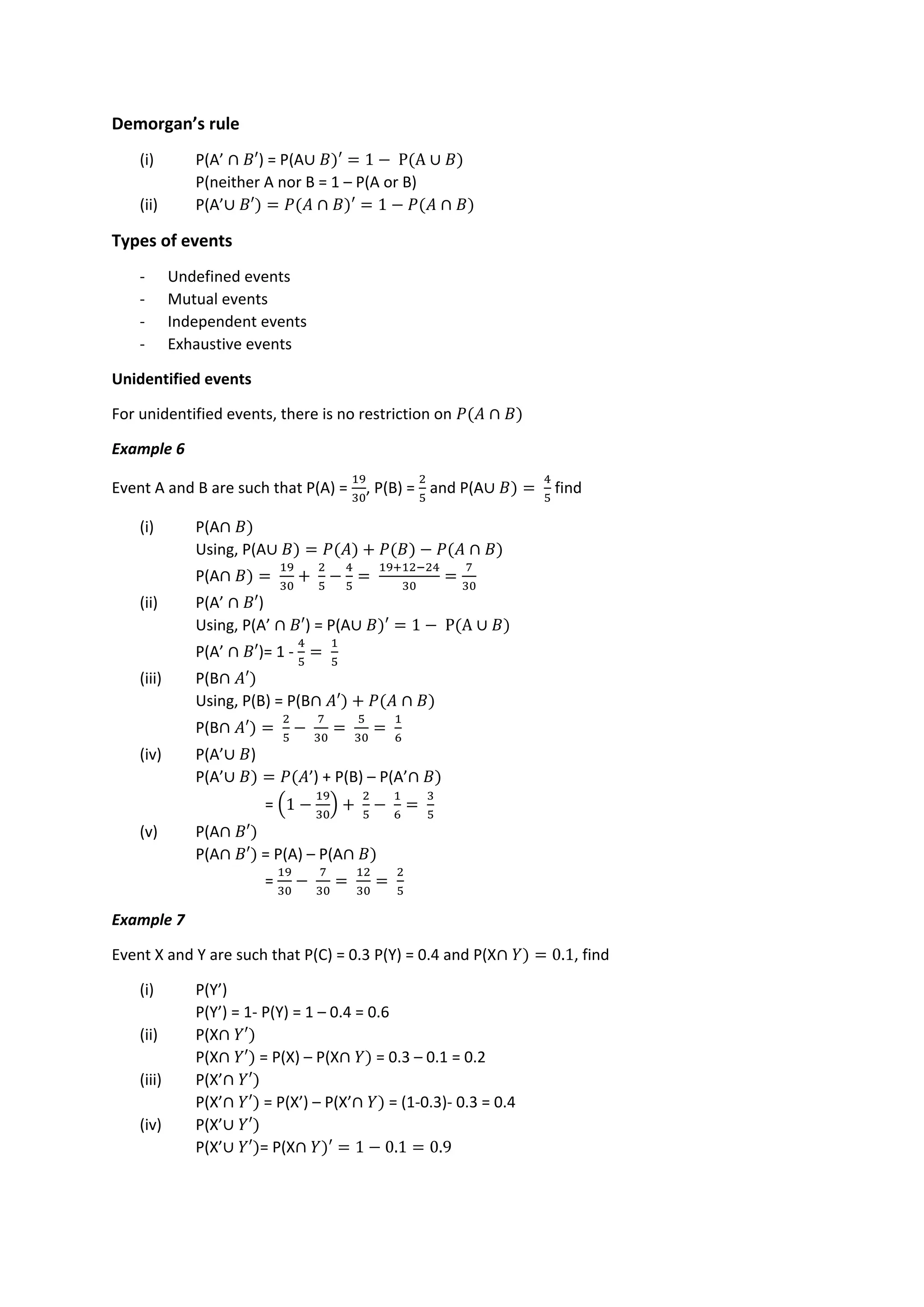
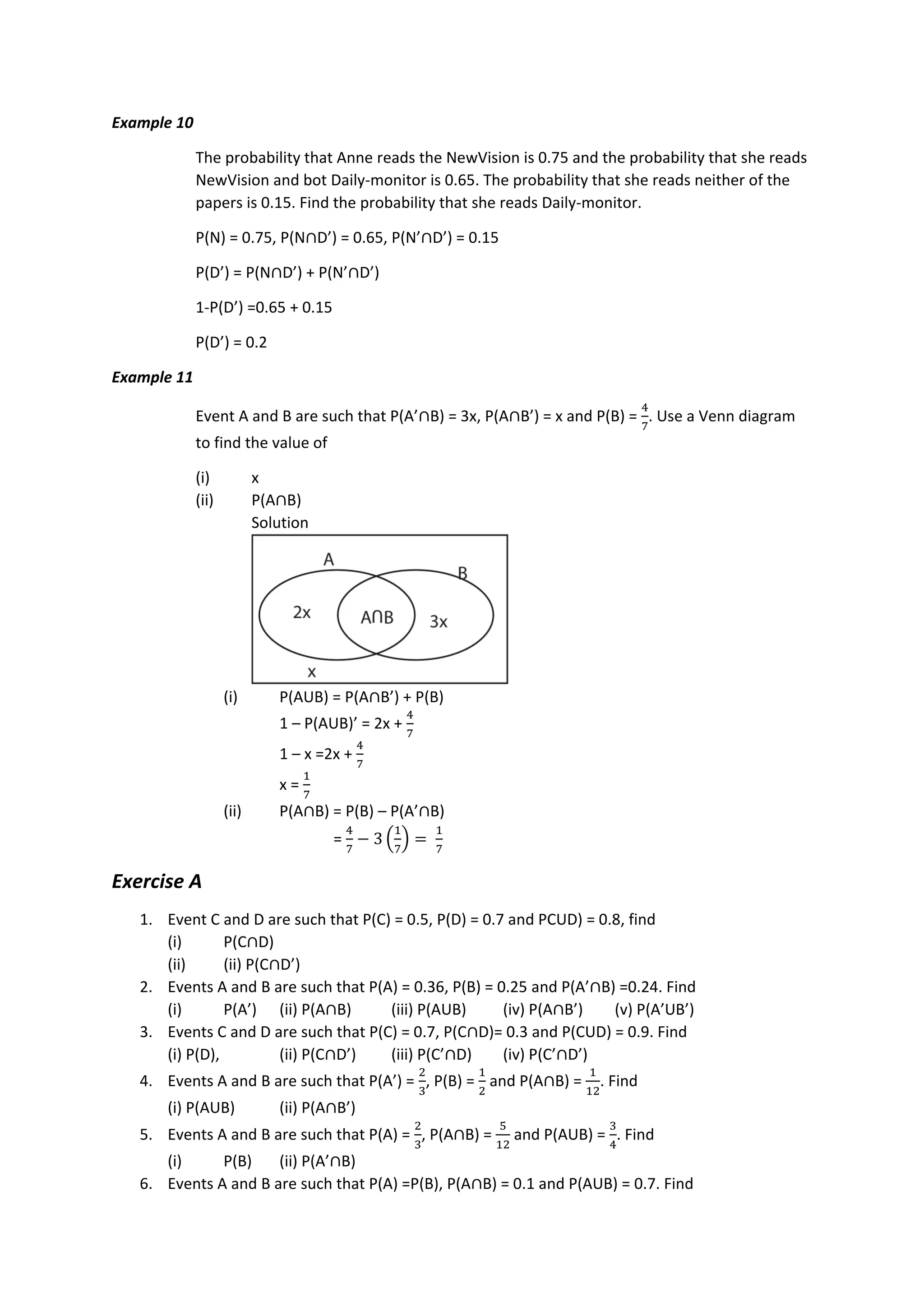
![P(A) = 1- P(A’) = 1 -
2
3
=
1
3
P(AUB) = P(A) + P(B) - P(A∩B) =
1
3
+
1
2
−
1
12
=
9
12
=
3
4
= 0.75
(ii) P(A∩B’)
P(A) = P(A∩B) + P(A∩B’)
P(A∩B’) =
1
3
−
1
12
=
3
12
=
1
4
= 0.25
5. Events A and B are such that P(A) =
2
3
, P(A∩B) =
5
12
and P(AUB) =
3
4
. Find
(i) P(B)
P(AUB) = P(A) + P(B) - P(A∩B)
P(B) =
3
4
+
5
12
−
2
3
=
6
12
=
1
2
= 0.5
(ii) (ii) P(A’∩B)
P(B) = P(A∩B) + P(A′ ∩B)
P(A′ ∩B) =
1
2
−
5
12
=
1
12
6. Events A and B are such that P(A) =P(B), P(A∩B) = 0.1 and P(AUB) = 0.7. Find
(i) P(A)
P(AUB) = P(A) + P(B) - P(A∩B)
2P(A) = 0.7 + 0.1 =0.8
P(A) = 0.4
(ii) P(A’UB)
P(A) = P(A∩B) + P(A∩B’)
P(A∩B’) = 0.4 -0.1 = 0.3
P(A∪ 𝐵′) = P(B) + P(A’) – P(A∩ 𝐵′)
= 0.4 +(1-0.4) – 0.3
= 0.57
7. Event A and B are such that P(A) =
7
12
, P(B) =
3
4
and PA∩B) =
2
5
. Find
(i) P(AUB)
P(AUB) = P(A) + P(B) - PA∩B)
=
7
12
+
3
4
-
2
5
=
56
60
=
14
15
(ii) (ii)P(A∩B’)
P(A) = PA∩B)+ P(A∩B’)
P(A∩B’) =
7
12
−
2
5
=
11
60
]
Mutually exclusive events
Two events are mutually exclusive if they do not occur together i.e. P(A∩B)=0
P(AUB) = P(A) + P(B)
Example12
Events A and B are mutually exclusive such that P(B) =
1
2
, P(A) =
2
5
, find
(i) P(AUB)
P(AUB) = P(A) + P(B) =
1
2
+
2
5
=
9
10
= 0.9
(ii) P(A’∩B)
P(A’∩B) = P(B) - P(A∩B) = 0.5 – 0 = 0.5](https://image.slidesharecdn.com/a-level-math-paper-2-probability-theory-250903184509-592b4b61/75/A-level-math-paper-2-Probability-theory-pdf-7-2048.jpg)
![(ii) P(A)
P(A’UB) = P(A’) + P(B) – P(A’∩B)
0.45 = P(A’) + 0.3 – 0.3
P(A’) = 0.45
P(A) = 1- P(A’) = 1- 0.45 = 0.55
(iii) P(A’∩B) = 0.55
P(B)= P(A∩B) + P(A’∩B)
P(A’∩B) = P(B) - P(A∩B) = 0.3 – 0 = 0.3
(iv) P(A’∩B’) = P(AUB)’ = 1 – P(AUB) = 1 – (P(A) + P(B) = 1- (0.55 + 0.3) = 0.15
(v) P(A’UB’) = P(A∩B)’ = 1- P(A∩B) = 1-0 = 1
(vi) P(A’UB) = P(A’) + P(B) – P(A’∩B)
=(1 – 0.55) + 0.3 - 0.3 =0.45
6. Event A and B are mutually exclusive such P(AUB) = 0.9, P(AUB’) = 0.6, find
(i) P(B) = 0.4
P(A) + P(B’) – P(A∩B’) =0.6
P(A) + [1 – P(B)] – P(A) = 0.6
1-P(B) = 0.6
P(B) = 0.4
(ii) P(A) = 0.5
P(A) + P(B) = 0.9
P(A) = 0.9 – 0.4 = 0.9
(iii) P(A’UB) = P(A’) + P(B)– P(A’∩B)
= (1 - 0.5) + 0.4 – 0.4 = 0.5
(iv) P(A’∩B’) = P(AUB)’ = 1- P(AUB) = 1 – 09 = 0.1
(v) P(A’UB’) = P(A∩B)’ = 1 - P(A∩B) = 1 - 0 = 1
Independent event
Two events A and B are independent if the occurrence of one does not affect the other
(i) P (A∩B) = P(A) x P(B)
(ii) P (A′ ∩B) = P(A’) x P(B)
(iii) P (A∩B’) = P(A) x P(B’)
(iv) P (A′ ∩B’) = P(A’) x P(B’)](https://image.slidesharecdn.com/a-level-math-paper-2-probability-theory-250903184509-592b4b61/75/A-level-math-paper-2-Probability-theory-pdf-10-2048.jpg)
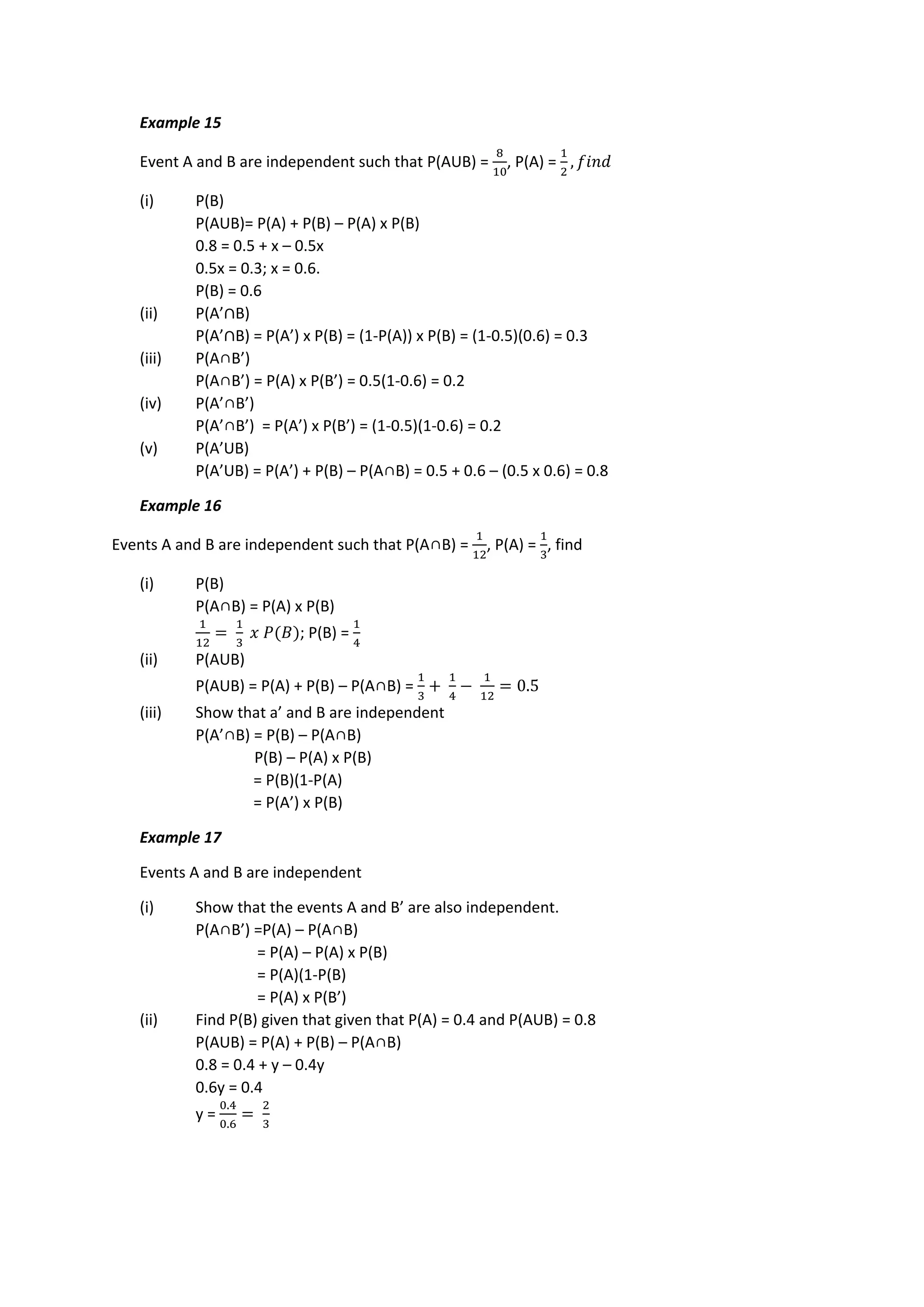
![Example 17
Events A and B are independent such that P(AUB’) =
9
10
, P(A) =
2
5
, find
(i) P(B)
P(AUB’) = P(A) + P(B’) – P(A∩B’)
0.9 = 0.4 + (1-y) – 0.4(1- y) = 0.4 + 1 –y – 0.4 + 0.4y = 1 – 0.6y
0.6y = 0.1
y =
0.1
0.6
=
1
6
(ii) P(AUB)
P(AUB) = P(A) + P(B)- P(A∩B)=
2
5
+
1
6
−
2
5
𝑥
1
6
=
12+5−2
30
=
15
30
= 0.5
(iii) Show that A’ and B’ are independent
P(A’ ∩B’) = 1 – P(AUB)
= 1- [P(A) + P(B)- P(A)x P(B)]
= 1- [P(A) + P(B) (1-P(A)]
= 1 – P(A) - P(B)x P(A’)
= P(A’) - P(B)x P(A’)
= P(A’)[1-P(B)]
= P(A’) x P(B’)
Example 18
The probability of two independent events A and B occurring together is
1
8
. The probability that
either or both events occur is
5
8
. Find
(i) P(A)
(ii) P(B)
Solution
Given P(AUB) =
5
8
and P(A∩B) =
1
8
Let P(A) = x and P(B) = y
x + y – xy =
5
8
….. (i)
xy =
1
8
x =
1
8𝑦
………… (ii)
(i) and (ii)
1
8𝑦
+ 𝑦 −
1
8
=
5
8
1
8𝑦
+ 𝑦 =
6
8
Multiplying through by 8y
1 + 8y2
= 6y](https://image.slidesharecdn.com/a-level-math-paper-2-probability-theory-250903184509-592b4b61/75/A-level-math-paper-2-Probability-theory-pdf-12-2048.jpg)
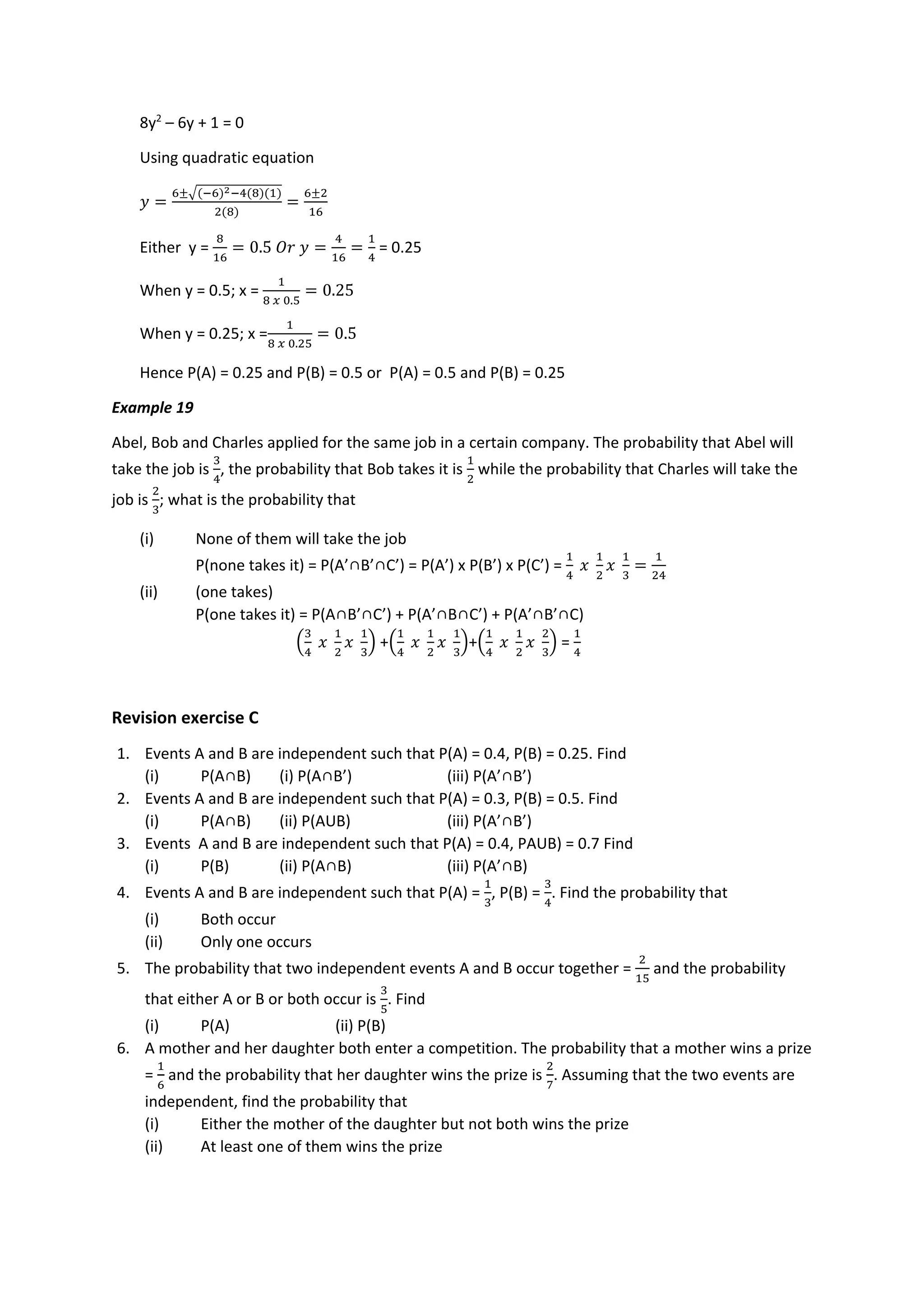
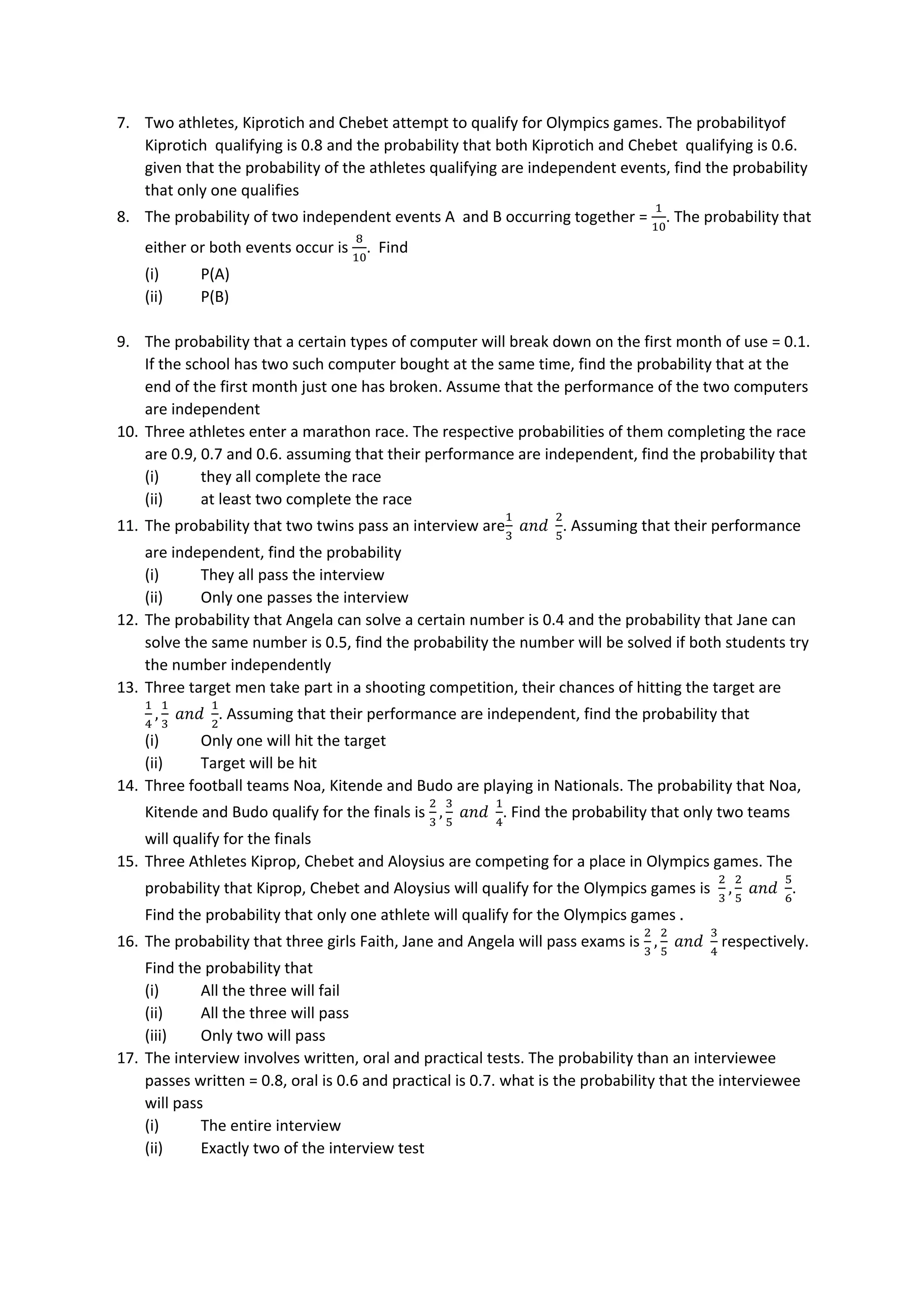
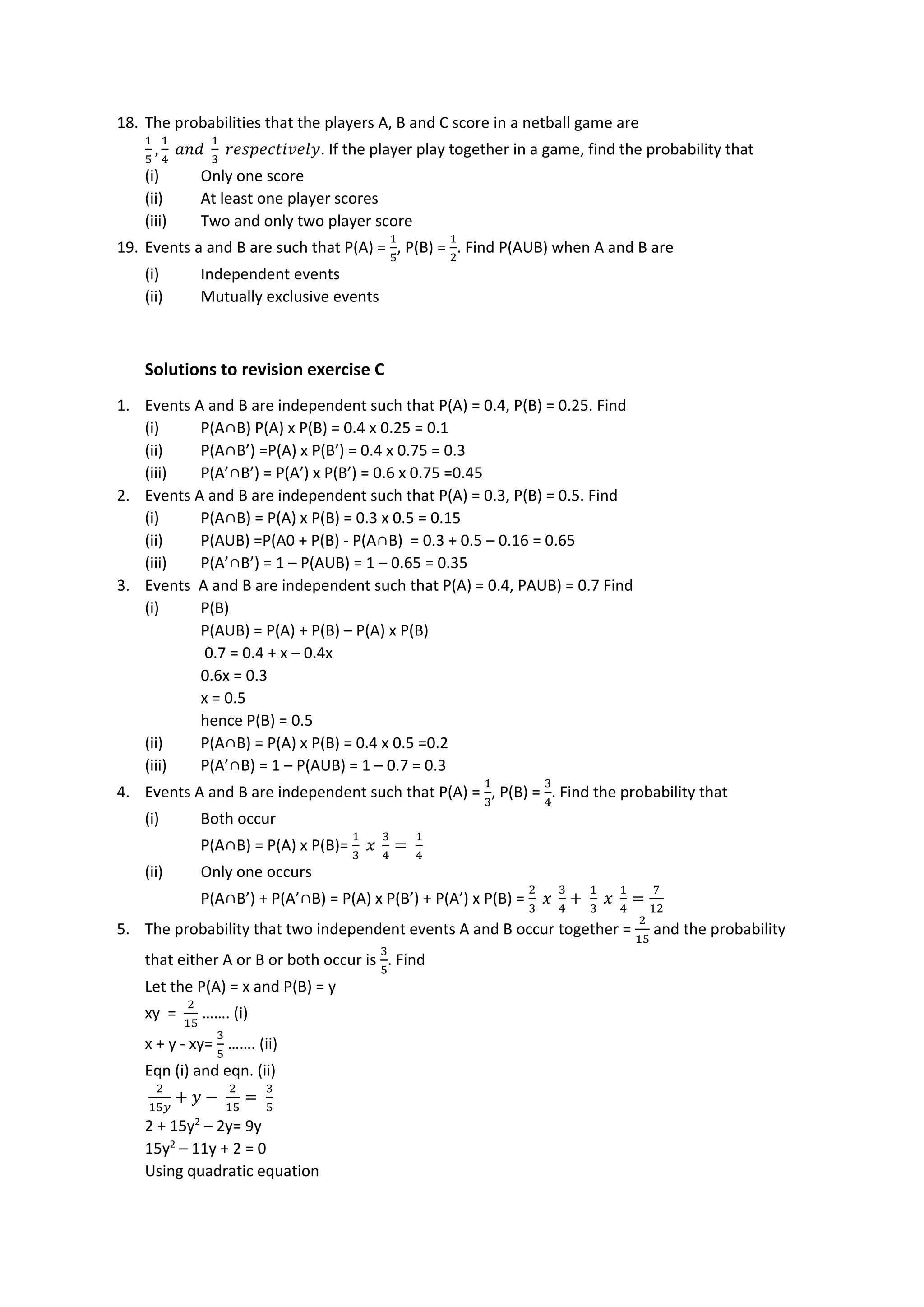
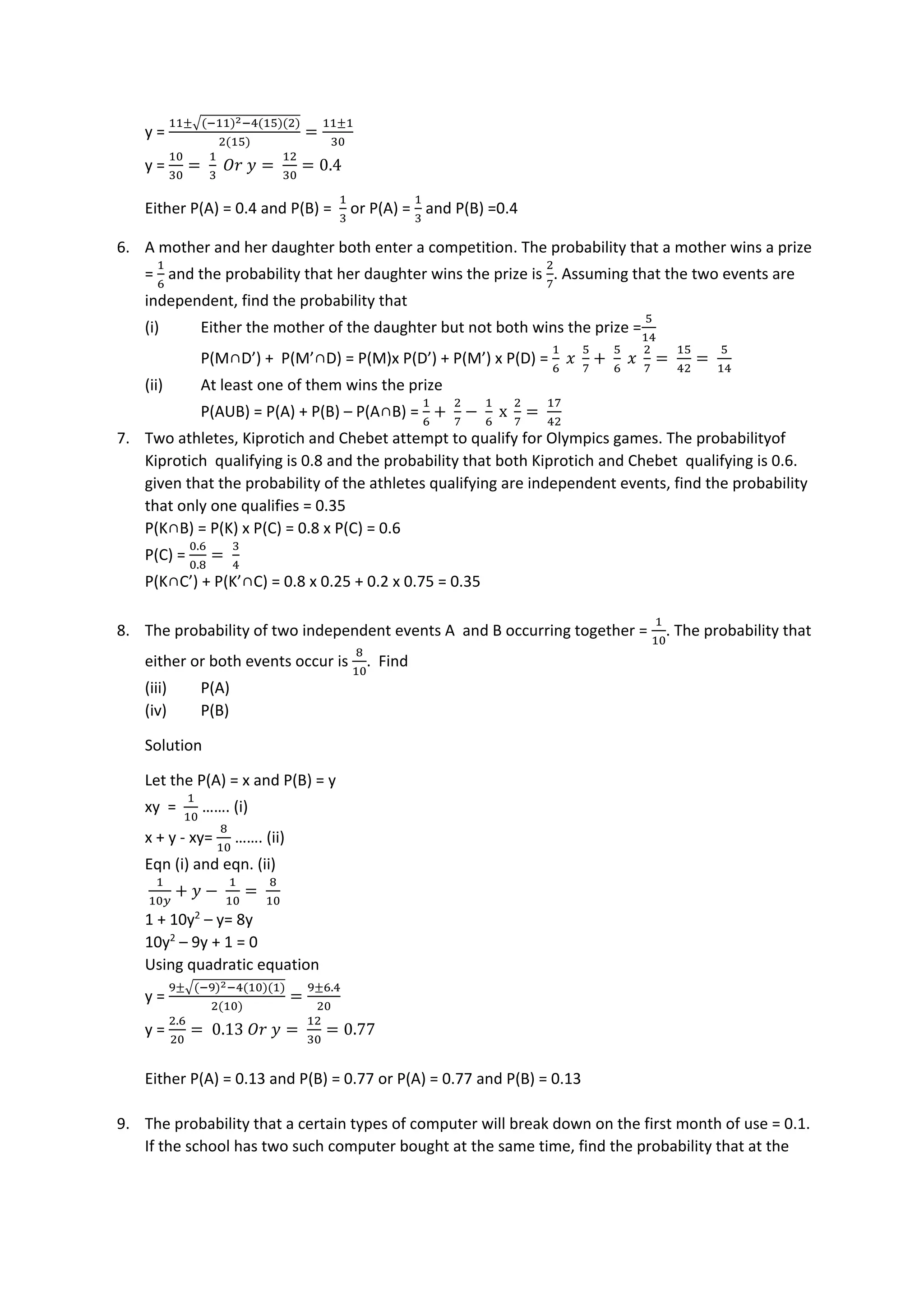
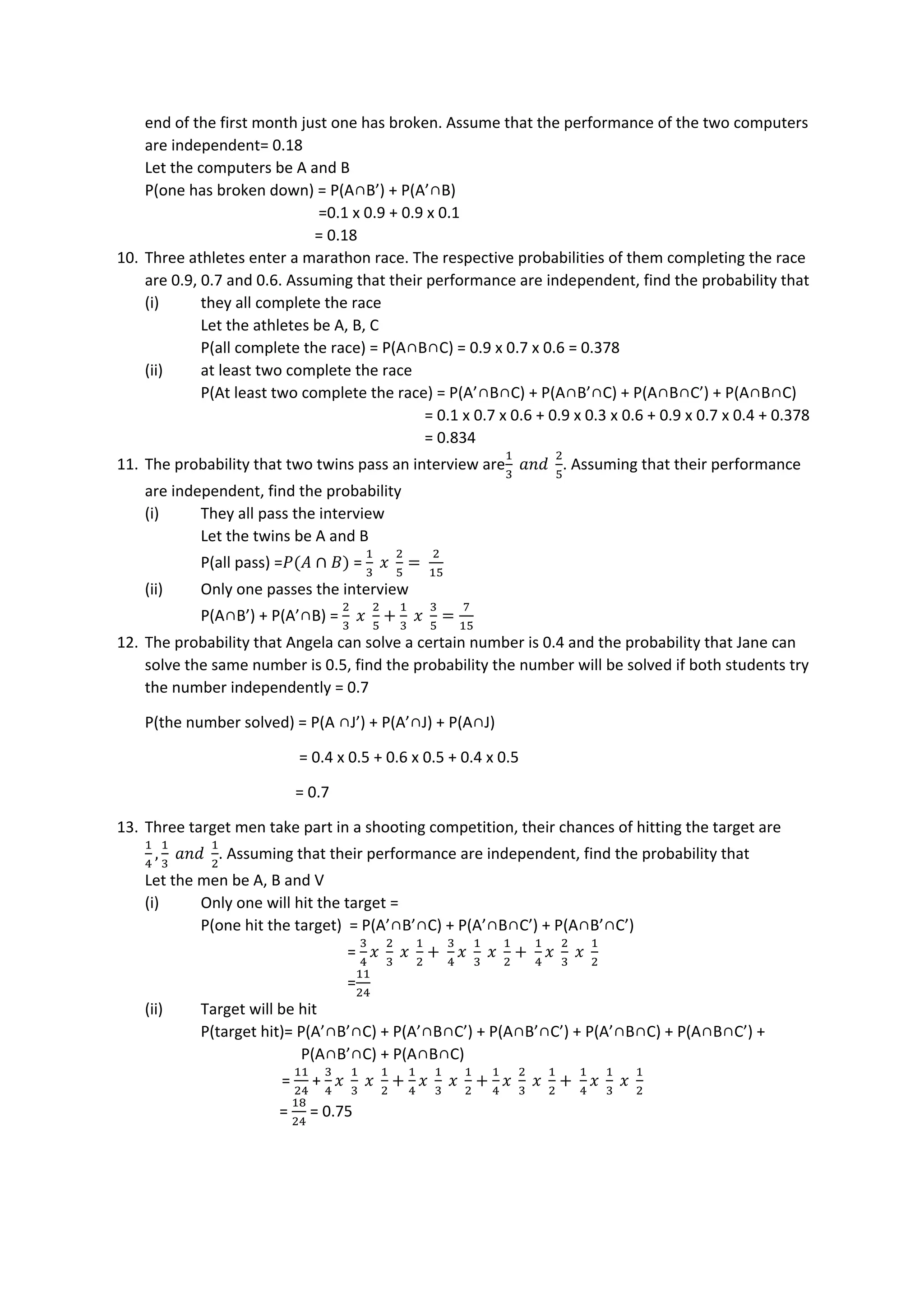
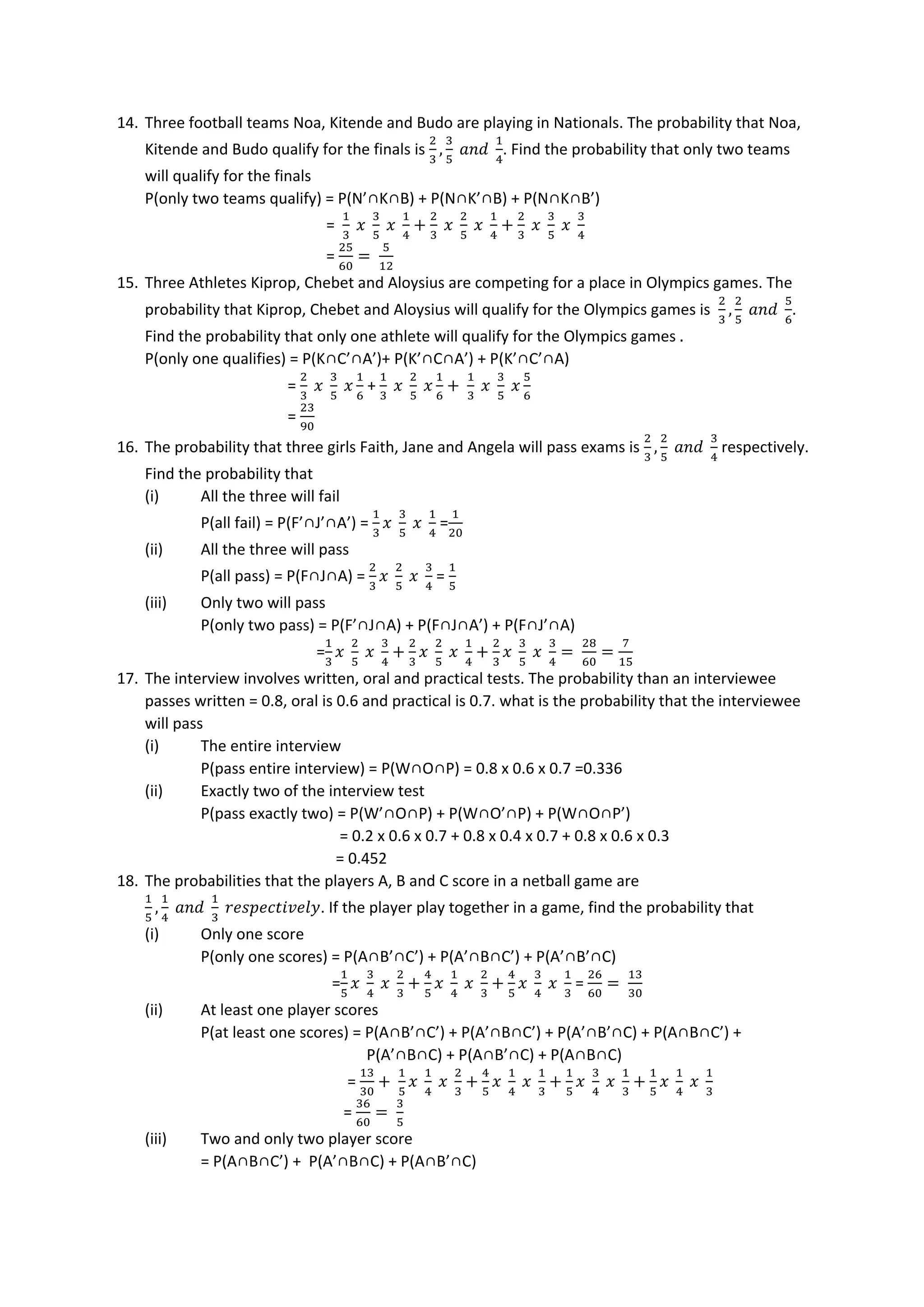
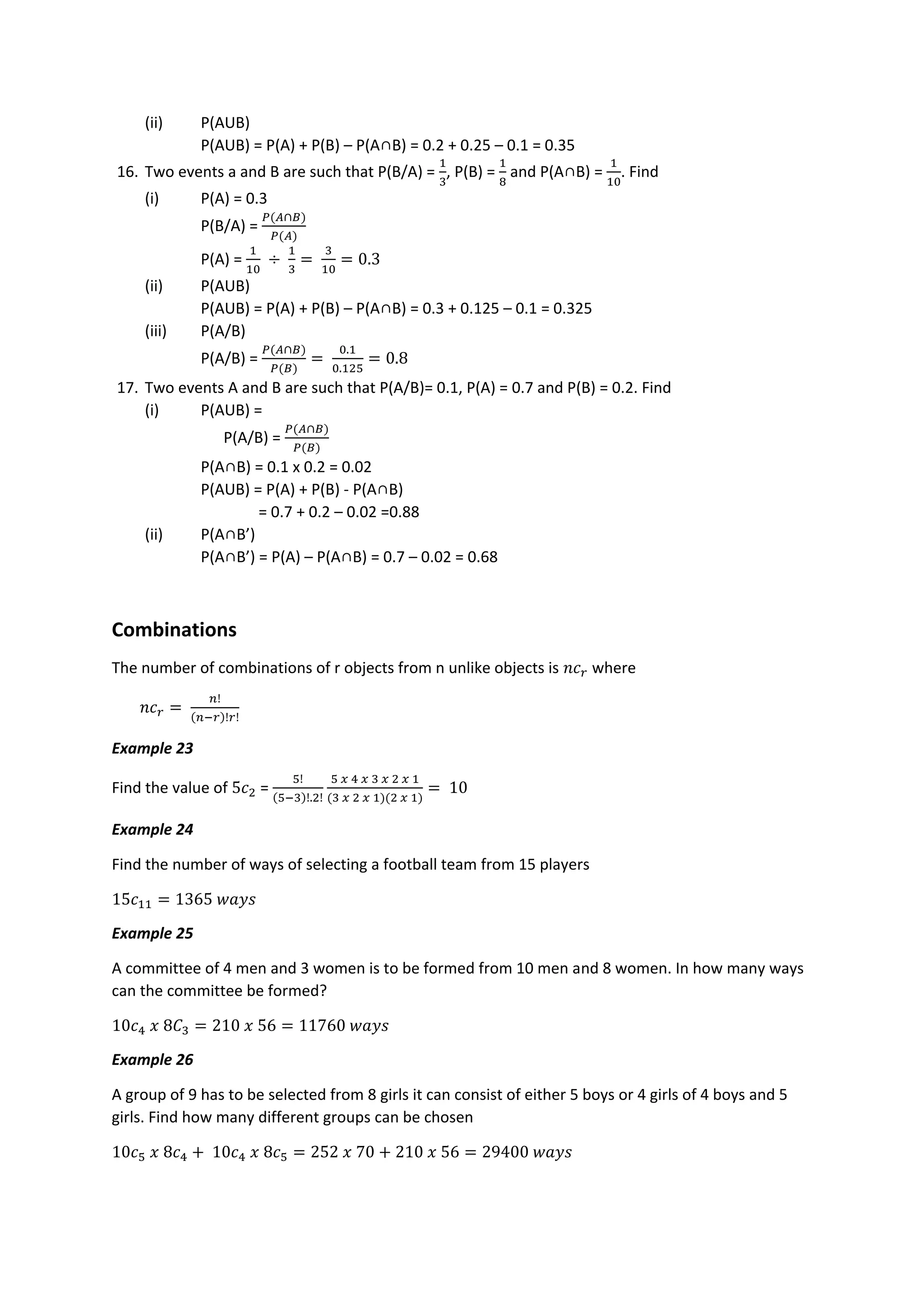
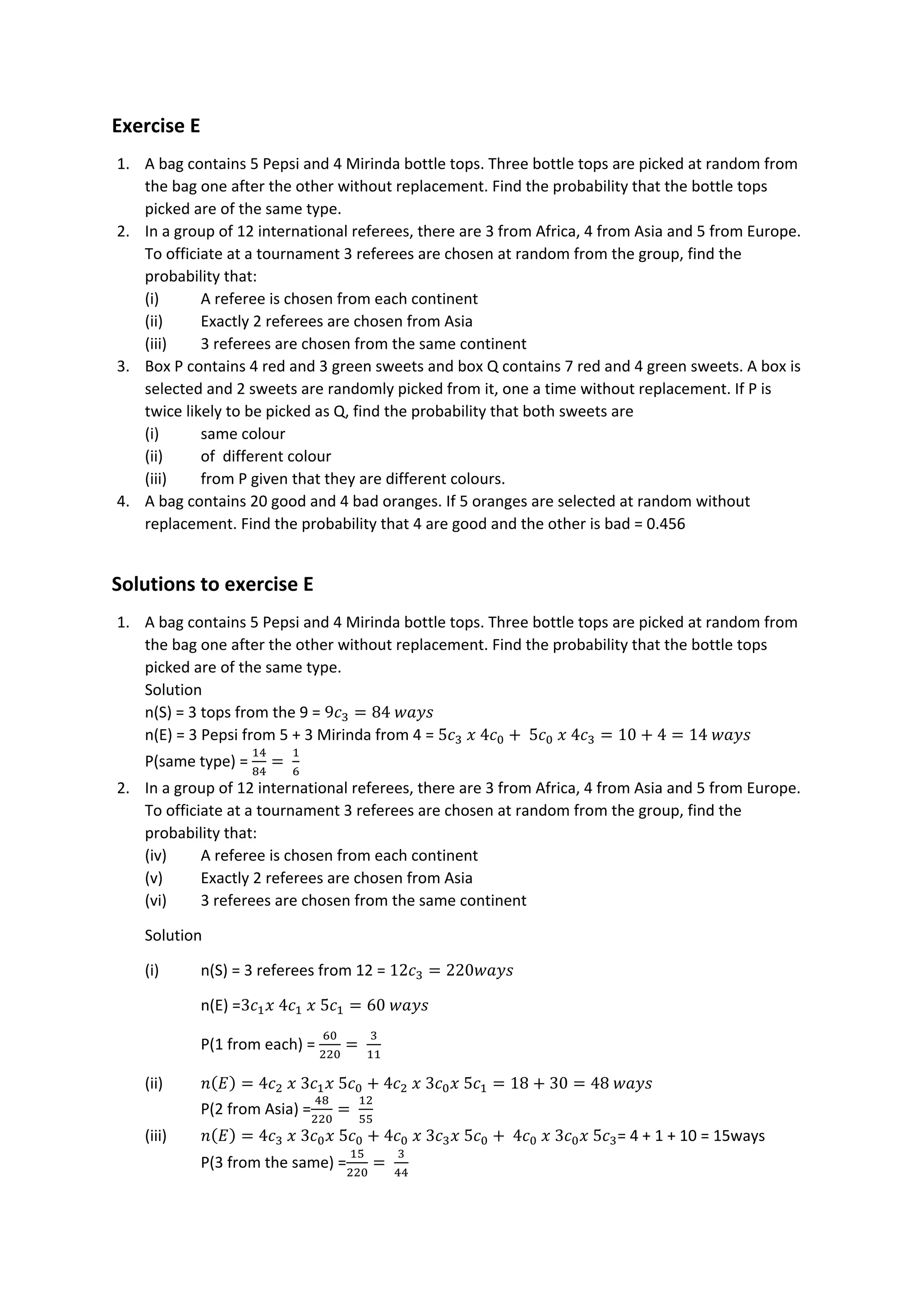
![3. Box P contains 4 red and 3 green sweets and box Q contains 7 red and 4 green sweets. A box is
selected and 2 sweets are randomly picked from it, one a time without replacement. If P is
twice likely to be picked as Q, find the probability that both sweets are
(iv) same colour
(v) of different colour
(vi) from P given that they are different colours.
Solution
(i) P(both the same colour) =
2
3
[
4𝑐2 𝑥 3𝑐0
7𝑐2
] +
2
3
[
4𝑐0 𝑥 3𝑐2
7𝑐2
] +
1
3
[
7𝑐2 𝑥 4𝑐0
11𝑐2
] +
1
3
[
7𝑐0 𝑥 4𝑐2
11𝑐2
]
= 0.4494
(ii) P(both different colour) =
2
3
[
4𝑐1 𝑥 3𝑐1
7𝑐2
] +
1
3
[
7𝑐1 𝑥 4𝑐1
11𝑐2
] = 0.5506
(iii) P(from P/different colour) =
2
3
[
4𝑐1 𝑥 3𝑐1
7𝑐2
]
0.5506
= 0.6919
4. A bag contains 20 good and 4 bad oranges. If 5 oranges are selected at random without
replacement. Find the probability that 4 are good and the other is bad
P(X= 4) =
20𝑐4.4𝑐1
24𝑐5
= 0.456
Probability tree diagram
Example 27
A factory makes cakes. When an inspector tests a random sample of cakes, the probability of any
cake being contaminated is 0.025. Jane bought two of the cakes made from the factory. Find the
probability
(i) both are contaminated
(ii) only one is contaminate
Solution
(i) P(both contaminated) = P(C∩ 𝐶) =0.025 x 0.025 = 0.000625
(ii) P(one contaminated) =P(C∩ 𝐶′) + P(C′ ∩ 𝐶) =0.025 x 0.975 + 0.975 x 0.025 = 0.04875
Example 28
A box contains 3 red balls and 4 blue balls. Two balls are randomly drawn one after the other
without replacement. Find the probability that
(i) 1st
ball is blue
(ii) 2nd
ball is red
(iii) 2nd
ball is red given that the 1st
was blue](https://image.slidesharecdn.com/a-level-math-paper-2-probability-theory-250903184509-592b4b61/75/A-level-math-paper-2-Probability-theory-pdf-26-2048.jpg)
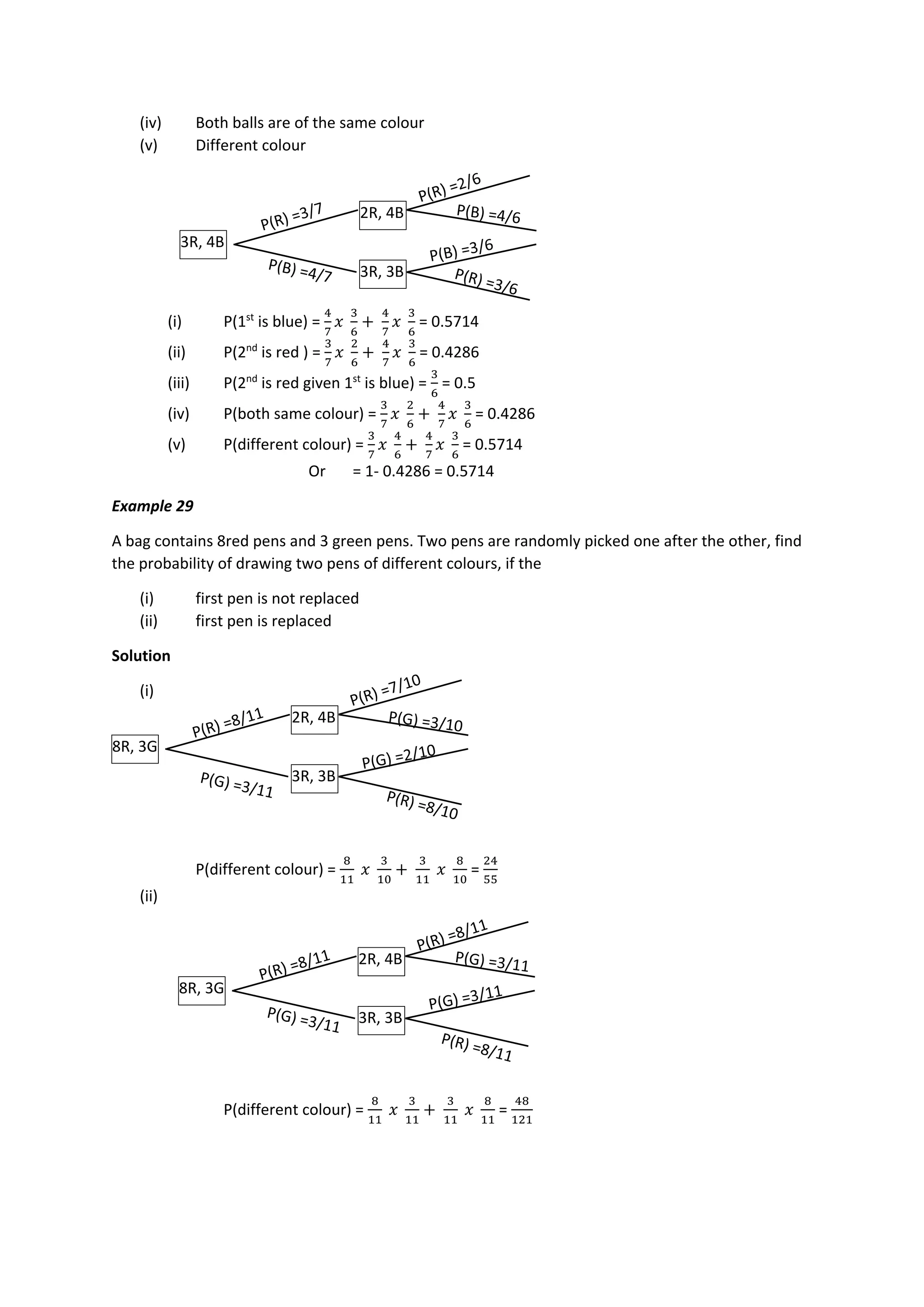
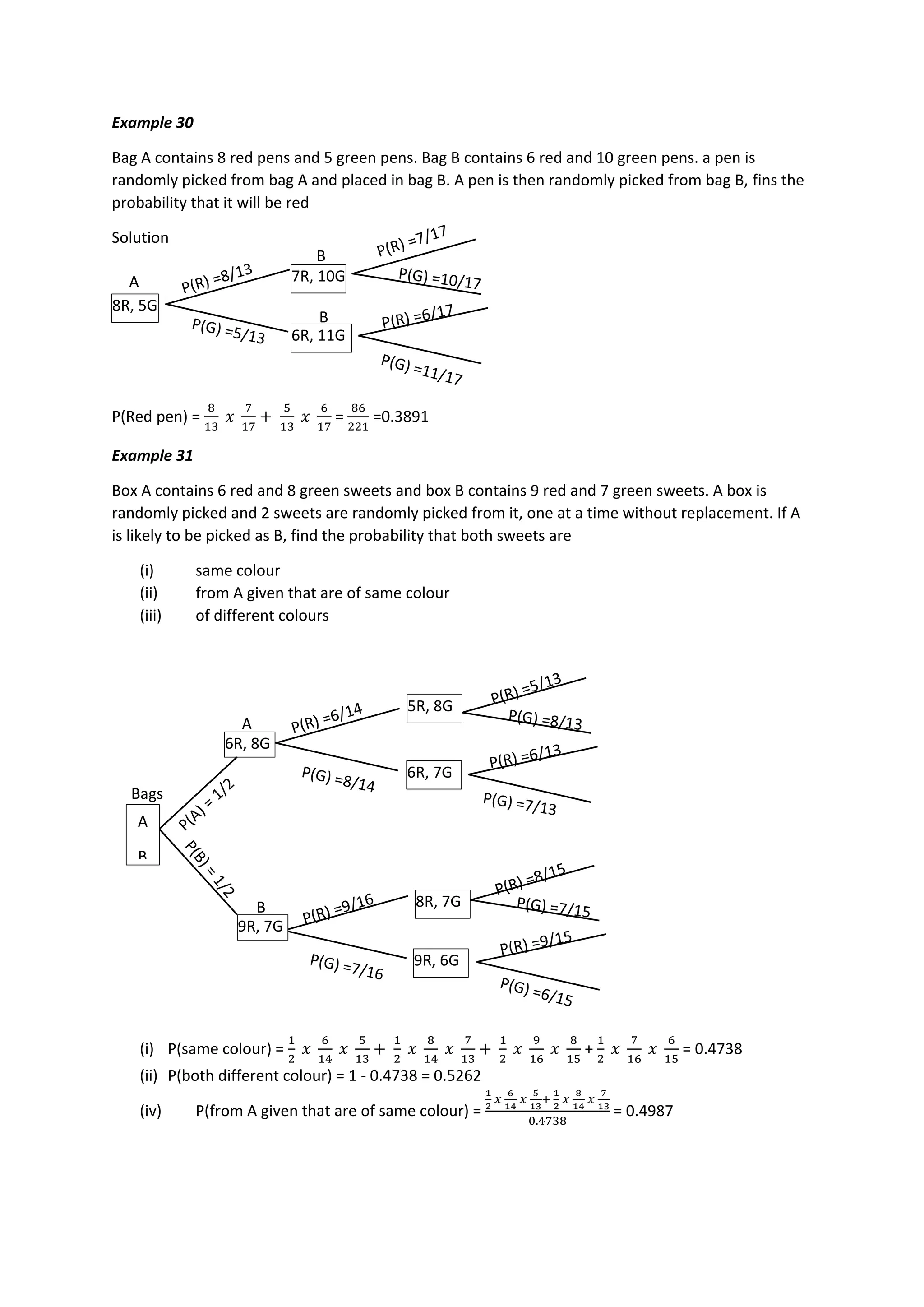
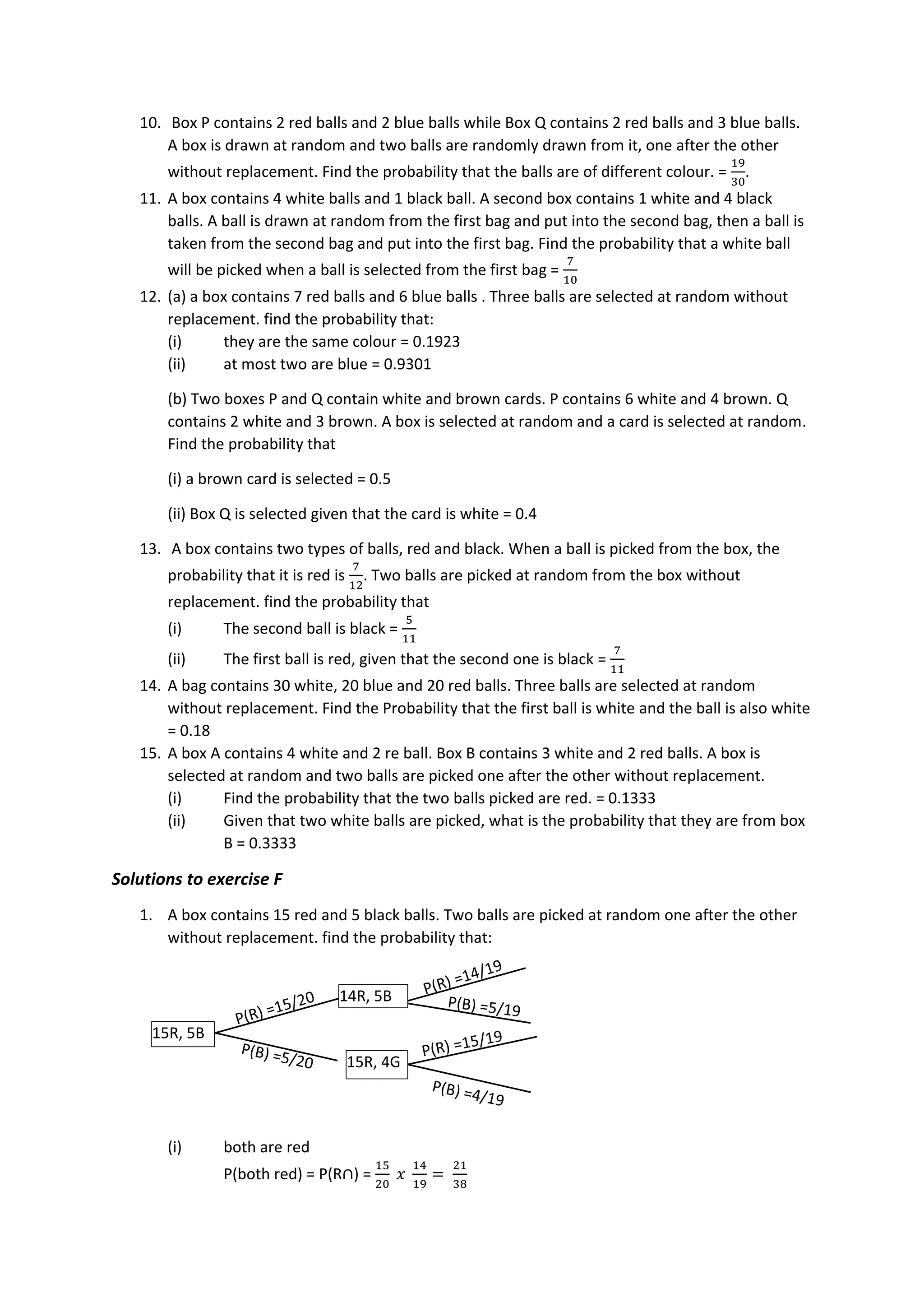
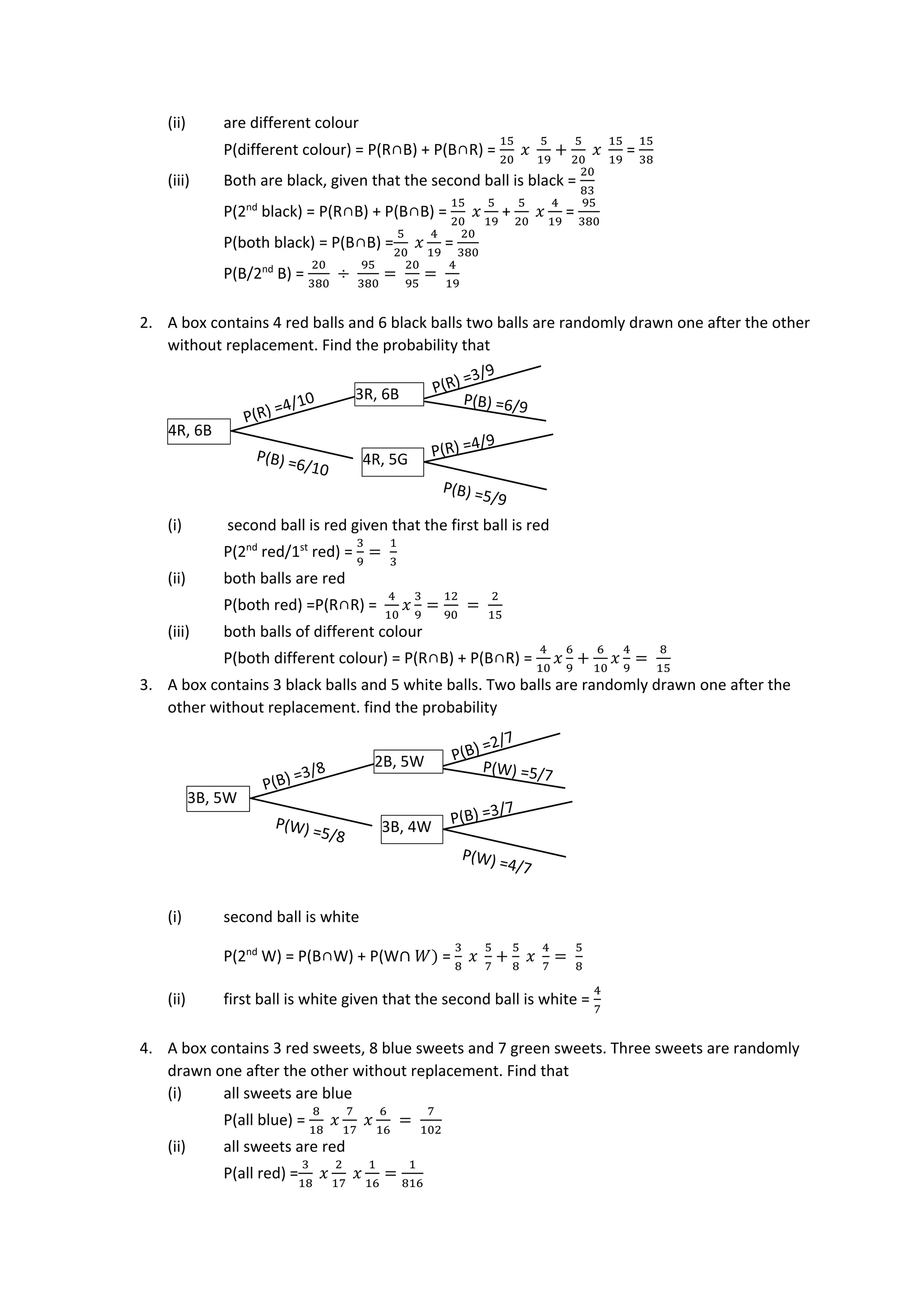
![(iii) one of each colour
P(each colour) = P(R∩B∩G) + P(R∩G∩B) + P(B∩R∩G) + P(B∩G∩R)+ P(G∩B∩R) + P(G∩R∩B)
=6(
3
18
𝑥
8
17
𝑥
7
16
) =
7
34
5. A box contains 7 black sweets and 3 white sweets. Three sweets are randomly drawn one
after the other with replacement. Find the probability that:
(i) all three sweets are black
P(all black) = P(B∩B∩B) = 0.7 x 0.7 x 0.7 = 0.343
(ii) a white, black and a white sweet in that order are chosen
=0.3 x 0.7 x 0.3= 0.063
(iii) two white and one black sweets are drawn
P(2W, 1B) = P(W∩W∩B) + P(W∩B∩W) + P(B∩W∩W)
= 3(0.3 x 0.3 x 0.7) = 0.189
(iv) at least one black sweet drawn
P(at least 1B) = [P(W∩W∩B) + P(W∩B∩W) + P(B∩W∩W)]+ P(W∩B∩B) +
P(B∩B∩W) + P(B∩W∩B) + P(B∩B∩B)
= 0.189 +3(0.3 x 0.7 x 0.7) + 0.7 x 0.7 x 0.7
= 0.973
6. A coin is tossed four times, find the probability of obtaining less than two heads.
P(less than 2H) = P(H∩T∩T∩T) + P(T∩H∩T∩T) + P(T∩T∩H∩T)+ P(T∩T∩T∩H) + P(T∩T∩T∩T)
= 5(
1
2
𝑥
1
2
𝑥
1
2
𝑥
1
2
) =
5
16
7. The probability that I am late for work is 0.05. Find the probability that on two consecutive
mornings:
(i) I am late for work twice
= P(L∩L) = 0.05 x 0.05= 0.0025
(ii) I am late for work once
= P(L∩L’) + P(L’∩L) = 2(0.05 x 0.95) = 0.095
8. A box A contains 3 red balls and 4 brown balls while box B contains 3 red balls and 2 brown
balls. A box is drawn at random and one ball is randomly drawn from it. Find the probability
that;
(i) the ball is red
P(R) = P(A∩R) + P(B ∩ R) =
1
2
𝑥
3
7
+
1
2
𝑥
3
5
=
3
14
+
3
10
=
18
35
(ii) the ball came from box A given that it is red
P(A/R) =
P(A∩R)
𝑃(𝑅)
=
3
14
𝑥
35
18
=
5
12
9. A bag contains 10 white and 6 red balls two balls are randomly drawn one after the other
without replacement. Find the probability that the second ball drawn is
(i) red given that the first one was white
=
6
15
= 0.4
(ii) white
P(2nd
W) = P(W∩W) + P(R∩W) =
10
16
𝑥
9
15
+
6
16
𝑥
10
15
= 0.675
10. Box P contains 2 red balls and 2 blue balls while Box Q contains 2 red balls and 3 blue balls.
A box is drawn at random and two balls are randomly drawn from it, one after the other
without replacement. Find the probability that the balls are of different colour. =
19
30
.
P(different colour) = P(P∩R∩B) + P(P∩B∩R) + P(Q∩R∩B)+ P(Q∩R∩B)](https://image.slidesharecdn.com/a-level-math-paper-2-probability-theory-250903184509-592b4b61/75/A-level-math-paper-2-Probability-theory-pdf-32-2048.jpg)
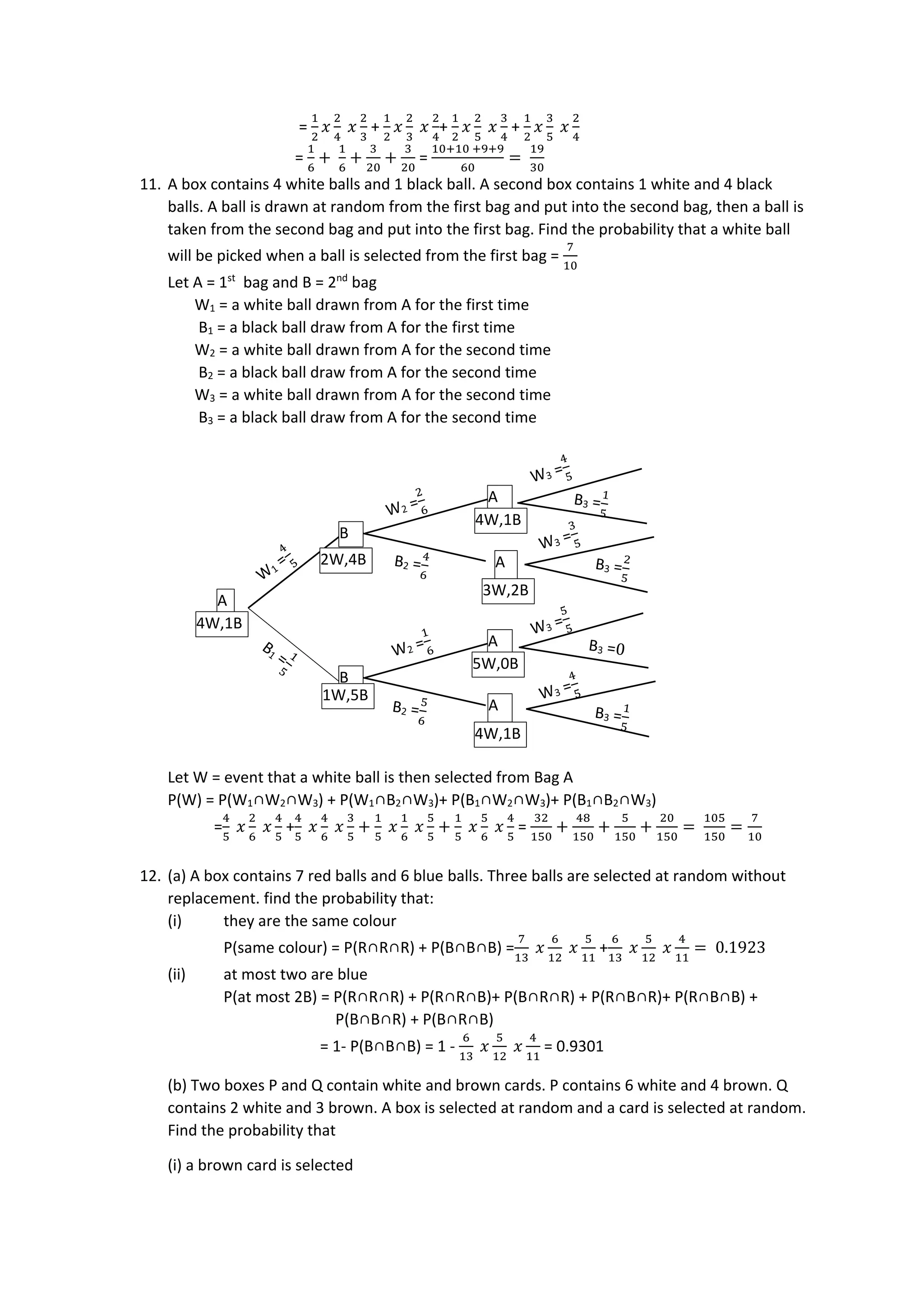
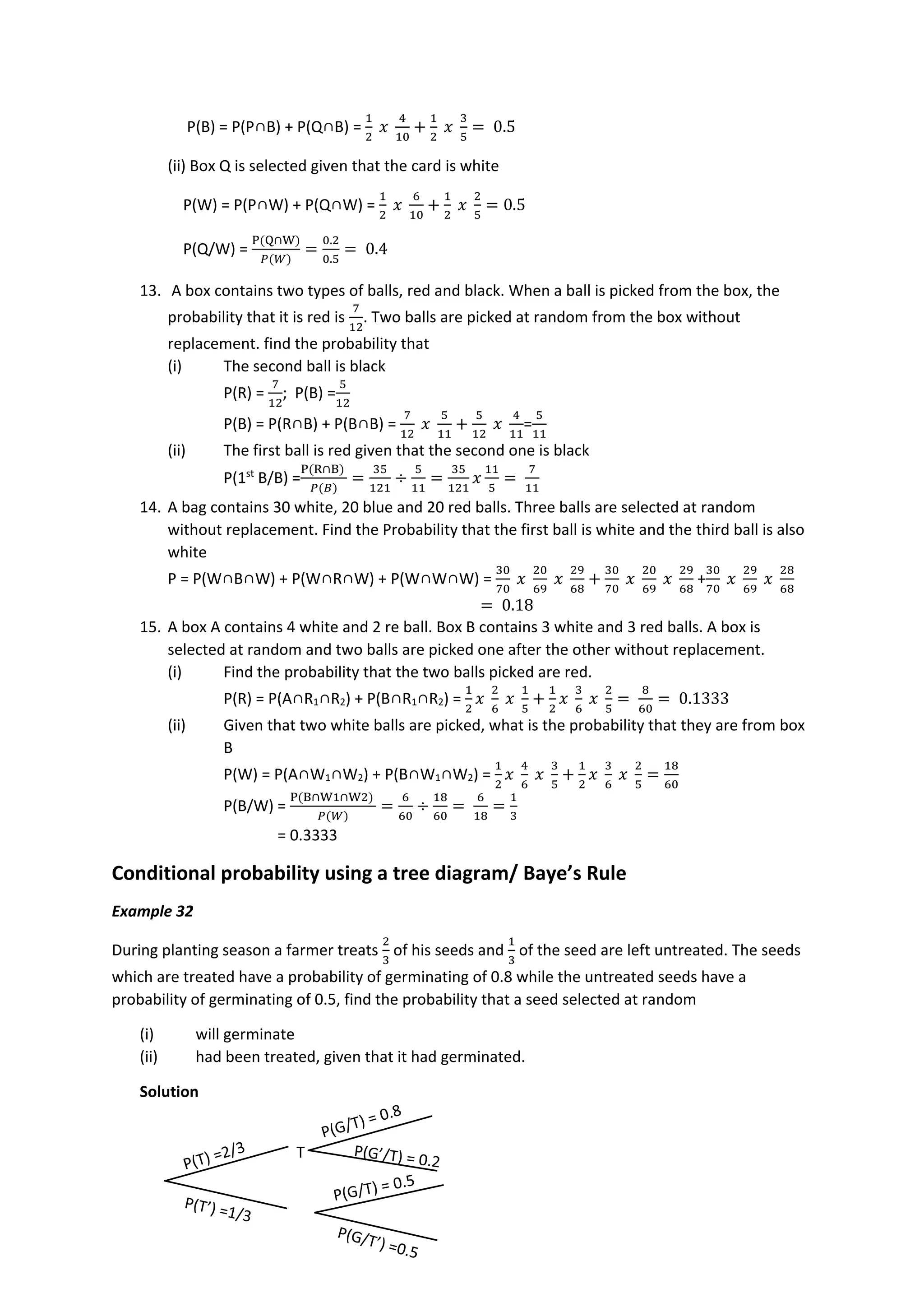
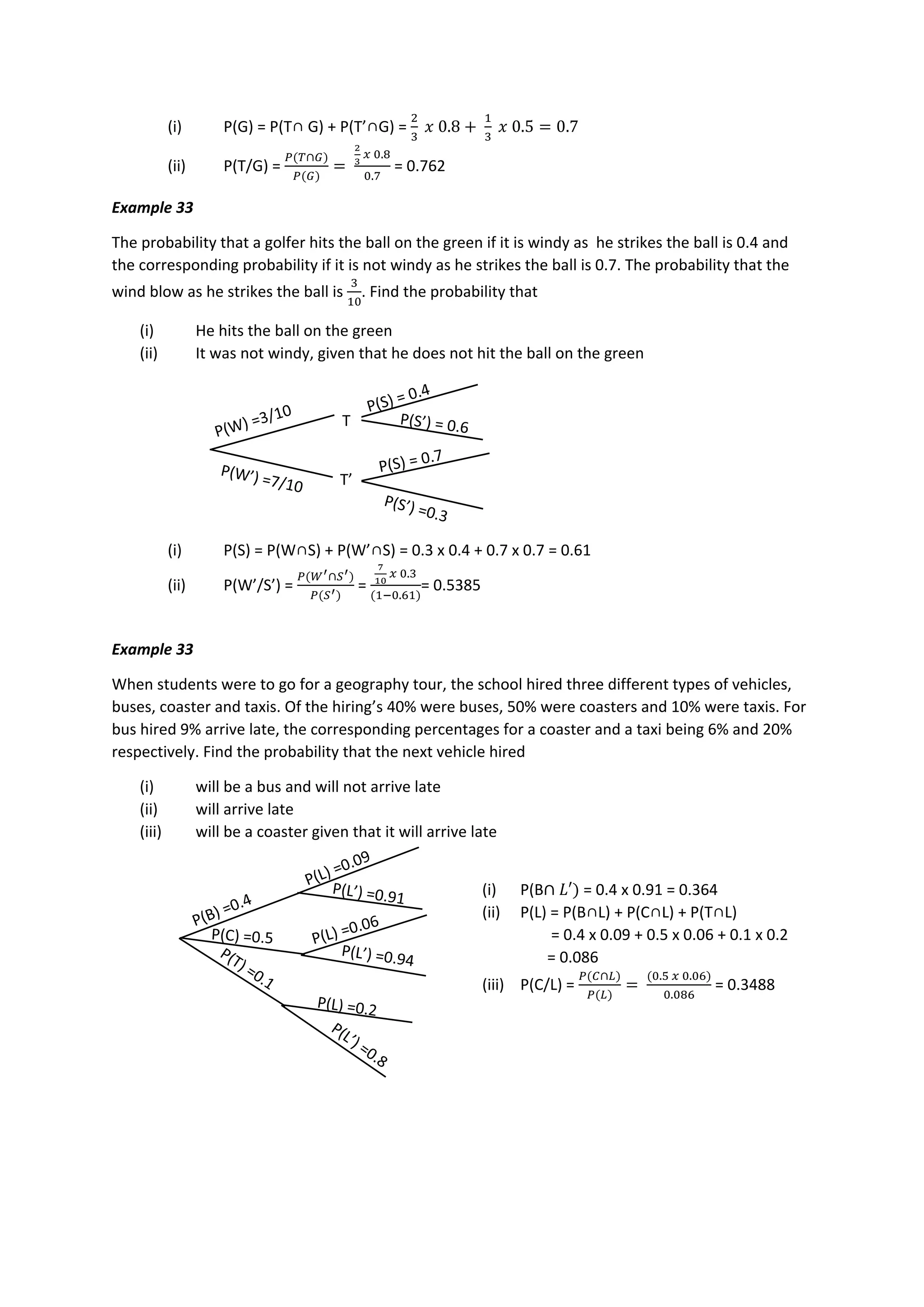
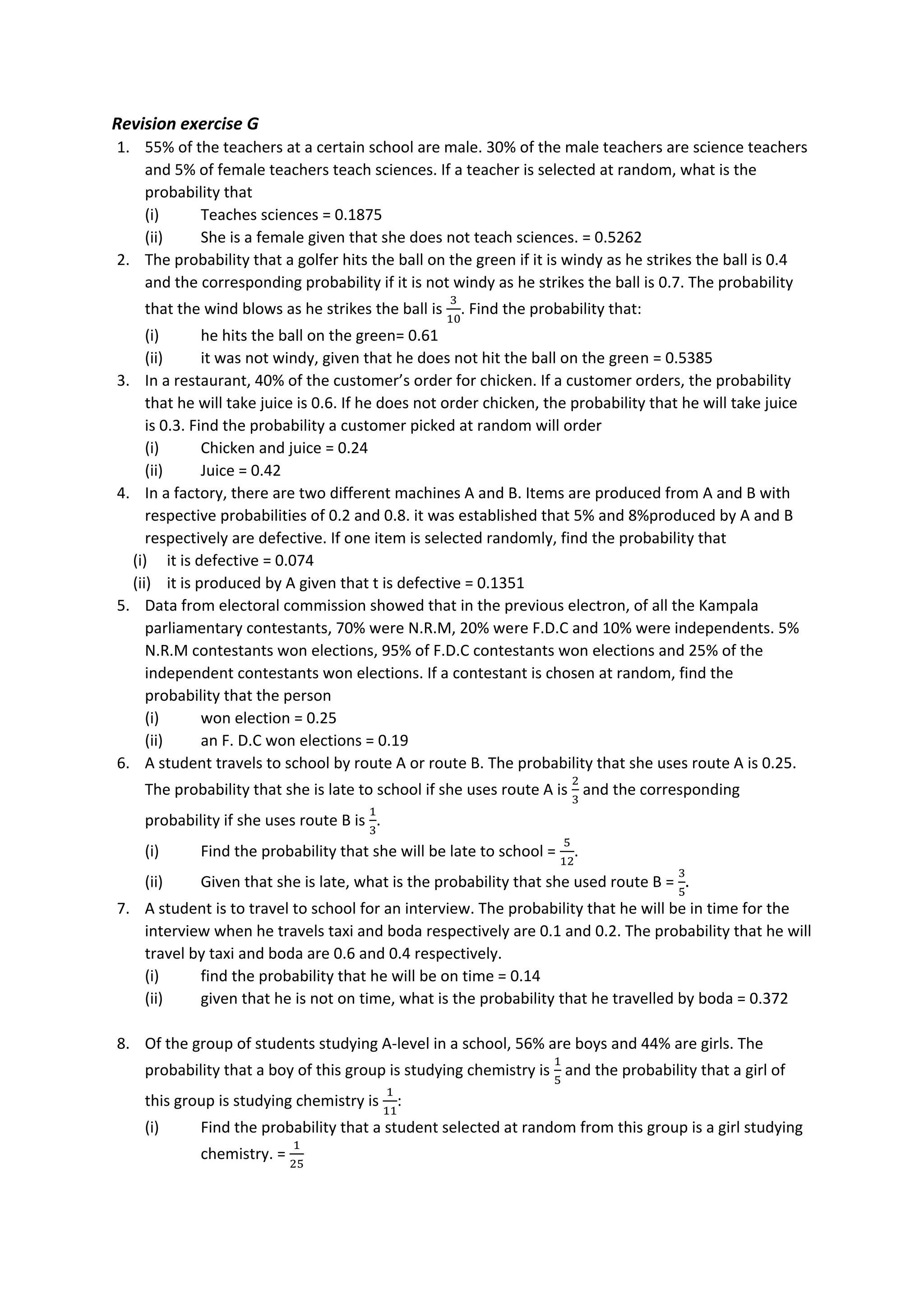
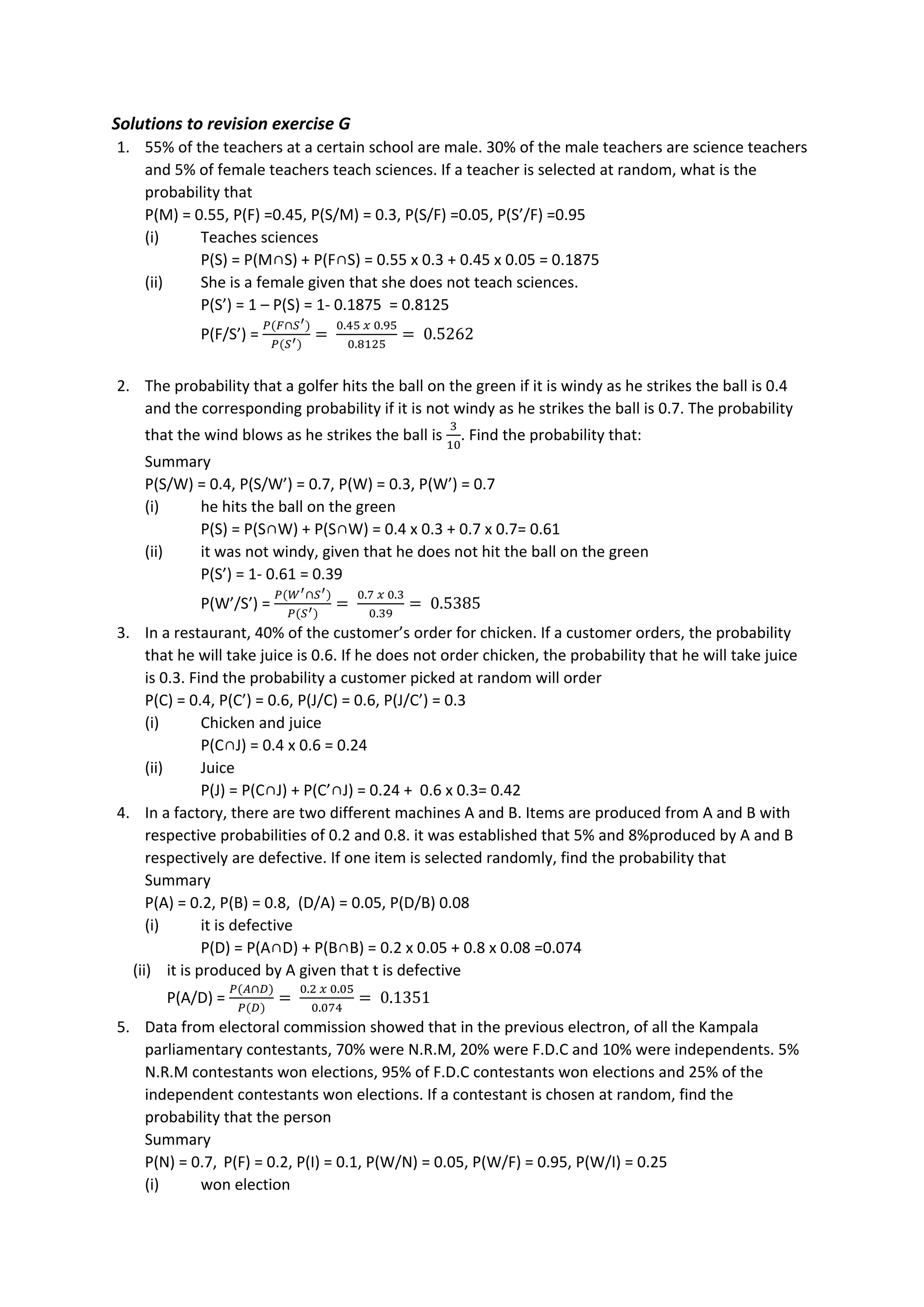
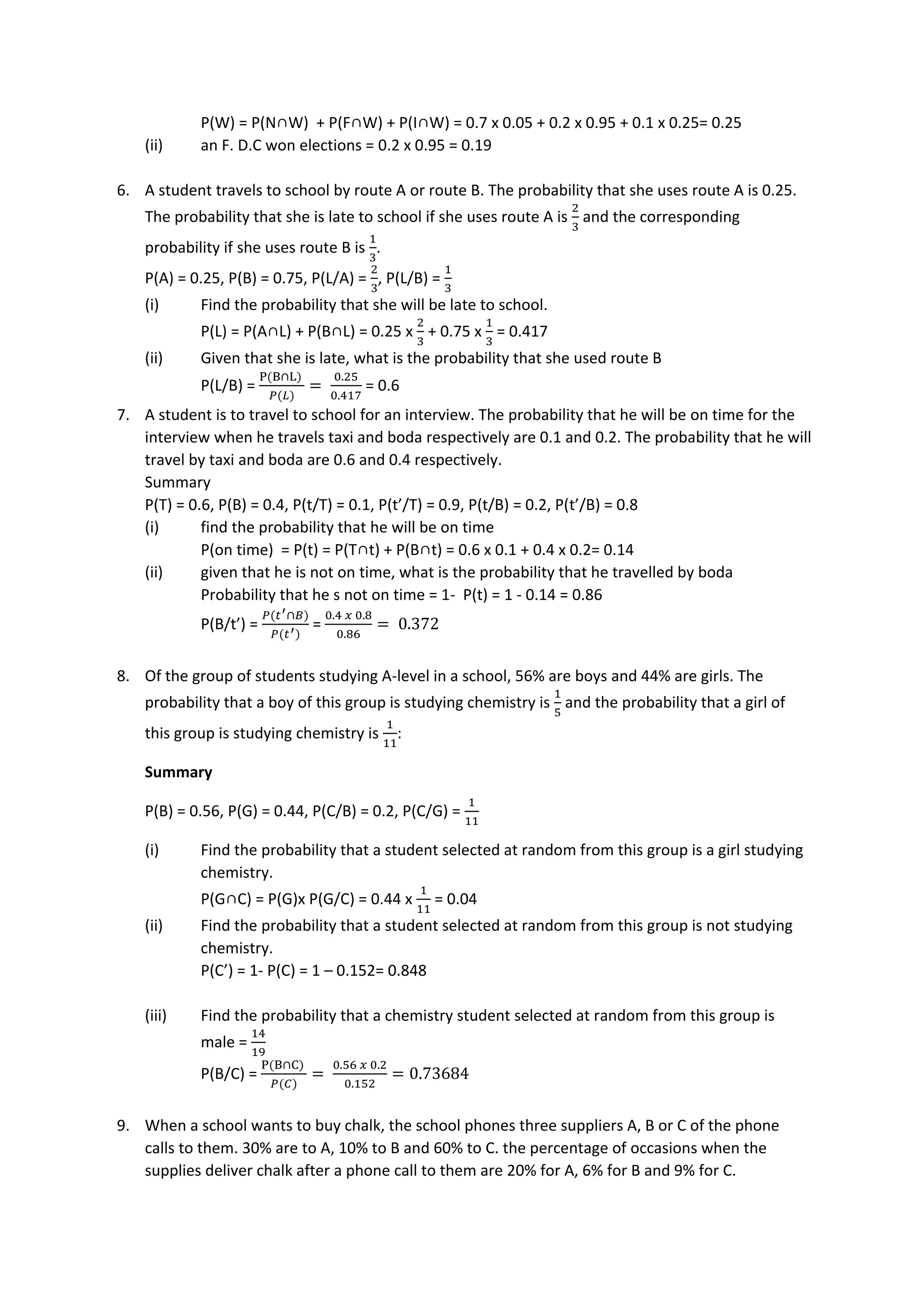
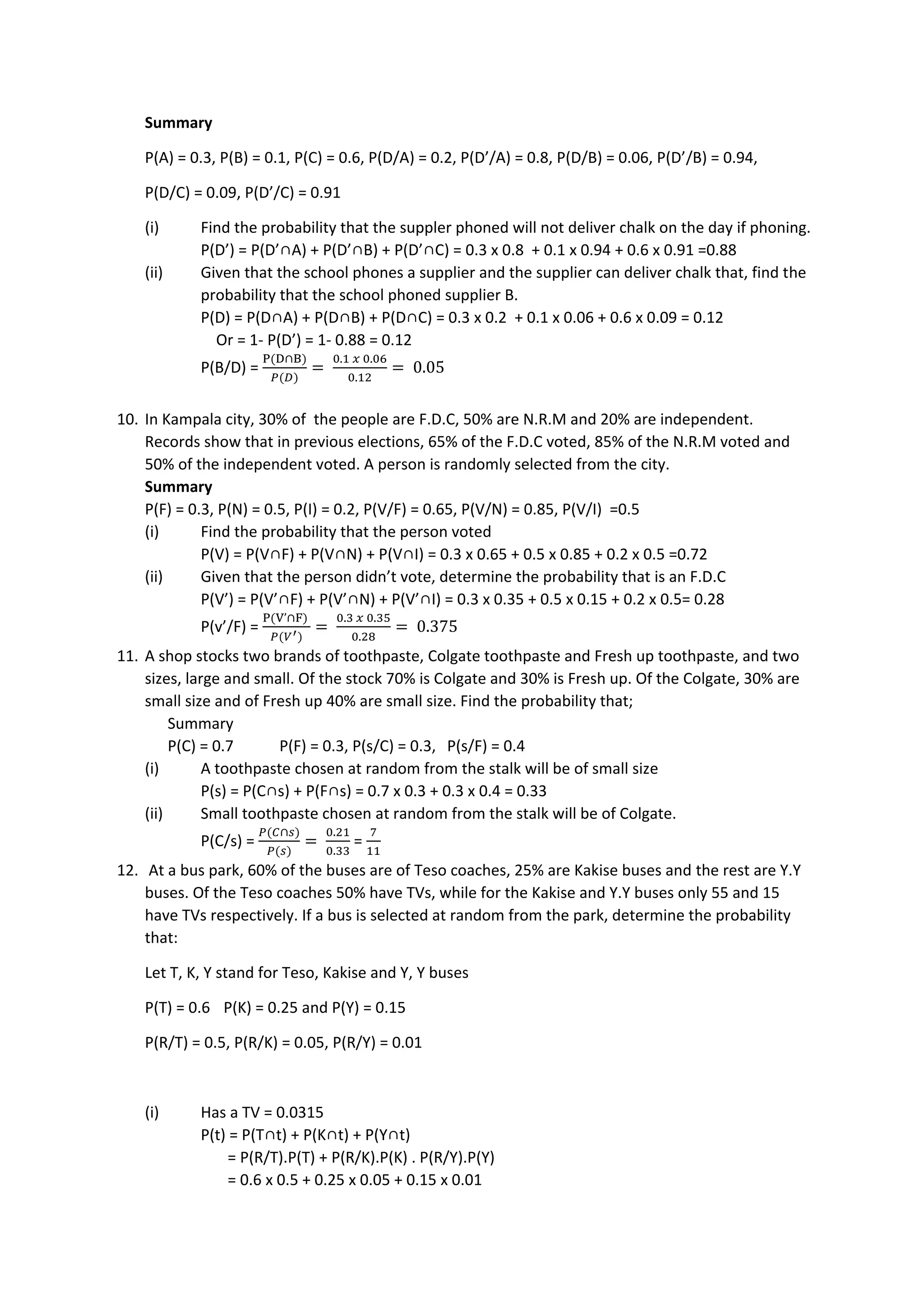
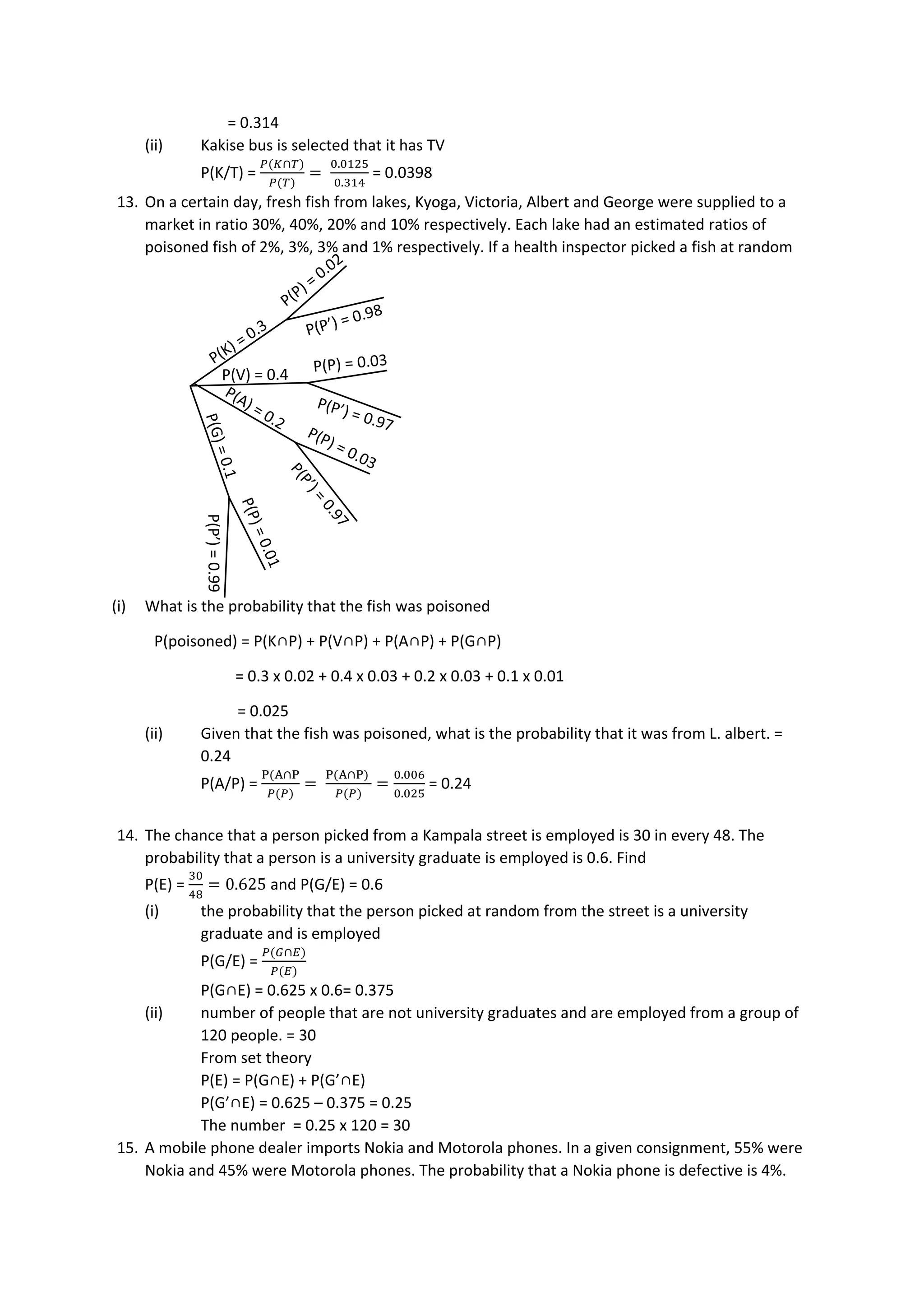
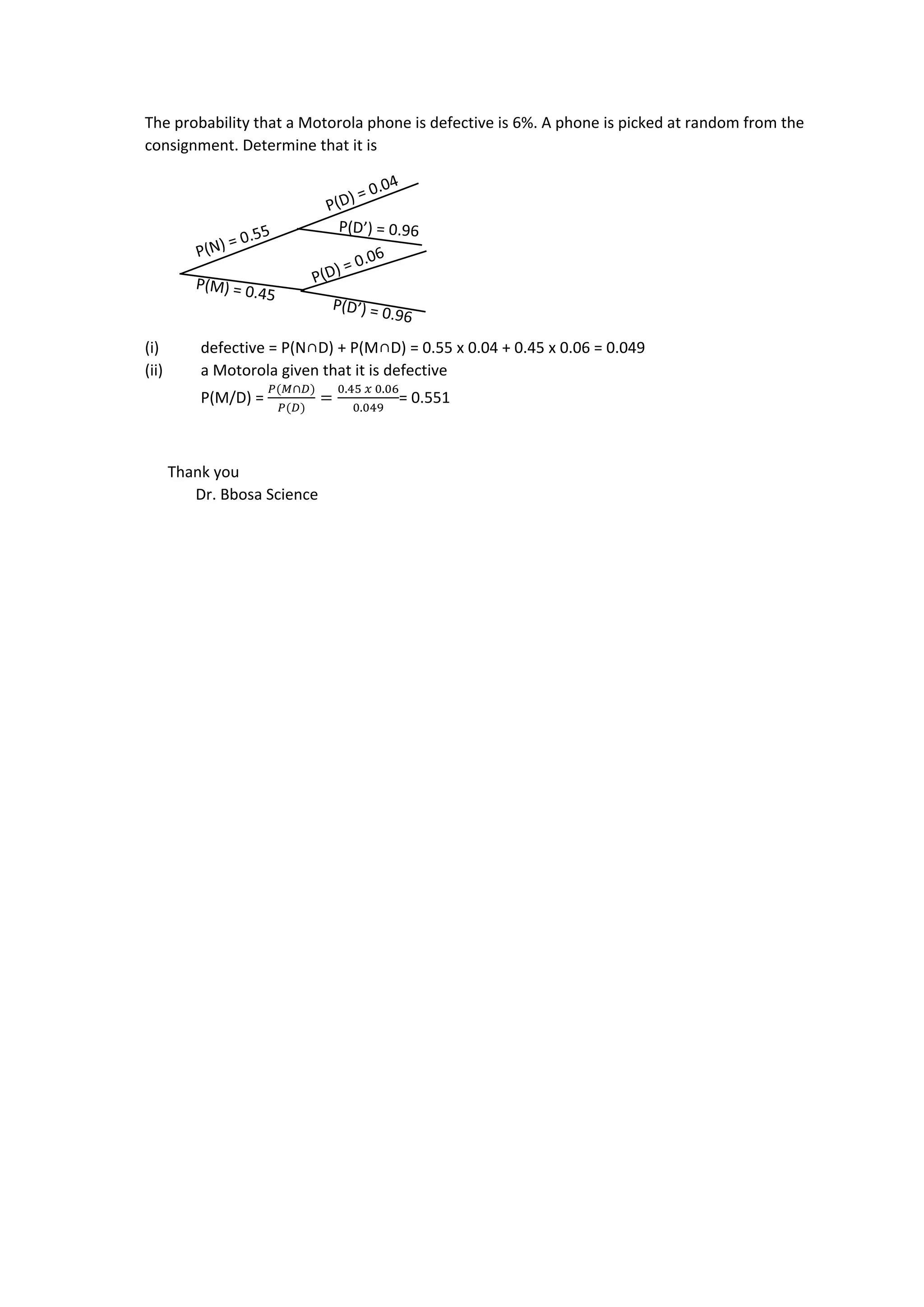

![[Junoon - E - Jee] - Probability - 13th Nov.pdf](https://cdn.slidesharecdn.com/ss_thumbnails/junoon-e-jee-probability-13thnov-220729074209-f7bdaf6a-thumbnail.jpg?width=640&height=640&fit=bounds)


