SESSION ID:
#RSAC
Andrew Case
Proactive Measures to Mitigate
Insider Threat
HUM-W03
Director of Research
Volexity
@attrc
#RSAC
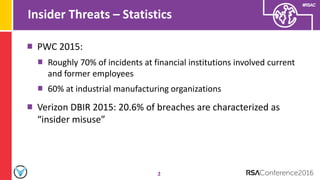
Insider Threats – Statistics
2
PWC 2015:
Roughly 70% of incidents at financial institutions involved current
and former employees
60% at industrial manufacturing organizations
Verizon DBIR 2015: 20.6% of breaches are characterized as
“insider misuse”
#RSAC
Insider Threat Defenses – Passive/Default
3
Examples
Production systems without extra logging or security measures
No automated alerts or remote logs generated
Pros
Simplest to implement
Provides the evidence needed for post-mortem forensics
Cons
Only useful after damage is caused
Can be fully disrupted by anti-forensics
Often very expensive and non-repeatable
#RSAC
Insider Threat Defenses - Detection
4
Examples
Log file accesses, software installation, and USB device usage
Generate alerts on access to file storage services (e.g., Dropbox)
Pros
If implemented correctly, finds activity before it causes harm
Less inhibiting than full prevention
Cons
If implemented incorrectly, finds activity after irreparable harm
Requires active effort by the security team
#RSAC
Insider Threat Defenses - Prevention
5
Examples
Prevent all removable media from being used
Block access to personal email and file storage services
Block end-users from installing software
Pros
Stops a technique before it can be used
Cheapest once implemented
Cons
Often clashes with a company’s office culture
Can inhibit department-specific productivity
#RSAC
Application to Real World Cases
6
We will now look at several real-world insider-threat cases that I
investigated
Combined, the insiders took over 100 million dollars of
IP/customers from their previous employers (my clients)
As I describe these cases, think about how your company would
currently fare against such malicious activity and what, if any,
mechanism(s) you have in place to detect the activity before
irreparable harm is done
#RSAC
The Bank Heist - Background
7
Employee of a financial institution sees greener pastures at a
competitor
Contacts competitor about bringing him and his team to the
competitor
Along with their very wealthy clients
Proceeds to take nearly every document related to the clients,
his team’s records, and client management forms
#RSAC
The Bank Heist – Forensic Analysis
8
File servers and internal web apps were scraped for sensitive
information
Moved data out of organization control through USB, personal
email, and printing
Files were locally deleted after being exfiltrated
The forensic timeline showed over 100 files taken and the
precise times that the actions occurred
#RSAC
Proactive Measures – File Search
9
Secure Network Architecture
Monitoring File Share Accesses
#RSAC
Proactive Measures – File Exfiltration
10
USB
Printing/Scanning
Personal Email
Cloud Storage*
* This case is several years old and cloud services were not very
popular then but are used extensively in modern, similar scenarios
#RSAC
Abuse of Power - Background
11
Plant manager at a manufacturing company was using “down
time” of the company’s machines to run a side business
He purchased some materials on his own, some were ordered
through the company’s accounts
Was only caught through a machine malfunction
#RSAC
Abuse of Power – Forensic Analysis
12
The rogue manager had logged into control systems during non-
client billable hours
The manager scheduled manufacturing jobs outside of any
legitimate work order
The manager deleted associated files in a failed attempt to cover
his tracks
#RSAC
Proactive Measures – Accounts & Systems
13
Technical measures
Monitor user logins
Monitor system usage
Business measures
No critical business processes should be controlled by one person
#RSAC
Offline Exfiltration - Background
14
Victim organization had very tight data exfiltration controls
Laptops utilized full disk encryption (FDE)
... but desktops did not!
Path to exfiltration:
1. Copy sensitive files to desktop during business hours
2. Remove hard drive before leaving and take home
3. Offline mount hard drive and copy files
#RSAC
Offline Exfiltration – Forensic Analysis
15
If done properly, this leaves no traces for (reasonable) forensics
to find
The employee in this instance could create, modify, and delete
files from the disk at will
Was only caught after making other “mistakes” and confessing to
the disk removal
#RSAC
Proactive Measures - Full Disk Encryption
16
Utilize FDE for everything!
Be wary of offline decrypt capabilities
The user knows his/her own password…
#RSAC
Anti-Forensics - Background
17
Two key employees leave the victim company simultaneously
Soon after, important clients end contracts
Previous employees’ equipment investigated for signs of
improper client interactions
#RSAC
Anti-Forensics – Forensics Analysis
18
Employees utilized heavy anti-forensics
Both factory reset their company provided Android phones
Employee 1 ran CCleaner before returning his computer
Employee 2 replaced the hard drive with one bought from
Amazon
#RSAC
Anti-Forensics – Proactive Measures
19
Tracking application downloads and installs
Application whitelisting
#RSAC
Proactive Measures – Employee Termination
20
Companies work against themselves by not properly assessing
and preserving employee equipment (laptops, desktops, phones,
tablets) post termination
These policies, or lack thereof, can inhibit forensic investigation,
legal proceeding, and recovery and understanding of stolen data
#RSAC
Bad Policy Examples
21
Re-install/re-purpose systems immediately upon employee
termination
No check of all system components against IT inventory
No check of historical removable media usage
#RSAC
Get Proactive Against Insider Threat
22
Within a month you should be able to identify:
Deficiencies that could allow for exfiltration
Deficiencies in key employee oversight
Policy deficiencies related to employee termination
Within three months be able to:
Remediate critical deficiencies
Have a working plan to remediate all deficiencies
#RSAC
Wrapping Up & Q/A
23
If you aren’t being proactive then you are just waiting to become
a victim
While insider threats are the most prevalent, they are also the
most preventable through proactive policy and technical controls
Contact info:
acase@volexity.com (3DE6E0C8)
@attrc

Proactive Measures to Mitigate Insider Threat

  • 1.
    SESSION ID: #RSAC Andrew Case ProactiveMeasures to Mitigate Insider Threat HUM-W03 Director of Research Volexity @attrc
  • 2.
    #RSAC Insider Threats –Statistics 2 PWC 2015: Roughly 70% of incidents at financial institutions involved current and former employees 60% at industrial manufacturing organizations Verizon DBIR 2015: 20.6% of breaches are characterized as “insider misuse”
  • 3.
    #RSAC Insider Threat Defenses– Passive/Default 3 Examples Production systems without extra logging or security measures No automated alerts or remote logs generated Pros Simplest to implement Provides the evidence needed for post-mortem forensics Cons Only useful after damage is caused Can be fully disrupted by anti-forensics Often very expensive and non-repeatable
  • 4.
    #RSAC Insider Threat Defenses- Detection 4 Examples Log file accesses, software installation, and USB device usage Generate alerts on access to file storage services (e.g., Dropbox) Pros If implemented correctly, finds activity before it causes harm Less inhibiting than full prevention Cons If implemented incorrectly, finds activity after irreparable harm Requires active effort by the security team
  • 5.
    #RSAC Insider Threat Defenses- Prevention 5 Examples Prevent all removable media from being used Block access to personal email and file storage services Block end-users from installing software Pros Stops a technique before it can be used Cheapest once implemented Cons Often clashes with a company’s office culture Can inhibit department-specific productivity
  • 6.
    #RSAC Application to RealWorld Cases 6 We will now look at several real-world insider-threat cases that I investigated Combined, the insiders took over 100 million dollars of IP/customers from their previous employers (my clients) As I describe these cases, think about how your company would currently fare against such malicious activity and what, if any, mechanism(s) you have in place to detect the activity before irreparable harm is done
  • 7.
    #RSAC The Bank Heist- Background 7 Employee of a financial institution sees greener pastures at a competitor Contacts competitor about bringing him and his team to the competitor Along with their very wealthy clients Proceeds to take nearly every document related to the clients, his team’s records, and client management forms
  • 8.
    #RSAC The Bank Heist– Forensic Analysis 8 File servers and internal web apps were scraped for sensitive information Moved data out of organization control through USB, personal email, and printing Files were locally deleted after being exfiltrated The forensic timeline showed over 100 files taken and the precise times that the actions occurred
  • 9.
    #RSAC Proactive Measures –File Search 9 Secure Network Architecture Monitoring File Share Accesses
  • 10.
    #RSAC Proactive Measures –File Exfiltration 10 USB Printing/Scanning Personal Email Cloud Storage* * This case is several years old and cloud services were not very popular then but are used extensively in modern, similar scenarios
  • 11.
    #RSAC Abuse of Power- Background 11 Plant manager at a manufacturing company was using “down time” of the company’s machines to run a side business He purchased some materials on his own, some were ordered through the company’s accounts Was only caught through a machine malfunction
  • 12.
    #RSAC Abuse of Power– Forensic Analysis 12 The rogue manager had logged into control systems during non- client billable hours The manager scheduled manufacturing jobs outside of any legitimate work order The manager deleted associated files in a failed attempt to cover his tracks
  • 13.
    #RSAC Proactive Measures –Accounts & Systems 13 Technical measures Monitor user logins Monitor system usage Business measures No critical business processes should be controlled by one person
  • 14.
    #RSAC Offline Exfiltration -Background 14 Victim organization had very tight data exfiltration controls Laptops utilized full disk encryption (FDE) ... but desktops did not! Path to exfiltration: 1. Copy sensitive files to desktop during business hours 2. Remove hard drive before leaving and take home 3. Offline mount hard drive and copy files
  • 15.
    #RSAC Offline Exfiltration –Forensic Analysis 15 If done properly, this leaves no traces for (reasonable) forensics to find The employee in this instance could create, modify, and delete files from the disk at will Was only caught after making other “mistakes” and confessing to the disk removal
  • 16.
    #RSAC Proactive Measures -Full Disk Encryption 16 Utilize FDE for everything! Be wary of offline decrypt capabilities The user knows his/her own password…
  • 17.
    #RSAC Anti-Forensics - Background 17 Twokey employees leave the victim company simultaneously Soon after, important clients end contracts Previous employees’ equipment investigated for signs of improper client interactions
  • 18.
    #RSAC Anti-Forensics – ForensicsAnalysis 18 Employees utilized heavy anti-forensics Both factory reset their company provided Android phones Employee 1 ran CCleaner before returning his computer Employee 2 replaced the hard drive with one bought from Amazon
  • 19.
    #RSAC Anti-Forensics – ProactiveMeasures 19 Tracking application downloads and installs Application whitelisting
  • 20.
    #RSAC Proactive Measures –Employee Termination 20 Companies work against themselves by not properly assessing and preserving employee equipment (laptops, desktops, phones, tablets) post termination These policies, or lack thereof, can inhibit forensic investigation, legal proceeding, and recovery and understanding of stolen data
  • 21.
    #RSAC Bad Policy Examples 21 Re-install/re-purposesystems immediately upon employee termination No check of all system components against IT inventory No check of historical removable media usage
  • 22.
    #RSAC Get Proactive AgainstInsider Threat 22 Within a month you should be able to identify: Deficiencies that could allow for exfiltration Deficiencies in key employee oversight Policy deficiencies related to employee termination Within three months be able to: Remediate critical deficiencies Have a working plan to remediate all deficiencies
  • 23.
    #RSAC Wrapping Up &Q/A 23 If you aren’t being proactive then you are just waiting to become a victim While insider threats are the most prevalent, they are also the most preventable through proactive policy and technical controls Contact info: acase@volexity.com (3DE6E0C8) @attrc