Blockchain and It's Practical Use Cases
Ken Bradberry, CTO Xerox Healthcare
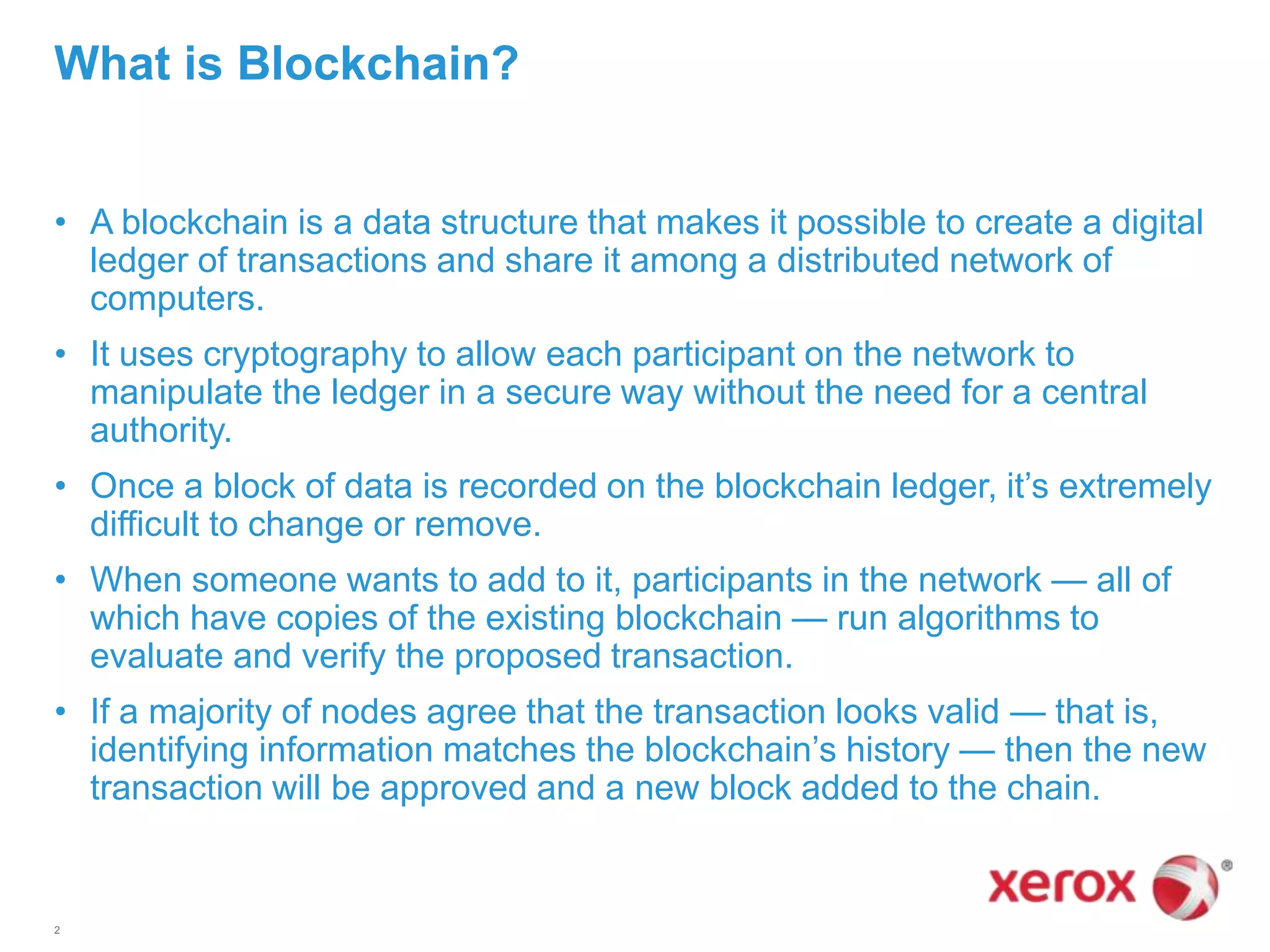
• A blockchain is a data structure that makes it possible to create a digital
ledger of transactions and share it among a distributed network of
computers.
• It uses cryptography to allow each participant on the network to
manipulate the ledger in a secure way without the need for a central
authority.
• Once a block of data is recorded on the blockchain ledger, it’s extremely
difficult to change or remove.
• When someone wants to add to it, participants in the network — all of
which have copies of the existing blockchain — run algorithms to
evaluate and verify the proposed transaction.
• If a majority of nodes agree that the transaction looks valid — that is,
identifying information matches the blockchain’s history — then the new
transaction will be approved and a new block added to the chain.
What is Blockchain?
2
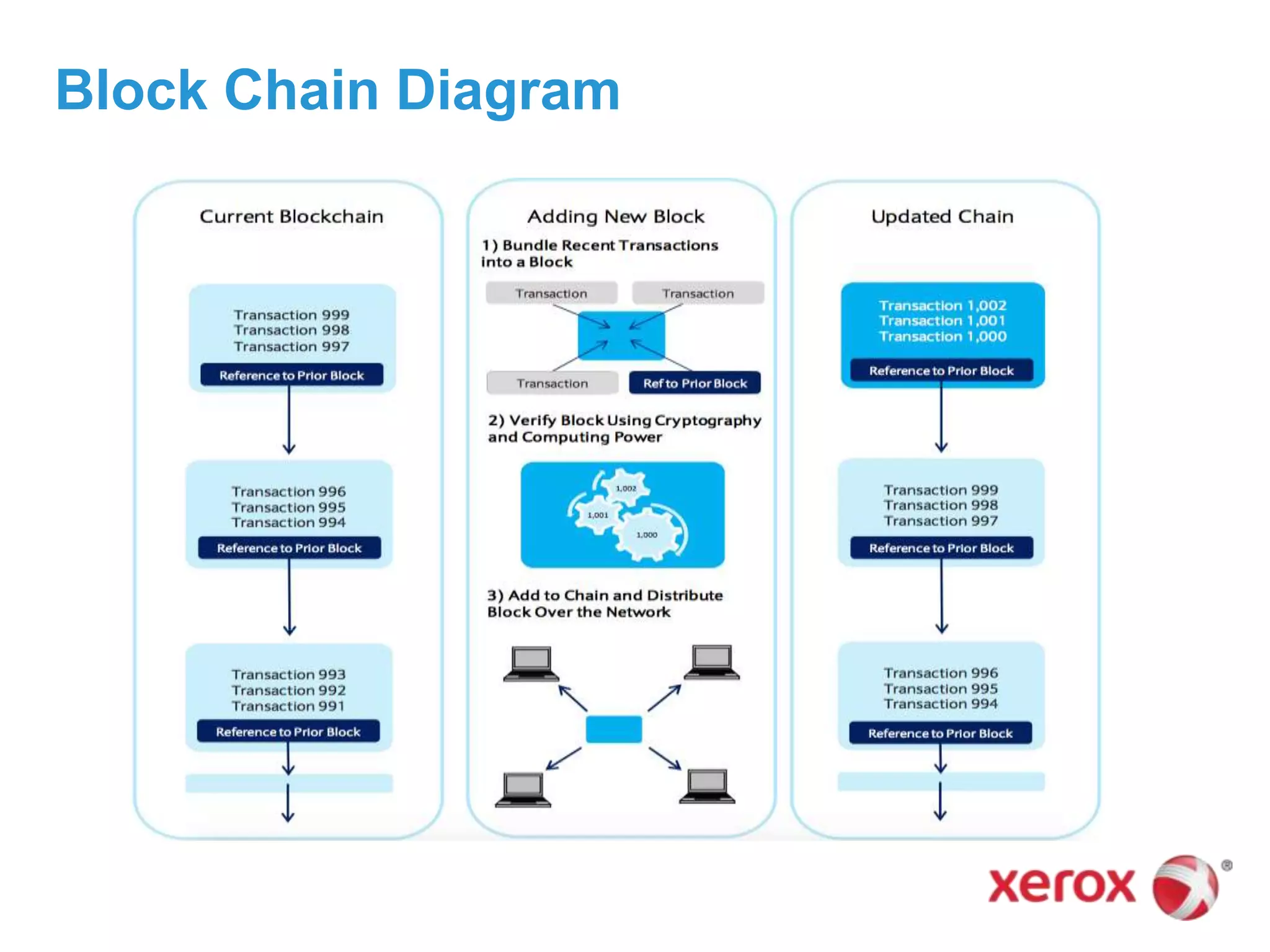
Block Chain Diagram
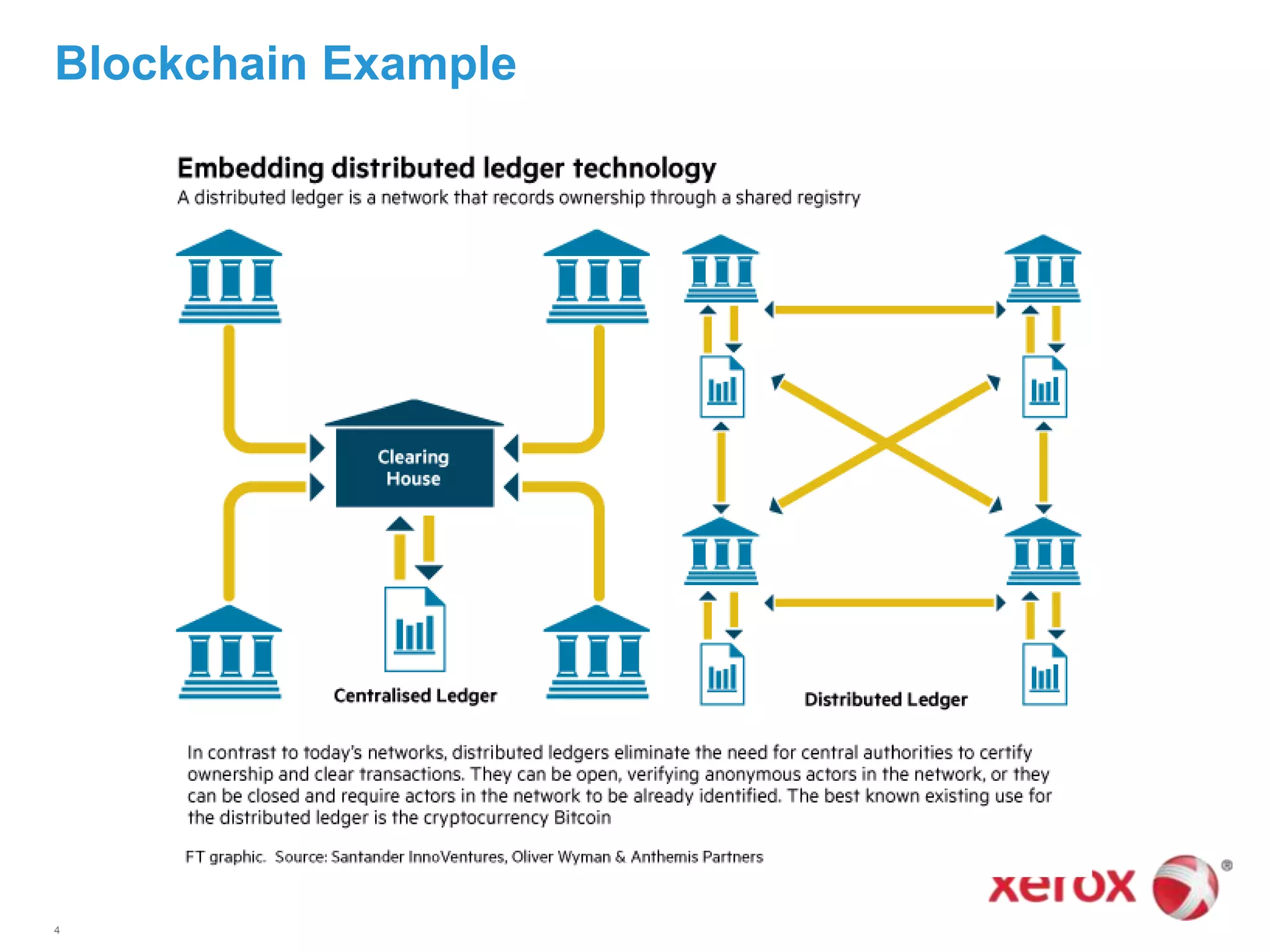
Blockchain Example
4
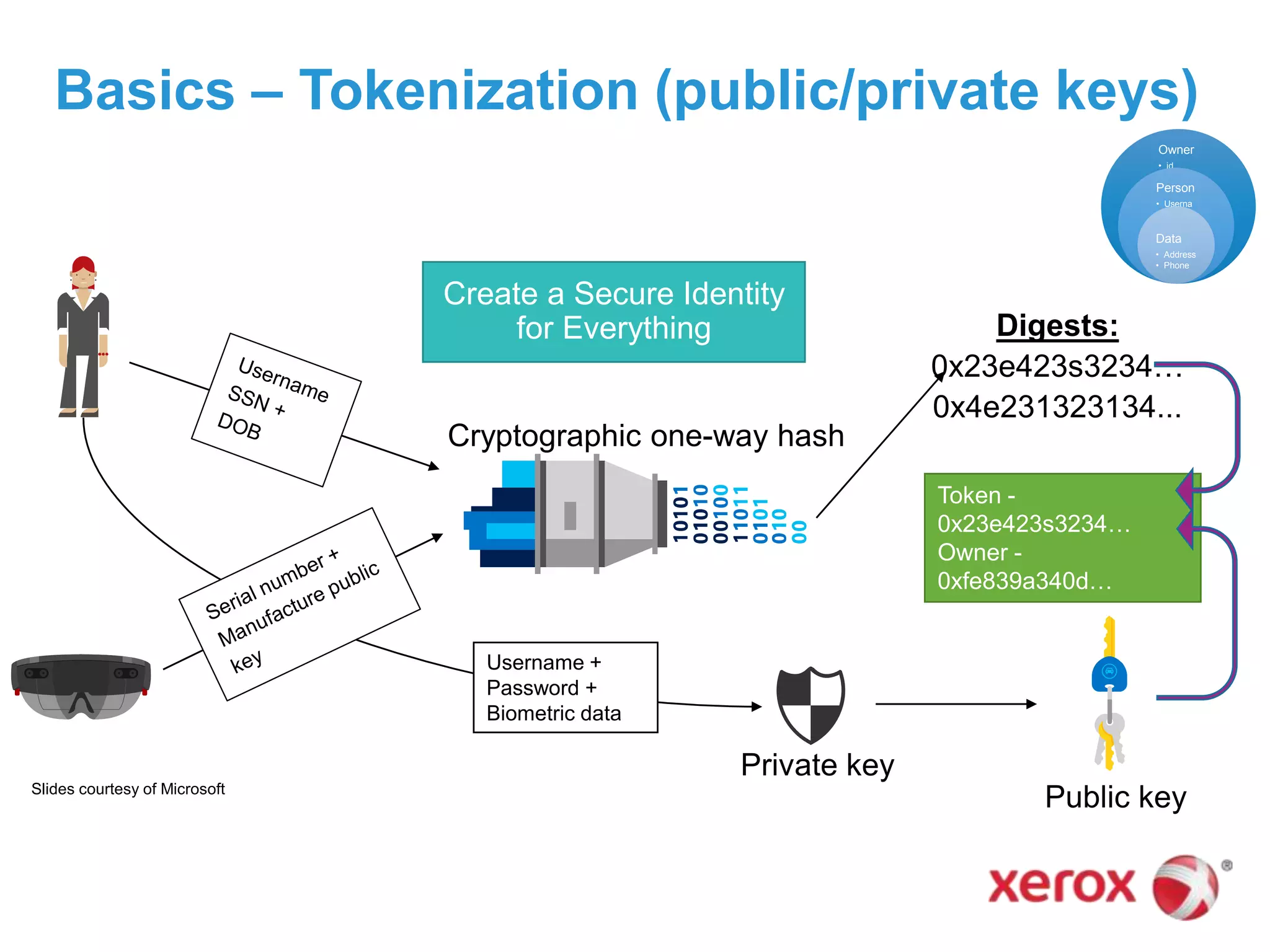
Username +
Password +
Biometric data
Basics – Tokenization (public/private keys)
Create a Secure Identity
for Everything
Token -
0x23e423s3234…
Owner -
0xfe839a340d…
Owner
• id
• proof
Person
• Userna
me
• SSN
• DOB
Data
• Address
• Phone
Slides courtesy of Microsoft
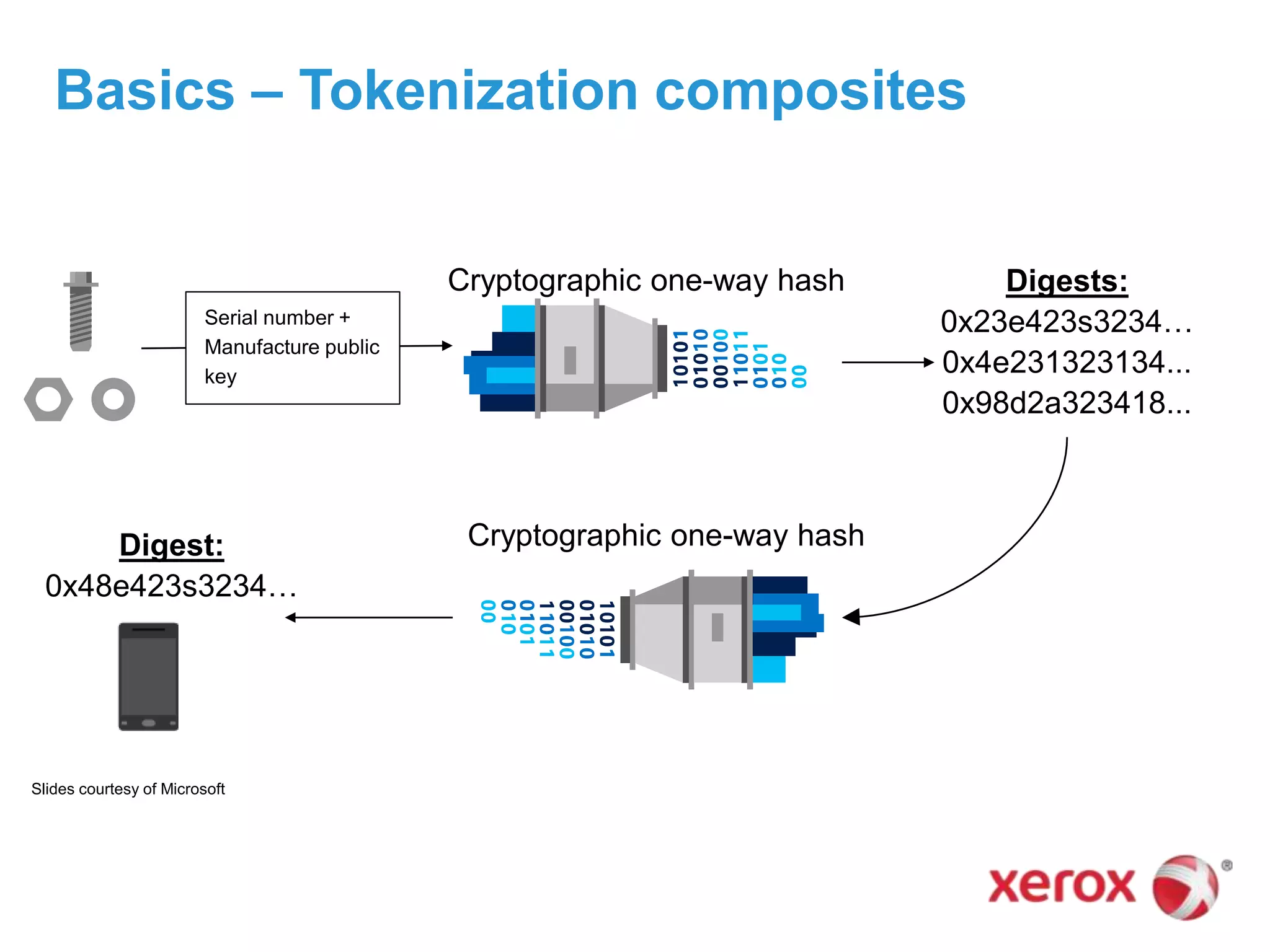
Basics – Tokenization composites
Slides courtesy of Microsoft
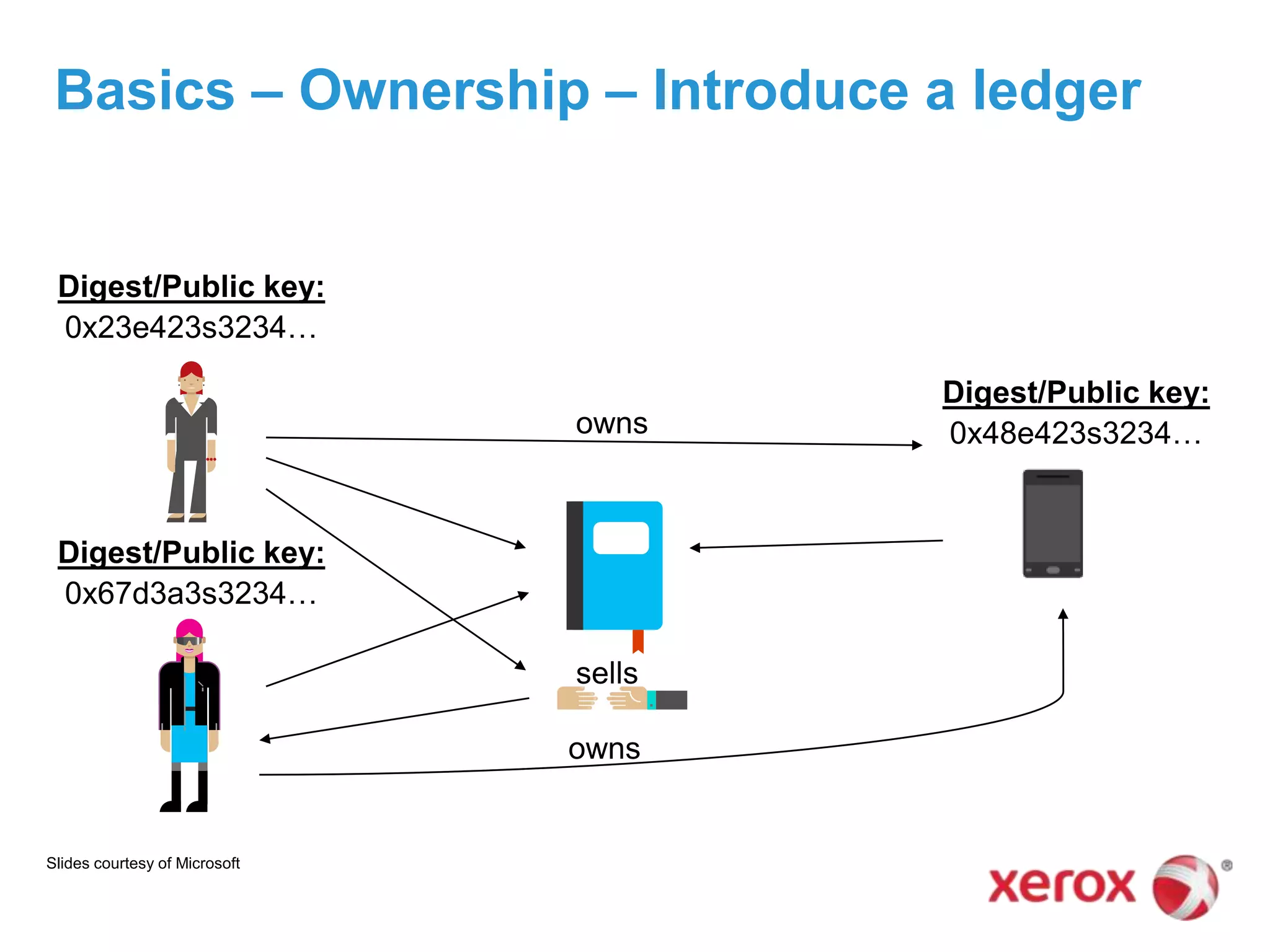
Basics – Ownership – Introduce a ledger
Slides courtesy of Microsoft
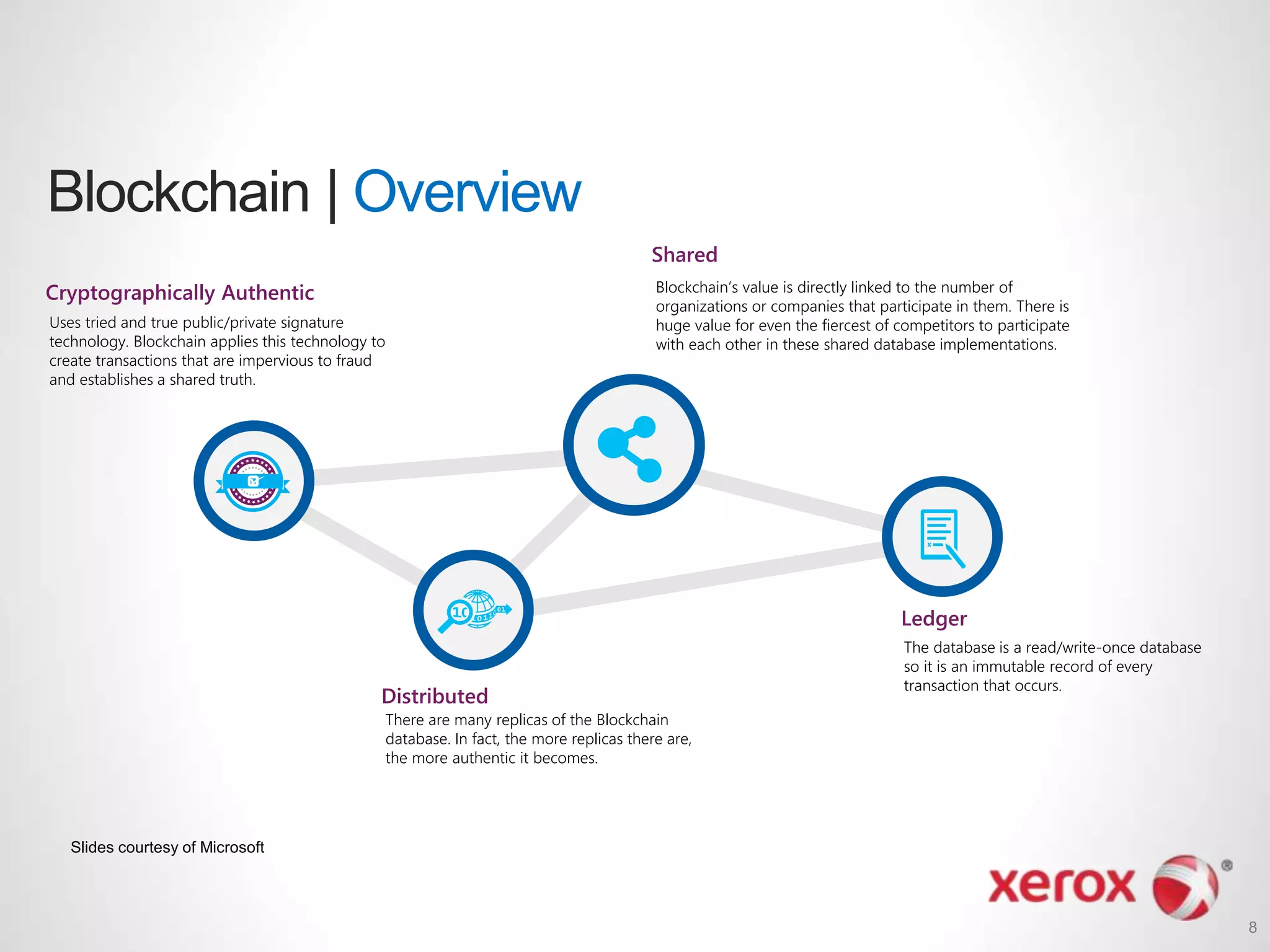
Blockchain | Overview
Cryptographically Authentic
Uses tried and true public/private signature
technology. Blockchain applies this technology to
create transactions that are impervious to fraud
and establishes a shared truth.
Shared
Blockchain’s value is directly linked to the number of
organizations or companies that participate in them. There is
huge value for even the fiercest of competitors to participate
with each other in these shared database implementations.
Distributed
There are many replicas of the Blockchain
database. In fact, the more replicas there are,
the more authentic it becomes.
Ledger
The database is a read/write-once database
so it is an immutable record of every
transaction that occurs.
8
Slides courtesy of Microsoft
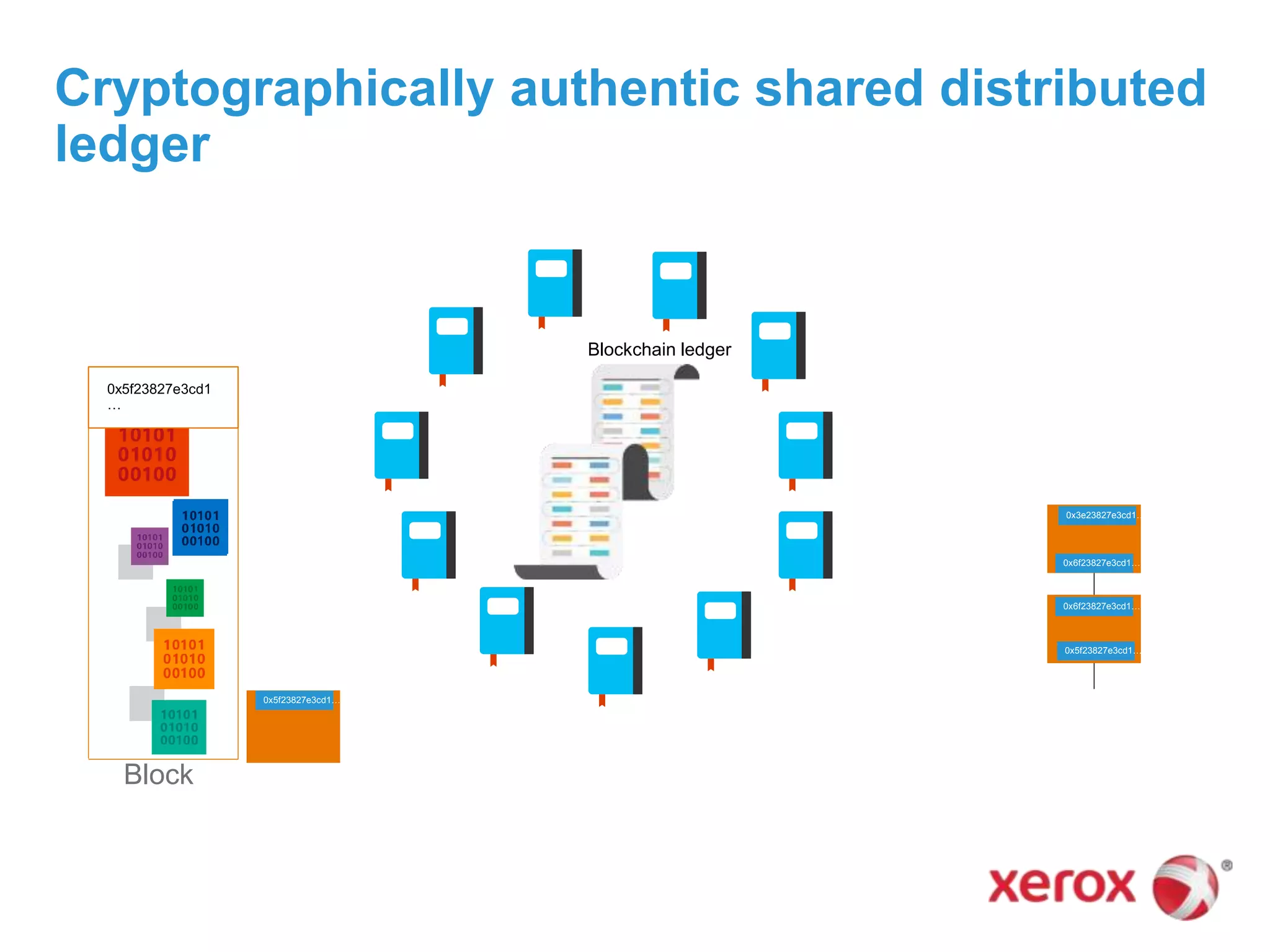
Cryptographically authentic shared distributed
ledger
Blockchain ledger
Block
0x5f23827e3cd1…
0x6f23827e3cd1…
0x3e23827e3cd1…
0x6f23827e3cd1…
0x5f23827e3cd1…
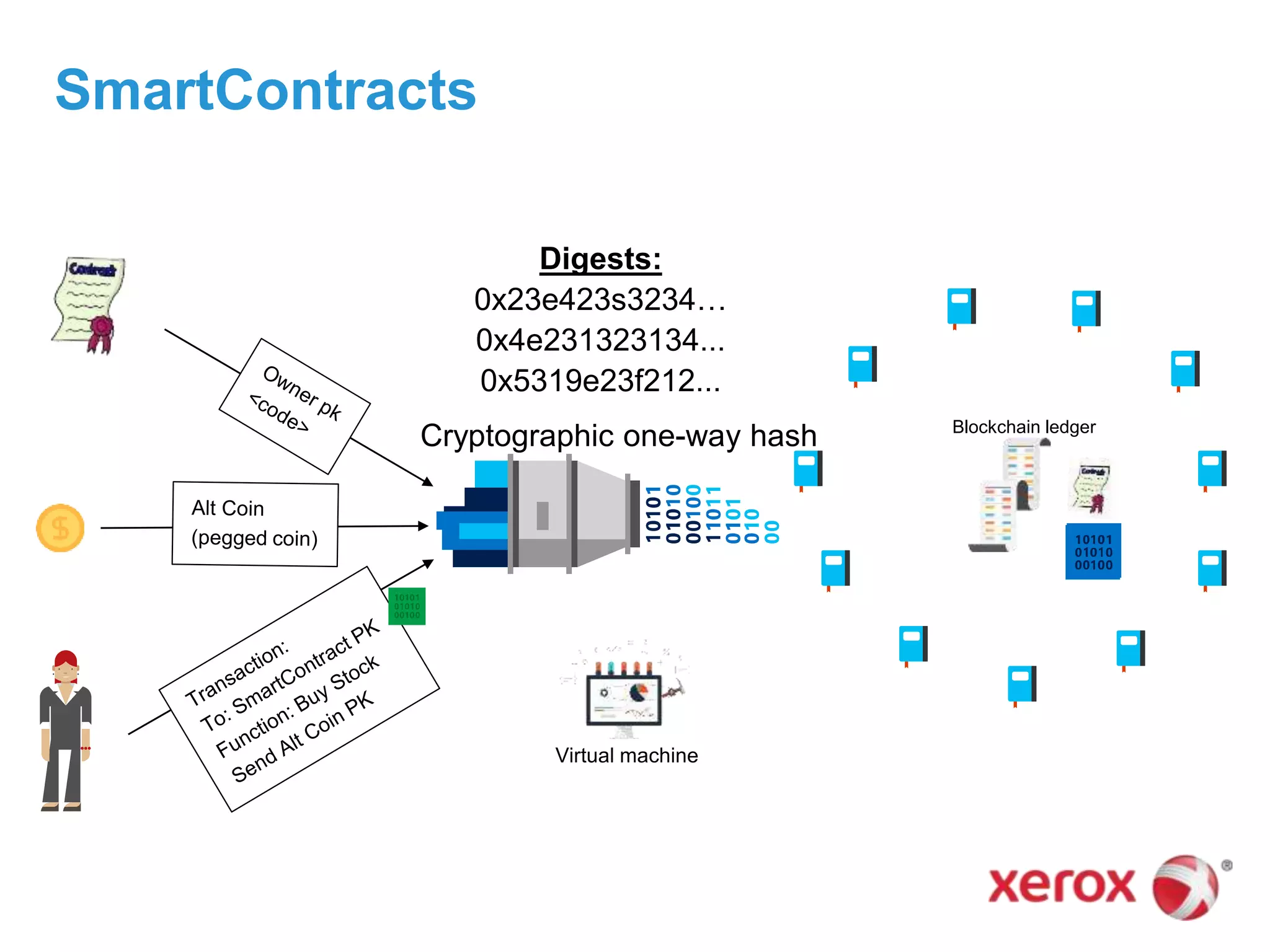
SmartContracts
Blockchain ledger
Payments and Remittance – Transactions can occur directly between
two parties on a frictionless P2P basis. The technology’s application for
overseas transactions has the potential to reduce risk, transaction costs
and to improve speed, efficiency and transparency.
Issuance, Ownership and Transfer of Financial Instruments – A
blockchain-based securities market allows traders to buy or sell stocks
directly on exchanges or directly to other market participants in a P2P
manner without the intermediation services provide by a broker or
clearinghouse.
Clearing and Settlement Latency – On the blockchain, the entire
lifecycle of a trade, including its execution, clearing and settlement can
occur at trade level, lowering post-trade latency and reducing counterparty
exposures.
Practical Use of Block Chain - Financial
Smart Contracts – Smart contracts would automatically pay providers
when conditions of service are established such as;
•Validation that a service was received by a registered Medicaid patient
•Service was provided by a properly registered doctor & provider
•Neither party is on a known list of past participants in any fraud
Cost Containment – The block chain can be filtered to identify and alert
about specific activity on the chain, monitoring, using patterns, can include
data that represents a doctor, consumer, drugs, procedures, all can to
tokenized and added to the chain.
• Building a rule base using best practices, CPT codes, ICD codes,
medical procedures and other costs can be monitored and audited
using blockchain.
Practical Use of Block Chain - Healthcare
12
EHR storage & security - Blockchain is a security technology at its core
and with the ever-present concern over the security of electronic health
records, it is likely to cater to this challenge first as it enters healthcare.
This approach can secure medical records and audit trails using the
Blockchain.
• We can do this by cryptographically encoding private medical data and
then a digital fingerprint is formed for time-stamping and verification
purposes.
DNA wallets – This concept stores genetic and medical data which is
again secured via the blockchain and accessed using private keys and
this will form a “DNA wallet”. This could allow healthcare providers to
securely share – and possibly monetize – patient data, helping
pharmaceutical companies to tailor drugs more efficiently.
Practical Use of Block Chain - Healthcare
Anti-counterfeit drugs – The industry is designing blockchain in the
fight against counterfeit drugs. It features panels on drug packages
that can be peeled or scratched off to reveal a unique verification tag.
This is then cross referenced with the blockchain to ensure that the
pharmaceutical product is legitimate.
Protein folding - Stanford University previously relied on expensive
super computers to simulate protein folding as it happens incredibly
fast.
• This method was obviously costly and had a single point of failure.
Using the blockchain, they can instead use a decentralized network
of over 170,000 computers to produce 40,000 teraflops of
computing power.
• This example will grab the attention of other industries that utilize
expensive supercomputers. This could even make its way into the
analytical space by utilizing a broad base of data for predictive
analytics.
The challenge when defining block chain technologies is how to position it
for the future. This use case explores patient identity and the delivery of
EMR and other patient information necessary to deliver healthcare.
• In the world that we live in and increasing over time is that each
human or patient is actually a conglomerate of a huge variety of data.
• In the past have had EMR’s and maybe that was adequate.
• The patient of the future is a composite of EMR data and the data
from other provider EMR’s be it a hospital, ambulatory or urgent care,
pharmacies, genomic data, huge data set from our wearables,
survey’s, implants and IoT.
Block Chain – Healthcare example
• The patient of the future is a vast collection of data.
• Currently when someone comes into a healthcare institution, all we
have today is a small database of data, and has some file that is
separated and might be faxed or in stacks of paper.
• With that requires a form of identity that connects that patient to the
data they are carrying or in a variety of databases where MR numbers
are different and patient information can be inconsistent.
• The potential of block chain utilized by the payer and provider can
streamline this process.
• The healthcare entities would join a block chain to have access to a
large network of verified and secure data.
Block Chain – Healthcare example
• When a patient comes to the hospital and wants care, the provider has
a method to see all the imaging data, EMR information.
• In additional all the wearable data, pharma data, genomic data, the
past claims data, because that provider is part of this block chain
network we have access to this information where the validity of the
data and identity is immutable and easy to access.
• The advantages of block chain enabled solution is that healthcare
providers will have a greater ability to treat patients, with a better
picture and understanding of the patient’s health.
• It will also save in costs, today in a fixed fee based healthcare system
when you run a redundant test the system makes money, in the future
value based model that will not be the case and that redundant
procedure will not be reimbursed, access via block chain can eliminate
that redundant test and reduce cost.
Block Chain – Healthcare example
• Block chain has the potential to improve treatment.
• This is the core mission for healthcare providers, to improve quality
and reduce the cost of healthcare by enabling the secure delivery of
data across multiple providers and modalities.
• Improve safety by providing a more reliable identity management
process and reduce the stress on patient’s when communicating
health information as they inherent more responsibility in their own
care.
Block Chain – Healthcare example
Enterprise Block chains need more
‒ How to work with existing systems
‒ Operations and management
‒ Privacy understanding
‒ Identity and Key Management
‒ Be great to have some analytics
‒ Tools need to improve
What’s missing?
How can CISO’s address the blockchain challenge?
“Blockchain has the potential to become a significant trust enabler in the CISO’s arsenal.
However, solutions are unclear, standards have yet to coalesce and regulation is far on the
horizon. CISOs must make informed technology decisions that align with the organization’s
risk appetite and tolerance.”
Block chain is not widely adopted in any industry, not in the least in
healthcare.
• So why should we sign up for an unproven technology?
• I do not discount the concept, just that when the broader market has not adopted it
begs the question. Now when I wake up tomorrow & see headlines that Microsoft is
using Blockchain to drive their new security software and their stock is up 25%, then
that will settle my skepticism….but until then…
From my perspective we still need to firm the problems we want to
solve…so I don’t much worry about the solution yet.
We now have the hammer and now we are looking for a nail.
Questions
©2016 Xerox Corporation. All rights reserved. Xerox®, Xerox and Design® and “Work Can Work Better” are trademarks of Xerox Corporation in
the United States and/or other countries.

Practical Applications of Block Chain Technologies

  • 1.
    Blockchain and It'sPractical Use Cases Ken Bradberry, CTO Xerox Healthcare
  • 2.
    • A blockchainis a data structure that makes it possible to create a digital ledger of transactions and share it among a distributed network of computers. • It uses cryptography to allow each participant on the network to manipulate the ledger in a secure way without the need for a central authority. • Once a block of data is recorded on the blockchain ledger, it’s extremely difficult to change or remove. • When someone wants to add to it, participants in the network — all of which have copies of the existing blockchain — run algorithms to evaluate and verify the proposed transaction. • If a majority of nodes agree that the transaction looks valid — that is, identifying information matches the blockchain’s history — then the new transaction will be approved and a new block added to the chain. What is Blockchain? 2
  • 3.
  • 4.
  • 5.
    Username + Password + Biometricdata Basics – Tokenization (public/private keys) Create a Secure Identity for Everything Token - 0x23e423s3234… Owner - 0xfe839a340d… Owner • id • proof Person • Userna me • SSN • DOB Data • Address • Phone Slides courtesy of Microsoft
  • 6.
    Basics – Tokenizationcomposites Slides courtesy of Microsoft
  • 7.
    Basics – Ownership– Introduce a ledger Slides courtesy of Microsoft
  • 8.
    Blockchain | Overview CryptographicallyAuthentic Uses tried and true public/private signature technology. Blockchain applies this technology to create transactions that are impervious to fraud and establishes a shared truth. Shared Blockchain’s value is directly linked to the number of organizations or companies that participate in them. There is huge value for even the fiercest of competitors to participate with each other in these shared database implementations. Distributed There are many replicas of the Blockchain database. In fact, the more replicas there are, the more authentic it becomes. Ledger The database is a read/write-once database so it is an immutable record of every transaction that occurs. 8 Slides courtesy of Microsoft
  • 9.
    Cryptographically authentic shareddistributed ledger Blockchain ledger Block 0x5f23827e3cd1… 0x6f23827e3cd1… 0x3e23827e3cd1… 0x6f23827e3cd1… 0x5f23827e3cd1…
  • 10.
  • 11.
    Payments and Remittance– Transactions can occur directly between two parties on a frictionless P2P basis. The technology’s application for overseas transactions has the potential to reduce risk, transaction costs and to improve speed, efficiency and transparency. Issuance, Ownership and Transfer of Financial Instruments – A blockchain-based securities market allows traders to buy or sell stocks directly on exchanges or directly to other market participants in a P2P manner without the intermediation services provide by a broker or clearinghouse. Clearing and Settlement Latency – On the blockchain, the entire lifecycle of a trade, including its execution, clearing and settlement can occur at trade level, lowering post-trade latency and reducing counterparty exposures. Practical Use of Block Chain - Financial
  • 12.
    Smart Contracts –Smart contracts would automatically pay providers when conditions of service are established such as; •Validation that a service was received by a registered Medicaid patient •Service was provided by a properly registered doctor & provider •Neither party is on a known list of past participants in any fraud Cost Containment – The block chain can be filtered to identify and alert about specific activity on the chain, monitoring, using patterns, can include data that represents a doctor, consumer, drugs, procedures, all can to tokenized and added to the chain. • Building a rule base using best practices, CPT codes, ICD codes, medical procedures and other costs can be monitored and audited using blockchain. Practical Use of Block Chain - Healthcare 12
  • 13.
    EHR storage &security - Blockchain is a security technology at its core and with the ever-present concern over the security of electronic health records, it is likely to cater to this challenge first as it enters healthcare. This approach can secure medical records and audit trails using the Blockchain. • We can do this by cryptographically encoding private medical data and then a digital fingerprint is formed for time-stamping and verification purposes. DNA wallets – This concept stores genetic and medical data which is again secured via the blockchain and accessed using private keys and this will form a “DNA wallet”. This could allow healthcare providers to securely share – and possibly monetize – patient data, helping pharmaceutical companies to tailor drugs more efficiently. Practical Use of Block Chain - Healthcare
  • 14.
    Practical Use ofBlock Chain - Healthcare Anti-counterfeit drugs – The industry is designing blockchain in the fight against counterfeit drugs. It features panels on drug packages that can be peeled or scratched off to reveal a unique verification tag. This is then cross referenced with the blockchain to ensure that the pharmaceutical product is legitimate. Protein folding - Stanford University previously relied on expensive super computers to simulate protein folding as it happens incredibly fast. • This method was obviously costly and had a single point of failure. Using the blockchain, they can instead use a decentralized network of over 170,000 computers to produce 40,000 teraflops of computing power. • This example will grab the attention of other industries that utilize expensive supercomputers. This could even make its way into the analytical space by utilizing a broad base of data for predictive analytics.
  • 15.
    The challenge whendefining block chain technologies is how to position it for the future. This use case explores patient identity and the delivery of EMR and other patient information necessary to deliver healthcare. • In the world that we live in and increasing over time is that each human or patient is actually a conglomerate of a huge variety of data. • In the past have had EMR’s and maybe that was adequate. • The patient of the future is a composite of EMR data and the data from other provider EMR’s be it a hospital, ambulatory or urgent care, pharmacies, genomic data, huge data set from our wearables, survey’s, implants and IoT. Block Chain – Healthcare example
  • 16.
    • The patientof the future is a vast collection of data. • Currently when someone comes into a healthcare institution, all we have today is a small database of data, and has some file that is separated and might be faxed or in stacks of paper. • With that requires a form of identity that connects that patient to the data they are carrying or in a variety of databases where MR numbers are different and patient information can be inconsistent. • The potential of block chain utilized by the payer and provider can streamline this process. • The healthcare entities would join a block chain to have access to a large network of verified and secure data. Block Chain – Healthcare example
  • 17.
    • When apatient comes to the hospital and wants care, the provider has a method to see all the imaging data, EMR information. • In additional all the wearable data, pharma data, genomic data, the past claims data, because that provider is part of this block chain network we have access to this information where the validity of the data and identity is immutable and easy to access. • The advantages of block chain enabled solution is that healthcare providers will have a greater ability to treat patients, with a better picture and understanding of the patient’s health. • It will also save in costs, today in a fixed fee based healthcare system when you run a redundant test the system makes money, in the future value based model that will not be the case and that redundant procedure will not be reimbursed, access via block chain can eliminate that redundant test and reduce cost. Block Chain – Healthcare example
  • 18.
    • Block chainhas the potential to improve treatment. • This is the core mission for healthcare providers, to improve quality and reduce the cost of healthcare by enabling the secure delivery of data across multiple providers and modalities. • Improve safety by providing a more reliable identity management process and reduce the stress on patient’s when communicating health information as they inherent more responsibility in their own care. Block Chain – Healthcare example
  • 19.
    Enterprise Block chainsneed more ‒ How to work with existing systems ‒ Operations and management ‒ Privacy understanding ‒ Identity and Key Management ‒ Be great to have some analytics ‒ Tools need to improve What’s missing?
  • 20.
    How can CISO’saddress the blockchain challenge? “Blockchain has the potential to become a significant trust enabler in the CISO’s arsenal. However, solutions are unclear, standards have yet to coalesce and regulation is far on the horizon. CISOs must make informed technology decisions that align with the organization’s risk appetite and tolerance.” Block chain is not widely adopted in any industry, not in the least in healthcare. • So why should we sign up for an unproven technology? • I do not discount the concept, just that when the broader market has not adopted it begs the question. Now when I wake up tomorrow & see headlines that Microsoft is using Blockchain to drive their new security software and their stock is up 25%, then that will settle my skepticism….but until then… From my perspective we still need to firm the problems we want to solve…so I don’t much worry about the solution yet. We now have the hammer and now we are looking for a nail. Questions
  • 21.
    ©2016 Xerox Corporation.All rights reserved. Xerox®, Xerox and Design® and “Work Can Work Better” are trademarks of Xerox Corporation in the United States and/or other countries.

Editor's Notes

  • #6 Start – 2 types of things – Unique and Non-Unique that need to be represented digitally. Unique like a person – typically represented digitally with user name and password – moving to bio metrics and multi authorization techniques, fingerprint, face scan, pin number from a specific cell phone. Non-unique like a cell phone – typically represented by a serial number assigned by the manufacturer. A SKU refers to its “type” which is not unique. Establishing this is called provenance. Enter a Cryptographic One-Way Hash – there are lots of these SHA-1, 2, MDA…etc Not important, but the concept is the same regardless of the function. The Cryptographic One-Way Hash creates a Deterministic Digest of its inputs. Meaning, if the values you put in are the same you will always get the same output or hash digest allowing you to use this identifier (also a public key) Unique items do not can be hashed as is, because they are unique...but how they are represented are the weak link here. Unique items usually “own” things that are non-unique. A non-unique thing represented as a serial number is a problem, because its identifier is only unique to its creator another product could have the same serial number from a different creator. Non-unique items also take multiple inputs to create a digest, public key of manufacturer, sku and mayby a nonce or most often a salt value. Anyway a Hash function produces a hash Digest that is often refered to as a public key, where the inputs that created the disgest are the private key. There is no way to determine the private key values from the public key...thus one-way. Basics in establishing a Digital Bearer Instrument. Establishing provenance, assigning ownership, transfering ownership, tracking modiftication and determining lineage across systems. So a person can create a public key with a combination of identifiers where a non-unique item requires similar inputs. This creates a public/private key pair which is the foundation for blockchain technology.
  • #7 A composite is a collection of public keys as inputs to create a digest for an item containing other items.
  • #8 Introduce a ledger to record these public keys and you can do all sorts of things. Record the provenance of things, assign ownership and transfer ownership.
  • #9 Cryptographically authentic shared distributed ledger Cryptographically authentic – each transaction recorded in the database is digitally signed and mathematically guaranteed to be authentic and impervious to fraud. The transaction was signed by the entity that has the private key. No question. The truth Shared – the database’s main value is that it is shared between separate entities, like companies. The more entities shared the greater the value Distributed – many copies of the database exist and they are replicas of each other in relative time Ledger – a write-once, thus immutable, ledger that records every transaction. The entire history of all transactions is available; math doesn’t lie and there is nowhere to hide Value – a shared ledger of truth between separate entities that may be competitors and/or partners with each other The rest is just how it is implemented
  • #10 So, logically there is a single ledger that is replicated to as many copies as possible. All copies are write once and read copies (immutable) and the synchronize transactions using something called a consensus algorithm. Transactions are written to a block, like a bucket. They stack on top of each other. Once the block is full, it gets capped (mined for proof of work consensus), capping is essentially hashing all the transactions in the block and starting a new block with the digest of the completed one thus linking the blocks in a chain. Mathematically, this creates a stronger truth the longer the chain.
  • #11 Start with someone creating a SmartContract to Sell a Stock That gets recorded as an address (PK) on the blockchain along with its code Enter in Mary Who has an Alt Coin on the chain that she can spend Mary wants to buy the stock offered in the smart contract Mary creates a transaction to the SmartContract to Buy the Stock with the Alt Coin as payment The Transaction gets sent to the SmartContract. The SmartContract receives the message, then executes the code to sell the SmartContract buy running the code in the Virtual Machine that: Executes the transfer of ownership of the stock from the Seller to the Buyer Transfers the Alt-Coin or a portion of its value for the stock to the Seller, pays any transaction fees out of the ALT-Coin as well Does any other logic it needs to perform in order to complete the transaction.