Strategic Management
Concepts & Cases
8th edition
Fred R.David
Chapter 9:
Strategy Review,
Evaluation, & Control
Strategy Review
Thefirm’s internal and externalenvironments
are dynamic. Therefore, the best
conceived and implemented strategies
become obsolete!
Strategy Evaluation—the 3 Basics
1. Examining the underlying basis of the firm’s
strategy
2. Comparing actual to expected results
3. Taking corrective action to address
performance gaps
Exhibit 17–6 Managerial Decisions in the Control
Process
opyright © 2010 Pearson Education, Inc.C
Publishing as Prentice Hall
17–4
Strategy Review
Effective StrategyEvaluation
• Adequate and timely feedback
Thecornerstone of effective
evaluation
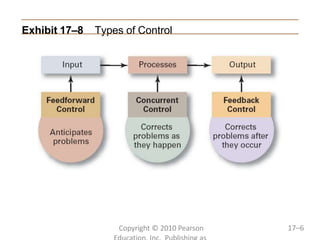
Exhibit 17–8 Types of Control
Copyright © 2010 Pearson 17–6
Copyright © 2010 Pearson 17–7
Tools for Measuring Organizational
Performance
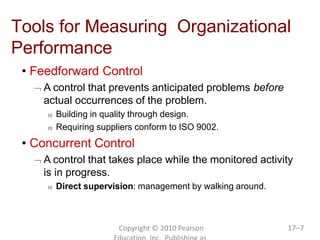
• Feedforward Control
 A control that prevents anticipated problems before
actual occurrences of the problem.
 Building in quality through design.
 Requiring suppliers conform to ISO 9002.
• Concurrent Control
 A control that takes place while the monitored activity
is in progress.
 Direct supervision: management by walking around.
Copyright ©in2fo0r1m0aPteioanrsoonnEhodouwcawtieollnl,thInecy.
Publishing as Prentice Hall
are doing.
17–8
Tools for Measuring
Organizational Performance
(cont’d)
• Feedback Control
 A control that takes place after an activity is done.
 Corrective action is after-the-fact, when the problem has
already occurred.
 Advantages of feedback controls:
 Provide managers with information on the effectiveness of
their planning efforts.
 Enhance employee motivation by providing them with
Strategy Review
StrategyEvaluation
• Must haveboth
Short- & long-termfocus
Strategy Review
Four Criteria (RichardRumelt):
• Consistency
• Consonance
• Feasibility
• Advantage
Consistency
A strategy should not present inconsistent
goals and policies
• If managerial problems continue despite changes in
personnel and are issue based, then strategies may be
inconsistent.
• If success for one department means failure for another
department, then strategies may be inconsistent.
• If policy problems/issues continue to be brought to the
top for resolution, then strategies may be inconsistent.
Exhibit 17–4 Defining the Acceptable Range of
Variation
Copyright © 2010 Pearson 17–12
Consonance
Strategists need to examine sets of trends as well
as individual trends in evaluating strategies.
• Strategy must represent an adaptive response to the
external environment and critical changes occurring
within it.
• Most trends are the result of interactions among other
trends.
• Difficult in matching key internal and external factors in
formulation of strategy.
Feasibility
© 2001 Prentice Hall
Ch. 9-9
Strategy must neither overtax available resources
nor create unsolvable subproblems.
• Can the strategy be attempted within the physical,
human and financial resources of the enterprise?
• Limitation on strategic choice imposed by individual and
organizational capabilities must be considered.
• Important to examine whether in the past the
organization has demonstrated the capabilities, abilities,
competencies, skills, and talents to carry out strategy.
Strategy Review
• Increase in environment’s
complexity
• Difficulty in predicting the
future with accuracy
• Increasing number of
variables
Contemporary
Strategy
Evaluation
Difficulties
Strategy Review
• Rate of obsolescence of even
the best plans
• Increase in domestic and
world events
• Decreasing time span for
which planning can be done
with any certainty
Contemporary
Strategy
Evaluation
Difficulties
Strategy Review
Processof EvaluatingStrategies:
• Should initiate managerial questioning of
expectations and assumptions
• Should trigger areview of objectivesand
values
• Should stimulate creativity in generating
alternatives and criteria of evaluation
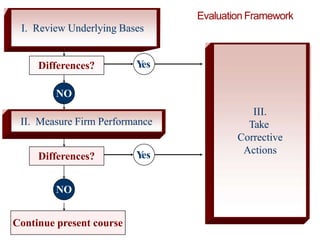
Evaluation Framework
I. Review Underlying Bases
Continue present course
II. Measure Firm Performance
III.
Take
Corrective
Actions
Differences?
Differences?
Yes
NO
Yes
NO
I. Review Basesof Strategy
• Develop aRevisedEFEMatrix:
• How have competitors reacted to our
strategies?
• How have competitors’ strategies changed?
• Havemajor competitors’ strengthsand
weaknesses changed?
I. Review Basesof Strategy
• Why are competitors making certain
strategic changes?
• Why are somecompetitors’strategies
more successfulthan others?
• How satisfied are our competitorswith
their present market positions and
profitability?
I. Review Basesof Strategy
• How far can our major competitorsbe
pushedbefore retaliating?
• How could we more effectively cooperate
with ourcompetitors?
I. Review Basesof Strategy
KeyQuestions in Evaluating Strategy:
• Are our internal strengths stillstrengths?
• Havewe added other internal strengths?
• Are our internal weaknesses still weaknesses?
I. Review Basesof Strategy
• Dowe now have other internal
weaknesses?
• Are our external opportunities still
opportunities?
• Are there now externalopportunities?
I. Review Basesof Strategy
• Are our external threats stillthreats?
• Are there now other externalthreats?
• Are we vulnerable to a hostiletakeover?
II. Measure Performance
• Comparethe firm’s performanceover
different time periods.
• Comparethe firm’s performanceto
competitors.
• Compare the firm’s performanceto
industry averages.
II. Measure Performance
QuantitativeAnalysis:
 Return on investment
 Return on equity
 Profit margin
 Market share
 Debt to equity
 Earningsper share
 Salesgrowth
 Asset growth
Copyright © 2010 Pearson 17–27
Financial
Controls• Traditional Controls
 Ratio analysis
 Liquidity
 Leverage
 Activity
 Profitability
 Budget Analysis
 Quantitative standards
 Deviations
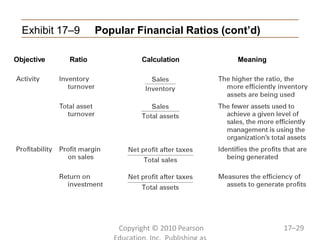
Exhibit 17–9 Popular Financial Ratios
Objective
Copyright © 2010 Pearson 17–28
Ratio Calculation Meaning
Exhibit 17–9 Popular Financial Ratios (cont’d)
Objective
Copyright © 2010 Pearson 17–29
Ratio Calculation Meaning
II. Measure Performance
QualitativeAnalysis:
 Isthe strategy internally consistent?
 Isthe strategy consistent with the
environment?
 Isthe strategy appropriate in viewof
available resources?
 Doesthe strategy involve anacceptable
degree of risk?
Copyright © 2010 Pearson 17–31
Information Controls
• Purposes of Information Controls
 As a tool to help managers control other
organizational activities.
 Managers need the right information at the right time and in
the right amount.
 As an organizational area that managers need to
control.
 Managers must have comprehensive and secure controls in
place to protect the organization’s important information.
Copyright © 2010 Pearson 17–32
Information Controls (cont’d)
• Management Information Systems (MIS)
 A system used to provide management with needed
information on a regular basis.
 Data: an unorganized collection of raw, unanalyzed facts
(e.g., unsorted list of customer names).
 Information: data that has been analyzed and organized
such that it has value and relevance to managers.
Copyright © 2010 Pearson 17–33
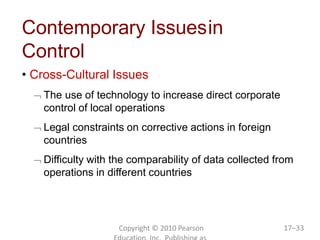
Contemporary Issuesin
Control
• Cross-Cultural Issues
 The use of technology to increase direct corporate
control of local operations
 Legal constraints on corrective actions in foreign
countries
 Difficulty with the comparability of data collected from
operations in different countries
Copyrighte©m2p0lo1y0ePeeparrrsoodnucEctdivuictya.tion,Inc.
Publishing as Prentice Hall
17–34
Contemporary Issuesin
Control (cont’d)
• Workplace Concerns
 Workplace privacy versus workplace monitoring:
 E-mail, telephone, computer, and Internet usage
 Productivity, harassment, security, confidentiality, intellectual
property protection
 Employee theft
 The unauthorized taking of company property by employees
for their personal use.
 Workplace violence
 Anger, rage, and violence in the workplace is affecting
Pearson Education, Inc.
Exhibit 17–11 Top Internet Video Sites Viewed
at Work
Top 10 Internet video brands viewed in the U.S. while
at work for January 2008, in millions of streams
Watching,” Wall Street Journal,
PMuarbchl4i,s2h00i8n,pg.B3a. s Prentice Hall
17–35
YouTube 674.2
Yahoo 156.5
Fox Interactive Media 92.8
MSN/Windows Live 74.2
ESPN 68.3
CNN Digital 41.6
Turner Entertainment 41.4
NBC Universal 30.5
Disney Online 27.2
Source: Bobby White, “The New
CWoorkpplayceriRgulehs:tN©o
Vid2eo010
Nickelodeon 23.5
Copyright © 2010 Pearson Education, Inc.
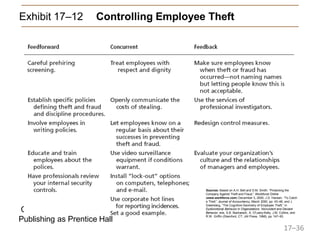
Exhibit 17–12 Controlling Employee Theft
Sources: Based on A.H. Bell and D.M. Smith. “Protecting the
Company Against Theft and Fraud,” Workforce Online
(www.workforce.com) December 3, 2000; J.D. Hansen. “To Catch
a Thief,” Journal of Accountancy, March 2000, pp. 43–46; and J.
Greenberg, “The Cognitive Geometry of Employee Theft,” in
Dysfunctional Behavior in Organizations: Nonviolent and Deviant
Behavior, eds. S.B. Bacharach, A. O’Leary-Kelly, J.M. Collins, and
Publishing as Prentice Hall
R.W. Griffin (Stamford, CT: JAI Press, 1998), pp. 147–93.
17–36
18 and Over, in “Desk Rage.” BusinessWeek, November 20, 2000, p. 12.
17–37
Exhibit 17–13 Workplace Violence
Witnessed yelling or other verbal abuse 42%
Yelled at co-workers themselves 29%
Cried over work-related issues 23%
Seen someone purposely damage
machines or furniture 14%
Seen physical violence in the workplace 10%
Struck a co-worker 2%
Copyright © 2010 Pearson Education, Inc.
PSo
uurc
be:
liIn
ste
hgr
ia
nR
gealt
ayR
ses
Pour
rc
ees,
nO
tc
ito
cb
eer-N
Hove
am
lb
lerSurvey of Adults
Exhibit 17–14 Controlling Workplace Violence
Sources: Based on M. Gorkin, “Five Strategies and Structures for Reducing
Workplace Violence,” Workforce Online (www.workforce.com). December
3, 2000; “Investigating Workplace Violence: Where Do You Start?”
Workforce Online (www.forceforce.com), December 3, 2000; “Ten Tips
on Recognizing and Minimizing Violence,” Workforce Online
(www.workforce.com), December 3, 2000; and “Points to Cover in a
Workplace Violence Policy,” Workforce Online (www.workforce.com),
ght © 2010 Pearson Education, Inc.Copyri
Publishing as Prentice Hall
December 3, 2000.
17–38
II. Measure Performance
QualitativeAnalysis:
 Doesthe strategy havean appropriate time
framework?
 Isthe strategyworkable?
III. TakeCorrective Action
Making changes to reposition afirm
competitively for thefuture
Strategy-Evaluation AssessmentMatrix
Corrective actions
Corrective actions
Corrective actions
Corrective actions
Corrective actions
Corrective actions
Corrective actions
Continue course
No
Yes
No
Yes
No
Yes
No
Yes
No
Yes
Yes
No
No
Yes
Yes
No
No
Yes
Yes
Yes
Yes
No
No
No
Result
Has the firm
progressed
satisfactorily toward
achieving its stated
objectives?
Have major
changes
occurred in
the firm’s
external
strategic
position?
Have major
changes
occurred in
the firm’s
internal
strategic
position?
Strategy Review
Characteristics of an effectivesystem
• Evaluation activities must beeconomical.
• Evaluation activities must bemeaningful.
Strategy Review
Characteristics of an effectivesystem
• Evaluation activities must providetimely
information.
• Evaluation system should be designed to
provide atrue picture of what is
happening.
Strategy Review
Characteristics of an effectivesystem
• Information derived from evaluation
processshould facilitate action.
• Evaluation process should not dominate
decisions.
Strategy Review
ContingencyPlanning
• Identify both beneficial andunfavorable
events that could possibly derail the
strategy or strategies.
• Specify trigger points. Calculate about
when contingent events are likely tooccur.
Strategy Review
ContingencyPlanning
• Assessthe impact of eachcontingent
event. Estimate the potential benefitor
harm of eachcontingentevent.
• Develop contingency plans. Insure that
they are compatible with currentstrategy
and are economically feasible.
Strategy Review
ContingencyPlanning
• Assessthe counterimpact of each
contingency plan. This quantifies the
potential value of eachplan.
• Determine early warning signals for key
contingent events.
• Develop advance action plans to take
advantage of available leadtime.
Strategy Review
Auditing
• Financial audits to determine
correspondence between assertionsbased
on strategic plans and establishedcriteria
• Environmental audits to insure soundand
safe practices

Strategic Management chap09

  • 1.
    Strategic Management Concepts &Cases 8th edition Fred R.David Chapter 9: Strategy Review, Evaluation, & Control
  • 2.
    Strategy Review Thefirm’s internaland externalenvironments are dynamic. Therefore, the best conceived and implemented strategies become obsolete!
  • 3.
    Strategy Evaluation—the 3Basics 1. Examining the underlying basis of the firm’s strategy 2. Comparing actual to expected results 3. Taking corrective action to address performance gaps
  • 4.
    Exhibit 17–6 ManagerialDecisions in the Control Process opyright © 2010 Pearson Education, Inc.C Publishing as Prentice Hall 17–4
  • 5.
    Strategy Review Effective StrategyEvaluation •Adequate and timely feedback Thecornerstone of effective evaluation
  • 6.
    Exhibit 17–8 Typesof Control Copyright © 2010 Pearson 17–6
  • 7.
    Copyright © 2010Pearson 17–7 Tools for Measuring Organizational Performance • Feedforward Control  A control that prevents anticipated problems before actual occurrences of the problem.  Building in quality through design.  Requiring suppliers conform to ISO 9002. • Concurrent Control  A control that takes place while the monitored activity is in progress.  Direct supervision: management by walking around.
  • 8.
    Copyright ©in2fo0r1m0aPteioanrsoonnEhodouwcawtieollnl,thInecy. Publishing asPrentice Hall are doing. 17–8 Tools for Measuring Organizational Performance (cont’d) • Feedback Control  A control that takes place after an activity is done.  Corrective action is after-the-fact, when the problem has already occurred.  Advantages of feedback controls:  Provide managers with information on the effectiveness of their planning efforts.  Enhance employee motivation by providing them with
  • 9.
    Strategy Review StrategyEvaluation • Musthaveboth Short- & long-termfocus
  • 10.
    Strategy Review Four Criteria(RichardRumelt): • Consistency • Consonance • Feasibility • Advantage
  • 11.
    Consistency A strategy shouldnot present inconsistent goals and policies • If managerial problems continue despite changes in personnel and are issue based, then strategies may be inconsistent. • If success for one department means failure for another department, then strategies may be inconsistent. • If policy problems/issues continue to be brought to the top for resolution, then strategies may be inconsistent.
  • 12.
    Exhibit 17–4 Definingthe Acceptable Range of Variation Copyright © 2010 Pearson 17–12
  • 13.
    Consonance Strategists need toexamine sets of trends as well as individual trends in evaluating strategies. • Strategy must represent an adaptive response to the external environment and critical changes occurring within it. • Most trends are the result of interactions among other trends. • Difficult in matching key internal and external factors in formulation of strategy.
  • 14.
    Feasibility © 2001 PrenticeHall Ch. 9-9 Strategy must neither overtax available resources nor create unsolvable subproblems. • Can the strategy be attempted within the physical, human and financial resources of the enterprise? • Limitation on strategic choice imposed by individual and organizational capabilities must be considered. • Important to examine whether in the past the organization has demonstrated the capabilities, abilities, competencies, skills, and talents to carry out strategy.
  • 15.
    Strategy Review • Increasein environment’s complexity • Difficulty in predicting the future with accuracy • Increasing number of variables Contemporary Strategy Evaluation Difficulties
  • 16.
    Strategy Review • Rateof obsolescence of even the best plans • Increase in domestic and world events • Decreasing time span for which planning can be done with any certainty Contemporary Strategy Evaluation Difficulties
  • 17.
    Strategy Review Processof EvaluatingStrategies: •Should initiate managerial questioning of expectations and assumptions • Should trigger areview of objectivesand values • Should stimulate creativity in generating alternatives and criteria of evaluation
  • 18.
    Evaluation Framework I. ReviewUnderlying Bases Continue present course II. Measure Firm Performance III. Take Corrective Actions Differences? Differences? Yes NO Yes NO
  • 19.
    I. Review BasesofStrategy • Develop aRevisedEFEMatrix: • How have competitors reacted to our strategies? • How have competitors’ strategies changed? • Havemajor competitors’ strengthsand weaknesses changed?
  • 20.
    I. Review BasesofStrategy • Why are competitors making certain strategic changes? • Why are somecompetitors’strategies more successfulthan others? • How satisfied are our competitorswith their present market positions and profitability?
  • 21.
    I. Review BasesofStrategy • How far can our major competitorsbe pushedbefore retaliating? • How could we more effectively cooperate with ourcompetitors?
  • 22.
    I. Review BasesofStrategy KeyQuestions in Evaluating Strategy: • Are our internal strengths stillstrengths? • Havewe added other internal strengths? • Are our internal weaknesses still weaknesses?
  • 23.
    I. Review BasesofStrategy • Dowe now have other internal weaknesses? • Are our external opportunities still opportunities? • Are there now externalopportunities?
  • 24.
    I. Review BasesofStrategy • Are our external threats stillthreats? • Are there now other externalthreats? • Are we vulnerable to a hostiletakeover?
  • 25.
    II. Measure Performance •Comparethe firm’s performanceover different time periods. • Comparethe firm’s performanceto competitors. • Compare the firm’s performanceto industry averages.
  • 26.
    II. Measure Performance QuantitativeAnalysis: Return on investment  Return on equity  Profit margin  Market share  Debt to equity  Earningsper share  Salesgrowth  Asset growth
  • 27.
    Copyright © 2010Pearson 17–27 Financial Controls• Traditional Controls  Ratio analysis  Liquidity  Leverage  Activity  Profitability  Budget Analysis  Quantitative standards  Deviations
  • 28.
    Exhibit 17–9 PopularFinancial Ratios Objective Copyright © 2010 Pearson 17–28 Ratio Calculation Meaning
  • 29.
    Exhibit 17–9 PopularFinancial Ratios (cont’d) Objective Copyright © 2010 Pearson 17–29 Ratio Calculation Meaning
  • 30.
    II. Measure Performance QualitativeAnalysis: Isthe strategy internally consistent?  Isthe strategy consistent with the environment?  Isthe strategy appropriate in viewof available resources?  Doesthe strategy involve anacceptable degree of risk?
  • 31.
    Copyright © 2010Pearson 17–31 Information Controls • Purposes of Information Controls  As a tool to help managers control other organizational activities.  Managers need the right information at the right time and in the right amount.  As an organizational area that managers need to control.  Managers must have comprehensive and secure controls in place to protect the organization’s important information.
  • 32.
    Copyright © 2010Pearson 17–32 Information Controls (cont’d) • Management Information Systems (MIS)  A system used to provide management with needed information on a regular basis.  Data: an unorganized collection of raw, unanalyzed facts (e.g., unsorted list of customer names).  Information: data that has been analyzed and organized such that it has value and relevance to managers.
  • 33.
    Copyright © 2010Pearson 17–33 Contemporary Issuesin Control • Cross-Cultural Issues  The use of technology to increase direct corporate control of local operations  Legal constraints on corrective actions in foreign countries  Difficulty with the comparability of data collected from operations in different countries
  • 34.
    Copyrighte©m2p0lo1y0ePeeparrrsoodnucEctdivuictya.tion,Inc. Publishing as PrenticeHall 17–34 Contemporary Issuesin Control (cont’d) • Workplace Concerns  Workplace privacy versus workplace monitoring:  E-mail, telephone, computer, and Internet usage  Productivity, harassment, security, confidentiality, intellectual property protection  Employee theft  The unauthorized taking of company property by employees for their personal use.  Workplace violence  Anger, rage, and violence in the workplace is affecting
  • 35.
    Pearson Education, Inc. Exhibit17–11 Top Internet Video Sites Viewed at Work Top 10 Internet video brands viewed in the U.S. while at work for January 2008, in millions of streams Watching,” Wall Street Journal, PMuarbchl4i,s2h00i8n,pg.B3a. s Prentice Hall 17–35 YouTube 674.2 Yahoo 156.5 Fox Interactive Media 92.8 MSN/Windows Live 74.2 ESPN 68.3 CNN Digital 41.6 Turner Entertainment 41.4 NBC Universal 30.5 Disney Online 27.2 Source: Bobby White, “The New CWoorkpplayceriRgulehs:tN©o Vid2eo010 Nickelodeon 23.5
  • 36.
    Copyright © 2010Pearson Education, Inc. Exhibit 17–12 Controlling Employee Theft Sources: Based on A.H. Bell and D.M. Smith. “Protecting the Company Against Theft and Fraud,” Workforce Online (www.workforce.com) December 3, 2000; J.D. Hansen. “To Catch a Thief,” Journal of Accountancy, March 2000, pp. 43–46; and J. Greenberg, “The Cognitive Geometry of Employee Theft,” in Dysfunctional Behavior in Organizations: Nonviolent and Deviant Behavior, eds. S.B. Bacharach, A. O’Leary-Kelly, J.M. Collins, and Publishing as Prentice Hall R.W. Griffin (Stamford, CT: JAI Press, 1998), pp. 147–93. 17–36
  • 37.
    18 and Over,in “Desk Rage.” BusinessWeek, November 20, 2000, p. 12. 17–37 Exhibit 17–13 Workplace Violence Witnessed yelling or other verbal abuse 42% Yelled at co-workers themselves 29% Cried over work-related issues 23% Seen someone purposely damage machines or furniture 14% Seen physical violence in the workplace 10% Struck a co-worker 2% Copyright © 2010 Pearson Education, Inc. PSo uurc be: liIn ste hgr ia nR gealt ayR ses Pour rc ees, nO tc ito cb eer-N Hove am lb lerSurvey of Adults
  • 38.
    Exhibit 17–14 ControllingWorkplace Violence Sources: Based on M. Gorkin, “Five Strategies and Structures for Reducing Workplace Violence,” Workforce Online (www.workforce.com). December 3, 2000; “Investigating Workplace Violence: Where Do You Start?” Workforce Online (www.forceforce.com), December 3, 2000; “Ten Tips on Recognizing and Minimizing Violence,” Workforce Online (www.workforce.com), December 3, 2000; and “Points to Cover in a Workplace Violence Policy,” Workforce Online (www.workforce.com), ght © 2010 Pearson Education, Inc.Copyri Publishing as Prentice Hall December 3, 2000. 17–38
  • 39.
    II. Measure Performance QualitativeAnalysis: Doesthe strategy havean appropriate time framework?  Isthe strategyworkable?
  • 40.
    III. TakeCorrective Action Makingchanges to reposition afirm competitively for thefuture
  • 41.
    Strategy-Evaluation AssessmentMatrix Corrective actions Correctiveactions Corrective actions Corrective actions Corrective actions Corrective actions Corrective actions Continue course No Yes No Yes No Yes No Yes No Yes Yes No No Yes Yes No No Yes Yes Yes Yes No No No Result Has the firm progressed satisfactorily toward achieving its stated objectives? Have major changes occurred in the firm’s external strategic position? Have major changes occurred in the firm’s internal strategic position?
  • 42.
    Strategy Review Characteristics ofan effectivesystem • Evaluation activities must beeconomical. • Evaluation activities must bemeaningful.
  • 43.
    Strategy Review Characteristics ofan effectivesystem • Evaluation activities must providetimely information. • Evaluation system should be designed to provide atrue picture of what is happening.
  • 44.
    Strategy Review Characteristics ofan effectivesystem • Information derived from evaluation processshould facilitate action. • Evaluation process should not dominate decisions.
  • 45.
    Strategy Review ContingencyPlanning • Identifyboth beneficial andunfavorable events that could possibly derail the strategy or strategies. • Specify trigger points. Calculate about when contingent events are likely tooccur.
  • 46.
    Strategy Review ContingencyPlanning • Assesstheimpact of eachcontingent event. Estimate the potential benefitor harm of eachcontingentevent. • Develop contingency plans. Insure that they are compatible with currentstrategy and are economically feasible.
  • 47.
    Strategy Review ContingencyPlanning • Assessthecounterimpact of each contingency plan. This quantifies the potential value of eachplan. • Determine early warning signals for key contingent events. • Develop advance action plans to take advantage of available leadtime.
  • 48.
    Strategy Review Auditing • Financialaudits to determine correspondence between assertionsbased on strategic plans and establishedcriteria • Environmental audits to insure soundand safe practices