Presented to 
Dr. Abid Hussain Ch 
Submitted by 
Mamoona Shahzad 
MP/2012-27
A PLAN 
• A Plan is a deliberate attempt to spell out how the 
resources of a country should be put to use. It has 
some general and specific goals, which are to be 
achieved within a specific period of time. The general 
goals of a Plan are growth, modernization, full 
employment, self-reliance and equity. But all Plans 
may not give equal importance to all of them. 
• Each Plan can have some specific goals like 
improvement of agriculture and education.
BRIEF INTRODUCTION OF FIVE YEAR 
PLANNING IN PAKISTAN 
• The first five year plan was made in 1955 and 
from that time to up till now eight five year 
plan have been made in history of Pakistan 
after regular intervals.1970-1978 was the only 
period when no five year plan was 
implemented. Tenth five year plan is going to 
be implemented from 2010. No ninth plan is 
made in history of Pakistan.
Detail of plans is given 
below 
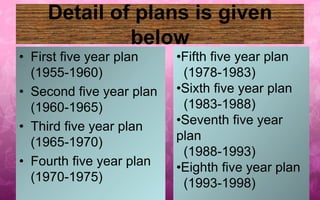
• First five year plan 
(1955-1960) 
• Second five year plan 
(1960-1965) 
• Third five year plan 
(1965-1970) 
• Fourth five year plan 
(1970-1975) 
•Fifth five year plan 
(1978-1983) 
•Sixth five year plan 
(1983-1988) 
•Seventh five year 
plan 
(1988-1993) 
•Eighth five year plan 
(1993-1998)
FIRST FIVE YEAR PLAN (1955- 
1960) 
The First Five Year Plan was launched two and a half 
years late in December 1957. 
Size of Plan: 
• The size of plan was Rs.11, 500 Million which was 
revised to Rs.10, 800 Million. 
• It was decided to invest Rs.7, 500 Million in public 
sectors and Rs.3, 300 Million in Private sector. 
• Rs.66, 000 Million were decided to finance by internal 
sources and Rs.42,000 Million by external sources.
Objectives 
 To raise national income and per capita income 
 To raise the national income and the standard of living of the people 
 To improve the balance of payments of the country by increasing 
 exports and by production of substitutes for imports 
 To increase the opportunities for useful employment in the country 
 To make steady progress in providing social services; housing, 
 education, health and social welfare 
 To increase rapidly the rate of development, especially in East 
 Pakistan and other relatively less developed areas 
 In first five year plan highest priority was given to the agriculture sector 
and the industrial sector
Targets 
• Increase in national income by 15% 
• Increase in population by 7% 
• Increase in Balance of payment by 15% 
• 60% increase in production of industrial sector 
• Rehabilitation and renovation of Railway 
• Increase in savings from 5 to 7 % 
• 1 Million Additional children to be admitted to primary 
schools 
• and 1,44,000 to be put in secondary schools
• It proclaimed that a system of universal 
primary education is imperative. 
• The Plan proposed to add 4000 new 
schools to the 15,602 already in 
existence in the country. 6 additional 
schools were also proposed to be built 
under the Village-AID programme.
• The number of trained primary teachers were 
to be increased from about 75,000 to about 
118,500 raising the percentage of trained 
teachers in primary schools from about 65 to 
85 percent. 
• These additions were estimated to increase 
school enrolment by about 600,000 to one 
million children, and raise the primary 
enrolment rate from 43 to 49 percent.
• It was claimed that “The foundations laid 
for primary education during this plan 
period will permit a rapid advance on a 
sound and confident basis towards the 
goal of universal free compulsory 
primary education”.
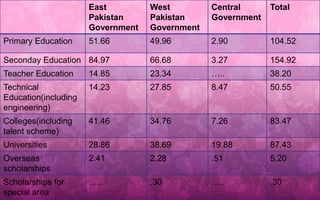
East 
Pakistan 
Government 
West 
Pakistan 
Government 
Central 
Government 
Total 
Primary Education 51.66 49.96 2.90 104.52 
Seconday Education 84.97 66.68 3.27 154.92 
Teacher Education 14.85 23.34 ….. 38.20 
Technical 
14.23 27.85 8.47 50.55 
Education(including 
engineering) 
Colleges(including 
talent scheme) 
41.46 34.76 7.26 83.47 
Universities 28.86 38.69 19.88 87.43 
Overseas 
2.41 2.28 .51 5.20 
scholarships 
Scholarships for 
special area 
….. .30 ….. .30
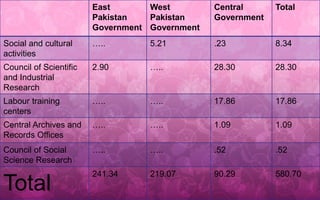
East 
Pakistan 
Government 
West 
Pakistan 
Government 
Central 
Government 
Total 
Social and cultural 
activities 
….. 5.21 .23 8.34 
Council of Scientific 
and Industrial 
Research 
2.90 ….. 28.30 28.30 
Labour training 
centers 
….. ….. 17.86 17.86 
Central Archives and 
Records Offices 
….. ….. 1.09 1.09 
Council of Social 
Science Research 
….. ….. .52 .52 
Total 241.34 219.07 90.29 580.70
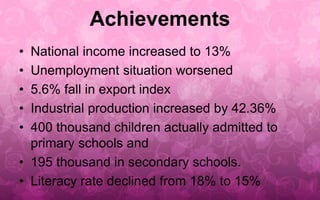
Achievements 
• National income increased to 13% 
• Unemployment situation worsened 
• 5.6% fall in export index 
• Industrial production increased by 42.36% 
• 400 thousand children actually admitted to 
primary schools and 
• 195 thousand in secondary schools. 
• Literacy rate declined from 18% to 15%
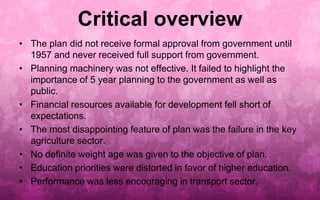
Critical overview 
• The plan did not receive formal approval from government until 
1957 and never received full support from government. 
• Planning machinery was not effective. It failed to highlight the 
importance of 5 year planning to the government as well as 
public. 
• Financial resources available for development fell short of 
expectations. 
• The most disappointing feature of plan was the failure in the key 
agriculture sector. 
• No definite weight age was given to the objective of plan. 
• Education priorities were distorted in favor of higher education. 
• Performance was less encouraging in transport sector.
Thank 
You!

FIRST FIVE YEAR PLAN

  • 3.
    Presented to Dr.Abid Hussain Ch Submitted by Mamoona Shahzad MP/2012-27
  • 5.
    A PLAN •A Plan is a deliberate attempt to spell out how the resources of a country should be put to use. It has some general and specific goals, which are to be achieved within a specific period of time. The general goals of a Plan are growth, modernization, full employment, self-reliance and equity. But all Plans may not give equal importance to all of them. • Each Plan can have some specific goals like improvement of agriculture and education.
  • 6.
    BRIEF INTRODUCTION OFFIVE YEAR PLANNING IN PAKISTAN • The first five year plan was made in 1955 and from that time to up till now eight five year plan have been made in history of Pakistan after regular intervals.1970-1978 was the only period when no five year plan was implemented. Tenth five year plan is going to be implemented from 2010. No ninth plan is made in history of Pakistan.
  • 7.
    Detail of plansis given below • First five year plan (1955-1960) • Second five year plan (1960-1965) • Third five year plan (1965-1970) • Fourth five year plan (1970-1975) •Fifth five year plan (1978-1983) •Sixth five year plan (1983-1988) •Seventh five year plan (1988-1993) •Eighth five year plan (1993-1998)
  • 8.
    FIRST FIVE YEARPLAN (1955- 1960) The First Five Year Plan was launched two and a half years late in December 1957. Size of Plan: • The size of plan was Rs.11, 500 Million which was revised to Rs.10, 800 Million. • It was decided to invest Rs.7, 500 Million in public sectors and Rs.3, 300 Million in Private sector. • Rs.66, 000 Million were decided to finance by internal sources and Rs.42,000 Million by external sources.
  • 9.
    Objectives  Toraise national income and per capita income  To raise the national income and the standard of living of the people  To improve the balance of payments of the country by increasing  exports and by production of substitutes for imports  To increase the opportunities for useful employment in the country  To make steady progress in providing social services; housing,  education, health and social welfare  To increase rapidly the rate of development, especially in East  Pakistan and other relatively less developed areas  In first five year plan highest priority was given to the agriculture sector and the industrial sector
  • 10.
    Targets • Increasein national income by 15% • Increase in population by 7% • Increase in Balance of payment by 15% • 60% increase in production of industrial sector • Rehabilitation and renovation of Railway • Increase in savings from 5 to 7 % • 1 Million Additional children to be admitted to primary schools • and 1,44,000 to be put in secondary schools
  • 11.
    • It proclaimedthat a system of universal primary education is imperative. • The Plan proposed to add 4000 new schools to the 15,602 already in existence in the country. 6 additional schools were also proposed to be built under the Village-AID programme.
  • 12.
    • The numberof trained primary teachers were to be increased from about 75,000 to about 118,500 raising the percentage of trained teachers in primary schools from about 65 to 85 percent. • These additions were estimated to increase school enrolment by about 600,000 to one million children, and raise the primary enrolment rate from 43 to 49 percent.
  • 13.
    • It wasclaimed that “The foundations laid for primary education during this plan period will permit a rapid advance on a sound and confident basis towards the goal of universal free compulsory primary education”.
  • 14.
    East Pakistan Government West Pakistan Government Central Government Total Primary Education 51.66 49.96 2.90 104.52 Seconday Education 84.97 66.68 3.27 154.92 Teacher Education 14.85 23.34 ….. 38.20 Technical 14.23 27.85 8.47 50.55 Education(including engineering) Colleges(including talent scheme) 41.46 34.76 7.26 83.47 Universities 28.86 38.69 19.88 87.43 Overseas 2.41 2.28 .51 5.20 scholarships Scholarships for special area ….. .30 ….. .30
  • 15.
    East Pakistan Government West Pakistan Government Central Government Total Social and cultural activities ….. 5.21 .23 8.34 Council of Scientific and Industrial Research 2.90 ….. 28.30 28.30 Labour training centers ….. ….. 17.86 17.86 Central Archives and Records Offices ….. ….. 1.09 1.09 Council of Social Science Research ….. ….. .52 .52 Total 241.34 219.07 90.29 580.70
  • 16.
    Achievements • Nationalincome increased to 13% • Unemployment situation worsened • 5.6% fall in export index • Industrial production increased by 42.36% • 400 thousand children actually admitted to primary schools and • 195 thousand in secondary schools. • Literacy rate declined from 18% to 15%
  • 17.
    Critical overview •The plan did not receive formal approval from government until 1957 and never received full support from government. • Planning machinery was not effective. It failed to highlight the importance of 5 year planning to the government as well as public. • Financial resources available for development fell short of expectations. • The most disappointing feature of plan was the failure in the key agriculture sector. • No definite weight age was given to the objective of plan. • Education priorities were distorted in favor of higher education. • Performance was less encouraging in transport sector.
  • 18.