:: SIX MINUTES AND FORTY SECONDS
Alec McPhedran
Skills Channel TV
ON PRINCIPLED NEGOTIATION
First of all, who
are we?
 We specialise in creative training.
coaching and facilitation
 We are experts about skills
development
 We focus on leadership, strategy,
management and personal
development
 We help businesses and
individuals change and grow
 Our aim is to help people achieve
Based on the book Getting to Yes, first published in 1981 by Roger Fisher and William Ury
TRAINING
COACHING MENTORING
Being instructed on what to do,
sometimes all together
One to one development
on a specific skill, mainly
being asked
Guidance, wisdom,
challenge and support on
the person
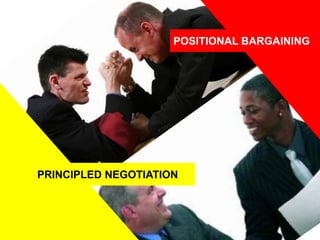
POSITIONAL BARGAINING
PRINCIPLED NEGOTIATION
TRAINING
COACHING MENTORING
Being instructed on what to do,
sometimes all together
One to one development
on a specific skill, mainly
being asked
Guidance, wisdom,
challenge and support on
the person
POSITIONAL BARGAINING
PRINCIPLED NEGOTIATION
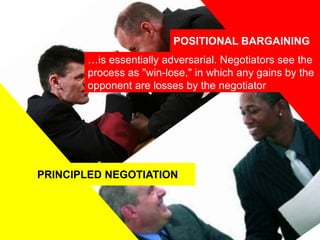
…is essentially adversarial. Negotiators see the
process as "win-lose," in which any gains by the
opponent are losses by the negotiator
TRAINING
COACHING MENTORING
Being instructed on what to do,
sometimes all together
One to one development
on a specific skill, mainly
being asked
Guidance, wisdom,
challenge and support on
the person
POSITIONAL BARGAINING
PRINCIPLED NEGOTIATION
…is an shared interest-based approach to negotiation that
focuses primarily on finding a mutually shared outcome.
…is essentially adversarial. Negotiators see the
process as "win-lose," in which any gains by the
opponent are losses by the negotiator.
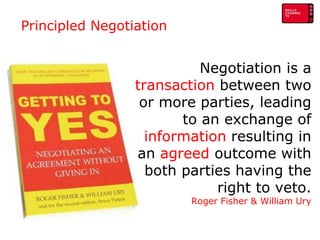
Negotiation is a
transaction between two
or more parties, leading
to an exchange of
information resulting in
an agreed outcome with
both parties having the
right to veto.
Roger Fisher & William Ury
Principled Negotiation
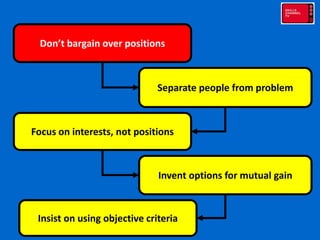
Focus on interests, not positions
Separate people from problem
Don’t bargain over positions
Insist on using objective criteria
Invent options for mutual gain
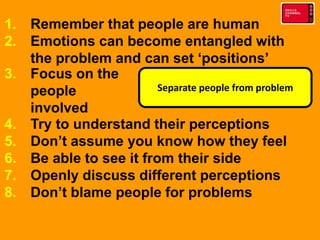
Separate people from problem
1. Remember that people are human
2. Emotions can become entangled with
the problem and can set ‘positions’
3. Focus on the
people
involved
4. Try to understand their perceptions
5. Don’t assume you know how they feel
6. Be able to see it from their side
7. Openly discuss different perceptions
8. Don’t blame people for problems
1. Underlying interests may be compatible
2. Interests can inform positions
3. Look at interest from their perspective
4. Sharing interests can show both sides
not as opposed as initially thought
Focus on interests, not positions
5. Seek to
understand
their needs and wants
6. Money is NOT the most important driver,
sometimes there are human needs
7. Openly discuss and understand
interests
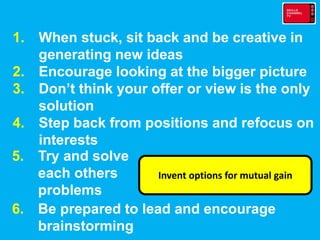
Invent options for mutual gain
1. When stuck, sit back and be creative in
generating new ideas
2. Encourage looking at the bigger picture
3. Don’t think your offer or view is the only
solution
4. Step back from positions and refocus on
interests
5. Try and solve
each others
problems
6. Be prepared to lead and encourage
brainstorming
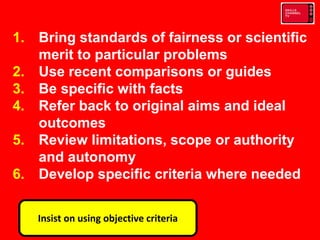
Insist on using objective criteria
1. Bring standards of fairness or scientific
merit to particular problems
2. Use recent comparisons or guides
3. Be specific with facts
4. Refer back to original aims and ideal
outcomes
5. Review limitations, scope or authority
and autonomy
6. Develop specific criteria where needed
Put forward
your points
 WHO
 WHAT
 WHY
 WHERE
 WHEN
 HOW
Advocacy and Inquiry
Understand
their situation
 WHO
 WHAT
 WHY
 WHERE
 WHEN
 HOW
PRINCIPLED
PRINCIPLED
Having available
options during a
negotiation is a good
alternative which
empowers you with
the confidence to
either reach a
mutually satisfactory
agreement, or walk
away to a better
alternative.
BATNA
 The cost - Ask yourself how much it will
cost to make the deal relative to the
cost of your best alternative. Cost
estimation may entail both the short
term and the long term. It boils down to
figuring out which of your options is the
most affordable.
 Feasibility - Which option is the most
feasible? Which one can you
realistically apply over all the rest of
your available options?
 Impact - Which of your options will have
the most immediate positive influence
on your current state of affairs?
 Consequences - What do you think or
estimate will happen as you consider
each option as a possible solution?
With thanks to
The Negotiation Experts
BATNA
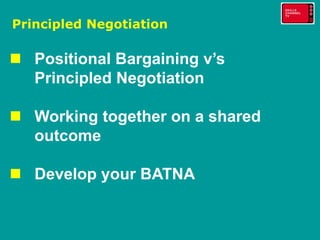
Principled Negotiation
 Positional Bargaining v’s
Principled Negotiation
 Working together on a shared
outcome
 Develop your BATNA
During a negotiation, it would
be wise not to take anything
personally. If you leave
personalities out of it, you will
be able to see opportunities
more objectively.
Brian Koslow
www.skillschannel.tv
0845 83 777 63
Thanks for looking. We hope you
found it useful.

Principled Negotiation

  • 1.
    :: SIX MINUTESAND FORTY SECONDS Alec McPhedran Skills Channel TV ON PRINCIPLED NEGOTIATION
  • 2.
    First of all,who are we?  We specialise in creative training. coaching and facilitation  We are experts about skills development  We focus on leadership, strategy, management and personal development  We help businesses and individuals change and grow  Our aim is to help people achieve
  • 3.
    Based on thebook Getting to Yes, first published in 1981 by Roger Fisher and William Ury
  • 4.
    TRAINING COACHING MENTORING Being instructedon what to do, sometimes all together One to one development on a specific skill, mainly being asked Guidance, wisdom, challenge and support on the person POSITIONAL BARGAINING PRINCIPLED NEGOTIATION
  • 5.
    TRAINING COACHING MENTORING Being instructedon what to do, sometimes all together One to one development on a specific skill, mainly being asked Guidance, wisdom, challenge and support on the person POSITIONAL BARGAINING PRINCIPLED NEGOTIATION …is essentially adversarial. Negotiators see the process as "win-lose," in which any gains by the opponent are losses by the negotiator
  • 6.
    TRAINING COACHING MENTORING Being instructedon what to do, sometimes all together One to one development on a specific skill, mainly being asked Guidance, wisdom, challenge and support on the person POSITIONAL BARGAINING PRINCIPLED NEGOTIATION …is an shared interest-based approach to negotiation that focuses primarily on finding a mutually shared outcome. …is essentially adversarial. Negotiators see the process as "win-lose," in which any gains by the opponent are losses by the negotiator.
  • 7.
    Negotiation is a transactionbetween two or more parties, leading to an exchange of information resulting in an agreed outcome with both parties having the right to veto. Roger Fisher & William Ury Principled Negotiation
  • 8.
    Focus on interests,not positions Separate people from problem Don’t bargain over positions Insist on using objective criteria Invent options for mutual gain
  • 9.
    Separate people fromproblem 1. Remember that people are human 2. Emotions can become entangled with the problem and can set ‘positions’ 3. Focus on the people involved 4. Try to understand their perceptions 5. Don’t assume you know how they feel 6. Be able to see it from their side 7. Openly discuss different perceptions 8. Don’t blame people for problems
  • 10.
    1. Underlying interestsmay be compatible 2. Interests can inform positions 3. Look at interest from their perspective 4. Sharing interests can show both sides not as opposed as initially thought Focus on interests, not positions 5. Seek to understand their needs and wants 6. Money is NOT the most important driver, sometimes there are human needs 7. Openly discuss and understand interests
  • 11.
    Invent options formutual gain 1. When stuck, sit back and be creative in generating new ideas 2. Encourage looking at the bigger picture 3. Don’t think your offer or view is the only solution 4. Step back from positions and refocus on interests 5. Try and solve each others problems 6. Be prepared to lead and encourage brainstorming
  • 12.
    Insist on usingobjective criteria 1. Bring standards of fairness or scientific merit to particular problems 2. Use recent comparisons or guides 3. Be specific with facts 4. Refer back to original aims and ideal outcomes 5. Review limitations, scope or authority and autonomy 6. Develop specific criteria where needed
  • 13.
    Put forward your points WHO  WHAT  WHY  WHERE  WHEN  HOW Advocacy and Inquiry Understand their situation  WHO  WHAT  WHY  WHERE  WHEN  HOW
  • 15.
  • 16.
    Having available options duringa negotiation is a good alternative which empowers you with the confidence to either reach a mutually satisfactory agreement, or walk away to a better alternative. BATNA
  • 17.
     The cost- Ask yourself how much it will cost to make the deal relative to the cost of your best alternative. Cost estimation may entail both the short term and the long term. It boils down to figuring out which of your options is the most affordable.  Feasibility - Which option is the most feasible? Which one can you realistically apply over all the rest of your available options?  Impact - Which of your options will have the most immediate positive influence on your current state of affairs?  Consequences - What do you think or estimate will happen as you consider each option as a possible solution? With thanks to The Negotiation Experts BATNA
  • 18.
    Principled Negotiation  PositionalBargaining v’s Principled Negotiation  Working together on a shared outcome  Develop your BATNA
  • 19.
    During a negotiation,it would be wise not to take anything personally. If you leave personalities out of it, you will be able to see opportunities more objectively. Brian Koslow
  • 20.
    www.skillschannel.tv www.skillschannel.tv 0845 83 77763 Thanks for looking. We hope you found it useful.