Negotiation Skills

Abhijith R

S
Negotiation
 The word "negotiation" originated from the Latin

expression, "negotiatus", which means "to carry
on business".
 The process of conferring to arrive at an agreement between different
parties, each with their own interests and preferences.

 “A give-and-take decision-making process

involving interdependent parties with different
preferences.”
Definition
“Negotiating is the process of
communicating back and forth, for the
purpose of reaching a joint agreement
about differing needs or ideas.”
Features of Negotiation
S Minimum two parties
S Predetermined goals
S Expecting an outcome

S Resolution and Consensus
S Parties willing to modify their positions

S Parties should understand the purpose of

negotiation
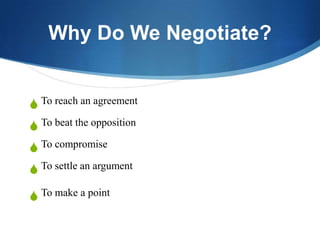
Why Do We Negotiate?

S To reach an agreement

S To beat the opposition
S To compromise
S To settle an argument
S To make a point
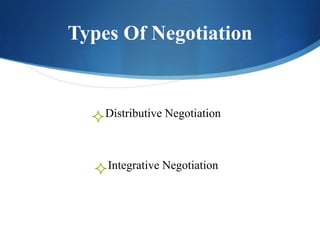
Types Of Negotiation

Distributive Negotiation
Integrative Negotiation
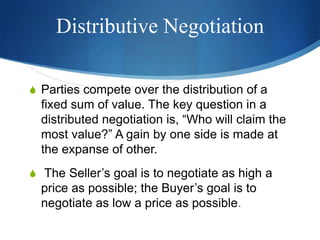
Distributive Negotiation
S Parties compete over the distribution of a

fixed sum of value. The key question in a
distributed negotiation is, “Who will claim the
most value?” A gain by one side is made at
the expanse of other.
S The Seller’s goal is to negotiate as high a

price as possible; the Buyer’s goal is to
negotiate as low a price as possible.
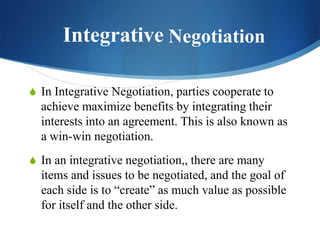
Integrative Negotiation
S In Integrative Negotiation, parties cooperate to

achieve maximize benefits by integrating their
interests into an agreement. This is also known as
a win-win negotiation.
S In an integrative negotiation,, there are many

items and issues to be negotiated, and the goal of
each side is to “create” as much value as possible
for itself and the other side.
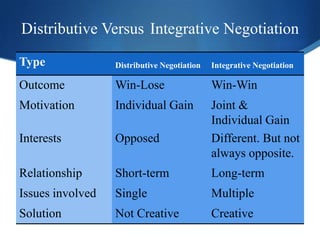
Distributive Versus Integrative Negotiation
Type

Distributive Negotiation

Integrative Negotiation

Outcome

Win-Lose

Win-Win

Motivation

Individual Gain

Interests

Opposed

Joint &
Individual Gain
Different. But not
always opposite.

Relationship

Short-term

Long-term

Issues involved

Single

Multiple

Solution

Not Creative

Creative
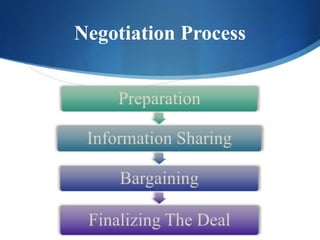
Negotiation Process
Basic Principles Common To
All Forms Of Negotiation
 There are minimum 2 parties involved in the

negotiation process. There exists some common
interest, either in the subject matter of the
negotiation or in the negotiating context, that puts
or keeps the parties in contact.
 Though the parties have the same degree of

interest, they initially start with different opinions
and objectives which hinders the outcome in
general.
 In the beginning, parties consider that

negotiation is a better way of trying to solve their
differences.

 Each party is under an impression that there is a

possibility of persuading the other party to
modify their original position, as initially parties
feel that they shall maintain their opening
position and persuade the other to change.
S During the process, the ideal outcome proves

unattainable but parties retain their hope of an
acceptable final agreement.
S Each party has some influence or power – real or

assumed – over the other’s ability to act.

S The process of negotiation is that of interaction

between people – usually this is direct and verbal
interchange.
Characteristics Of An Effective
Negotiator
S He should be a good learner and observer.
S Should know the body language of the people at

the negotiation process.
S Should be open and flexible and yet firm.
S Exercise great patience, coolness and maturity.
S Should possess leadership qualities.
S Should control emotions and not show his

weaknesses.
S Should bargain from the position of strength.

S Should know and anticipate the pros and cons of

his each move and its repercussions.
S Should know how to create the momentum for

the negotiations and must know when to exit and
where to exit by closing the talks successfully.
S Should build trust and confidence.

S Should be confident and optimist.
S Should have clear cut goals and objectives.
S If necessary, he should provide a face saving

formula for his counter party.
S Should be able to grasp the situation from many

dimensions.
S Should know human psychology and face reading
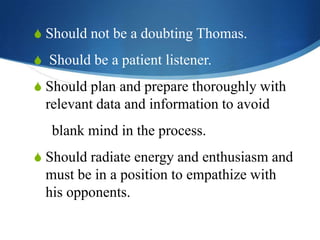
S Should not be a doubting Thomas.
S Should be a patient listener.
S Should plan and prepare thoroughly with

relevant data and information to avoid

blank mind in the process.
S Should radiate energy and enthusiasm and

must be in a position to empathize with
his opponents.
Types Of Negotiation In
Organizations
S
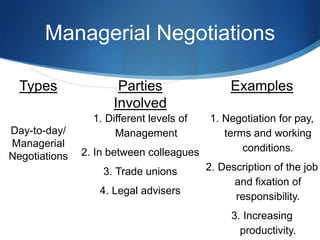
Managerial Negotiations
Types
Day-to-day/
Managerial
Negotiations

Parties
Involved

Examples

1. Different levels of
Management

1. Negotiation for pay,
terms and working
conditions.

2. In between colleagues
3. Trade unions
4. Legal advisers

2. Description of the job
and fixation of
responsibility.
3. Increasing
productivity.
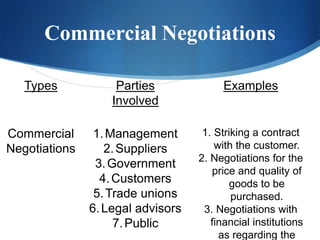
Commercial Negotiations
Types

Parties
Involved

Examples

Commercial
Negotiations

1. Management
2. Suppliers
3. Government
4. Customers
5. Trade unions
6. Legal advisors
7. Public

1. Striking a contract
with the customer.
2. Negotiations for the
price and quality of
goods to be
purchased.
3. Negotiations with
financial institutions
as regarding the
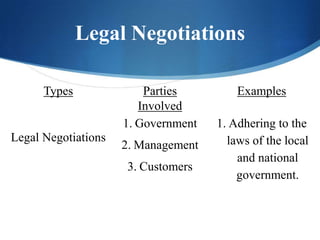
Legal Negotiations
Types

Legal Negotiations

Parties
Involved
1. Government
2. Management
3. Customers

Examples
1. Adhering to the
laws of the local
and national
government.
10 Techniques for Better
Negotiation

S
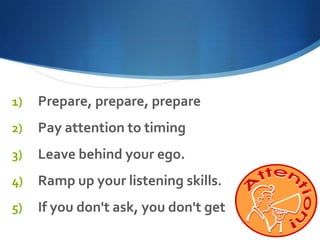
1)

Prepare, prepare, prepare

2)

Pay attention to timing

3)

Leave behind your ego.

4)

Ramp up your listening skills.

5)

If you don't ask, you don't get
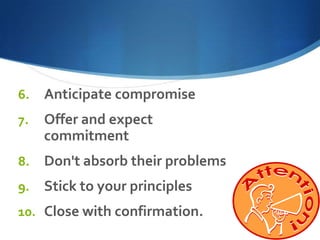
6.

Anticipate compromise

7.

Offer and expect
commitment

8.

Don't absorb their problems

9.

Stick to your principles

10. Close with confirmation.

Negotiation skills

  • 1.
  • 2.
    Negotiation  The word"negotiation" originated from the Latin expression, "negotiatus", which means "to carry on business".  The process of conferring to arrive at an agreement between different parties, each with their own interests and preferences.  “A give-and-take decision-making process involving interdependent parties with different preferences.”
  • 3.
    Definition “Negotiating is theprocess of communicating back and forth, for the purpose of reaching a joint agreement about differing needs or ideas.”
  • 4.
    Features of Negotiation SMinimum two parties S Predetermined goals S Expecting an outcome S Resolution and Consensus S Parties willing to modify their positions S Parties should understand the purpose of negotiation
  • 5.
    Why Do WeNegotiate? S To reach an agreement S To beat the opposition S To compromise S To settle an argument S To make a point
  • 6.
    Types Of Negotiation DistributiveNegotiation Integrative Negotiation
  • 7.
    Distributive Negotiation S Partiescompete over the distribution of a fixed sum of value. The key question in a distributed negotiation is, “Who will claim the most value?” A gain by one side is made at the expanse of other. S The Seller’s goal is to negotiate as high a price as possible; the Buyer’s goal is to negotiate as low a price as possible.
  • 8.
    Integrative Negotiation S InIntegrative Negotiation, parties cooperate to achieve maximize benefits by integrating their interests into an agreement. This is also known as a win-win negotiation. S In an integrative negotiation,, there are many items and issues to be negotiated, and the goal of each side is to “create” as much value as possible for itself and the other side.
  • 9.
    Distributive Versus IntegrativeNegotiation Type Distributive Negotiation Integrative Negotiation Outcome Win-Lose Win-Win Motivation Individual Gain Interests Opposed Joint & Individual Gain Different. But not always opposite. Relationship Short-term Long-term Issues involved Single Multiple Solution Not Creative Creative
  • 10.
  • 11.
    Basic Principles CommonTo All Forms Of Negotiation  There are minimum 2 parties involved in the negotiation process. There exists some common interest, either in the subject matter of the negotiation or in the negotiating context, that puts or keeps the parties in contact.  Though the parties have the same degree of interest, they initially start with different opinions and objectives which hinders the outcome in general.
  • 12.
     In thebeginning, parties consider that negotiation is a better way of trying to solve their differences.  Each party is under an impression that there is a possibility of persuading the other party to modify their original position, as initially parties feel that they shall maintain their opening position and persuade the other to change.
  • 13.
    S During theprocess, the ideal outcome proves unattainable but parties retain their hope of an acceptable final agreement. S Each party has some influence or power – real or assumed – over the other’s ability to act. S The process of negotiation is that of interaction between people – usually this is direct and verbal interchange.
  • 14.
    Characteristics Of AnEffective Negotiator S He should be a good learner and observer. S Should know the body language of the people at the negotiation process. S Should be open and flexible and yet firm. S Exercise great patience, coolness and maturity. S Should possess leadership qualities.
  • 15.
    S Should controlemotions and not show his weaknesses. S Should bargain from the position of strength. S Should know and anticipate the pros and cons of his each move and its repercussions. S Should know how to create the momentum for the negotiations and must know when to exit and where to exit by closing the talks successfully.
  • 16.
    S Should buildtrust and confidence. S Should be confident and optimist. S Should have clear cut goals and objectives. S If necessary, he should provide a face saving formula for his counter party. S Should be able to grasp the situation from many dimensions. S Should know human psychology and face reading
  • 17.
    S Should notbe a doubting Thomas. S Should be a patient listener. S Should plan and prepare thoroughly with relevant data and information to avoid blank mind in the process. S Should radiate energy and enthusiasm and must be in a position to empathize with his opponents.
  • 18.
    Types Of NegotiationIn Organizations S
  • 19.
    Managerial Negotiations Types Day-to-day/ Managerial Negotiations Parties Involved Examples 1. Differentlevels of Management 1. Negotiation for pay, terms and working conditions. 2. In between colleagues 3. Trade unions 4. Legal advisers 2. Description of the job and fixation of responsibility. 3. Increasing productivity.
  • 20.
    Commercial Negotiations Types Parties Involved Examples Commercial Negotiations 1. Management 2.Suppliers 3. Government 4. Customers 5. Trade unions 6. Legal advisors 7. Public 1. Striking a contract with the customer. 2. Negotiations for the price and quality of goods to be purchased. 3. Negotiations with financial institutions as regarding the
  • 21.
    Legal Negotiations Types Legal Negotiations Parties Involved 1.Government 2. Management 3. Customers Examples 1. Adhering to the laws of the local and national government.
  • 22.
    10 Techniques forBetter Negotiation S
  • 23.
    1) Prepare, prepare, prepare 2) Payattention to timing 3) Leave behind your ego. 4) Ramp up your listening skills. 5) If you don't ask, you don't get
  • 24.
    6. Anticipate compromise 7. Offer andexpect commitment 8. Don't absorb their problems 9. Stick to your principles 10. Close with confirmation.

Editor's Notes

  • #20 Day-to-day / Managerial Negotiations Such types of negotiations are done within the organization and are related to the internal problems in the organization. It is in regards to the working relationship between the groups of employees. Usually, the manager needs to interact with the members at different levels in the organization structure. For conducting the day-to-day business, internally, the superior needs to allot job responsibilities, maintain a flow of information, direct the record keeping and many more activities for smooth functioning. All this requires entering into negotiations with the parties internal to the organization.
  • #21 Commercial NegotiationsSuch types of negotiations are conducted with external parties. The driving forces behind such negotiations are usually financial gains. They are based on a give-and-take relationship. Commercial negotiations successfully end up into contracts. It relates to foregoing of one resource to get the other.
  • #22 Legal Negotiations These negotiations are usually formal and legally binding. Disputes over precedents can become as significant as the main issue. They are also contractual in nature and relate to gaining legal ground.
  • #24 Prepare, prepare, prepare. Enter a negotiation without proper preparation and you've already lost. Start with yourself. Make sure you are clear on what you really want out of the arrangement. Research the other side to better understand their needs as well as their strengths and weaknesses. Enlist help from experts, such as an accountant, attorney or tech guru. Pay attention to timing. Timing is important in any negotiation. Sure, you must know what to ask for. But be sensitive to when you ask for it. There are times to press ahead, and times to wait. When you are looking your best is the time to press for what you want. But beware of pushing too hard and poisoning any long-term relationship. Leave behind your ego. The best negotiators either don't care or don't show they care about who gets credit for a successful deal. Their talent is in making the other side feel like the final agreement was all their idea. Ramp up your listening skills. The best negotiators are often quiet listeners who patiently let others have the floor while they make their case. They never interrupt. Encourage the other side to talk first. That helps set up one of negotiation's oldest maxims: Whoever mentions numbers first, loses. While that's not always true, it's generally better to sit tight and let the other side go first. Even if they don't mention numbers, it gives you a chance to ask what they are thinking. If you don't ask, you don't get. Another tenet of negotiating is "Go high, or go home." As part of your preparation, define your highest justifiable price. As long as you can argue convincingly, don't be afraid to aim high. But no ultimatums, please. Take-it-or-leave-it offers are usually out of place.
  • #25 Anticipate compromise. You should expect to make concessions and plan what they might be. Of course, the other side is thinking the same, so never take their first offer. Even if it's better than you'd hoped for, practice your best look of disappointment and politely decline. You never know what else you can get. Offer and expect commitment. The glue that keeps deals from unraveling is an unshakable commitment to deliver. You should offer this comfort level to others. Likewise, avoid deals where the other side does not demonstrate commitment. Don't absorb their problems. In most negotiations, you will hear all of the other side's problems and reasons they can't give you what you want. They want their problems to become yours, but don't let them. Instead, deal with each as they come up and try to solve them. If their "budget" is too low, for example, maybe there are other places that money could come from. Stick to your principles. As an individual and a business owner, you likely have a set of guiding principles — values that you just won't compromise. If you find negotiations crossing those boundaries, it might be a deal you can live without. Close with confirmation. At the close of any meeting — even if no final deal is struck — recap the points covered and any areas of agreement. Make sure everyone confirms. Follow-up with appropriate letters or emails. Do not leave behind loose ends.