Instituto de Formación Docente Continua Lenguas Vivas Bariloche
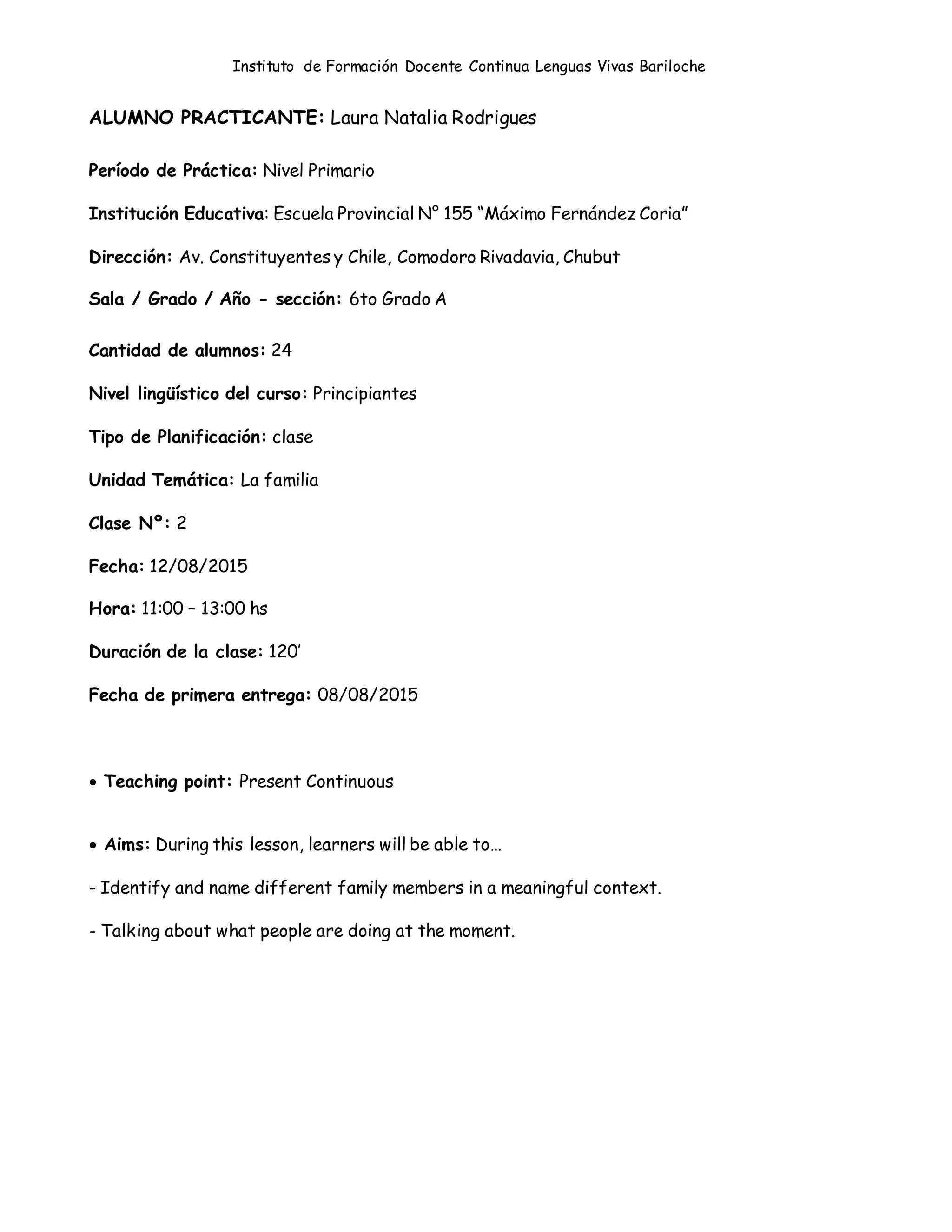
ALUMNO PRACTICANTE: Laura Natalia Rodrigues
Período de Práctica: Nivel Primario
Institución Educativa: Escuela Provincial N° 155 “Máximo Fernández Coria”
Dirección: Av. Constituyentes y Chile, Comodoro Rivadavia, Chubut
Sala / Grado / Año - sección: 6to Grado A
Cantidad de alumnos: 24
Nivel lingüístico del curso: Principiantes
Tipo de Planificación: clase
Unidad Temática: La familia
Clase Nº: 2
Fecha: 12/08/2015
Hora: 11:00 – 13:00 hs
Duración de la clase: 120’
Fecha de primera entrega: 08/08/2015
 Teaching point: Present Continuous
 Aims: During this lesson, learners will be able to…
- Identify and name different family members in a meaningful context.
- Talking about what people are doing at the moment.
Instituto de Formación Docente Continua Lenguas Vivas Bariloche
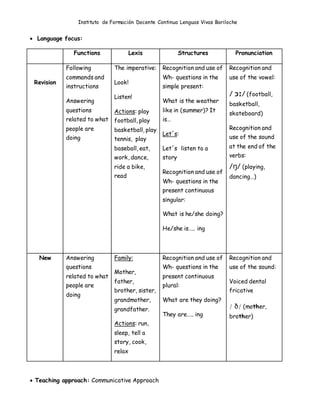
 Language focus:
Functions Lexis Structures Pronunciation
Revision
Following
commands and
instructions
Answering
questions
related to what
people are
doing
The imperative:
Look!
Listen!
Actions: play
football, play
basketball, play
tennis, play
baseball, eat,
work, dance,
ride a bike,
read
Recognition and use of
Wh- questions in the
simple present:
What is the weather
like in (summer)? It
is…
Let´s:
Let´s listen to a
story
Recognition and use of
Wh- questions in the
present continuous
singular:
What is he/she doing?
He/she is….. ing
Recognition and
use of the vowel:
/ ɔː/ (football,
basketball,
skateboard)
Recognition and
use of the sound
at the end of the
verbs:
/ŋ/ (playing,
dancing…)
New Answering
questions
related to what
people are
doing
Family:
Mother,
father,
brother, sister,
grandmother,
grandfather.
Actions: run,
sleep, tell a
story, cook,
relax
Recognition and use of
Wh- questions in the
present continuous
plural:
What are they doing?
They are….. ing
Recognition and
use of the sound:
Voiced dental
fricative
/ ð/ (mother,
brother)
 Teaching approach: Communicative Approach
Instituto de Formación Docente Continua Lenguas Vivas Bariloche
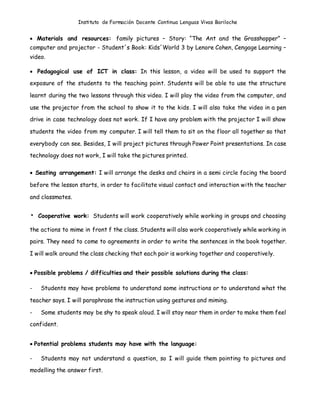
 Materials and resources: family pictures – Story: “The Ant and the Grasshopper” –
computer and projector - Student´s Book: Kids´World 3 by Lenore Cohen, Cengage Learning –
video.
 Pedagogical use of ICT in class: In this lesson, a video will be used to support the
exposure of the students to the teaching point. Students will be able to use the structure
learnt during the two lessons through this video. I will play the video from the computer, and
use the projector from the school to show it to the kids. I will also take the video in a pen
drive in case technology does not work. If I have any problem with the projector I will show
students the video from my computer. I will tell them to sit on the floor all together so that
everybody can see. Besides, I will project pictures through Power Point presentations. In case
technology does not work, I will take the pictures printed.
 Seating arrangement: I will arrange the desks and chairs in a semi circle facing the board
before the lesson starts, in order to facilitate visual contact and interaction with the teacher
and classmates.
• Cooperative work: Students will work cooperatively while working in groups and choosing
the actions to mime in front f the class. Students will also work cooperatively while working in
pairs. They need to come to agreements in order to write the sentences in the book together.
I will walk around the class checking that each pair is working together and cooperatively.
 Possible problems / difficulties and their possible solutions during the class:
- Students may have problems to understand some instructions or to understand what the
teacher says. I will paraphrase the instruction using gestures and miming.
- Some students may be shy to speak aloud. I will stay near them in order to make them feel
confident.
 Potential problems students may have with the language:
- Students may not understand a question, so I will guide them pointing to pictures and
modelling the answer first.
Instituto de Formación Docente Continua Lenguas Vivas Bariloche
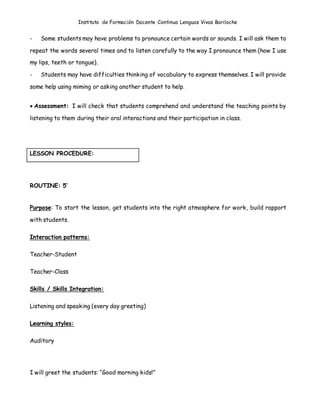
- Some students may have problems to pronounce certain words or sounds. I will ask them to
repeat the words several times and to listen carefully to the way I pronounce them (how I use
my lips, teeth or tongue).
- Students may have difficulties thinking of vocabulary to express themselves. I will provide
some help using miming or asking another student to help.
 Assessment: I will check that students comprehend and understand the teaching points by
listening to them during their oral interactions and their participation in class.
LESSON PROCEDURE:
ROUTINE: 5’
Purpose: To start the lesson, get students into the right atmosphere for work, build rapport
with students.
Interaction patterns:
Teacher-Student
Teacher-Class
Skills / Skills Integration:
Listening and speaking (every day greeting)
Learning styles:
Auditory
I will greet the students: “Good morning kids!”
Instituto de Formación Docente Continua Lenguas Vivas Bariloche
I will encourage them to answer: “Good morning Miss Natalia”.
Teacher: “How are you today? Fine?”
“Great! What day is today?
Students: “Wednesday”
Teacher: “Ok! How do we say? Today is...”
I will encourage students to finish the sentence and all of them to repeat “Today is
Wednesday”
I will write it on the board and I will say: “What number is today?”
Students: “Twelve”
Teacher: “Ok. How do we say it? It is Wednesday 12th
of August”. I will write the date on the
board.
Then I will ask: “What´s the weather like today?” and I will look through the window to check.
Students: “(Sunny/ cloudy/cold)”.
Teacher: “It is (sunny) and (cold)” I will encourage them to repeat and I will write it on the
board.
WARM-UP: (15 minutes)
Purpose: To revise vocabulary and the structure learnt the previous lesson in a meaningful
context and get the students engaged with the topic of family.
Interaction patterns:
Teacher-Class
Instituto de Formación Docente Continua Lenguas Vivas Bariloche
Teacher-Student
Skills:
Listening
Speaking (repeating and answering)
Learning styles:
Visual, auditory
I will say: “Do you remember the story that I told you last class?”
Students: “Yes”.
Teacher: “What is the name of the story?”
Students: “The Ant and the Grasshopper”
Teacher: “Very good!”
I will show students a Power Point with these pictures from the story. In case technology
doesn´t work, I will take the book to school and show the pictures from it.
Instituto de Formación Docente Continua Lenguas Vivas Bariloche
Source: “The Ant and the Grasshopper. by John Porell – Level 2 Readers, Cengage Learning
National Geographic.
I will ask students: “Look at this picture! What is the ant doing? What is she doing?”
Students: “working in the garden”.
Teacher: “Great! How do we say it?” “She is …”
Students: “She is working in the garden”
Teacher: “What is the grasshopper doing?”
Students: “He is playing basketball”
I will follow the same procedure with the rest of the pictures.
Transition: “Well done! Today Ant wants to introduce her family to us! Do you want to know her
family?”
PRESENTATION (15 minutes)
Purpose: To introduce the new items of vocabulary which are mother, father, sister, brother,
grandmother and grandfather in a meaningful context.
Interaction patterns:
Teacher-Class
Skills / Skills Integration:
Listening
Instituto de Formación Docente Continua Lenguas Vivas Bariloche
Speaking (repeating, answering)
Learning styles:
Visual, auditory
I will show students a Power Point with these pictures. In case technology doesn´t work, I will
take the pictures printed.
MOTHER FATHER
BROTHERS SISTERS
Instituto de Formación Docente Continua Lenguas Vivas Bariloche
GRANDMA GRANDPA
I will show them the different slides and I will say:
“She is the mother” I will encourage them to repeat. “She is the mother”. “Who is she?
Students: “She is the mother”.
“He is the father”. Again, I will encourage them to repeat. “He is the father” Who is he?”
Students: “He is the father”.
“They are the sisters. Who are they?”
Students: “They are the sisters”.
I will do the same with the rest of the family members.
Transition: “Well done kids! Now, let´s see what they are doing!”
- DEVELOPMENT
 Activity 1 (35 minutes)
Purpose: To check understanding while introducing the new structure (Present Continuous
plural).
Interaction patterns:
Teacher-Class
Teacher- Student
Instituto de Formación Docente Continua Lenguas Vivas Bariloche
Skills / Skills Integration:
Listening and speaking
Learning styles:
Visual, auditory, kinaesthetic
I will stick the pictures of the mother and the father on the board and I will say:
“Look kids! Here we have the parents: the mother and the father. They are running” I will
encourage them to repeat: “They are running” I will also mime the action. “What are they
doing?” “They are…”
Students: “They are running”.
I will write the sentence on the board.
Teacher: “Great! Now look at the sisters! They are eating” I will encourage them to repeat.
“What are they doing?”
Students: “They are eating”.
I will follow the same procedure with the brothers and the grandparents and I will write the
sentences on the board.
I will assign each student a member of the family. I will give each student a card with a
member of the family written on it and I will say:
“Listen kids, now I will give each of you a card with a member of the family written on it. So,
for example, Macarena you will be mother, Santiago you will be father, Guadalupe you will be
sister” and so on. There are 12 boys and 12 girls in this classroom, so if nobody is absent for
this lesson I will have four mothers, four fathers, four sisters, four brothers, four
grandmothers and 4 grandfathers.
I will ask each group to go to the front and to choose an action that we saw the previous class
or during this one, such as eat, run, ride a bike, play football, play basketball, work, play tennis
and to mime it for the rest of the students. The rest of the class should guess the action and
say: “They are (playing basketball)”. I will write all the actions that we saw on the board for
Instituto de Formación Docente Continua Lenguas Vivas Bariloche
them to see and choose more easily. I will ask them help me remember the actions in order to
write them.
“Kids, I will say mothers go to the front and all the students who have the card with the word
mother should come to the front and choose an action that we saw last class or today, such as
eat, run, ride a bike, play football, play basketball, work, play tennis and mime it for the rest of
the class. Your classmates have to guess and say what you are doing. For example: “They are
(playing basketball). I will write the actions on the board. What actions did we see? Can you
help me?
Students: “eat, run, ride a bike, play football, play basketball, work, play tennis”
Teacher: “What else?”
Students: “play baseball, read, dance”
Teacher: “Fantastic! “Do you understand what you have to do? Can you please explain what you
have to do?” I will tell one of the students to explain or translate the instructions.
“Very good! Let´s start: Fathers come/go to the front. Now, choose and action and mime it for
the rest”.
I will talk to the rest of the class and say: “What are they doing?”
Students: “They are (running)”
Transition: “Great work kids!!”
 Activity 2 (25 minutes)
Purpose: To practice the new structure (Present Continuous).
Interaction patterns:
Teacher- Class
Teacher- Student
Student - Student
Instituto de Formación Docente Continua Lenguas Vivas Bariloche
Skills / Skills Integration:
Listening, speaking and writing
Learning styles:
Visual, auditory
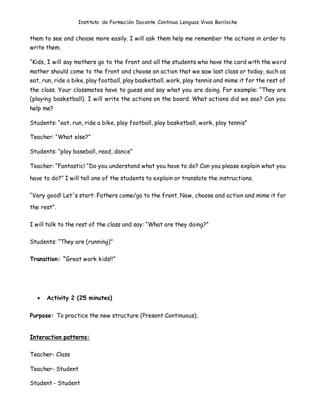
I will tell students to open their Student´s Book at page 38.
Note: The English teacher told me to include any activity from the book in this lesson, related
to the topic students are learning. Besides, she told me that some students do not have the
book and some of them usually forget it at home. In those cases, I will tell students to share
the book with a partner.
“Look kids. Open the book at page 38. If you don´t have the book here, you can work with a
partner and share.”
Source: Student´s Book: Kids´World 3 by
Lenore Cohen, Cengage Learning.
Instituto de Formación Docente Continua Lenguas Vivas Bariloche
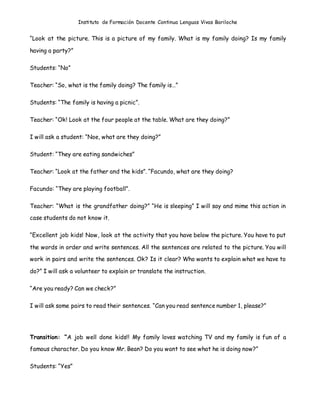
“Look at the picture. This is a picture of my family. What is my family doing? Is my family
having a party?”
Students: “No”
Teacher: “So, what is the family doing? The family is…”
Students: “The family is having a picnic”.
Teacher: “Ok! Look at the four people at the table. What are they doing?”
I will ask a student: “Noe, what are they doing?”
Student: “They are eating sandwiches”
Teacher: “Look at the father and the kids”. “Facundo, what are they doing?
Facundo: “They are playing football”.
Teacher: “What is the grandfather doing?” “He is sleeping” I will say and mime this action in
case students do not know it.
“Excellent job kids! Now, look at the activity that you have below the picture. You have to put
the words in order and write sentences. All the sentences are related to the picture. You will
work in pairs and write the sentences. Ok? Is it clear? Who wants to explain what we have to
do?” I will ask a volunteer to explain or translate the instruction.
“Are you ready? Can we check?”
I will ask some pairs to read their sentences. “Can you read sentence number 1, please?”
Transition: “A job well done kids!! My family loves watching TV and my family is fun of a
famous character. Do you know Mr. Bean? Do you want to see what he is doing now?”
Students: “Yes”
Instituto de Formación Docente Continua Lenguas Vivas Bariloche
 Activity 3 (20 minutes)
Purpose: To check understanding of the new structure (Present Continuous).
Interaction patterns:
Teacher- Class
Skills / Skills Integration:
Listening, speaking
Learning styles:
Visual, auditory
Teacher: “Ok! Pay attention to what he and the people in the video are doing. Right? Let´s
watch!”
I will show the video until 3:25.
I will ask: “Did you like the video? Let´s watch it again and listen to my questions”.
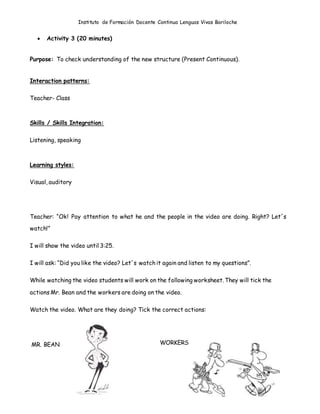
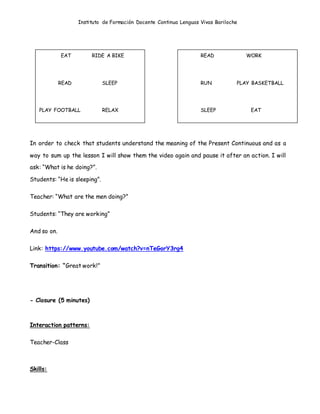
While watching the video students will work on the following worksheet. They will tick the
actions Mr. Bean and the workers are doing on the video.
Watch the video. What are they doing? Tick the correct actions:
MR. BEAN WORKERS
Instituto de Formación Docente Continua Lenguas Vivas Bariloche
In order to check that students understand the meaning of the Present Continuous and as a
way to sum up the lesson I will show them the video again and pause it after an action. I will
ask: “What is he doing?”.
Students: “He is sleeping”.
Teacher: “What are the men doing?”
Students: “They are working”
And so on.
Link: https://www.youtube.com/watch?v=nTeGorY3rg4
Transition: “Great work!”
- Closure (5 minutes)
Interaction patterns:
Teacher-Class
Skills:
EAT RIDE A BIKE
READ SLEEP
PLAY FOOTBALL RELAX
READ WORK
RUN PLAY BASKETBALL
SLEEP EAT
Instituto de Formación Docente Continua Lenguas Vivas Bariloche
Listening
Speaking
Learning styles:
Auditory
I will tell the students that our lesson is over and that we have to say goodbye.
“Goodbye kids! This is my last class with you, so I want to say thank you for everything and for
being so nice students! I have something for you!”
I will give a lollipop to each student before they go home.
- HOMEWORK:
As this is my last lesson with the kids, the English teacher told me not to give them homework
as she will be in charge of the students the following lesson.
I will send a note to the families inviting them to watch the video we watched in class with
their kids.
Estimada Familia:
Hoy estuvimos trabajando con un video en la clase de Inglés. Los invitamos a ingresar al
siguiente link https://www.youtube.com/watch?v=nTeGorY3rg4 y compartir este video con
sus hijos. Los niños podrán así continuar aprendiendo y disfrutar de este video junto a
ustedes.
Miss Natalia

Rodrigues - TPD - Segundo período - Planificación 2

  • 1.
    Instituto de FormaciónDocente Continua Lenguas Vivas Bariloche ALUMNO PRACTICANTE: Laura Natalia Rodrigues Período de Práctica: Nivel Primario Institución Educativa: Escuela Provincial N° 155 “Máximo Fernández Coria” Dirección: Av. Constituyentes y Chile, Comodoro Rivadavia, Chubut Sala / Grado / Año - sección: 6to Grado A Cantidad de alumnos: 24 Nivel lingüístico del curso: Principiantes Tipo de Planificación: clase Unidad Temática: La familia Clase Nº: 2 Fecha: 12/08/2015 Hora: 11:00 – 13:00 hs Duración de la clase: 120’ Fecha de primera entrega: 08/08/2015  Teaching point: Present Continuous  Aims: During this lesson, learners will be able to… - Identify and name different family members in a meaningful context. - Talking about what people are doing at the moment.
  • 2.
    Instituto de FormaciónDocente Continua Lenguas Vivas Bariloche  Language focus: Functions Lexis Structures Pronunciation Revision Following commands and instructions Answering questions related to what people are doing The imperative: Look! Listen! Actions: play football, play basketball, play tennis, play baseball, eat, work, dance, ride a bike, read Recognition and use of Wh- questions in the simple present: What is the weather like in (summer)? It is… Let´s: Let´s listen to a story Recognition and use of Wh- questions in the present continuous singular: What is he/she doing? He/she is….. ing Recognition and use of the vowel: / ɔː/ (football, basketball, skateboard) Recognition and use of the sound at the end of the verbs: /ŋ/ (playing, dancing…) New Answering questions related to what people are doing Family: Mother, father, brother, sister, grandmother, grandfather. Actions: run, sleep, tell a story, cook, relax Recognition and use of Wh- questions in the present continuous plural: What are they doing? They are….. ing Recognition and use of the sound: Voiced dental fricative / ð/ (mother, brother)  Teaching approach: Communicative Approach
  • 3.
    Instituto de FormaciónDocente Continua Lenguas Vivas Bariloche  Materials and resources: family pictures – Story: “The Ant and the Grasshopper” – computer and projector - Student´s Book: Kids´World 3 by Lenore Cohen, Cengage Learning – video.  Pedagogical use of ICT in class: In this lesson, a video will be used to support the exposure of the students to the teaching point. Students will be able to use the structure learnt during the two lessons through this video. I will play the video from the computer, and use the projector from the school to show it to the kids. I will also take the video in a pen drive in case technology does not work. If I have any problem with the projector I will show students the video from my computer. I will tell them to sit on the floor all together so that everybody can see. Besides, I will project pictures through Power Point presentations. In case technology does not work, I will take the pictures printed.  Seating arrangement: I will arrange the desks and chairs in a semi circle facing the board before the lesson starts, in order to facilitate visual contact and interaction with the teacher and classmates. • Cooperative work: Students will work cooperatively while working in groups and choosing the actions to mime in front f the class. Students will also work cooperatively while working in pairs. They need to come to agreements in order to write the sentences in the book together. I will walk around the class checking that each pair is working together and cooperatively.  Possible problems / difficulties and their possible solutions during the class: - Students may have problems to understand some instructions or to understand what the teacher says. I will paraphrase the instruction using gestures and miming. - Some students may be shy to speak aloud. I will stay near them in order to make them feel confident.  Potential problems students may have with the language: - Students may not understand a question, so I will guide them pointing to pictures and modelling the answer first.
  • 4.
    Instituto de FormaciónDocente Continua Lenguas Vivas Bariloche - Some students may have problems to pronounce certain words or sounds. I will ask them to repeat the words several times and to listen carefully to the way I pronounce them (how I use my lips, teeth or tongue). - Students may have difficulties thinking of vocabulary to express themselves. I will provide some help using miming or asking another student to help.  Assessment: I will check that students comprehend and understand the teaching points by listening to them during their oral interactions and their participation in class. LESSON PROCEDURE: ROUTINE: 5’ Purpose: To start the lesson, get students into the right atmosphere for work, build rapport with students. Interaction patterns: Teacher-Student Teacher-Class Skills / Skills Integration: Listening and speaking (every day greeting) Learning styles: Auditory I will greet the students: “Good morning kids!”
  • 5.
    Instituto de FormaciónDocente Continua Lenguas Vivas Bariloche I will encourage them to answer: “Good morning Miss Natalia”. Teacher: “How are you today? Fine?” “Great! What day is today? Students: “Wednesday” Teacher: “Ok! How do we say? Today is...” I will encourage students to finish the sentence and all of them to repeat “Today is Wednesday” I will write it on the board and I will say: “What number is today?” Students: “Twelve” Teacher: “Ok. How do we say it? It is Wednesday 12th of August”. I will write the date on the board. Then I will ask: “What´s the weather like today?” and I will look through the window to check. Students: “(Sunny/ cloudy/cold)”. Teacher: “It is (sunny) and (cold)” I will encourage them to repeat and I will write it on the board. WARM-UP: (15 minutes) Purpose: To revise vocabulary and the structure learnt the previous lesson in a meaningful context and get the students engaged with the topic of family. Interaction patterns: Teacher-Class
  • 6.
    Instituto de FormaciónDocente Continua Lenguas Vivas Bariloche Teacher-Student Skills: Listening Speaking (repeating and answering) Learning styles: Visual, auditory I will say: “Do you remember the story that I told you last class?” Students: “Yes”. Teacher: “What is the name of the story?” Students: “The Ant and the Grasshopper” Teacher: “Very good!” I will show students a Power Point with these pictures from the story. In case technology doesn´t work, I will take the book to school and show the pictures from it.
  • 7.
    Instituto de FormaciónDocente Continua Lenguas Vivas Bariloche Source: “The Ant and the Grasshopper. by John Porell – Level 2 Readers, Cengage Learning National Geographic. I will ask students: “Look at this picture! What is the ant doing? What is she doing?” Students: “working in the garden”. Teacher: “Great! How do we say it?” “She is …” Students: “She is working in the garden” Teacher: “What is the grasshopper doing?” Students: “He is playing basketball” I will follow the same procedure with the rest of the pictures. Transition: “Well done! Today Ant wants to introduce her family to us! Do you want to know her family?” PRESENTATION (15 minutes) Purpose: To introduce the new items of vocabulary which are mother, father, sister, brother, grandmother and grandfather in a meaningful context. Interaction patterns: Teacher-Class Skills / Skills Integration: Listening
  • 8.
    Instituto de FormaciónDocente Continua Lenguas Vivas Bariloche Speaking (repeating, answering) Learning styles: Visual, auditory I will show students a Power Point with these pictures. In case technology doesn´t work, I will take the pictures printed. MOTHER FATHER BROTHERS SISTERS
  • 9.
    Instituto de FormaciónDocente Continua Lenguas Vivas Bariloche GRANDMA GRANDPA I will show them the different slides and I will say: “She is the mother” I will encourage them to repeat. “She is the mother”. “Who is she? Students: “She is the mother”. “He is the father”. Again, I will encourage them to repeat. “He is the father” Who is he?” Students: “He is the father”. “They are the sisters. Who are they?” Students: “They are the sisters”. I will do the same with the rest of the family members. Transition: “Well done kids! Now, let´s see what they are doing!” - DEVELOPMENT  Activity 1 (35 minutes) Purpose: To check understanding while introducing the new structure (Present Continuous plural). Interaction patterns: Teacher-Class Teacher- Student
  • 10.
    Instituto de FormaciónDocente Continua Lenguas Vivas Bariloche Skills / Skills Integration: Listening and speaking Learning styles: Visual, auditory, kinaesthetic I will stick the pictures of the mother and the father on the board and I will say: “Look kids! Here we have the parents: the mother and the father. They are running” I will encourage them to repeat: “They are running” I will also mime the action. “What are they doing?” “They are…” Students: “They are running”. I will write the sentence on the board. Teacher: “Great! Now look at the sisters! They are eating” I will encourage them to repeat. “What are they doing?” Students: “They are eating”. I will follow the same procedure with the brothers and the grandparents and I will write the sentences on the board. I will assign each student a member of the family. I will give each student a card with a member of the family written on it and I will say: “Listen kids, now I will give each of you a card with a member of the family written on it. So, for example, Macarena you will be mother, Santiago you will be father, Guadalupe you will be sister” and so on. There are 12 boys and 12 girls in this classroom, so if nobody is absent for this lesson I will have four mothers, four fathers, four sisters, four brothers, four grandmothers and 4 grandfathers. I will ask each group to go to the front and to choose an action that we saw the previous class or during this one, such as eat, run, ride a bike, play football, play basketball, work, play tennis and to mime it for the rest of the students. The rest of the class should guess the action and say: “They are (playing basketball)”. I will write all the actions that we saw on the board for
  • 11.
    Instituto de FormaciónDocente Continua Lenguas Vivas Bariloche them to see and choose more easily. I will ask them help me remember the actions in order to write them. “Kids, I will say mothers go to the front and all the students who have the card with the word mother should come to the front and choose an action that we saw last class or today, such as eat, run, ride a bike, play football, play basketball, work, play tennis and mime it for the rest of the class. Your classmates have to guess and say what you are doing. For example: “They are (playing basketball). I will write the actions on the board. What actions did we see? Can you help me? Students: “eat, run, ride a bike, play football, play basketball, work, play tennis” Teacher: “What else?” Students: “play baseball, read, dance” Teacher: “Fantastic! “Do you understand what you have to do? Can you please explain what you have to do?” I will tell one of the students to explain or translate the instructions. “Very good! Let´s start: Fathers come/go to the front. Now, choose and action and mime it for the rest”. I will talk to the rest of the class and say: “What are they doing?” Students: “They are (running)” Transition: “Great work kids!!”  Activity 2 (25 minutes) Purpose: To practice the new structure (Present Continuous). Interaction patterns: Teacher- Class Teacher- Student Student - Student
  • 12.
    Instituto de FormaciónDocente Continua Lenguas Vivas Bariloche Skills / Skills Integration: Listening, speaking and writing Learning styles: Visual, auditory I will tell students to open their Student´s Book at page 38. Note: The English teacher told me to include any activity from the book in this lesson, related to the topic students are learning. Besides, she told me that some students do not have the book and some of them usually forget it at home. In those cases, I will tell students to share the book with a partner. “Look kids. Open the book at page 38. If you don´t have the book here, you can work with a partner and share.” Source: Student´s Book: Kids´World 3 by Lenore Cohen, Cengage Learning.
  • 13.
    Instituto de FormaciónDocente Continua Lenguas Vivas Bariloche “Look at the picture. This is a picture of my family. What is my family doing? Is my family having a party?” Students: “No” Teacher: “So, what is the family doing? The family is…” Students: “The family is having a picnic”. Teacher: “Ok! Look at the four people at the table. What are they doing?” I will ask a student: “Noe, what are they doing?” Student: “They are eating sandwiches” Teacher: “Look at the father and the kids”. “Facundo, what are they doing? Facundo: “They are playing football”. Teacher: “What is the grandfather doing?” “He is sleeping” I will say and mime this action in case students do not know it. “Excellent job kids! Now, look at the activity that you have below the picture. You have to put the words in order and write sentences. All the sentences are related to the picture. You will work in pairs and write the sentences. Ok? Is it clear? Who wants to explain what we have to do?” I will ask a volunteer to explain or translate the instruction. “Are you ready? Can we check?” I will ask some pairs to read their sentences. “Can you read sentence number 1, please?” Transition: “A job well done kids!! My family loves watching TV and my family is fun of a famous character. Do you know Mr. Bean? Do you want to see what he is doing now?” Students: “Yes”
  • 14.
    Instituto de FormaciónDocente Continua Lenguas Vivas Bariloche  Activity 3 (20 minutes) Purpose: To check understanding of the new structure (Present Continuous). Interaction patterns: Teacher- Class Skills / Skills Integration: Listening, speaking Learning styles: Visual, auditory Teacher: “Ok! Pay attention to what he and the people in the video are doing. Right? Let´s watch!” I will show the video until 3:25. I will ask: “Did you like the video? Let´s watch it again and listen to my questions”. While watching the video students will work on the following worksheet. They will tick the actions Mr. Bean and the workers are doing on the video. Watch the video. What are they doing? Tick the correct actions: MR. BEAN WORKERS
  • 15.
    Instituto de FormaciónDocente Continua Lenguas Vivas Bariloche In order to check that students understand the meaning of the Present Continuous and as a way to sum up the lesson I will show them the video again and pause it after an action. I will ask: “What is he doing?”. Students: “He is sleeping”. Teacher: “What are the men doing?” Students: “They are working” And so on. Link: https://www.youtube.com/watch?v=nTeGorY3rg4 Transition: “Great work!” - Closure (5 minutes) Interaction patterns: Teacher-Class Skills: EAT RIDE A BIKE READ SLEEP PLAY FOOTBALL RELAX READ WORK RUN PLAY BASKETBALL SLEEP EAT
  • 16.
    Instituto de FormaciónDocente Continua Lenguas Vivas Bariloche Listening Speaking Learning styles: Auditory I will tell the students that our lesson is over and that we have to say goodbye. “Goodbye kids! This is my last class with you, so I want to say thank you for everything and for being so nice students! I have something for you!” I will give a lollipop to each student before they go home. - HOMEWORK: As this is my last lesson with the kids, the English teacher told me not to give them homework as she will be in charge of the students the following lesson. I will send a note to the families inviting them to watch the video we watched in class with their kids. Estimada Familia: Hoy estuvimos trabajando con un video en la clase de Inglés. Los invitamos a ingresar al siguiente link https://www.youtube.com/watch?v=nTeGorY3rg4 y compartir este video con sus hijos. Los niños podrán así continuar aprendiendo y disfrutar de este video junto a ustedes. Miss Natalia