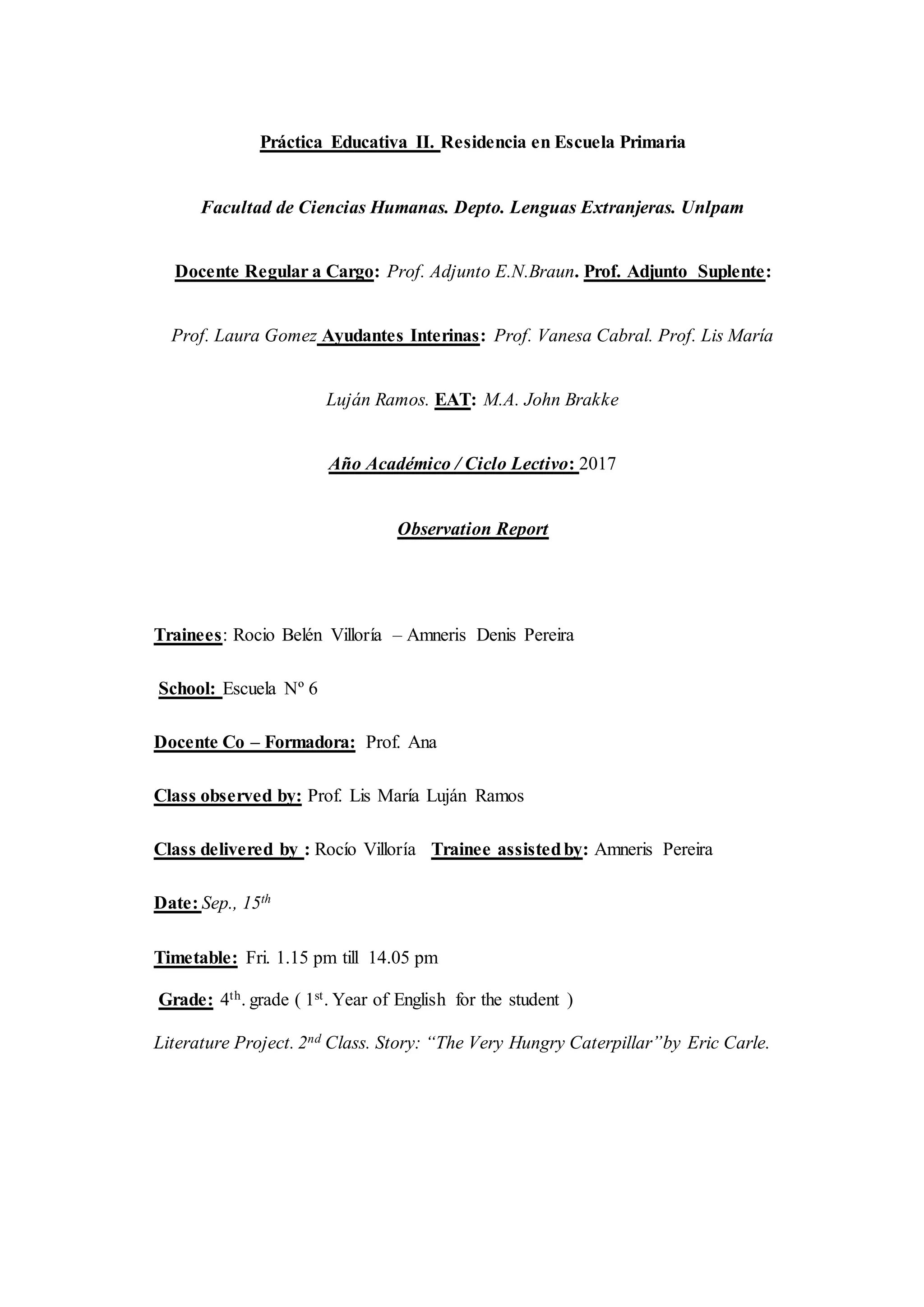
Práctica Educativa II. Residencia en Escuela Primaria
Facultad de Ciencias Humanas. Depto. Lenguas Extranjeras. Unlpam
Docente Regular a Cargo: Prof. Adjunto E.N.Braun. Prof. Adjunto Suplente:
Prof. Laura Gomez Ayudantes Interinas: Prof. Vanesa Cabral. Prof. Lis María
Luján Ramos. EAT: M.A. John Brakke
Año Académico / Ciclo Lectivo: 2017
Observation Report
Trainees: Rocio Belén Villoría – Amneris Denis Pereira
School: Escuela Nº 6
Docente Co – Formadora: Prof. Ana
Class observed by: Prof. Lis María Luján Ramos
Class delivered by : Rocío Villoría Trainee assistedby: Amneris Pereira
Date: Sep., 15th
Timetable: Fri. 1.15 pm till 14.05 pm
Grade: 4th. grade ( 1st. Year of English for the student )
Literature Project. 2nd Class. Story: “The Very Hungry Caterpillar”by Eric Carle.
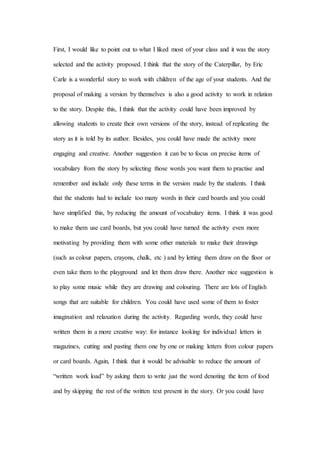
First, I would like to point out to what I liked most of your class and it was the story
selected and the activity proposed. I think that the story of the Caterpillar, by Eric
Carle is a wonderful story to work with children of the age of your students. And the
proposal of making a version by themselves is also a good activity to work in relation
to the story. Despite this, I think that the activity could have been improved by
allowing students to create their own versions of the story, instead of replicating the
story as it is told by its author. Besides, you could have made the activity more
engaging and creative. Another suggestion it can be to focus on precise items of
vocabulary from the story by selecting those words you want them to practise and
remember and include only these terms in the version made by the students. I think
that the students had to include too many words in their card boards and you could
have simplified this, by reducing the amount of vocabulary items. I think it was good
to make them use card boards, but you could have turned the activity even more
motivating by providing them with some other materials to make their drawings
(such as colour papers, crayons, chalk, etc ) and by letting them draw on the floor or
even take them to the playground and let them draw there. Another nice suggestion is
to play some music while they are drawing and colouring. There are lots of English
songs that are suitable for children. You could have used some of them to foster
imagination and relaxation during the activity. Regarding words, they could have
written them in a more creative way: for instance looking for individual letters in
magazines, cutting and pasting them one by one or making letters from colour papers
or card boards. Again, I think that it would be advisable to reduce the amount of
“written work load” by asking them to write just the word denoting the item of food
and by skipping the rest of the written text present in the story. Or you could have
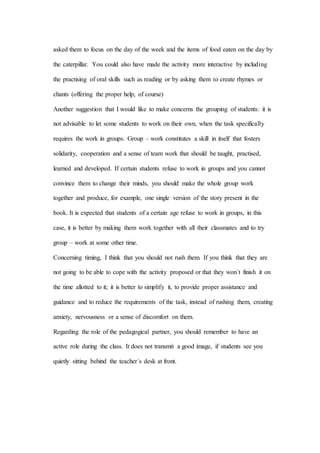
asked them to focus on the day of the week and the items of food eaten on the day by
the caterpillar. You could also have made the activity more interactive by including
the practising of oral skills such as reading or by asking them to create rhymes or
chants (offering the proper help, of course)
Another suggestion that I would like to make concerns the grouping of students: it is
not advisable to let some students to work on their own, when the task specifically
requires the work in groups. Group – work constitutes a skill in itself that fosters
solidarity, cooperation and a sense of team work that should be taught, practised,
learned and developed. If certain students refuse to work in groups and you cannot
convince them to change their minds, you should make the whole group work
together and produce, for example, one single version of the story present in the
book. It is expected that students of a certain age refuse to work in groups, in this
case, it is better by making them work together with all their classmates and to try
group – work at some other time.
Concerning timing, I think that you should not rush them. If you think that they are
not going to be able to cope with the activity proposed or that they won´t finish it on
the time allotted to it; it is better to simplify it, to provide proper assistance and
guidance and to reduce the requirements of the task, instead of rushing them, creating
anxiety, nervousness or a sense of discomfort on them.
Regarding the role of the pedagogical partner, you should remember to have an
active role during the class. It does not transmit a good image, if students see you
quietly sitting behind the teacher´s desk at front.
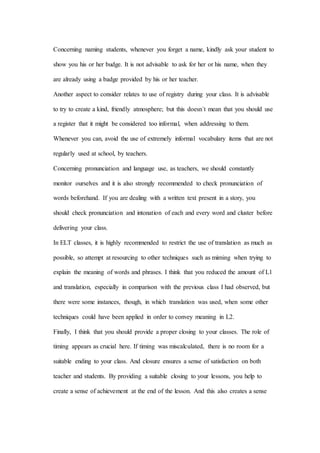
Concerning naming students, whenever you forget a name, kindly ask your student to
show you his or her budge. It is not advisable to ask for her or his name, when they
are already using a badge provided by his or her teacher.
Another aspect to consider relates to use of registry during your class. It is advisable
to try to create a kind, friendly atmosphere; but this doesn´t mean that you should use
a register that it might be considered too informal, when addressing to them.
Whenever you can, avoid the use of extremely informal vocabulary items that are not
regularly used at school, by teachers.
Concerning pronunciation and language use, as teachers, we should constantly
monitor ourselves and it is also strongly recommended to check pronunciation of
words beforehand. If you are dealing with a written text present in a story, you
should check pronunciation and intonation of each and every word and cluster before
delivering your class.
In ELT classes, it is highly recommended to restrict the use of translation as much as
possible, so attempt at resourcing to other techniques such as miming when trying to
explain the meaning of words and phrases. I think that you reduced the amount of L1
and translation, especially in comparison with the previous class I had observed, but
there were some instances, though, in which translation was used, when some other
techniques could have been applied in order to convey meaning in L2.
Finally, I think that you should provide a proper closing to your classes. The role of
timing appears as crucial here. If timing was miscalculated, there is no room for a
suitable ending to your class. And closure ensures a sense of satisfaction on both
teacher and students. By providing a suitable closing to your lessons, you help to
create a sense of achievement at the end of the lesson. And this also creates a sense
of confidence on part of your students, that makes them rely more on you and depend
less on the help provided by the mentor teacher.
As a conclusion, I would like to point out that most of the suggestions previously
made were taken into account and that this has turned into an improvement in your
practicum.

4º Observation Report

  • 1.
    Práctica Educativa II.Residencia en Escuela Primaria Facultad de Ciencias Humanas. Depto. Lenguas Extranjeras. Unlpam Docente Regular a Cargo: Prof. Adjunto E.N.Braun. Prof. Adjunto Suplente: Prof. Laura Gomez Ayudantes Interinas: Prof. Vanesa Cabral. Prof. Lis María Luján Ramos. EAT: M.A. John Brakke Año Académico / Ciclo Lectivo: 2017 Observation Report Trainees: Rocio Belén Villoría – Amneris Denis Pereira School: Escuela Nº 6 Docente Co – Formadora: Prof. Ana Class observed by: Prof. Lis María Luján Ramos Class delivered by : Rocío Villoría Trainee assistedby: Amneris Pereira Date: Sep., 15th Timetable: Fri. 1.15 pm till 14.05 pm Grade: 4th. grade ( 1st. Year of English for the student ) Literature Project. 2nd Class. Story: “The Very Hungry Caterpillar”by Eric Carle.
  • 2.
    First, I wouldlike to point out to what I liked most of your class and it was the story selected and the activity proposed. I think that the story of the Caterpillar, by Eric Carle is a wonderful story to work with children of the age of your students. And the proposal of making a version by themselves is also a good activity to work in relation to the story. Despite this, I think that the activity could have been improved by allowing students to create their own versions of the story, instead of replicating the story as it is told by its author. Besides, you could have made the activity more engaging and creative. Another suggestion it can be to focus on precise items of vocabulary from the story by selecting those words you want them to practise and remember and include only these terms in the version made by the students. I think that the students had to include too many words in their card boards and you could have simplified this, by reducing the amount of vocabulary items. I think it was good to make them use card boards, but you could have turned the activity even more motivating by providing them with some other materials to make their drawings (such as colour papers, crayons, chalk, etc ) and by letting them draw on the floor or even take them to the playground and let them draw there. Another nice suggestion is to play some music while they are drawing and colouring. There are lots of English songs that are suitable for children. You could have used some of them to foster imagination and relaxation during the activity. Regarding words, they could have written them in a more creative way: for instance looking for individual letters in magazines, cutting and pasting them one by one or making letters from colour papers or card boards. Again, I think that it would be advisable to reduce the amount of “written work load” by asking them to write just the word denoting the item of food and by skipping the rest of the written text present in the story. Or you could have
  • 3.
    asked them tofocus on the day of the week and the items of food eaten on the day by the caterpillar. You could also have made the activity more interactive by including the practising of oral skills such as reading or by asking them to create rhymes or chants (offering the proper help, of course) Another suggestion that I would like to make concerns the grouping of students: it is not advisable to let some students to work on their own, when the task specifically requires the work in groups. Group – work constitutes a skill in itself that fosters solidarity, cooperation and a sense of team work that should be taught, practised, learned and developed. If certain students refuse to work in groups and you cannot convince them to change their minds, you should make the whole group work together and produce, for example, one single version of the story present in the book. It is expected that students of a certain age refuse to work in groups, in this case, it is better by making them work together with all their classmates and to try group – work at some other time. Concerning timing, I think that you should not rush them. If you think that they are not going to be able to cope with the activity proposed or that they won´t finish it on the time allotted to it; it is better to simplify it, to provide proper assistance and guidance and to reduce the requirements of the task, instead of rushing them, creating anxiety, nervousness or a sense of discomfort on them. Regarding the role of the pedagogical partner, you should remember to have an active role during the class. It does not transmit a good image, if students see you quietly sitting behind the teacher´s desk at front.
  • 4.
    Concerning naming students,whenever you forget a name, kindly ask your student to show you his or her budge. It is not advisable to ask for her or his name, when they are already using a badge provided by his or her teacher. Another aspect to consider relates to use of registry during your class. It is advisable to try to create a kind, friendly atmosphere; but this doesn´t mean that you should use a register that it might be considered too informal, when addressing to them. Whenever you can, avoid the use of extremely informal vocabulary items that are not regularly used at school, by teachers. Concerning pronunciation and language use, as teachers, we should constantly monitor ourselves and it is also strongly recommended to check pronunciation of words beforehand. If you are dealing with a written text present in a story, you should check pronunciation and intonation of each and every word and cluster before delivering your class. In ELT classes, it is highly recommended to restrict the use of translation as much as possible, so attempt at resourcing to other techniques such as miming when trying to explain the meaning of words and phrases. I think that you reduced the amount of L1 and translation, especially in comparison with the previous class I had observed, but there were some instances, though, in which translation was used, when some other techniques could have been applied in order to convey meaning in L2. Finally, I think that you should provide a proper closing to your classes. The role of timing appears as crucial here. If timing was miscalculated, there is no room for a suitable ending to your class. And closure ensures a sense of satisfaction on both teacher and students. By providing a suitable closing to your lessons, you help to create a sense of achievement at the end of the lesson. And this also creates a sense
  • 5.
    of confidence onpart of your students, that makes them rely more on you and depend less on the help provided by the mentor teacher. As a conclusion, I would like to point out that most of the suggestions previously made were taken into account and that this has turned into an improvement in your practicum.