ALUMNO RESIDENTE: Calizaya, María Eugenia
Período de Práctica: Nivel Secundario.
Institución Educativa: CEM N° 39
Dirección: Avenida Antártida Argentina y Avenida Pocha López.
Sala/Grado/Sección: 3er Año II División
Cantidad de alumnos: 23 alumnos.
Nivel Lingüístico del curso: Elementary
Tipo de Planificación: Clase
Unidad Temática: Past Simple Tense
Clase N°: 7
Fecha: 03/10/2017
Hora: 13.20 hs a 13.55 hs
Duración de la clase: 40 minutos.
Fecha de primera entrega: 01/10/2017
Teaching points:
• Revision of Past Simple (Irregular and Irregular verbs)
• Revision of countable and uncountable nouns.
• Use of the new structure: Reported Speech
Learning Aims:
• Develop the students´ reading skills by texts in the target language.
• Practicing pronunciation and intonation by asking and answering using the new
structures.
• Develop speaking and listening skills by interacting with peers and the teacher.
• Develop their writing skills by writing sentences in context using the target
structure.
Language Focus:
Function Lexis Structure Pronunciation
REVISION Talking about
past events.
Regular and
Irregular verbs.
I was his friend was /wɒz/
NEW Talking about
past events.
Reported
Speech.
He said, I was
his friend
said /sɛd/
 Teaching Approach: The lesson is based on Communicative Approach and
organized through the PPP method.
 Integration of skills: The skills the students develop are listening and speaking
skills, through the listening of the statements from their partners and the production
of their own chunks of language in order to report what they said. Also the students
develop reading and writing skills throughout the activities.
 Materials and resources: For this lesson we need a blackboard and white chalk,
cardstock and copies of the activities.
 Pedagogical use of ICT in class or at home: We do not use ICT to develop this
class.
 Seating arrangement: The students will be on their own tables, and later arranged in
pairs. Assessment: I’ll check the students’ comprehension by making gestures and
miming. I’ll encourage them to produce chunks of language during the speaking
stage.
 Possible problems/difficulties and possible solutions: The activities may take longer
than expected. So, I´ll check the time spent during each activity. Students will
surely use their mother tongue as they are not used to using English. In that case I
will provide them with the equivalent in English.
 Potential Problems students may have with the language: I will use different
techniques to help them use the new items, such as repeating the vocabulary items,
giving the first part of sentences and questions so they can complete them and
encourage the students to participate. Regarding the pronunciation, I will not focus
on correcting every item, but to the production of chunks of language and
encouraging them to use the new structures in context.
Aurelia 10/2/17 8:35 AM
Comment [1]: This	
  example	
  belong	
  to	
  direct	
  
speech.	
  
 Assessment: I will assess them by asking questions individually so as they can give
me examples, and using echoing to check their listening comprehension. Also I
correct the written activities and homework in order to check the comprehension of
the new items and grammatical structures.
Routine: 5 minutes
I´ll walk into the classroom and greet the students: “Hello! How are you?” I start the lesson
get them into the mood of work.
The students are prepared to play to True and False statements. The students are asked to
work in pair group, so I give them each group a pair of sentences. They have to decide
which one is true and which false.
Then I ask them to stick on two cardstocks, one labeled with the title TRUE and the other
FALSE.
The statements are:
 Apollo 11 landed on Mars.
 The strawberries are vegetables.
 The cell phones were invented in 2017.
 There are many bottles of wine in the school.
 Chocolate is horrible.
 There aren´t computers in the school.
 I haven´t got a cell phone.
 I didn’t play guitar yesterday.
 Neil Armstrong walked on the moon fast
 Buzz Aldrin wasn´t an austronaut.
 ARSAT 1 is not a satellite.
 Music is dangerous.
 I shook my hand with my friend.
 Beans are vegetables.
 The Moon is not a planet.
Aurelia 10/2/17 8:36 AM
Deleted: in
 The expedition to the moon was successful.
 The astronauts left an inscription in the moon.
 Armstrong said: “That´s one small step for the man, one giant leap for mankind”
 Driving carefully is good.
 Invap is in Río Negro.
 The astronauts didn´t sing beautifully.
 Playing cards in class is not good.
 The Spring festival was on 21st. September.
 We love our school.
TRUE FALSE
As they finish with the activity they read aloud the sentences and then stick on the
cardstock.
Transition: I congratulate the team that won the competition and tell the students: “Ok, now
we will work on what you said”
Presentation: 10 minutes
Purpose: Further expose learners to the target language, foster comprehension.
I ask the students if they can tell me what sentence “Lorena” said it was right?. EA: Kurt
Cobain was very famous. Excellent! And then I ask about some other sentences the other
students said it was right or wrong.
I write on the board:
Lorena said Kurt Cobain was very famous.
With the class as a whole I highlight the difference between what I say and how to report
what other people said or thought. I underline relevant structure on the board. I encourage
students to provide additional examples orally, using different sentences.
Transition: The students copy the examples elicited from the previous task in their
notebooks and then I tell them we are going practice a little more.
Development:
Activity 1: 10 minutes
Purpose: foster contextualized practice of the teaching points. Focus on specific structures
related directly to the class topic.
Materials: One copy of the activity for each student.
I tell the students we are going to Report what the teacher of English said last week. They
have to make these sentences, the first one is already done:
1.- What did the teacher say?.
Me: How many students have you got?
Teacher Mónica: There are 24 students. MONICA SAID THERE WERE 24 STUDENTS.
• Me: Do you like teaching?
Teacher Mónica: Yes! I love teaching.
• Me: Did you go to the headmaster´s office yesterday?
Teacher Mónica: No, I didn´t go to the office yesterday.
• Me: Did you like hamburguers?
Teacher Mónica: not really, I like more pizza.
• Me: What kind of music do you like most?
Teacher Mónica: I like rock music.
• Me: Who is your best friend?
Teacher Mónica: Lucía is my best friend.
Aurelia 10/2/17 8:38 AM
Comment [2]: They	
  haven´t	
  already	
  worked	
  on	
  
tense	
  changes…	
  How	
  are	
  you	
  planning	
  to	
  deal	
  with	
  
that?	
  
Transition: Once they’ve finished, we check answers with the whole class writing on the
board the correct sentences. After doing this activity, I tell them: “Excellent job! Keep on
working!”
Activity 2: 10 minutes
Purpose: review the vocabulary and to further expose to the new vocabulary.
Materials: A copy of the activity for each student.
I asked students to work in pairs to do this activity. First they have to choose a sentence
from the list provided and then student B has to report what he/she said.
I SAY…
We passed upon the stair yesterday.
I shook his hand.
I spoke to you.
I searched a pencil.
We lost control.
He was face to face with the enemy.
There were many carrots.
Transition: Once they are finished, I ask some students to read reported sentences aloud.
Closure: 5 minutes
Purpose: Review the vocabulary and end this lesson.
At this stage, I tell the students as a final activity they have to prepare a “cheat note” with
what they learned today and write it down in their folders.
Aurelia 10/2/17 8:39 AM
Comment [3]: This	
  activity	
  is	
  similar	
  to	
  the	
  
previous	
  one.	
  They	
  just	
  have	
  to	
  report	
  sentences.	
  
How	
  can	
  you	
  make	
  it	
  more	
  meaningful?	
  
What	
  about	
  a	
  phone	
  conversation?	
  	
  
Once they finish I tell them: “Oh no! The class is over! See you next class! Goodbye!
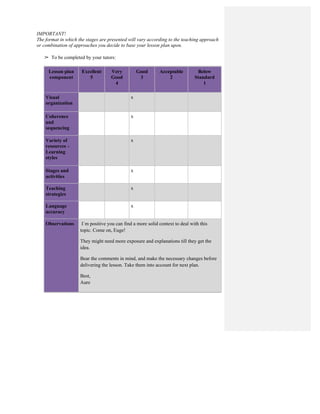
IMPORTANT!
The format in which the stages are presented will vary according to the teaching approach
or combination of approaches you decide to base your lesson plan upon.
➢ To be completed by your tutors:
Lesson plan
component
Excellent
5
Very
Good
4
Good
3
Acceptable
2
Below
Standard
1
Visual
organization
x
Coherence
and
sequencing
x
Variety of
resources –
Learning
styles
x
Stages and
activities
x
Teaching
strategies
x
Language
accuracy
x
Observations I´m positive you can find a more solid context to deal with this
topic. Come on, Euge!
They might need more exposure and explanations till they get the
idea.
Bear the comments in mind, and make the necessary changes before
delivering the lesson. Take them into account for next plan.
Best,
Aure
Secondary Level - Class Plan 7

Secondary Level - Class Plan 7

  • 1.
    ALUMNO RESIDENTE: Calizaya,María Eugenia Período de Práctica: Nivel Secundario. Institución Educativa: CEM N° 39 Dirección: Avenida Antártida Argentina y Avenida Pocha López. Sala/Grado/Sección: 3er Año II División Cantidad de alumnos: 23 alumnos. Nivel Lingüístico del curso: Elementary Tipo de Planificación: Clase Unidad Temática: Past Simple Tense Clase N°: 7 Fecha: 03/10/2017 Hora: 13.20 hs a 13.55 hs Duración de la clase: 40 minutos. Fecha de primera entrega: 01/10/2017 Teaching points: • Revision of Past Simple (Irregular and Irregular verbs) • Revision of countable and uncountable nouns. • Use of the new structure: Reported Speech
  • 2.
    Learning Aims: • Developthe students´ reading skills by texts in the target language. • Practicing pronunciation and intonation by asking and answering using the new structures. • Develop speaking and listening skills by interacting with peers and the teacher. • Develop their writing skills by writing sentences in context using the target structure. Language Focus: Function Lexis Structure Pronunciation REVISION Talking about past events. Regular and Irregular verbs. I was his friend was /wɒz/ NEW Talking about past events. Reported Speech. He said, I was his friend said /sɛd/  Teaching Approach: The lesson is based on Communicative Approach and organized through the PPP method.  Integration of skills: The skills the students develop are listening and speaking skills, through the listening of the statements from their partners and the production of their own chunks of language in order to report what they said. Also the students develop reading and writing skills throughout the activities.  Materials and resources: For this lesson we need a blackboard and white chalk, cardstock and copies of the activities.  Pedagogical use of ICT in class or at home: We do not use ICT to develop this class.  Seating arrangement: The students will be on their own tables, and later arranged in pairs. Assessment: I’ll check the students’ comprehension by making gestures and miming. I’ll encourage them to produce chunks of language during the speaking stage.  Possible problems/difficulties and possible solutions: The activities may take longer than expected. So, I´ll check the time spent during each activity. Students will surely use their mother tongue as they are not used to using English. In that case I will provide them with the equivalent in English.  Potential Problems students may have with the language: I will use different techniques to help them use the new items, such as repeating the vocabulary items, giving the first part of sentences and questions so they can complete them and encourage the students to participate. Regarding the pronunciation, I will not focus on correcting every item, but to the production of chunks of language and encouraging them to use the new structures in context. Aurelia 10/2/17 8:35 AM Comment [1]: This  example  belong  to  direct   speech.  
  • 3.
     Assessment: Iwill assess them by asking questions individually so as they can give me examples, and using echoing to check their listening comprehension. Also I correct the written activities and homework in order to check the comprehension of the new items and grammatical structures. Routine: 5 minutes I´ll walk into the classroom and greet the students: “Hello! How are you?” I start the lesson get them into the mood of work. The students are prepared to play to True and False statements. The students are asked to work in pair group, so I give them each group a pair of sentences. They have to decide which one is true and which false. Then I ask them to stick on two cardstocks, one labeled with the title TRUE and the other FALSE. The statements are:  Apollo 11 landed on Mars.  The strawberries are vegetables.  The cell phones were invented in 2017.  There are many bottles of wine in the school.  Chocolate is horrible.  There aren´t computers in the school.  I haven´t got a cell phone.  I didn’t play guitar yesterday.  Neil Armstrong walked on the moon fast  Buzz Aldrin wasn´t an austronaut.  ARSAT 1 is not a satellite.  Music is dangerous.  I shook my hand with my friend.  Beans are vegetables.  The Moon is not a planet. Aurelia 10/2/17 8:36 AM Deleted: in
  • 4.
     The expeditionto the moon was successful.  The astronauts left an inscription in the moon.  Armstrong said: “That´s one small step for the man, one giant leap for mankind”  Driving carefully is good.  Invap is in Río Negro.  The astronauts didn´t sing beautifully.  Playing cards in class is not good.  The Spring festival was on 21st. September.  We love our school. TRUE FALSE As they finish with the activity they read aloud the sentences and then stick on the cardstock. Transition: I congratulate the team that won the competition and tell the students: “Ok, now we will work on what you said” Presentation: 10 minutes Purpose: Further expose learners to the target language, foster comprehension. I ask the students if they can tell me what sentence “Lorena” said it was right?. EA: Kurt Cobain was very famous. Excellent! And then I ask about some other sentences the other students said it was right or wrong.
  • 5.
    I write onthe board: Lorena said Kurt Cobain was very famous. With the class as a whole I highlight the difference between what I say and how to report what other people said or thought. I underline relevant structure on the board. I encourage students to provide additional examples orally, using different sentences. Transition: The students copy the examples elicited from the previous task in their notebooks and then I tell them we are going practice a little more. Development: Activity 1: 10 minutes Purpose: foster contextualized practice of the teaching points. Focus on specific structures related directly to the class topic. Materials: One copy of the activity for each student. I tell the students we are going to Report what the teacher of English said last week. They have to make these sentences, the first one is already done: 1.- What did the teacher say?. Me: How many students have you got? Teacher Mónica: There are 24 students. MONICA SAID THERE WERE 24 STUDENTS. • Me: Do you like teaching? Teacher Mónica: Yes! I love teaching. • Me: Did you go to the headmaster´s office yesterday? Teacher Mónica: No, I didn´t go to the office yesterday. • Me: Did you like hamburguers? Teacher Mónica: not really, I like more pizza. • Me: What kind of music do you like most? Teacher Mónica: I like rock music. • Me: Who is your best friend? Teacher Mónica: Lucía is my best friend. Aurelia 10/2/17 8:38 AM Comment [2]: They  haven´t  already  worked  on   tense  changes…  How  are  you  planning  to  deal  with   that?  
  • 6.
    Transition: Once they’vefinished, we check answers with the whole class writing on the board the correct sentences. After doing this activity, I tell them: “Excellent job! Keep on working!” Activity 2: 10 minutes Purpose: review the vocabulary and to further expose to the new vocabulary. Materials: A copy of the activity for each student. I asked students to work in pairs to do this activity. First they have to choose a sentence from the list provided and then student B has to report what he/she said. I SAY… We passed upon the stair yesterday. I shook his hand. I spoke to you. I searched a pencil. We lost control. He was face to face with the enemy. There were many carrots. Transition: Once they are finished, I ask some students to read reported sentences aloud. Closure: 5 minutes Purpose: Review the vocabulary and end this lesson. At this stage, I tell the students as a final activity they have to prepare a “cheat note” with what they learned today and write it down in their folders. Aurelia 10/2/17 8:39 AM Comment [3]: This  activity  is  similar  to  the   previous  one.  They  just  have  to  report  sentences.   How  can  you  make  it  more  meaningful?   What  about  a  phone  conversation?    
  • 7.
    Once they finishI tell them: “Oh no! The class is over! See you next class! Goodbye!
  • 8.
    IMPORTANT! The format inwhich the stages are presented will vary according to the teaching approach or combination of approaches you decide to base your lesson plan upon. ➢ To be completed by your tutors: Lesson plan component Excellent 5 Very Good 4 Good 3 Acceptable 2 Below Standard 1 Visual organization x Coherence and sequencing x Variety of resources – Learning styles x Stages and activities x Teaching strategies x Language accuracy x Observations I´m positive you can find a more solid context to deal with this topic. Come on, Euge! They might need more exposure and explanations till they get the idea. Bear the comments in mind, and make the necessary changes before delivering the lesson. Take them into account for next plan. Best, Aure