1
Ms. Mahimi Kanchana
Faculty of Engineering
University of Moratuwa
Pricing Practices
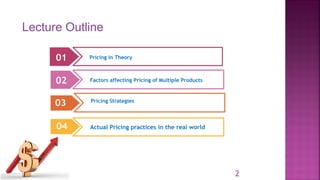
Lecture Outline
2
Pricing in Theory
02
03 Pricing Strategies
04 Actual Pricing practices in the real world
01
Factors affecting Pricing of Multiple Products
What is Price?
3
The amount of money expected, required, or given
in payment for something.
Pricing in Theory
4
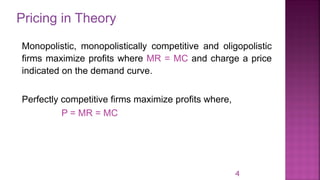
Monopolistic, monopolistically competitive and oligopolistic
firms maximize profits where MR = MC and charge a price
indicated on the demand curve.
Perfectly competitive firms maximize profits where,
P = MR = MC
Pricing in Theory (Contd.)
5
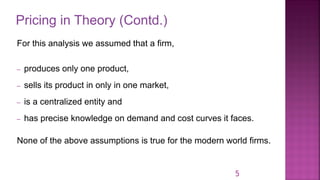
For this analysis we assumed that a firm,
– produces only one product,
– sells its product in only in one market,
– is a centralized entity and
– has precise knowledge on demand and cost curves it faces.
None of the above assumptions is true for the modern world firms.
Actual Pricing Practices
6
Today, many firms produce multiple products, sell in many
markets, are decentralized with a number of semiautonom
ous divisions, and have general knowledge on demand an
d cost curves.
In pricing practices, we learn how do the firms price their
products in these complicated situations.
Pricing Strategy
7
A business can use a variety of pricing strategies when selling a
product or services. The Price can be set to maximize profitability
for each unit sold or from the market overall. It can be used to de
fend an existing market from new entrants, to increase market sh
are within a market or to enter a new market. Businesses may be
nefit from lowering or raising prices, depending on the needs and
behaviors of customers and clients in the particular market. Findi
ng the right pricing strategy is an important element in running a
successful business.
Pricing Strategy Objectives
8
▪ Long Run Profits
▪ Short Run Profits
▪ Increase Sales Volume
▪ Company Growth
▪ Match Competitors Price
▪ Create Interest &
Excitement about the
Product
▪ Discourage Competitors
From cutting Price
▪ Social, Ethical & Ideological
Objectives
▪ Discourage New Entrants
▪ Survival
Decisions in Pricing Strategy
9
▪ Fixed & Variable Cost
▪ Competition
▪ Company Objectives
▪ Proposed Positioning Strategies
▪ Target Group & Willingness to Pay
▪ External Market Demand
▪ Internal Factors; Product Cost & Objectives of Company
Pricing Strategy for Challenging Economic
Times
10
▪ Pricing is a market consideration, not a cost consideration.
▪ Understand your customers’ primary goals. Be clear on what the
customer wants first, then set pricing and bundling decisions.
▪ Consider bundling products or services together. Always bundle a low-
and high-valued product together. This will create higher sales and
greater profitability.
Pricing Strategy for Challenging Economic
Times
11
▪ Understand your value proposition. Have a clear understanding of if
and how your product or service is differentiated from the competition.
▪ Know where you are on the scale of "innovative-to-commoditized."
▪ Build the customers’ perception of value. Constantly build on
customer perception. The more subtle the differentiation of the
product or service, the more often customers need to be reminded of
the value of your product or service
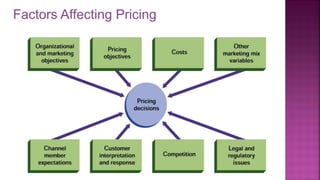
Factors Affecting Pricing
12
Types of Actual Pricing Practices
13
▪ Marketing Skimming
▪ Value Pricing
▪ Loss Leader
▪ Psychological Pricing
▪ Going Rate (Price
Leadership)
▪ Price Discrimination
▪ Penetration Pricing
▪ Cost Plus Pricing
▪ Contribution Pricing
▪ Target Pricing
▪ Marginal Cost Pricing
▪ Absorption Cost Pricing
▪ Destroyer Pricing
Market Skimming Pricing
14
▪ High Price low volume
▪ Skim the Profit from the Market
▪ Suitable for the products that have short life cycle or Which
will face competition at some point in future.
▪ Most appropriate when demand is inelastic
▪ Examples; Play Station, Digital Technology, Apple products
etc.
Value Pricing
15
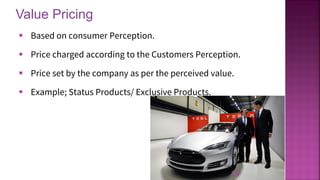
▪ Based on consumer Perception.
▪ Price charged according to the Customers Perception.
▪ Price set by the company as per the perceived value.
▪ Example; Status Products/ Exclusive Products.
Loss Leader Pricing
16
Loss Leader Pricing
17
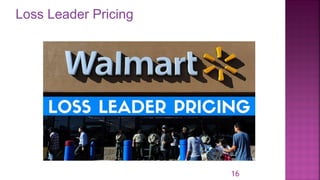
▪ Goods/services deliberately sold below cost to encourage
sales elsewhere
▪ Typical in supermarkets, e.g. at Christmas, selling bottles of
gin at £3 in the hope that people will be attracted to the store
and buy other things
▪ Purchases of other items more than covers ‘loss’ on item sold
e.g. ‘Free’ mobile phone when taking on contract package
Psychological Pricing
18
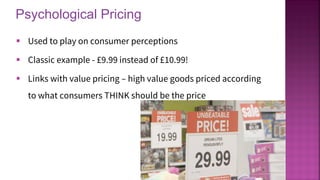
▪ Used to play on consumer perceptions
▪ Classic example - £9.99 instead of £10.99!
▪ Links with value pricing – high value goods priced according
to what consumers THINK should be the price
Going Rate Pricing
19
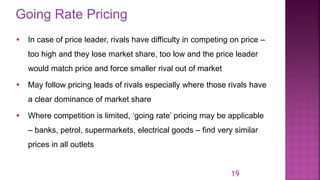
▪ In case of price leader, rivals have difficulty in competing on price –
too high and they lose market share, too low and the price leader
would match price and force smaller rival out of market
▪ May follow pricing leads of rivals especially where those rivals have
a clear dominance of market share
▪ Where competition is limited, ‘going rate’ pricing may be applicable
– banks, petrol, supermarkets, electrical goods – find very similar
prices in all outlets
Price Discrimination Pricing
20
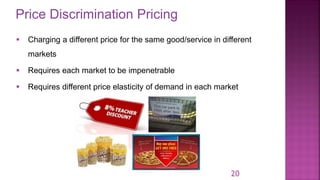
▪ Charging a different price for the same good/service in different
markets
▪ Requires each market to be impenetrable
▪ Requires different price elasticity of demand in each market
Price Discrimination Pricing
21
▪ Prices for rail travel differ for the same journey at different times of
the day
▪ The purpose of price discrimination is to capture the market's
consumer surplus. Price discrimination allows the seller to generate
the most revenue possible for a good or service .
Price Discrimination Pricing
22
Price discrimination occurs when identical goods or services are sold at
different prices from the same provider. There are three types of price
discrimination:
▪ First degree - the seller must know the absolute maximum price
that every consumer is willing to pay.
▪ Second degree - the price of the good or service varies according
to quantity demanded.
▪ Third degree - the price of the good or service varies by attributes
such as location, age, sex, and economic status.
Penetration Pricing
23
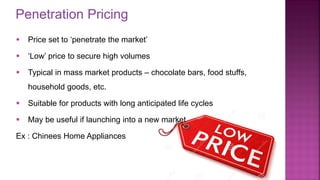
▪ Price set to ‘penetrate the market’
▪ ‘Low’ price to secure high volumes
▪ Typical in mass market products – chocolate bars, food stuffs,
household goods, etc.
▪ Suitable for products with long anticipated life cycles
▪ May be useful if launching into a new market
Ex : Chinees Home Appliances
Cost Plus Pricing
24
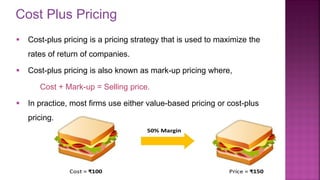
▪ Cost-plus pricing is a pricing strategy that is used to maximize the
rates of return of companies.
▪ Cost-plus pricing is also known as mark-up pricing where,
Cost + Mark-up = Selling price.
▪ In practice, most firms use either value-based pricing or cost-plus
pricing.
Contribution Pricing
25
▪ Prices set to ensure coverage of variable costs and a
‘contribution’ to the fixed costs
Contribution = Selling Price – Variable (direct costs)
▪ Similar in principle to marginal cost pricing
▪ Break-even analysis might be useful in such circumstances
Target Pricing
26
▪ Setting price to ‘target’ a specified profit level
▪ Estimates of the cost and potential revenue at different prices,
and thus the break-even have to be made, to determine the mark-
up
Mark-up = Profit/Cost x 100
Marginal Cost Pricing
27
▪ Marginal cost – the cost of producing ONE extra or ONE fewer
item of production
▪ MC pricing – allows flexibility
▪ Particularly relevant in transport where fixed costs may be
relatively high
▪ Allows variable pricing structure
e.g. on a flight from London to New York – providing the cost of the extra
passenger is covered, the price could be varied a good deal to attract customers
and fill the aircraft
Absorption Cost Pricing
28
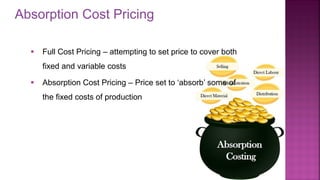
▪ Full Cost Pricing – attempting to set price to cover both
fixed and variable costs
▪ Absorption Cost Pricing – Price set to ‘absorb’ some of
the fixed costs of production
Destroyer Pricing
29
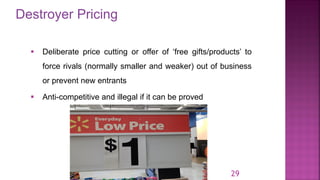
▪ Deliberate price cutting or offer of ‘free gifts/products’ to
force rivals (normally smaller and weaker) out of business
or prevent new entrants
▪ Anti-competitive and illegal if it can be proved
Thank You

Pricing Practices Pricing Practices Pricing Practices

  • 1.
    1 Ms. Mahimi Kanchana Facultyof Engineering University of Moratuwa Pricing Practices
  • 2.
    Lecture Outline 2 Pricing inTheory 02 03 Pricing Strategies 04 Actual Pricing practices in the real world 01 Factors affecting Pricing of Multiple Products
  • 3.
    What is Price? 3 Theamount of money expected, required, or given in payment for something.
  • 4.
    Pricing in Theory 4 Monopolistic,monopolistically competitive and oligopolistic firms maximize profits where MR = MC and charge a price indicated on the demand curve. Perfectly competitive firms maximize profits where, P = MR = MC
  • 5.
    Pricing in Theory(Contd.) 5 For this analysis we assumed that a firm, – produces only one product, – sells its product in only in one market, – is a centralized entity and – has precise knowledge on demand and cost curves it faces. None of the above assumptions is true for the modern world firms.
  • 6.
    Actual Pricing Practices 6 Today,many firms produce multiple products, sell in many markets, are decentralized with a number of semiautonom ous divisions, and have general knowledge on demand an d cost curves. In pricing practices, we learn how do the firms price their products in these complicated situations.
  • 7.
    Pricing Strategy 7 A businesscan use a variety of pricing strategies when selling a product or services. The Price can be set to maximize profitability for each unit sold or from the market overall. It can be used to de fend an existing market from new entrants, to increase market sh are within a market or to enter a new market. Businesses may be nefit from lowering or raising prices, depending on the needs and behaviors of customers and clients in the particular market. Findi ng the right pricing strategy is an important element in running a successful business.
  • 8.
    Pricing Strategy Objectives 8 ▪Long Run Profits ▪ Short Run Profits ▪ Increase Sales Volume ▪ Company Growth ▪ Match Competitors Price ▪ Create Interest & Excitement about the Product ▪ Discourage Competitors From cutting Price ▪ Social, Ethical & Ideological Objectives ▪ Discourage New Entrants ▪ Survival
  • 9.
    Decisions in PricingStrategy 9 ▪ Fixed & Variable Cost ▪ Competition ▪ Company Objectives ▪ Proposed Positioning Strategies ▪ Target Group & Willingness to Pay ▪ External Market Demand ▪ Internal Factors; Product Cost & Objectives of Company
  • 10.
    Pricing Strategy forChallenging Economic Times 10 ▪ Pricing is a market consideration, not a cost consideration. ▪ Understand your customers’ primary goals. Be clear on what the customer wants first, then set pricing and bundling decisions. ▪ Consider bundling products or services together. Always bundle a low- and high-valued product together. This will create higher sales and greater profitability.
  • 11.
    Pricing Strategy forChallenging Economic Times 11 ▪ Understand your value proposition. Have a clear understanding of if and how your product or service is differentiated from the competition. ▪ Know where you are on the scale of "innovative-to-commoditized." ▪ Build the customers’ perception of value. Constantly build on customer perception. The more subtle the differentiation of the product or service, the more often customers need to be reminded of the value of your product or service
  • 12.
  • 13.
    Types of ActualPricing Practices 13 ▪ Marketing Skimming ▪ Value Pricing ▪ Loss Leader ▪ Psychological Pricing ▪ Going Rate (Price Leadership) ▪ Price Discrimination ▪ Penetration Pricing ▪ Cost Plus Pricing ▪ Contribution Pricing ▪ Target Pricing ▪ Marginal Cost Pricing ▪ Absorption Cost Pricing ▪ Destroyer Pricing
  • 14.
    Market Skimming Pricing 14 ▪High Price low volume ▪ Skim the Profit from the Market ▪ Suitable for the products that have short life cycle or Which will face competition at some point in future. ▪ Most appropriate when demand is inelastic ▪ Examples; Play Station, Digital Technology, Apple products etc.
  • 15.
    Value Pricing 15 ▪ Basedon consumer Perception. ▪ Price charged according to the Customers Perception. ▪ Price set by the company as per the perceived value. ▪ Example; Status Products/ Exclusive Products.
  • 16.
  • 17.
    Loss Leader Pricing 17 ▪Goods/services deliberately sold below cost to encourage sales elsewhere ▪ Typical in supermarkets, e.g. at Christmas, selling bottles of gin at £3 in the hope that people will be attracted to the store and buy other things ▪ Purchases of other items more than covers ‘loss’ on item sold e.g. ‘Free’ mobile phone when taking on contract package
  • 18.
    Psychological Pricing 18 ▪ Usedto play on consumer perceptions ▪ Classic example - £9.99 instead of £10.99! ▪ Links with value pricing – high value goods priced according to what consumers THINK should be the price
  • 19.
    Going Rate Pricing 19 ▪In case of price leader, rivals have difficulty in competing on price – too high and they lose market share, too low and the price leader would match price and force smaller rival out of market ▪ May follow pricing leads of rivals especially where those rivals have a clear dominance of market share ▪ Where competition is limited, ‘going rate’ pricing may be applicable – banks, petrol, supermarkets, electrical goods – find very similar prices in all outlets
  • 20.
    Price Discrimination Pricing 20 ▪Charging a different price for the same good/service in different markets ▪ Requires each market to be impenetrable ▪ Requires different price elasticity of demand in each market
  • 21.
    Price Discrimination Pricing 21 ▪Prices for rail travel differ for the same journey at different times of the day ▪ The purpose of price discrimination is to capture the market's consumer surplus. Price discrimination allows the seller to generate the most revenue possible for a good or service .
  • 22.
    Price Discrimination Pricing 22 Pricediscrimination occurs when identical goods or services are sold at different prices from the same provider. There are three types of price discrimination: ▪ First degree - the seller must know the absolute maximum price that every consumer is willing to pay. ▪ Second degree - the price of the good or service varies according to quantity demanded. ▪ Third degree - the price of the good or service varies by attributes such as location, age, sex, and economic status.
  • 23.
    Penetration Pricing 23 ▪ Priceset to ‘penetrate the market’ ▪ ‘Low’ price to secure high volumes ▪ Typical in mass market products – chocolate bars, food stuffs, household goods, etc. ▪ Suitable for products with long anticipated life cycles ▪ May be useful if launching into a new market Ex : Chinees Home Appliances
  • 24.
    Cost Plus Pricing 24 ▪Cost-plus pricing is a pricing strategy that is used to maximize the rates of return of companies. ▪ Cost-plus pricing is also known as mark-up pricing where, Cost + Mark-up = Selling price. ▪ In practice, most firms use either value-based pricing or cost-plus pricing.
  • 25.
    Contribution Pricing 25 ▪ Pricesset to ensure coverage of variable costs and a ‘contribution’ to the fixed costs Contribution = Selling Price – Variable (direct costs) ▪ Similar in principle to marginal cost pricing ▪ Break-even analysis might be useful in such circumstances
  • 26.
    Target Pricing 26 ▪ Settingprice to ‘target’ a specified profit level ▪ Estimates of the cost and potential revenue at different prices, and thus the break-even have to be made, to determine the mark- up Mark-up = Profit/Cost x 100
  • 27.
    Marginal Cost Pricing 27 ▪Marginal cost – the cost of producing ONE extra or ONE fewer item of production ▪ MC pricing – allows flexibility ▪ Particularly relevant in transport where fixed costs may be relatively high ▪ Allows variable pricing structure e.g. on a flight from London to New York – providing the cost of the extra passenger is covered, the price could be varied a good deal to attract customers and fill the aircraft
  • 28.
    Absorption Cost Pricing 28 ▪Full Cost Pricing – attempting to set price to cover both fixed and variable costs ▪ Absorption Cost Pricing – Price set to ‘absorb’ some of the fixed costs of production
  • 29.
    Destroyer Pricing 29 ▪ Deliberateprice cutting or offer of ‘free gifts/products’ to force rivals (normally smaller and weaker) out of business or prevent new entrants ▪ Anti-competitive and illegal if it can be proved
  • 30.