PRICING
 Pricing is the process of determining what a company
will receive in exchange for its product or service.
Pricing factors are manufacturing cost, market place,
competition, market condition, brand, and quality of
product.
4/4/2015 1
PRICING
 Deciding what to charge from customers
4/4/2015 2
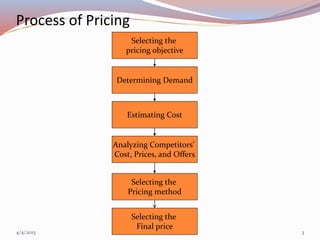
Process of Pricing
Selecting the
pricing objective
Determining Demand
Estimating Cost
Analyzing Competitors’
Cost, Prices, and Offers
Selecting the
Pricing method
Selecting the
Final price
4/4/2015 3
1.Selecting the pricing objective
 Survival
 Maximize current profits
 Maximize their market share
 Quality leadership
 Other Objective
4/4/2015 4
2.Determining the demand
• Price sensitivity
• Estimating demand curves
• Price elasticity of demand
4/4/2015 5
3.Estimating Cost
 Types of Cost and Levels of Production
 Fixed costs (overhead)
 Variable cost
 Total cost
 Average cost
4/4/2015 6
4.Analyzing Competitors’ Cost,
Prices, and Offers
 Within the range of possible prices determine by
market demand and company costs, the firm must
take competitors cost, prices and possible price
reactions into account.
4/4/2015 7
5.Selecting a Pricing Method
 Markup Pricing
 Target-Return Pricing
 Perceived value pricing
 Going rate pricing
 Bid pricing
 Sealed bid pricing
4/4/2015 8
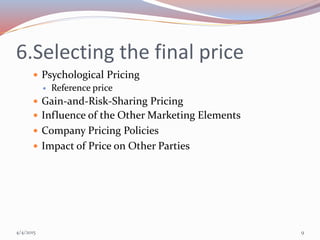
6.Selecting the final price
 Psychological Pricing
 Reference price
 Gain-and-Risk-Sharing Pricing
 Influence of the Other Marketing Elements
 Company Pricing Policies
 Impact of Price on Other Parties
4/4/2015 9
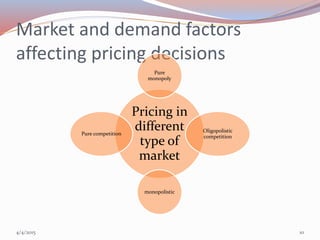
Market and demand factors
affecting pricing decisions
Pricing in
different
type of
market
Pure
monopoly
Oligopolistic
competition
monopolistic
Pure competition
4/4/2015 10
4/4/2015 11
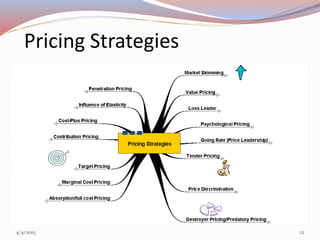
Pricing Strategies
4/4/2015 12
Penetration Pricing
4/4/2015 13
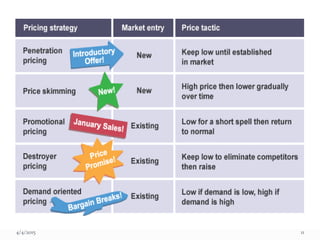
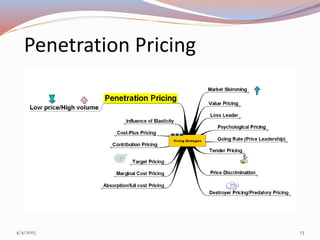
Penetration Pricing
 Price set to ‘penetrate the market’
 ‘Low’ price to secure high volumes
 Typical in mass market products – chocolate bars,
food stuffs, household goods, etc.
 Suitable for products with long anticipated life
cycles
 May be useful if launching into a new market
4/4/2015 14
Market Skimming
4/4/2015 15
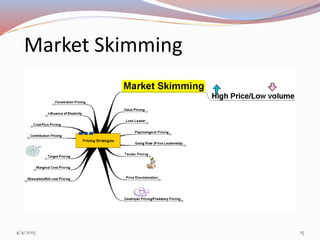
Market Skimming
 High price, Low volumes
 Skim the profit from the
market
 Suitable for products that have
short life cycles or which will
face competition at some
point in the future (e.g. after a
patent runs out)
 Examples include: Playstation,
jewellery, digital technology,
new DVDs, etc.
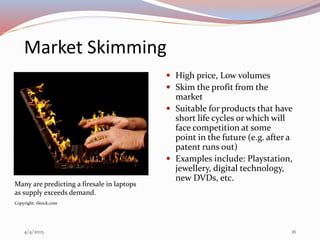
Many are predicting a firesale in laptops
as supply exceeds demand.
Copyright: iStock.com
4/4/2015 16
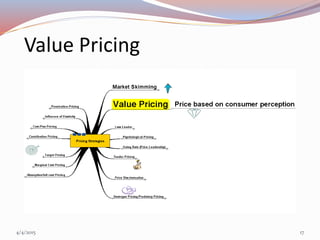
Value Pricing
4/4/2015 17
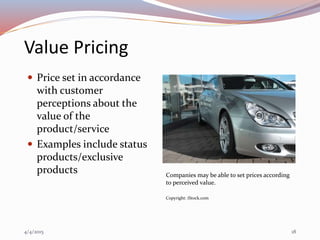
Value Pricing
 Price set in accordance
with customer
perceptions about the
value of the
product/service
 Examples include status
products/exclusive
products Companies may be able to set prices according
to perceived value.
Copyright: iStock.com
4/4/2015 18
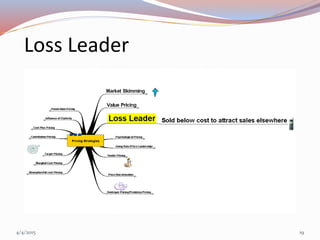
Loss Leader
4/4/2015 19
Loss Leader
 Goods/services deliberately sold below cost to
encourage sales elsewhere
 Typical in supermarkets, e.g. at Christmas, selling
bottles of gin at £3 in the hope that people will be
attracted to the store and buy other things
 Purchases of other items more than covers ‘loss’ on
item sold
 e.g. ‘Free’ mobile phone when taking on contract
package
4/4/2015 20
Psychological Pricing
4/4/2015 21
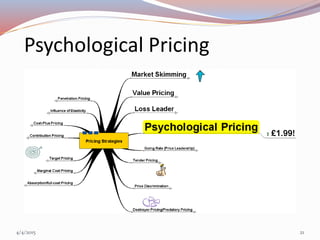
Psychological Pricing
 Used to play on consumer perceptions
 Classic example - £9.99 instead of £10.99!
 Links with value pricing – high value goods priced
according to what consumers THINK should be the
price
4/4/2015 22
Going Rate (Price Leadership)
4/4/2015 23
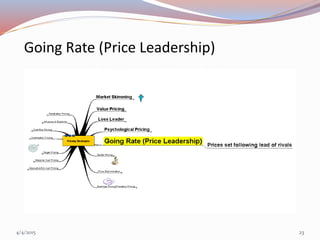
Going Rate (Price Leadership)
 In case of price leader, rivals have difficulty in competing
on price – too high and they lose market share, too low and
the price leader would match price and force smaller rival
out of market
 May follow pricing leads of rivals especially where those
rivals have a clear dominance of market share
 Where competition is limited, ‘going rate’ pricing may be
applicable – banks, petrol, supermarkets, electrical goods –
find very similar prices in all outlets
4/4/2015 24
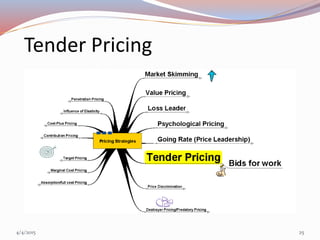
Tender Pricing
4/4/2015 25
Tender Pricing
 Many contracts awarded on a tender basis
 Firm (or firms) submit their price for carrying out the
work
 Purchaser then chooses which represents best value
 Mostly done in secret
4/4/2015 26
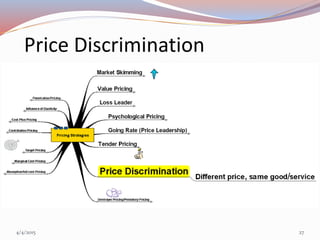
Price Discrimination
4/4/2015 27
Price Discrimination
 Charging a different price
for the same good/service
in different markets
 Requires each market to
be impenetrable
 Requires different price
elasticity of demand in
each market
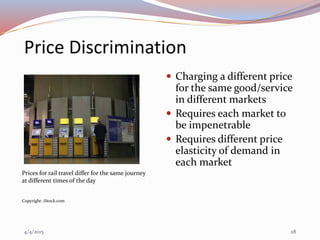
Prices for rail travel differ for the same journey
at different times of the day
Copyright: iStock.com
4/4/2015 28
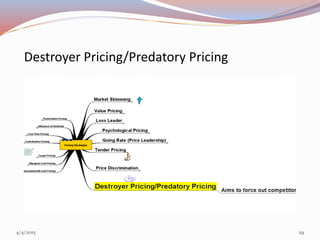
Destroyer Pricing/Predatory Pricing
4/4/2015 29
Destroyer/Predatory Pricing
 Deliberate price cutting or offer of ‘free
gifts/products’ to force rivals (normally smaller
and weaker) out of business or prevent new
entrants
 Anti-competitive and illegal if it can be proved
4/4/2015 30
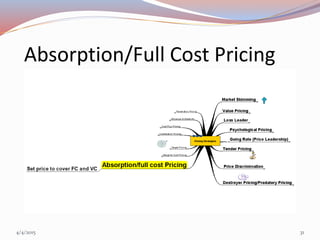
Absorption/Full Cost Pricing
4/4/2015 31
Absorption/Full Cost Pricing
 Full Cost Pricing – attempting to set price to cover
both fixed and variable costs
 Absorption Cost Pricing – Price set to ‘absorb’ some of
the fixed costs of production
4/4/2015 32
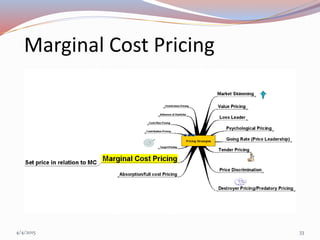
Marginal Cost Pricing
4/4/2015 33
Marginal Cost Pricing
 Marginal cost – the cost of producing ONE extra or ONE
fewer item of production
 MC pricing – allows flexibility
 Particularly relevant in transport where fixed costs may be
relatively high
 Allows variable pricing structure – e.g. on a flight from
London to New York – providing the cost of the extra
passenger is covered, the price could be varied a good deal
to attract customers and fill the aircraft
4/4/2015 34
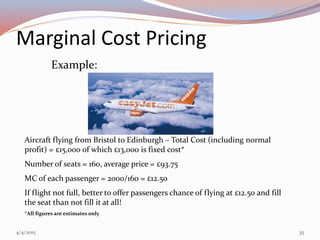
Marginal Cost Pricing
Example:
Aircraft flying from Bristol to Edinburgh – Total Cost (including normal
profit) = £15,000 of which £13,000 is fixed cost*
Number of seats = 160, average price = £93.75
MC of each passenger = 2000/160 = £12.50
If flight not full, better to offer passengers chance of flying at £12.50 and fill
the seat than not fill it at all!
*All figures are estimates only
4/4/2015 35
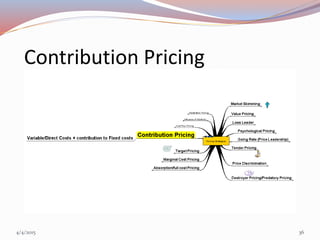
Contribution Pricing
4/4/2015 36
Contribution Pricing
 Contribution = Selling Price – Variable (direct costs)
 Prices set to ensure coverage of variable costs and a
‘contribution’ to the fixed costs
 Similar in principle to marginal cost pricing
 Break-even analysis might be useful in such
circumstances
4/4/2015 37
Target Pricing
4/4/2015 38
Target Pricing
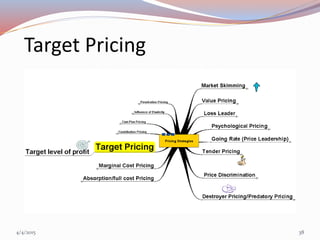
 Setting price to ‘target’ a specified profit level
 Estimates of the cost and potential revenue at different
prices, and thus the break-even have to be made, to
determine the mark-up
 Mark-up = Profit/Cost x 100
4/4/2015 39
Cost-Plus Pricing
4/4/2015 40
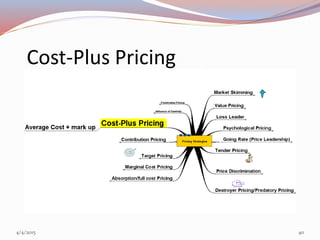
Cost-Plus Pricing
 Calculation of the average cost (AC) plus a mark up
 AC = Total Cost/Output
4/4/2015 41
Influence of Elasticity
4/4/2015 42
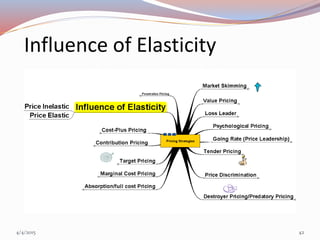
Influence of Elasticity
 Any pricing decision must be mindful of the
impact of price elasticity
 The degree of price elasticity impacts on the level
of sales and hence revenue
 Elasticity focuses on proportionate (percentage)
changes
 PED = % Change in Quantity demanded/%
Change in Price
4/4/2015 43
Influence of Elasticity
 Price Inelastic:
 % change in Q < % change in P
 e.g. a 5% increase in price would be met by a fall in
sales of something less than 5%
 Revenue would rise
 A 7% reduction in price would lead to a rise in
sales of something less than 7%
 Revenue would fall
4/4/2015 44
Influence of Elasticity
 Price Elastic:
 % change in quantity demanded > % change in
price
 e.g. A 4% rise in price would lead to sales
falling by something more than 4%
 Revenue would fall
 A 9% fall in price would lead to a rise in sales of
something more than 9%
 Revenue would rise
4/4/2015 45
4/4/2015 46

Sandeep singh sisodiya

  • 1.
    PRICING  Pricing isthe process of determining what a company will receive in exchange for its product or service. Pricing factors are manufacturing cost, market place, competition, market condition, brand, and quality of product. 4/4/2015 1
  • 2.
    PRICING  Deciding whatto charge from customers 4/4/2015 2
  • 3.
    Process of Pricing Selectingthe pricing objective Determining Demand Estimating Cost Analyzing Competitors’ Cost, Prices, and Offers Selecting the Pricing method Selecting the Final price 4/4/2015 3
  • 4.
    1.Selecting the pricingobjective  Survival  Maximize current profits  Maximize their market share  Quality leadership  Other Objective 4/4/2015 4
  • 5.
    2.Determining the demand •Price sensitivity • Estimating demand curves • Price elasticity of demand 4/4/2015 5
  • 6.
    3.Estimating Cost  Typesof Cost and Levels of Production  Fixed costs (overhead)  Variable cost  Total cost  Average cost 4/4/2015 6
  • 7.
    4.Analyzing Competitors’ Cost, Prices,and Offers  Within the range of possible prices determine by market demand and company costs, the firm must take competitors cost, prices and possible price reactions into account. 4/4/2015 7
  • 8.
    5.Selecting a PricingMethod  Markup Pricing  Target-Return Pricing  Perceived value pricing  Going rate pricing  Bid pricing  Sealed bid pricing 4/4/2015 8
  • 9.
    6.Selecting the finalprice  Psychological Pricing  Reference price  Gain-and-Risk-Sharing Pricing  Influence of the Other Marketing Elements  Company Pricing Policies  Impact of Price on Other Parties 4/4/2015 9
  • 10.
    Market and demandfactors affecting pricing decisions Pricing in different type of market Pure monopoly Oligopolistic competition monopolistic Pure competition 4/4/2015 10
  • 11.
  • 12.
  • 13.
  • 14.
    Penetration Pricing  Priceset to ‘penetrate the market’  ‘Low’ price to secure high volumes  Typical in mass market products – chocolate bars, food stuffs, household goods, etc.  Suitable for products with long anticipated life cycles  May be useful if launching into a new market 4/4/2015 14
  • 15.
  • 16.
    Market Skimming  Highprice, Low volumes  Skim the profit from the market  Suitable for products that have short life cycles or which will face competition at some point in the future (e.g. after a patent runs out)  Examples include: Playstation, jewellery, digital technology, new DVDs, etc. Many are predicting a firesale in laptops as supply exceeds demand. Copyright: iStock.com 4/4/2015 16
  • 17.
  • 18.
    Value Pricing  Priceset in accordance with customer perceptions about the value of the product/service  Examples include status products/exclusive products Companies may be able to set prices according to perceived value. Copyright: iStock.com 4/4/2015 18
  • 19.
  • 20.
    Loss Leader  Goods/servicesdeliberately sold below cost to encourage sales elsewhere  Typical in supermarkets, e.g. at Christmas, selling bottles of gin at £3 in the hope that people will be attracted to the store and buy other things  Purchases of other items more than covers ‘loss’ on item sold  e.g. ‘Free’ mobile phone when taking on contract package 4/4/2015 20
  • 21.
  • 22.
    Psychological Pricing  Usedto play on consumer perceptions  Classic example - £9.99 instead of £10.99!  Links with value pricing – high value goods priced according to what consumers THINK should be the price 4/4/2015 22
  • 23.
    Going Rate (PriceLeadership) 4/4/2015 23
  • 24.
    Going Rate (PriceLeadership)  In case of price leader, rivals have difficulty in competing on price – too high and they lose market share, too low and the price leader would match price and force smaller rival out of market  May follow pricing leads of rivals especially where those rivals have a clear dominance of market share  Where competition is limited, ‘going rate’ pricing may be applicable – banks, petrol, supermarkets, electrical goods – find very similar prices in all outlets 4/4/2015 24
  • 25.
  • 26.
    Tender Pricing  Manycontracts awarded on a tender basis  Firm (or firms) submit their price for carrying out the work  Purchaser then chooses which represents best value  Mostly done in secret 4/4/2015 26
  • 27.
  • 28.
    Price Discrimination  Charginga different price for the same good/service in different markets  Requires each market to be impenetrable  Requires different price elasticity of demand in each market Prices for rail travel differ for the same journey at different times of the day Copyright: iStock.com 4/4/2015 28
  • 29.
  • 30.
    Destroyer/Predatory Pricing  Deliberateprice cutting or offer of ‘free gifts/products’ to force rivals (normally smaller and weaker) out of business or prevent new entrants  Anti-competitive and illegal if it can be proved 4/4/2015 30
  • 31.
  • 32.
    Absorption/Full Cost Pricing Full Cost Pricing – attempting to set price to cover both fixed and variable costs  Absorption Cost Pricing – Price set to ‘absorb’ some of the fixed costs of production 4/4/2015 32
  • 33.
  • 34.
    Marginal Cost Pricing Marginal cost – the cost of producing ONE extra or ONE fewer item of production  MC pricing – allows flexibility  Particularly relevant in transport where fixed costs may be relatively high  Allows variable pricing structure – e.g. on a flight from London to New York – providing the cost of the extra passenger is covered, the price could be varied a good deal to attract customers and fill the aircraft 4/4/2015 34
  • 35.
    Marginal Cost Pricing Example: Aircraftflying from Bristol to Edinburgh – Total Cost (including normal profit) = £15,000 of which £13,000 is fixed cost* Number of seats = 160, average price = £93.75 MC of each passenger = 2000/160 = £12.50 If flight not full, better to offer passengers chance of flying at £12.50 and fill the seat than not fill it at all! *All figures are estimates only 4/4/2015 35
  • 36.
  • 37.
    Contribution Pricing  Contribution= Selling Price – Variable (direct costs)  Prices set to ensure coverage of variable costs and a ‘contribution’ to the fixed costs  Similar in principle to marginal cost pricing  Break-even analysis might be useful in such circumstances 4/4/2015 37
  • 38.
  • 39.
    Target Pricing  Settingprice to ‘target’ a specified profit level  Estimates of the cost and potential revenue at different prices, and thus the break-even have to be made, to determine the mark-up  Mark-up = Profit/Cost x 100 4/4/2015 39
  • 40.
  • 41.
    Cost-Plus Pricing  Calculationof the average cost (AC) plus a mark up  AC = Total Cost/Output 4/4/2015 41
  • 42.
  • 43.
    Influence of Elasticity Any pricing decision must be mindful of the impact of price elasticity  The degree of price elasticity impacts on the level of sales and hence revenue  Elasticity focuses on proportionate (percentage) changes  PED = % Change in Quantity demanded/% Change in Price 4/4/2015 43
  • 44.
    Influence of Elasticity Price Inelastic:  % change in Q < % change in P  e.g. a 5% increase in price would be met by a fall in sales of something less than 5%  Revenue would rise  A 7% reduction in price would lead to a rise in sales of something less than 7%  Revenue would fall 4/4/2015 44
  • 45.
    Influence of Elasticity Price Elastic:  % change in quantity demanded > % change in price  e.g. A 4% rise in price would lead to sales falling by something more than 4%  Revenue would fall  A 9% fall in price would lead to a rise in sales of something more than 9%  Revenue would rise 4/4/2015 45
  • 46.