10/10/2017
1
Pressure Relief Devices
The-Safety-Valve.com
2
Meet- en Regeltechniek
Objectives of this Presentation
The aim of this presentation is to explain
the most common phrases around Pressure Relief Devices
 Scope of this presentation
 Definition of a Safety valve
 Reasons for Excess Pressure
 Classification – Definition of Safety Valves
 Design - Options
 Applications - Installations
 Institutions, Standards and Regulations
 Set pressure – CDTP – Overpressure - Blowdown
 Back pressure – Inlet pressure
 Legal aspects
 Maintenance
 Calculation example
10/10/2017
2
3
Meet- en Regeltechniek
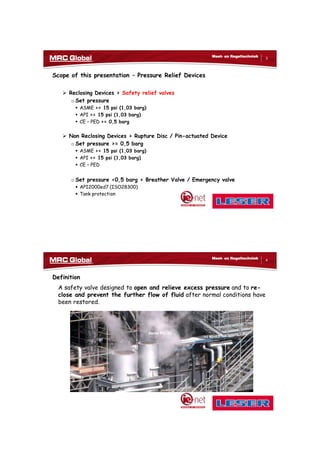
Scope of this presentation – Pressure Relief Devices
 Reclosing Devices > Safety relief valves
o Set pressure
 ASME >= 15 psi (1,03 barg)
 API >= 15 psi (1,03 barg)
 CE – PED >= 0,5 barg
 Non Reclosing Devices > Rupture Disc / Pin-actuated Device
o Set pressure >= 0,5 barg
 ASME >= 15 psi (1,03 barg)
 API >= 15 psi (1,03 barg)
 CE – PED
o Set pressure <0,5 barg > Breather Valve / Emergency valve
 API2000ed7 (ISO28300)
 Tank protection
4
Meet- en Regeltechniek
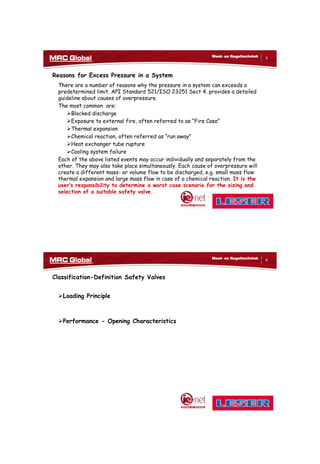
Definition
A safety valve designed to open and relieve excess pressure and to re-
close and prevent the further flow of fluid after normal conditions have
been restored.
Asme Ptc 25
10/10/2017
3
5
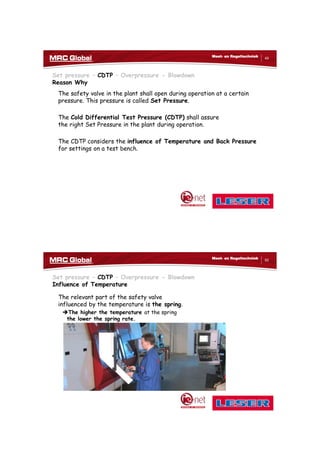
Meet- en Regeltechniek
Reasons for Excess Pressure in a System
There are a number of reasons why the pressure in a system can exceeds a
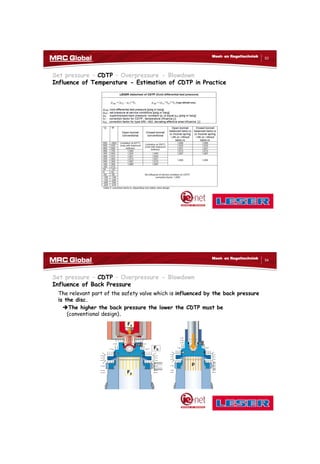
predetermined limit. API Standard 521/ISO 23251 Sect 4. provides a detailed
guideline about causes of overpressure.
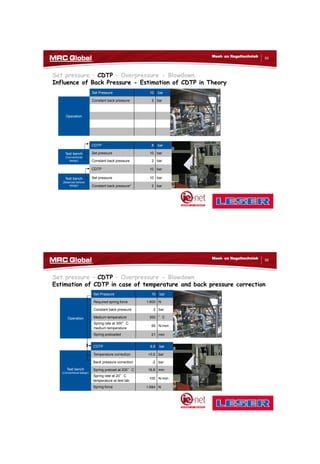
The most common are:
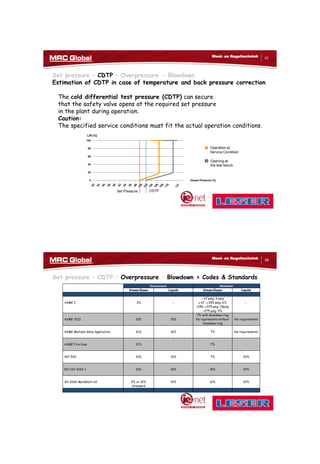
Blocked discharge
Exposure to external fire, often referred to as “Fire Case”
Thermal expansion
Chemical reaction, often referred as “run away”
Heat exchanger tube rupture
Cooling system failure
Each of the above listed events may occur individually and separately from the
other. They may also take place simultaneously. Each cause of overpressure will
create a different mass- or volume flow to be discharged, e.g. small mass flow
thermal expansion and large mass flow in case of a chemical reaction. It is the
user’s responsibility to determine a worst case scenario for the sizing and
selection of a suitable safety valve.
6
Meet- en Regeltechniek
Classification-Definition Safety Valves
Loading Principle
Performance - Opening Characteristics
10/10/2017
4
7
Meet- en Regeltechniek
Classifcation–Definition Safety Valves – Loading Principle
Safety Valves
Direct-load
Spring loaded Weight loaded
Controlled
Controlled
Safety
Pressure Relief
System
Pilot-Operated
Safety Valve
8
Meet- en Regeltechniek
Loading principle – Spring Loaded Safety Valves
A pressure relief valve in which the opening and closing
of the valve is controlled by a spring.
10/10/2017
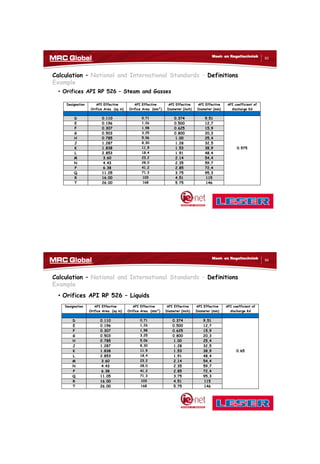
5
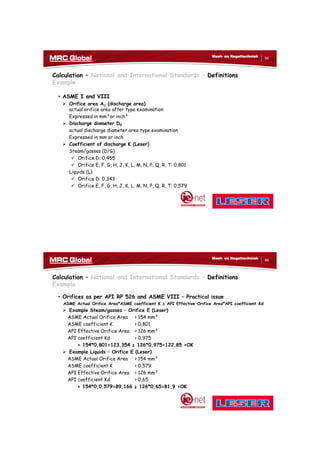
9
Meet- en Regeltechniek
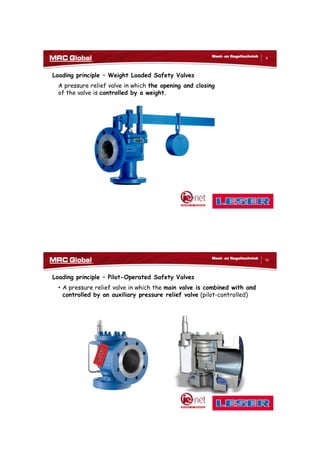
Loading principle – Weight Loaded Safety Valves
A pressure relief valve in which the opening and closing
of the valve is controlled by a weight.
10
Meet- en Regeltechniek
Loading principle – Pilot-Operated Safety Valves
• A pressure relief valve in which the main valve is combined with and
controlled by an auxiliary pressure relief valve (pilot-controlled)
10/10/2017
6
11
Meet- en Regeltechniek
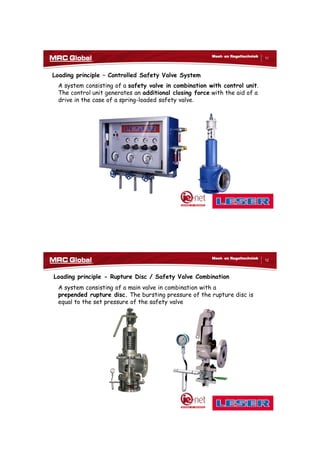
Loading principle – Controlled Safety Valve System
A system consisting of a safety valve in combination with control unit.
The control unit generates an additional closing force with the aid of a
drive in the case of a spring-loaded safety valve.
12
Meet- en Regeltechniek
Loading principle - Rupture Disc / Safety Valve Combination
A system consisting of a main valve in combination with a
prepended rupture disc. The bursting pressure of the rupture disc is
equal to the set pressure of the safety valve
10/10/2017
7
13
Meet- en Regeltechniek
Classification-Definition Safety Valves-AD2000-A2
Performance / Opening Characteristics
 Opening Characteristics
o Normal Safety Valve Pursuant to AD 2000 Information Sheet A2
A spring loaded pressure relief valve actuated by the static pressure upstream of
the valve. The valve opens in proportion to the pressure increase over the opening
pressure. Used primarily with liquid service (non-compressible).
100
80
60
40
20
0
Lift [%]
pc
p = set pressure pc = opening pressure
pp = popping pressure ps = closing pressure
90 100 110
ps
p
Pressure [%]
pp
14
Meet- en Regeltechniek
Classification-Definition Safety Valves-AD2000-A2
Performance / Opening Characteristics
 Opening Characteristics
o Normal Safety Valve Pursuant to AD 2000 Information Sheet A2
A spring-loaded normal safety valve opening proportionately or suddenly within a
pressure increase of 10%.
Used with all media: steam, vapour, gas and liquids.
100
80
60
40
20
0
Lift [%]
pc
p = set pressure pc = opening pressure
pp = popping pressure ps = closing pressure
ps
p
Pressure [%]
pp
80 90 100 105 110 120
Standard 10% - Pop-Acting
10/10/2017
8
15
Meet- en Regeltechniek
Classification-Definition Safety Valves-AD2000-A2
Performance / Opening Characteristics
 Opening Characteristics
o Full-lift Safety Valve Pursuant to AD 2000 Information Sheet A2
A spring-loaded full-lift safety valve opening suddenly within a pressure increase of
5%. Primarily used for gas, steam and vapour
100
80
60
40
20
0
Lift [%]
pc
p = set pressure pc = opening pressure
pp = popping pressure ps = closing pressure
ps
p
Pressure [%]
pp
80 90 100 105 110 120
Sudden opening within 5%
16
Meet- en Regeltechniek
Classification-Definition Safety Valves-ASME PTC 25-2014
Performance / Opening Characteristics
 Relief valve
o A pressure relief valve characterized by gradual opening that is generally
proportional to the increase in pressure. It is normally used for incompressible
fluids.
 Safety relief valve
o A pressure relief valve characterized by rapid opening or by gradual opening that
is generally proportional to the increase in pressure. It can be used for
compressible or incompressible fluids.
 Safety valve
o A pressure relief valve characterized by rapid opening and normally used to
relieve compressible fluids.
Prssure [%]
10/10/2017
9
17
Meet- en Regeltechniek
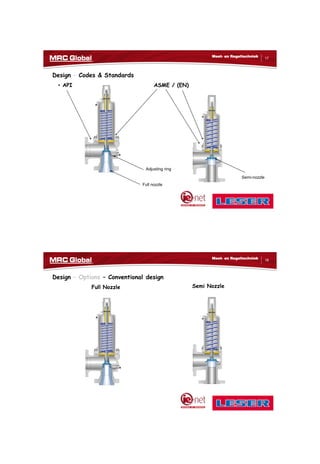
Design – Codes & Standards
• API ASME / (EN)
Adjusting ring
Full nozzle
Semi-nozzle
18
Meet- en Regeltechniek
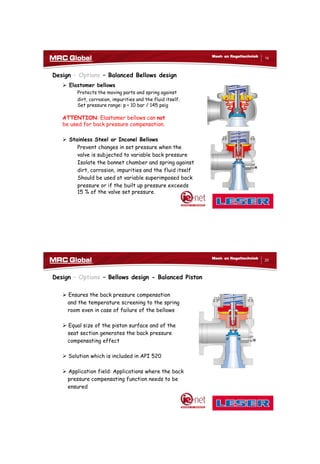
Design – Options – Conventional design
Full Nozzle
Full Nozzle
Semi Nozzle
10/10/2017
10
19
Meet- en Regeltechniek
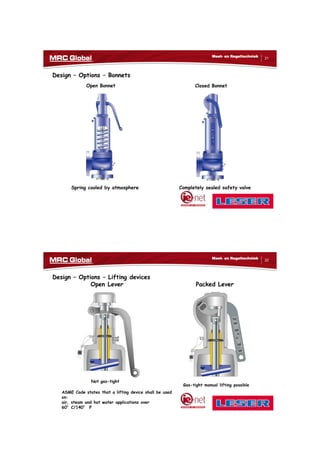
Design – Options – Balanced Bellows design
 Elastomer bellows
Protects the moving parts and spring against
dirt, corrosion, impurities and the fluid itself.
Set pressure range: p < 10 bar / 145 psig
ATTENTION: Elastomer bellows can not
be used for back pressure compensation.
 Stainless Steel or Inconel Bellows
Prevent changes in set pressure when the
valve is subjected to variable back pressure
Isolate the bonnet chamber and spring against
dirt, corrosion, impurities and the fluid itself
Should be used at variable superimposed back
pressure or if the built up pressure exceeds
15 % of the valve set pressure.
20
Meet- en Regeltechniek
Design – Options – Bellows design - Balanced Piston
 Ensures the back pressure compensation
and the temperature screening to the spring
room even in case of failure of the bellows
 Equal size of the piston surface and of the
seat section generates the back pressure
compensating effect
 Solution which is included in API 520
 Application field: Applications where the back
pressure compensating function needs to be
ensured
10/10/2017
11
21
Meet- en Regeltechniek
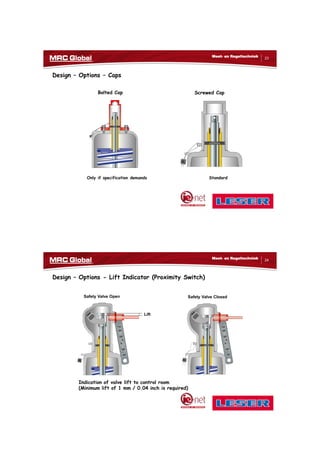
Design – Options – Bonnets
Open Bonnet Closed Bonnet
Spring cooled by atmosphere Completely sealed safety valve
22
Meet- en Regeltechniek
Design – Options – Lifting devices
Open Lever Packed Lever
Not gas-tight
Gas-tight manual lifting possible
ASME Code states that a lifting device shall be used
on:
air, steam and hot water applications over
60°C/140° F
10/10/2017
12
23
Meet- en Regeltechniek
Design – Options – Caps
Only if specification demands Standard
Screwed CapBolted Cap
24
Meet- en Regeltechniek
Design – Options - Lift Indicator (Proximity Switch)
Lift
Indication of valve lift to control room
(Minimum lift of 1 mm / 0.04 inch is required)
Safety Valve Open Safety Valve Closed
10/10/2017
13
25
Meet- en Regeltechniek
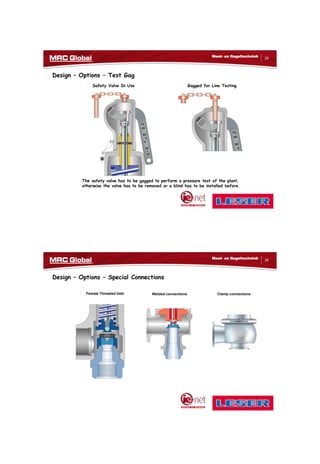
Design – Options – Test Gag
Safety Valve In Use Gagged for Line Testing
The safety valve has to be gagged to perform a pressure test of the plant,
otherwise the valve has to be removed or a blind has to be installed before.
26
Meet- en Regeltechniek
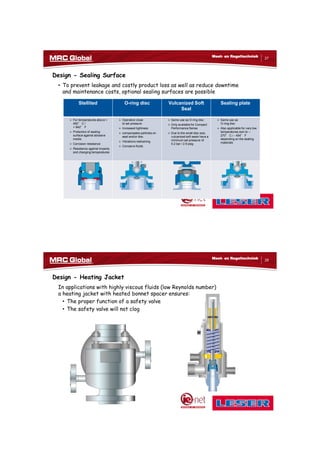
Design – Options – Special Connections
Welded connectionsFemale Threaded Inlet Clamp connections
10/10/2017
14
27
Meet- en Regeltechniek
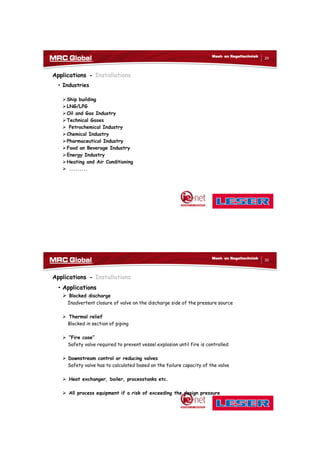
Design - Sealing Surface
• To prevent leakage and costly product loss as well as reduce downtime
and maintenance costs, optional sealing surfaces are possible
Stellited O-ring disc Vulcanized Soft
Seal
Sealing plate
 For temperatures above +
450° C /
+ 842° F
 Protection of sealing
surface against abrasive
media
 Corrosion resistance
 Resistance against impacts
and changing temperatures
 Operation close
to set pressure
 Increased tightness
 compensates particles on
seat and/or disc
 Vibrations restraining
 Corrosive fluids
 Same use as O-ring disc
 Only available for Compact
Performance Series
 Due to the small disc size,
vulcanized soft seals have a
minimum set pressure of
0.2 bar / 2.9 psig
 Same use as
O-ring disc
 Also applicable for very low
temperatures own to –
270° C / - 454° F
depending on the sealing
materials
28
Meet- en Regeltechniek
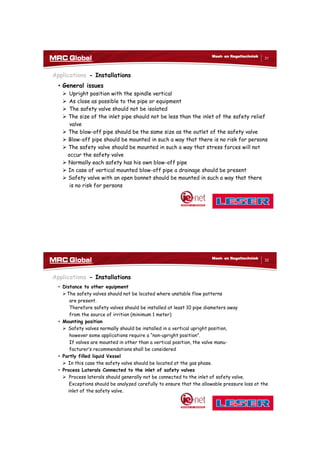
Design - Heating Jacket
In applications with highly viscous fluids (low Reynolds number)
a heating jacket with heated bonnet spacer ensures:
• The proper function of a safety valve
• The safety valve will not clog
10/10/2017
15
29
Meet- en Regeltechniek
Applications - Installations
• Industries
Ship building
LNG/LPG
Oil and Gas Industry
Technical Gases
 Petrochemical Industry
Chemical Industry
Pharmaceutical Industry
Food an Beverage Industry
Energy Industry
Heating and Air Conditioning
 .........
30
Meet- en Regeltechniek
Applications - Installations
• Applications
 Blocked discharge
Inadvertent closure of valve on the discharge side of the pressure source
 Thermal relief
Blocked in section of piping
 “Fire case”
Safety valve required to prevent vessel explosion until fire is controlled
 Downstream control or reducing valves
Safety valve has to calculated based on the failure capacity of the valve
 Heat exchanger, boiler, processtanks etc.
 All process equipment if a risk of exceeding the design pressure
10/10/2017
16
31
Meet- en Regeltechniek
Applications - Installations
• General issues
 Upright position with the spindle vertical
 As close as possible to the pipe or equipment
 The safety valve should not be isolated
 The size of the inlet pipe should not be less than the inlet of the safety relief
valve
 The blow-off pipe should be the same size as the outlet of the safety valve
 Blow-off pipe should be mounted in such a way that there is no risk for persons
 The safety valve should be mounted in such a way that stress forces will not
occur the safety valve
 Normally each safety has his own blow-off pipe
 In case of vertical mounted blow-off pipe a drainage should be present
 Safety valve with an open bonnet should be mounted in such a way that there
is no risk for persons
32
Meet- en Regeltechniek
Applications - Installations
• Distance to other equipment
The safety valves should not be located where unstable flow patterns
are present.
Therefore safety valves should be installed at least 10 pipe diameters away
from the source of irrition (minimum 1 meter)
• Mounting position
 Safety valves normally should be installed in a vertical upright position,
however some applications require a “non-upright position”.
If valves are mounted in other than a vertical position, the valve manu-
facturer’s recommendations shall be considered
• Partly filled liquid Vessel
 In this case the safety valve should be located at the gas phase.
• Process Laterals Connected to the inlet of safety valves
 Process laterals should generally not be connected to the inlet of safety valve.
Exceptions should be analyzed carefully to ensure that the allowable pressure loss at the
inlet of the safety valve.
10/10/2017
17
33
Meet- en Regeltechniek
Applications - Installations
• Drainage
 Adequate drainage of the outlet line to achieve a proper safety valve
performance
This means that normally no medium or condensate will stay inside the safety
valve.
The following directions should be followed:
 The drainage should always run via the outlet line
At the lowest point of the outlet line sufficient drainage should be installed for
discharging condensate
To avoid back-flow, a drip pan elbow can be used
Some standards require an additional drain hole within the safety valve (API526)
34
Meet- en Regeltechniek
Institutions, Standards and Regulations > Most usual
Area of application Applicable
regulations
Issuer of regulations Symbol Monitoring organisation
USA ASME > Law
ASME I > XII
ASME Section I
ASME Section II
ASME Section VIII
American Society of
Mechanical Engineers
National Board (NB)
Europe P(pressure) E(equipment)
D(directive) > Guideline
European Council/
European Parliament
Office appointed (TUEV –
AIB – Apragaz f.e.)
ISO EN 4126
Part 1 > 11
International
Organization for
Standardization
International API > Recommended
Practices
RP520/521/576
Std 526/527
American Petroleum
Instistute (API)
Manufacturer
10/10/2017
18
35
Meet- en Regeltechniek
Institutions, Standards and Regulations > Local
• TSSA/CSA/CRN/ABSA (Canada)
• AQSIQ (China)
• KOSHA (Korea)
• EAC (Russia, Belarus, Kazakhstan)
• UDT Poland
• Indian Boiler Code
• …
36
Meet- en Regeltechniek
Institutions, Standards and Regulations > ASME
ASME Code Section I
•This is a construction code covering power, electric and miniature boilers and high
temperature boilers (fired) used
in stationary service above 15 psig.
ASME Code Section II
• This is a construction code listing materials suitable
for the construction of safety valves according to ASME Code.
• In order for a part to be used in the construction of a safety valve,
the material must appear in ASME Code Section II.
• This section also provides the pressure and temperature limits
for the available materials of safety valve bodies and bonnets
ASME Code Section VIII
• This is a construction code covering the basic rules
for the construction, design, fabrication, inspection and
certification of pressure vessels (unfired) above 15 psig.
10/10/2017
19
37
Meet- en Regeltechniek
Institutions, Standards and Regulations > National Board of Boiler and
Pressure Vessel Inspectors (NB)
•The NB represents the enforcement agencies who assure adherence
to provisions of the ASME boiler and pressure vessel codes.
•The NB:
• Sets inspection standards
• Qualifies inspectors
• Works for owners, insurers
• Maintains records (Red Book – NB-18)
• Looks into violations
• Covers repair (VR Stamp)
38
Meet- en Regeltechniek
Institutions, Standards and Regulations > EN ISO 4126
• This is a European code related to the PED covering safety devices for
protection against excessive pressure
• Different Sections of the EN ISO 4126 deal
with the requirements, design and manufacture of safety devices
• EN ISO 4126-1 > Safety Valves (spring loaded)
• EN ISO 4126-2 > Bursting Discs Safety devices
• EN ISO 4126-3 > Safety Valves and Bursting Discs in Combination
• EN ISO 4126-4 > Pilot Operated Safety Valves
• EN ISO 4126-5 > Controlled Safety Valves Pressure Relief Systems
(CRPRS)
• EN ISO 4126-6 > Application, Installation of Bursting discs
• EN ISO 4126-7 > Sizing (Common data > steam tables, etc…
• EN ISO 4126-8 > Performance testing bursting Discs (draft)
• EN ISO 4126-9 > Application and Installation
• EN ISO 4126-10 > Performance testing SRV… just starting
10/10/2017
20
39
Meet- en Regeltechniek
Institutions, Standards and Regulations > American Petroleum Institute
(API)
•API publishes several standards dealing with safety valves:
• API 520 Part 1 – Sizing & Selection of Pressure Relief Devices
• API 520 Part 2 – Installation
of Pressure Relief Devices
• API 521 – Guide for Pressure-Relieving & Depressurizing Systems
• API 526 – Flanged Steel Safety Relief Valves
• API 527 – Seat Tightness
of Pressure Relief Valves
40
Meet- en Regeltechniek
Institutions, Standards and Regulations > API 520
• API 520 Part 1
• Applies to the sizing and selection of pressure relief devices
for equipment with an MAWP of 15 psig or greater.
• Protection of unfired vessels
• Basic definitions
• Operational characteristics of pressure relief devices
• Sizing procedures and methods
• API 520 Part 2
• Covers methods of installation for pressure relief devices
on equipment with an MAWP of 15 psig or greater.
10/10/2017
21
41
Meet- en Regeltechniek
Institutions, Standards and Regulations > API 521
•API 521 is designed to aid in the selection of the system
that is most appropriate for the risks and circumstances
involved in various installations.
• This standard provides guidelines for:
• Examining the principal causes of overpressure
• Determining individual relieving rates
• Including fire vapor generation and fire gas expansion
• Selecting and designing disposal systems
42
Meet- en Regeltechniek
Institutions, Standards and Regulations > API 526
•API 526 is a purchasing specification for flanged steel
pressure relief valves. Requirements are given for
spring loaded pressure relief valves and pilot-operated
relief valves.
• API 526 has standardized the following items:
• Orifice designation and area
• Valve size and pressure rating, inlet and outlet
• Materials
• Pressure-temperature limits
• Center-to-face dimensions, inlet and outlet
• Inspection and shop tests
• Identification and preparation for shipment
10/10/2017
22
43
Meet- en Regeltechniek
Institutions, Standards and Regulations > API 527
•API 527 describes tests to determine the seat tightness
of metal and soft-seated pressure relief valves.
Valves of conventional, bellows, and pilot-operated designs
are covered. Acceptable leakage rates are defined.
• It contains criteria for:
• Testing with air
• Testing with steam
• Testing with water
• Testing with air – another method
44
Meet- en Regeltechniek
Set pressure – CDTP – Overpressure - Blowdown
Set Pressure Definition
 ASME PTC 25, 2001, 2.7 OC of PRD
o The value of increasing inlet static pressure at which
a pressure relief device displays one of the operational
characteristics as defined under:
opening pressure, popping pressure,
start-to-leak pressure, burst pressure or
breaking pressure.
o (The applicable operating characteristic for a specific
device design is specified by the device manufacturer).
 API 520, 2000, 1.2.3.3 a.
o The set pressure is the inlet gauge pressure
at which the pressure relief device is set to open
under service conditions.
10/10/2017
23
45
Meet- en Regeltechniek
Set pressure – CDTP – Overpressure – Blowdown
Set Pressure Definition
 ISO 4126-1, 2004, 3.2. 1
o Predetermined pressure at which a safety valve
under operating conditions commences to open.
o Note:
It is the gauge pressure measured at the valve inlet
at which the pressure forces tending to open the valve
for the specific service conditions are in equilibrium
with the forces retaining the valve disc on its seat.
 The symbol is p.
46
Meet- en Regeltechniek
Set pressure – CDTP – Overpressure – Blowdown
Set Pressure Tolerance – Codes & Standards
• DIN EN ISO 4126-1
 +/- 3% of the set pressure or +/- 0,15 barg, whichever is greater
• ASME Code Section I
 ≤70 psi (0,5 MPa) > +/- 2 psi (15 kPa)
 >70 (0,5) and ≤300 (2,1) > +/- 3% of set pressure
 >300 (2,1) and ≤1000 (7,0) > +/- 10% of set pressure
 >1000 (7,0) > +/- 1% of set pressure
• ASME Code Section VIII
 ≤70 psi (0,5 MPa) > +/- 2 psi (15 kPa)
 >70 (0,5) > +/- 3% of set pressure
10/10/2017
24
47
Meet- en Regeltechniek
Set pressure – CDTP – Overpressure – Blowdown
Set Pressure Tolerance – Codes & Standards
• Suggestion for setting tolerances during the setting of safety valves by TüV
Nord, no minus tolerance allowed due to the operation pressure of the
installation
 ≤1,0 bar > +0,05 bar of set pressure
 >1,0 bar ≤5 bar > +0,10 bar of set pressure
 >5 barg > +3% of set pressure
• AD 2000, memorandum A2, chapter 11
• API 526, API 527, API 576
• DIN EN 837-1
48
Meet- en Regeltechniek
Set pressure – CDTP – Overpressure – Blowdown
Definition of Cold Differential Test Pressure (CDTP)
Codes and Standards
 CDTP is used if correction of set pressure of safety valves
according to deviation of service conditions is necessary.
ASME PTC 25, 2001, 2.7 OC of PRD
o The inlet static pressure at which a pressure relief valve is adjusted
to open on the test stand. This test pressure includes corrections for service conditions
of superimposed back pressure and/or temperature.
 API 20, 2000, Part I, 1.2.3.3 b.
o The cold differential test pressure (CDTP) is the pressure at which
a pressure relief valve is adjusted to open on the test stand.
The cold differential test pressure includes corrections for the service conditions of
back pressure or temperature or both.
 ISO 4126-1, 2004, 3.2.5
o The inlet static pressure at which a safety valve is set to commence
to open on the test bench. NOTE: This test pressure includes corrections
for service conditions, e.g. back pressure and/or temperature.
10/10/2017
25
49
Meet- en Regeltechniek
Set pressure – CDTP – Overpressure - Blowdown
Reason Why
The safety valve in the plant shall open during operation at a certain
pressure. This pressure is called Set Pressure.
The Cold Differential Test Pressure (CDTP) shall assure
the right Set Pressure in the plant during operation.
The CDTP considers the influence of Temperature and Back Pressure
for settings on a test bench.
50
Meet- en Regeltechniek
Set pressure – CDTP – Overpressure - Blowdown
Influence of Temperature
The relevant part of the safety valve
influenced by the temperature is the spring.
The higher the temperature at the spring
the lower the spring rate.
10/10/2017
26
51
Meet- en Regeltechniek
Set pressure – CDTP – Overpressure - Blowdown
Influence of Temperature - Estimation of CDTP in Theory
Set Pressure 10 bar
Operation
Required spring force 2.000 N
Medium temperature 300 °C
Spring rate at 300°C
medium temperature
95 N/mm
Spring preloaded 21 mm
CDTP (acc. LDeS 1001.69
 + 0,5 bar temperature correction)
10,5 bar
Test bench
Spring preloaded 21 mm
Spring rate at 20°C
temperature at test lab
100 N/mm
Spring force 2.100 N
52
Meet- en Regeltechniek
Set pressure – CDTP – Overpressure - Blowdown
Influence of Temperature - Estimation of CDTP in Practice
-508 -308 -108 92 292 492 692 892
0,96
0,98
1
1,02
1,04
1,06
1,08
1,1
1,12
-300 -200 -100 0 100 200 300 400 500
Temperature T [°F]
CorrectionfactorkT
Temperature T [°C]
Conventional design with closed bonnet
upward set pressure (+3%) of allowable tolerances ( 3%)
according to EN ISO 4126-1 2003-09
downward set pressure (-3%) of allowable tolarance
( 3) according to EN ISO 4126-1 2003-09
Approved correction curve by
German TÜV Nord
10/10/2017
27
53
Meet- en Regeltechniek
Set pressure – CDTP – Overpressure - Blowdown
Influence of Temperature - Estimation of CDTP in Practice
54
Meet- en Regeltechniek
Set pressure – CDTP – Overpressure - Blowdown
Influence of Back Pressure
The relevant part of the safety valve which is influenced by the back pressure
is the disc.
The higher the back pressure the lower the CDTP must be
(conventional design).
Fs
Fp
Fb
p
10/10/2017
28
55
Meet- en Regeltechniek
Set pressure – CDTP – Overpressure - Blowdown
Influence of Back Pressure - Estimation of CDTP in Theory
Set Pressure 10 bar
Operation
Constant back pressure 2 bar
CDTP 8 bar
Test bench
(Conventional
design)
Set pressure 10 bar
Constant back pressure 2 bar
CDTP 10 bar
Test bench
(Balanced bellows
design)
Set pressure 10 bar
Constant back pressure* 2 bar
56
Meet- en Regeltechniek
Set pressure – CDTP – Overpressure - Blowdown
Estimation of CDTP in case of temperature and back pressure correction
Set Pressure 10 bar
Operation
Required spring force 1.600 N
Constant back pressure 2 bar
Medium temperature 300 °C
Spring rate at 300°C
medium temperature
95 N/mm
Spring preloaded 21 mm
CDTP 8,5 bar
Test bench
(Conventional design)
Temperature correction +0,5 bar
Back pressure correction -2 bar
Spring preload at 200°C 16,8 mm
Spring rate at 20°C
temperature at test lab
100 N/mm
Spring force 1.684 N
10/10/2017
29
57
Meet- en Regeltechniek
Set pressure – CDTP – Overpressure - Blowdown
Estimation of CDTP in case of temperature and back pressure correction
The cold differential test pressure (CDTP) can secure
that the safety valve opens at the required set pressure
in the plant during operation.
Caution:
The specified service conditions must fit the actual operation conditions.
0
20
40
60
80
100
82 84 86 88 90 92 94 96 98
100
102
104
106
108
110
121
Lift (%)
Set Pressure CDTP
Vessel Pressure (%)
Operation at
Service Condition
Opening at
the test bench
58
Meet- en Regeltechniek
Set pressure – CDTP – Overpressure – Blowdown > Codes & Standards
Overpressure Blowdown
Steam/Gases Liquids Steam/Gases Liquids
ASME I 3% -
< 67 psig: 4 psig
≥ 67…≤ 250 psig: 6%
>250…≤375 psig: 15psig
>375 psig: 4%
-
ASME VIII 10% 10%
7% with blowdown ring
No rquirements without
blowdown ring
No requirements
ASME Multiple Valve Application 16% 16% 7% No requirements
ASME Fire Case 21%
-
7% -
API 520 10% 10% 7% 20%
EN ISO 4126-1 10% 10% 15% 20%
AD 2000-Merkblatt A2 5% or 10%
Standard
10% 10% 20%
10/10/2017
30
59
Meet- en Regeltechniek
Back pressure lost – Definition
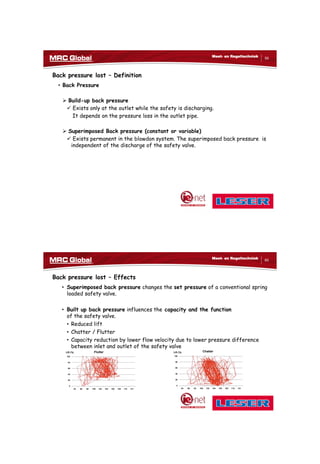
• Back Pressure
 Build-up back pressure
 Exists only at the outlet while the safety is discharging.
It depends on the pressure loss in the outlet pipe.
 Superimposed Back pressure (constant or variable)
 Exists permanent in the blowdon system. The superimposed back pressure is
independent of the discharge of the safety valve.
60
Meet- en Regeltechniek
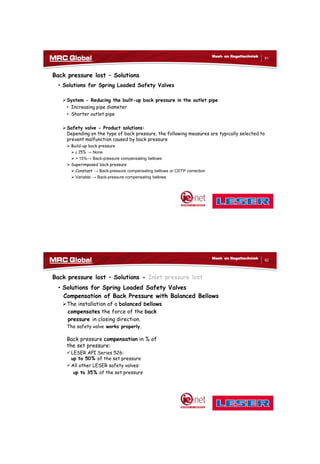
Back pressure lost – Effects
• Superimposed back pressure changes the set pressure of a conventional spring
loaded safety valve.
• Built up back pressure influences the capacity and the function
of the safety valve.
• Reduced lift
• Chatter / Flutter
• Capacity reduction by lower flow velocity due to lower pressure difference
between inlet and outlet of the safety valve
0
20
40
60
80
100
94 96 98 100 102 104 106 108 110 121
0
20
40
60
80
100
94 96 98 100 102 104 106 108 110 121
Lift (%) Lift (%)Flutter Chatter
10/10/2017
31
61
Meet- en Regeltechniek
Back pressure lost – Solutions
• Solutions for Spring Loaded Safety Valves
System - Reducing the built-up back pressure in the outlet pipe
• Increasing pipe diameter
• Shorter outlet pipe
Safety valve - Product solutions:
Depending on the type of back pressure, the following measures are typically selected to
prevent malfunction caused by back pressure
 Build-up back pressure
 ≤ 15% → None
 > 15%→ Back-pressure compensating bellows
 Superimposed back pressure
 Constant → Back-pressure compensating bellows or CDTP correction
 Variable → Back-pressure compensating bellows
62
Meet- en Regeltechniek
Back pressure lost – Solutions - Inlet pressure lost
• Solutions for Spring Loaded Safety Valves
Compensation of Back Pressure with Balanced Bellows
The installation of a balanced bellows
compensates the force of the back
pressure in closing direction.
The safety valve works properly.
Back pressure compensation in % of
the set pressure:
LESER API Series 526:
up to 50% of the set pressure
All other LESER safety valves:
up to 35% of the set pressure
10/10/2017
32
63
Meet- en Regeltechniek
Back pressure lost – Solutions
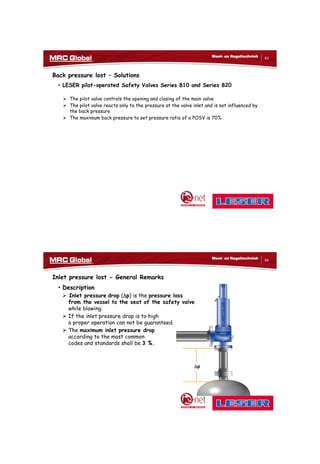
• LESER pilot-operated Safety Valves Series 810 and Series 820
 The pilot valve controls the opening and closing of the main valve
 The pilot valve reacts only to the pressure at the valve inlet and is not influenced by
the back pressure
 The maximum back pressure to set pressure ratio of a POSV is 70%
64
Meet- en Regeltechniek
Inlet pressure lost - General Remarks
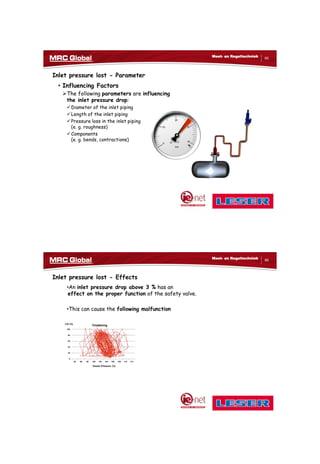
• Description
 Inlet pressure drop (p) is the pressure loss
from the vessel to the seat of the safety valve
while blowing.
 If the inlet pressure drop is to high
a proper operation can not be guaranteed.
 The maximum inlet pressure drop
according to the most common
codes and standards shall be 3 %.
p
10/10/2017
33
65
Meet- en Regeltechniek
Inlet pressure lost - Parameter
• Influencing Factors
The following parameters are influencing
the inlet pressure drop:
Diameter of the inlet piping
Length of the inlet piping
Pressure loss in the inlet piping
(e. g. roughness)
Components
(e. g. bends, contractions)
66
Meet- en Regeltechniek
Inlet pressure lost - Effects
•An inlet pressure drop above 3 % has an
effect on the proper function of the safety valve.
•This can cause the following malfunction
0
20
40
60
80
100
94 96 98 100 102 104 106 108 110 121
ChatteringLift (%)
Vessel Pressure (%)
10/10/2017
34
67
Meet- en Regeltechniek
Inlet pressure lost - Definitions
• For the most common international codes and standards a maximum pressure loss
of 3 % from the vessel to the safety valve is required (API-EN ISO)
 When a pressure relief valve is installed on a line directly connected to a vessel,
the non-recoverable pressure loss between the protected equipment and
the pressure relief valve should not exceed 3 % of the set pressure of the
valve.
 An engineering analysis of the valve performance at higher Inlet losses
may permit increasing the allowable pressure loss above 3%.
68
Meet- en Regeltechniek
Inlet pressure lost - Measures
•The following adjustments prevent malfunction
are based on inlet pressure drop:
 Reduction of flow speed by
• increasing pipe diameter
• reduction of flow capacity using a smaller valve
• reduction of flow capacity using a lift restriction
• reduction of flow capacity using an O-ring damper
 Reduction of flow resistance by
• shorter inlet pipe
• smooth connection to the vessel false correct
10/10/2017
35
69
Meet- en Regeltechniek
Legal aspects- Overview of different legislations concerning Safety
Valves
 Royal Decree steam of ´91
 Compressed air installations
 Gasstorage
 LPG storage
 Additional conditions in environmentalpermit for other applications
(proces, … )
 CE-declaration
70
Meet- en Regeltechniek
Legal aspects - Royal Decree steam of ´91
 Precommisioning testing
o Testing of discharge capacity
 Life test
 Calculations (No longer permitted by EN 12953, only life test)
o Verification of documents
 Periodical examination
o At the same time as Internal inspection
10/10/2017
36
71
Meet- en Regeltechniek
Legal aspects - Royal Decree steam of ´91
Type of equipment Maxi interval internal
inspection (months)
SG of group1 (SG=Steam Generator)
SG of group 2
SG of group 3
SG of group 4
24
18
24
13
SV (SV=Steam Vessel)
SV connected to SG of 1 and 3
SV with high frequence of pressure- and depressurising
36
48 if agreed by NoBO
13
HE (HE=Heat Exchanger)
HE connected to SG of 1 and 3
36
48
Group 1: 100 t/h (*)
Group 2: water-tube boilers
• 500 m2 and (*)
• or build after 1945 and (*)
Group 3: integrated part of a productionunit intended to work
for 1 minimum year without interruption (*)
Group 4: all others
(*) with internal inspection by NoBo
+ inspection of boilerfeed- and
boilerwater
NoBO shall inspect the
watertreatment and analyse
watersamples every year
72
Meet- en Regeltechniek
Legal aspects - Royal Decree steam of ´91
 Testing of set pressure
o Testing on test unit
o Onstream testing (trevitest, hydrotest, prevent test, …)
o Live test
 Approved valveshops → no new approvals possible !!
o What ?
o 2 different kinds: at owners site / external companies
o Yearly audit by Vinçotte is mandatory to keep the approval.
10/10/2017
37
73
Meet- en Regeltechniek
Legal aspects – Compressed air installations
 Flanders
o Vlarem II art. 5.16.3.2
 Brussels
o 24/AV 56 Gas + 24bis/AV 56 Gas
 Walloon
o DGW 03/04/2003
 Scope of the legislations/differations between the 3 regions
o Capacity of the vessel
o Demands in environmentalpermit
o Precommisioning testing
o Periodical examination
74
Meet- en Regeltechniek
Legal aspects – Gas storage facilities
Flanders
o Vlarem II art. 5.16.6
 Brussels
o No legislation → Demands in environmentalpermit
 Walloon
o No legislation → Demands in environmentalpermit
 Scope of the legislations/differations between the 3 regions
o Capacity of the vessel
o Demands in environmentalpermit
o Precommisioning testing
o Periodical examination
10/10/2017
38
75
Meet- en Regeltechniek
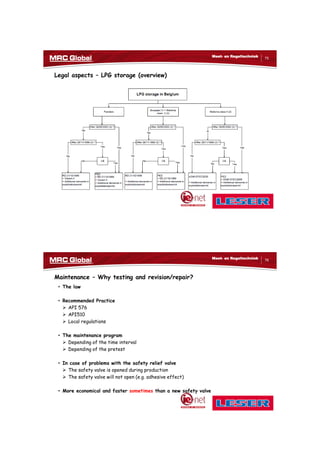
Legal aspects – LPG storage (overview)
76
Meet- en Regeltechniek
Maintenance – Why testing and revision/repair?
• The law
• Recommended Practice
 API 576
 API510
 Local regulations
• The maintenance program
 Depending of the time interval
 Depending of the pretest
• In case of problems with the safety relief valve
 The safety valve is opened during production
 The safety valve will not open (e.g. adhesive effect)
• More economical and faster sometimes than a new safety valve
10/10/2017
39
77
Meet- en Regeltechniek
Maintenance – Why testing and revision/repair?
• Leser statement
 Due to the individual operating conditions and in consideration of the different
mediums, Leser gives no general reference for an inspection time
interval.
In coordination between Leser, different operators, and the notified body the
following procedure has proven itself.
In accordance with the operating conditions an initial interval of 24 month has
proven itself.
If the safety valve opens frequently or the medium is corrosive
the inspection time interval should be 12 months.
78
Meet- en Regeltechniek
Maintenance – Testing methods – Test bench – On site
• Pretest
 Set pressure
 Functional Tightness – Rules and standards
• DIN EN ISO 4126-1, 6.6 Seat leakage test: no specific requirement regarding the leak
rate
• DIN EN 12266-1, A.4 Seat tightness, Test P12: no specific requirement regarding the
leak rate
• ASME Code Section VIII Vessels, Part UG- 136(d) (5): reference to the requirements
of API 527
• API 527: the only internationally recognised standard for the seal tightness of safety
valves including requirements of the leak rate and testing method.
10/10/2017
40
79
Meet- en Regeltechniek
Maintenance – Testing methods – Test bench – On site
• Pretest
 Functional Tightness
Functional tightness = seat tightness between
the disc and seat
80
Meet- en Regeltechniek
Maintenance – Testing methods – Test bench – On site
• Pretest
 Functional Tightness – Test methods
Gas-tight valves Valves with open bonnet
Bubble test (Kellog test)
Helium leak
Seat tightness procedure with air, applying of test fluid
Test time: 5 Sek
Extension: Max. 5 mm
Vessel
Connection to the Safety valve outlet
Immersion depth
Water
Transparent
containerInner tube-Ø
10/10/2017
41
81
Meet- en Regeltechniek
Maintenance – Testing methods – Test bench – On site
• Revision/repair
 Disassembling
 Measurement of the lift height
 Visual inspection of the inner parts
 Replacing damaged parts by original spare parts
 Lapping seat/disc
 Assembling safety valve
 Setting blow-down ring
 Setting set pressure > measurement of the lift height
 Testing set pressure and functional tighntness
 Test rapport
 Tagplate
 Sealing
82
Meet- en Regeltechniek
Maintenance – Testing methods – Test bench – On site
• Revision/repair
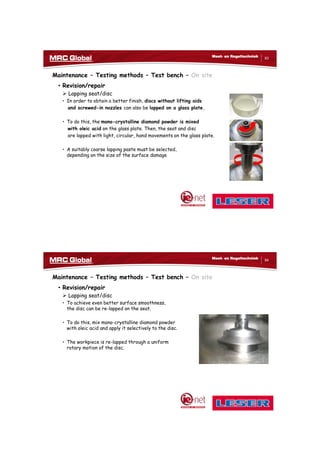
 Lapping seat/disc
• A lapping stamp is practical for reworking damage to rolled-in seats
and discs with a lifting aid.
• The lapping stamp is equipped with a ready-to-use lapping paste. The seat or disc is
lapped using a rotary motion of the stamp.
• A suitably coarse lapping paste must be selected depending on the size of the surface
damage.
10/10/2017
42
83
Meet- en Regeltechniek
Maintenance – Testing methods – Test bench – On site
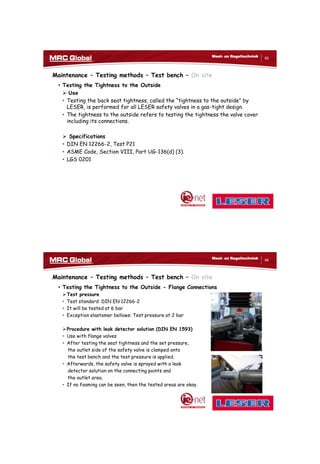
• Revision/repair
 Lapping seat/disc
• In order to obtain a better finish, discs without lifting aids
and screwed-in nozzles can also be lapped on a glass plate.
• To do this, the mono-crystalline diamond powder is mixed
with oleic acid on the glass plate. Then, the seat and disc
are lapped with light, circular, hand movements on the glass plate.
• A suitably coarse lapping paste must be selected,
depending on the size of the surface damage
84
Meet- en Regeltechniek
Maintenance – Testing methods – Test bench – On site
• Revision/repair
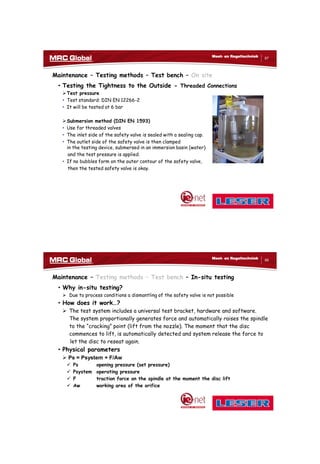
 Lapping seat/disc
• To achieve even better surface smoothness,
the disc can be re-lapped on the seat.
• To do this, mix mono-crystalline diamond powder
with oleic acid and apply it selectively to the disc.
• The workpiece is re-lapped through a uniform
rotary motion of the disc.
10/10/2017
43
85
Meet- en Regeltechniek
Maintenance – Testing methods – Test bench – On site
• Testing the Tightness to the Outside
 Use
• Testing the back seat tightness, called the “tightness to the outside” by
LESER, is performed for all LESER safety valves in a gas-tight design.
• The tightness to the outside refers to testing the tightness the valve cover
including its connections.
 Specifications
• DIN EN 12266-2, Test P21
• ASME Code, Section VIII, Part UG-136(d) (3).
• LGS 0201
86
Meet- en Regeltechniek
Maintenance – Testing methods – Test bench – On site
• Testing the Tightness to the Outside - Flange Connections
Test pressure
• Test standard: DIN EN 12266-2
• It will be tested at 6 bar
• Exception elastomer bellows: Test pressure at 2 bar
Procedure with leak detector solution (DIN EN 1593)
• Use with flange valves
• After testing the seat tightness and the set pressure,
the outlet side of the safety valve is clamped onto
the test bench and the test pressure is applied.
• Afterwards, the safety valve is sprayed with a leak
detector solution on the connecting points and
the outlet area.
• If no foaming can be seen, then the tested areas are okay.
10/10/2017
44
87
Meet- en Regeltechniek
Maintenance – Testing methods – Test bench – On site
• Testing the Tightness to the Outside - Threaded Connections
Test pressure
• Test standard: DIN EN 12266-2
• It will be tested at 6 bar
Submersion method (DIN EN 1593)
• Use for threaded valves
• The inlet side of the safety valve is sealed with a sealing cap.
• The outlet side of the safety valve is then clamped
in the testing device, submersed in an immersion basin (water)
and the test pressure is applied.
• If no bubbles form on the outer contour of the safety valve,
then the tested safety valve is okay.
88
Meet- en Regeltechniek
Maintenance – Testing methods – Test bench – In-situ testing
• Why in-situ testing?
 Due to process conditions a dismantling of the safety valve is not possible
• How does it work…?
 The test system includes a universal test bracket, hardware and software.
The system proportionally generates force and automatically raises the spindle
to the “cracking” point (lift from the nozzle). The moment that the disc
commences to lift, is automatically detected and system release the force to
let the disc to reseat again.
• Physical parameters
 Ps = Psystem + F/Aw
 Ps opening pressure (set pressure)
 Psystem operating pressure
 F traction force on the spindle at the moment the disc lift
 Aw working area of the orifice
10/10/2017
45
89
Meet- en Regeltechniek
Maintenance – Testing methods – Test bench – In-situ testing
• Important comments
 vertical position
 only for spring loaded safety valves
 spindle and disc fixed together
 working diameter of orifice > 20 mm
 to have relevant measurements a minimum traction force requires a minimum
set pressure depending of the type of the safety valve and the operating
pressure
 no liftdstopper
 check the datasheet of the safety valve before changing the set
pressure
90
Meet- en Regeltechniek
Calculation – National and International Standards – Definitions
Example
• Calculation levels for safety valves
ISO 4126-1
AD 2000-Merkblatt A2
TRD 421
API 520
ASME I and VIII
• Calculation levels on inlet pressure loss and back pressure
ISO 4126-9
Chapter 7 + 9
AD 2000-Merkblatt A2 Chapter 6
TRD 421 Chapter 6
10/10/2017
46
91
Meet- en Regeltechniek
Calculation – National and International Standards – Definitions
Example
• ISO 4126-1
Rated (derated) coefficient of discharge > K = 0,9 * Kd
Coefficient of discharge > Kd
Viscosity correction factor > Kv
• API 520
Coefficient of discharge > Kd
Viscosity correction factor > Kv
 Superheated steam correction factor > KSH
Correction factor for back pressure > Kb
Correction factor for bursting disc > Kc
• ASME I and VIII
Rated (derated) coefficient of discharge > K = 0,9 * Kd
Coefficient of discharge > Kd
Superheated steam correction factor > KSH
Correction factor for back pressure > Kb
Correction factor for bursting disc > Kc
92
Meet- en Regeltechniek
Calculation – National and International Standards – Definitions
Example
• ISO 4126-1
 Orifice area A0 (discharge area)
actual orifice area
Expressed in mm²
 Discharge diameter D0
actual discharge diameter
Expressed in mm
• API 520
 Orifice area A0 (discharge area)
Nominal according to API 526
Expressed in letter (D, E, F, G, H, J, K, L, M, N, P, Q, R, T)
 Discharge diameter D0
Nominal according to API 526
Expressed in mm/inch
10/10/2017
47
93
Meet- en Regeltechniek
Calculation – National and International Standards – Definitions
Example
• Orifices API RP 526 – Steam and Gasses
Designation API Effective
Orifice Area (sq in)
API Effective
Orifice Area (mm²)
API Effective
Diameter (inch)
API Effective
Diameter (mm)
API coefficient of
discharge Kd
D 0.110 0,71 0.374 9,51
E 0.196 1,26 0.500 12,7
F 0.307 1,98 0.625 15,9
G 0.503 3,25 0.800 20,3
H 0.785 5,06 1.00 25,4
J 1.287 8,30 1.28 32,5
K 1.838 11,9 1.53 38,9 0.975
L 2.853 18,4 1.91 48,4
M 3.60 23,2 2.14 54,4
N 4.43 28,0 2.35 59,7
P 6.38 41,2 2.85 72,4
Q 11.05 71,3 3.75 95,3
R 16.00 103 4.51 115
T 26.00 168 5.75 146
94
Meet- en Regeltechniek
Calculation – National and International Standards – Definitions
Example
• Orifices API RP 526 – Liquids
Designation API Effective
Orifice Area (sq in)
API Effective
Orifice Area (mm²)
API Effective
Diameter (inch)
API Effective
Diameter (mm)
API coefficient of
discharge Kd
D 0.110 0,71 0.374 9,51
E 0.196 1,26 0.500 12,7
F 0.307 1,98 0.625 15,9
G 0.503 3,25 0.800 20,3
H 0.785 5,06 1.00 25,4
J 1.287 8,30 1.28 32,5
K 1.838 11,9 1.53 38,9 0.65
L 2.853 18,4 1.91 48,4
M 3.60 23,2 2.14 54,4
N 4.43 28,0 2.35 59,7
P 6.38 41,2 2.85 72,4
Q 11.05 71,3 3.75 95,3
R 16.00 103 4.51 115
T 26.00 168 5.75 146
10/10/2017
48
95
Meet- en Regeltechniek
Calculation – National and International Standards – Definitions
Example
• ASME I and VIII
 Orifice area A0 (discharge area)
actual orifice area after type examination
Expressed in mm²or inch²
 Discharge diameter D0
actual discharge diameter area type examination
Expressed in mm or inch
 Coefficient of discharge K (Leser)
Steam/gasses (D/G)
 Orifice D: 0,455
 Orifice E, F, G, H, J, K, L, M, N, P, Q, R, T: 0,801
Liquids (L)
 Orifice D: 0,343
 Orifice E, F, G, H, J, K, L, M, N, P, Q, R, T: 0,579
96
Meet- en Regeltechniek
Calculation – National and International Standards – Definitions
Example
• Orifices as per API RP 526 and ASME VIII – Practical issue
ASME Actual Orifice Area*ASME coefficient K ≥ API Effective Orifice Area*API coefficient Kd
 Example Steam/gasses – Orifice E (Leser)
ASME Actual Orifice Area > 154 mm²
ASME coefficient K > 0,801
API Effective Orifice Area > 126 mm²
API coefficient Kd > 0,975
> 154*0,801=123,354 ≥ 126*0,975=122,85 >OK
 Example Liquids – Orifice E (Leser)
ASME Actual Orifice Area > 154 mm²
ASME coefficient K > 0,579
API Effective Orifice Area > 126 mm²
API coefficient Kd > 0,65
> 154*0,0,579=89,166 ≥ 126*0,65=81,9 >OK
10/10/2017
49
97
Meet- en Regeltechniek
Calculation – National and International Standards – Definitions
Example
........Program Files (x86)LeserVALVESTAR 7
On the web-site of Leser the Valvestar is avaible as web-version for free.
Procedure:
Choose the web-site of Leser
Under service you will find the access to Valvestar
98
Meet- en Regeltechniek
Open Discussion // Conclusion
10/10/2017
50
99
Meet- en Regeltechniek
Thanks for your attention

Pressure Relief Devices

  • 1.
    10/10/2017 1 Pressure Relief Devices The-Safety-Valve.com 2 Meet-en Regeltechniek Objectives of this Presentation The aim of this presentation is to explain the most common phrases around Pressure Relief Devices  Scope of this presentation  Definition of a Safety valve  Reasons for Excess Pressure  Classification – Definition of Safety Valves  Design - Options  Applications - Installations  Institutions, Standards and Regulations  Set pressure – CDTP – Overpressure - Blowdown  Back pressure – Inlet pressure  Legal aspects  Maintenance  Calculation example
  • 2.
    10/10/2017 2 3 Meet- en Regeltechniek Scopeof this presentation – Pressure Relief Devices  Reclosing Devices > Safety relief valves o Set pressure  ASME >= 15 psi (1,03 barg)  API >= 15 psi (1,03 barg)  CE – PED >= 0,5 barg  Non Reclosing Devices > Rupture Disc / Pin-actuated Device o Set pressure >= 0,5 barg  ASME >= 15 psi (1,03 barg)  API >= 15 psi (1,03 barg)  CE – PED o Set pressure <0,5 barg > Breather Valve / Emergency valve  API2000ed7 (ISO28300)  Tank protection 4 Meet- en Regeltechniek Definition A safety valve designed to open and relieve excess pressure and to re- close and prevent the further flow of fluid after normal conditions have been restored. Asme Ptc 25
  • 3.
    10/10/2017 3 5 Meet- en Regeltechniek Reasonsfor Excess Pressure in a System There are a number of reasons why the pressure in a system can exceeds a predetermined limit. API Standard 521/ISO 23251 Sect 4. provides a detailed guideline about causes of overpressure. The most common are: Blocked discharge Exposure to external fire, often referred to as “Fire Case” Thermal expansion Chemical reaction, often referred as “run away” Heat exchanger tube rupture Cooling system failure Each of the above listed events may occur individually and separately from the other. They may also take place simultaneously. Each cause of overpressure will create a different mass- or volume flow to be discharged, e.g. small mass flow thermal expansion and large mass flow in case of a chemical reaction. It is the user’s responsibility to determine a worst case scenario for the sizing and selection of a suitable safety valve. 6 Meet- en Regeltechniek Classification-Definition Safety Valves Loading Principle Performance - Opening Characteristics
  • 4.
    10/10/2017 4 7 Meet- en Regeltechniek Classifcation–DefinitionSafety Valves – Loading Principle Safety Valves Direct-load Spring loaded Weight loaded Controlled Controlled Safety Pressure Relief System Pilot-Operated Safety Valve 8 Meet- en Regeltechniek Loading principle – Spring Loaded Safety Valves A pressure relief valve in which the opening and closing of the valve is controlled by a spring.
  • 5.
    10/10/2017 5 9 Meet- en Regeltechniek Loadingprinciple – Weight Loaded Safety Valves A pressure relief valve in which the opening and closing of the valve is controlled by a weight. 10 Meet- en Regeltechniek Loading principle – Pilot-Operated Safety Valves • A pressure relief valve in which the main valve is combined with and controlled by an auxiliary pressure relief valve (pilot-controlled)
  • 6.
    10/10/2017 6 11 Meet- en Regeltechniek Loadingprinciple – Controlled Safety Valve System A system consisting of a safety valve in combination with control unit. The control unit generates an additional closing force with the aid of a drive in the case of a spring-loaded safety valve. 12 Meet- en Regeltechniek Loading principle - Rupture Disc / Safety Valve Combination A system consisting of a main valve in combination with a prepended rupture disc. The bursting pressure of the rupture disc is equal to the set pressure of the safety valve
  • 7.
    10/10/2017 7 13 Meet- en Regeltechniek Classification-DefinitionSafety Valves-AD2000-A2 Performance / Opening Characteristics  Opening Characteristics o Normal Safety Valve Pursuant to AD 2000 Information Sheet A2 A spring loaded pressure relief valve actuated by the static pressure upstream of the valve. The valve opens in proportion to the pressure increase over the opening pressure. Used primarily with liquid service (non-compressible). 100 80 60 40 20 0 Lift [%] pc p = set pressure pc = opening pressure pp = popping pressure ps = closing pressure 90 100 110 ps p Pressure [%] pp 14 Meet- en Regeltechniek Classification-Definition Safety Valves-AD2000-A2 Performance / Opening Characteristics  Opening Characteristics o Normal Safety Valve Pursuant to AD 2000 Information Sheet A2 A spring-loaded normal safety valve opening proportionately or suddenly within a pressure increase of 10%. Used with all media: steam, vapour, gas and liquids. 100 80 60 40 20 0 Lift [%] pc p = set pressure pc = opening pressure pp = popping pressure ps = closing pressure ps p Pressure [%] pp 80 90 100 105 110 120 Standard 10% - Pop-Acting
  • 8.
    10/10/2017 8 15 Meet- en Regeltechniek Classification-DefinitionSafety Valves-AD2000-A2 Performance / Opening Characteristics  Opening Characteristics o Full-lift Safety Valve Pursuant to AD 2000 Information Sheet A2 A spring-loaded full-lift safety valve opening suddenly within a pressure increase of 5%. Primarily used for gas, steam and vapour 100 80 60 40 20 0 Lift [%] pc p = set pressure pc = opening pressure pp = popping pressure ps = closing pressure ps p Pressure [%] pp 80 90 100 105 110 120 Sudden opening within 5% 16 Meet- en Regeltechniek Classification-Definition Safety Valves-ASME PTC 25-2014 Performance / Opening Characteristics  Relief valve o A pressure relief valve characterized by gradual opening that is generally proportional to the increase in pressure. It is normally used for incompressible fluids.  Safety relief valve o A pressure relief valve characterized by rapid opening or by gradual opening that is generally proportional to the increase in pressure. It can be used for compressible or incompressible fluids.  Safety valve o A pressure relief valve characterized by rapid opening and normally used to relieve compressible fluids. Prssure [%]
  • 9.
    10/10/2017 9 17 Meet- en Regeltechniek Design– Codes & Standards • API ASME / (EN) Adjusting ring Full nozzle Semi-nozzle 18 Meet- en Regeltechniek Design – Options – Conventional design Full Nozzle Full Nozzle Semi Nozzle
  • 10.
    10/10/2017 10 19 Meet- en Regeltechniek Design– Options – Balanced Bellows design  Elastomer bellows Protects the moving parts and spring against dirt, corrosion, impurities and the fluid itself. Set pressure range: p < 10 bar / 145 psig ATTENTION: Elastomer bellows can not be used for back pressure compensation.  Stainless Steel or Inconel Bellows Prevent changes in set pressure when the valve is subjected to variable back pressure Isolate the bonnet chamber and spring against dirt, corrosion, impurities and the fluid itself Should be used at variable superimposed back pressure or if the built up pressure exceeds 15 % of the valve set pressure. 20 Meet- en Regeltechniek Design – Options – Bellows design - Balanced Piston  Ensures the back pressure compensation and the temperature screening to the spring room even in case of failure of the bellows  Equal size of the piston surface and of the seat section generates the back pressure compensating effect  Solution which is included in API 520  Application field: Applications where the back pressure compensating function needs to be ensured
  • 11.
    10/10/2017 11 21 Meet- en Regeltechniek Design– Options – Bonnets Open Bonnet Closed Bonnet Spring cooled by atmosphere Completely sealed safety valve 22 Meet- en Regeltechniek Design – Options – Lifting devices Open Lever Packed Lever Not gas-tight Gas-tight manual lifting possible ASME Code states that a lifting device shall be used on: air, steam and hot water applications over 60°C/140° F
  • 12.
    10/10/2017 12 23 Meet- en Regeltechniek Design– Options – Caps Only if specification demands Standard Screwed CapBolted Cap 24 Meet- en Regeltechniek Design – Options - Lift Indicator (Proximity Switch) Lift Indication of valve lift to control room (Minimum lift of 1 mm / 0.04 inch is required) Safety Valve Open Safety Valve Closed
  • 13.
    10/10/2017 13 25 Meet- en Regeltechniek Design– Options – Test Gag Safety Valve In Use Gagged for Line Testing The safety valve has to be gagged to perform a pressure test of the plant, otherwise the valve has to be removed or a blind has to be installed before. 26 Meet- en Regeltechniek Design – Options – Special Connections Welded connectionsFemale Threaded Inlet Clamp connections
  • 14.
    10/10/2017 14 27 Meet- en Regeltechniek Design- Sealing Surface • To prevent leakage and costly product loss as well as reduce downtime and maintenance costs, optional sealing surfaces are possible Stellited O-ring disc Vulcanized Soft Seal Sealing plate  For temperatures above + 450° C / + 842° F  Protection of sealing surface against abrasive media  Corrosion resistance  Resistance against impacts and changing temperatures  Operation close to set pressure  Increased tightness  compensates particles on seat and/or disc  Vibrations restraining  Corrosive fluids  Same use as O-ring disc  Only available for Compact Performance Series  Due to the small disc size, vulcanized soft seals have a minimum set pressure of 0.2 bar / 2.9 psig  Same use as O-ring disc  Also applicable for very low temperatures own to – 270° C / - 454° F depending on the sealing materials 28 Meet- en Regeltechniek Design - Heating Jacket In applications with highly viscous fluids (low Reynolds number) a heating jacket with heated bonnet spacer ensures: • The proper function of a safety valve • The safety valve will not clog
  • 15.
    10/10/2017 15 29 Meet- en Regeltechniek Applications- Installations • Industries Ship building LNG/LPG Oil and Gas Industry Technical Gases  Petrochemical Industry Chemical Industry Pharmaceutical Industry Food an Beverage Industry Energy Industry Heating and Air Conditioning  ......... 30 Meet- en Regeltechniek Applications - Installations • Applications  Blocked discharge Inadvertent closure of valve on the discharge side of the pressure source  Thermal relief Blocked in section of piping  “Fire case” Safety valve required to prevent vessel explosion until fire is controlled  Downstream control or reducing valves Safety valve has to calculated based on the failure capacity of the valve  Heat exchanger, boiler, processtanks etc.  All process equipment if a risk of exceeding the design pressure
  • 16.
    10/10/2017 16 31 Meet- en Regeltechniek Applications- Installations • General issues  Upright position with the spindle vertical  As close as possible to the pipe or equipment  The safety valve should not be isolated  The size of the inlet pipe should not be less than the inlet of the safety relief valve  The blow-off pipe should be the same size as the outlet of the safety valve  Blow-off pipe should be mounted in such a way that there is no risk for persons  The safety valve should be mounted in such a way that stress forces will not occur the safety valve  Normally each safety has his own blow-off pipe  In case of vertical mounted blow-off pipe a drainage should be present  Safety valve with an open bonnet should be mounted in such a way that there is no risk for persons 32 Meet- en Regeltechniek Applications - Installations • Distance to other equipment The safety valves should not be located where unstable flow patterns are present. Therefore safety valves should be installed at least 10 pipe diameters away from the source of irrition (minimum 1 meter) • Mounting position  Safety valves normally should be installed in a vertical upright position, however some applications require a “non-upright position”. If valves are mounted in other than a vertical position, the valve manu- facturer’s recommendations shall be considered • Partly filled liquid Vessel  In this case the safety valve should be located at the gas phase. • Process Laterals Connected to the inlet of safety valves  Process laterals should generally not be connected to the inlet of safety valve. Exceptions should be analyzed carefully to ensure that the allowable pressure loss at the inlet of the safety valve.
  • 17.
    10/10/2017 17 33 Meet- en Regeltechniek Applications- Installations • Drainage  Adequate drainage of the outlet line to achieve a proper safety valve performance This means that normally no medium or condensate will stay inside the safety valve. The following directions should be followed:  The drainage should always run via the outlet line At the lowest point of the outlet line sufficient drainage should be installed for discharging condensate To avoid back-flow, a drip pan elbow can be used Some standards require an additional drain hole within the safety valve (API526) 34 Meet- en Regeltechniek Institutions, Standards and Regulations > Most usual Area of application Applicable regulations Issuer of regulations Symbol Monitoring organisation USA ASME > Law ASME I > XII ASME Section I ASME Section II ASME Section VIII American Society of Mechanical Engineers National Board (NB) Europe P(pressure) E(equipment) D(directive) > Guideline European Council/ European Parliament Office appointed (TUEV – AIB – Apragaz f.e.) ISO EN 4126 Part 1 > 11 International Organization for Standardization International API > Recommended Practices RP520/521/576 Std 526/527 American Petroleum Instistute (API) Manufacturer
  • 18.
    10/10/2017 18 35 Meet- en Regeltechniek Institutions,Standards and Regulations > Local • TSSA/CSA/CRN/ABSA (Canada) • AQSIQ (China) • KOSHA (Korea) • EAC (Russia, Belarus, Kazakhstan) • UDT Poland • Indian Boiler Code • … 36 Meet- en Regeltechniek Institutions, Standards and Regulations > ASME ASME Code Section I •This is a construction code covering power, electric and miniature boilers and high temperature boilers (fired) used in stationary service above 15 psig. ASME Code Section II • This is a construction code listing materials suitable for the construction of safety valves according to ASME Code. • In order for a part to be used in the construction of a safety valve, the material must appear in ASME Code Section II. • This section also provides the pressure and temperature limits for the available materials of safety valve bodies and bonnets ASME Code Section VIII • This is a construction code covering the basic rules for the construction, design, fabrication, inspection and certification of pressure vessels (unfired) above 15 psig.
  • 19.
    10/10/2017 19 37 Meet- en Regeltechniek Institutions,Standards and Regulations > National Board of Boiler and Pressure Vessel Inspectors (NB) •The NB represents the enforcement agencies who assure adherence to provisions of the ASME boiler and pressure vessel codes. •The NB: • Sets inspection standards • Qualifies inspectors • Works for owners, insurers • Maintains records (Red Book – NB-18) • Looks into violations • Covers repair (VR Stamp) 38 Meet- en Regeltechniek Institutions, Standards and Regulations > EN ISO 4126 • This is a European code related to the PED covering safety devices for protection against excessive pressure • Different Sections of the EN ISO 4126 deal with the requirements, design and manufacture of safety devices • EN ISO 4126-1 > Safety Valves (spring loaded) • EN ISO 4126-2 > Bursting Discs Safety devices • EN ISO 4126-3 > Safety Valves and Bursting Discs in Combination • EN ISO 4126-4 > Pilot Operated Safety Valves • EN ISO 4126-5 > Controlled Safety Valves Pressure Relief Systems (CRPRS) • EN ISO 4126-6 > Application, Installation of Bursting discs • EN ISO 4126-7 > Sizing (Common data > steam tables, etc… • EN ISO 4126-8 > Performance testing bursting Discs (draft) • EN ISO 4126-9 > Application and Installation • EN ISO 4126-10 > Performance testing SRV… just starting
  • 20.
    10/10/2017 20 39 Meet- en Regeltechniek Institutions,Standards and Regulations > American Petroleum Institute (API) •API publishes several standards dealing with safety valves: • API 520 Part 1 – Sizing & Selection of Pressure Relief Devices • API 520 Part 2 – Installation of Pressure Relief Devices • API 521 – Guide for Pressure-Relieving & Depressurizing Systems • API 526 – Flanged Steel Safety Relief Valves • API 527 – Seat Tightness of Pressure Relief Valves 40 Meet- en Regeltechniek Institutions, Standards and Regulations > API 520 • API 520 Part 1 • Applies to the sizing and selection of pressure relief devices for equipment with an MAWP of 15 psig or greater. • Protection of unfired vessels • Basic definitions • Operational characteristics of pressure relief devices • Sizing procedures and methods • API 520 Part 2 • Covers methods of installation for pressure relief devices on equipment with an MAWP of 15 psig or greater.
  • 21.
    10/10/2017 21 41 Meet- en Regeltechniek Institutions,Standards and Regulations > API 521 •API 521 is designed to aid in the selection of the system that is most appropriate for the risks and circumstances involved in various installations. • This standard provides guidelines for: • Examining the principal causes of overpressure • Determining individual relieving rates • Including fire vapor generation and fire gas expansion • Selecting and designing disposal systems 42 Meet- en Regeltechniek Institutions, Standards and Regulations > API 526 •API 526 is a purchasing specification for flanged steel pressure relief valves. Requirements are given for spring loaded pressure relief valves and pilot-operated relief valves. • API 526 has standardized the following items: • Orifice designation and area • Valve size and pressure rating, inlet and outlet • Materials • Pressure-temperature limits • Center-to-face dimensions, inlet and outlet • Inspection and shop tests • Identification and preparation for shipment
  • 22.
    10/10/2017 22 43 Meet- en Regeltechniek Institutions,Standards and Regulations > API 527 •API 527 describes tests to determine the seat tightness of metal and soft-seated pressure relief valves. Valves of conventional, bellows, and pilot-operated designs are covered. Acceptable leakage rates are defined. • It contains criteria for: • Testing with air • Testing with steam • Testing with water • Testing with air – another method 44 Meet- en Regeltechniek Set pressure – CDTP – Overpressure - Blowdown Set Pressure Definition  ASME PTC 25, 2001, 2.7 OC of PRD o The value of increasing inlet static pressure at which a pressure relief device displays one of the operational characteristics as defined under: opening pressure, popping pressure, start-to-leak pressure, burst pressure or breaking pressure. o (The applicable operating characteristic for a specific device design is specified by the device manufacturer).  API 520, 2000, 1.2.3.3 a. o The set pressure is the inlet gauge pressure at which the pressure relief device is set to open under service conditions.
  • 23.
    10/10/2017 23 45 Meet- en Regeltechniek Setpressure – CDTP – Overpressure – Blowdown Set Pressure Definition  ISO 4126-1, 2004, 3.2. 1 o Predetermined pressure at which a safety valve under operating conditions commences to open. o Note: It is the gauge pressure measured at the valve inlet at which the pressure forces tending to open the valve for the specific service conditions are in equilibrium with the forces retaining the valve disc on its seat.  The symbol is p. 46 Meet- en Regeltechniek Set pressure – CDTP – Overpressure – Blowdown Set Pressure Tolerance – Codes & Standards • DIN EN ISO 4126-1  +/- 3% of the set pressure or +/- 0,15 barg, whichever is greater • ASME Code Section I  ≤70 psi (0,5 MPa) > +/- 2 psi (15 kPa)  >70 (0,5) and ≤300 (2,1) > +/- 3% of set pressure  >300 (2,1) and ≤1000 (7,0) > +/- 10% of set pressure  >1000 (7,0) > +/- 1% of set pressure • ASME Code Section VIII  ≤70 psi (0,5 MPa) > +/- 2 psi (15 kPa)  >70 (0,5) > +/- 3% of set pressure
  • 24.
    10/10/2017 24 47 Meet- en Regeltechniek Setpressure – CDTP – Overpressure – Blowdown Set Pressure Tolerance – Codes & Standards • Suggestion for setting tolerances during the setting of safety valves by TüV Nord, no minus tolerance allowed due to the operation pressure of the installation  ≤1,0 bar > +0,05 bar of set pressure  >1,0 bar ≤5 bar > +0,10 bar of set pressure  >5 barg > +3% of set pressure • AD 2000, memorandum A2, chapter 11 • API 526, API 527, API 576 • DIN EN 837-1 48 Meet- en Regeltechniek Set pressure – CDTP – Overpressure – Blowdown Definition of Cold Differential Test Pressure (CDTP) Codes and Standards  CDTP is used if correction of set pressure of safety valves according to deviation of service conditions is necessary. ASME PTC 25, 2001, 2.7 OC of PRD o The inlet static pressure at which a pressure relief valve is adjusted to open on the test stand. This test pressure includes corrections for service conditions of superimposed back pressure and/or temperature.  API 20, 2000, Part I, 1.2.3.3 b. o The cold differential test pressure (CDTP) is the pressure at which a pressure relief valve is adjusted to open on the test stand. The cold differential test pressure includes corrections for the service conditions of back pressure or temperature or both.  ISO 4126-1, 2004, 3.2.5 o The inlet static pressure at which a safety valve is set to commence to open on the test bench. NOTE: This test pressure includes corrections for service conditions, e.g. back pressure and/or temperature.
  • 25.
    10/10/2017 25 49 Meet- en Regeltechniek Setpressure – CDTP – Overpressure - Blowdown Reason Why The safety valve in the plant shall open during operation at a certain pressure. This pressure is called Set Pressure. The Cold Differential Test Pressure (CDTP) shall assure the right Set Pressure in the plant during operation. The CDTP considers the influence of Temperature and Back Pressure for settings on a test bench. 50 Meet- en Regeltechniek Set pressure – CDTP – Overpressure - Blowdown Influence of Temperature The relevant part of the safety valve influenced by the temperature is the spring. The higher the temperature at the spring the lower the spring rate.
  • 26.
    10/10/2017 26 51 Meet- en Regeltechniek Setpressure – CDTP – Overpressure - Blowdown Influence of Temperature - Estimation of CDTP in Theory Set Pressure 10 bar Operation Required spring force 2.000 N Medium temperature 300 °C Spring rate at 300°C medium temperature 95 N/mm Spring preloaded 21 mm CDTP (acc. LDeS 1001.69  + 0,5 bar temperature correction) 10,5 bar Test bench Spring preloaded 21 mm Spring rate at 20°C temperature at test lab 100 N/mm Spring force 2.100 N 52 Meet- en Regeltechniek Set pressure – CDTP – Overpressure - Blowdown Influence of Temperature - Estimation of CDTP in Practice -508 -308 -108 92 292 492 692 892 0,96 0,98 1 1,02 1,04 1,06 1,08 1,1 1,12 -300 -200 -100 0 100 200 300 400 500 Temperature T [°F] CorrectionfactorkT Temperature T [°C] Conventional design with closed bonnet upward set pressure (+3%) of allowable tolerances ( 3%) according to EN ISO 4126-1 2003-09 downward set pressure (-3%) of allowable tolarance ( 3) according to EN ISO 4126-1 2003-09 Approved correction curve by German TÜV Nord
  • 27.
    10/10/2017 27 53 Meet- en Regeltechniek Setpressure – CDTP – Overpressure - Blowdown Influence of Temperature - Estimation of CDTP in Practice 54 Meet- en Regeltechniek Set pressure – CDTP – Overpressure - Blowdown Influence of Back Pressure The relevant part of the safety valve which is influenced by the back pressure is the disc. The higher the back pressure the lower the CDTP must be (conventional design). Fs Fp Fb p
  • 28.
    10/10/2017 28 55 Meet- en Regeltechniek Setpressure – CDTP – Overpressure - Blowdown Influence of Back Pressure - Estimation of CDTP in Theory Set Pressure 10 bar Operation Constant back pressure 2 bar CDTP 8 bar Test bench (Conventional design) Set pressure 10 bar Constant back pressure 2 bar CDTP 10 bar Test bench (Balanced bellows design) Set pressure 10 bar Constant back pressure* 2 bar 56 Meet- en Regeltechniek Set pressure – CDTP – Overpressure - Blowdown Estimation of CDTP in case of temperature and back pressure correction Set Pressure 10 bar Operation Required spring force 1.600 N Constant back pressure 2 bar Medium temperature 300 °C Spring rate at 300°C medium temperature 95 N/mm Spring preloaded 21 mm CDTP 8,5 bar Test bench (Conventional design) Temperature correction +0,5 bar Back pressure correction -2 bar Spring preload at 200°C 16,8 mm Spring rate at 20°C temperature at test lab 100 N/mm Spring force 1.684 N
  • 29.
    10/10/2017 29 57 Meet- en Regeltechniek Setpressure – CDTP – Overpressure - Blowdown Estimation of CDTP in case of temperature and back pressure correction The cold differential test pressure (CDTP) can secure that the safety valve opens at the required set pressure in the plant during operation. Caution: The specified service conditions must fit the actual operation conditions. 0 20 40 60 80 100 82 84 86 88 90 92 94 96 98 100 102 104 106 108 110 121 Lift (%) Set Pressure CDTP Vessel Pressure (%) Operation at Service Condition Opening at the test bench 58 Meet- en Regeltechniek Set pressure – CDTP – Overpressure – Blowdown > Codes & Standards Overpressure Blowdown Steam/Gases Liquids Steam/Gases Liquids ASME I 3% - < 67 psig: 4 psig ≥ 67…≤ 250 psig: 6% >250…≤375 psig: 15psig >375 psig: 4% - ASME VIII 10% 10% 7% with blowdown ring No rquirements without blowdown ring No requirements ASME Multiple Valve Application 16% 16% 7% No requirements ASME Fire Case 21% - 7% - API 520 10% 10% 7% 20% EN ISO 4126-1 10% 10% 15% 20% AD 2000-Merkblatt A2 5% or 10% Standard 10% 10% 20%
  • 30.
    10/10/2017 30 59 Meet- en Regeltechniek Backpressure lost – Definition • Back Pressure  Build-up back pressure  Exists only at the outlet while the safety is discharging. It depends on the pressure loss in the outlet pipe.  Superimposed Back pressure (constant or variable)  Exists permanent in the blowdon system. The superimposed back pressure is independent of the discharge of the safety valve. 60 Meet- en Regeltechniek Back pressure lost – Effects • Superimposed back pressure changes the set pressure of a conventional spring loaded safety valve. • Built up back pressure influences the capacity and the function of the safety valve. • Reduced lift • Chatter / Flutter • Capacity reduction by lower flow velocity due to lower pressure difference between inlet and outlet of the safety valve 0 20 40 60 80 100 94 96 98 100 102 104 106 108 110 121 0 20 40 60 80 100 94 96 98 100 102 104 106 108 110 121 Lift (%) Lift (%)Flutter Chatter
  • 31.
    10/10/2017 31 61 Meet- en Regeltechniek Backpressure lost – Solutions • Solutions for Spring Loaded Safety Valves System - Reducing the built-up back pressure in the outlet pipe • Increasing pipe diameter • Shorter outlet pipe Safety valve - Product solutions: Depending on the type of back pressure, the following measures are typically selected to prevent malfunction caused by back pressure  Build-up back pressure  ≤ 15% → None  > 15%→ Back-pressure compensating bellows  Superimposed back pressure  Constant → Back-pressure compensating bellows or CDTP correction  Variable → Back-pressure compensating bellows 62 Meet- en Regeltechniek Back pressure lost – Solutions - Inlet pressure lost • Solutions for Spring Loaded Safety Valves Compensation of Back Pressure with Balanced Bellows The installation of a balanced bellows compensates the force of the back pressure in closing direction. The safety valve works properly. Back pressure compensation in % of the set pressure: LESER API Series 526: up to 50% of the set pressure All other LESER safety valves: up to 35% of the set pressure
  • 32.
    10/10/2017 32 63 Meet- en Regeltechniek Backpressure lost – Solutions • LESER pilot-operated Safety Valves Series 810 and Series 820  The pilot valve controls the opening and closing of the main valve  The pilot valve reacts only to the pressure at the valve inlet and is not influenced by the back pressure  The maximum back pressure to set pressure ratio of a POSV is 70% 64 Meet- en Regeltechniek Inlet pressure lost - General Remarks • Description  Inlet pressure drop (p) is the pressure loss from the vessel to the seat of the safety valve while blowing.  If the inlet pressure drop is to high a proper operation can not be guaranteed.  The maximum inlet pressure drop according to the most common codes and standards shall be 3 %. p
  • 33.
    10/10/2017 33 65 Meet- en Regeltechniek Inletpressure lost - Parameter • Influencing Factors The following parameters are influencing the inlet pressure drop: Diameter of the inlet piping Length of the inlet piping Pressure loss in the inlet piping (e. g. roughness) Components (e. g. bends, contractions) 66 Meet- en Regeltechniek Inlet pressure lost - Effects •An inlet pressure drop above 3 % has an effect on the proper function of the safety valve. •This can cause the following malfunction 0 20 40 60 80 100 94 96 98 100 102 104 106 108 110 121 ChatteringLift (%) Vessel Pressure (%)
  • 34.
    10/10/2017 34 67 Meet- en Regeltechniek Inletpressure lost - Definitions • For the most common international codes and standards a maximum pressure loss of 3 % from the vessel to the safety valve is required (API-EN ISO)  When a pressure relief valve is installed on a line directly connected to a vessel, the non-recoverable pressure loss between the protected equipment and the pressure relief valve should not exceed 3 % of the set pressure of the valve.  An engineering analysis of the valve performance at higher Inlet losses may permit increasing the allowable pressure loss above 3%. 68 Meet- en Regeltechniek Inlet pressure lost - Measures •The following adjustments prevent malfunction are based on inlet pressure drop:  Reduction of flow speed by • increasing pipe diameter • reduction of flow capacity using a smaller valve • reduction of flow capacity using a lift restriction • reduction of flow capacity using an O-ring damper  Reduction of flow resistance by • shorter inlet pipe • smooth connection to the vessel false correct
  • 35.
    10/10/2017 35 69 Meet- en Regeltechniek Legalaspects- Overview of different legislations concerning Safety Valves  Royal Decree steam of ´91  Compressed air installations  Gasstorage  LPG storage  Additional conditions in environmentalpermit for other applications (proces, … )  CE-declaration 70 Meet- en Regeltechniek Legal aspects - Royal Decree steam of ´91  Precommisioning testing o Testing of discharge capacity  Life test  Calculations (No longer permitted by EN 12953, only life test) o Verification of documents  Periodical examination o At the same time as Internal inspection
  • 36.
    10/10/2017 36 71 Meet- en Regeltechniek Legalaspects - Royal Decree steam of ´91 Type of equipment Maxi interval internal inspection (months) SG of group1 (SG=Steam Generator) SG of group 2 SG of group 3 SG of group 4 24 18 24 13 SV (SV=Steam Vessel) SV connected to SG of 1 and 3 SV with high frequence of pressure- and depressurising 36 48 if agreed by NoBO 13 HE (HE=Heat Exchanger) HE connected to SG of 1 and 3 36 48 Group 1: 100 t/h (*) Group 2: water-tube boilers • 500 m2 and (*) • or build after 1945 and (*) Group 3: integrated part of a productionunit intended to work for 1 minimum year without interruption (*) Group 4: all others (*) with internal inspection by NoBo + inspection of boilerfeed- and boilerwater NoBO shall inspect the watertreatment and analyse watersamples every year 72 Meet- en Regeltechniek Legal aspects - Royal Decree steam of ´91  Testing of set pressure o Testing on test unit o Onstream testing (trevitest, hydrotest, prevent test, …) o Live test  Approved valveshops → no new approvals possible !! o What ? o 2 different kinds: at owners site / external companies o Yearly audit by Vinçotte is mandatory to keep the approval.
  • 37.
    10/10/2017 37 73 Meet- en Regeltechniek Legalaspects – Compressed air installations  Flanders o Vlarem II art. 5.16.3.2  Brussels o 24/AV 56 Gas + 24bis/AV 56 Gas  Walloon o DGW 03/04/2003  Scope of the legislations/differations between the 3 regions o Capacity of the vessel o Demands in environmentalpermit o Precommisioning testing o Periodical examination 74 Meet- en Regeltechniek Legal aspects – Gas storage facilities Flanders o Vlarem II art. 5.16.6  Brussels o No legislation → Demands in environmentalpermit  Walloon o No legislation → Demands in environmentalpermit  Scope of the legislations/differations between the 3 regions o Capacity of the vessel o Demands in environmentalpermit o Precommisioning testing o Periodical examination
  • 38.
    10/10/2017 38 75 Meet- en Regeltechniek Legalaspects – LPG storage (overview) 76 Meet- en Regeltechniek Maintenance – Why testing and revision/repair? • The law • Recommended Practice  API 576  API510  Local regulations • The maintenance program  Depending of the time interval  Depending of the pretest • In case of problems with the safety relief valve  The safety valve is opened during production  The safety valve will not open (e.g. adhesive effect) • More economical and faster sometimes than a new safety valve
  • 39.
    10/10/2017 39 77 Meet- en Regeltechniek Maintenance– Why testing and revision/repair? • Leser statement  Due to the individual operating conditions and in consideration of the different mediums, Leser gives no general reference for an inspection time interval. In coordination between Leser, different operators, and the notified body the following procedure has proven itself. In accordance with the operating conditions an initial interval of 24 month has proven itself. If the safety valve opens frequently or the medium is corrosive the inspection time interval should be 12 months. 78 Meet- en Regeltechniek Maintenance – Testing methods – Test bench – On site • Pretest  Set pressure  Functional Tightness – Rules and standards • DIN EN ISO 4126-1, 6.6 Seat leakage test: no specific requirement regarding the leak rate • DIN EN 12266-1, A.4 Seat tightness, Test P12: no specific requirement regarding the leak rate • ASME Code Section VIII Vessels, Part UG- 136(d) (5): reference to the requirements of API 527 • API 527: the only internationally recognised standard for the seal tightness of safety valves including requirements of the leak rate and testing method.
  • 40.
    10/10/2017 40 79 Meet- en Regeltechniek Maintenance– Testing methods – Test bench – On site • Pretest  Functional Tightness Functional tightness = seat tightness between the disc and seat 80 Meet- en Regeltechniek Maintenance – Testing methods – Test bench – On site • Pretest  Functional Tightness – Test methods Gas-tight valves Valves with open bonnet Bubble test (Kellog test) Helium leak Seat tightness procedure with air, applying of test fluid Test time: 5 Sek Extension: Max. 5 mm Vessel Connection to the Safety valve outlet Immersion depth Water Transparent containerInner tube-Ø
  • 41.
    10/10/2017 41 81 Meet- en Regeltechniek Maintenance– Testing methods – Test bench – On site • Revision/repair  Disassembling  Measurement of the lift height  Visual inspection of the inner parts  Replacing damaged parts by original spare parts  Lapping seat/disc  Assembling safety valve  Setting blow-down ring  Setting set pressure > measurement of the lift height  Testing set pressure and functional tighntness  Test rapport  Tagplate  Sealing 82 Meet- en Regeltechniek Maintenance – Testing methods – Test bench – On site • Revision/repair  Lapping seat/disc • A lapping stamp is practical for reworking damage to rolled-in seats and discs with a lifting aid. • The lapping stamp is equipped with a ready-to-use lapping paste. The seat or disc is lapped using a rotary motion of the stamp. • A suitably coarse lapping paste must be selected depending on the size of the surface damage.
  • 42.
    10/10/2017 42 83 Meet- en Regeltechniek Maintenance– Testing methods – Test bench – On site • Revision/repair  Lapping seat/disc • In order to obtain a better finish, discs without lifting aids and screwed-in nozzles can also be lapped on a glass plate. • To do this, the mono-crystalline diamond powder is mixed with oleic acid on the glass plate. Then, the seat and disc are lapped with light, circular, hand movements on the glass plate. • A suitably coarse lapping paste must be selected, depending on the size of the surface damage 84 Meet- en Regeltechniek Maintenance – Testing methods – Test bench – On site • Revision/repair  Lapping seat/disc • To achieve even better surface smoothness, the disc can be re-lapped on the seat. • To do this, mix mono-crystalline diamond powder with oleic acid and apply it selectively to the disc. • The workpiece is re-lapped through a uniform rotary motion of the disc.
  • 43.
    10/10/2017 43 85 Meet- en Regeltechniek Maintenance– Testing methods – Test bench – On site • Testing the Tightness to the Outside  Use • Testing the back seat tightness, called the “tightness to the outside” by LESER, is performed for all LESER safety valves in a gas-tight design. • The tightness to the outside refers to testing the tightness the valve cover including its connections.  Specifications • DIN EN 12266-2, Test P21 • ASME Code, Section VIII, Part UG-136(d) (3). • LGS 0201 86 Meet- en Regeltechniek Maintenance – Testing methods – Test bench – On site • Testing the Tightness to the Outside - Flange Connections Test pressure • Test standard: DIN EN 12266-2 • It will be tested at 6 bar • Exception elastomer bellows: Test pressure at 2 bar Procedure with leak detector solution (DIN EN 1593) • Use with flange valves • After testing the seat tightness and the set pressure, the outlet side of the safety valve is clamped onto the test bench and the test pressure is applied. • Afterwards, the safety valve is sprayed with a leak detector solution on the connecting points and the outlet area. • If no foaming can be seen, then the tested areas are okay.
  • 44.
    10/10/2017 44 87 Meet- en Regeltechniek Maintenance– Testing methods – Test bench – On site • Testing the Tightness to the Outside - Threaded Connections Test pressure • Test standard: DIN EN 12266-2 • It will be tested at 6 bar Submersion method (DIN EN 1593) • Use for threaded valves • The inlet side of the safety valve is sealed with a sealing cap. • The outlet side of the safety valve is then clamped in the testing device, submersed in an immersion basin (water) and the test pressure is applied. • If no bubbles form on the outer contour of the safety valve, then the tested safety valve is okay. 88 Meet- en Regeltechniek Maintenance – Testing methods – Test bench – In-situ testing • Why in-situ testing?  Due to process conditions a dismantling of the safety valve is not possible • How does it work…?  The test system includes a universal test bracket, hardware and software. The system proportionally generates force and automatically raises the spindle to the “cracking” point (lift from the nozzle). The moment that the disc commences to lift, is automatically detected and system release the force to let the disc to reseat again. • Physical parameters  Ps = Psystem + F/Aw  Ps opening pressure (set pressure)  Psystem operating pressure  F traction force on the spindle at the moment the disc lift  Aw working area of the orifice
  • 45.
    10/10/2017 45 89 Meet- en Regeltechniek Maintenance– Testing methods – Test bench – In-situ testing • Important comments  vertical position  only for spring loaded safety valves  spindle and disc fixed together  working diameter of orifice > 20 mm  to have relevant measurements a minimum traction force requires a minimum set pressure depending of the type of the safety valve and the operating pressure  no liftdstopper  check the datasheet of the safety valve before changing the set pressure 90 Meet- en Regeltechniek Calculation – National and International Standards – Definitions Example • Calculation levels for safety valves ISO 4126-1 AD 2000-Merkblatt A2 TRD 421 API 520 ASME I and VIII • Calculation levels on inlet pressure loss and back pressure ISO 4126-9 Chapter 7 + 9 AD 2000-Merkblatt A2 Chapter 6 TRD 421 Chapter 6
  • 46.
    10/10/2017 46 91 Meet- en Regeltechniek Calculation– National and International Standards – Definitions Example • ISO 4126-1 Rated (derated) coefficient of discharge > K = 0,9 * Kd Coefficient of discharge > Kd Viscosity correction factor > Kv • API 520 Coefficient of discharge > Kd Viscosity correction factor > Kv  Superheated steam correction factor > KSH Correction factor for back pressure > Kb Correction factor for bursting disc > Kc • ASME I and VIII Rated (derated) coefficient of discharge > K = 0,9 * Kd Coefficient of discharge > Kd Superheated steam correction factor > KSH Correction factor for back pressure > Kb Correction factor for bursting disc > Kc 92 Meet- en Regeltechniek Calculation – National and International Standards – Definitions Example • ISO 4126-1  Orifice area A0 (discharge area) actual orifice area Expressed in mm²  Discharge diameter D0 actual discharge diameter Expressed in mm • API 520  Orifice area A0 (discharge area) Nominal according to API 526 Expressed in letter (D, E, F, G, H, J, K, L, M, N, P, Q, R, T)  Discharge diameter D0 Nominal according to API 526 Expressed in mm/inch
  • 47.
    10/10/2017 47 93 Meet- en Regeltechniek Calculation– National and International Standards – Definitions Example • Orifices API RP 526 – Steam and Gasses Designation API Effective Orifice Area (sq in) API Effective Orifice Area (mm²) API Effective Diameter (inch) API Effective Diameter (mm) API coefficient of discharge Kd D 0.110 0,71 0.374 9,51 E 0.196 1,26 0.500 12,7 F 0.307 1,98 0.625 15,9 G 0.503 3,25 0.800 20,3 H 0.785 5,06 1.00 25,4 J 1.287 8,30 1.28 32,5 K 1.838 11,9 1.53 38,9 0.975 L 2.853 18,4 1.91 48,4 M 3.60 23,2 2.14 54,4 N 4.43 28,0 2.35 59,7 P 6.38 41,2 2.85 72,4 Q 11.05 71,3 3.75 95,3 R 16.00 103 4.51 115 T 26.00 168 5.75 146 94 Meet- en Regeltechniek Calculation – National and International Standards – Definitions Example • Orifices API RP 526 – Liquids Designation API Effective Orifice Area (sq in) API Effective Orifice Area (mm²) API Effective Diameter (inch) API Effective Diameter (mm) API coefficient of discharge Kd D 0.110 0,71 0.374 9,51 E 0.196 1,26 0.500 12,7 F 0.307 1,98 0.625 15,9 G 0.503 3,25 0.800 20,3 H 0.785 5,06 1.00 25,4 J 1.287 8,30 1.28 32,5 K 1.838 11,9 1.53 38,9 0.65 L 2.853 18,4 1.91 48,4 M 3.60 23,2 2.14 54,4 N 4.43 28,0 2.35 59,7 P 6.38 41,2 2.85 72,4 Q 11.05 71,3 3.75 95,3 R 16.00 103 4.51 115 T 26.00 168 5.75 146
  • 48.
    10/10/2017 48 95 Meet- en Regeltechniek Calculation– National and International Standards – Definitions Example • ASME I and VIII  Orifice area A0 (discharge area) actual orifice area after type examination Expressed in mm²or inch²  Discharge diameter D0 actual discharge diameter area type examination Expressed in mm or inch  Coefficient of discharge K (Leser) Steam/gasses (D/G)  Orifice D: 0,455  Orifice E, F, G, H, J, K, L, M, N, P, Q, R, T: 0,801 Liquids (L)  Orifice D: 0,343  Orifice E, F, G, H, J, K, L, M, N, P, Q, R, T: 0,579 96 Meet- en Regeltechniek Calculation – National and International Standards – Definitions Example • Orifices as per API RP 526 and ASME VIII – Practical issue ASME Actual Orifice Area*ASME coefficient K ≥ API Effective Orifice Area*API coefficient Kd  Example Steam/gasses – Orifice E (Leser) ASME Actual Orifice Area > 154 mm² ASME coefficient K > 0,801 API Effective Orifice Area > 126 mm² API coefficient Kd > 0,975 > 154*0,801=123,354 ≥ 126*0,975=122,85 >OK  Example Liquids – Orifice E (Leser) ASME Actual Orifice Area > 154 mm² ASME coefficient K > 0,579 API Effective Orifice Area > 126 mm² API coefficient Kd > 0,65 > 154*0,0,579=89,166 ≥ 126*0,65=81,9 >OK
  • 49.
    10/10/2017 49 97 Meet- en Regeltechniek Calculation– National and International Standards – Definitions Example ........Program Files (x86)LeserVALVESTAR 7 On the web-site of Leser the Valvestar is avaible as web-version for free. Procedure: Choose the web-site of Leser Under service you will find the access to Valvestar 98 Meet- en Regeltechniek Open Discussion // Conclusion
  • 50.