MANGO
Scientific name: Mangifera indica L Family: Anacardiaceae.
Origin: Indo Burma region
Mango is the most important among the tropical fruits of India and it is very
popular and considered to be the choicest of all fruits grown in India. It is
known as the, ―king of fruits‖, owing to delicious quality of fruit, richness in
vitamins and minerals and liking to Indian palate. It is also one of the best
fruits of the world. Mango occupies the pride place in India as apple in
temperate and grapes in sub-tropical regions of the world. Mango thus
deserves to be ―the national fruit of India‖. It is also one of the most ancient
fruits of the country being cultivated for the past 4000-6000 years. It is a
sacred tree for Hindus (because of its blossoms used in the worship of gods
and its leaves made in to festoons for hanging over doorways on so many
occasions).
No other country can surpass India in the number of varieties and richness of
their flavour. Ripe mango is exceedingly refreshing to eat and is an excellent
source of Vitamin-A and C. The immature and green fruit is used in various
ways in curries, pickles and chutneys. Ripe mango slices and pulp can be
preserved and canned for use when the fresh fruit is out of season.
Mango was found throughout South- East Asia and the Malayan - archipelago
in early days. The Portuguese, who opened the sea routes, were responsible
for the world wide distribution of mango from indo-Burma and indo-china
regions.
Out of 63 mango-producing countries all over the world, India grows it to the
maximum, contributing about 11 million tonnes, roughly 58% of the world
production of 19 million tonnes. In India it is cultivated in an area of 12.3 lakh
hectares occupying 22% of the total area under fruits in India and with a
production of about 11 million tonnes constituting about 23% of total
production of fruits.
The area in AP is about 2.8 lakh hectares with a production of about 31 lakh tones
and productivity of 12 tonnes per ha.
The important mango growing districts in AP are Krishna, W.Godavari, Vishakapatnam,
E.Godavari, Vigayanagaram, Srikakulam, Chittoor, Kadapa and
Khammam districts. In AP maximum area is in East Godavari followed by Khammam
and chittoor districts.
Mango varieties: There are nearly 1000 mango varieties in India. Of these,
however only about 20 varieties are grown on a commercial scale. The
commercial varieties of mango in India are specific to different regions of the
country.
The important commercial varieties of mangoes
Varieties grown and recommended for different tracts of Andhra Pradesh:
Coastal districts: Suvarnarekha, Baneshan, Juicy varieties and Rajpuri.
Rayalaseema area: Neelum, Bangalora, Baneshan, Rumani, Cherukurasam, and
Panchadarakalasa.
Andhra Pradesh Banganapalli, Suvarnarekha, Neelum and Totapuri
Bihar
Bombay Green, Chausa, Dashehari, Fazli, Gulabkhas,
Kishen Bhog, Himsagar, Zardalu and Langra
Gujarat
Kesar, Alphonso, Rajapuri, Jamadar, Totapuri, Neelum,
Dashehari and Langra
Haryana Chausa, Dashehari, Langra and Fazli
Himachal
Pradesh
Chausa, Dashehari and Langra
Karnataka Alphonso, Totapuri, Banganapalli, Pairi, Neelum and Mulgoa
Madhya Pradesh
Alphonso, Bombay Green, Dashehari, Fazli, Langra and
Neelum
Maharashtra Alphonso, Kesar and Pairi
Punjab Chausa, Dashehari and Malda
Rajasthan Bombay Green, Chausa, Dashehari and Langra
Tamil Nadu Alphonso, Totapuri, Banganapalli and Neelum
Uttar Pradesh Bombay Green, Chausa, Dashehari and Langra
West Bengal
Fazli, Gulabkhas, Himsagar, Kishenbhog, Langra and
Bombay Green
Telangana Region: Alphonso, Pairi (Peter), Mahamooda, Dashehari, safeda and
Goa bunder.
The important mango varieties grown on a commercial scale in AP are-
Neelum Baneshan, Bangalora, Rumani, Khader, Mulgoa, Panchadarakalasa,
china suvarnarekha, cherukurasam, Janardhanpasand.
Hybrid varieties: Attempets are being made to obtain varieties with maximum
desirable characters. For this purpose some hybrids were developed in
different research stations, Salient characteristics of the important mango
hybrids are-
Mango Hybrids and their characters
Hybrid Parents Distinguishing characters
Fruit Research Satation,Anantharajupet-Kadapa District
Neeleshan Neelum X Baneshan. Late maturing and Good quality.
Neelgoa Neelum X Yerra Mulgoa Regular bearing,high yielding‘ good
keeping quality and late maturing
Swarna Jahangir Chinna suvarnarekha
X
Jahangir.
Medium yielder, fruits are attractive in
colour,good transporting quality and late
maturing
AU Rumani: Mulgoa X Rumani. Heavy and regular bearer with good
keeping quality & late season
KMH-1(Kodur
mango hybrid -1)
Cheruku rasam X Khader Semi-dwarf type having regular
bearing habit& good keeping quality
Fruit Research Satation,Sangareddy,Medak District
Manjeera Rumani X Neelum Precocious, regular bearer& heavy
yielder
I ndian Institute of Horticultural Research, Bangalore
Arka Aruna Banganapalli X Alphonso Dwarf, regular, prolific & medium
bearer. Free from fibre and spongy
tissue.
Arka Puneet Alphonso X Banganapalli Regular and prolific bearer. Free from
spongy tissue with good Keeping
quality.Suitable for table &processing.
Arka Anmol Alphonso X
Janardhanpasand
Regular & prolific bearer. Fibreless ,
free from spongy tissue &keeping
quality
Arka Neelkiran Alphonso X Neelum Ideal for high density planting. Regular
bearer with very good Keeping and
late season.
Indian Agricultural Research Institute, New Delhi
Amrapali Dashehari X Nellum Regular& late bearing. Very dwarf
suitable for high density planting
Mallika Neelum X Dashehari Regular bearer, midseason variety
&resistant to fruit drop.
Regional Fruit Research Station, Vengurla
Ratna
(Neelphonso)
Neelum X Alphonso Semi-dwarf, regular in bearing, good
keeping quality. Fruits are free from
spongy tissue.
Sindhu Back cross progeny of
Ratna
(RatnaX Alphonso)
Stone is extremely thin( seedless
mango), regular in bearing, free from
spongy tissue & fibreless
Agricultural Research In stitute, Sabour, UP.
Prabhasankar Bombay X kalaepad Semi dwarf, regular in bearer, fruit is of
good keeping quality. Strong tendency
to bear fruits in adverse weather
conditions.
Mahamudbahar Bombay X kalaepad Tree is semi dwarf and regular in
bearing.
Jawahar Gulabkhas x
Mahamooda Bahar
Semi dwarf, highly regular in bearing
&precocious
Horticultural college and Research Institute, Periyakulam.
PKM-1 Chinna suvarnarekha
X Neelum
Bears fruits in clusters. Regular bearer,
suitable for long distance transport
PKM-2 Neelum X Alphonso Bears fruits in clusters. Regular bearer
with good quality& keeping quality
Depending on utility:
Tabl varieties: Baneshan, Neelum, Bangalora, Rumani,Alphonso,Mahamooda
and Goa bunder.
Juicy varieties: Chinna rasam, Pedda rasam, Cheruku rasam, Kothapalli kobbari,
Panchadara kalasa. Panakalu, Phirangi laddu.
Table and juicy varieties: Chinna suvarnarekha , Peter.
Off-season Varieties: Neelum, Bangalora, Baramasi, Rumani,Royal special.
Pickle varieties: Achar pasand, Tellagulabi of Nuzivid, Alipasand, Guddemar
(Hamlet)
Varieties for preservation: Baneshan and Bangalora.
Mango varieties can be divided into different groups-
Depending on time of availability:
Early Varieties: Olour, Rajpuri, Ronnet Alphonso,Suvarnarekha, Panakalu.
Mid-season varieties: Baneshan, Panchadarakalasa, Mallika, Chinna rasam,
Kothapalli kobbari, Peddarasam etc.
Late varieties: Mulgoa, Jalalsaheb, Amrapali, Janardhanpasand ,Neelum and
Bangalora etc.
Off-Season Varieties: Rumani, Neelum, Baramasi, Sadabahar, Bangalora, Royal
special. etc.
Poly embryonic varieties: When seed of polyembryonic mango variety is
sown several seedlings will arise. Only one of those is sexual and the others
are nucellar seedlings, which develops from the cells of nucellus. The nucellar
seedlings behave exactly like the female parent and are comparable to
vegetatively propagated plants.
The polyembryonic varieties of India are unfortunately poor in quality. Their
only use is as rootstock for other superior varieties. The uniformity of such
rootstocks would help in standardizing the performance of scion trees and
eliminate the variability inherent in monoembryonic rootstocks of unknown
origin.
Polyembryonic varieties impart great vigour to the scion and influence the
yield also. The yield of Baneshan and Neelum was found to be better on
pahutan and Goa than on any other polyembryonic stocks in A.p.
Polyembryonic varieties of India: Bappakai, Chandrakaran, Bellary, Goa,
Kurukkan, Nileswar dwarf. Olour, Pahutan, Salem, Mazagoaon, Mylepalium
and vellaikolumban. —These are common in west coast i.e., Malabar region
in west coast.
Polyembryonic varieties introduced from other countries in to India:Apricot,
Simmonds, Higgins, Pico, Sabre, Saigon, Strawberry, Cambodiana, Turpentine and
Carabao.
Climate: Although, it is a tropical fruit, the mango equally grows well under
semitropical conditions. Mango can grow from sea level to an altitude of about
1500 meters provided; there is no high humidity, rain or frost during the
flowering period. However it cannot be grown on a commercial scale in areas
above 600 m. It thrives equally well from kanyakumari in south India to sub-
mountainous region in N.India.
Temperature, rainfall and wind velocity are the main climatic factors, which
influence its growth and fruiting. It cannot stand severe frost, especially when
the tree is young. Mango requires a frost-free dry period at the time of
flowering and sufficient heat during the ripening of the fruit. It can grow in
temperature range of 0OC to 45OC but the minimum for growth lies above
10OC, the optimum near 25OC and the maximum at 42OC. The prevailing
temperature also effects the sex expression. The percentage of perfect
flowers in some of the south Indian varieties has been observed to be much
less under N.Indian conditions. This has been attributed to low, minimum and
maximum temperatures obtained during the period of panicle development as
compared to those of south India.
Most of the mango varieties thrive in places with good rainfall (75-375 cm per
annum) and dry summer. The distribution of rainfall is more important than its
amount. However, rain during flowering is detrimental to the crop as it
interferes with pollination but also encourages greater incidence of pests and
diseases. Dry period before blossoming is conducive to profuse flowering.
Strong winds and cyclones during fruiting season can play havoc and blow
away the crop completely.
The time of flowering is effected by the climate. In N.India flowering occurs
late in February while in S.India flowering occurs early October to December.
Hence the crop is ready by March-April in A.P, Tamil Nadu and Maharastra,
June-July in eastern UP; July-August in western UP and Rajastan.
Kanyakumari, receiving rainfall all through the year; resulting in multiple and
short periods of water showers and having virtually the same temperature
through out the year, mango fruits are obtained practically all-round the year.
Soils: Mango can be grown on a wide variety of soils, ranging from alluvial to
lateritic, provided it is deep (2.0-2.5m) and well drained. Suitable pH for
mango is 5.5-7.0 .A soil with good drainage ,permeability, a fair water holding
capacity and ground water at a depth 0f 3-4m are features of an ideal soil fro
mango. Very poor, shallow, alkaline, rocky and calcareous soil should be
avoided.
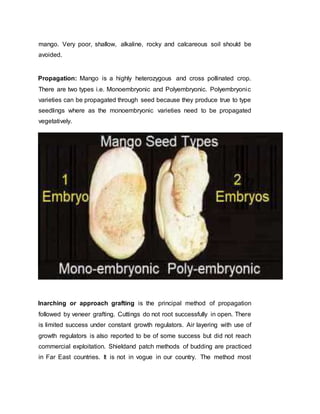
Propagation: Mango is a highly heterozygous and cross pollinated crop.
There are two types i.e. Monoembryonic and Polyembryonic. Polyembryonic
varieties can be propagated through seed because they produce true to type
seedlings where as the monoembryonic varieties need to be propagated
vegetatively.
Inarching or approach grafting is the principal method of propagation
followed by veneer grafting. Cuttings do not root successfully in open. There
is limited success under constant growth regulators. Air layering with use of
growth regulators is also reported to be of some success but did not reach
commercial exploitation. Shieldand patch methods of budding are practiced
in Far East countries. It is not in vogue in our country. The method most
commonly used in this country is therefore, inarching because of its high
percentage of success.
Inarching has some drawbacks:
 The rootstocks have to taken to the scion tree for grafting.
 Scaffolding has to be built to hold the rootstock pots at scion level.
 The rootstock plants have to be watered individually while they are perched at
various levels and at odd places hidden in the scion tree and all these increases
the cost of production of grafts making it very cumbersome.
Several devices have been suggested to get over these difficulties:
o Grafting in rainy season, so that, the rains wet the stocks. o Avoiding the pot of
the rootstock by substituting it with grass wrapping.
o Use of grafting pot stands
o Reducing pre grafting and post grafting irrigation costs on the, by keeping the
pots in a trench and letting in water to irrigate them.
o Training the scion trees to low heights.
o Wrapping roots in moss or soil and covering with polythene sheet so that no
watering will be needed till union takes place
Amongst the grafting methods, the detached scion method is gaining
popularity (veneer grafting).This has the striking advantage in using the
scion sticks for propagation and the twigs from the variety to be propagated
can be cut from the mother plant and taken to the rootstock seedling growing
in a nursery. The scion stick, which is procured, must be 3-4 months old. It is
found that scions ranging from 2.5 to 10 cm in length are suitable for the
purpose. But the growth of the scion is always more when bigger scion pieces
are used. If necessary the scion sticks can be stored for 6 days during April
to June by wrapping them in moist paper and enclosing in an alkaline bag
without any deterioration in the percentage of success. This is a less
expensive and easy method of propagation to inarching.
Rootstocks: A full knowledge about the effect of using of the species of
Mangifera and other genera of the family as rootstocks is not available. Other
species of Mangifera like M.foetida and M.odorata have been found to show
promise as rootstock. Kalaypad variety is said to be dwarfing stock and a wild
mango variety Pulima (Ceylon) is considered as prolific rootstock.
Polyembryonic seedlings which are uniform amongst themselves are
recommended as rootstocks as they reduce variability due to the rootstock.
Among them Pahutan and Olour are particularly good. Clonal rootstocks
have-not been on trail but the rooting of mango cuttings and layers with
hormones and its effects offer a great scope in selection of rootstocks for
mango.
Kurukkan : Salt resistant and Polyembryonic.
Olour : Vigorous rootstock
Rumani,Kalepad&Vellaikolamban : Dwarfing.
Moovandan and Nekkare : Salt tolerant.
Pulima : Prolific rootstock
Planting: Planting is generally done with a ball of earth during rainy season
in moderately rainy places and on the cessation of rains in the heavy rainfall
areas. There is a popular preference for aged plants to young plants, but
practically there is no difference in fruiting. The young plants are easy to
transport and to establish. Planting is done in previously dug, exposed and
filled pits of 3‘X3‘X3‘size.Sometimes wood is also burnt in the pits. Application
of nitrogen to young plants hastens growth and before filling the pits 50 kg. of
well-decomposed FYM, 2 kilograms of super phosphate are added. If white
ant problem is there 100 to 150 grams of polydol power should be added per
pit. Cow dung if applied produces too much heat and attracts white ants and
hence should not be applied where white ants are a serious problem. Manure
is applied 2 months before planting or 6 months after planting. Planting isdone
on a cool day and preferably in the evenings and watered immediately and
staked. While planting grafts, the graft joint or the union should be 20 cm
above the soil surface to prevent entry of disease carrying organisms in to the
graft joint.
Spacing: Old orchards are planted too densely and the trees grow tall and
upright. Cultivation is difficult. Diseases and pests are common in closely
planted orchards. So, yields will be low. Spacing depends on the spread of
varieties. Spreading varieties like Peter requires more spacing when
compared to varieties like Najukpasand. Normally spacing adopted for grafts
is 10 X 10 M and for seedlings and in very fertile soils it is 12 X 12M. Generally
square system of planting is followed.
The spacing adopted under high density planting is 5X3 / 5X2.5 / 4x4 / 3x2.5
2.5x2.5m. In high density planting for Manjeera and Mahamooda the spacing
adopted is 4.5 X 4.5 M and for Amrapali it is 2.5 x 2.5 M.
Inter crops and Intercultural: Vegetables like bhendi, cowpea, potato
,cucurbits and leguminous crops like groundnut and bean, dwarf banana and
cover crops like sesbania and Crotalaria juncea can be raised and buried in
the soil for green manuring.
Often young plants produce flowers. These are pinched of during first 3-4
years. Otherwise the vigour of the plant is lost. Removal of weeds is required
at least twice a year. Mango requires no pruning except removal of dead,
diseased and dried parts and branches arising within 3 feet above the ground
level. This will help in easy cultivation.
Irrigation: The irrigation requirements of young and non-bearing trees are
different from those of bearing trees. During young and non-bearing period
speedy growth of the trees and expeditious development of their leaf canopy
are the chief objectives to be achieved. This would require more frequent
irrigations through ought the year than for the bearing trees. The newly
planted young plants up to their first 4-6 months should secure irrigations
twice in a week in hot weather. For the first 4-5 years, the irrigations must be
frequent and regular though of light intensity because the root spread in the
initial years are not very extensive. During rainy season, the interval may be
adjusted keeping in view the intensity and distribution of rainfall.
In bearing trees 2-3 months preceding flowering season, ie.during October-
December profuse irrigation is not advisable to induce flowering and to arrest
vegetative growth. Irrigation may be beneficial from February to June. This
stop the fruit drop and helps in development of fruit size. When the trees are
in full bearing stage, generally 2-3 irrigations are given between fruit set and
fruit development. It is better to avoid irrigations before harvesting for better
quality of the fruit.
Basin system of irrigation is generally followed to economize water. The basins
may be connected in series or to a channel dug in-between rows.
Manuring: Mango orchards are not generally manured. But if manured, the
yield will be more. The chief requirements during pre-bearing age are rapid
growth and the development of strong framework. Good cropping, regular
bearing and high fruit quality are the prime objectives of bearing trees.
For non-bearing trees liberal doses of Nitrogen, phosphorous and reasonable
amounts of potassium are to be applied. During non-bearing stage nitrogen is
particularly needed in heavy quantities to support healthy and fast growth.
It would be advantageous to apply substantial portion of nitrogen in the form
of organic matter, so that the texture of the soil, its moisture holding capacity
and ultimately the development of roots there in may be improved.
Phosphorous is needed for the development of roots, respiration and
translocation of carbohydrates. Application of potassium will help in
development of fruit, increases fruit quality and control of fruit drop.
During bearing age the manurial programme aims to secure sufficient
vegetative growth early in the season for the next year‘s growth and to ensure
regular bearing with superior quality. This can be achieved by heavy dose of
nitrogen a little earlier than flowering in the on year to initiate vegetative growth
and suppression of bud differentiation. So, that cropping in the ‗on‘ year is
reduced and the production of vegetative shoots is promoted. Mango
manuring is therefore, quite complicated problem and grower has to keep in
view all factors involved to get good results.
Manurial schedule:
Age of the FYM Nitrogen Phosphorous Potash
plant (Kg) (grams/plant) (grams/plant) (grams/plant)
1-3 years 5-20 50-100 40-80 100-200
4-6 years 25-50 100-200 80-100 200-400
7-9 years 60-90 200-250 120-160 400-600
10 years and 100 250 160 600 above
The manures and fertilizers are applied in a shallow ring dug around the base
of the tree in young orchards. In old bearing orchards, they are broadcasted
under the canopy of the plant leaving 30-60 cm from the trunk and thoroughly
mixed into the soil. In grown up orchards there is a prevalence of different
timings of fertilizers application in various regions of the country depending
upon the intensity and period of rainfall, fruiting period, periods of vegetative
flushes, irrigation facilities etc.,. In A.P. the manures and fertilizers are applied
in two split doses. First dose is given during JuneJuly, consisting of complete
Nitrogen with half potash at the onset of monsoon. The second dose is applied
during September-October with FYM, super phosphate and remaining half of
potash.
Foliar application: Promotes growth, improves fruit set, yield and quality.
Foliar spray is given immediately after the harvest of the crop—urea @ 1-2%
and another after flowering and at marble stage to improve fruit set and to
reduce fruit drop.
Training: The training of mango plants in the initial stages is very essential to
give them proper shape. Specially, when the graft has branched too low, the
process of training becomes very important. At least 75cm of the main stem
should be kept free from branching and the first leader of main branch should
be allowed after that. The main branches should be spaced in such a way that
they grow in different directions and are at least 20-25cm apart. Otherwise
there is every chance of breakage due to smaller crotch angles and heavy
top.
Pruning: Proper pruning of mango trees after the harvest gives the best
results in terms of disease and pest management, diversion of food materials
to the productive shoots, increased photosynthetic activity and increased
carbohydrate and starch content, early production of new flush that bear the
crop in the next season. Pruning also helps in increased cytokinin, Ascorbic
acid and auxin content, which is beneficial for flowering. Abscissic acid level
will also increase which inhibits the vegetative growth and promote flowering.
Thus pruning helps in obtaining regular fruiting and production of quality fruits.
After giving a rest period of 15-20 days after harvesting, pruning has to be taken up.
The details of pruning are:
• Remove all the old inflorescences that flowered during the previous
season. This encourages the production of new vegetative flushes
early in the season, which can mature in winter and flower in the
succeeding season.
• Remove all the lower branches, which are expected to touch the
ground due to weight of fruits in the ensuing season. This facilitates
easy operation under the tree.
• Prune all the diseased, dead and broken branches and twigs.
• Remove all the unfruitful branches and shoots that are lying inside the
canopy to facilitate free circulation of air and to allow sunlight. These
branches and twigs if not removed will harbour the pests like fruit
borers, webbers, leaf miners and diseases like anthracnose, bacterial
spots, powdery mildew, black band, pestalotia and red rust.
• In case of aged trees the top has to be opened by pruning the central
stem at the top. A small branch on eastern and western side may be
pruned to allow sun light into tree canopy and for proper ventilation.
• Spray the trees after pruning thoroughly with 1% Bordeaux mixture or
with 0.3% copper oxychloride as a prophylactic spray to control several
diseases.
• Paste all the cut ends with 10% Bordeaux paste or with Copper oxy
chloride paste. Collect the pruned parts and destroy by burning.
Problems in mango cultivation:
Alternate (Biennial) and Irregular bearing in Mango: It is a burning problem
in mango industry since; it renders cultivation of mango less remunerative to
the growers. When the mango tree bears heavy crop, the bearing season is
called ‗on‘year. When it bears a poor or lean or no crop, the season is called
‗off‘year. In both the years the mango grower is at a loss. In the ‗on‘year
there is abundant fruiting and the market is flooded with fruits and the prices
fall down. In the off year, there is scarcity of fruits for supply to market, prices
are highly remunerative but the grower has a very little or no fruits to supply
to the market. Most of the promising varieties like dashehari, Langda,
Mulgoa,Kesar etc. are prone to this malady.
In some instances, however, failure to crop in one year is not followed by normal crop.
Instead, two or more bad years succeeds before a good cropping year occurs again.
Thus, the rhythm of bearing is not strictly alternate but irregular and erratic.
The non-bearing intervals seem to be longer in neglected orchards and old ones,
while in good orchard it tends to appear a biennial bearing or alternate bearing.
Causes:
1. The habit of bearing heavy and poor or no crop in alternate years is
believed to be an inherent character because some varieties, viz., Fazil,
Neelum, and Bangalora are regular bearers.
The maturity and age of trees and seasonal vegetative growth influence
and control flowering in mango. In western India, vegetative flushes occur
in February – March, March-April or beginning of monsoon and October-
November. In Bihar, new leafy growth occurs in early spring, April-May
and July-August. In U.P., vegetative growth occurs in two flushes in
March-April and July-August. In South India, vegetative growth takes
place in February-June and October-November. In Punjab, new flushes
appear in April-May and August.
In mango a definite relationship appears to exist between growth of
vegetative flushes and fruit bud formation. An early production of shoots
during the first flush (February-April), and an early cessation of the growth
in the season seem to be conducive to regular bearing in mango. But in
several old and neglected orchards the tree bearing heavily in a year put
forth little or no vegetative growth during flowering to fruit maturity, and as
such no fruiting wood is available for the following year, which
consequently, turns out to be an off year for cropping.
Generally 8-10 month old mature shoots produced in spring and early
summer that cease to grow at least 4 months prior to blossoming season
will initiate flowering. Thus the spring and summer shoots get sufficient
time to grow rest and mature for producing flowers but later formed shoots
fail to achieve this physiological maturity. However, in regular bearing
varieties,eg.,Rumani,even in December emerged shoots are capable of
producing flowers to the extent of 83% only and 15% of these flowered in
next year. This indicates that a vast majority of vegetative nonflowering
shoots produced, though correct in stage of maturity, were lacking in vital
substance necessary to induce flower buds. Thus this hypothesis doesn‘t
hold good for biennial bearing.
2. It is also contended that irregular bearing in mango was caused by
nutritional deficiency especially Nitrogen. A proportionate increase in
nitrogen leads to vegetative growth, whereas its proportionate decrease
induces flowering. Higher starch reserves, total carbohydrates and C: N
ratio favour flower bud formation but not in Baramasi and regular bearing
varieties. Studies on nitrogen content in stems and leaves of different
cultivars indicated possibility of high no. of trees to flower, but no
correlation between flower bud initiation and total nitrogen could be
derived. Thus C: N ratio reserve, though playing an important role in
flowering, is not the primary cause of biennial bearing.
3. Higher level of auxin like substances and an inhibitor (similar to ABA)
and lower levels of gibberellins (GA3) like substances are vital for
floriferous shoot in mango.
4. The varieties that produce mostly terminal inflorescence and only few
axillary types of flower clusters are more markedly biennial bearers; while
those varieties which produce a greater percentage of axillary
inflorescence are moderately regular bearing. Unfortunately, most of our
good dessert varieties are biennial bearers.
5. Adverse climatic factors such as cloudy weather, rains, high humidity,
convert an ‗on‘ year in to an ‗off‘ year by promoting incidence mango
hoppers and diseases like powdery mildew and anthracnose etc.,
especially during flowering, preventing pollination and damaging the floral
parts. Frost and low temperatures during flowering adversely affect fruit
set there by turning an ‗on‘ year in to ‗off‘ year. However, these don‘t form
basic causes of biennial bearing.
In view of the above various possible factors associated with this problem can be
grouped as—internal factors and external factors.
Internal factors: Physiological, genetical, nutritional, sex ratio and hormonal imbalance.
External factors: Rain, wind, low temperatures, cloudy weather, light, pests and
diseases.
Suggested measures to overcome alternate bearing:
 Planting of varieties which are regular bearers Eg., Totapuri, Rumani,
Banglora, Neelum, Mallika, Amrapali and Ratna.
 Plough and harrow the orchard twice in a year, in the beginning of the
monsoon after harvest and in October.
 Apply the fertilizers as per recommended schedule.
 After the harvest of the crop, dead and diseased branches and the
Loranthus parasite should be cut off and removed.
 Deblossoming: Half the no. of flower clusters are removed from the
tree in the on year as soon as they emerge. The food reserves of these
deblossomed shoots would be utilized by the tree in producing
vegetative growths in the spring and summer and mature to produce.
 Ringing: A ring of bark of about 1.25cm wide is removed from
branches of about 15 cm thicknesses. Ringing causes concentration of
large amount of carbohydrates in the branch above the ring and it
would put forth blossoms instead of vegetative growth. Ringing has to
be done in month of August. This is not advisable as it devitalizes the
tree and should not be followed as a regular practice.
 Over vigorous trees may be subjected to induce rest by withholding
irrigation with good exposure to sunlight. Application of common salt
@ 2.5 kg. Per tree in September checks vegetative growth causing
accumulation of carbohydrates for induction of flowering. This is
practiced in over-vigorous trees and not on weak trees.
 Pruning: Proper pruning of mango trees after the harvest gives the
best results in terms of disease and pest management, diversion of
food materials to the productive shoots, increased photosynthetic
activity and increased carbohydrate and starch content, early
production of new flush that bear the crop in the next season. Pruning
also helps in increased cytokinin content, Ascorbic acid and auxin,
which was beneficial for flowering. Abscissic acid level will also
increase which inhibits the vegetative growth and promoted flowering.
Thus pruning helps in obtaining regular fruiting and production of
quality fruits.
 Smudging during October-December is reported to be useful in forcing
Mango to flower with limited practical utility.
 Hybridization: By crossing good quality variety with regular bearing
varieties may be helpful in inducing regular bearing tendency in to the
hybrid. Eg. Mallika and Neeleshan.
 Providing orchards with wind breaks, regular ploughing, and liberal
manuring at appropriate intervals and adequate irrigation and other
cultural practices are also recommended for regular bearing.
 Spraying Ethrel during October at 200 ppm at 20 days interval till
flowering appears.
 Spraying 1% urea immediately after harvest of fruits in rain fed
orchards and prophylactic sprays against mango hopper during
September- October, also helps in regularity in bearing.
 Application of growth retardants like Placlobutrazol (Cultar) especially
in areas like Konkan where the climate is hot and humid which results
in continuous vegetative growth, inhibits the growth promoting
gibberellins with in the tree with the result that vegetative growth gets
restricted and trees put forth regular flowering.
Mango malformation: It is a complex and serious malady in North India and
not so common in South India. Some varieties like Chausa, Bombay green
and Fajri jafrani are more susceptible than others in N.India.
This malady has been distinguished into two groups i.e., vegetative
malformation and Floral malformation.
Vegetative malformation is more pronounced in young plants. Affected
mango seedlings or young plants develop excessive vegetative branches
which have limited growth, swollen and with very short internodes and develop
abnormally compact rosette like shoots presenting a bunchy top appearance.
Floral malformation: The affected inflorescence becomes clustered and
round. Most of the flowers lack essential organs and don‘t set fruit and its
inflorescence continuously hang on the tree for months, being more green
and sturdy.
Causes: Various causes like nutritional disorders, physiological, viral, fungal and
acarological are reported.
The available literature doesn‘t appear to support the above causes except the
fungal; the only positive evidence for the cause of this is fungal origin. I.e.,
Fusarium moniliforis.
Control measures:
a. Destruct the infected small plant or plant parts
b. Spraying a fungicide like Captan @ 3grams or Bavistin @ 1gram / litre of water
c. Remove the affected parts by pruning 30cms below and paste with Bordeaux
paste.
d. Early deblossoming combined with NAA 20ppm spray during October also
reduces this considerably.
e. Bhardhan variety of U.P. is resistant and free from this infestation.
Spongy tissue: A non-edible patch of flesh develops in the mesocarp of the
fruit and becomes spongy, sour and yellowish is termed as spongy tissue.
This can be detected only after cutting the ripe fruit. It is a physiological
disorder in which the fruit pulp remains unripe because of unhydrolised starch
due to inactivation of ripening enzyme because of high temperature,
convective heat, and post harvest exposure to sunlight are the causes.
Alphonso variety is very susceptible to this spongy tissue.
Remedial measures:
 Sod culture and mulching are useful in reducing spongy tissue.
 Growing mango hybrids Ratna and Arka Puneet, which are free from this
problem.
 Harvesting fruits when they are three fourths matured rather than fully
matured ones also reduces this malady.
Fruit Drop: Fruit drop is serious problem in mango and cause great loss to the
growers. A tree producing several thousand panicles yields only a few hundred fruits.
Most of the flowers falling down after full bloom or at later stage of
development. Only 0.1 to 0.25% perfect flowers or even less develop in to
mature fruit. Fruits drop at all stages of maturity. Maximum fruit drop takes
place in last week of April or first week of May depends upon favourable
condition. The fruit drop can be divided in to three distinct phases eg., pin
head drop, post setting drop and May drop.
The flower drop as well as the fruit drop is primarily due to the formation of an
abscission layer at the point of attachment of the fruit with the twig. Several
factors have been considered responsible for the formation of abscission
layer. The causes can be divided in to two;
External causes:
• Unfavourable climatic conditions.
• High incidence of serious diseases like powery mildew and anthracnose and
pests like hoppers and mealy bugs.
Internal causes:
• Poor soil
• Lack of pollination
• Low stigmatic receptivity
• Defective perfect flowers
• Poor pollen transference
• Occurrence and extent of self-incompatibility.
• Abortion of embryo
• Degeneration of ovules.
• Competition between developing fruit lets.
• Drought / lack of irrigation.
Measures to prevent fruit drop:
• Spraying of 2, 4-D @ 10 ppm or NAA @ 50 ppm at pea stage and at marble stage
helps in preventing fruit drop.
• Providing pollenisers for self-incompatible types.
• Maintaining sufficient soil moisture also prevents fruit drop and helps in increasing
the size of the fruit.
• Provision of wind beaks all around the orchards, which prevents drop due to high
velocity winds at the time of fruit development.
Cropping: Grafted mango usually starts bearing from the 4th to 6th year after
planting. The precocious varieties like dasehari start bearing even from the
third or fourth year onwards. A grafted mango tree usually continue to bear till
up to 50 years, but its most prolific years of bearing are generally from the 10
to 14 years. Seedling trees usually take about 8 years to come to bearing but
their productive life is much longer.
Harvesting indices: It requires considerable experience to judge the stage
of maturity at which the fruits are to be picked. If the fruits are harvested at an
immature stage, they develop white patches and the normal TSS / Acid ratio
is also not obtained. On the other hand, if the fruits are harvested when over
mature or fully ripe, more microbial and physiological spoilage occurs due to
increased susceptibility of fruits, thus reduces the shelf life of fruits. The
correct stage of harvesting of fruits can be judged in several ways.
 Attainment of full size of a variety is indicated by stoppage of increase in
size and flesh becomes soft.
 Appearance of bloom (Whitish waxy layer), characteristic colour or spots
on the skin and development of typical flavour of a variety are also
important indications of maturity.
 When a few ripe fruits have fallen on their own accord from the tree, the
rest of the fruits are considered sufficiently mature.
 The sap which exudes at the stem end on picking a mature fruit is thick
and dries quickly.
 If the fruit sinks in water, if it is dropped in to water indicates its maturity.
 Specific gravity, TSS and pressure tests are also employed for testing the
maturity of fruits. Generally a specific gravity of 1.01 and 1.02. TSS of 12
to 15 % and a pressure of 1.75 -2.0 kg. Per sq. cm will give a fair index of
maturity.
 In some varieties, oil glands on skin of the fruit become distinctly clear.
 Measurement of the percentage of the starch in the flesh is found to be a
comparatively accurate method for judging the maturity of the fruit.
 For judging the maturity, the physical development of the fruit such as
rounding of ventral edge, development of beak, outgrowing of shoulders,
filling up of hollow at the stem end, broadening of apical end should also
be considered for judging the maturity of the fruit.
For judging the maturity of the fruits one should not rely only on one criterion but
should consider as many criteria as possible.
Harvesting of fruits: The fruit injured or even slightly bruised during the
picking operation losses its keeping quality and becomes unfit for dispatch to
distant markets. The usual practice of harvesting the fruits is knocking down
the fruits or shaking the trees violently to get the fruit down need to be
discouraged. If the fruit is hanging high, it should be picked up with the help
of a step ladder. In no case, the picker should climb up the tree as this practice
is harmful both for the tree and the picker. The fruits should always be
harvested and the harvested fruits are placed in canvass bags or padded
baskets and carried to the packing house. A small fruit stalk should be kept
with the fruit at the time of harvesting helps in keeping the fruits in better
condition in transportation and storage.
Yield: The yield of mango depends on no. of factors like age of the plant, soil
fertility, climatic conditions, variety, type of plant material like graft or seedling,
management of the orchard etc.
A mango tree having an age of 5 years bears about 200 fruits and 10-20 years
bears a crop of 500-1000 fruits during an ―on‖ year. During 20-40 years its
yield may range between 1000-3000 fruits.
BANANA
Botanical name: Musa spp. Family: Musaceae
Origin: Tropical regions of South East Asia (Assam, Burma, Indo-China region).
Banana is one of the oldest fruits known to mankind. Its antiquity can be traced
back to Garden of paradise where eve was said to have used its leaves to
cover her modesty. It may be one of the reasons why banana is called ‗Apple
of Paradise‘ and botanically named Musa paradisiaca. Banana plants refer
to Biblical legend as ―Tree of wisdom‖ for good and evil in the Garden of
Eden. The word Muza was derived from the Arabic term Muza, which probably
came from the Sanskrit, word Moka and got its place in Koran as the ―Tree
of paradise‖,similar to that of ―tree of wisdom‖ in Bible.
Importance: Every part of the plant has a ready use.
The ripe fruits are delicious and are used for table purpose.
The fruits of some cultivars are used as breakfast food after steaming.
The end of the inflorescence, technically known as pendant is cooked as a
vegetable.
Many products are made from banana such as banana chips, fig, soft drink,
flour and jam.
Banana flour is prepared from unripe fruits and banana powder from ripe fruits.
Starch is manufactured from pseudo stem.
The pseudo stems of banana of all types have been used for manufacturing
paperboards.
In South India, the leaf of Banana is used as a plate for serving meals.
The sheaths and leaves are used for making crude ropes.
The banana species Musa textiles is well known for their strong fibre.
Nutritional Value:
a) Banana is a good source of vitamin A and a fair source of Vitamin C and
B2
b) Banana fruits are rich source of minerals like magnesium, sodium,
potassium and phosphorous and fair source of calcium and iron.
Banana is the second largest produced fruit after mango in India accounting for
21.87 per cent of the total fruit production from 10.49 per cent of the area.
Varieties: In banana there are three types. They are table varieties, culinary
types and hill bananas. There are several varieties in banana but the
commercially important varies are-
Table varieties -Poovan, dwarf Cavendish, Robusta, Grand nine,
Rasthali,Grosmichel, Virupakshi, Nendran,Monthan.
Culinary varieties: Monthan. There are also other varieties like Yenugu bontha and
boodidha bontha belonging to this group.
Hill Bananas: Virupakhi (Syn: Sirumalai, and Mala Vazhai.)
Climate: The banana is strictly a tropical crop. It grows luxuriantly inthe warm,
humid and rainy climate of tropical regions of the equator. It grows well in
regions with a temperature range of 10-40OC and an average of 23OC. In
cooler climate the duration is extended, sucker production is affected and
bunches are small. Low temperature
i.e. less than 10OC is unsuitable since, they lead to a condition called choke
or impeded inflorescence and bunch development. Banana grows well
under high rainfall areas .On an average 100 mm rainfall per month appears
to be satisfactory for growth of banana. Hot winds blowing in high speed
during the summer months shred and desiccate the leaves. Stagnation of
water is injurious and may cause diseases like panama wilt. Banana comes
up well up to an altitude of 1500m above sea level in the tropics. The hill
bananas in Tamilnadu are raised between elevations of 500-1500m mostly
under rain fed conditions. Absence of strong winds and cyclones are
important.
Soils: Banana is voracious feeder and requires a well-drained soil with
plentiful organic matter. Even though banana requires heavy irrigation, it
cannot with stand water stagnation. Therefore, the soil should be well drained
and deep (At least 1m depth).It grows successfully in loamy soils, well drained
clay soils of delta areas, irrigated medium soils. The production in lighter soils
is good. Saline soils with salinity percentage exceeding 0.05 are unsuitable.
Banana can grow well even under slightly alkaline soils. Such soils are found
preferable for avoiding the wilt disease, which is known to be severe in acid
soils.
Propagation: Banana is propagated vegetaively through suckers and rhizomes.
Suckers: There are two types of suckers. 1) Water sucker 2) Sword sucker.
Water sucker: Have broad leaves and broad pseudostem and they don‘t
produce a healthy banana clump and hence not suitable for planting.
Sword sucker: It has a strong large base, gradually tapering to a slender
point with one or two narrow sword like leaves at the tip. The sword sucker is
most vigorous, grows fast and comes in to bearing early. Hence, sword
suckers are preferred for planting.
Rhizomes: After harvest, a number of its suckers are encouraged to grow up
to 1-2 feet. They are then dug out and their pseudo stems are completely cut
above the solid rhizome and roots removed. The rhizomes weighing about
450-900 grams are stored for two months in a dry place under shade. During
storing the bottom remains cut off leaving the heart bud prominent at the top
of the rhizome. The conical rhizomes, which have a sound heart, will be
selected for planting. Sometimes the rhizomes are cut in bits of 1 kilogram
and are used for planting.
Selection of sucker: Select only 3-4 months old suckers from healthy
vigorously growing and good yielding plants. The sword suckers should have
4-5‖ diameter at the base and 2-3 kg weight.
Preparation of the sucker: The selected suckers should be separated from
its mother plant along with a portion of a rhizome. Later, the stem of the
suckers should be beheaded at 20-30 cm height in a slanting manner. This
helps in producing new leaves quickly. The slanting cut also prevents the
stagnation of water in the sucker. The old roots should be removed and then
dipped in 0.1% cereson @ 1 g.per litre of water for 5 minutes before planting.
Land preparation: The land should be deeply ploughed, harrowed and
leveled and pits of 45cmx45cmx45cm should be dug at the required spacing.
The pits should be exposed for weathering for about a week to control the
presence of any grubs, ants, weevils etc. The soil from the pits should be
mixed with the following thoroughly.
5-10 kg of FYM
0.5 kg of castor or neem cake
2 kg of wood ash or 50 grams of muriate of potash
200 grams of super phosphate.
The pits are then filled with the above-manured soil thoroughly. While filling
the pits with the manured soil apply to the pit 50 grams of lindane dust to
control weevil which affects the rhizome or sucker in the soil. The sword
suckers are later planted straight in the pit along with a portion of rhizome at
a depth of 10-15cm.
Planting: The period of planting should be such that the active growth phase
of the plant may continue un-hampered during the flower bud initiation stage
or stage at which embryonic bunch is formed inside the pseudo stem. This
generally occurs between 4 and 5 months after planting. This stage
determines the no. of hands / fingers in future bunch after planting. At this
stage there should be any extreme cold or hot weather or lack of soil moisture
or lack of nutrients in the soil. June-July (On set of monsoon) is the planting
season.
In general the beginning of monsoon i.e. June is the best time for planting
banana in most parts, as the rapid growth during first 4 months of monsoon is
particularly helpful. In the heavy rainfall tracts like Malabar planting is done
after the cessation of monsoon from September to October. This also makes
the plants quite small during the expected periods of high winds, storms and
cyclones etc.
Spacing: The spacing varies greatly according to the variety and climate.
Variety Spacing
(Meters)
No. Of plants/ha.
Poovan,Monthan,Rasthali & Nendran 2.1X2.1 2150
Dwarf Cavendish 1.8X 1.8 3000
Robusta 1.8X 1.8 3000
Nendran 2.0X 2.0 2500
Hill bananas
2.4X 3.0
4.8X 3.0
1350
670
4.8X 4.8 420
Cultural operations in Banana:
Desuckering: During the growth of the mother plant, the suckers arise from
its rhizomes from time to time. If all these suckers are allowed to grow, the
mother plant looses its vigour and normal development resulting in lower
bunch weight and total yield. Therefore the suckers should not be allowed to
grow near the parent plant till the mother plant commences flowering. At
flowering (six months after planting), a vigorous growing sword sucker should
be allowed to grow and one more sucker is encouraged to shoot out from the
soil when the parent plant matures its fruits. Thus the parent plant has
completed its life, it has only two suckers. When the mother plant is harvested
and removed, the first sucker which is 6 months old takes the lead and
becomes the mother plant in the next generation and thus the successive
generations of suckers arising one after the other at 6 months interval
perpetuate.
Removal of all suckers up to flowering of mother plant and maintaining only
one follower afterwards is the best desuckering practice. However under high
density planting it is better to leave the follower after harvesting 75-80% of the
plant crop so that uniform cultural practices can be followed. It has been
observed that sucker removal had no effect on yield in the first harvest, but
yield in the second harvest was highest in plants left with one sucker followed
by plants left with 2 or 3 suckers and was lowest in plants without removal of
suckers.
Desuckering or pruning is the removal of unwanted suckers. It is done by
either cutting off the sucker or the heart may be destroyed with out detaching
the sucker from the parent plant. Some times kerosene is poured into the
cavity left after digging the sucker. In South India, crow bar with a chisel like
end is used for damaging the sucker.
Trashing: It is the removal of undesirable material from the banana field like
dried, diseased and decayed leaves, pseudo stem after harvest, male bud,
last end of inflorescence and withered floral parts.
Mattocking: After harvest of the bunch, the plant stem should be cut in stages at
least after 30-45 days to facilitate mobilization of the nutrients from the mother to
the developing ratoon plant. The pseudo stem should be cut leaving a stump of
about
0.6m height.
Wrapping of bunches: It is covering of bunches with polythene or gunny
cloth that protects the fruits from intense heat, hot wind etc. and improves the
colour of the fruits.
Tipping: It is the removal of heart or male bud. The large heart shaped flower
bud, contains infertile male flowers in reddish scale leaves. This heart flower
bud persists even after the fertile flowers have developed and formed in to a
bunch. It should be cut soon after the bunch is formed, other wise it is likely
to use up some of the food, which would otherwise go to the development of
fruits. It is a practice recommended for improving the appearance of the bunch
as well as to ward off ‗fingertip‘ disease.
Removal of floral remnants: The removal of dried and persistent floral
remnants present at the apex of the fruit or finger helps in preventing the
spread of fungal diseases. These floral remnants provide shelter to some of
the fungal spores.
Propping: It is a method by which support is given to banana bearing plants
with the help of bamboo, casuarinas or eucalyptus poles, protecting them from
bending or falling down due to heavy bunch load and from heavy damage by
wind. It is very essential for tall varieties.
Earthing up: It should be done during the rainy season to provide drainage
and to avoid water logging at the base. It is to be done once in 2 or 3 months
to prevent soil erosion from the basins and to avoid direct contact of water
with pseudo stem. Due to earthing up there are fair chances of formation of
good root system. It is better that whole rows of banana are strongly ridged
up about 10‖ high.
Weeding: In the first four months after planting, it is necessary to remove
weeds. The stirring of the soil by the spade after every 6 or 7 irrigations is
necessary to maintain its tilth and absorptive power.
Weeds can also be checked by the use of herbicides. Diuron @ 4 kg per
hectare and simazine @ 6kgper hectare control grasses and broad leaved
weeds when applied after planting and repeated 30 days after planting.
Glyphosate @ 1 kg a.i. per hectare at the time of planting followed by 0.5 kg
a.i.per hectare at 30 and 60 days after planting of suckers is recommended.
Banana is sensitive to 2, 4-D and hence the phenoxy compounds are not
used. Nutrient sprays: Spraying of a mixture containing 2% urea and
potassium Dihydrogen phosphate immediately after the emergence of
inflorescence stalk helps in increasing the size of the bunch and fruit content.
Cropping: Banana fruits develop parthenocarpically. Banana comes to
flowering in about 9 months after planting. The dwarf bananas are ready for
harvest with in 11-14 months after planting, while tall cultivars take about 14-
16 months to harvest. The fruits become ready in 3-4 months after flowering.
Dwarf Cavendish variety takes about 11 months, Robusta 12 months and
poovan about 13 months from planting to harvesting. Banana is categorized
as climacteric fruit. Fruits don‘t ripe early and uniformly on the plant.
The maturity standards of banana fruit, although vary with the variety and the
purpose of marketing, can be judged by physical characters as well as by
chemical analysis. The physical characters like colour, shape, size and the
ratio between consumable to non-consumable portions are taken in to
consideration.
The total period required from planting to first harvesting is also taken into
consideration for harvesting of the bunch. In India the main banana season is
from September to April.
The indications of maturity for harvesting are:
 The fruits are harvested when top leaves start drying.
 Change in colour of the fruit from deep green to light green.
 Tendency of floral ends of the fruits to shed with slightest touch of the hand.
 Fruits should be plump and their angles should have rounded off i.e.; after the
attainment of ¾ th full stage before the bunch is harvested.
For export purpose, three fourths of the full maturity stage (recognized by the
sharp angularities of the fingers) is considered to harvest. At this stage, the
dwarf Cavendish shows a pulp-skin ratio of 35:1 or 40:1.
The entire bunch is harvested with one-foot long stalk. After 15 minutes of
harvest, when the latex flow ceases, the bunch should be packed properly
and should not be allowed to come in contact with soil.
Yield: Yield of banana varies with variety, agro climatic situation and
management practices adopted for production. Under Indian condition,
varying yield between 15-40 tonnes per hectare has been reported.
Tall cultivars usually yield 15-20 tonnes /ha. Dwarf varieties are 30-40 tonnes per
hectare.
CITRUS
Botanical Name: Citrus sps. Family: Rutaceae
Origin: Tropical and Subtropical regions of south East Asia.
Citrus fruits are a group of fruits comprising of mandarins, sweet oranges,
grape fruit, limes and lemons etc., Citrus fruits have a prominent place among
popular, extensively grown tropical and subtropical fruits. In India citrus is
considered to be the third most important fruit crop.
Citrus fruits possess juice sacks. Unlike other fruits they lack firm pulp.Mostly
citrus fruits are consumed as fresh fruits particularly sweet
oranges,mandarinsand grape fruit. Citrus fruits are not only delicious and
refreshing but also they provide vitamins, minerals and many other
substances. Citrus fruits contain considerable amounts of Vitamin C. Fruits
are also good source of Vitamin and P.The mild bitterness in juice is due to
the presence of glucoside called Naringin which is said to have a medicinal
value. The rind of the citrus fruits is rich in pectin and essential oils.
Important citrus species: There are several citrus fruits in the world. Some
are ancient ones and some are recent ones. Citrus species readily crosses
with each other .so new types are coming up from time to time.
There are 16 species in the genus Citrus as per Swingle (1943) and 144
species as per Tanaka (1950).Hence classification of the kinds and varieties
are complicated. An abundance of locally used names and changing botanical
nomenclature also hinders distinct classification.
Important Citrus Species:
1. Sweet orange Citrus sinensis
2. Mandarin Orange Citrus reticulata
3 Acid lime Citrus aurantifolia
4. Lemon Citrus limon
5 Grape fruit Citrus paradisi
6 Pummelo Citrus grandis
7. Citron Citrus medica
8. Sweet lime Citrus limettoides
9 Gaganimma Citrus pennivesiculata
10 Vadlapudi Orange Citrus madaraspatana
11. Sour Orange Citrus aurantium
12 Rough lemon Citrus jamberi
13 Rangapur Lime Citrus limonia
Important citrus cultivars grown in India:
(1)Sweet Orange: More than half a dozen varieties are cultivated. Among them the
important ones are-Sathgudi, Mosambi and Batavian.
The other varieties of Sweet Orange are-Malta, Malta Blood Red, Jaffa, Hamlin,
Washington Navel Orange and Pineapple.
(2)Mandarin Oranges: The important commercially grown varieties are- Nagapur
Mandarin, Coorg Mandarin, Khasi Orange, Kinnow Mandarin
Kinnow Mandarin is a hybrid between King Mandarin (C.nobilis) and willow leaf
Mandarin (C.deliciosa).
The other varieties are- Ponkan, Satsuma Mandarin, Dancy Tangarin, Darjeeling or
Sikkim Orange and Cleopatra Mandarin.
(3)Limes and Lemons: These are acid fruits. Generally employed for preparing
drinks.
Limes-These include Acid lime, Key lime, Mexican Lime, Tahiti lime, Sweet
lime, Coorg lime and Rangapur lime and sour lime. Among them the mostly
cultivated one is acid lime. The important varieties of acid lime are -Vikram,
Pramalini, Chakradhar, Balaji etc.
Lemons: Often confused with limes. These are grown in small scale in pockets. In
this there are two types. They are seeded and seedless.
Seed Varieties-Lisbon, Villa Franca, Eureka, Nepali Round, Nepali Oblong and
Rajhamundry.
Seedless Varieties- Malta, Lucknow and Italian.
Climate: The sub-tropical climate is the best suited for citrus growth and
development. Temperature below - 40C is harmful for the young plants. Soil
temperature around 250C seems to be optimum for root growth. Dry and arid
conditions coupled with well defined summer having low rainfall (ranging from
75cm to 250 cm) are most favourable for the growth of the crop. High humidity
favours spread of many diseases. Frost is highly injurious. Hot wind during
summer results in desiccationand drop of flowers and young fruits. Darjeeling
Mandarin (Khasi Orange type) grows in altitude upto 2000m as it is adapted
to a cooler climate
Soil: Citrus can grow well in wide range of soils. Soil properties like soil
reaction, soil fertility, drainage, free lime and salt concentrations, etc. are
some important factors that determine the success of citrus plantation. Citrus
fruits flourish well on light soils with a good drainage. Deepsoils with pH range
of 5.5 to 7.5 are considered good. However, they can grow in pH range of 4
to 9. Presence of calcium carbonate concentration within feeding zone may
adversely affect the growth. Light loam on heavier but well drained sub-soils
appears to be ideal for citrus.
Propagation: Seeds exhibit 45-90% polyembryony.The seedlings are
comparatively more free from decline and other virus diseases which are not
transmitted through seed. Yet the yields are not good compared to budded
plants on account of the beneficial responses of the root stock
viz.,earliness,high yield and adaptability to the environment and soil, good
quality, resistance to diseases and pests.
Vegetative propagation methods like budding are practiced. Shield budding
or Tbudding is practiced all over the world. The varieties to be propagated
should be well known for their good performance and free from diseases. The
root stock should be compatible with the scions and well adapted to the soils
of the regions where tress are intended to be grown.
Rootstocks: The stock and scion must be compatible and should be capable
of producing long lived, productive trees. The influence of the most important
and widely used root stocks and their characteristics should be known to the
grower for choosing the right kind of stock for the locality.
The most commonly used stocks for sweet orange as well as mandarins in India
are Jamberi (Rough Lemon) and Karna Khatta.
The following rootstocks have been tried to study their influence.
1. Jamberi: With more number of seeds, high percentage of germination
and polyembryony is a vigorous stock for Sathgudi. The tree top is oval. Fruits
are large, rind is rough and thick and juice is insipid. Morality is very high due
to quick decline or other diseases out of use.
2. Gajanimma: It has all the good nursery characters of Jamberi and has
a prolific but is susceptible to gummosis and collar rot resulting in high
mortality and hence disordered.
3. Trifoliate Orange: It is the hardiest root stock and does well in forestry
areas. Resistant to many virus diseases. The plant gets dwarfed on this root
stock and is frost resistant.
4. Karnakhatta: It is found to be most common and satisfactory rootstock
for grape fruit, for heavy and wet soil to Punjab and U.P.
5. Sathgudi seedling: Suitable for moderately heavy soils. It gives
smooth joint. The trees are long lived being tolerant to decline. Yields are
moderate. Fruits are of fine quality and good keeping quality.
6. Rangpur lime: It is used as stock for Mosambi in Bombay region. It is
a vigorous grower, resistant to many of the virus diseases chiefly Tristeza
virus. It gives high yields with fruits of much better quality and hence
recommended as stock for sweet orange.
7.Acid lime: Slow growth. Thorns make it difficult to bud. Resistant to high water table
conditions.
8. Kichili: Drought resistant. Slow growth and gives a globular tree.
9. Pummelo: It has given a dwarf tree.
10. Wood apple: Dwarfs Sathgudi very much. Reduces prebearing period,
longevity and yield but increases the sweetness of fruit.
11. Sweet Lime: It is a satisfactory stock for Nagpur Santhra with better quality
and tighter skin.
Raising of root stock seedlings: - Seeds freshly extracted from mature fruits
picked from healthy, vigorous and good yielding trees are sown on raised
beds during JulyAug. The slimy substance on the seeds is removed by mixing
by them with wood ash and drying them under shade. The seeds take 20-30
days to germinate and in another month, a pair of leaves emerge. After 3 or 4
months 60cm in height. The seedlings are transplanted late the nursery beds
under shade and spaced 20cm apart and the seedlings will be ready in a year.
Selecting bud wood: Buds should be collected from a tree or trees of the
desired variety. Bud sticks are commonly selected from the next to last
growth flush (the wood behind the current flush) and from the current growth
flush after it has matured and hardened. Older growth flushes can be used
if the bark still is green.
Round twigs about the size of a pencil are preferred. The buds located in the
axils of the leaves (where the leaf is attached to the wood) should be well
developed, but still dormant.
After the bud wood is cut from the tree, the undesirable wood and/or growth
flush should be removed and the remaining bud wood should be trimmed to
lengths of 2025 cm (8-10 inches). The leaves should be cut off leaving a stub
of the petiole 3-4mm (1/8 inch) long to protect the buds.
Trimmed bud sticks should be labeled and used immediately or placed in
plastic bags in a cool place. Include a moist paper towel to maintain turgidity
and freshness. The label should include the variety, date of collection and
source. Bud sticks are usually tied in bundles for ease of handling.
Budding: The seedlings are ready for budding in about a year and budding
along with a chip of wood gives good results. In mandarin the removal of wood
seems to decrease the percentage of success. Generally done winter in July
or in September in South India and October and December in North India. T-
Budding or Shield budding is easy to perform. The root stock is generally
budded at a height of about 9‖.
Sweet Orange: It is propagated by Shield or T- budding. The root stocks
mainly used are Jamberi and Rangapur lime. In Andhra Pradesh mainly
Rangapur lime is used as a rootstock.
Acid Lime: It is commonly propagated by seed all over the country because
the seeds exhibit a high percentage of polyembryony. The nucellar seedlings
are identical with the parent in growth and production. These seedlings are
hardy compared to the budded plants. The seedlings take a little longer time
than budded plants to start bearing but soon over take them in yield. If budded,
gajanimma is a prolific stock but there is scope for the spread and
transmission of diseases and the budlings are shortlived.
Lemons, Grape Fruit and Pummelo: Italian lemon which is seedless, it is
propagated by budding on Jambheri in the Deccan region. For lemons the
root stocks found suitable in Punjab and U.P are Rough lemon and kharna
Katta.Pummelo is comparatively monoembryonic and hence budded plants of
pummelo are usually raised on the root stocks of Jatti Katt, iJamberi
etc.Similar is the case of Grapefruit.Pummelo as a root stock is found
compatible with grape fruit.
Mandarins: Mandarins are largely propagated by seed all over the country
except Nagapur Santhra which is the only budded variety grown on a
commercial scale around Nagapur (Vidharba) in Maharastra producing the
finest mandarins of the world.
Planting:
Preparation of the filed: The land is ploughed until a fine tilth is obtained. If
it is a virgin land all the existing vegetation should be removed along with the
roots. The land is leveled and pits are marked as per the system of planting
to be adopted.
Lay out: The square system of layout is commonly followed for planting the
citrus crop. In order to facilitate orchard management practices economically
and efficiently. Citrus trees should be planted in straight rows.
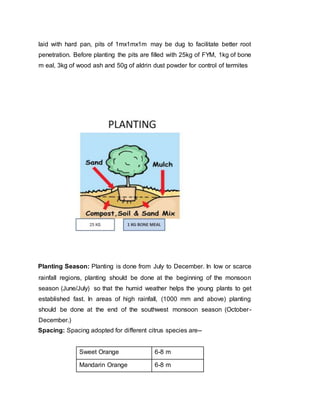
Digging of Pits: Pits of ½m x ½ m x ½ m size may be dug at required
distances 3-4 weeks prior to planting. But where the soils are shallow or under
laid with hard pan, pits of 1mx1mx1m may be dug to facilitate better root
penetration. Before planting the pits are filled with 25kg of FYM, 1kg of bone
m eal, 3kg of wood ash and 50g of aldrin dust powder for control of termites
Planting Season: Planting is done from July to December. In low or scarce
rainfall regions, planting should be done at the beginning of the monsoon
season (June/July) so that the humid weather helps the young plants to get
established fast. In areas of high rainfall, (1000 mm and above) planting
should be done at the end of the southwest monsoon season (October-
December.)
Spacing: Spacing adopted for different citrus species are--
Sweet Orange 6-8 m
Mandarin Orange 6-8 m
Acid lime 5-6 m
Lemon 6-8 m
Pummelo 6-8 m
Grape Fruit 6-8 m
Irrigation: Sweet orange trees are much more specific in their water
requirement than any other fruit crops. Higher requirement of water is needed
to produce satisfactory crop. Most of the santra plantations in India are rain
fed conditions. Irrigation requirement of santra trees in the plains is similar to
that of sweet orange,
Irrigation should be given when the top of the soil goes dry of once in 7-15
depending on the soil and weather. Irrigation water should not directly touch
the tree trunk as it spreads diseases like gummosis and the soil should not be
allowed to to get excessively dry as it results in leaf fall.
Irrigation should be given immediately after manuring.Water is very essential
during blossoming and fruiting periods. Any shortage of water during maturity
periods causes shrinking of the fruit and drying up of the pulp. As the trees
advances in age the basins should be extended up to the drip of the tree.
Manures and fertilizers: In Andhra Pradesh, citrus growers apply large
quantities of farmyard manure and organic cakes (Castor, Neem, Pongamia
etc) to improve soil structure and to create favourable conditions for healthy
growth. Further, to meet the high demands for nutrients and to maintain plant
productivity, organic manures are supplemented with chemical fertilizers. The
fertilizer schedule recommended for Andhra Pradesh is
Age of Plant Sathgudi Acid Lime
N P 205
gms
K20 N P205
gms
K20
1 Year 300 70 80 375 150 200
2 Year 600 140 160 750 300 400
3 Year 900 210 240 1125 450 600
4th Year 1200 280 320 1500 600 800
5th Year & above 1500 350 400 1500 600 800
Fertilizers should be applied in a circular band at a radial distance of 120 cm
from the trunk of the plant is the most beneficial. Deep placement of fertilizers
should be avoided. In fact, the maximum root activity in sweet orange
plantation was found within a depth of 25 cm while in acid lime they are more
surface oriented, 80-95% being located in the top 10 cm. As such, fertilizers
are worked in shallow into the surface soil.
A composit nutrient spray prepared and sprayed twice or thrice at 20-25 Days
intervel commencing from the appearance of new flush will correct
deficiencies and increases the yield and quality of fruits. It is prepared as
follows.
Zinc Sulphate 500 g
Copper Sulphate 280 g
Magnesium Sulphate 200 g
Ferrous Sulphate 200 g
Borax 100 g
Manganese Sulphate(Amorphouse) 200 g
Lime 900 g
Urea 1000 g
Water 100 lit.
Training and pruning: In order to allow the growth of a strong trunk, all
shoots in the first 40-50 cm from ground level developed in the early stage
should be removed. The centre of the plant should remain open. Branches
should be well distributed to all sides. Cross twigs and water suckers are to
be removed early. The bearing trees require little or no pruning. All diseased,
injured and drooping branches and dead wood are to be removed periodically
for initiating citrus greening.
Interculture: Before manuring, the basins are dug and the weeds are
removed. The tree basins should be kept free of weeds. Superficial cultivation
of citrus orchards is practiced to keep them free of weeds. Deep cultivation
should be avoided.
Root stock sprouts water suckers and dead wood have to be periodically
removed and cut ends are pasted with Bordeaux paste. Occasionally the
water suckers are to be observed and they should be removed,.
Intercrops: Leguminous crops like soybean, gram, groundnut, cow peas,
french bean, peas etc., may be grown in citrus orchards. Intercropping is
advisable during the initial three-four years after planting.
Bahar Treatment: If left to nature the trees may bloom and fruit irregularly
through-out the year. In order to overcome this problem and to force a full crop
in any of the three seasons, as required by the grower and the traders, Bahar
treatment is practiced in citrus orchards. In Andhra Pradesh, the citrus trees
generally bloom three times a year, i.e., in January-February (Ambe bahar or
Angam), June (Mrig bahar or Edagam) and October (Hastha bahar or
Gairangam). Trees are treated for Ambe bahar (January-February), in
November or December. In this method, from November onwards the amount
of water is gradually reduced in successive irrigations and completely stopped
in December. About the middle of December, the land is ploughed. When the
trees start showing wilting symptoms (3-4 weeks), the soil around the tree to
a distance of 120 cm is dug a depth of 10 cm and the recommended manure
is added to the soil and the trees are irrigated. The first irrigation that follows
is sparing while the subsequent ones are more plentiful. Flowers appear about
a month after the first irrigation. In Maharashatra, the roots are also exposed
for about 10 days as part of the bahar treatment. This method is occasionally
practiced in a few places in Andhra Pradesh Consequently; plants give new
vegetative growth, profuse flowering and fruiting. . However, this treatment is
considered to be harmful in the long run and not encouraged as a routine
practice.
Cropping: Budded sweet orange trees give a commercial crop in about 5
years. Mandarins may take one or two years more. Seedling trees take about
8 years to come to bearing. The life of budded tree is about 35 years and of
seedling about 60 years.
The fruit ripens in about 9 months after flowering. The harvesting season
varies in different parts of the country. Sweet orange have three seasons of
flowering and fruiting. The seasons of harvest in Rayalaseema are:
Angam season from September to February which yields about 80% of total
annual yield. Gairangam starts from July to September.Edagaru season
starts from March to May.Cro is very negligible during this season.
Bastavian oranges yield during August -September. In North India these fruits
ripen from November-February.
The mandarins have three seasons similar to sweet orange in the agency
tract. The main harvesting season santras in coorg is from December to April
and off season crops are available from July to September.
Fruit Drop: Fruit drop in citrus occurs more or less in three distinct stages
viz., post setting drop, pea size drop and pre-harvest drop. Among which the
last one is most important and causes huge loss to the farmers. Based on the
causal factors, the fruit drop can be classified broadly as i) Physiological drop
ii) Entomological drop and iii) Pathological drop.
i) Physiological drop-Although the initial fruit drop period in citrus is
primarily from physiological reasons, the term is strongly associated to
October fruit drop and describes the abscission of fruitlets as they approach
0.5-2.0 cm in diameter. This is mainly due to competition among fruits for
carbohydrates, water, hormone and other metabolites. The problem is highly
aggravated by water stress and humidity.
ii) Entomological fruit drop--Citrus bud mite and orange bug are some
important pests which causes heavy drop of flowers and fruits in oranges.
Besides fruit fly
(Daucus dorsalis) and fruit sucking moth (Otheris fullonica) are mainly causing fruit drop
in the later crucial stage of fruit ripening. Pre-harvest fruit drop is mainly caused by fruit
fly infestation. Its activity is first noticed during last week of October which continues till
the final harvest.
iii) Pathological fruit drop--Fruit drop also occurs due to pathogenic fungi
viz. Botryodiplodia theobromae, Colletotrichum gleosporoides and Alternaria
citri (stem end rot) which mainly occurs predominantly on the mature fruits
near ripening. High inoculum of these fungi in the orchards builds up due to
dead twigs on the bearing trees. Water spot also causes fruit drop in which
the rind absorbs large amounts of water in localized areas during period of
prolonged rains or dampness.
Control of fruit drop—
Maintain balance nutrients in the plants to develop sufficient foliage to
support the developing fruits.
Prune the plants after harvesting to minimize pest and disease incidence.
Proper drainage should be made to avoid water stagnation.
Irrigation should be applied at critical stages viz., flowering, fruit set and fruit
development.
Dropped fruits should not be left in the filed as they acts as carrier for the
diseases
Spray GA3 10 ppm + urea 1% at the time of flowering
Spray 2, 4-D 15 ppm + Benomyl / carbendazim 1000 ppm + urea 1%
one month after fruit set when the fruit size reaches pea size (8-10 mm).
Spray GA3 10 ppm + potassium nitrate 1% two month after fruit set (18-20
mm fruit size).
Spray ZnSo4 (0.4%) + MgSo4 (0.2%) + CuSo4 (0.3%) at fortnight interval will
decrease the fruit drop and increase the fruit yield.
Harvesting: Generally, citrus trees start bearing fruits 3 - 5 years from
planting (although economic yields start from the fifth year and the trees may
take 8 to 10 years to achieve full productivity) and can be harvested 5 - 6
months from flowering depending on the variety and the environment.
Maturity Indices:
Unlike some other fruits, citrus fruits do not ripen further once they have been
removed from the tree, so it is important that they are picked at the right stage
of maturity. Maturity is measured depending on different characteristics such
as color, juice content, level of soluble solid (sugar) and solids to acid ratio.
Normally, citrus fruits are harvested by hand. Fruit is best harvested after 8:00
in the morning, when dew has dried up, since otherwise, if the fruit was still
wet, it would become dark and get spoiled. In addition, as citrus fruits are cold-
sensitive (the plant dies at 3-5º C below 0ºC), growers must have special care
to protect the trees against cold. Lemons and limes are the citrus fruits the
most sensitive to cold weather.
The general way to pick the fruit is by pulling it from the stem, using gloves in
order to avoid damaging the fruit. Once harvested, the fruit has to be graded,
sorted, washed and waxed, before being packed for delivery to the fresh
market.
Yield:
Sweet Orange 600-800 fruits/tree with a maximum of 1200
Mandarins 1000-1500 fruits/tree with a maximum of 5000
Acid Lime 3000-6000 fruits/tree
Melons 600-800 fruits/tree
Pummelo 100 fruits
Grape fruit 500 fruits

Fruits unit -i

  • 1.
    MANGO Scientific name: Mangiferaindica L Family: Anacardiaceae. Origin: Indo Burma region Mango is the most important among the tropical fruits of India and it is very popular and considered to be the choicest of all fruits grown in India. It is known as the, ―king of fruits‖, owing to delicious quality of fruit, richness in vitamins and minerals and liking to Indian palate. It is also one of the best fruits of the world. Mango occupies the pride place in India as apple in temperate and grapes in sub-tropical regions of the world. Mango thus deserves to be ―the national fruit of India‖. It is also one of the most ancient fruits of the country being cultivated for the past 4000-6000 years. It is a sacred tree for Hindus (because of its blossoms used in the worship of gods and its leaves made in to festoons for hanging over doorways on so many occasions). No other country can surpass India in the number of varieties and richness of their flavour. Ripe mango is exceedingly refreshing to eat and is an excellent source of Vitamin-A and C. The immature and green fruit is used in various ways in curries, pickles and chutneys. Ripe mango slices and pulp can be preserved and canned for use when the fresh fruit is out of season. Mango was found throughout South- East Asia and the Malayan - archipelago in early days. The Portuguese, who opened the sea routes, were responsible for the world wide distribution of mango from indo-Burma and indo-china regions. Out of 63 mango-producing countries all over the world, India grows it to the maximum, contributing about 11 million tonnes, roughly 58% of the world production of 19 million tonnes. In India it is cultivated in an area of 12.3 lakh
  • 2.
    hectares occupying 22%of the total area under fruits in India and with a production of about 11 million tonnes constituting about 23% of total production of fruits. The area in AP is about 2.8 lakh hectares with a production of about 31 lakh tones and productivity of 12 tonnes per ha. The important mango growing districts in AP are Krishna, W.Godavari, Vishakapatnam, E.Godavari, Vigayanagaram, Srikakulam, Chittoor, Kadapa and Khammam districts. In AP maximum area is in East Godavari followed by Khammam and chittoor districts. Mango varieties: There are nearly 1000 mango varieties in India. Of these, however only about 20 varieties are grown on a commercial scale. The commercial varieties of mango in India are specific to different regions of the country. The important commercial varieties of mangoes
  • 3.
    Varieties grown andrecommended for different tracts of Andhra Pradesh: Coastal districts: Suvarnarekha, Baneshan, Juicy varieties and Rajpuri. Rayalaseema area: Neelum, Bangalora, Baneshan, Rumani, Cherukurasam, and Panchadarakalasa. Andhra Pradesh Banganapalli, Suvarnarekha, Neelum and Totapuri Bihar Bombay Green, Chausa, Dashehari, Fazli, Gulabkhas, Kishen Bhog, Himsagar, Zardalu and Langra Gujarat Kesar, Alphonso, Rajapuri, Jamadar, Totapuri, Neelum, Dashehari and Langra Haryana Chausa, Dashehari, Langra and Fazli Himachal Pradesh Chausa, Dashehari and Langra Karnataka Alphonso, Totapuri, Banganapalli, Pairi, Neelum and Mulgoa Madhya Pradesh Alphonso, Bombay Green, Dashehari, Fazli, Langra and Neelum Maharashtra Alphonso, Kesar and Pairi Punjab Chausa, Dashehari and Malda Rajasthan Bombay Green, Chausa, Dashehari and Langra Tamil Nadu Alphonso, Totapuri, Banganapalli and Neelum Uttar Pradesh Bombay Green, Chausa, Dashehari and Langra West Bengal Fazli, Gulabkhas, Himsagar, Kishenbhog, Langra and Bombay Green
  • 4.
    Telangana Region: Alphonso,Pairi (Peter), Mahamooda, Dashehari, safeda and Goa bunder. The important mango varieties grown on a commercial scale in AP are- Neelum Baneshan, Bangalora, Rumani, Khader, Mulgoa, Panchadarakalasa, china suvarnarekha, cherukurasam, Janardhanpasand. Hybrid varieties: Attempets are being made to obtain varieties with maximum desirable characters. For this purpose some hybrids were developed in different research stations, Salient characteristics of the important mango hybrids are- Mango Hybrids and their characters Hybrid Parents Distinguishing characters Fruit Research Satation,Anantharajupet-Kadapa District Neeleshan Neelum X Baneshan. Late maturing and Good quality. Neelgoa Neelum X Yerra Mulgoa Regular bearing,high yielding‘ good keeping quality and late maturing Swarna Jahangir Chinna suvarnarekha X Jahangir. Medium yielder, fruits are attractive in colour,good transporting quality and late maturing AU Rumani: Mulgoa X Rumani. Heavy and regular bearer with good keeping quality & late season
  • 5.
    KMH-1(Kodur mango hybrid -1) Cherukurasam X Khader Semi-dwarf type having regular bearing habit& good keeping quality Fruit Research Satation,Sangareddy,Medak District Manjeera Rumani X Neelum Precocious, regular bearer& heavy yielder I ndian Institute of Horticultural Research, Bangalore Arka Aruna Banganapalli X Alphonso Dwarf, regular, prolific & medium bearer. Free from fibre and spongy tissue. Arka Puneet Alphonso X Banganapalli Regular and prolific bearer. Free from spongy tissue with good Keeping quality.Suitable for table &processing. Arka Anmol Alphonso X Janardhanpasand Regular & prolific bearer. Fibreless , free from spongy tissue &keeping quality Arka Neelkiran Alphonso X Neelum Ideal for high density planting. Regular bearer with very good Keeping and late season. Indian Agricultural Research Institute, New Delhi Amrapali Dashehari X Nellum Regular& late bearing. Very dwarf suitable for high density planting Mallika Neelum X Dashehari Regular bearer, midseason variety &resistant to fruit drop.
  • 6.
    Regional Fruit ResearchStation, Vengurla Ratna (Neelphonso) Neelum X Alphonso Semi-dwarf, regular in bearing, good keeping quality. Fruits are free from spongy tissue. Sindhu Back cross progeny of Ratna (RatnaX Alphonso) Stone is extremely thin( seedless mango), regular in bearing, free from spongy tissue & fibreless Agricultural Research In stitute, Sabour, UP. Prabhasankar Bombay X kalaepad Semi dwarf, regular in bearer, fruit is of good keeping quality. Strong tendency to bear fruits in adverse weather conditions. Mahamudbahar Bombay X kalaepad Tree is semi dwarf and regular in bearing. Jawahar Gulabkhas x Mahamooda Bahar Semi dwarf, highly regular in bearing &precocious Horticultural college and Research Institute, Periyakulam. PKM-1 Chinna suvarnarekha X Neelum Bears fruits in clusters. Regular bearer, suitable for long distance transport
  • 7.
    PKM-2 Neelum XAlphonso Bears fruits in clusters. Regular bearer with good quality& keeping quality Depending on utility: Tabl varieties: Baneshan, Neelum, Bangalora, Rumani,Alphonso,Mahamooda and Goa bunder. Juicy varieties: Chinna rasam, Pedda rasam, Cheruku rasam, Kothapalli kobbari, Panchadara kalasa. Panakalu, Phirangi laddu. Table and juicy varieties: Chinna suvarnarekha , Peter. Off-season Varieties: Neelum, Bangalora, Baramasi, Rumani,Royal special. Pickle varieties: Achar pasand, Tellagulabi of Nuzivid, Alipasand, Guddemar (Hamlet) Varieties for preservation: Baneshan and Bangalora. Mango varieties can be divided into different groups- Depending on time of availability: Early Varieties: Olour, Rajpuri, Ronnet Alphonso,Suvarnarekha, Panakalu. Mid-season varieties: Baneshan, Panchadarakalasa, Mallika, Chinna rasam, Kothapalli kobbari, Peddarasam etc. Late varieties: Mulgoa, Jalalsaheb, Amrapali, Janardhanpasand ,Neelum and Bangalora etc. Off-Season Varieties: Rumani, Neelum, Baramasi, Sadabahar, Bangalora, Royal special. etc.
  • 8.
    Poly embryonic varieties:When seed of polyembryonic mango variety is sown several seedlings will arise. Only one of those is sexual and the others are nucellar seedlings, which develops from the cells of nucellus. The nucellar seedlings behave exactly like the female parent and are comparable to vegetatively propagated plants. The polyembryonic varieties of India are unfortunately poor in quality. Their only use is as rootstock for other superior varieties. The uniformity of such rootstocks would help in standardizing the performance of scion trees and eliminate the variability inherent in monoembryonic rootstocks of unknown origin. Polyembryonic varieties impart great vigour to the scion and influence the yield also. The yield of Baneshan and Neelum was found to be better on pahutan and Goa than on any other polyembryonic stocks in A.p. Polyembryonic varieties of India: Bappakai, Chandrakaran, Bellary, Goa, Kurukkan, Nileswar dwarf. Olour, Pahutan, Salem, Mazagoaon, Mylepalium and vellaikolumban. —These are common in west coast i.e., Malabar region in west coast. Polyembryonic varieties introduced from other countries in to India:Apricot, Simmonds, Higgins, Pico, Sabre, Saigon, Strawberry, Cambodiana, Turpentine and Carabao. Climate: Although, it is a tropical fruit, the mango equally grows well under semitropical conditions. Mango can grow from sea level to an altitude of about 1500 meters provided; there is no high humidity, rain or frost during the flowering period. However it cannot be grown on a commercial scale in areas above 600 m. It thrives equally well from kanyakumari in south India to sub- mountainous region in N.India.
  • 9.
    Temperature, rainfall andwind velocity are the main climatic factors, which influence its growth and fruiting. It cannot stand severe frost, especially when the tree is young. Mango requires a frost-free dry period at the time of flowering and sufficient heat during the ripening of the fruit. It can grow in temperature range of 0OC to 45OC but the minimum for growth lies above 10OC, the optimum near 25OC and the maximum at 42OC. The prevailing temperature also effects the sex expression. The percentage of perfect flowers in some of the south Indian varieties has been observed to be much less under N.Indian conditions. This has been attributed to low, minimum and maximum temperatures obtained during the period of panicle development as compared to those of south India. Most of the mango varieties thrive in places with good rainfall (75-375 cm per annum) and dry summer. The distribution of rainfall is more important than its amount. However, rain during flowering is detrimental to the crop as it interferes with pollination but also encourages greater incidence of pests and diseases. Dry period before blossoming is conducive to profuse flowering. Strong winds and cyclones during fruiting season can play havoc and blow away the crop completely. The time of flowering is effected by the climate. In N.India flowering occurs late in February while in S.India flowering occurs early October to December. Hence the crop is ready by March-April in A.P, Tamil Nadu and Maharastra, June-July in eastern UP; July-August in western UP and Rajastan. Kanyakumari, receiving rainfall all through the year; resulting in multiple and short periods of water showers and having virtually the same temperature through out the year, mango fruits are obtained practically all-round the year. Soils: Mango can be grown on a wide variety of soils, ranging from alluvial to lateritic, provided it is deep (2.0-2.5m) and well drained. Suitable pH for mango is 5.5-7.0 .A soil with good drainage ,permeability, a fair water holding capacity and ground water at a depth 0f 3-4m are features of an ideal soil fro
  • 10.
    mango. Very poor,shallow, alkaline, rocky and calcareous soil should be avoided. Propagation: Mango is a highly heterozygous and cross pollinated crop. There are two types i.e. Monoembryonic and Polyembryonic. Polyembryonic varieties can be propagated through seed because they produce true to type seedlings where as the monoembryonic varieties need to be propagated vegetatively. Inarching or approach grafting is the principal method of propagation followed by veneer grafting. Cuttings do not root successfully in open. There is limited success under constant growth regulators. Air layering with use of growth regulators is also reported to be of some success but did not reach commercial exploitation. Shieldand patch methods of budding are practiced in Far East countries. It is not in vogue in our country. The method most
  • 11.
    commonly used inthis country is therefore, inarching because of its high percentage of success. Inarching has some drawbacks:  The rootstocks have to taken to the scion tree for grafting.  Scaffolding has to be built to hold the rootstock pots at scion level.  The rootstock plants have to be watered individually while they are perched at various levels and at odd places hidden in the scion tree and all these increases the cost of production of grafts making it very cumbersome. Several devices have been suggested to get over these difficulties: o Grafting in rainy season, so that, the rains wet the stocks. o Avoiding the pot of the rootstock by substituting it with grass wrapping. o Use of grafting pot stands o Reducing pre grafting and post grafting irrigation costs on the, by keeping the pots in a trench and letting in water to irrigate them. o Training the scion trees to low heights. o Wrapping roots in moss or soil and covering with polythene sheet so that no watering will be needed till union takes place Amongst the grafting methods, the detached scion method is gaining popularity (veneer grafting).This has the striking advantage in using the scion sticks for propagation and the twigs from the variety to be propagated can be cut from the mother plant and taken to the rootstock seedling growing in a nursery. The scion stick, which is procured, must be 3-4 months old. It is found that scions ranging from 2.5 to 10 cm in length are suitable for the purpose. But the growth of the scion is always more when bigger scion pieces are used. If necessary the scion sticks can be stored for 6 days during April to June by wrapping them in moist paper and enclosing in an alkaline bag
  • 12.
    without any deteriorationin the percentage of success. This is a less expensive and easy method of propagation to inarching. Rootstocks: A full knowledge about the effect of using of the species of Mangifera and other genera of the family as rootstocks is not available. Other species of Mangifera like M.foetida and M.odorata have been found to show promise as rootstock. Kalaypad variety is said to be dwarfing stock and a wild mango variety Pulima (Ceylon) is considered as prolific rootstock. Polyembryonic seedlings which are uniform amongst themselves are recommended as rootstocks as they reduce variability due to the rootstock. Among them Pahutan and Olour are particularly good. Clonal rootstocks have-not been on trail but the rooting of mango cuttings and layers with hormones and its effects offer a great scope in selection of rootstocks for mango. Kurukkan : Salt resistant and Polyembryonic. Olour : Vigorous rootstock Rumani,Kalepad&Vellaikolamban : Dwarfing. Moovandan and Nekkare : Salt tolerant. Pulima : Prolific rootstock Planting: Planting is generally done with a ball of earth during rainy season in moderately rainy places and on the cessation of rains in the heavy rainfall areas. There is a popular preference for aged plants to young plants, but practically there is no difference in fruiting. The young plants are easy to transport and to establish. Planting is done in previously dug, exposed and filled pits of 3‘X3‘X3‘size.Sometimes wood is also burnt in the pits. Application of nitrogen to young plants hastens growth and before filling the pits 50 kg. of well-decomposed FYM, 2 kilograms of super phosphate are added. If white ant problem is there 100 to 150 grams of polydol power should be added per pit. Cow dung if applied produces too much heat and attracts white ants and hence should not be applied where white ants are a serious problem. Manure is applied 2 months before planting or 6 months after planting. Planting isdone
  • 13.
    on a coolday and preferably in the evenings and watered immediately and staked. While planting grafts, the graft joint or the union should be 20 cm above the soil surface to prevent entry of disease carrying organisms in to the graft joint. Spacing: Old orchards are planted too densely and the trees grow tall and upright. Cultivation is difficult. Diseases and pests are common in closely planted orchards. So, yields will be low. Spacing depends on the spread of varieties. Spreading varieties like Peter requires more spacing when compared to varieties like Najukpasand. Normally spacing adopted for grafts is 10 X 10 M and for seedlings and in very fertile soils it is 12 X 12M. Generally square system of planting is followed. The spacing adopted under high density planting is 5X3 / 5X2.5 / 4x4 / 3x2.5 2.5x2.5m. In high density planting for Manjeera and Mahamooda the spacing adopted is 4.5 X 4.5 M and for Amrapali it is 2.5 x 2.5 M. Inter crops and Intercultural: Vegetables like bhendi, cowpea, potato ,cucurbits and leguminous crops like groundnut and bean, dwarf banana and cover crops like sesbania and Crotalaria juncea can be raised and buried in the soil for green manuring. Often young plants produce flowers. These are pinched of during first 3-4 years. Otherwise the vigour of the plant is lost. Removal of weeds is required at least twice a year. Mango requires no pruning except removal of dead, diseased and dried parts and branches arising within 3 feet above the ground level. This will help in easy cultivation.
  • 14.
    Irrigation: The irrigationrequirements of young and non-bearing trees are different from those of bearing trees. During young and non-bearing period speedy growth of the trees and expeditious development of their leaf canopy are the chief objectives to be achieved. This would require more frequent irrigations through ought the year than for the bearing trees. The newly planted young plants up to their first 4-6 months should secure irrigations twice in a week in hot weather. For the first 4-5 years, the irrigations must be frequent and regular though of light intensity because the root spread in the initial years are not very extensive. During rainy season, the interval may be adjusted keeping in view the intensity and distribution of rainfall. In bearing trees 2-3 months preceding flowering season, ie.during October- December profuse irrigation is not advisable to induce flowering and to arrest vegetative growth. Irrigation may be beneficial from February to June. This stop the fruit drop and helps in development of fruit size. When the trees are in full bearing stage, generally 2-3 irrigations are given between fruit set and fruit development. It is better to avoid irrigations before harvesting for better quality of the fruit. Basin system of irrigation is generally followed to economize water. The basins may be connected in series or to a channel dug in-between rows. Manuring: Mango orchards are not generally manured. But if manured, the yield will be more. The chief requirements during pre-bearing age are rapid growth and the development of strong framework. Good cropping, regular bearing and high fruit quality are the prime objectives of bearing trees. For non-bearing trees liberal doses of Nitrogen, phosphorous and reasonable amounts of potassium are to be applied. During non-bearing stage nitrogen is particularly needed in heavy quantities to support healthy and fast growth.
  • 15.
    It would beadvantageous to apply substantial portion of nitrogen in the form of organic matter, so that the texture of the soil, its moisture holding capacity and ultimately the development of roots there in may be improved. Phosphorous is needed for the development of roots, respiration and translocation of carbohydrates. Application of potassium will help in development of fruit, increases fruit quality and control of fruit drop. During bearing age the manurial programme aims to secure sufficient vegetative growth early in the season for the next year‘s growth and to ensure regular bearing with superior quality. This can be achieved by heavy dose of nitrogen a little earlier than flowering in the on year to initiate vegetative growth and suppression of bud differentiation. So, that cropping in the ‗on‘ year is reduced and the production of vegetative shoots is promoted. Mango manuring is therefore, quite complicated problem and grower has to keep in view all factors involved to get good results. Manurial schedule: Age of the FYM Nitrogen Phosphorous Potash plant (Kg) (grams/plant) (grams/plant) (grams/plant) 1-3 years 5-20 50-100 40-80 100-200 4-6 years 25-50 100-200 80-100 200-400 7-9 years 60-90 200-250 120-160 400-600 10 years and 100 250 160 600 above The manures and fertilizers are applied in a shallow ring dug around the base of the tree in young orchards. In old bearing orchards, they are broadcasted under the canopy of the plant leaving 30-60 cm from the trunk and thoroughly mixed into the soil. In grown up orchards there is a prevalence of different timings of fertilizers application in various regions of the country depending upon the intensity and period of rainfall, fruiting period, periods of vegetative flushes, irrigation facilities etc.,. In A.P. the manures and fertilizers are applied in two split doses. First dose is given during JuneJuly, consisting of complete
  • 16.
    Nitrogen with halfpotash at the onset of monsoon. The second dose is applied during September-October with FYM, super phosphate and remaining half of potash. Foliar application: Promotes growth, improves fruit set, yield and quality. Foliar spray is given immediately after the harvest of the crop—urea @ 1-2% and another after flowering and at marble stage to improve fruit set and to reduce fruit drop. Training: The training of mango plants in the initial stages is very essential to give them proper shape. Specially, when the graft has branched too low, the process of training becomes very important. At least 75cm of the main stem should be kept free from branching and the first leader of main branch should
  • 17.
    be allowed afterthat. The main branches should be spaced in such a way that they grow in different directions and are at least 20-25cm apart. Otherwise there is every chance of breakage due to smaller crotch angles and heavy top. Pruning: Proper pruning of mango trees after the harvest gives the best results in terms of disease and pest management, diversion of food materials to the productive shoots, increased photosynthetic activity and increased carbohydrate and starch content, early production of new flush that bear the crop in the next season. Pruning also helps in increased cytokinin, Ascorbic acid and auxin content, which is beneficial for flowering. Abscissic acid level will also increase which inhibits the vegetative growth and promote flowering. Thus pruning helps in obtaining regular fruiting and production of quality fruits. After giving a rest period of 15-20 days after harvesting, pruning has to be taken up. The details of pruning are: • Remove all the old inflorescences that flowered during the previous season. This encourages the production of new vegetative flushes early in the season, which can mature in winter and flower in the succeeding season. • Remove all the lower branches, which are expected to touch the ground due to weight of fruits in the ensuing season. This facilitates easy operation under the tree. • Prune all the diseased, dead and broken branches and twigs. • Remove all the unfruitful branches and shoots that are lying inside the canopy to facilitate free circulation of air and to allow sunlight. These branches and twigs if not removed will harbour the pests like fruit borers, webbers, leaf miners and diseases like anthracnose, bacterial spots, powdery mildew, black band, pestalotia and red rust.
  • 18.
    • In caseof aged trees the top has to be opened by pruning the central stem at the top. A small branch on eastern and western side may be pruned to allow sun light into tree canopy and for proper ventilation. • Spray the trees after pruning thoroughly with 1% Bordeaux mixture or with 0.3% copper oxychloride as a prophylactic spray to control several diseases. • Paste all the cut ends with 10% Bordeaux paste or with Copper oxy chloride paste. Collect the pruned parts and destroy by burning. Problems in mango cultivation: Alternate (Biennial) and Irregular bearing in Mango: It is a burning problem in mango industry since; it renders cultivation of mango less remunerative to the growers. When the mango tree bears heavy crop, the bearing season is called ‗on‘year. When it bears a poor or lean or no crop, the season is called ‗off‘year. In both the years the mango grower is at a loss. In the ‗on‘year there is abundant fruiting and the market is flooded with fruits and the prices fall down. In the off year, there is scarcity of fruits for supply to market, prices are highly remunerative but the grower has a very little or no fruits to supply to the market. Most of the promising varieties like dashehari, Langda, Mulgoa,Kesar etc. are prone to this malady. In some instances, however, failure to crop in one year is not followed by normal crop. Instead, two or more bad years succeeds before a good cropping year occurs again. Thus, the rhythm of bearing is not strictly alternate but irregular and erratic. The non-bearing intervals seem to be longer in neglected orchards and old ones, while in good orchard it tends to appear a biennial bearing or alternate bearing. Causes:
  • 19.
    1. The habitof bearing heavy and poor or no crop in alternate years is believed to be an inherent character because some varieties, viz., Fazil, Neelum, and Bangalora are regular bearers. The maturity and age of trees and seasonal vegetative growth influence and control flowering in mango. In western India, vegetative flushes occur in February – March, March-April or beginning of monsoon and October- November. In Bihar, new leafy growth occurs in early spring, April-May and July-August. In U.P., vegetative growth occurs in two flushes in March-April and July-August. In South India, vegetative growth takes place in February-June and October-November. In Punjab, new flushes appear in April-May and August. In mango a definite relationship appears to exist between growth of vegetative flushes and fruit bud formation. An early production of shoots during the first flush (February-April), and an early cessation of the growth in the season seem to be conducive to regular bearing in mango. But in several old and neglected orchards the tree bearing heavily in a year put forth little or no vegetative growth during flowering to fruit maturity, and as such no fruiting wood is available for the following year, which consequently, turns out to be an off year for cropping. Generally 8-10 month old mature shoots produced in spring and early summer that cease to grow at least 4 months prior to blossoming season will initiate flowering. Thus the spring and summer shoots get sufficient time to grow rest and mature for producing flowers but later formed shoots fail to achieve this physiological maturity. However, in regular bearing varieties,eg.,Rumani,even in December emerged shoots are capable of producing flowers to the extent of 83% only and 15% of these flowered in next year. This indicates that a vast majority of vegetative nonflowering shoots produced, though correct in stage of maturity, were lacking in vital substance necessary to induce flower buds. Thus this hypothesis doesn‘t hold good for biennial bearing.
  • 20.
    2. It isalso contended that irregular bearing in mango was caused by nutritional deficiency especially Nitrogen. A proportionate increase in nitrogen leads to vegetative growth, whereas its proportionate decrease induces flowering. Higher starch reserves, total carbohydrates and C: N ratio favour flower bud formation but not in Baramasi and regular bearing varieties. Studies on nitrogen content in stems and leaves of different cultivars indicated possibility of high no. of trees to flower, but no correlation between flower bud initiation and total nitrogen could be derived. Thus C: N ratio reserve, though playing an important role in flowering, is not the primary cause of biennial bearing. 3. Higher level of auxin like substances and an inhibitor (similar to ABA) and lower levels of gibberellins (GA3) like substances are vital for floriferous shoot in mango. 4. The varieties that produce mostly terminal inflorescence and only few axillary types of flower clusters are more markedly biennial bearers; while those varieties which produce a greater percentage of axillary inflorescence are moderately regular bearing. Unfortunately, most of our good dessert varieties are biennial bearers. 5. Adverse climatic factors such as cloudy weather, rains, high humidity, convert an ‗on‘ year in to an ‗off‘ year by promoting incidence mango hoppers and diseases like powdery mildew and anthracnose etc., especially during flowering, preventing pollination and damaging the floral parts. Frost and low temperatures during flowering adversely affect fruit set there by turning an ‗on‘ year in to ‗off‘ year. However, these don‘t form basic causes of biennial bearing. In view of the above various possible factors associated with this problem can be grouped as—internal factors and external factors. Internal factors: Physiological, genetical, nutritional, sex ratio and hormonal imbalance.
  • 21.
    External factors: Rain,wind, low temperatures, cloudy weather, light, pests and diseases. Suggested measures to overcome alternate bearing:  Planting of varieties which are regular bearers Eg., Totapuri, Rumani, Banglora, Neelum, Mallika, Amrapali and Ratna.  Plough and harrow the orchard twice in a year, in the beginning of the monsoon after harvest and in October.  Apply the fertilizers as per recommended schedule.  After the harvest of the crop, dead and diseased branches and the Loranthus parasite should be cut off and removed.  Deblossoming: Half the no. of flower clusters are removed from the tree in the on year as soon as they emerge. The food reserves of these deblossomed shoots would be utilized by the tree in producing vegetative growths in the spring and summer and mature to produce.  Ringing: A ring of bark of about 1.25cm wide is removed from branches of about 15 cm thicknesses. Ringing causes concentration of large amount of carbohydrates in the branch above the ring and it would put forth blossoms instead of vegetative growth. Ringing has to be done in month of August. This is not advisable as it devitalizes the tree and should not be followed as a regular practice.  Over vigorous trees may be subjected to induce rest by withholding irrigation with good exposure to sunlight. Application of common salt @ 2.5 kg. Per tree in September checks vegetative growth causing accumulation of carbohydrates for induction of flowering. This is practiced in over-vigorous trees and not on weak trees.  Pruning: Proper pruning of mango trees after the harvest gives the best results in terms of disease and pest management, diversion of food materials to the productive shoots, increased photosynthetic
  • 22.
    activity and increasedcarbohydrate and starch content, early production of new flush that bear the crop in the next season. Pruning also helps in increased cytokinin content, Ascorbic acid and auxin, which was beneficial for flowering. Abscissic acid level will also increase which inhibits the vegetative growth and promoted flowering. Thus pruning helps in obtaining regular fruiting and production of quality fruits.  Smudging during October-December is reported to be useful in forcing Mango to flower with limited practical utility.  Hybridization: By crossing good quality variety with regular bearing varieties may be helpful in inducing regular bearing tendency in to the hybrid. Eg. Mallika and Neeleshan.  Providing orchards with wind breaks, regular ploughing, and liberal manuring at appropriate intervals and adequate irrigation and other cultural practices are also recommended for regular bearing.  Spraying Ethrel during October at 200 ppm at 20 days interval till flowering appears.  Spraying 1% urea immediately after harvest of fruits in rain fed orchards and prophylactic sprays against mango hopper during September- October, also helps in regularity in bearing.  Application of growth retardants like Placlobutrazol (Cultar) especially in areas like Konkan where the climate is hot and humid which results in continuous vegetative growth, inhibits the growth promoting gibberellins with in the tree with the result that vegetative growth gets restricted and trees put forth regular flowering. Mango malformation: It is a complex and serious malady in North India and not so common in South India. Some varieties like Chausa, Bombay green and Fajri jafrani are more susceptible than others in N.India.
  • 23.
    This malady hasbeen distinguished into two groups i.e., vegetative malformation and Floral malformation. Vegetative malformation is more pronounced in young plants. Affected mango seedlings or young plants develop excessive vegetative branches which have limited growth, swollen and with very short internodes and develop abnormally compact rosette like shoots presenting a bunchy top appearance. Floral malformation: The affected inflorescence becomes clustered and round. Most of the flowers lack essential organs and don‘t set fruit and its inflorescence continuously hang on the tree for months, being more green and sturdy. Causes: Various causes like nutritional disorders, physiological, viral, fungal and acarological are reported. The available literature doesn‘t appear to support the above causes except the fungal; the only positive evidence for the cause of this is fungal origin. I.e., Fusarium moniliforis. Control measures: a. Destruct the infected small plant or plant parts b. Spraying a fungicide like Captan @ 3grams or Bavistin @ 1gram / litre of water c. Remove the affected parts by pruning 30cms below and paste with Bordeaux paste. d. Early deblossoming combined with NAA 20ppm spray during October also reduces this considerably. e. Bhardhan variety of U.P. is resistant and free from this infestation. Spongy tissue: A non-edible patch of flesh develops in the mesocarp of the fruit and becomes spongy, sour and yellowish is termed as spongy tissue. This can be detected only after cutting the ripe fruit. It is a physiological
  • 24.
    disorder in whichthe fruit pulp remains unripe because of unhydrolised starch due to inactivation of ripening enzyme because of high temperature, convective heat, and post harvest exposure to sunlight are the causes. Alphonso variety is very susceptible to this spongy tissue. Remedial measures:  Sod culture and mulching are useful in reducing spongy tissue.  Growing mango hybrids Ratna and Arka Puneet, which are free from this problem.  Harvesting fruits when they are three fourths matured rather than fully matured ones also reduces this malady. Fruit Drop: Fruit drop is serious problem in mango and cause great loss to the growers. A tree producing several thousand panicles yields only a few hundred fruits. Most of the flowers falling down after full bloom or at later stage of development. Only 0.1 to 0.25% perfect flowers or even less develop in to mature fruit. Fruits drop at all stages of maturity. Maximum fruit drop takes place in last week of April or first week of May depends upon favourable condition. The fruit drop can be divided in to three distinct phases eg., pin head drop, post setting drop and May drop. The flower drop as well as the fruit drop is primarily due to the formation of an abscission layer at the point of attachment of the fruit with the twig. Several factors have been considered responsible for the formation of abscission layer. The causes can be divided in to two; External causes: • Unfavourable climatic conditions. • High incidence of serious diseases like powery mildew and anthracnose and pests like hoppers and mealy bugs.
  • 25.
    Internal causes: • Poorsoil • Lack of pollination • Low stigmatic receptivity • Defective perfect flowers • Poor pollen transference • Occurrence and extent of self-incompatibility. • Abortion of embryo • Degeneration of ovules. • Competition between developing fruit lets. • Drought / lack of irrigation. Measures to prevent fruit drop: • Spraying of 2, 4-D @ 10 ppm or NAA @ 50 ppm at pea stage and at marble stage helps in preventing fruit drop. • Providing pollenisers for self-incompatible types. • Maintaining sufficient soil moisture also prevents fruit drop and helps in increasing the size of the fruit. • Provision of wind beaks all around the orchards, which prevents drop due to high velocity winds at the time of fruit development. Cropping: Grafted mango usually starts bearing from the 4th to 6th year after planting. The precocious varieties like dasehari start bearing even from the third or fourth year onwards. A grafted mango tree usually continue to bear till up to 50 years, but its most prolific years of bearing are generally from the 10 to 14 years. Seedling trees usually take about 8 years to come to bearing but their productive life is much longer.
  • 27.
    Harvesting indices: Itrequires considerable experience to judge the stage of maturity at which the fruits are to be picked. If the fruits are harvested at an immature stage, they develop white patches and the normal TSS / Acid ratio is also not obtained. On the other hand, if the fruits are harvested when over mature or fully ripe, more microbial and physiological spoilage occurs due to increased susceptibility of fruits, thus reduces the shelf life of fruits. The correct stage of harvesting of fruits can be judged in several ways.  Attainment of full size of a variety is indicated by stoppage of increase in size and flesh becomes soft.  Appearance of bloom (Whitish waxy layer), characteristic colour or spots on the skin and development of typical flavour of a variety are also important indications of maturity.  When a few ripe fruits have fallen on their own accord from the tree, the rest of the fruits are considered sufficiently mature.  The sap which exudes at the stem end on picking a mature fruit is thick and dries quickly.  If the fruit sinks in water, if it is dropped in to water indicates its maturity.  Specific gravity, TSS and pressure tests are also employed for testing the maturity of fruits. Generally a specific gravity of 1.01 and 1.02. TSS of 12 to 15 % and a pressure of 1.75 -2.0 kg. Per sq. cm will give a fair index of maturity.  In some varieties, oil glands on skin of the fruit become distinctly clear.  Measurement of the percentage of the starch in the flesh is found to be a comparatively accurate method for judging the maturity of the fruit.  For judging the maturity, the physical development of the fruit such as rounding of ventral edge, development of beak, outgrowing of shoulders,
  • 28.
    filling up ofhollow at the stem end, broadening of apical end should also be considered for judging the maturity of the fruit. For judging the maturity of the fruits one should not rely only on one criterion but should consider as many criteria as possible. Harvesting of fruits: The fruit injured or even slightly bruised during the picking operation losses its keeping quality and becomes unfit for dispatch to distant markets. The usual practice of harvesting the fruits is knocking down the fruits or shaking the trees violently to get the fruit down need to be discouraged. If the fruit is hanging high, it should be picked up with the help of a step ladder. In no case, the picker should climb up the tree as this practice is harmful both for the tree and the picker. The fruits should always be harvested and the harvested fruits are placed in canvass bags or padded baskets and carried to the packing house. A small fruit stalk should be kept with the fruit at the time of harvesting helps in keeping the fruits in better condition in transportation and storage.
  • 29.
    Yield: The yieldof mango depends on no. of factors like age of the plant, soil fertility, climatic conditions, variety, type of plant material like graft or seedling, management of the orchard etc. A mango tree having an age of 5 years bears about 200 fruits and 10-20 years bears a crop of 500-1000 fruits during an ―on‖ year. During 20-40 years its yield may range between 1000-3000 fruits. BANANA Botanical name: Musa spp. Family: Musaceae Origin: Tropical regions of South East Asia (Assam, Burma, Indo-China region). Banana is one of the oldest fruits known to mankind. Its antiquity can be traced back to Garden of paradise where eve was said to have used its leaves to cover her modesty. It may be one of the reasons why banana is called ‗Apple of Paradise‘ and botanically named Musa paradisiaca. Banana plants refer to Biblical legend as ―Tree of wisdom‖ for good and evil in the Garden of Eden. The word Muza was derived from the Arabic term Muza, which probably came from the Sanskrit, word Moka and got its place in Koran as the ―Tree
  • 30.
    of paradise‖,similar tothat of ―tree of wisdom‖ in Bible. Importance: Every part of the plant has a ready use. The ripe fruits are delicious and are used for table purpose. The fruits of some cultivars are used as breakfast food after steaming. The end of the inflorescence, technically known as pendant is cooked as a vegetable. Many products are made from banana such as banana chips, fig, soft drink, flour and jam. Banana flour is prepared from unripe fruits and banana powder from ripe fruits. Starch is manufactured from pseudo stem. The pseudo stems of banana of all types have been used for manufacturing paperboards.
  • 31.
    In South India,the leaf of Banana is used as a plate for serving meals. The sheaths and leaves are used for making crude ropes. The banana species Musa textiles is well known for their strong fibre. Nutritional Value: a) Banana is a good source of vitamin A and a fair source of Vitamin C and B2 b) Banana fruits are rich source of minerals like magnesium, sodium, potassium and phosphorous and fair source of calcium and iron. Banana is the second largest produced fruit after mango in India accounting for 21.87 per cent of the total fruit production from 10.49 per cent of the area. Varieties: In banana there are three types. They are table varieties, culinary types and hill bananas. There are several varieties in banana but the commercially important varies are- Table varieties -Poovan, dwarf Cavendish, Robusta, Grand nine, Rasthali,Grosmichel, Virupakshi, Nendran,Monthan. Culinary varieties: Monthan. There are also other varieties like Yenugu bontha and boodidha bontha belonging to this group. Hill Bananas: Virupakhi (Syn: Sirumalai, and Mala Vazhai.) Climate: The banana is strictly a tropical crop. It grows luxuriantly inthe warm, humid and rainy climate of tropical regions of the equator. It grows well in regions with a temperature range of 10-40OC and an average of 23OC. In cooler climate the duration is extended, sucker production is affected and bunches are small. Low temperature
  • 32.
    i.e. less than10OC is unsuitable since, they lead to a condition called choke or impeded inflorescence and bunch development. Banana grows well under high rainfall areas .On an average 100 mm rainfall per month appears to be satisfactory for growth of banana. Hot winds blowing in high speed during the summer months shred and desiccate the leaves. Stagnation of water is injurious and may cause diseases like panama wilt. Banana comes up well up to an altitude of 1500m above sea level in the tropics. The hill bananas in Tamilnadu are raised between elevations of 500-1500m mostly under rain fed conditions. Absence of strong winds and cyclones are important. Soils: Banana is voracious feeder and requires a well-drained soil with plentiful organic matter. Even though banana requires heavy irrigation, it cannot with stand water stagnation. Therefore, the soil should be well drained and deep (At least 1m depth).It grows successfully in loamy soils, well drained clay soils of delta areas, irrigated medium soils. The production in lighter soils is good. Saline soils with salinity percentage exceeding 0.05 are unsuitable. Banana can grow well even under slightly alkaline soils. Such soils are found preferable for avoiding the wilt disease, which is known to be severe in acid soils. Propagation: Banana is propagated vegetaively through suckers and rhizomes. Suckers: There are two types of suckers. 1) Water sucker 2) Sword sucker. Water sucker: Have broad leaves and broad pseudostem and they don‘t produce a healthy banana clump and hence not suitable for planting. Sword sucker: It has a strong large base, gradually tapering to a slender point with one or two narrow sword like leaves at the tip. The sword sucker is most vigorous, grows fast and comes in to bearing early. Hence, sword suckers are preferred for planting.
  • 33.
    Rhizomes: After harvest,a number of its suckers are encouraged to grow up to 1-2 feet. They are then dug out and their pseudo stems are completely cut above the solid rhizome and roots removed. The rhizomes weighing about 450-900 grams are stored for two months in a dry place under shade. During storing the bottom remains cut off leaving the heart bud prominent at the top of the rhizome. The conical rhizomes, which have a sound heart, will be selected for planting. Sometimes the rhizomes are cut in bits of 1 kilogram and are used for planting. Selection of sucker: Select only 3-4 months old suckers from healthy vigorously growing and good yielding plants. The sword suckers should have 4-5‖ diameter at the base and 2-3 kg weight. Preparation of the sucker: The selected suckers should be separated from its mother plant along with a portion of a rhizome. Later, the stem of the suckers should be beheaded at 20-30 cm height in a slanting manner. This helps in producing new leaves quickly. The slanting cut also prevents the
  • 34.
    stagnation of waterin the sucker. The old roots should be removed and then dipped in 0.1% cereson @ 1 g.per litre of water for 5 minutes before planting. Land preparation: The land should be deeply ploughed, harrowed and leveled and pits of 45cmx45cmx45cm should be dug at the required spacing. The pits should be exposed for weathering for about a week to control the presence of any grubs, ants, weevils etc. The soil from the pits should be mixed with the following thoroughly.
  • 35.
    5-10 kg ofFYM 0.5 kg of castor or neem cake 2 kg of wood ash or 50 grams of muriate of potash 200 grams of super phosphate. The pits are then filled with the above-manured soil thoroughly. While filling the pits with the manured soil apply to the pit 50 grams of lindane dust to control weevil which affects the rhizome or sucker in the soil. The sword suckers are later planted straight in the pit along with a portion of rhizome at a depth of 10-15cm. Planting: The period of planting should be such that the active growth phase of the plant may continue un-hampered during the flower bud initiation stage or stage at which embryonic bunch is formed inside the pseudo stem. This generally occurs between 4 and 5 months after planting. This stage determines the no. of hands / fingers in future bunch after planting. At this stage there should be any extreme cold or hot weather or lack of soil moisture or lack of nutrients in the soil. June-July (On set of monsoon) is the planting season. In general the beginning of monsoon i.e. June is the best time for planting banana in most parts, as the rapid growth during first 4 months of monsoon is particularly helpful. In the heavy rainfall tracts like Malabar planting is done after the cessation of monsoon from September to October. This also makes the plants quite small during the expected periods of high winds, storms and cyclones etc. Spacing: The spacing varies greatly according to the variety and climate.
  • 36.
    Variety Spacing (Meters) No. Ofplants/ha. Poovan,Monthan,Rasthali & Nendran 2.1X2.1 2150 Dwarf Cavendish 1.8X 1.8 3000 Robusta 1.8X 1.8 3000 Nendran 2.0X 2.0 2500 Hill bananas 2.4X 3.0 4.8X 3.0 1350 670 4.8X 4.8 420 Cultural operations in Banana: Desuckering: During the growth of the mother plant, the suckers arise from its rhizomes from time to time. If all these suckers are allowed to grow, the mother plant looses its vigour and normal development resulting in lower bunch weight and total yield. Therefore the suckers should not be allowed to grow near the parent plant till the mother plant commences flowering. At flowering (six months after planting), a vigorous growing sword sucker should be allowed to grow and one more sucker is encouraged to shoot out from the soil when the parent plant matures its fruits. Thus the parent plant has completed its life, it has only two suckers. When the mother plant is harvested and removed, the first sucker which is 6 months old takes the lead and becomes the mother plant in the next generation and thus the successive generations of suckers arising one after the other at 6 months interval perpetuate. Removal of all suckers up to flowering of mother plant and maintaining only one follower afterwards is the best desuckering practice. However under high density planting it is better to leave the follower after harvesting 75-80% of the plant crop so that uniform cultural practices can be followed. It has been observed that sucker removal had no effect on yield in the first harvest, but yield in the second harvest was highest in plants left with one sucker followed
  • 37.
    by plants leftwith 2 or 3 suckers and was lowest in plants without removal of suckers. Desuckering or pruning is the removal of unwanted suckers. It is done by either cutting off the sucker or the heart may be destroyed with out detaching the sucker from the parent plant. Some times kerosene is poured into the cavity left after digging the sucker. In South India, crow bar with a chisel like end is used for damaging the sucker. Trashing: It is the removal of undesirable material from the banana field like dried, diseased and decayed leaves, pseudo stem after harvest, male bud, last end of inflorescence and withered floral parts. Mattocking: After harvest of the bunch, the plant stem should be cut in stages at least after 30-45 days to facilitate mobilization of the nutrients from the mother to the developing ratoon plant. The pseudo stem should be cut leaving a stump of about 0.6m height.
  • 38.
    Wrapping of bunches:It is covering of bunches with polythene or gunny cloth that protects the fruits from intense heat, hot wind etc. and improves the colour of the fruits.
  • 39.
    Tipping: It isthe removal of heart or male bud. The large heart shaped flower bud, contains infertile male flowers in reddish scale leaves. This heart flower bud persists even after the fertile flowers have developed and formed in to a bunch. It should be cut soon after the bunch is formed, other wise it is likely to use up some of the food, which would otherwise go to the development of fruits. It is a practice recommended for improving the appearance of the bunch as well as to ward off ‗fingertip‘ disease. Removal of floral remnants: The removal of dried and persistent floral remnants present at the apex of the fruit or finger helps in preventing the spread of fungal diseases. These floral remnants provide shelter to some of the fungal spores.
  • 40.
    Propping: It isa method by which support is given to banana bearing plants with the help of bamboo, casuarinas or eucalyptus poles, protecting them from bending or falling down due to heavy bunch load and from heavy damage by wind. It is very essential for tall varieties.
  • 41.
    Earthing up: Itshould be done during the rainy season to provide drainage and to avoid water logging at the base. It is to be done once in 2 or 3 months to prevent soil erosion from the basins and to avoid direct contact of water with pseudo stem. Due to earthing up there are fair chances of formation of good root system. It is better that whole rows of banana are strongly ridged up about 10‖ high.
  • 42.
    Weeding: In thefirst four months after planting, it is necessary to remove weeds. The stirring of the soil by the spade after every 6 or 7 irrigations is necessary to maintain its tilth and absorptive power. Weeds can also be checked by the use of herbicides. Diuron @ 4 kg per hectare and simazine @ 6kgper hectare control grasses and broad leaved weeds when applied after planting and repeated 30 days after planting. Glyphosate @ 1 kg a.i. per hectare at the time of planting followed by 0.5 kg a.i.per hectare at 30 and 60 days after planting of suckers is recommended. Banana is sensitive to 2, 4-D and hence the phenoxy compounds are not used. Nutrient sprays: Spraying of a mixture containing 2% urea and potassium Dihydrogen phosphate immediately after the emergence of inflorescence stalk helps in increasing the size of the bunch and fruit content.
  • 43.
    Cropping: Banana fruitsdevelop parthenocarpically. Banana comes to flowering in about 9 months after planting. The dwarf bananas are ready for harvest with in 11-14 months after planting, while tall cultivars take about 14- 16 months to harvest. The fruits become ready in 3-4 months after flowering. Dwarf Cavendish variety takes about 11 months, Robusta 12 months and poovan about 13 months from planting to harvesting. Banana is categorized as climacteric fruit. Fruits don‘t ripe early and uniformly on the plant.
  • 44.
    The maturity standardsof banana fruit, although vary with the variety and the purpose of marketing, can be judged by physical characters as well as by chemical analysis. The physical characters like colour, shape, size and the ratio between consumable to non-consumable portions are taken in to consideration. The total period required from planting to first harvesting is also taken into consideration for harvesting of the bunch. In India the main banana season is from September to April. The indications of maturity for harvesting are:  The fruits are harvested when top leaves start drying.  Change in colour of the fruit from deep green to light green.  Tendency of floral ends of the fruits to shed with slightest touch of the hand.  Fruits should be plump and their angles should have rounded off i.e.; after the attainment of ¾ th full stage before the bunch is harvested. For export purpose, three fourths of the full maturity stage (recognized by the sharp angularities of the fingers) is considered to harvest. At this stage, the dwarf Cavendish shows a pulp-skin ratio of 35:1 or 40:1. The entire bunch is harvested with one-foot long stalk. After 15 minutes of harvest, when the latex flow ceases, the bunch should be packed properly and should not be allowed to come in contact with soil. Yield: Yield of banana varies with variety, agro climatic situation and management practices adopted for production. Under Indian condition, varying yield between 15-40 tonnes per hectare has been reported.
  • 45.
    Tall cultivars usuallyyield 15-20 tonnes /ha. Dwarf varieties are 30-40 tonnes per hectare. CITRUS Botanical Name: Citrus sps. Family: Rutaceae Origin: Tropical and Subtropical regions of south East Asia. Citrus fruits are a group of fruits comprising of mandarins, sweet oranges, grape fruit, limes and lemons etc., Citrus fruits have a prominent place among popular, extensively grown tropical and subtropical fruits. In India citrus is considered to be the third most important fruit crop. Citrus fruits possess juice sacks. Unlike other fruits they lack firm pulp.Mostly citrus fruits are consumed as fresh fruits particularly sweet oranges,mandarinsand grape fruit. Citrus fruits are not only delicious and refreshing but also they provide vitamins, minerals and many other substances. Citrus fruits contain considerable amounts of Vitamin C. Fruits are also good source of Vitamin and P.The mild bitterness in juice is due to the presence of glucoside called Naringin which is said to have a medicinal value. The rind of the citrus fruits is rich in pectin and essential oils.
  • 46.
    Important citrus species:There are several citrus fruits in the world. Some are ancient ones and some are recent ones. Citrus species readily crosses with each other .so new types are coming up from time to time. There are 16 species in the genus Citrus as per Swingle (1943) and 144 species as per Tanaka (1950).Hence classification of the kinds and varieties are complicated. An abundance of locally used names and changing botanical nomenclature also hinders distinct classification. Important Citrus Species: 1. Sweet orange Citrus sinensis 2. Mandarin Orange Citrus reticulata 3 Acid lime Citrus aurantifolia 4. Lemon Citrus limon 5 Grape fruit Citrus paradisi 6 Pummelo Citrus grandis
  • 47.
    7. Citron Citrusmedica 8. Sweet lime Citrus limettoides 9 Gaganimma Citrus pennivesiculata 10 Vadlapudi Orange Citrus madaraspatana 11. Sour Orange Citrus aurantium 12 Rough lemon Citrus jamberi 13 Rangapur Lime Citrus limonia Important citrus cultivars grown in India: (1)Sweet Orange: More than half a dozen varieties are cultivated. Among them the important ones are-Sathgudi, Mosambi and Batavian. The other varieties of Sweet Orange are-Malta, Malta Blood Red, Jaffa, Hamlin, Washington Navel Orange and Pineapple. (2)Mandarin Oranges: The important commercially grown varieties are- Nagapur Mandarin, Coorg Mandarin, Khasi Orange, Kinnow Mandarin Kinnow Mandarin is a hybrid between King Mandarin (C.nobilis) and willow leaf Mandarin (C.deliciosa). The other varieties are- Ponkan, Satsuma Mandarin, Dancy Tangarin, Darjeeling or Sikkim Orange and Cleopatra Mandarin. (3)Limes and Lemons: These are acid fruits. Generally employed for preparing drinks. Limes-These include Acid lime, Key lime, Mexican Lime, Tahiti lime, Sweet lime, Coorg lime and Rangapur lime and sour lime. Among them the mostly
  • 48.
    cultivated one isacid lime. The important varieties of acid lime are -Vikram, Pramalini, Chakradhar, Balaji etc. Lemons: Often confused with limes. These are grown in small scale in pockets. In this there are two types. They are seeded and seedless. Seed Varieties-Lisbon, Villa Franca, Eureka, Nepali Round, Nepali Oblong and Rajhamundry. Seedless Varieties- Malta, Lucknow and Italian. Climate: The sub-tropical climate is the best suited for citrus growth and development. Temperature below - 40C is harmful for the young plants. Soil temperature around 250C seems to be optimum for root growth. Dry and arid conditions coupled with well defined summer having low rainfall (ranging from 75cm to 250 cm) are most favourable for the growth of the crop. High humidity favours spread of many diseases. Frost is highly injurious. Hot wind during summer results in desiccationand drop of flowers and young fruits. Darjeeling Mandarin (Khasi Orange type) grows in altitude upto 2000m as it is adapted to a cooler climate Soil: Citrus can grow well in wide range of soils. Soil properties like soil reaction, soil fertility, drainage, free lime and salt concentrations, etc. are some important factors that determine the success of citrus plantation. Citrus fruits flourish well on light soils with a good drainage. Deepsoils with pH range of 5.5 to 7.5 are considered good. However, they can grow in pH range of 4 to 9. Presence of calcium carbonate concentration within feeding zone may adversely affect the growth. Light loam on heavier but well drained sub-soils appears to be ideal for citrus. Propagation: Seeds exhibit 45-90% polyembryony.The seedlings are comparatively more free from decline and other virus diseases which are not transmitted through seed. Yet the yields are not good compared to budded
  • 49.
    plants on accountof the beneficial responses of the root stock viz.,earliness,high yield and adaptability to the environment and soil, good quality, resistance to diseases and pests. Vegetative propagation methods like budding are practiced. Shield budding or Tbudding is practiced all over the world. The varieties to be propagated should be well known for their good performance and free from diseases. The root stock should be compatible with the scions and well adapted to the soils of the regions where tress are intended to be grown. Rootstocks: The stock and scion must be compatible and should be capable of producing long lived, productive trees. The influence of the most important and widely used root stocks and their characteristics should be known to the grower for choosing the right kind of stock for the locality. The most commonly used stocks for sweet orange as well as mandarins in India are Jamberi (Rough Lemon) and Karna Khatta. The following rootstocks have been tried to study their influence. 1. Jamberi: With more number of seeds, high percentage of germination and polyembryony is a vigorous stock for Sathgudi. The tree top is oval. Fruits are large, rind is rough and thick and juice is insipid. Morality is very high due to quick decline or other diseases out of use. 2. Gajanimma: It has all the good nursery characters of Jamberi and has a prolific but is susceptible to gummosis and collar rot resulting in high mortality and hence disordered.
  • 50.
    3. Trifoliate Orange:It is the hardiest root stock and does well in forestry areas. Resistant to many virus diseases. The plant gets dwarfed on this root stock and is frost resistant. 4. Karnakhatta: It is found to be most common and satisfactory rootstock for grape fruit, for heavy and wet soil to Punjab and U.P. 5. Sathgudi seedling: Suitable for moderately heavy soils. It gives smooth joint. The trees are long lived being tolerant to decline. Yields are moderate. Fruits are of fine quality and good keeping quality. 6. Rangpur lime: It is used as stock for Mosambi in Bombay region. It is a vigorous grower, resistant to many of the virus diseases chiefly Tristeza virus. It gives high yields with fruits of much better quality and hence recommended as stock for sweet orange. 7.Acid lime: Slow growth. Thorns make it difficult to bud. Resistant to high water table conditions. 8. Kichili: Drought resistant. Slow growth and gives a globular tree. 9. Pummelo: It has given a dwarf tree. 10. Wood apple: Dwarfs Sathgudi very much. Reduces prebearing period, longevity and yield but increases the sweetness of fruit. 11. Sweet Lime: It is a satisfactory stock for Nagpur Santhra with better quality and tighter skin. Raising of root stock seedlings: - Seeds freshly extracted from mature fruits picked from healthy, vigorous and good yielding trees are sown on raised
  • 51.
    beds during JulyAug.The slimy substance on the seeds is removed by mixing by them with wood ash and drying them under shade. The seeds take 20-30 days to germinate and in another month, a pair of leaves emerge. After 3 or 4 months 60cm in height. The seedlings are transplanted late the nursery beds under shade and spaced 20cm apart and the seedlings will be ready in a year. Selecting bud wood: Buds should be collected from a tree or trees of the desired variety. Bud sticks are commonly selected from the next to last growth flush (the wood behind the current flush) and from the current growth flush after it has matured and hardened. Older growth flushes can be used if the bark still is green. Round twigs about the size of a pencil are preferred. The buds located in the axils of the leaves (where the leaf is attached to the wood) should be well developed, but still dormant. After the bud wood is cut from the tree, the undesirable wood and/or growth flush should be removed and the remaining bud wood should be trimmed to lengths of 2025 cm (8-10 inches). The leaves should be cut off leaving a stub of the petiole 3-4mm (1/8 inch) long to protect the buds. Trimmed bud sticks should be labeled and used immediately or placed in plastic bags in a cool place. Include a moist paper towel to maintain turgidity and freshness. The label should include the variety, date of collection and source. Bud sticks are usually tied in bundles for ease of handling.
  • 52.
    Budding: The seedlingsare ready for budding in about a year and budding along with a chip of wood gives good results. In mandarin the removal of wood seems to decrease the percentage of success. Generally done winter in July or in September in South India and October and December in North India. T- Budding or Shield budding is easy to perform. The root stock is generally budded at a height of about 9‖. Sweet Orange: It is propagated by Shield or T- budding. The root stocks mainly used are Jamberi and Rangapur lime. In Andhra Pradesh mainly Rangapur lime is used as a rootstock. Acid Lime: It is commonly propagated by seed all over the country because the seeds exhibit a high percentage of polyembryony. The nucellar seedlings are identical with the parent in growth and production. These seedlings are hardy compared to the budded plants. The seedlings take a little longer time
  • 53.
    than budded plantsto start bearing but soon over take them in yield. If budded, gajanimma is a prolific stock but there is scope for the spread and transmission of diseases and the budlings are shortlived. Lemons, Grape Fruit and Pummelo: Italian lemon which is seedless, it is propagated by budding on Jambheri in the Deccan region. For lemons the root stocks found suitable in Punjab and U.P are Rough lemon and kharna Katta.Pummelo is comparatively monoembryonic and hence budded plants of pummelo are usually raised on the root stocks of Jatti Katt, iJamberi etc.Similar is the case of Grapefruit.Pummelo as a root stock is found compatible with grape fruit. Mandarins: Mandarins are largely propagated by seed all over the country except Nagapur Santhra which is the only budded variety grown on a commercial scale around Nagapur (Vidharba) in Maharastra producing the finest mandarins of the world. Planting: Preparation of the filed: The land is ploughed until a fine tilth is obtained. If it is a virgin land all the existing vegetation should be removed along with the roots. The land is leveled and pits are marked as per the system of planting to be adopted. Lay out: The square system of layout is commonly followed for planting the citrus crop. In order to facilitate orchard management practices economically and efficiently. Citrus trees should be planted in straight rows. Digging of Pits: Pits of ½m x ½ m x ½ m size may be dug at required distances 3-4 weeks prior to planting. But where the soils are shallow or under
  • 54.
    laid with hardpan, pits of 1mx1mx1m may be dug to facilitate better root penetration. Before planting the pits are filled with 25kg of FYM, 1kg of bone m eal, 3kg of wood ash and 50g of aldrin dust powder for control of termites Planting Season: Planting is done from July to December. In low or scarce rainfall regions, planting should be done at the beginning of the monsoon season (June/July) so that the humid weather helps the young plants to get established fast. In areas of high rainfall, (1000 mm and above) planting should be done at the end of the southwest monsoon season (October- December.) Spacing: Spacing adopted for different citrus species are-- Sweet Orange 6-8 m Mandarin Orange 6-8 m
  • 55.
    Acid lime 5-6m Lemon 6-8 m Pummelo 6-8 m Grape Fruit 6-8 m Irrigation: Sweet orange trees are much more specific in their water requirement than any other fruit crops. Higher requirement of water is needed to produce satisfactory crop. Most of the santra plantations in India are rain fed conditions. Irrigation requirement of santra trees in the plains is similar to that of sweet orange, Irrigation should be given when the top of the soil goes dry of once in 7-15 depending on the soil and weather. Irrigation water should not directly touch the tree trunk as it spreads diseases like gummosis and the soil should not be allowed to to get excessively dry as it results in leaf fall. Irrigation should be given immediately after manuring.Water is very essential during blossoming and fruiting periods. Any shortage of water during maturity periods causes shrinking of the fruit and drying up of the pulp. As the trees advances in age the basins should be extended up to the drip of the tree. Manures and fertilizers: In Andhra Pradesh, citrus growers apply large quantities of farmyard manure and organic cakes (Castor, Neem, Pongamia etc) to improve soil structure and to create favourable conditions for healthy growth. Further, to meet the high demands for nutrients and to maintain plant productivity, organic manures are supplemented with chemical fertilizers. The fertilizer schedule recommended for Andhra Pradesh is Age of Plant Sathgudi Acid Lime N P 205 gms K20 N P205 gms K20 1 Year 300 70 80 375 150 200 2 Year 600 140 160 750 300 400
  • 56.
    3 Year 900210 240 1125 450 600 4th Year 1200 280 320 1500 600 800 5th Year & above 1500 350 400 1500 600 800 Fertilizers should be applied in a circular band at a radial distance of 120 cm from the trunk of the plant is the most beneficial. Deep placement of fertilizers should be avoided. In fact, the maximum root activity in sweet orange plantation was found within a depth of 25 cm while in acid lime they are more surface oriented, 80-95% being located in the top 10 cm. As such, fertilizers are worked in shallow into the surface soil. A composit nutrient spray prepared and sprayed twice or thrice at 20-25 Days intervel commencing from the appearance of new flush will correct deficiencies and increases the yield and quality of fruits. It is prepared as follows. Zinc Sulphate 500 g Copper Sulphate 280 g Magnesium Sulphate 200 g Ferrous Sulphate 200 g Borax 100 g Manganese Sulphate(Amorphouse) 200 g Lime 900 g Urea 1000 g Water 100 lit. Training and pruning: In order to allow the growth of a strong trunk, all shoots in the first 40-50 cm from ground level developed in the early stage should be removed. The centre of the plant should remain open. Branches should be well distributed to all sides. Cross twigs and water suckers are to be removed early. The bearing trees require little or no pruning. All diseased,
  • 57.
    injured and droopingbranches and dead wood are to be removed periodically for initiating citrus greening. Interculture: Before manuring, the basins are dug and the weeds are removed. The tree basins should be kept free of weeds. Superficial cultivation of citrus orchards is practiced to keep them free of weeds. Deep cultivation should be avoided. Root stock sprouts water suckers and dead wood have to be periodically removed and cut ends are pasted with Bordeaux paste. Occasionally the water suckers are to be observed and they should be removed,. Intercrops: Leguminous crops like soybean, gram, groundnut, cow peas, french bean, peas etc., may be grown in citrus orchards. Intercropping is advisable during the initial three-four years after planting. Bahar Treatment: If left to nature the trees may bloom and fruit irregularly through-out the year. In order to overcome this problem and to force a full crop in any of the three seasons, as required by the grower and the traders, Bahar treatment is practiced in citrus orchards. In Andhra Pradesh, the citrus trees generally bloom three times a year, i.e., in January-February (Ambe bahar or Angam), June (Mrig bahar or Edagam) and October (Hastha bahar or Gairangam). Trees are treated for Ambe bahar (January-February), in November or December. In this method, from November onwards the amount of water is gradually reduced in successive irrigations and completely stopped in December. About the middle of December, the land is ploughed. When the trees start showing wilting symptoms (3-4 weeks), the soil around the tree to a distance of 120 cm is dug a depth of 10 cm and the recommended manure is added to the soil and the trees are irrigated. The first irrigation that follows is sparing while the subsequent ones are more plentiful. Flowers appear about a month after the first irrigation. In Maharashatra, the roots are also exposed
  • 58.
    for about 10days as part of the bahar treatment. This method is occasionally practiced in a few places in Andhra Pradesh Consequently; plants give new vegetative growth, profuse flowering and fruiting. . However, this treatment is considered to be harmful in the long run and not encouraged as a routine practice. Cropping: Budded sweet orange trees give a commercial crop in about 5 years. Mandarins may take one or two years more. Seedling trees take about 8 years to come to bearing. The life of budded tree is about 35 years and of seedling about 60 years. The fruit ripens in about 9 months after flowering. The harvesting season varies in different parts of the country. Sweet orange have three seasons of flowering and fruiting. The seasons of harvest in Rayalaseema are: Angam season from September to February which yields about 80% of total annual yield. Gairangam starts from July to September.Edagaru season starts from March to May.Cro is very negligible during this season. Bastavian oranges yield during August -September. In North India these fruits ripen from November-February. The mandarins have three seasons similar to sweet orange in the agency tract. The main harvesting season santras in coorg is from December to April and off season crops are available from July to September. Fruit Drop: Fruit drop in citrus occurs more or less in three distinct stages viz., post setting drop, pea size drop and pre-harvest drop. Among which the last one is most important and causes huge loss to the farmers. Based on the causal factors, the fruit drop can be classified broadly as i) Physiological drop ii) Entomological drop and iii) Pathological drop.
  • 59.
    i) Physiological drop-Althoughthe initial fruit drop period in citrus is primarily from physiological reasons, the term is strongly associated to October fruit drop and describes the abscission of fruitlets as they approach 0.5-2.0 cm in diameter. This is mainly due to competition among fruits for carbohydrates, water, hormone and other metabolites. The problem is highly aggravated by water stress and humidity. ii) Entomological fruit drop--Citrus bud mite and orange bug are some important pests which causes heavy drop of flowers and fruits in oranges. Besides fruit fly (Daucus dorsalis) and fruit sucking moth (Otheris fullonica) are mainly causing fruit drop in the later crucial stage of fruit ripening. Pre-harvest fruit drop is mainly caused by fruit fly infestation. Its activity is first noticed during last week of October which continues till the final harvest. iii) Pathological fruit drop--Fruit drop also occurs due to pathogenic fungi viz. Botryodiplodia theobromae, Colletotrichum gleosporoides and Alternaria citri (stem end rot) which mainly occurs predominantly on the mature fruits near ripening. High inoculum of these fungi in the orchards builds up due to dead twigs on the bearing trees. Water spot also causes fruit drop in which the rind absorbs large amounts of water in localized areas during period of prolonged rains or dampness. Control of fruit drop— Maintain balance nutrients in the plants to develop sufficient foliage to support the developing fruits. Prune the plants after harvesting to minimize pest and disease incidence. Proper drainage should be made to avoid water stagnation. Irrigation should be applied at critical stages viz., flowering, fruit set and fruit development.
  • 60.
    Dropped fruits shouldnot be left in the filed as they acts as carrier for the diseases Spray GA3 10 ppm + urea 1% at the time of flowering Spray 2, 4-D 15 ppm + Benomyl / carbendazim 1000 ppm + urea 1% one month after fruit set when the fruit size reaches pea size (8-10 mm). Spray GA3 10 ppm + potassium nitrate 1% two month after fruit set (18-20 mm fruit size). Spray ZnSo4 (0.4%) + MgSo4 (0.2%) + CuSo4 (0.3%) at fortnight interval will decrease the fruit drop and increase the fruit yield. Harvesting: Generally, citrus trees start bearing fruits 3 - 5 years from planting (although economic yields start from the fifth year and the trees may take 8 to 10 years to achieve full productivity) and can be harvested 5 - 6 months from flowering depending on the variety and the environment. Maturity Indices: Unlike some other fruits, citrus fruits do not ripen further once they have been removed from the tree, so it is important that they are picked at the right stage of maturity. Maturity is measured depending on different characteristics such as color, juice content, level of soluble solid (sugar) and solids to acid ratio. Normally, citrus fruits are harvested by hand. Fruit is best harvested after 8:00 in the morning, when dew has dried up, since otherwise, if the fruit was still wet, it would become dark and get spoiled. In addition, as citrus fruits are cold- sensitive (the plant dies at 3-5º C below 0ºC), growers must have special care to protect the trees against cold. Lemons and limes are the citrus fruits the most sensitive to cold weather. The general way to pick the fruit is by pulling it from the stem, using gloves in order to avoid damaging the fruit. Once harvested, the fruit has to be graded,
  • 61.
    sorted, washed andwaxed, before being packed for delivery to the fresh market. Yield: Sweet Orange 600-800 fruits/tree with a maximum of 1200 Mandarins 1000-1500 fruits/tree with a maximum of 5000 Acid Lime 3000-6000 fruits/tree Melons 600-800 fruits/tree Pummelo 100 fruits Grape fruit 500 fruits