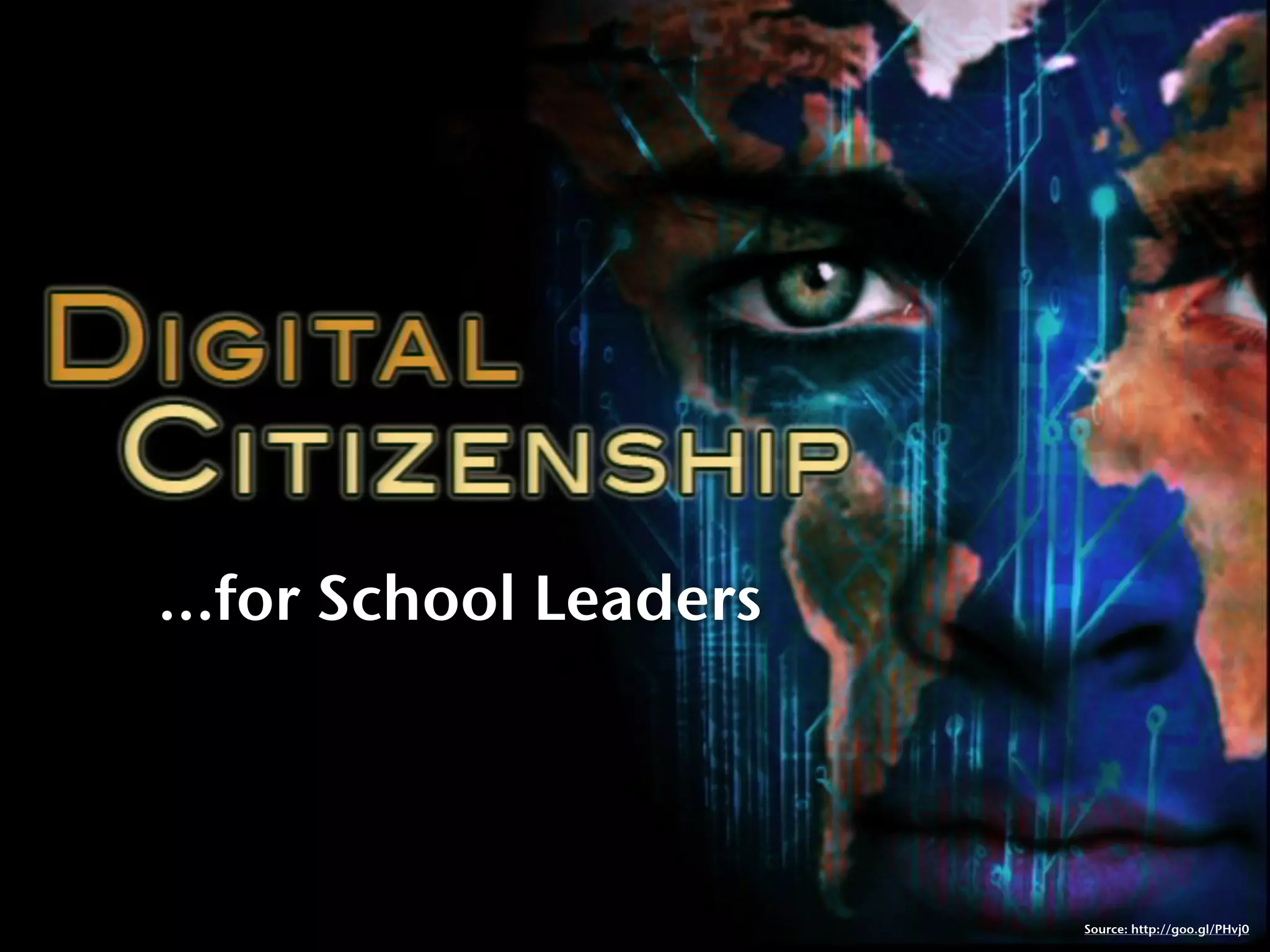
...for School Leaders


                        Source: http://goo.gl/PHvj0
Acknowledgements
•Dr. Mike Ribble on “Teaching Digital Citizenship Reflection: A 4 Stage Technology Learning
Framework”; Available online at http://euclidnets.wikispaces.com/file/view/DCReflect.pdf

•Silvia Tolisano (a.k.a. langwitches) on “Digital Citizenship-Parents and Schools Working
Together”; Available online at http://goo.gl/Atymq


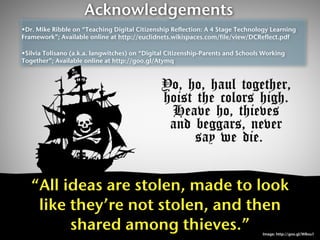
   “All ideas are stolen, made to look
    like they’re not stolen, and then
         shared among thieves.”                                                  Image: http://goo.gl/W8ou1
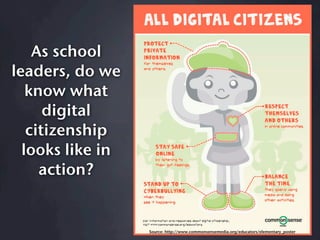
As school
leaders, do we
   know what
      digital
   citizenship
  looks like in
     action?


                  Source: http://www.commonsensemedia.org/educators/elementary_poster
3 goals for slideshow
1. commit acts of arson


                                             http://goo.gl/SJoce


               Source: http://goo.gl/Pb0AV
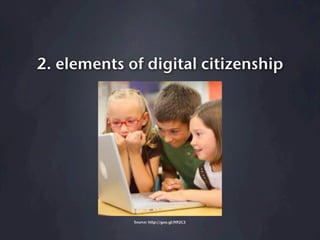
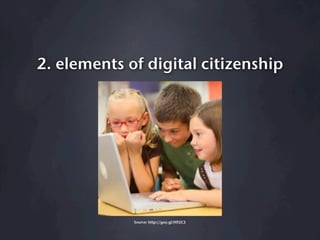
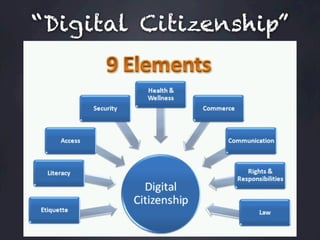
2. elements of digital citizenship


             Source: http://goo.gl/H92C5
http://goo.gl/LUvT4


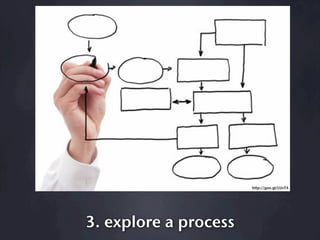
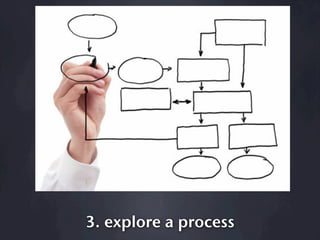
3. explore a process
Source: http://goo.gl/iILUi


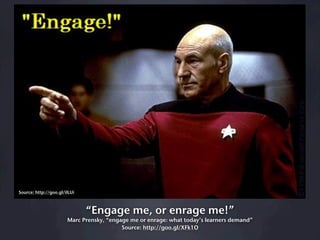
                              “Engage me, or enrage me!”
                       Marc Prensky, “engage me or enrage: what today’s learners demand”
                                          Source: http://goo.gl/XFk1O
1. commit acts of arson


                                             http://goo.gl/SJoce


               Source: http://goo.gl/Pb0AV
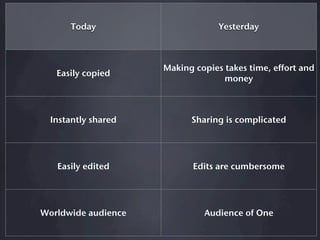
Today                       Yesterday


                     Making copies takes time, effort and
   Easily copied
                                   money


  Instantly shared         Sharing is complicated


   Easily edited            Edits are cumbersome


Worldwide audience            Audience of One
http://goo.gl/b75T0


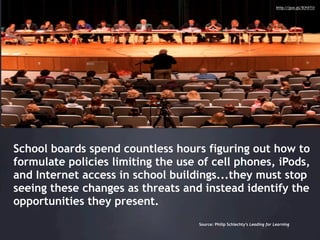
School boards spend countless hours figuring out how to
formulate policies limiting the use of cell phones, iPods,
and Internet access in school buildings...they must stop
seeing these changes as threats and instead identify the
opportunities they present.
                                    Source: Philip Schlechty’s Leading for Learning
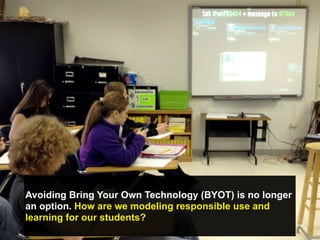
Avoiding Bring Your Own Technology (BYOT) is no longer
an option. How are we modeling responsible use and
learning for our students?
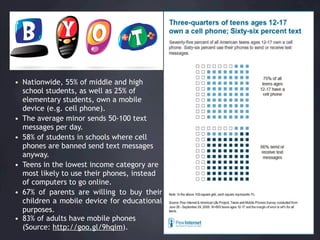
• Nationwide, 55% of middle and high
  school students, as well as 25% of
  elementary students, own a mobile
  device (e.g. cell phone).
• The average minor sends 50-100 text
  messages per day.
• 58% of students in schools where cell
  phones are banned send text messages
  anyway.
• Teens in the lowest income category are
  most likely to use their phones, instead
  of computers to go online.
• 67% of parents are willing to buy their
  children a mobile device for educational
  purposes.
• 83% of adults have mobile phones
  (Source: http://goo.gl/9hqim).
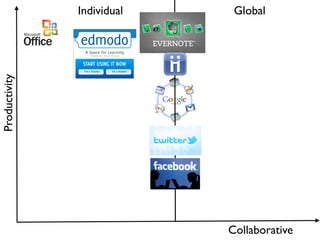
Productivity   Individual    Global


                            Collaborative
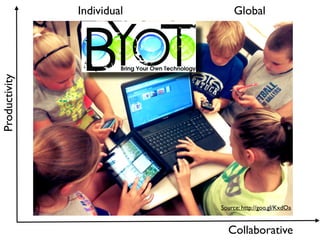
Individual                             Global
                            http://goo.gl/owTxM
Productivity


                                                  Source: http://goo.gl/KxdOa


                                                    Collaborative
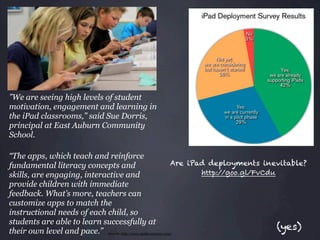
”We are seeing high levels of student
motivation, engagement and learning in
the iPad classrooms,” said Sue Dorris,
principal at East Auburn Community
School.

“The apps, which teach and reinforce
fundamental literacy concepts and                              Are iPad deployments inevitable?
skills, are engaging, interactive and                                 http://goo.gl/FvCdu
provide children with immediate
feedback. What’s more, teachers can
customize apps to match the
instructional needs of each child, so
students are able to learn successfully at
their own level and pace.” Source: http://www.ipadinschools.com/                          (yes)
2. elements of digital citizenship


             Source: http://goo.gl/H92C5
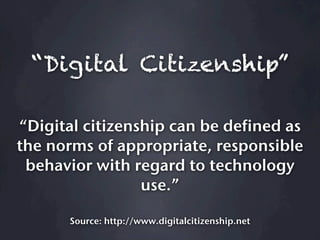
“Digital Citizenship”

“Digital citizenship can be defined as
the norms of appropriate, responsible
 behavior with regard to technology
                 use.”

       Source: http://www.digitalcitizenship.net
“Digital Citizenship”
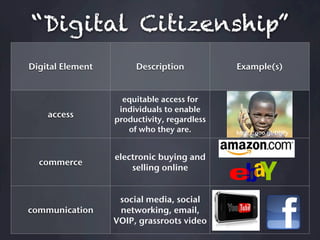
Digital Element        Description           Example(s)


                    equitable access for
                   individuals to enable
    access
                  productivity, regardless
                     of who they are.        http://goo.gl/DlJPy


                  electronic buying and
  commerce
                      selling online


                   social media, social
communication      networking, email,
                  VOIP, grassroots video
“Digital Citizenship”
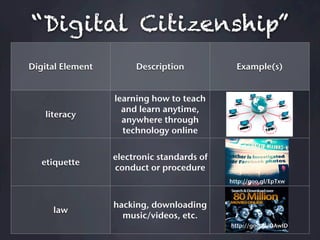
Digital Element        Description            Example(s)


                  learning how to teach
                    and learn anytime,
   literacy
                    anywhere through
                    technology online        http://goo.gl/vbPsc


                  electronic standards of
   etiquette
                  conduct or procedure
                                            http://goo.gl/EpTxw


                  hacking, downloading
     law
                    music/videos, etc.
                                            http://goo.gl/OAwID
“Digital Citizenship”
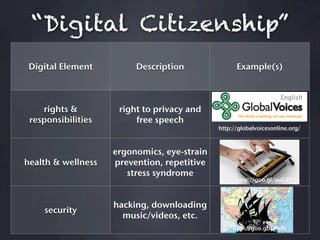
 Digital Element         Description               Example(s)


    rights &         right to privacy and
 responsibilities        free speech
                                             http://globalvoicesonline.org/


                    ergonomics, eye-strain
health & wellness   prevention, repetitive
                       stress syndrome
                                                   http://goo.gl/auG5Y


                    hacking, downloading
    security
                      music/videos, etc.
                                                  http://goo.gl/pPxBz
3. explore a process
“Digital Citizenship”

“Digital citizenship can be defined as
the norms of appropriate, responsible
 behavior with regard to technology
                 use.”

       Source: http://www.digitalcitizenship.net
“Digital Citizenship”

“Digital citizenship can be defined as
the norms of appropriate, responsible
 behavior with regard to technology
                 use.”

       Source: http://www.digitalcitizenship.net
2.
   1.
                                  Under-
Awareness
                                 standing
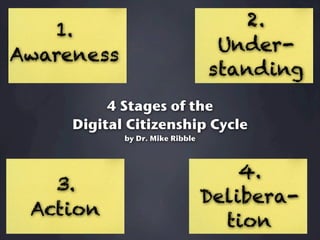
          4 Stages of the
     Digital Citizenship Cycle
            by Dr. Mike Ribble


                                     4.
   3.
                                 Delibera-
 Action
                                   tion
Scenario

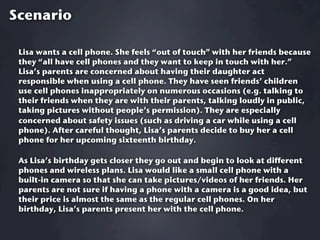
 Lisa wants a cell phone. She feels “out of touch” with her friends because
 they “all have cell phones and they want to keep in touch with her.”
 Lisa’s parents are concerned about having their daughter act
 responsible when using a cell phone. They have seen friends’ children
 use cell phones inappropriately on numerous occasions (e.g. talking to
 their friends when they are with their parents, talking loudly in public,
 taking pictures without people’s permission). They are especially
 concerned about safety issues (such as driving a car while using a cell
 phone). After careful thought, Lisa’s parents decide to buy her a cell
 phone for her upcoming sixteenth birthday.

 As Lisa’s birthday gets closer they go out and begin to look at different
 phones and wireless plans. Lisa would like a small cell phone with a
 built-in camera so that she can take pictures/videos of her friends. Her
 parents are not sure if having a phone with a camera is a good idea, but
 their price is almost the same as the regular cell phones. On her
 birthday, Lisa’s parents present her with the cell phone.
1.
Awareness

 Lisa and her parents sit down to
 discuss the mobile device and what
 the positive and negative
 implications are of using it. They
 discuss its use with others, such as
 family and friends.
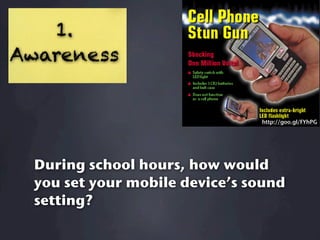
1.
Awareness


                                http://goo.gl/FYhPG


  During school hours, how would
  you set your mobile device’s sound
  setting?
During school hours, how would
you set your mobile device’s sound
setting?
Think - Pair - Share


How did you comparison shop for
your mobile device in your family?
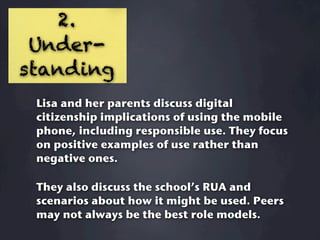
2.
 Under-
standing
 Lisa and her parents discuss digital
 citizenship implications of using the mobile
 phone, including responsible use. They focus
 on positive examples of use rather than
 negative ones.

 They also discuss the school’s RUA and
 scenarios about how it might be used. Peers
 may not always be the best role models.
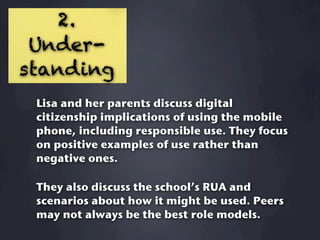
2.
 Under-
standing
 Lisa and her parents discuss digital
 citizenship implications of using the mobile
 phone, including responsible use. They focus
 on positive examples of use rather than
 negative ones.

 They also discuss the school’s RUA and
 scenarios about how it might be used. Peers
 may not always be the best role models.
3.
Action


Lisa begins using the mobile device and freely
shares her mistakes with her parents. Parents
assure her this is part of the learning process,
keeping dialogue open.
4.
Delibera-
  tion

 Lisa is granted more privileges in the use of
 her mobile phone, and frequently reflects on
 her appropriate, responsible usage of the
 device. She continues to share that with her
 parents and they become co-learners in the
 process of using technology.
This imperfect presentation was
prepared by:

Miguel Guhlin -
http://bit.ly/ecisddc

Email: miguel.guhlin@ecisd.net
Ecdc4sleaders

  • 1.
    ...for School Leaders Source: http://goo.gl/PHvj0
  • 2.
    Acknowledgements •Dr. Mike Ribbleon “Teaching Digital Citizenship Reflection: A 4 Stage Technology Learning Framework”; Available online at http://euclidnets.wikispaces.com/file/view/DCReflect.pdf •Silvia Tolisano (a.k.a. langwitches) on “Digital Citizenship-Parents and Schools Working Together”; Available online at http://goo.gl/Atymq “All ideas are stolen, made to look like they’re not stolen, and then shared among thieves.” Image: http://goo.gl/W8ou1
  • 3.
    As school leaders, dowe know what digital citizenship looks like in action? Source: http://www.commonsensemedia.org/educators/elementary_poster
  • 4.
    3 goals forslideshow
  • 5.
    1. commit actsof arson http://goo.gl/SJoce Source: http://goo.gl/Pb0AV
  • 6.
    2. elements ofdigital citizenship Source: http://goo.gl/H92C5
  • 7.
  • 8.
    Source: http://goo.gl/iILUi “Engage me, or enrage me!” Marc Prensky, “engage me or enrage: what today’s learners demand” Source: http://goo.gl/XFk1O
  • 9.
    1. commit actsof arson http://goo.gl/SJoce Source: http://goo.gl/Pb0AV
  • 12.
    Today Yesterday Making copies takes time, effort and Easily copied money Instantly shared Sharing is complicated Easily edited Edits are cumbersome Worldwide audience Audience of One
  • 15.
    http://goo.gl/b75T0 School boards spendcountless hours figuring out how to formulate policies limiting the use of cell phones, iPods, and Internet access in school buildings...they must stop seeing these changes as threats and instead identify the opportunities they present. Source: Philip Schlechty’s Leading for Learning
  • 16.
    Avoiding Bring YourOwn Technology (BYOT) is no longer an option. How are we modeling responsible use and learning for our students?
  • 17.
    • Nationwide, 55%of middle and high school students, as well as 25% of elementary students, own a mobile device (e.g. cell phone). • The average minor sends 50-100 text messages per day. • 58% of students in schools where cell phones are banned send text messages anyway. • Teens in the lowest income category are most likely to use their phones, instead of computers to go online. • 67% of parents are willing to buy their children a mobile device for educational purposes. • 83% of adults have mobile phones (Source: http://goo.gl/9hqim).
  • 18.
    Productivity Individual Global Collaborative
  • 19.
    Individual Global http://goo.gl/owTxM Productivity Source: http://goo.gl/KxdOa Collaborative
  • 20.
    ”We are seeinghigh levels of student motivation, engagement and learning in the iPad classrooms,” said Sue Dorris, principal at East Auburn Community School. “The apps, which teach and reinforce fundamental literacy concepts and Are iPad deployments inevitable? skills, are engaging, interactive and http://goo.gl/FvCdu provide children with immediate feedback. What’s more, teachers can customize apps to match the instructional needs of each child, so students are able to learn successfully at their own level and pace.” Source: http://www.ipadinschools.com/ (yes)
  • 22.
    2. elements ofdigital citizenship Source: http://goo.gl/H92C5
  • 23.
    “Digital Citizenship” “Digital citizenshipcan be defined as the norms of appropriate, responsible behavior with regard to technology use.” Source: http://www.digitalcitizenship.net
  • 24.
  • 25.
    “Digital Citizenship” Digital Element Description Example(s) equitable access for individuals to enable access productivity, regardless of who they are. http://goo.gl/DlJPy electronic buying and commerce selling online social media, social communication networking, email, VOIP, grassroots video
  • 26.
    “Digital Citizenship” Digital Element Description Example(s) learning how to teach and learn anytime, literacy anywhere through technology online http://goo.gl/vbPsc electronic standards of etiquette conduct or procedure http://goo.gl/EpTxw hacking, downloading law music/videos, etc. http://goo.gl/OAwID
  • 27.
    “Digital Citizenship” DigitalElement Description Example(s) rights & right to privacy and responsibilities free speech http://globalvoicesonline.org/ ergonomics, eye-strain health & wellness prevention, repetitive stress syndrome http://goo.gl/auG5Y hacking, downloading security music/videos, etc. http://goo.gl/pPxBz
  • 28.
    3. explore aprocess
  • 29.
    “Digital Citizenship” “Digital citizenshipcan be defined as the norms of appropriate, responsible behavior with regard to technology use.” Source: http://www.digitalcitizenship.net
  • 30.
    “Digital Citizenship” “Digital citizenshipcan be defined as the norms of appropriate, responsible behavior with regard to technology use.” Source: http://www.digitalcitizenship.net
  • 31.
    2. 1. Under- Awareness standing 4 Stages of the Digital Citizenship Cycle by Dr. Mike Ribble 4. 3. Delibera- Action tion
  • 32.
    Scenario Lisa wantsa cell phone. She feels “out of touch” with her friends because they “all have cell phones and they want to keep in touch with her.” Lisa’s parents are concerned about having their daughter act responsible when using a cell phone. They have seen friends’ children use cell phones inappropriately on numerous occasions (e.g. talking to their friends when they are with their parents, talking loudly in public, taking pictures without people’s permission). They are especially concerned about safety issues (such as driving a car while using a cell phone). After careful thought, Lisa’s parents decide to buy her a cell phone for her upcoming sixteenth birthday. As Lisa’s birthday gets closer they go out and begin to look at different phones and wireless plans. Lisa would like a small cell phone with a built-in camera so that she can take pictures/videos of her friends. Her parents are not sure if having a phone with a camera is a good idea, but their price is almost the same as the regular cell phones. On her birthday, Lisa’s parents present her with the cell phone.
  • 33.
    1. Awareness Lisa andher parents sit down to discuss the mobile device and what the positive and negative implications are of using it. They discuss its use with others, such as family and friends.
  • 34.
    1. Awareness http://goo.gl/FYhPG During school hours, how would you set your mobile device’s sound setting?
  • 35.
    During school hours,how would you set your mobile device’s sound setting?
  • 36.
    Think - Pair- Share How did you comparison shop for your mobile device in your family?
  • 37.
    2. Under- standing Lisaand her parents discuss digital citizenship implications of using the mobile phone, including responsible use. They focus on positive examples of use rather than negative ones. They also discuss the school’s RUA and scenarios about how it might be used. Peers may not always be the best role models.
  • 38.
    2. Under- standing Lisaand her parents discuss digital citizenship implications of using the mobile phone, including responsible use. They focus on positive examples of use rather than negative ones. They also discuss the school’s RUA and scenarios about how it might be used. Peers may not always be the best role models.
  • 39.
    3. Action Lisa begins usingthe mobile device and freely shares her mistakes with her parents. Parents assure her this is part of the learning process, keeping dialogue open.
  • 40.
    4. Delibera- tion Lisa is granted more privileges in the use of her mobile phone, and frequently reflects on her appropriate, responsible usage of the device. She continues to share that with her parents and they become co-learners in the process of using technology.
  • 41.
    This imperfect presentationwas prepared by: Miguel Guhlin - http://bit.ly/ecisddc Email: miguel.guhlin@ecisd.net