What is your belief ?
and
Research proposal
IBM 208
Win Singphatanakul
Ask yourself first ?
Do you believe in that there is always a single answer for every
question? Or Multiple answers?
Are you an unbiased or biased person ?
Do you view the reality as “Objective” something that can be
measured objectively.
Do you view the reality as “Human construction” where there is
no single answer and the reality cannot be measured.
Do you feel that to find out the answer in the research do you
need to interact with the subject or not to interact with the
subject?
Qualitative or Quantitative
Are you qualitative or quantitative person?
Two main concepts
Positivist (Quantitative) sees reality as a concrete structure “God
has a plan for you”
Interpretivist (Qualitative) sees reality as a projection of human
imagination “Multiple answers and choices exist in the world”
Quantitative as positivist
Good quantitative research is seen as precise
measurements, statistical analysis and verifiable truth.
The main aim of positivist is to identify universal laws
of human behaviour so that we can control and predict
events
Qualitative as interpretivist
Qualitative researcher believes that human are
complex, somewhat unpredictable.
The role of the research is seen to be the deep
understanding of human behaviour
The aim of Qualitative research is to discover how
humans construct meanings in their contextual setting.
The differences between the two
Quantitative research is based on deductive reasoning.
Qualitative research involves inductive reasoning
Deductive and Inductive
Deductive:
Researcher begins with a theoretical proposition and
then moves towards concrete empirical evidence
Inductive
Is a process by which we observe certain phenomena
and arrive at certain conclusion.
The researcher begins with detailed observations of the
world and moves towards more theoretical
generalization and ideas.
Research Simple rules
Before conducting a Management research, you have to
look at the problem critically
Can you do it ?
If so, where will you find the date?
Even if the data Exist, can you get access to them?
Presuming that you have access to the data, what will
you do with them after they are in your possession ?
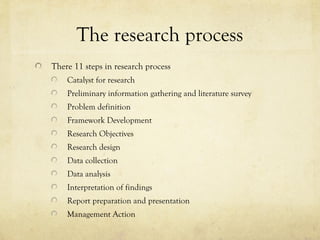
The research process
There 11 steps in research process
Catalyst for research
Preliminary information gathering and literature survey
Problem definition
Framework Development
Research Objectives
Research design
Data collection
Data analysis
Interpretation of findings
Report preparation and presentation
Management Action
Problem definition: Defining your
topic
Define the topic: what are you focusing on?
Youth suicide, Environmental, etc.
Define the nature of the research:
Is your aim to discover, explore, explain, describe. Or compare
Define the questions you are interested in:
Whether you are interested in what, where, how when, why.
Indicate what you are exploring
Whether you are looking for impacts, increases, decreases,
relationships, correlations, causes etc.
Set the boundaries
When you face with an interesting ideas that might be related to
your research, ask yourself “What does this have to do with my
questions”
Defining Topic
What if you are not even sure about the topic area?
You have no idea what interests to pursue?
You are not ALONE…..
You should start with generating ideas by honing your
curiosity, using your creativity and exploring your
options.
The best way is using concept map (mind map)
Another way is….. to come and see me 
Research proposal
1. The working title of your project
2. Author
3. Anticipated outputs (whichever are relevant):
4. Intended readers (can include markers or examiners)
5. What is the central question your project will pose?
1. What is the answer it will provide?
2. If your readers had only one sentence to summarise your project,
what would it be?
6. Why will you do the work?
1. What will you do?
2. What will be the results?
3. What can your project add to theory?
4. What can your project add to practice?
7. What might remain unresolved?
Research proposal (cont.)
Research Objectives
Is the problem or opportunity worth ongoing
investigation?-(Justification)
Literature Review
Problem Definition
Are you following me ?
What is literature review?
The purpose of literature review is to help researchers
narrow down the research questions and know what to
look for. Therefore the researchers can
Inform readers of developments in the field
Establish your own credibility
Argue the need for, and relevance of, their study
Good Literature review usually leads logically to a good
problem statement.
Group Discussion
Discuss this question “What are the component of quality of life?”
– Think about how would you approach to answer this question?
– What would be the objective of this question?
– Is this question worth on going investigation?
– Who will read this research?
– What type of literature you would look into?
– What is the nature of the research?
– What are you exploring? Are looking for impacts, increases, decreases,
relationships, correlations, causes?
– What is the answer it will provide?
– What can your project add to practice?
– Any difficulties in conducting this research?
– What might remain unresolved?

Presentation2

  • 1.
    What is yourbelief ? and Research proposal IBM 208 Win Singphatanakul
  • 2.
    Ask yourself first? Do you believe in that there is always a single answer for every question? Or Multiple answers? Are you an unbiased or biased person ? Do you view the reality as “Objective” something that can be measured objectively. Do you view the reality as “Human construction” where there is no single answer and the reality cannot be measured. Do you feel that to find out the answer in the research do you need to interact with the subject or not to interact with the subject?
  • 3.
    Qualitative or Quantitative Areyou qualitative or quantitative person? Two main concepts Positivist (Quantitative) sees reality as a concrete structure “God has a plan for you” Interpretivist (Qualitative) sees reality as a projection of human imagination “Multiple answers and choices exist in the world”
  • 4.
    Quantitative as positivist Goodquantitative research is seen as precise measurements, statistical analysis and verifiable truth. The main aim of positivist is to identify universal laws of human behaviour so that we can control and predict events
  • 5.
    Qualitative as interpretivist Qualitativeresearcher believes that human are complex, somewhat unpredictable. The role of the research is seen to be the deep understanding of human behaviour The aim of Qualitative research is to discover how humans construct meanings in their contextual setting.
  • 6.
    The differences betweenthe two Quantitative research is based on deductive reasoning. Qualitative research involves inductive reasoning
  • 7.
    Deductive and Inductive Deductive: Researcherbegins with a theoretical proposition and then moves towards concrete empirical evidence Inductive Is a process by which we observe certain phenomena and arrive at certain conclusion. The researcher begins with detailed observations of the world and moves towards more theoretical generalization and ideas.
  • 8.
    Research Simple rules Beforeconducting a Management research, you have to look at the problem critically Can you do it ? If so, where will you find the date? Even if the data Exist, can you get access to them? Presuming that you have access to the data, what will you do with them after they are in your possession ?
  • 9.
    The research process There11 steps in research process Catalyst for research Preliminary information gathering and literature survey Problem definition Framework Development Research Objectives Research design Data collection Data analysis Interpretation of findings Report preparation and presentation Management Action
  • 10.
    Problem definition: Definingyour topic Define the topic: what are you focusing on? Youth suicide, Environmental, etc. Define the nature of the research: Is your aim to discover, explore, explain, describe. Or compare Define the questions you are interested in: Whether you are interested in what, where, how when, why. Indicate what you are exploring Whether you are looking for impacts, increases, decreases, relationships, correlations, causes etc. Set the boundaries When you face with an interesting ideas that might be related to your research, ask yourself “What does this have to do with my questions”
  • 11.
    Defining Topic What ifyou are not even sure about the topic area? You have no idea what interests to pursue? You are not ALONE….. You should start with generating ideas by honing your curiosity, using your creativity and exploring your options. The best way is using concept map (mind map) Another way is….. to come and see me 
  • 12.
    Research proposal 1. Theworking title of your project 2. Author 3. Anticipated outputs (whichever are relevant): 4. Intended readers (can include markers or examiners) 5. What is the central question your project will pose? 1. What is the answer it will provide? 2. If your readers had only one sentence to summarise your project, what would it be? 6. Why will you do the work? 1. What will you do? 2. What will be the results? 3. What can your project add to theory? 4. What can your project add to practice? 7. What might remain unresolved?
  • 13.
    Research proposal (cont.) ResearchObjectives Is the problem or opportunity worth ongoing investigation?-(Justification) Literature Review Problem Definition Are you following me ?
  • 14.
    What is literaturereview? The purpose of literature review is to help researchers narrow down the research questions and know what to look for. Therefore the researchers can Inform readers of developments in the field Establish your own credibility Argue the need for, and relevance of, their study Good Literature review usually leads logically to a good problem statement.
  • 15.
    Group Discussion Discuss thisquestion “What are the component of quality of life?” – Think about how would you approach to answer this question? – What would be the objective of this question? – Is this question worth on going investigation? – Who will read this research? – What type of literature you would look into? – What is the nature of the research? – What are you exploring? Are looking for impacts, increases, decreases, relationships, correlations, causes? – What is the answer it will provide? – What can your project add to practice? – Any difficulties in conducting this research? – What might remain unresolved?

Editor's Notes

  • #8 Show figure 2.1 page 36 and show table 2.1 page 35 about the different approach
  • #10 Show Research design Circle