The document outlines the critical steps in formulating a research problem, emphasizing the importance of selecting a relevant topic and conducting thorough investigations. It details a seven-step process: identifying a broad area, dissecting it into subareas, selecting a specific focus, raising research questions, formulating objectives, checking feasibility, and double-checking enthusiasm and resources. Each step provides guidance on developing a manageable and well-defined research study.
STEPS IN FORMULATING
RESEARCHPROBLEM
Prepared by
Ms Rijitha R
MA, M.Phil (Comm), SET
Assistant Professor, Department of EM
2.
Steps in Formulatinga Research
Problem
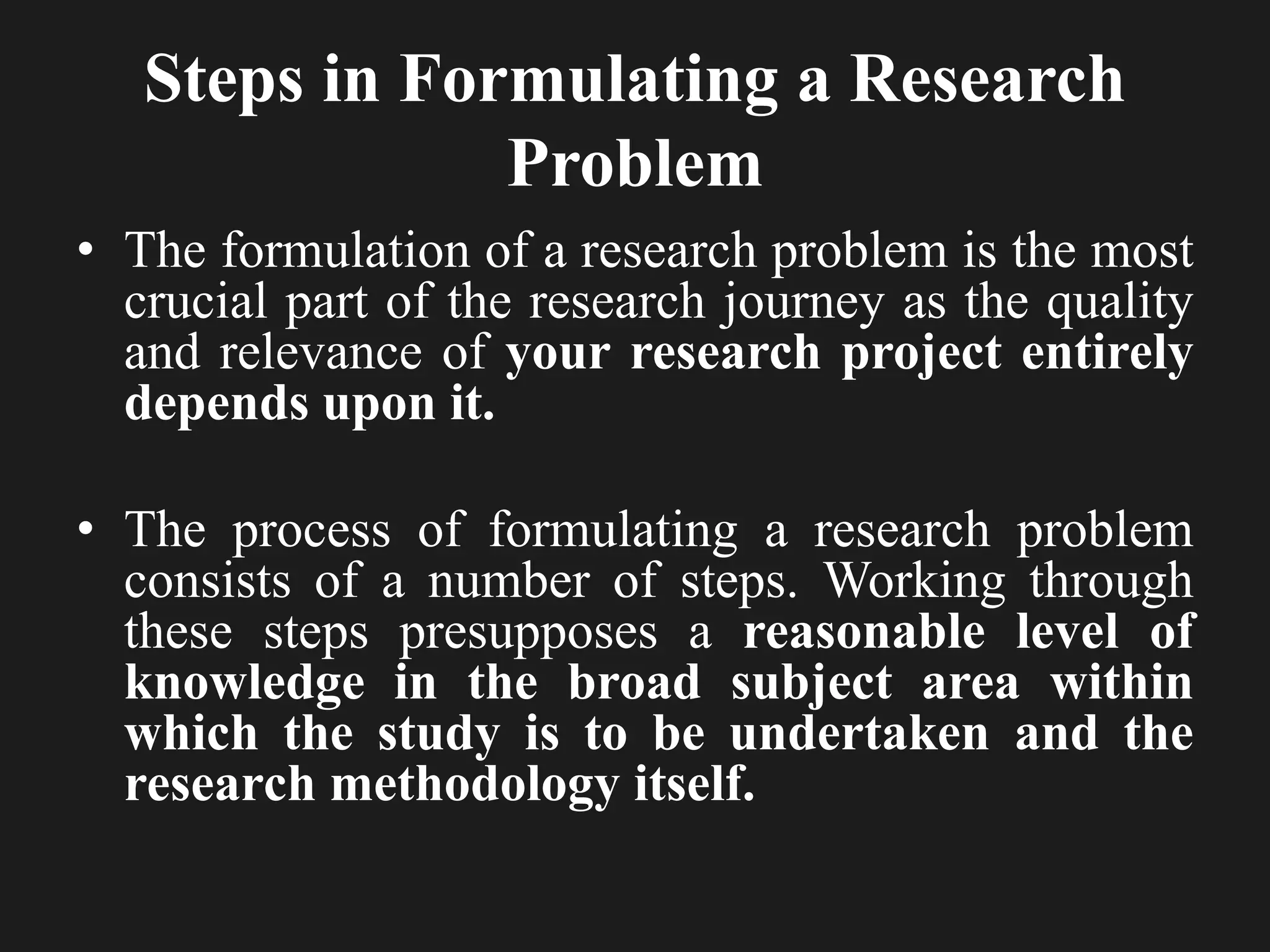
• The formulation of a research problem is the most
crucial part of the research journey as the quality
and relevance of your research project entirely
depends upon it.
• The process of formulating a research problem
consists of a number of steps. Working through
these steps presupposes a reasonable level of
knowledge in the broad subject area within
which the study is to be undertaken and the
research methodology itself.
3.
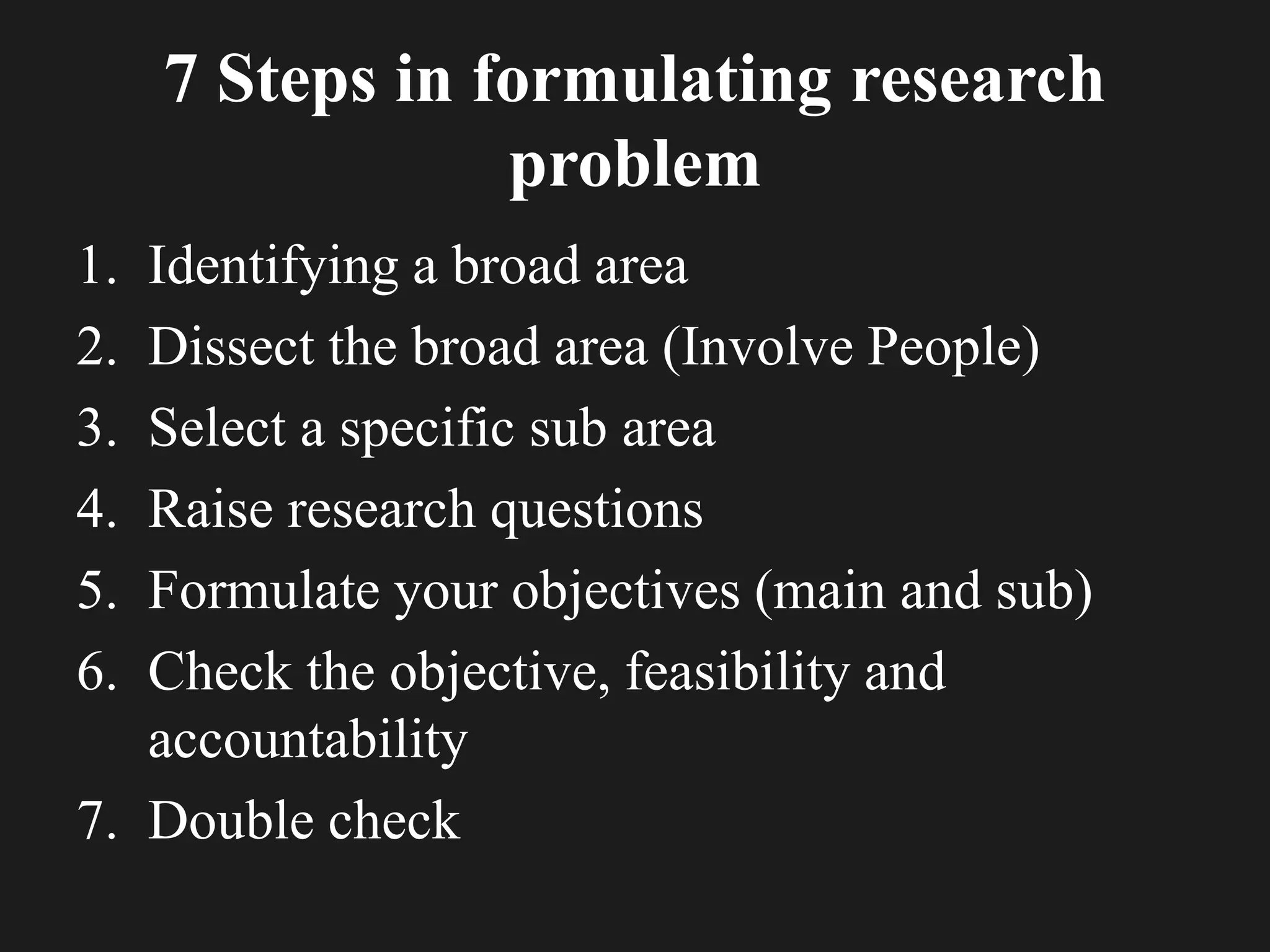
7 Steps informulating research
problem
1. Identifying a broad area
2. Dissect the broad area (Involve People)
3. Select a specific sub area
4. Raise research questions
5. Formulate your objectives (main and sub)
6. Check the objective, feasibility and
accountability
7. Double check
4.
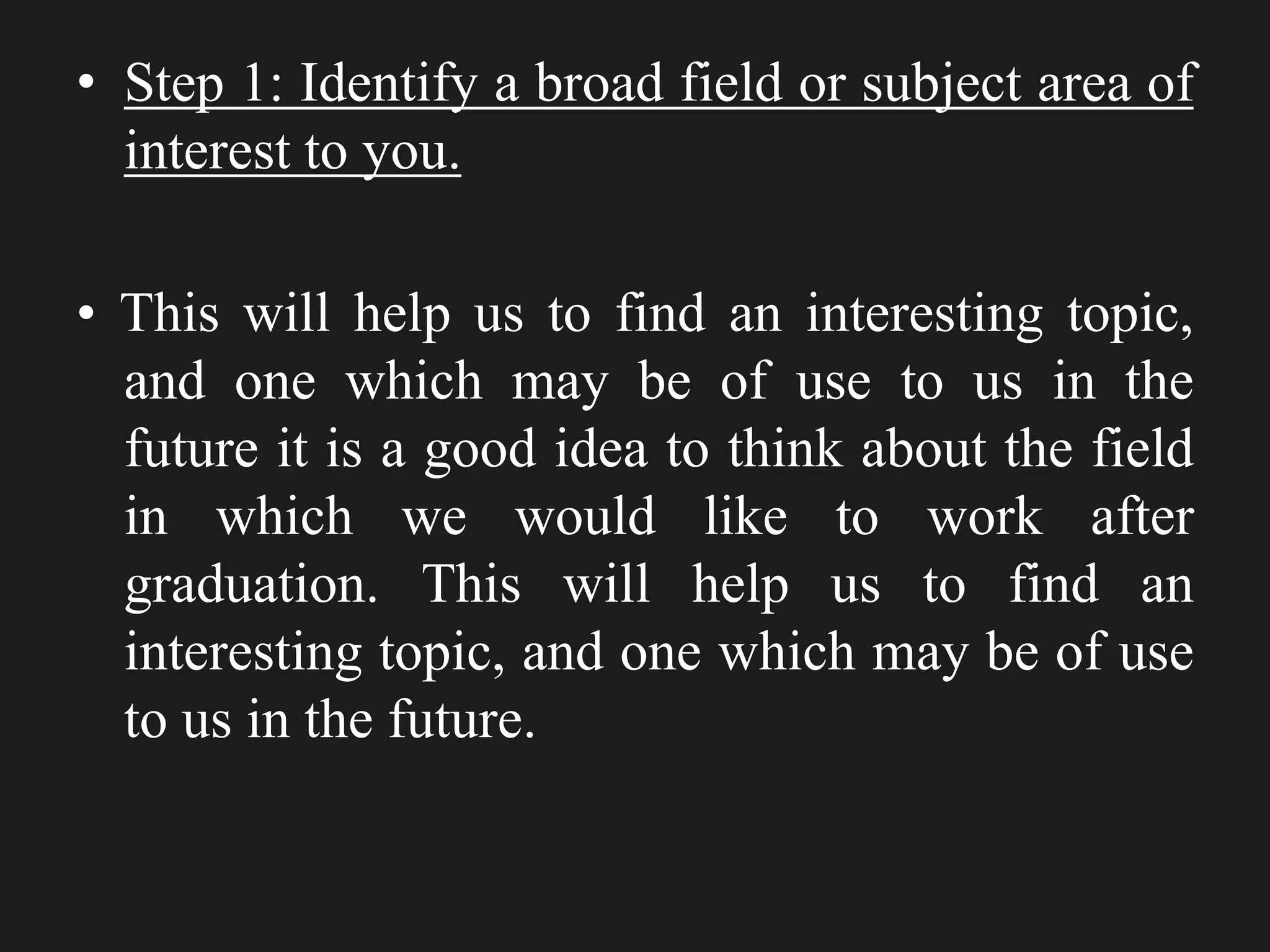
• Step 1:Identify a broad field or subject area of
interest to you.
• This will help us to find an interesting topic,
and one which may be of use to us in the
future it is a good idea to think about the field
in which we would like to work after
graduation. This will help us to find an
interesting topic, and one which may be of use
to us in the future.
5.
• Step 2:Dissect the broad areas into subareas
• In preparing this list of subareas we should also
consult others who have some knowledge of
the area and the literature in our subject area.
• Once we have developed an exhaustive list of
the subareas from various sources, we proceed
to the next stage where we select what will
become the basis of your enquiry.
6.
• Step 3:Select what is of most interest to you.
• One way to decide what interests us most is to start
with the process of elimination. We should go
through our list and delete all those subareas in
which we are not very interested.
• We need to continue until we are left with
something that is manageable considering the
time available to us, our level of expertise and
other resources needed to undertake the study.
• Once we are confident that we have selected an
issue we are passionateabout and can manage, we
are ready to go to the next step.
7.
• Step 4:Raise research questions
• We should make a list of whatever questions
come to our mind relating to our chosen
subarea and if we think there are too many to
be manageable, go through the process of
elimination, as we did in Step 3.
8.
• Step 5:Formulate objectives
• Both our main objectives and our sub-objectives
now need to be formulated, which grow out of our
research questions. The main difference between
objectives and research questions is the way in
which they are written.
• Research questions are obviously that – questions.
Objectives transform these questions into
behavioral aims by using action-oriented words
such as ‘to find out’, ‘to determine’, ‘to ascertain’
and ‘to examine’.
9.
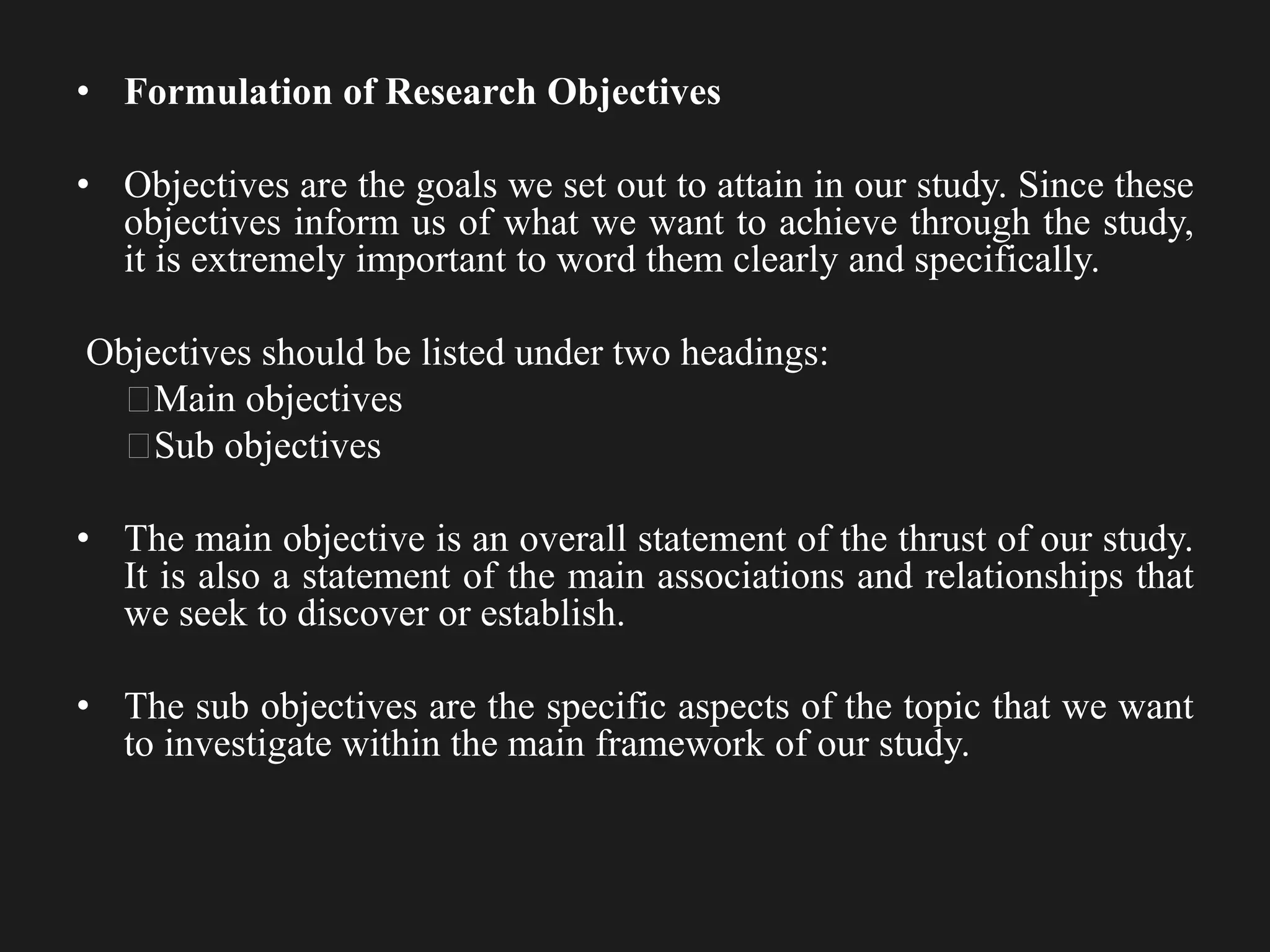
• Formulation ofResearch Objectives
• Objectives are the goals we set out to attain in our study. Since these
objectives inform us of what we want to achieve through the study,
it is extremely important to word them clearly and specifically.
Objectives should be listed under two headings:
Main objectives
Sub objectives
• The main objective is an overall statement of the thrust of our study.
It is also a statement of the main associations and relationships that
we seek to discover or establish.
• The sub objectives are the specific aspects of the topic that we want
to investigate within the main framework of our study.
10.
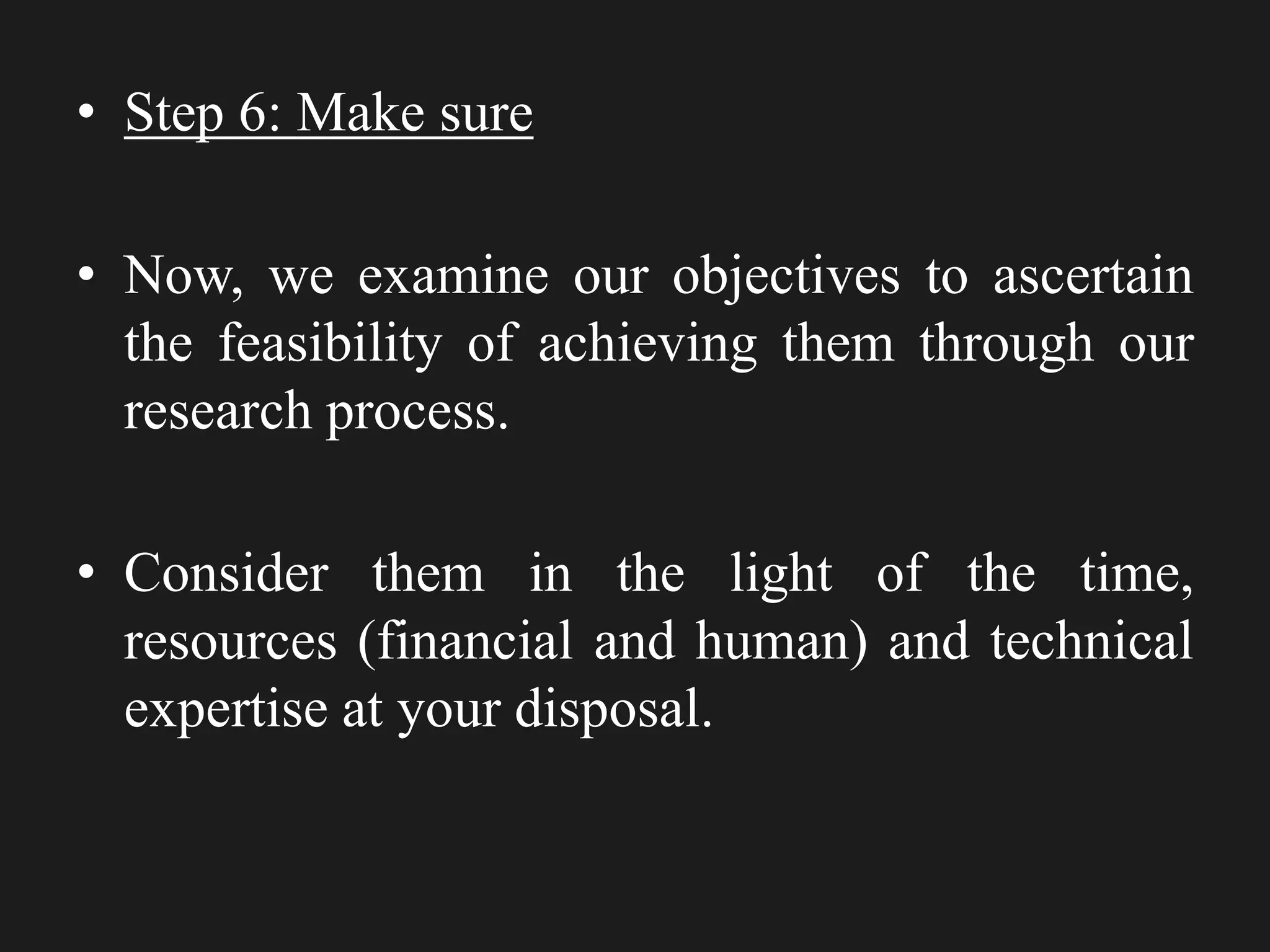
• Step 6:Make sure
• Now, we examine our objectives to ascertain
the feasibility of achieving them through our
research process.
• Consider them in the light of the time,
resources (financial and human) and technical
expertise at your disposal.
11.
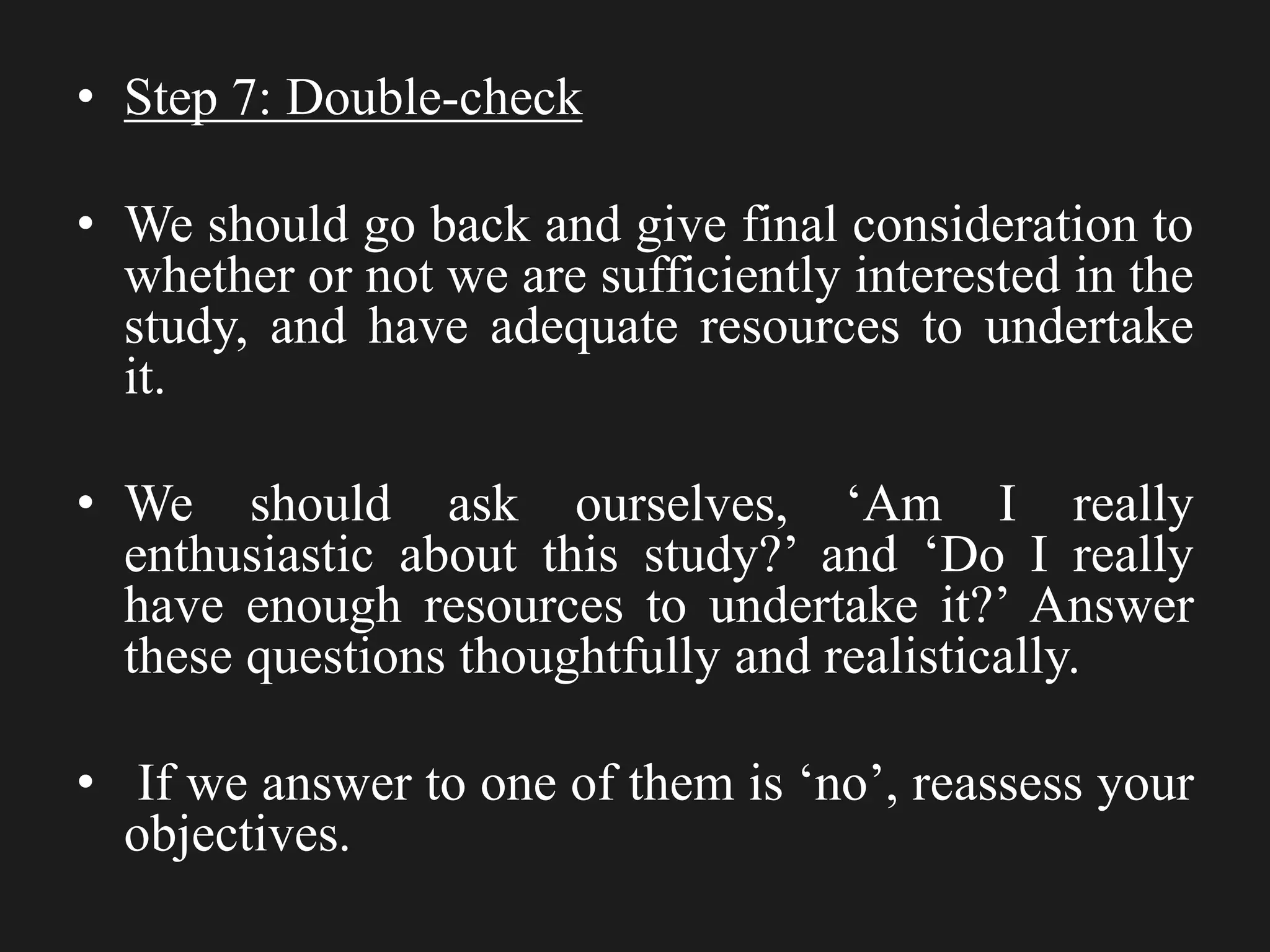
• Step 7:Double-check
• We should go back and give final consideration to
whether or not we are sufficiently interested in the
study, and have adequate resources to undertake
it.
• We should ask ourselves, ‘Am I really
enthusiastic about this study?’ and ‘Do I really
have enough resources to undertake it?’ Answer
these questions thoughtfully and realistically.
• If we answer to one of them is ‘no’, reassess your
objectives.
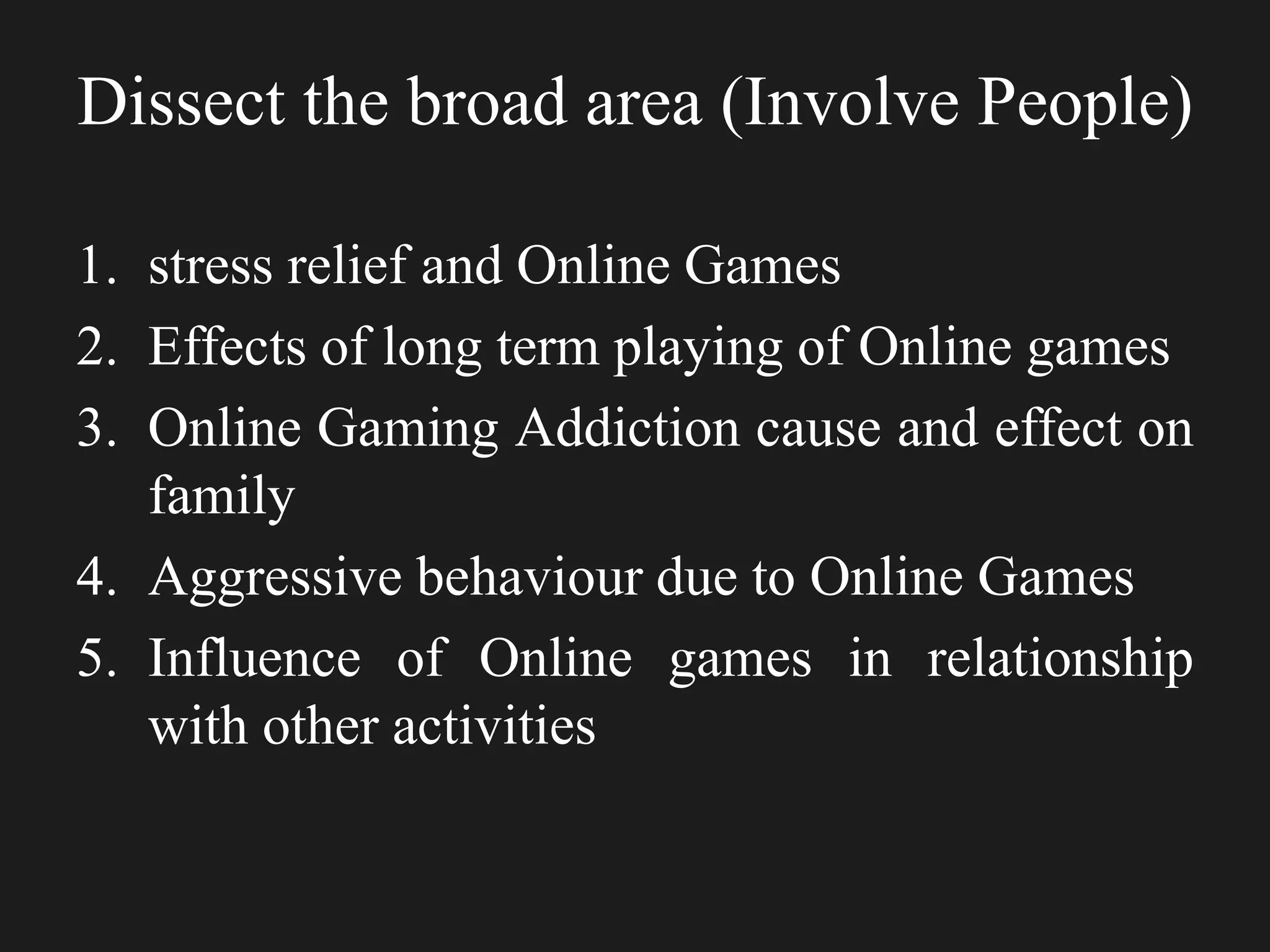
Dissect the broadarea (Involve People)
1. stress relief and Online Games
2. Effects of long term playing of Online games
3. Online Gaming Addiction cause and effect on
family
4. Aggressive behaviour due to Online Games
5. Influence of Online games in relationship
with other activities
15.
Select a specificarea- (Narrow down
your topic)
• Aggressive behaviour due to online gaming
16.
Raise research questions-Aggressive
behaviour due to gaming
• Effects on the duration of playing online
games that causes mental stress.
• Influence on the behavioural patterns while
playing games (Aggressive, Anger, Anxiety
and Fear)
• Impact on friends and family
17.
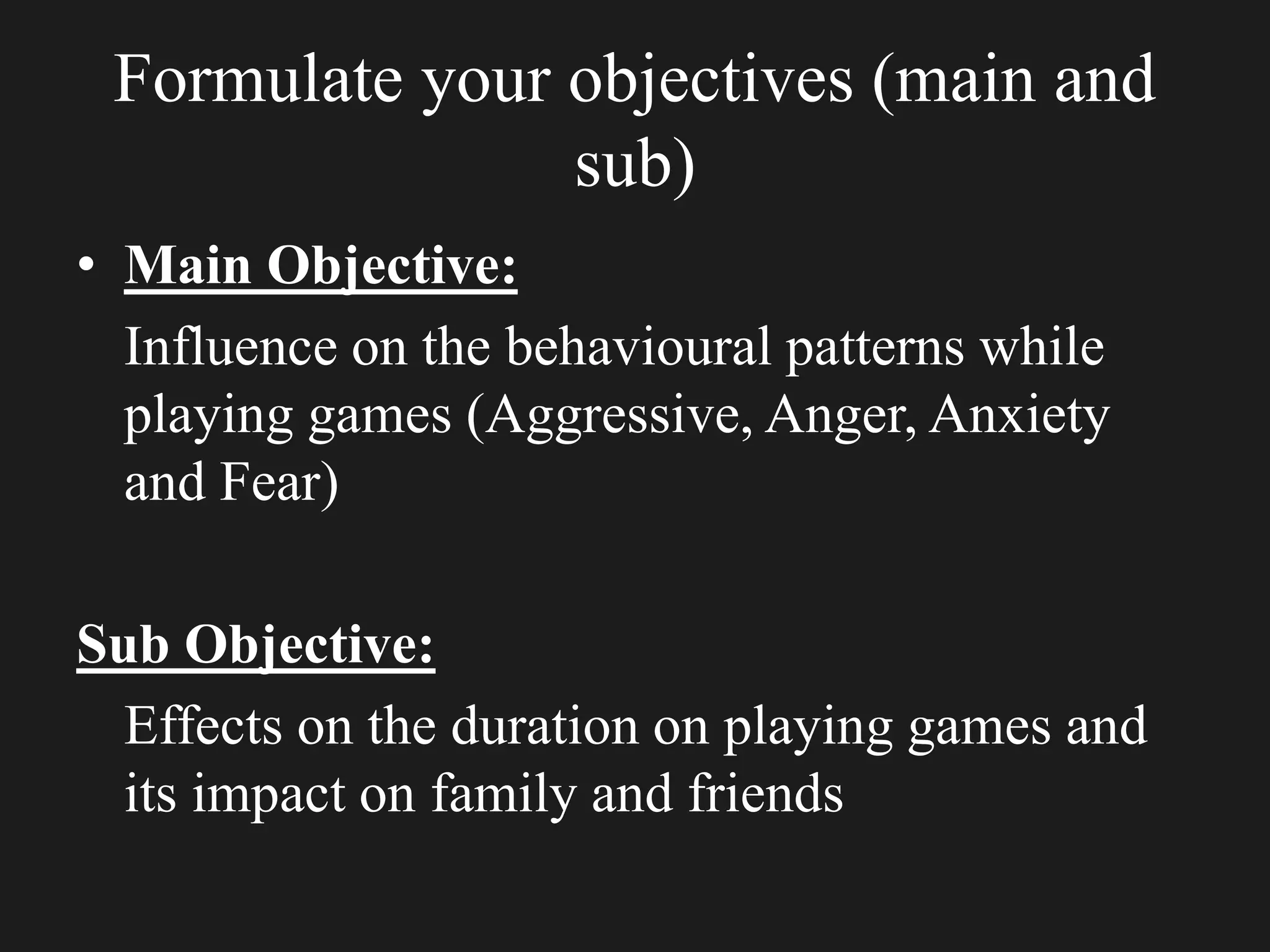
Formulate your objectives(main and
sub)
• Main Objective:
Influence on the behavioural patterns while
playing games (Aggressive, Anger, Anxiety
and Fear)
Sub Objective:
Effects on the duration on playing games and
its impact on family and friends
18.
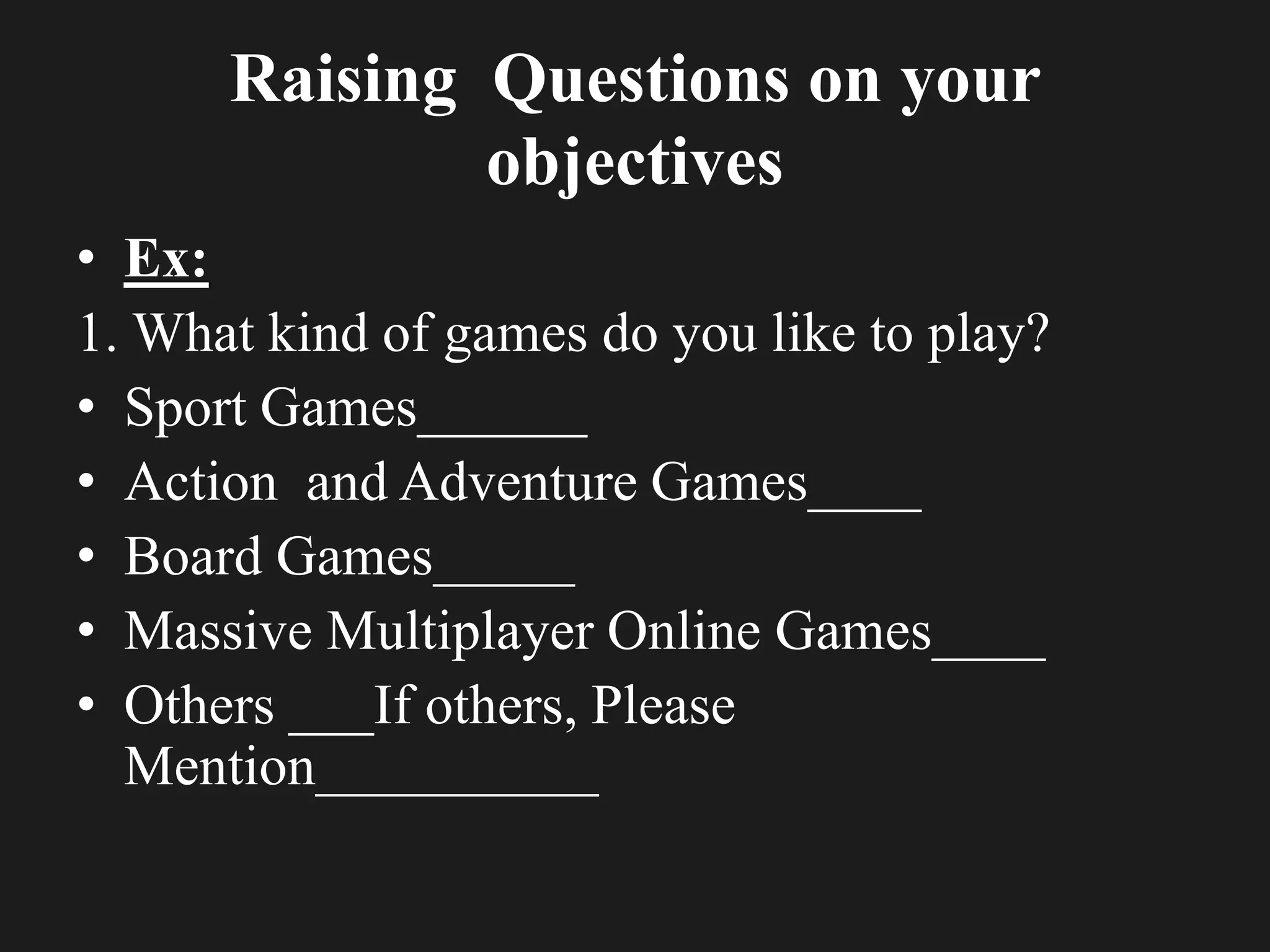
Raising Questions onyour
objectives
• Ex:
1. What kind of games do you like to play?
• Sport Games______
• Action and Adventure Games____
• Board Games_____
• Massive Multiplayer Online Games____
• Others ___If others, Please
Mention__________
19.
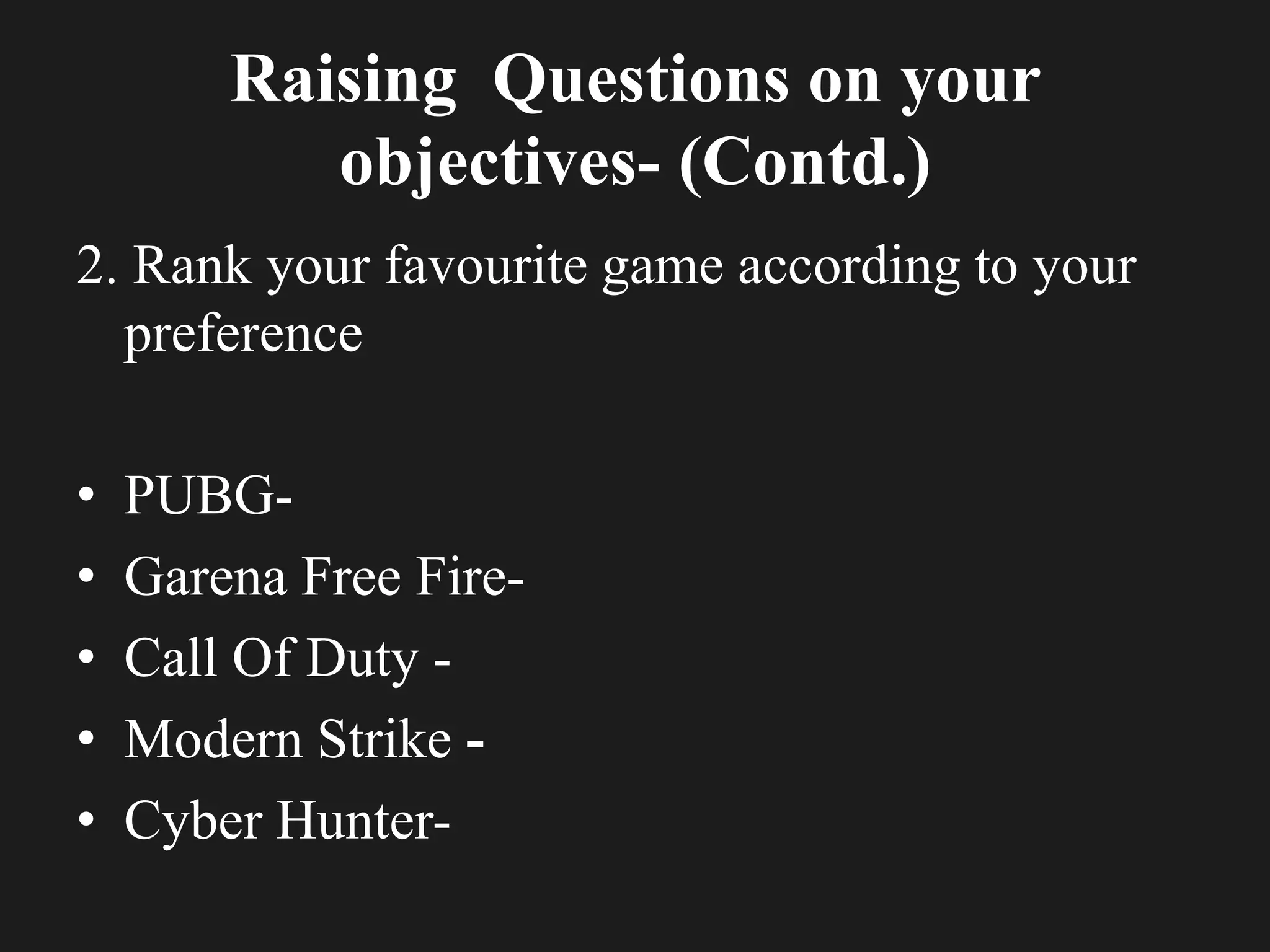
Raising Questions onyour
objectives- (Contd.)
2. Rank your favourite game according to your
preference
• PUBG-
• Garena Free Fire-
• Call Of Duty -
• Modern Strike -
• Cyber Hunter-
20.
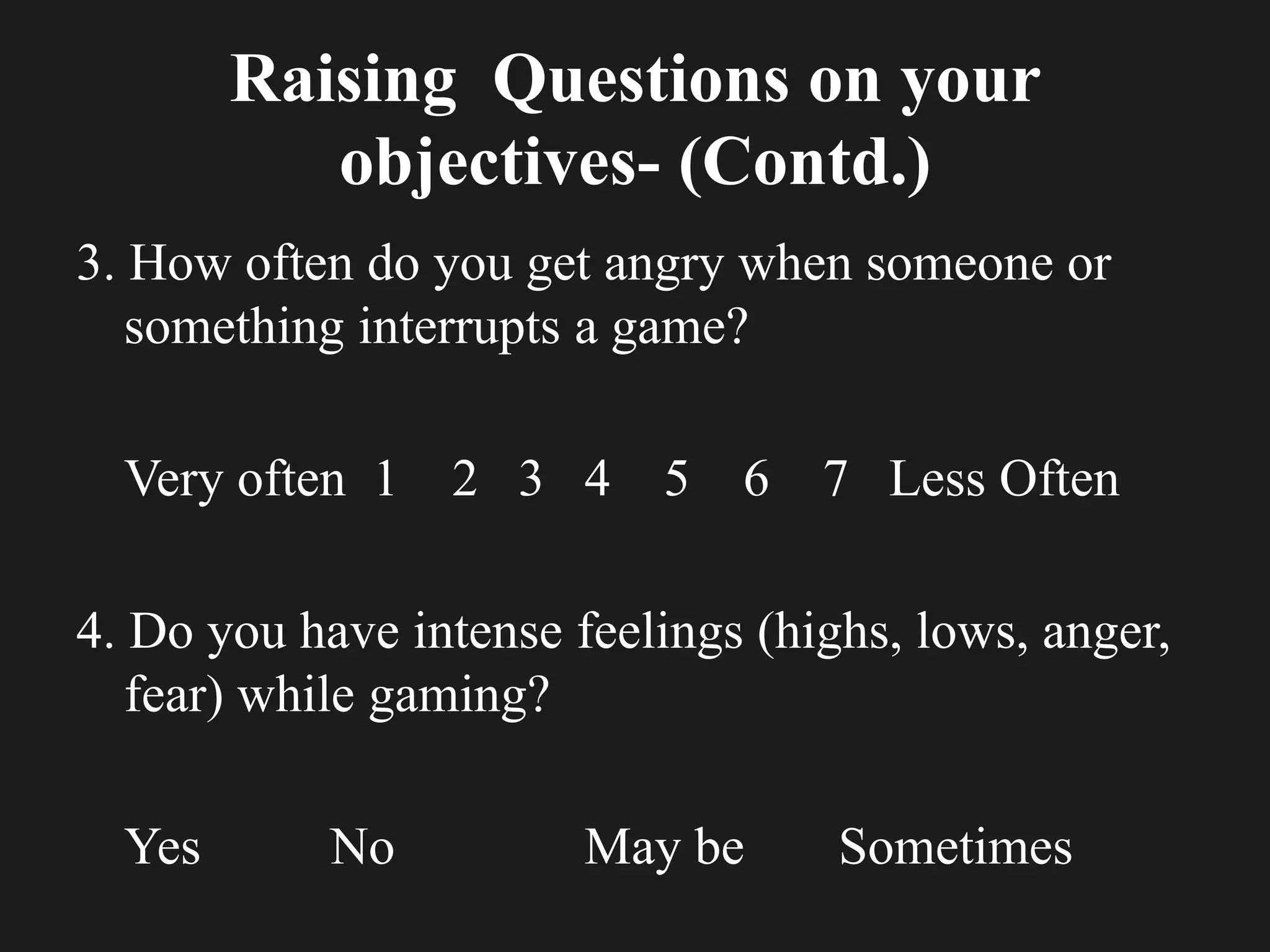
Raising Questions onyour
objectives- (Contd.)
3. How often do you get angry when someone or
something interrupts a game?
Very often 1 2 3 4 5 6 7 Less Often
4. Do you have intense feelings (highs, lows, anger,
fear) while gaming?
Yes No May be Sometimes
21.
Raising Questions onyour
objectives
• Do you lose hours of sleep to gaming?
• Have you called in sick or late to work or skipped
classes to game?
• Have you sworn off a game, uninstalled it, and later
returned to it?
• Does gaming contribute to arguments in your
relationships?
• Has gaming taken the place of any hobbies or sports
you used to enjoy?
• Do you forget appointments, responsibilities or
deadlines in work or school when gaming?
22.
Check the objective,feasibility and
accountability
• Selecting Proper Target group
• Ask Relevant questions
• Check with financial resources
• Limitations of Time related with the topic
• Opinion on SME or availability of relevant study materials
like . (Review of literature, Books, Journals, Links etc)
23.
Double check
• YourInterest in the study
• Agree with your objective (by framing your
hypothesis)
• Undertake the study
24.
Assignment- Try forYourself
1. Frame a Topic (or) Choose the selected topic of
your review.
2. Identifying the broad area
3. Dissect the broad area (Involve People)
4. Select a specific sub area
5. Raise research questions
6. Formulate your objectives (main and sub)
7. Check the objective, feasibility and
accountability (Check availability of data or
references)