• Role of Medical Laboratory In
Management Of
Diabetes Mellitus
• Dr Ghulam Murtaza
Resident Chemical Pathology R1
DUHS
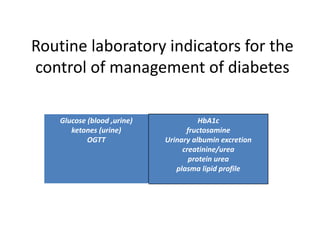
Routine laboratory indicators for the
control of management of diabetes
Glucose (blood ,urine)
ketones (urine)
OGTT
HbA1c
fructosamine
Urinary albumin excretion
creatinine/urea
protein urea
plasma lipid profile
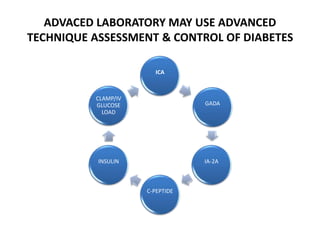
ADVACED LABORATORY MAY USE ADVANCED
TECHNIQUE ASSESSMENT & CONTROL OF DIABETES
ICA
GADA
IA-2A
C-PEPTIDE
INSULIN
CLAMP/IV
GLUCOSE
LOAD
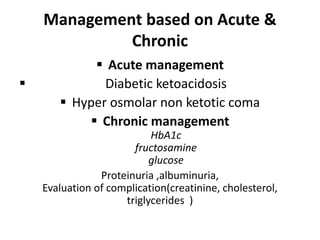
Management based on Acute &
Chronic
 Acute management
 Diabetic ketoacidosis
 Hyper osmolar non ketotic coma
 Chronic management
HbA1c
fructosamine
glucose
Proteinuria ,albuminuria,
Evaluation of complication(creatinine, cholesterol,
triglycerides )
Self monitoring of blood glucose level
• Diabetic patient esp. Those who need insulin therapy, to achieve
normal glycemia
• The renal threshold ( blood glucose concentration above which
glucose appear in urine ) approx.: 160 to 180mg.dl (8.9 to 10
mmol)
• May be decrease in pregnancy or childhood
• A decrease threshold ±100mg/dl :5.6mmol/L is known as
renal glycosuria
(monitoring urine glucose concentration lacks sensitivity
& specifity )
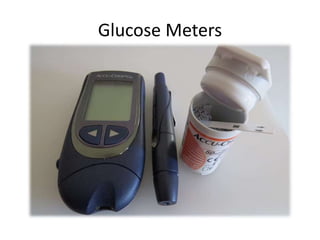
Glucose Meters
 Most commonly used in routine by ,patient
,physicians ,hospitals ( in clinic & bed sides)
 Help in modification of insulin dose
 Use same methodology as used for glucose
analysis ( glucose oxidase ,glucose
dehydrogenase )
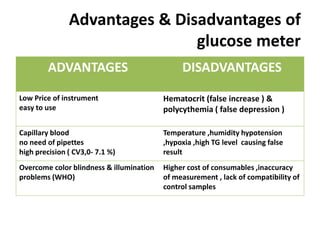
Advantages & Disadvantages of
glucose meter
ADVANTAGES DISADVANTAGES
Low Price of instrument
easy to use
Hematocrit (false increase ) &
polycythemia ( false depression )
Capillary blood
no need of pipettes
high precision ( CV3,0- 7.1 %)
Temperature ,humidity hypotension
,hypoxia ,high TG level causing false
result
Overcome color blindness & illumination
problems (WHO)
Higher cost of consumables ,inaccuracy
of measurement , lack of compatibility of
control samples
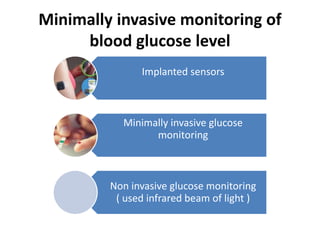
Minimally invasive monitoring of
blood glucose level
Implanted sensors
Minimally invasive glucose
monitoring
Non invasive glucose monitoring
( used infrared beam of light )
KETONE BODIES
• Ketone bodies acetoacetate ,acetone ,&β
hydroxybutyric acid are catabolic products of free fatty
acids
• Principal ketone bodies , βHBA,AcAc,are usually present
in equimolar amounts , Acetone usually present in only
small quantities, is derived from spontaneous
decarboxylation of AcAc
• In starvation or 3 days fast ketone provides 30 to 40 %
of energy requirements
Clinical significance
• Excessive formation is of ketone bodies results in increased
blood concentration ( ketonemia)
& increase excretion in urine ( ketonuria)
• Occurs in decrease availability of carbohydrates or ( such as
starvation or frequent vomiting) or decrease use of
carbohydrates (such as DM, glycogen storages disease
,alkalosis ,& alcohol )
• ADA states that urine ketone testing is an important part of
monitoring by patient with diabetes type one ,pregnancy
with pre existing diabetes ,& GDM
Detection of ketone bodies by
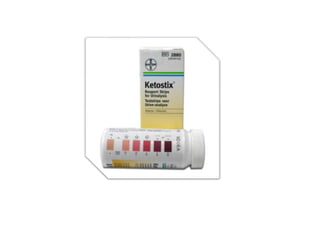
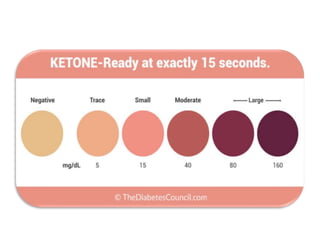
ketostix
• Modification of nitroprusside test in which
reagent strip is used instead of tablets
• Gives result in 15 se with specimen containing
at least 50mg of acetoacetate/L
• Accompanying color chart gives reading for
ketone concentration
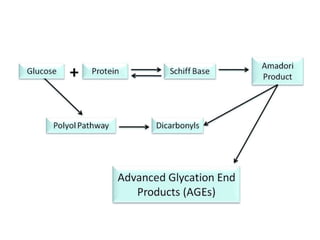
Glycated protein
• Protein react spontaneously in blood with glucose to form
glycated derivatives , this reaction occurs under physiological
& without involvement of enzymes called glycation
o Hemoglobin ,HbA1,HbA1c have been used to refer to
hemoglobin that has been modified by nonenzymatic addition
of glucose residues
o Formation is irreversible ,depends on RBC life & blood
glucose concentration
Retrospective indicator of average blood glucose concentration
over the previous 8-10 weeks
• GHb values are free from day to day glucose
fluctuations, unaffected by recent exercise ,or
food ingestion
• Any condition that substantially changes
erythrocyte life span will alter HbA1c
like hemolytic anemia & IDA
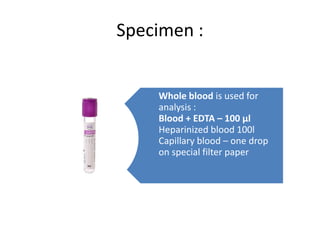
Specimen :
Whole blood is used for
analysis :
Blood + EDTA – 100 µl
Heparinized blood 100l
Capillary blood – one drop
on special filter paper
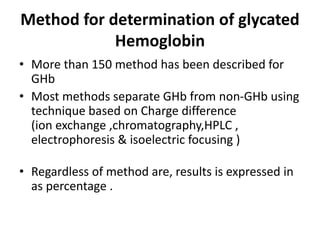
Method for determination of glycated
Hemoglobin
• More than 150 method has been described for
GHb
• Most methods separate GHb from non-GHb using
technique based on Charge difference
(ion exchange ,chromatography,HPLC ,
electrophoresis & isoelectric focusing )
• Regardless of method are, results is expressed in
as percentage .
Albuminuria
• Microalbuminuria
• Microalbuminuria is detection of small
quantity of Albumin in the urine i.e. 30-300
mg/d (and NOT small-size albumin)
• Urinary Albumin: Creatinine ratio is more
useful (normal < 3.0 mg/mmol of creatinine)
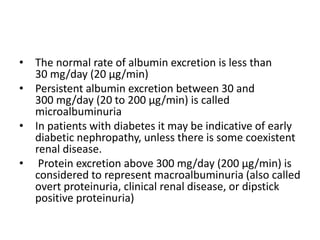
• The normal rate of albumin excretion is less than
30 mg/day (20 µg/min)
• Persistent albumin excretion between 30 and
300 mg/day (20 to 200 µg/min) is called
microalbuminuria
• In patients with diabetes it may be indicative of early
diabetic nephropathy, unless there is some coexistent
renal disease.
• Protein excretion above 300 mg/day (200 µg/min) is
considered to represent macroalbuminuria (also called
overt proteinuria, clinical renal disease, or dipstick
positive proteinuria)
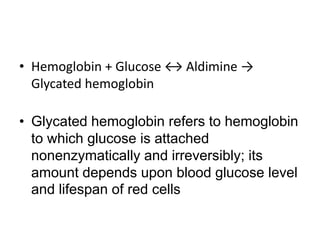
• Hemoglobin + Glucose ↔ Aldimine →
Glycated hemoglobin
• Glycated hemoglobin refers to hemoglobin
to which glucose is attached
nonenzymatically and irreversibly; its
amount depends upon blood glucose level
and lifespan of red cells
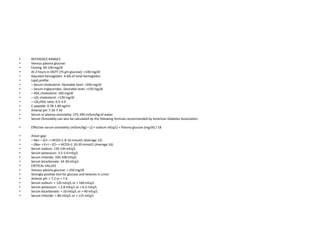
• REFERENCE RANGES
• Venous plasma glucose:
• Fasting: 60-100 mg/dl
• At 2 hours in OGTT (75 gm glucose): <140 mg/dl
• Glycated hemoglobin: 4-6% of total hemoglobin
• Lipid profile:
• – Serum cholesterol: Desirable level: <200 mg/dl
• – Serum triglycerides: Desirable level: <150 mg/dl
• – HDL cholesterol: ≥60 mg/dl
• – LDL cholesterol: <130 mg/dl
• – LDL/HDL ratio: 0.5-3.0
• C-peptide: 0.78-1.89 ng/ml
• Arterial pH: 7.35-7.45
• Serum or plasma osmolality: 275-295 mOsm/kg of water.
• Serum Osmolality can also be calculated by the following formula recommended by American Diabetes Association:
• Effective serum osmolality (mOsm/kg) = (2 × sodium mEq/L) + Plasma glucose (mg/dl) / 18
• Anion gap:
• – Na+ – (Cl– + HCO3–): 8-16 mmol/L (Average 12)
• – (Na+ + K+) – (Cl– + HCO3–): 10-20 mmol/L (Average 16)
• Serum sodium: 135-145 mEq/L
• Serum potassium: 3.5-5.0 mEq/L
• Serum chloride: 100-108 mEq/L
• Serum bicarbonate: 24-30 mEq/L
• CRITICAL VALUES
• Venous plasma glucose: > 450 mg/dl
• Strongly positive test for glucose and ketones in urine
• Arterial pH: < 7.2 or > 7.6
• Serum sodium: < 120 mEq/L or > 160 mEq/L
• Serum potassium: < 2.8 mEq/L or > 6.2 mEq/L
• Serum bicarbonate: < 10 mEq/L or > 40 mEq/L
• Serum chloride: < 80 mEq/L or > 115 mEq/L
Presentation1 dm 2
Presentation1 dm 2

Presentation1 dm 2

  • 1.
    • Role ofMedical Laboratory In Management Of Diabetes Mellitus • Dr Ghulam Murtaza Resident Chemical Pathology R1 DUHS
  • 2.
    Routine laboratory indicatorsfor the control of management of diabetes Glucose (blood ,urine) ketones (urine) OGTT HbA1c fructosamine Urinary albumin excretion creatinine/urea protein urea plasma lipid profile
  • 3.
    ADVACED LABORATORY MAYUSE ADVANCED TECHNIQUE ASSESSMENT & CONTROL OF DIABETES ICA GADA IA-2A C-PEPTIDE INSULIN CLAMP/IV GLUCOSE LOAD
  • 4.
    Management based onAcute & Chronic  Acute management  Diabetic ketoacidosis  Hyper osmolar non ketotic coma  Chronic management HbA1c fructosamine glucose Proteinuria ,albuminuria, Evaluation of complication(creatinine, cholesterol, triglycerides )
  • 5.
    Self monitoring ofblood glucose level • Diabetic patient esp. Those who need insulin therapy, to achieve normal glycemia • The renal threshold ( blood glucose concentration above which glucose appear in urine ) approx.: 160 to 180mg.dl (8.9 to 10 mmol) • May be decrease in pregnancy or childhood • A decrease threshold ±100mg/dl :5.6mmol/L is known as renal glycosuria (monitoring urine glucose concentration lacks sensitivity & specifity )
  • 6.
  • 7.
     Most commonlyused in routine by ,patient ,physicians ,hospitals ( in clinic & bed sides)  Help in modification of insulin dose  Use same methodology as used for glucose analysis ( glucose oxidase ,glucose dehydrogenase )
  • 8.
    Advantages & Disadvantagesof glucose meter ADVANTAGES DISADVANTAGES Low Price of instrument easy to use Hematocrit (false increase ) & polycythemia ( false depression ) Capillary blood no need of pipettes high precision ( CV3,0- 7.1 %) Temperature ,humidity hypotension ,hypoxia ,high TG level causing false result Overcome color blindness & illumination problems (WHO) Higher cost of consumables ,inaccuracy of measurement , lack of compatibility of control samples
  • 9.
    Minimally invasive monitoringof blood glucose level Implanted sensors Minimally invasive glucose monitoring Non invasive glucose monitoring ( used infrared beam of light )
  • 10.
    KETONE BODIES • Ketonebodies acetoacetate ,acetone ,&β hydroxybutyric acid are catabolic products of free fatty acids • Principal ketone bodies , βHBA,AcAc,are usually present in equimolar amounts , Acetone usually present in only small quantities, is derived from spontaneous decarboxylation of AcAc • In starvation or 3 days fast ketone provides 30 to 40 % of energy requirements
  • 11.
    Clinical significance • Excessiveformation is of ketone bodies results in increased blood concentration ( ketonemia) & increase excretion in urine ( ketonuria) • Occurs in decrease availability of carbohydrates or ( such as starvation or frequent vomiting) or decrease use of carbohydrates (such as DM, glycogen storages disease ,alkalosis ,& alcohol ) • ADA states that urine ketone testing is an important part of monitoring by patient with diabetes type one ,pregnancy with pre existing diabetes ,& GDM
  • 12.
    Detection of ketonebodies by ketostix • Modification of nitroprusside test in which reagent strip is used instead of tablets • Gives result in 15 se with specimen containing at least 50mg of acetoacetate/L • Accompanying color chart gives reading for ketone concentration
  • 15.
    Glycated protein • Proteinreact spontaneously in blood with glucose to form glycated derivatives , this reaction occurs under physiological & without involvement of enzymes called glycation o Hemoglobin ,HbA1,HbA1c have been used to refer to hemoglobin that has been modified by nonenzymatic addition of glucose residues o Formation is irreversible ,depends on RBC life & blood glucose concentration Retrospective indicator of average blood glucose concentration over the previous 8-10 weeks
  • 16.
    • GHb valuesare free from day to day glucose fluctuations, unaffected by recent exercise ,or food ingestion • Any condition that substantially changes erythrocyte life span will alter HbA1c like hemolytic anemia & IDA
  • 18.
    Specimen : Whole bloodis used for analysis : Blood + EDTA – 100 µl Heparinized blood 100l Capillary blood – one drop on special filter paper
  • 19.
    Method for determinationof glycated Hemoglobin • More than 150 method has been described for GHb • Most methods separate GHb from non-GHb using technique based on Charge difference (ion exchange ,chromatography,HPLC , electrophoresis & isoelectric focusing ) • Regardless of method are, results is expressed in as percentage .
  • 25.
    Albuminuria • Microalbuminuria • Microalbuminuriais detection of small quantity of Albumin in the urine i.e. 30-300 mg/d (and NOT small-size albumin) • Urinary Albumin: Creatinine ratio is more useful (normal < 3.0 mg/mmol of creatinine)
  • 26.
    • The normalrate of albumin excretion is less than 30 mg/day (20 µg/min) • Persistent albumin excretion between 30 and 300 mg/day (20 to 200 µg/min) is called microalbuminuria • In patients with diabetes it may be indicative of early diabetic nephropathy, unless there is some coexistent renal disease. • Protein excretion above 300 mg/day (200 µg/min) is considered to represent macroalbuminuria (also called overt proteinuria, clinical renal disease, or dipstick positive proteinuria)
  • 28.
    • Hemoglobin +Glucose ↔ Aldimine → Glycated hemoglobin • Glycated hemoglobin refers to hemoglobin to which glucose is attached nonenzymatically and irreversibly; its amount depends upon blood glucose level and lifespan of red cells
  • 29.
    • REFERENCE RANGES •Venous plasma glucose: • Fasting: 60-100 mg/dl • At 2 hours in OGTT (75 gm glucose): <140 mg/dl • Glycated hemoglobin: 4-6% of total hemoglobin • Lipid profile: • – Serum cholesterol: Desirable level: <200 mg/dl • – Serum triglycerides: Desirable level: <150 mg/dl • – HDL cholesterol: ≥60 mg/dl • – LDL cholesterol: <130 mg/dl • – LDL/HDL ratio: 0.5-3.0 • C-peptide: 0.78-1.89 ng/ml • Arterial pH: 7.35-7.45 • Serum or plasma osmolality: 275-295 mOsm/kg of water. • Serum Osmolality can also be calculated by the following formula recommended by American Diabetes Association: • Effective serum osmolality (mOsm/kg) = (2 × sodium mEq/L) + Plasma glucose (mg/dl) / 18 • Anion gap: • – Na+ – (Cl– + HCO3–): 8-16 mmol/L (Average 12) • – (Na+ + K+) – (Cl– + HCO3–): 10-20 mmol/L (Average 16) • Serum sodium: 135-145 mEq/L • Serum potassium: 3.5-5.0 mEq/L • Serum chloride: 100-108 mEq/L • Serum bicarbonate: 24-30 mEq/L • CRITICAL VALUES • Venous plasma glucose: > 450 mg/dl • Strongly positive test for glucose and ketones in urine • Arterial pH: < 7.2 or > 7.6 • Serum sodium: < 120 mEq/L or > 160 mEq/L • Serum potassium: < 2.8 mEq/L or > 6.2 mEq/L • Serum bicarbonate: < 10 mEq/L or > 40 mEq/L • Serum chloride: < 80 mEq/L or > 115 mEq/L

Editor's Notes

  • #6 Many factor like urine concentration ,fluid intake ,UTI affect & negative test does not distinguish between hypo-hyper- & euglycemia
  • #9 glucometer should not be used to diagnose of DM
  • #19 Reference WHO @2002