M E D I C I N E
KING SAUD UNIVERSITY
SiCl4
CuCl2
CCl4
HCN
MgCl2
KMnO4
H2O
H2O2
KClO3
Co2
Cl2O7
COOH
NH2
HbA
CH2O
PO4
SO2
NAOH
Biochemistry
ENDOCRINE Block
Practical Sessions
Important
Extra Information Numbers Doctors notes
Editing file
Doctors slides
A strong positive self-image
is the best possible
preparation for success.
- Joyce brothers
v This file contains one lecture.
v This work is done by students, so if there are any
mistakes please inform us .
v Lecture title :
Blood glucose
Outline
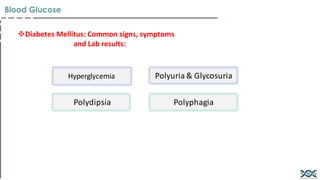
vDiabetes Mellitus: Common signs, symptoms
and Lab results:
Hyperglycemia
Polydipsia
Polyuria & Glycosuria
Polyphagia
Blood Glucose
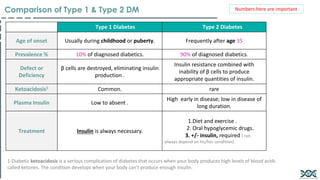
Type 1 Diabetes Type 2 Diabetes
Age of onset Usually during childhood or puberty. Frequently after age 35
Prevalence % 10% of diagnosed diabetics. 90% of diagnosed diabetics.
Defect or
Deficiency
β cells are destroyed, eliminating insulin
production .
Insulin resistance combined with
inability of β cells to produce
appropriate quantities of insulin.
Ketoacidosis1 Common. rare
Plasma Insulin Low to absent .
High early in disease; low in disease of
long duration.
Treatment Insulin is always necessary.
1.Diet and exercise .
2. Oral hypoglycemic drugs.
3. +/- insulin, required ( not
always depend on his/her condition)
1-Diabetic ketoacidosis is a serious complication of diabetes that occurs when your body produces high levels of blood acids
called ketones. The condition develops when your body can't produce enough insulin.
Numbers here are important
Comparison of Type 1 & Type 2 DM
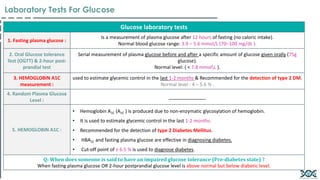
Glucose laboratory tests
1. Fasting plasma glucose :
Is a measurement of plasma glucose after 12 hours of fasting (no caloric intake).
Normal blood glucose range: 3.9 – 5.6 mmol/L (70–100 mg/dL ).
2. Oral Glucose tolerance
Test (OGTT) & 2-hour post-
prandial test
Serial measurement of plasma glucose before and after a specific amount of glucose given orally (75g
glucose).
Normal level: ( < 7.8 mmolL ).
3. HEMOGLOBIN A1C
measurement :
used to estimate glycemic control in the last 1-2 months & Recommended for the detection of type 2 DM.
Normal level : 4 – 5.6 % .
4. Random Plasma Glucose
Level :
______________
5. HEMOGLOBIN A1C :
• Hemoglobin A1C (A1C ) is produced due to non-enzymatic glycosylation of hemoglobin.
• It is used to estimate glycemic control in the last 1-2 months.
• Recommended for the detection of type 2 Diabetes Mellitus.
• HBA1C and fasting plasma glucose are effective in diagnosing diabetes.
• Cut-off point of ≥ 6.5 % is used to diagnose diabetes.
Q: When does someone is said to have an impaired glucose tolerance (Pre-diabetes state) ?
When fasting plasma glucose OR 2-hour postprandial glucose level is above normal but below diabetic level.
Laboratory Tests For Glucose
Categories Of Increased Risk of DM & Diagnosis Of DM
Test performed/ - Normal Pre-diabetes Diabetes
Fasting Plasma Glucose
(FPG)
Less than 100 mg/dl
FPG or IFG 1 : 100 - 125
mgdl
5.6 - 6.9 mmol/L
(fasting= No caloric intake for at least
8hs) 126 mgdl and over 7 mmol/L
and over
2 hours post glucose on the
75-g OGTT
Less than 140 mg/dl
OGGT or IGT2
[ 2 : 140 – 199 mgdl 7.8 –
11.0 mmol/L ]
200 mgdl and over 11.1 mmol/L and
over
HA1C Less than 5.7% 5.7% - 6.4 % 6.5% and over
Random Plasma Glucose
Level
_____ _____
200 mg/dl and over 11.1 mmol/L and
over
+ signs and symptoms of
hyperglycemia or hyperglycemic crisis
• Ketone Bodies:
• They produce by the liver and utilized for energy production by peripheral tissues . ( common in type I DM)
1. Acetone (exhaled by lungs, gives characteristic smell in diabetic ketoacidosis patients).
2. Acetoacetate.
3. β-Hydroxybutyrate.
4. Produced by the liver and utilized for energy production by peripheral tissues.
1- IFG: impaired fasting
glucose
2- IGT: impaired glucose
tolerance
Criteria For Diagnosis of Diabetes Mellitus
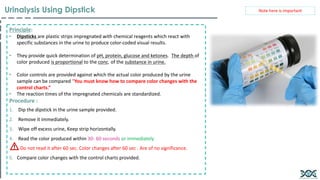
Principle:
• Dipsticks are plastic strips impregnated with chemical reagents which react with
specific substances in the urine to produce color-coded visual results.
• They provide quick determination of pH, protein, glucose and ketones. The depth of
color produced is proportional to the conc. of the substance in urine.
• Color controls are provided against which the actual color produced by the urine
sample can be compared “You must know how to compare color changes with the
control charts.”
• The reaction times of the impregnated chemicals are standardized.
Procedure :
1. Dip the dipstick in the urine sample provided.
2. Remove it immediately.
3. Wipe off excess urine, Keep strip horizontally.
4. Read the color produced within 30- 60 seconds or immediately
Do not read it after 60 sec. Color changes after 60 sec . Are of no significance.
5. Compare color changes with the control charts provided.
Note here is important
Urinalysis Using Dipstick
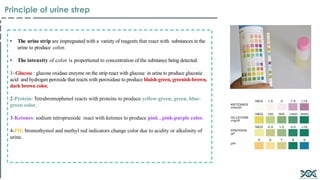
• The urine strip are impregnated with a variety of reagents that react with substances in the
urine to produce color.
• The intensity of color is proportional to concentration of the substance being detected.
1- Glucose : glucose oxidase enzyme on the strip react with glucose in urine to produce gluconic
acid and hydrogen peroxide that reacts with peroxidase to produce bluish-green, greenish-brown,
dark brown color.
2-Protein: Tetrabromophenol reacts with proteins to produce yellow-green, green, blue-
green color.
3-Ketones: sodium nitroprusside react with ketones to produce pink , pink-purple color.
4-PH: bromothymol and methyl red indicators change color due to acidity or alkalinity of
urine.
Principle of urine strep
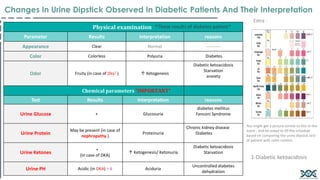
Physical examination
Parameter Results Interpretation reasons
Appearance Clear Normal ---------
Color Colorless Polyuria Diabetes
Odor Fruity (in case of Dka1 ) ↑ Ketogenesis
Diabetic ketoacidosis
Starvation
anxiety
Chemical parameters ”IMPORTANT”
Test Results Interpretation reasons
Urine Glucose + Glucosuria
diabetes mellitus
Fanconi Syndrome
Urine Protein
May be present (in case of
nephropathy )
Proteinuria
Chronic kidney disease
Diabetes
Urine Ketones
+
(In case of DKA)
↑ Ketogenesis/ Ketonuria
Diabetic ketoacidosis
Starvation
Urine PH Acidic (in DKA) > 6 Aciduria
Uncontrolled diabetes
dehydration
*These results of diabetes patient*
Extra :
You might get a picture similar to this in the
exam , and be asked to fill the schedule
based on comparing the urine dipstick test
of patient with color control.
1-Diabetic ketoacidosis
Changes In Urine Dipstick Observed In Diabetic Patients And Their Interpretation
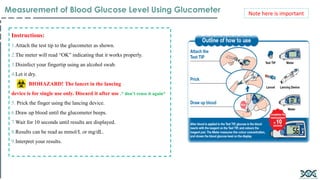
Instructions:
1.Attach the test tip to the glucometer as shown.
2.The meter will read “OK” indicating that it works properly.
3.Disinfect your fingertip using an alcohol swab.
4.Let it dry.
BIOHAZARD! The lancet in the lancing
device is for single use only. Discard it after use .* don’t reuse it again*
5. Prick the finger using the lancing device.
6.Draw up blood until the glucometer beeps.
7.Wait for 10 seconds until results are displayed.
8.Results can be read as mmol/L or mg/dL.
9.Interpret your results.
Note here is important
Measurement of Blood Glucose Level Using Glucometer
”IMPORTANT”
It allows patients to
detect their blood glucose
levels without visiting a
clinic .
It helps patients to
immediately confirm
hypo or hyperglycemia to
avoid complications.
It facilitates patient
education about diabetes
and its management by
giving them more self-
care responsibilities .
It helps to promote
wellbeing of patients .
Benefits of Self-monitoring of Blood Glucose Level
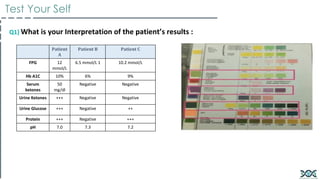
Q1) What is your Interpretation of the patient’s results :
Patient
A
Patient B Patient C
FPG 12
mmol/L
6.5 mmol/L 1 10.2 mmol/L
Hb A1C 10% 6% 9%
Serum
ketones
50
mg/dl
Negative Negative
Urine Ketones +++ Negative Negative
Urine Glucose +++ Negative ++
Protein +++ Negative +++
pH 7.0 7.3 7.2
Test Your Self
Test Your Self
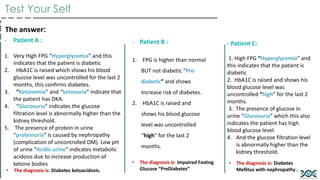
The answer:
- Patient C:
1. High FPG “Hyperglycemia” and
this indicates that the patient is
diabetic
2. HbA1C is raised and shows his
blood glucose level was
uncontrolled “high” for the last 2
months.
3. The presence of glucose in
urine “Glucosuria” which this also
indicates the patient has high
blood glucose level.
4. And the glucose filtration level
is abnormally higher than the
kidney threshold.
- Patient A :
1. Very High FPG “Hyperglycemia” and this
indicates that the patient is diabetic
2. HbA1C is raised which shows his blood
glucose level was uncontrolled for the last 2
months, this confirms diabetes.
3. “Ketonemia” and “ketonuria” indicate that
the patient has DKA.
4. “Glucosuria” indicates the glucose
filtration level is abnormally higher than the
kidney threshold.
5. The presence of protein in urine
“proteinuria” is caused by nephropathy
(complication of uncontrolled DM). Low pH
of urine “Acidic urine” indicates metabolic
acidosis due to increase production of
ketone bodies
- Patient B :
1. FPG is higher than normal
BUT not diabetic “Pre-
diabetic” and shows
Increase risk of diabetes.
2. HbA1C is raised and
shows his blood glucose
level was uncontrolled
“high” for the last 2
months.
• The diagnosis is: Diabetes ketoacidosis.
• The diagnosis is: Impaired Fasting
Glucose “PreDiabetes”
• The diagnosis is: Diabetes
Mellitus with nephropathy .
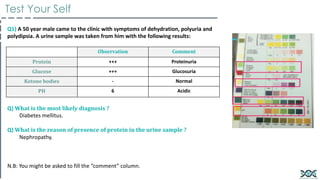
Q1) A 50 year male came to the clinic with symptoms of dehydration, polyuria and
polydipsia. A urine sample was taken from him with the following results:
Observation Comment
Protein +++ Proteinuria
Glucose +++ Glucosuria
Ketone bodies - Normal
PH 6 Acidic
Q) What is the most likely diagnosis ?
Diabetes mellitus.
Q) What is the reason of presence of protein in the urine sample ?
Nephropathy.
N.B: You might be asked to fill the “comment” column.
Test Your Self
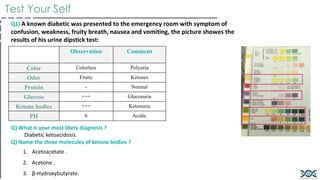
Observation Comment
Color Colorless Polyuria
Odor Fruity Ketones
Protein - Normal
Glucose +++ Glucosuria
Ketone bodies +++ Ketonuria
PH 6 Acidic
Q1) A known diabetic was presented to the emergency room with symptom of
confusion, weakness, fruity breath, nausea and vomiting, the picture showes the
results of his urine dipstick test:
Q) What is your most likely diagnosis ?
Diabetic ketoacidosis.
Q) Name the three molecules of ketone bodies ?
1. Acetoacetate .
2. Acetone .
3. β-Hydroxybutyrate.
Test Your Self
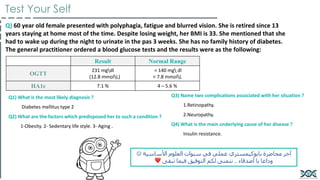
Q) 60 year old female presented with polyphagia, fatigue and blurred vision. She is retired since 13
years staying at home most of the time. Despite losing weight, her BMI is 33. She mentioned that she
had to wake up during the night to urinate in the pas 3 weeks. She has no family history of diabetes.
The general practitioner ordered a blood glucose tests and the results were as the following:
Result Normal Range
OGTT
231 mgdl
(12.8 mmolL)
< 140 mg dl
< 7.8 mmolL
HA1c 7.1 % 4 – 5.6 %
Q1) What is the most likely diagnosis ?
Diabetes mellitus type 2
Q2) What are the factors which predisposed her to such a condition ?
1-Obesity. 2- Sedentary life style. 3- Aging .
Test Your Self
‫آﺧﺮ‬
‫ﻣﺤﺎﺿﺮة‬
‫ﺑﺎﻳﻮﻛﯿﻤﺴﺘﺮي‬
‫ﻋﻤﻠﻲ‬
‫ﻓﻲ‬
‫ﺳﻨﻮات‬
‫اﻟﻌﻠﻮم‬
‫اﻷﺳﺎﺳﯿﺔ‬
J
‫وداﻋﺎ‬
‫ﻳﺎ‬
‫أﺻﺪﻗﺎء‬
..
‫ﻧﺘﻤﻨﻰ‬
‫ﻟﻜﻢ‬
‫اﻟﺘﻮﻓﯿﻖ‬
‫ﻓﯿﻤﺎ‬
‫ﺗﺒﻘﻰ‬
❤
Q3) Name two complications associated with her situation ?
1.Retinopathy.
2.Neuropathy.
Q4) What is the main underlying cause of her disease ?
Insulin resistance.
TEAM LEADERS
Mohammad Almutlaq
Razan Alotaibi
PLEASE CONTACT
US IF YOU HAVE
ANY ISSUE
THANK
YOU
FOR CHECKING
OUR WORK

Biochemistry practical Blood glucose .pdf

  • 1.
    M E DI C I N E KING SAUD UNIVERSITY SiCl4 CuCl2 CCl4 HCN MgCl2 KMnO4 H2O H2O2 KClO3 Co2 Cl2O7 COOH NH2 HbA CH2O PO4 SO2 NAOH Biochemistry ENDOCRINE Block Practical Sessions Important Extra Information Numbers Doctors notes Editing file Doctors slides A strong positive self-image is the best possible preparation for success. - Joyce brothers
  • 2.
    v This filecontains one lecture. v This work is done by students, so if there are any mistakes please inform us . v Lecture title : Blood glucose Outline
  • 3.
    vDiabetes Mellitus: Commonsigns, symptoms and Lab results: Hyperglycemia Polydipsia Polyuria & Glycosuria Polyphagia Blood Glucose
  • 4.
    Type 1 DiabetesType 2 Diabetes Age of onset Usually during childhood or puberty. Frequently after age 35 Prevalence % 10% of diagnosed diabetics. 90% of diagnosed diabetics. Defect or Deficiency β cells are destroyed, eliminating insulin production . Insulin resistance combined with inability of β cells to produce appropriate quantities of insulin. Ketoacidosis1 Common. rare Plasma Insulin Low to absent . High early in disease; low in disease of long duration. Treatment Insulin is always necessary. 1.Diet and exercise . 2. Oral hypoglycemic drugs. 3. +/- insulin, required ( not always depend on his/her condition) 1-Diabetic ketoacidosis is a serious complication of diabetes that occurs when your body produces high levels of blood acids called ketones. The condition develops when your body can't produce enough insulin. Numbers here are important Comparison of Type 1 & Type 2 DM
  • 5.
    Glucose laboratory tests 1.Fasting plasma glucose : Is a measurement of plasma glucose after 12 hours of fasting (no caloric intake). Normal blood glucose range: 3.9 – 5.6 mmol/L (70–100 mg/dL ). 2. Oral Glucose tolerance Test (OGTT) & 2-hour post- prandial test Serial measurement of plasma glucose before and after a specific amount of glucose given orally (75g glucose). Normal level: ( < 7.8 mmolL ). 3. HEMOGLOBIN A1C measurement : used to estimate glycemic control in the last 1-2 months & Recommended for the detection of type 2 DM. Normal level : 4 – 5.6 % . 4. Random Plasma Glucose Level : ______________ 5. HEMOGLOBIN A1C : • Hemoglobin A1C (A1C ) is produced due to non-enzymatic glycosylation of hemoglobin. • It is used to estimate glycemic control in the last 1-2 months. • Recommended for the detection of type 2 Diabetes Mellitus. • HBA1C and fasting plasma glucose are effective in diagnosing diabetes. • Cut-off point of ≥ 6.5 % is used to diagnose diabetes. Q: When does someone is said to have an impaired glucose tolerance (Pre-diabetes state) ? When fasting plasma glucose OR 2-hour postprandial glucose level is above normal but below diabetic level. Laboratory Tests For Glucose
  • 6.
    Categories Of IncreasedRisk of DM & Diagnosis Of DM Test performed/ - Normal Pre-diabetes Diabetes Fasting Plasma Glucose (FPG) Less than 100 mg/dl FPG or IFG 1 : 100 - 125 mgdl 5.6 - 6.9 mmol/L (fasting= No caloric intake for at least 8hs) 126 mgdl and over 7 mmol/L and over 2 hours post glucose on the 75-g OGTT Less than 140 mg/dl OGGT or IGT2 [ 2 : 140 – 199 mgdl 7.8 – 11.0 mmol/L ] 200 mgdl and over 11.1 mmol/L and over HA1C Less than 5.7% 5.7% - 6.4 % 6.5% and over Random Plasma Glucose Level _____ _____ 200 mg/dl and over 11.1 mmol/L and over + signs and symptoms of hyperglycemia or hyperglycemic crisis • Ketone Bodies: • They produce by the liver and utilized for energy production by peripheral tissues . ( common in type I DM) 1. Acetone (exhaled by lungs, gives characteristic smell in diabetic ketoacidosis patients). 2. Acetoacetate. 3. β-Hydroxybutyrate. 4. Produced by the liver and utilized for energy production by peripheral tissues. 1- IFG: impaired fasting glucose 2- IGT: impaired glucose tolerance Criteria For Diagnosis of Diabetes Mellitus
  • 7.
    Principle: • Dipsticks areplastic strips impregnated with chemical reagents which react with specific substances in the urine to produce color-coded visual results. • They provide quick determination of pH, protein, glucose and ketones. The depth of color produced is proportional to the conc. of the substance in urine. • Color controls are provided against which the actual color produced by the urine sample can be compared “You must know how to compare color changes with the control charts.” • The reaction times of the impregnated chemicals are standardized. Procedure : 1. Dip the dipstick in the urine sample provided. 2. Remove it immediately. 3. Wipe off excess urine, Keep strip horizontally. 4. Read the color produced within 30- 60 seconds or immediately Do not read it after 60 sec. Color changes after 60 sec . Are of no significance. 5. Compare color changes with the control charts provided. Note here is important Urinalysis Using Dipstick
  • 8.
    • The urinestrip are impregnated with a variety of reagents that react with substances in the urine to produce color. • The intensity of color is proportional to concentration of the substance being detected. 1- Glucose : glucose oxidase enzyme on the strip react with glucose in urine to produce gluconic acid and hydrogen peroxide that reacts with peroxidase to produce bluish-green, greenish-brown, dark brown color. 2-Protein: Tetrabromophenol reacts with proteins to produce yellow-green, green, blue- green color. 3-Ketones: sodium nitroprusside react with ketones to produce pink , pink-purple color. 4-PH: bromothymol and methyl red indicators change color due to acidity or alkalinity of urine. Principle of urine strep
  • 9.
    Physical examination Parameter ResultsInterpretation reasons Appearance Clear Normal --------- Color Colorless Polyuria Diabetes Odor Fruity (in case of Dka1 ) ↑ Ketogenesis Diabetic ketoacidosis Starvation anxiety Chemical parameters ”IMPORTANT” Test Results Interpretation reasons Urine Glucose + Glucosuria diabetes mellitus Fanconi Syndrome Urine Protein May be present (in case of nephropathy ) Proteinuria Chronic kidney disease Diabetes Urine Ketones + (In case of DKA) ↑ Ketogenesis/ Ketonuria Diabetic ketoacidosis Starvation Urine PH Acidic (in DKA) > 6 Aciduria Uncontrolled diabetes dehydration *These results of diabetes patient* Extra : You might get a picture similar to this in the exam , and be asked to fill the schedule based on comparing the urine dipstick test of patient with color control. 1-Diabetic ketoacidosis Changes In Urine Dipstick Observed In Diabetic Patients And Their Interpretation
  • 10.
    Instructions: 1.Attach the testtip to the glucometer as shown. 2.The meter will read “OK” indicating that it works properly. 3.Disinfect your fingertip using an alcohol swab. 4.Let it dry. BIOHAZARD! The lancet in the lancing device is for single use only. Discard it after use .* don’t reuse it again* 5. Prick the finger using the lancing device. 6.Draw up blood until the glucometer beeps. 7.Wait for 10 seconds until results are displayed. 8.Results can be read as mmol/L or mg/dL. 9.Interpret your results. Note here is important Measurement of Blood Glucose Level Using Glucometer
  • 11.
    ”IMPORTANT” It allows patientsto detect their blood glucose levels without visiting a clinic . It helps patients to immediately confirm hypo or hyperglycemia to avoid complications. It facilitates patient education about diabetes and its management by giving them more self- care responsibilities . It helps to promote wellbeing of patients . Benefits of Self-monitoring of Blood Glucose Level
  • 12.
    Q1) What isyour Interpretation of the patient’s results : Patient A Patient B Patient C FPG 12 mmol/L 6.5 mmol/L 1 10.2 mmol/L Hb A1C 10% 6% 9% Serum ketones 50 mg/dl Negative Negative Urine Ketones +++ Negative Negative Urine Glucose +++ Negative ++ Protein +++ Negative +++ pH 7.0 7.3 7.2 Test Your Self
  • 13.
    Test Your Self Theanswer: - Patient C: 1. High FPG “Hyperglycemia” and this indicates that the patient is diabetic 2. HbA1C is raised and shows his blood glucose level was uncontrolled “high” for the last 2 months. 3. The presence of glucose in urine “Glucosuria” which this also indicates the patient has high blood glucose level. 4. And the glucose filtration level is abnormally higher than the kidney threshold. - Patient A : 1. Very High FPG “Hyperglycemia” and this indicates that the patient is diabetic 2. HbA1C is raised which shows his blood glucose level was uncontrolled for the last 2 months, this confirms diabetes. 3. “Ketonemia” and “ketonuria” indicate that the patient has DKA. 4. “Glucosuria” indicates the glucose filtration level is abnormally higher than the kidney threshold. 5. The presence of protein in urine “proteinuria” is caused by nephropathy (complication of uncontrolled DM). Low pH of urine “Acidic urine” indicates metabolic acidosis due to increase production of ketone bodies - Patient B : 1. FPG is higher than normal BUT not diabetic “Pre- diabetic” and shows Increase risk of diabetes. 2. HbA1C is raised and shows his blood glucose level was uncontrolled “high” for the last 2 months. • The diagnosis is: Diabetes ketoacidosis. • The diagnosis is: Impaired Fasting Glucose “PreDiabetes” • The diagnosis is: Diabetes Mellitus with nephropathy .
  • 14.
    Q1) A 50year male came to the clinic with symptoms of dehydration, polyuria and polydipsia. A urine sample was taken from him with the following results: Observation Comment Protein +++ Proteinuria Glucose +++ Glucosuria Ketone bodies - Normal PH 6 Acidic Q) What is the most likely diagnosis ? Diabetes mellitus. Q) What is the reason of presence of protein in the urine sample ? Nephropathy. N.B: You might be asked to fill the “comment” column. Test Your Self
  • 15.
    Observation Comment Color ColorlessPolyuria Odor Fruity Ketones Protein - Normal Glucose +++ Glucosuria Ketone bodies +++ Ketonuria PH 6 Acidic Q1) A known diabetic was presented to the emergency room with symptom of confusion, weakness, fruity breath, nausea and vomiting, the picture showes the results of his urine dipstick test: Q) What is your most likely diagnosis ? Diabetic ketoacidosis. Q) Name the three molecules of ketone bodies ? 1. Acetoacetate . 2. Acetone . 3. β-Hydroxybutyrate. Test Your Self
  • 16.
    Q) 60 yearold female presented with polyphagia, fatigue and blurred vision. She is retired since 13 years staying at home most of the time. Despite losing weight, her BMI is 33. She mentioned that she had to wake up during the night to urinate in the pas 3 weeks. She has no family history of diabetes. The general practitioner ordered a blood glucose tests and the results were as the following: Result Normal Range OGTT 231 mgdl (12.8 mmolL) < 140 mg dl < 7.8 mmolL HA1c 7.1 % 4 – 5.6 % Q1) What is the most likely diagnosis ? Diabetes mellitus type 2 Q2) What are the factors which predisposed her to such a condition ? 1-Obesity. 2- Sedentary life style. 3- Aging . Test Your Self ‫آﺧﺮ‬ ‫ﻣﺤﺎﺿﺮة‬ ‫ﺑﺎﻳﻮﻛﯿﻤﺴﺘﺮي‬ ‫ﻋﻤﻠﻲ‬ ‫ﻓﻲ‬ ‫ﺳﻨﻮات‬ ‫اﻟﻌﻠﻮم‬ ‫اﻷﺳﺎﺳﯿﺔ‬ J ‫وداﻋﺎ‬ ‫ﻳﺎ‬ ‫أﺻﺪﻗﺎء‬ .. ‫ﻧﺘﻤﻨﻰ‬ ‫ﻟﻜﻢ‬ ‫اﻟﺘﻮﻓﯿﻖ‬ ‫ﻓﯿﻤﺎ‬ ‫ﺗﺒﻘﻰ‬ ❤ Q3) Name two complications associated with her situation ? 1.Retinopathy. 2.Neuropathy. Q4) What is the main underlying cause of her disease ? Insulin resistance.
  • 17.
    TEAM LEADERS Mohammad Almutlaq RazanAlotaibi PLEASE CONTACT US IF YOU HAVE ANY ISSUE THANK YOU FOR CHECKING OUR WORK