Polycystic ovarian syndrome
Dr.Ghulam Murtaza
resident chemical pathology
D.I.M.C
Introduction
• Most common endocrine abnormality in reproductive age
• Most common cause of infertility in women
• PCOS is becoming a frequently diagnosed condition in Pakistan where the prevalence is
as high as 15.7-37%
(Prevalence and Knowledge of Polycystic Ovary Syndrome (PCOS) Among Female Science Students of Different Public Universities of Quetta, Pakistan
June 2017 )
Historical Perspective
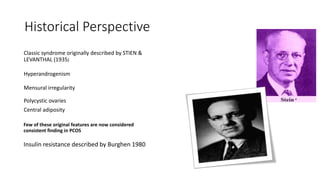
Classic syndrome originally described by STIEN &
LEVANTHAL (1935)
Hyperandrogenism
Mensural irregularity
Polycystic ovaries
Central adiposity
Few of these original features are now considered
consistent finding in PCOS
Insulin resistance described by Burghen 1980
PCOS epidemiology
• PCOS accounts for 95% of cases of hyperandrogenism
• PCOS is responsible for over 20% of all cases of amenorrhea
• PCOS is responsible for up to 75% of all cases of anovulatory
infertility
• The name is actually misnomer that ovaries are covered with follicles
not cysts ( Tietz )
PCOS
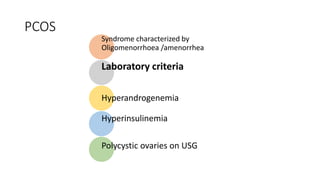
Syndrome characterized by
Oligomenorrhoea /amenorrhea
Laboratory criteria
Hyperandrogenemia
Hyperinsulinemia
Polycystic ovaries on USG
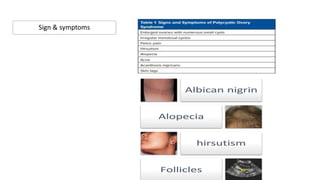
Sign & symptoms
Pathophysiology
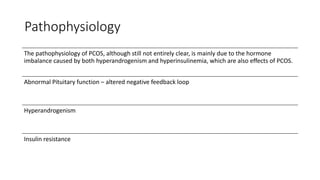
The pathophysiology of PCOS, although still not entirely clear, is mainly due to the hormone
imbalance caused by both hyperandrogenism and hyperinsulinemia, which are also effects of PCOS.
Abnormal Pituitary function – altered negative feedback loop
Hyperandrogenism
Insulin resistance
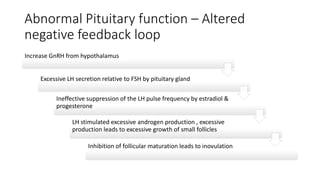
Abnormal Pituitary function – Altered
negative feedback loop
Increase GnRH from hypothalamus
Excessive LH secretion relative to FSH by pituitary gland
Ineffective suppression of the LH pulse frequency by estradiol &
progesterone
LH stimulated excessive androgen production , excessive
production leads to excessive growth of small follicles
Inhibition of follicular maturation leads to inovulation
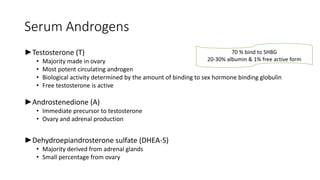
Serum Androgens
►Testosterone (T)
• Majority made in ovary
• Most potent circulating androgen
• Biological activity determined by the amount of binding to sex hormone binding globulin
• Free testosterone is active
►Androstenedione (A)
• Immediate precursor to testosterone
• Ovary and adrenal production
►Dehydroepiandrosterone sulfate (DHEA-S)
• Majority derived from adrenal glands
• Small percentage from ovary
70 % bind to SHBG
20-30% albumin & 1% free active form
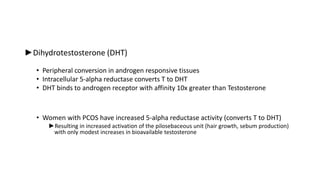
►Dihydrotestosterone (DHT)
• Peripheral conversion in androgen responsive tissues
• Intracellular 5-alpha reductase converts T to DHT
• DHT binds to androgen receptor with affinity 10x greater than Testosterone
• Women with PCOS have increased 5-alpha reductase activity (converts T to DHT)
►Resulting in increased activation of the pilosebaceous unit (hair growth, sebum production)
with only modest increases in bioavailable testosterone
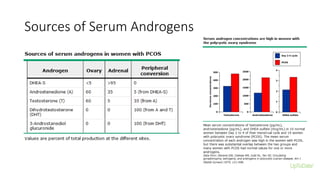
Hyperandrogenism :
Sources of Serum Androgens
Insulin resistance :
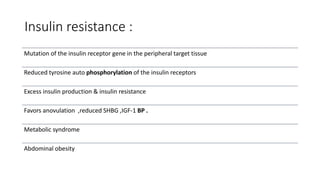
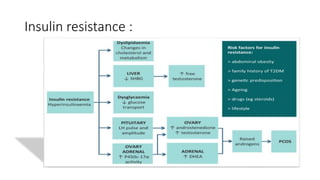
Mutation of the insulin receptor gene in the peripheral target tissue
Reduced tyrosine auto phosphorylation of the insulin receptors
Excess insulin production & insulin resistance
Favors anovulation ,reduced SHBG ,IGF-1 BP .
Metabolic syndrome
Abdominal obesity
Insulin resistance :
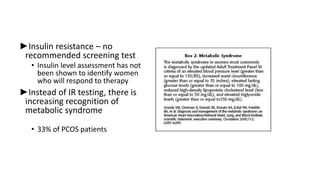
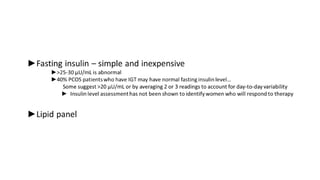
►Insulin resistance – no
recommended screening test
• Insulin level assessment has not
been shown to identify women
who will respond to therapy
►Instead of IR testing, there is
increasing recognition of
metabolic syndrome
• 33% of PCOS patients
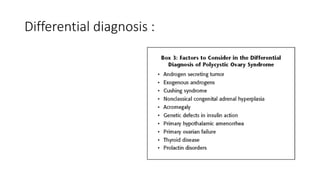
Differential diagnosis :
Labs :
Hyperandrogenism
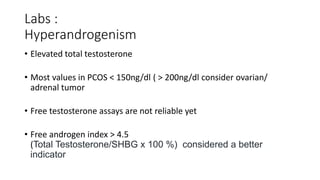
• Elevated total testosterone
• Most values in PCOS < 150ng/dl ( > 200ng/dl consider ovarian/
adrenal tumor
• Free testosterone assays are not reliable yet
• Free androgen index > 4.5
(Total Testosterone/SHBG x 100 %) considered a better
indicator
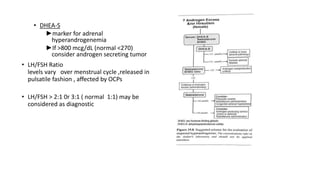
• DHEA-S
►marker for adrenal
hyperandrogenemia
►If >800 mcg/dL (normal <270)
consider androgen secreting tumor
• LH/FSH Ratio
levels vary over menstrual cycle ,released in
pulsatile fashion , affected by OCPs
• LH/FSH > 2:1 0r 3:1 ( normal 1:1) may be
considered as diagnostic
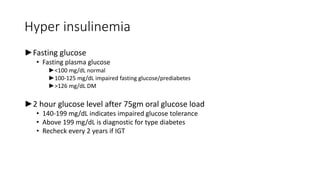
Hyper insulinemia
►Fasting glucose
• Fasting plasma glucose
►<100 mg/dL normal
►100-125 mg/dL impaired fasting glucose/prediabetes
►>126 mg/dL DM
►2 hour glucose level after 75gm oral glucose load
• 140-199 mg/dL indicates impaired glucose tolerance
• Above 199 mg/dL is diagnostic for type diabetes
• Recheck every 2 years if IGT
Labs :
• One may see the following:
• Increased free testosterone/N testosterone, increased androstenedione
• Increased DHEA-S, DHEA
• Increased LH, normal FH; Inc. LH/FSH
• Increased estradiol, estrone
• Increased fasting insulin
• Increased insulin resistance
• Decreased SHBG
• Mildly elevated prolactin
• Increased AST,ALT in pts with NASH
• Thank you ….

Pcos

  • 1.
    Polycystic ovarian syndrome Dr.GhulamMurtaza resident chemical pathology D.I.M.C
  • 2.
    Introduction • Most commonendocrine abnormality in reproductive age • Most common cause of infertility in women • PCOS is becoming a frequently diagnosed condition in Pakistan where the prevalence is as high as 15.7-37% (Prevalence and Knowledge of Polycystic Ovary Syndrome (PCOS) Among Female Science Students of Different Public Universities of Quetta, Pakistan June 2017 )
  • 3.
    Historical Perspective Classic syndromeoriginally described by STIEN & LEVANTHAL (1935) Hyperandrogenism Mensural irregularity Polycystic ovaries Central adiposity Few of these original features are now considered consistent finding in PCOS Insulin resistance described by Burghen 1980
  • 4.
    PCOS epidemiology • PCOSaccounts for 95% of cases of hyperandrogenism • PCOS is responsible for over 20% of all cases of amenorrhea • PCOS is responsible for up to 75% of all cases of anovulatory infertility • The name is actually misnomer that ovaries are covered with follicles not cysts ( Tietz )
  • 5.
    PCOS Syndrome characterized by Oligomenorrhoea/amenorrhea Laboratory criteria Hyperandrogenemia Hyperinsulinemia Polycystic ovaries on USG
  • 6.
  • 8.
    Pathophysiology The pathophysiology ofPCOS, although still not entirely clear, is mainly due to the hormone imbalance caused by both hyperandrogenism and hyperinsulinemia, which are also effects of PCOS. Abnormal Pituitary function – altered negative feedback loop Hyperandrogenism Insulin resistance
  • 9.
    Abnormal Pituitary function– Altered negative feedback loop Increase GnRH from hypothalamus Excessive LH secretion relative to FSH by pituitary gland Ineffective suppression of the LH pulse frequency by estradiol & progesterone LH stimulated excessive androgen production , excessive production leads to excessive growth of small follicles Inhibition of follicular maturation leads to inovulation
  • 10.
    Serum Androgens ►Testosterone (T) •Majority made in ovary • Most potent circulating androgen • Biological activity determined by the amount of binding to sex hormone binding globulin • Free testosterone is active ►Androstenedione (A) • Immediate precursor to testosterone • Ovary and adrenal production ►Dehydroepiandrosterone sulfate (DHEA-S) • Majority derived from adrenal glands • Small percentage from ovary 70 % bind to SHBG 20-30% albumin & 1% free active form
  • 11.
    ►Dihydrotestosterone (DHT) • Peripheralconversion in androgen responsive tissues • Intracellular 5-alpha reductase converts T to DHT • DHT binds to androgen receptor with affinity 10x greater than Testosterone • Women with PCOS have increased 5-alpha reductase activity (converts T to DHT) ►Resulting in increased activation of the pilosebaceous unit (hair growth, sebum production) with only modest increases in bioavailable testosterone
  • 12.
  • 13.
  • 14.
    Insulin resistance : Mutationof the insulin receptor gene in the peripheral target tissue Reduced tyrosine auto phosphorylation of the insulin receptors Excess insulin production & insulin resistance Favors anovulation ,reduced SHBG ,IGF-1 BP . Metabolic syndrome Abdominal obesity
  • 15.
  • 16.
    ►Insulin resistance –no recommended screening test • Insulin level assessment has not been shown to identify women who will respond to therapy ►Instead of IR testing, there is increasing recognition of metabolic syndrome • 33% of PCOS patients
  • 17.
  • 18.
    Labs : Hyperandrogenism • Elevatedtotal testosterone • Most values in PCOS < 150ng/dl ( > 200ng/dl consider ovarian/ adrenal tumor • Free testosterone assays are not reliable yet • Free androgen index > 4.5 (Total Testosterone/SHBG x 100 %) considered a better indicator
  • 19.
    • DHEA-S ►marker foradrenal hyperandrogenemia ►If >800 mcg/dL (normal <270) consider androgen secreting tumor • LH/FSH Ratio levels vary over menstrual cycle ,released in pulsatile fashion , affected by OCPs • LH/FSH > 2:1 0r 3:1 ( normal 1:1) may be considered as diagnostic
  • 20.
    Hyper insulinemia ►Fasting glucose •Fasting plasma glucose ►<100 mg/dL normal ►100-125 mg/dL impaired fasting glucose/prediabetes ►>126 mg/dL DM ►2 hour glucose level after 75gm oral glucose load • 140-199 mg/dL indicates impaired glucose tolerance • Above 199 mg/dL is diagnostic for type diabetes • Recheck every 2 years if IGT
  • 22.
    Labs : • Onemay see the following: • Increased free testosterone/N testosterone, increased androstenedione • Increased DHEA-S, DHEA • Increased LH, normal FH; Inc. LH/FSH • Increased estradiol, estrone • Increased fasting insulin • Increased insulin resistance • Decreased SHBG • Mildly elevated prolactin • Increased AST,ALT in pts with NASH
  • 24.