Meaning
• The term“wax” originates in the Old English
weax, meaning “the material of the
honeycomb.
3.
Chemical nature
Biological waxesare esters of long-chain (C14 to
C36) saturated and unsaturated fatty acids with
long-chain (C16 to C30) alcohols.
4.
Chemical nature
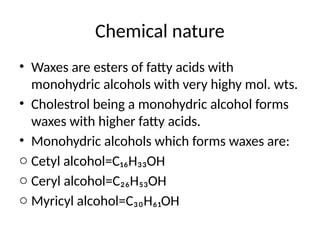
• Waxesare esters of fatty acids with
monohydric alcohols with very highy mol. wts.
• Cholestrol being a monohydric alcohol forms
waxes with higher fatty acids.
• Monohydric alcohols which forms waxes are:
o Cetyl alcohol=C₁₆H₃₃OH
o Ceryl alcohol=C₂₆H₅₃OH
o Myricyl alcohol=C₃₀H₆₁OH
5.
Types
• Animal wax
oBee wax
o Spermaceti
o Lanolin
• Plant wax
• Petroleum derived wax
o Montan wax
o Polyethylene and related derivatives
6.
Animal wax
• Thoseof animal origin typically consist of wax esters derived from a variety of carboxylic
acids and fatty alcohols.
• Examples:
o Beewax
The most commonly known animal wax is beeswax, but other insects also secrete waxes.
A major component of the beeswax used in constructing honeycombs is the ester myricyl
palmitate which is an ester of triacontanol and palmitic acid.
Its melting point is 62-65 °C.
o Spermaceti
Spermaceti occurs in large amounts in the head oil of the sperm whale.
One of its main constituents is cetyl palmitate, another ester of a fatty acid and a fatty
alcohol.
o Lanolin
Lanolin is a wax obtained from wool.
consisting of esters of sterols.
Plant wax
• Inwaxes of plant origin characteristic mixtures of unesterified hydrocarbons may
predominate over esters.
• Plants secrete waxes into and on the surface of their cuticles as a way to control
evaporation, wettability and hydration.
• The epicuticular waxes of plants are mixtures of substituted long-chain aliphatic
hydrocarbons, containing alkanes, alkyl esters, fatty acids, primary and secondary
alcohols, diols, ketones, aldehydes.
• Examples:
o Carnauba wax
From the commercial perspective, the most important plant wax is Carnauba wax,
a hard wax obtained from the Brazilian palm Copernicia prunifera.
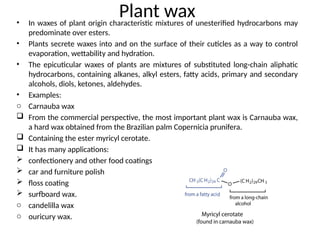
Containing the ester myricyl cerotate.
It has many applications:
confectionery and other food coatings
car and furniture polish
floss coating
surfboard wax.
o candelilla wax
o ouricury wax.
9.
Petroleum derived waxes
•Although many natural waxes contain esters, paraffin waxes are
hydrocarbons, mixtures of alkanes usually in a homologous series of
chain lengths.
• These materials represent a significant fraction of petroleum.
• They are REFINED by vacuum distillation.
• Paraffin waxes are mixtures of saturated n- and iso- alkanes,
naphthenes, and alkyl- and naphthene-substituted aromatic
compounds.
• The degree of branching has an important influence on the properties.
• Millions of tons of paraffin waxes are produced annually.
• They are used in foods (such as chewing gum and cheese wrapping), in
candles and cosmetics, as non-stick and waterproofing coatings and in
polishes.
10.
Petroleum derived eaxes
•Montan wax:
o Montan wax is a fossilized wax extracted from coal and lignite.
o It is very hard, reflecting the high concentration of saturated
fatty acids and alcohols.
o Although dark brown and smelly, they can be PURIFIED and
bleached to give commercially useful products.
• Polyethylene and related derivatives:
o Some waxes are obtained by cracking polyethylene at 400 °C.
o The products have the formula (CH2)nH2, where n ranges
between about 50 and 100.
11.
Properties
• Melting point:
oTheir melting points (60 to 100⁰C) are generally higher
than those of triacylglycerols.
o They generally melt above 45⁰C to give low viscosity
liquids.
• Solubility:
o The small polar ester group provides minimal solubility,
and waxes are essentially insoluble in water.
o Soluble in organic, nonpolar solvents.
• Lipase have no action upon them.
12.
Examples of biologicalwaxes
• Plant waxes-coats leaves and stem
• Bee wax- abdominal glands of bees
• Lanolin- sheep’s wool
• Cerumen- ceruminous glands in ear
• Suberin- bark of trees
• Sebum- sebaceous gland
13.
Functions
• In plankton,the free-floating microorganisms at the bottom of the
food chain for marine animals,waxes are the chief storage form of
metabolic fuel.
• Waxes also serve a diversity of other functions related to their water-
repellent properties and their firm consistency.
o Certain skin glands of vertebrates secrete waxes to protect hair and
skin and keep it pliable, lubricated and waterproof.
o Birds, particularly waterfowl secrete waxes from their preen glands to
keep their feathers water-repellent.
o The shiny leaves of holly,rhododendrons, poison ivy, and many
tropical plants are coated with a thick layer of waxes, which prevents
excessive evaporation of water and protects against Parasites.
14.
Commercial application
• Inthe pharmaceutical, COSMETIC, and other industries.
• Lanolin (from lamb’s wool), beeswax , carnauba wax (from a Brazilian palm tree),
and wax extracted from spermaceti oil (from sperm whale) are widely used in the
manufacture of lotions, ointments, and polishes.
• The main use of polyethylene and polypropylene waxes is in the formulation of
colourants for plastics.
• Waxes are mainly consumed industrially as components of complex formulations,
often for coatings.
• Waxes confer matting effects and wear resistance to paints.
• Polyethylene waxes are incorporated into inks in the form of dispersions to
decrease friction.
• They are employed as release agents.
• They are also used as slip agents, e.g. in furniture, and corrosion resistance.
• Waxes and hard fats such as tallow are used to make candles, used for lighting and
decoration.
• Waxes are used as finishes and coatings for wood products.[4] Beeswax is
frequently used as a lubricant on drawer slides where wood to wood contact
occurs.




![Commercial application
• In the pharmaceutical, COSMETIC, and other industries.
• Lanolin (from lamb’s wool), beeswax , carnauba wax (from a Brazilian palm tree),
and wax extracted from spermaceti oil (from sperm whale) are widely used in the
manufacture of lotions, ointments, and polishes.
• The main use of polyethylene and polypropylene waxes is in the formulation of
colourants for plastics.
• Waxes are mainly consumed industrially as components of complex formulations,
often for coatings.
• Waxes confer matting effects and wear resistance to paints.
• Polyethylene waxes are incorporated into inks in the form of dispersions to
decrease friction.
• They are employed as release agents.
• They are also used as slip agents, e.g. in furniture, and corrosion resistance.
• Waxes and hard fats such as tallow are used to make candles, used for lighting and
decoration.
• Waxes are used as finishes and coatings for wood products.[4] Beeswax is
frequently used as a lubricant on drawer slides where wood to wood contact
occurs.](https://image.slidesharecdn.com/7-250428111906-93ec4518/85/7-Waxes-pptx-pptx-7-Waxes-pptx-pptx-n-14-320.jpg)


