DENTAL WAXES
PAAVANA
1ST MDS
CONTENTS
 INTRODUCTION
 HISTORY
 DEFINITION
 CLASSIFICATION
 COMPONENTS
 CHARACTERISTICS OF WAXES
 IDEAL REQUIREMENTS
 PROPERTIES
 TYPES OF WAXES
 WAXING INSTRUMENTATION
 RECENT ADVANCES
 REVIEW OF LITERATURE
 CONCLUSION
 REFERENCES
INTRODUCTION
 Waxes are thermoplastic materials which are solids
at room temperature but melt without
decomposition to form mobile liquids.
 The word "wax" is derived from the old English
"weax" for the honeycomb of the bee- hive.
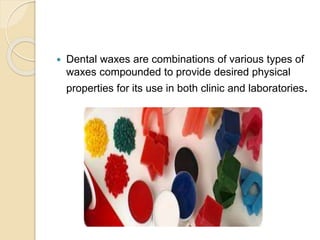
 Dental waxes are combinations of various types of
waxes compounded to provide desired physical
properties for its use in both clinic and laboratories.
HISTORY
 Oldest wax- Bees wax around 3000
B.C
 In Greek and Roman literature,
different applications of waxes are
described like sealing ships , as
binder matrix, protective covering of
art objects, tablets etc.
 Egyptians used bees wax for
mummification process
 1692- Matthaeus Gottfried Purmann used waxes
for impression making.
 1906-Lost wax technique by William H Taggart.
 1935- First synthetic liquid paraffin was produced
by Fischer – Tropsch procedure
DEFINITION
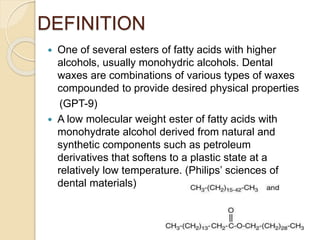
 One of several esters of fatty acids with higher
alcohols, usually monohydric alcohols. Dental
waxes are combinations of various types of waxes
compounded to provide desired physical properties
(GPT-9)
 A low molecular weight ester of fatty acids with
monohydrate alcohol derived from natural and
synthetic components such as petroleum
derivatives that softens to a plastic state at a
relatively low temperature. (Philips’ sciences of
dental materials)
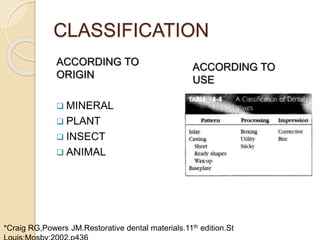
CLASSIFICATION
ACCORDING TO
ORIGIN
 MINERAL
 PLANT
 INSECT
 ANIMAL
ACCORDING TO
USE
*Craig RG,Powers JM.Restorative dental materials.11th edition.St
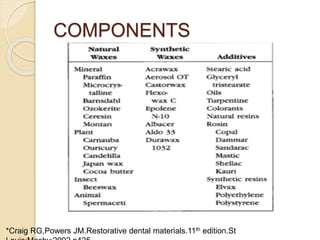
COMPONENTS
*Craig RG,Powers JM.Restorative dental materials.11th edition.St
MINERAL WAXES
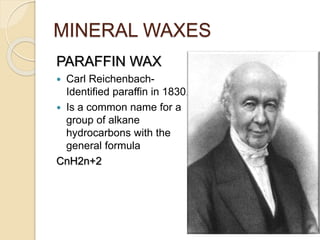
PARAFFIN WAX
 Carl Reichenbach-
Identified paraffin in 1830.
 Is a common name for a
group of alkane
hydrocarbons with the
general formula
CnH2n+2
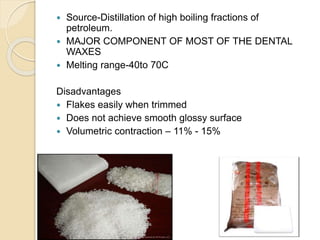
 Source-Distillation of high boiling fractions of
petroleum.
 MAJOR COMPONENT OF MOST OF THE DENTAL
WAXES
 Melting range-40to 70C
Disadvantages
 Flakes easily when trimmed
 Does not achieve smooth glossy surface
 Volumetric contraction – 11% - 15%
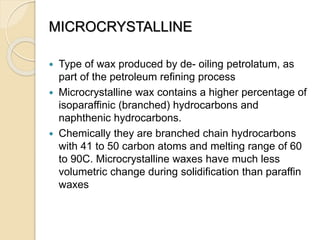
MICROCRYSTALLINE
 Type of wax produced by de- oiling petrolatum, as
part of the petroleum refining process
 Microcrystalline wax contains a higher percentage of
isoparaffinic (branched) hydrocarbons and
naphthenic hydrocarbons.
 Chemically they are branched chain hydrocarbons
with 41 to 50 carbon atoms and melting range of 60
to 90C. Microcrystalline waxes have much less
volumetric change during solidification than paraffin
waxes
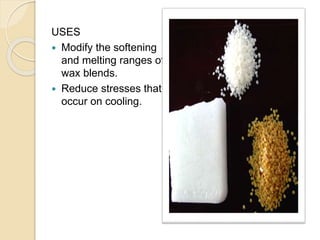
USES
 Modify the softening
and melting ranges of
wax blends.
 Reduce stresses that
occur on cooling.
BARNSDAHL
 Microcrystalline wax
used to increase the
melting range and
hardness and reduce
the flow of paraffin
waxes
 Melting range – 70-
74 degree Celsius
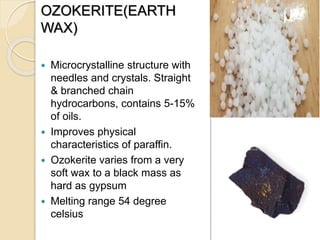
OZOKERITE(EARTH
WAX)
 Microcrystalline structure with
needles and crystals. Straight
& branched chain
hydrocarbons, contains 5-15%
of oils.
 Improves physical
characteristics of paraffin.
 Ozokerite varies from a very
soft wax to a black mass as
hard as gypsum
 Melting range 54 degree
celsius
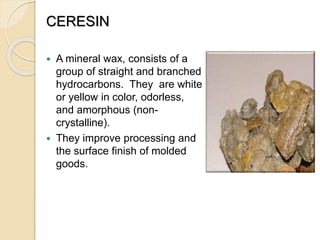
CERESIN
 A mineral wax, consists of a
group of straight and branched
hydrocarbons. They are white
or yellow in color, odorless,
and amorphous (non-
crystalline).
 They improve processing and
the surface finish of molded
goods.
MONTAN
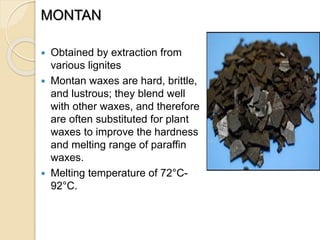
 Obtained by extraction from
various lignites
 Montan waxes are hard, brittle,
and lustrous; they blend well
with other waxes, and therefore
are often substituted for plant
waxes to improve the hardness
and melting range of paraffin
waxes.
 Melting temperature of 72°C-
92°C.
PLANT WAXES
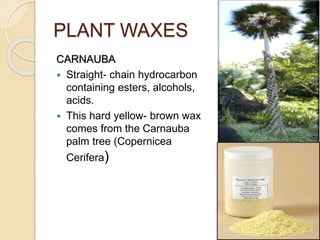
CARNAUBA
 Straight- chain hydrocarbon
containing esters, alcohols,
acids.
 This hard yellow- brown wax
comes from the Carnauba
palm tree (Copernicea
Cerifera)
 These waxes possess the outstanding quality of
increasing the melting range and hardness of
paraffin waxes.
 Melting range – 84-91degree
 Blended with paraffin wax to decrease the flow at
mouth temperature and produce glossy surface
OURICURY
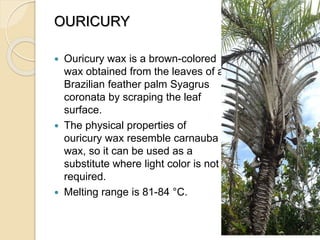
 Ouricury wax is a brown-colored
wax obtained from the leaves of a
Brazilian feather palm Syagrus
coronata by scraping the leaf
surface.
 The physical properties of
ouricury wax resemble carnauba
wax, so it can be used as a
substitute where light color is not
required.
 Melting range is 81-84 °C.
CANDELILLA
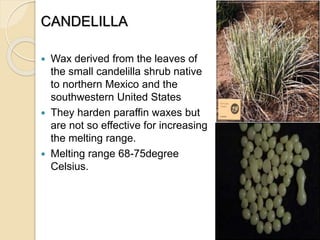
 Wax derived from the leaves of
the small candelilla shrub native
to northern Mexico and the
southwestern United States
 They harden paraffin waxes but
are not so effective for increasing
the melting range.
 Melting range 68-75degree
Celsius.
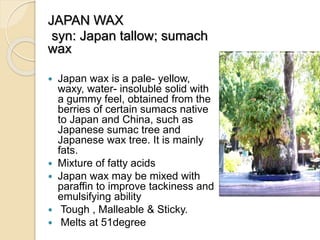
JAPAN WAX
syn: Japan tallow; sumach
wax
 Japan wax is a pale- yellow,
waxy, water- insoluble solid with
a gummy feel, obtained from the
berries of certain sumacs native
to Japan and China, such as
Japanese sumac tree and
Japanese wax tree. It is mainly
fats.
 Mixture of fatty acids
 Japan wax may be mixed with
paraffin to improve tackiness and
emulsifying ability
 Tough , Malleable & Sticky.
 Melts at 51degree
COCOA BUTTER
 Brittle at room temp.
 Completely fat and chiefly
composed of glycerides of
stearic palmitic , oleic, lauric
and lower fattyacids.
 Not true waxes
INSECT WAXES
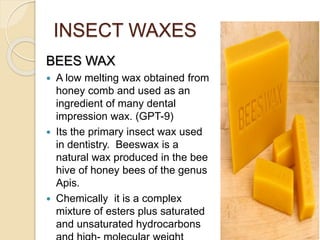
BEES WAX
 A low melting wax obtained from
honey comb and used as an
ingredient of many dental
impression wax. (GPT-9)
 Its the primary insect wax used
in dentistry. Beeswax is a
natural wax produced in the bee
hive of honey bees of the genus
Apis.
 Chemically it is a complex
mixture of esters plus saturated
and unsaturated hydrocarbons
 It is a brittle material at room temperature but
becomes plastic at body temperature.
 Beeswax has a high melting point range, of 62 to
64 degree C
 It is used to modify the properties of paraffin
waxes, and is the main component in sticky wax.
 It is less crystalline more amorphous.
 It is added to many waxes because of its desirable
flow properties at oral temperature.
ANIMAL WAXES
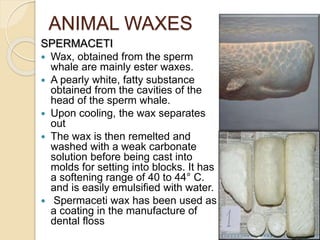
SPERMACETI
 Wax, obtained from the sperm
whale are mainly ester waxes.
 A pearly white, fatty substance
obtained from the cavities of the
head of the sperm whale.
 Upon cooling, the wax separates
out
 The wax is then remelted and
washed with a weak carbonate
solution before being cast into
molds for setting into blocks. It has
a softening range of 40 to 44° C.
and is easily emulsified with water.
 Spermaceti wax has been used as
a coating in the manufacture of
dental floss
SYNTHETIC WAXES
 Complex organic compounds of varied chemical
composition. Polymers of ethylene glycols.
 They show high degree of refinement, in contrast
with the contamination that is common in natural wax.
 Few are also prepared by reaction with natural waxes
 Carefully prepared under controlled conditions to give
standardized reliable results
 Limited compatibility with other waxes.
 Melting temperature from 37degree C –
63degreeC.
 Function as plasticizers and toughen films of wax.
 Have specific melting points and are blended with
natural waxes.
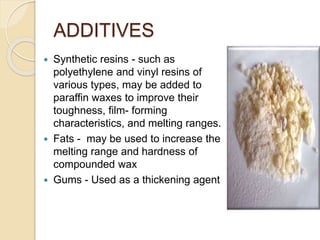
ADDITIVES
 Synthetic resins - such as
polyethylene and vinyl resins of
various types, may be added to
paraffin waxes to improve their
toughness, film- forming
characteristics, and melting ranges.
 Fats - may be used to increase the
melting range and hardness of
compounded wax
 Gums - Used as a thickening agent
IDEAL REQUIREMENTS
 Easy to mould when softened and NOT tear or
flake
 Capable of being melted and solidified a number of
times without change in properties
 No residue to be left after lost wax technique
 Should have low thermal contraction
 Correct flow properties.
 Good colour contrast with oral tissues
 Easy to carve without chipping
 Should fracture rather than deform upon removal
from cavity in case of an undercut
PROPERTIES OF
WAXES
THERMAL PROPERTIES
 SOLID-SOLID TRANSITION
TEMPERATURE:
 Temperature at which a sharp increase in coefficient of
thermal expansion which occurs indicating increased
molecular mobility.
 Also called softening temperature or glass transition
temperature.
 In waxes, at this temperature, transition from a
stable crystal lattice (orthorhombic) to hexagonal
form occurs which is present below the melting
point of wax and thus it allows the wax to be
manipulated easily without flaking or tearing.
 Wax is soft (not melted) at this temperature.
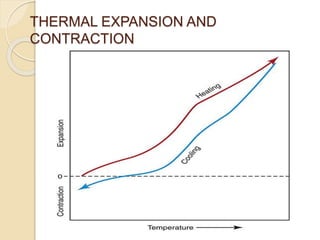
CO-EFFICIENT OF THERMAL EXPANSION
 Higher C.O.T.E than any other dental material
 Value: 350x10-6/˚C
 This will cause the wax to expand on heating and
appreciably shrink on cooling from solidification
temp to room temperature.
 On heating, may expand 0.7% when temp is
increased 20 ˚C
 On cooling from 37˚C to 25 ˚C , a linear shrinkage
of 0.35% occurs
 May cause distortion of wax patterns
THERMAL EXPANSION AND
CONTRACTION
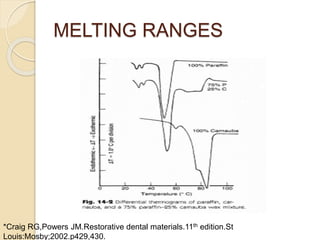
MELTING RANGE:
 Because waxes may
contain several types of
molecules, each having a
range of molecular weights,
they have melting ranges
rather than melting points
 Paraffin: 40-70 ˚C
 Microcrystalline: 60-90 ˚C
 Bees wax: 65-70 ˚C
THERMAL
CONDUCTIVITY:
Low thermal conductivity
MELTING RANGES
*Craig RG,Powers JM.Restorative dental materials.11th edition.St
Louis:Mosby;2002.p429,430.
MECHANICAL PROPERTIES
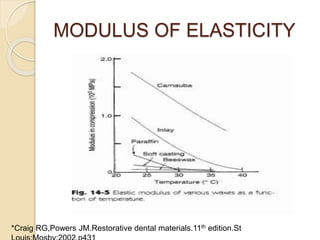
 Low compressive strength
 Low modulus of elasticity
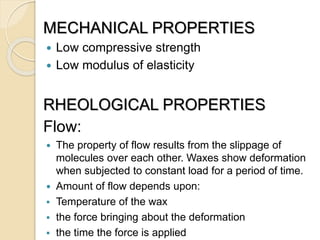
RHEOLOGICAL PROPERTIES
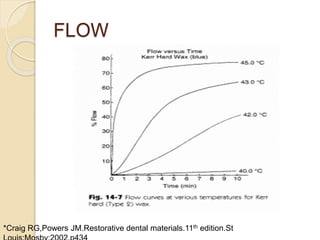
Flow:
 The property of flow results from the slippage of
molecules over each other. Waxes show deformation
when subjected to constant load for a period of time.
 Amount of flow depends upon:
 Temperature of the wax
 the force bringing about the deformation
 the time the force is applied
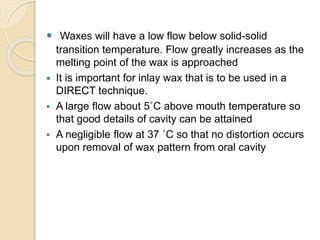
 Waxes will have a low flow below solid-solid
transition temperature. Flow greatly increases as the
melting point of the wax is approached
 It is important for inlay wax that is to be used in a
DIRECT technique.
 A large flow about 5˚C above mouth temperature so
that good details of cavity can be attained
 A negligible flow at 37 ˚C so that no distortion occurs
upon removal of wax pattern from oral cavity
FLOW
*Craig RG,Powers JM.Restorative dental materials.11th edition.St
INTERNAL STRESSES
 Waxes have low thermal conductivity making it
difficult to achieve uniform heating.
 If a wax is adapted to shape without adequate
heating to above Tg temperature, considerable
stresses will develop in the wax.
 If then the wax is warmed, relief of stresses will
occur resulting in distortion or warpage of wax
pattern.
DUCTILITY
 It is the ability of a material to be plastically
deformed
 it is indicated by plastic strain.
 The ductility of a material represents its ability to be
drawn into wire under a force of tension.
 It is a property related to the workability of a
material in the mouth (It is related to burnishability
of margins of pattern or casting).
 Wide melting ranges – greater ductility. e.g. :
Microcrystalline mineral waxes.
MODULUS OF ELASTICITY
*Craig RG,Powers JM.Restorative dental materials.11th edition.St
INLAY WAXES
 ADA specification – no 4
 Type of pattern wax
 Various colours (Blue, green, purple)
 Available in sticks, cakes, blocks
 USES:
Preparation of wax pattern for cast metal restorations
like inlays, onlays, crowns, bridges
TYPES:
 Type I (soft) For indirect technique
 Type II (Hard/Medium) For direct technique
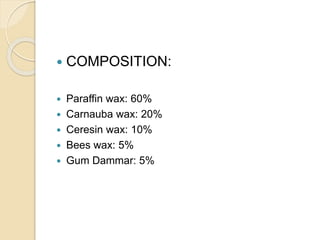
 COMPOSITION:
 Paraffin wax: 60%
 Carnauba wax: 20%
 Ceresin wax: 10%
 Bees wax: 5%
 Gum Dammar: 5%
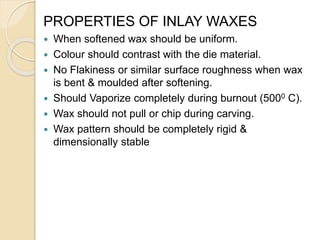
PROPERTIES OF INLAY WAXES
 When softened wax should be uniform.
 Colour should contrast with the die material.
 No Flakiness or similar surface roughness when wax
is bent & moulded after softening.
 Should Vaporize completely during burnout (5000 C).
 Wax should not pull or chip during carving.
 Wax pattern should be completely rigid &
dimensionally stable
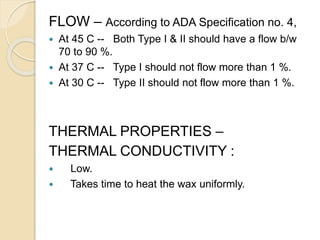
FLOW – According to ADA Specification no. 4,
 At 45 C -- Both Type I & II should have a flow b/w
70 to 90 %.
 At 37 C -- Type I should not flow more than 1 %.
 At 30 C -- Type II should not flow more than 1 %.
THERMAL PROPERTIES –
THERMAL CONDUCTIVITY :
 Low.
 Takes time to heat the wax uniformly.
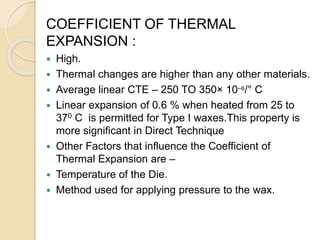
COEFFICIENT OF THERMAL
EXPANSION :
 High.
 Thermal changes are higher than any other materials.
 Average linear CTE – 250 TO 350× 10−6/° C
 Linear expansion of 0.6 % when heated from 25 to
370 C is permitted for Type I waxes.This property is
more significant in Direct Technique
 Other Factors that influence the Coefficient of
Thermal Expansion are –
 Temperature of the Die.
 Method used for applying pressure to the wax.
WAX DISTORTION –
 Most serious problem in Inlay wax.
 It is due to Release of Stresses in pattern due to
 Contraction on cooling.
 Occluded gas bubbles.
 Change of shape of wax during moulding.
 From Manipulation, Carving, Pooling & Removal.
CAUSES OF DISTORTION :
 If wax is not at uniform temp. when inserted in the
cavity.
 If wax is not held under uniform pressure during
cooling.
 If wax is added in an area of deficiency.
TO AVOID DISTORTION OF WAXES :
 Minimal carving & change in temperature.
 Minimal Storage of pattern.
 Use warm instrument for carving.
 Store it in a Fridge if necessary.
Comparative evaluation of conventional and accelerated
castings on marginal fit and surface roughness.
Jadhav VD, Motwani BK, Shinde J, Adhapure P. Contemp
Clin Dent 2017;8(3):405-410.
 The aim of this study was to evaluate the marginal fit
and surface roughness of complete cast crowns made
by a conventional and an accelerated casting
technique.
 This study was divided into three parts. In Part I, the
marginal fit of full metal crowns made by both casting
techniques in the vertical direction was checked, in Part
II, the fit of sectional metal crowns in the horizontal
direction made by both casting techniques was
checked, and in Part III, the surface roughness of disc-
shaped metal plate specimens made by both casting
techniques was checked.
 Conclusions: Accelerated casting technique
showed quite satisfactory results, but the
conventional technique was superior in terms of
marginal fit and surface roughness.
MANIPULATION OF INLAY
WAXES
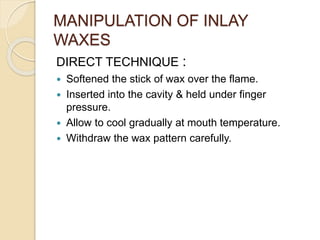
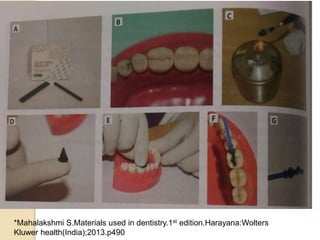
DIRECT TECHNIQUE :
 Softened the stick of wax over the flame.
 Inserted into the cavity & held under finger
pressure.
 Allow to cool gradually at mouth temperature.
 Withdraw the wax pattern carefully.
*Mahalakshmi S.Materials used in dentistry.1st edition.Harayana:Wolters
Kluwer health(India);2013.p490
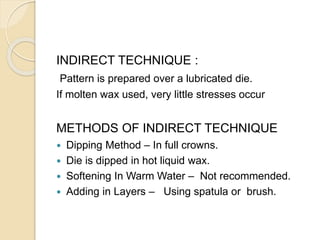
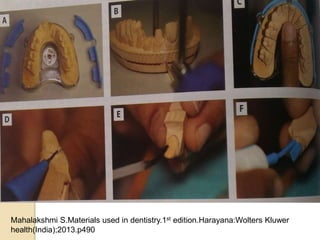
INDIRECT TECHNIQUE :
Pattern is prepared over a lubricated die.
If molten wax used, very little stresses occur
METHODS OF INDIRECT TECHNIQUE
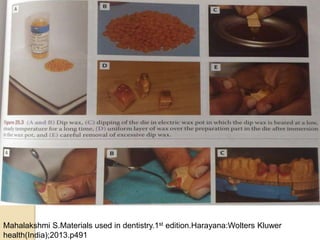
 Dipping Method – In full crowns.
 Die is dipped in hot liquid wax.
 Softening In Warm Water – Not recommended.
 Adding in Layers – Using spatula or brush.
Mahalakshmi S.Materials used in dentistry.1st edition.Harayana:Wolters Kluwer
health(India);2013.p490
Mahalakshmi S.Materials used in dentistry.1st edition.Harayana:Wolters Kluwer
health(India);2013.p491
 METHODS OF SOFTENING WAX
 Water Bath
 Flame of Bunsen burner
 Infrared lamp
 Wax annealer
BUNSEN BURNER
 In order to achieve even heating, the wax should be
held in the warm rising air above the flame and not in
the flame itself.
 If the surface becomes shiny it indicates that the wax
is becoming too hot and the outer layers are
beginning to melt.
WARM WATER
 Advantages: More regular softening
 Disadvantages: May leach out some constituents
,small quantities of water may become incorporated
causing an alteration in the properties.
INFRA RED LAMP - 250 W
 Method of softening ,used in standardization
testing of waxes
 Distance of the wax from the lamp must be
carefully controlled in order to cause softening but
not melting.
WAX ANNEALER
 Ideal method for softening wax
 Thermostatically controlled oven - constant temp.
 The annealer is most useful for inlay waxes.
 Analog Wax Heater :
Dental Lab Equipment is a high quality wax pot and
ideal for all dental applications. Its temperature
controlled heating system gives you a broad
temperature range of 70°F to 237°F (21°C to 112°C).
In addition, this wax pot features an insulated
thermoplastic housing which remains cool while wax
stays hot.
LOST WAX TECHNIQUE
METHOD OF CARVING/USAGE OF
INSTRUMENTS
Wax is added by heating the instrument in the bunsen
flame, touching it to the wax, and quickly reheating its
shank in the flame. Wax flow away from the hottest
part of the instrument so that if the shank is heated, a
bead of wax will flow off the tip, However if the tip is
heated, the wax will flow up the shank of the
instrument (to the considerable annoyance of
inexperienced operators).
 Wax carvers should be kept sharp and never
heated.
 When carving wax light pressure should be used to
obtain the desired smooth surface.
 Burnishing is an alternative to carving for obtaining
a smooth wax pattern of the desired contour.
Digital manipulation-when working uni manually all 10
fingers must be coordinated to perform their
respective tasks-less force is transmitted from finger
CASTING WAX
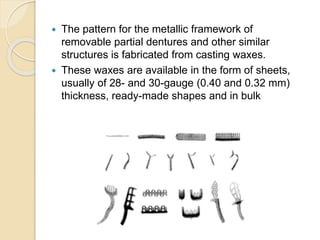
 The pattern for the metallic framework of
removable partial dentures and other similar
structures is fabricated from casting waxes.
 These waxes are available in the form of sheets,
usually of 28- and 30-gauge (0.40 and 0.32 mm)
thickness, ready-made shapes and in bulk
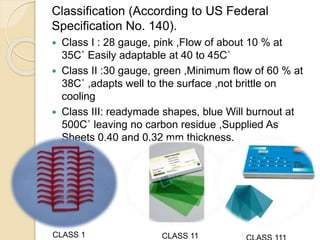
Classification (According to US Federal
Specification No. 140).
 Class I : 28 gauge, pink ,Flow of about 10 % at
35C˚ Easily adaptable at 40 to 45C˚
 Class II :30 gauge, green ,Minimum flow of 60 % at
38C˚ ,adapts well to the surface ,not brittle on
cooling
 Class III: readymade shapes, blue Will burnout at
500C˚ leaving no carbon residue ,Supplied As
Sheets 0.40 and 0.32 mm thickness.
CLASS 1 CLASS 11
PROPERTIES
 Highly ductile.
 Maximum flow at 35C is 10% AND Minimum flow
is60% at 38C.
 Pliable and is readily adaptable at 40C-45C.
 Vapourizes at 500C,leaving no residue.
USES
 To make patterns of the metallic frameworks for
removable partial denture.
BASEPLATE WAX /
MODELLING WAX
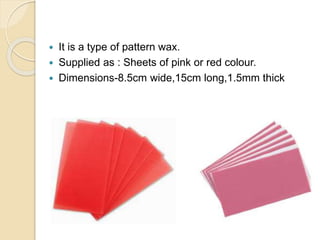
 It is a type of pattern wax.
 Supplied as : Sheets of pink or red colour.
 Dimensions-8.5cm wide,15cm long,1.5mm thick
 COMPOSITION
 Paraffin or ceresin -80.0%
 Beeswax- 12.0%
 Carnauba -2.5%
 Natural or synthetic resins- 3.0%
 Microcrystalline- 2.5%.
IDEAL REQUIREMENTS
 Capable of holding porcelain or acrylic teeth in
position both in normal room temperature and
mouth temperature.
 Softened sheets should cohere readily
 Not be flaky or adhering to fingers.
 Not cause irritation of oral tissues.
 Easy to trim with sharp instruments at 23C
 Produce smooth surface after gentle flaming.
 No residue on porcelain or plastic teeth during
processing.
 Colour should not separate or impregnate plaster
during processing.
 CLASSIFICATION (ADA SP. NO. 122)
 Type I soft — for building veneers
 Type II hard — to use in mouths in normal climates
 Type III extra-hard — for use in tropical climates
 The hardness is based on the amount of flow the
wax shows at 45C (113F).
USES
 To make occlusal rims
 Register vertical dimension
 Hold artificial teeth to base plate.
 Contour the denture after teeth is set.
 Impression tray extensions
 Custom tray spacers.
 Orthodontic appliance pattern
 To check occlusal clearance after tooth preparation.
 Also used to check the various articulating relations in
the mouth and to transfer them to mechanical
articulators.
STICKY WAX
 It is a type of processing wax.
 It is sticky when melted, with a max 5 %flow at 30 Cº
and 90 % at 43 Cº .
 It adheres closely to the surfaces when applied to it.
 If movement occurs the wax tends to fracture than
distort.
 At room temperature the wax is brittle and breaks
easily
COMPOSITION
 Yellow bees wax: 60%
 Resin: 17%
 Gum dammar: 17%
PROPERTIES
 Supplied as hexagonal strips of various
colours,often yellow.
 Brittle at room temperature and assumes thick
liquid consistency when heated.
 Does not have more than 0.2% residue on burnout
and not more than 0.5% shrinkage from 43C to
28C
Uses
 It is used to align fractured parts of acrylic dentures
.
 It is used to align fixed partial denture units before
soldering .
 It is used to seal a plaster splint to the stone cast
during porcelain firing.
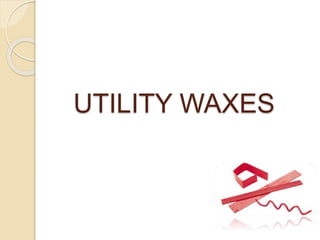
UTILITY WAXES
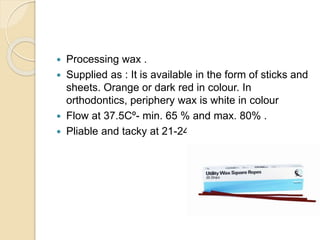
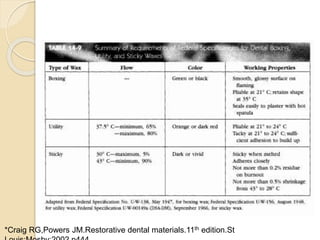
 Processing wax .
 Supplied as : It is available in the form of sticks and
sheets. Orange or dark red in colour. In
orthodontics, periphery wax is white in colour
 Flow at 37.5Cº- min. 65 % and max. 80% .
 Pliable and tacky at 21-24Cº
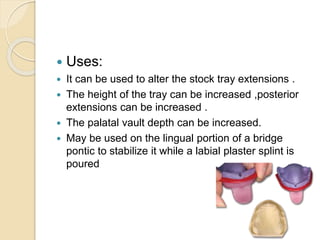
 Uses:
 It can be used to alter the stock tray extensions .
 The height of the tray can be increased ,posterior
extensions can be increased .
 The palatal vault depth can be increased.
 May be used on the lingual portion of a bridge
pontic to stabilize it while a labial plaster splint is
poured
*Craig RG,Powers JM.Restorative dental materials.11th edition.St
BEADING WAX &
BOXING WAX
 Processing wax.
USES:
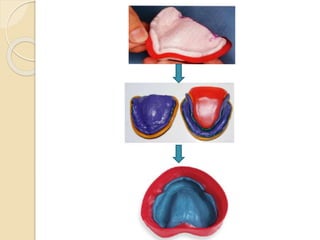
 Beading wax is adapted around the impression borders to
create the land area of the cast
 Boxing wax is used to build up vertical walls around the
impression in order to pour the gypsum product to make a
cast base.
 Supplied as :
 Boxing wax as sheets.
 beading wax as strips.
 PROPERTIES
 Pliable at 21C and retains shape at 35C
 ADVANTAGES
1. Preserves the extensions and landmarks.
2. Controls the thickness of the borders.
3. Controls the form and thickness of the base of the
cast.
4. Conserves the artificial stone.
CARDING WAX
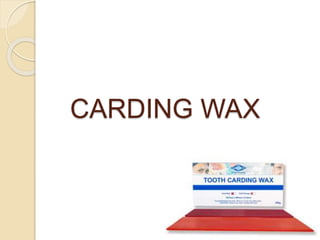
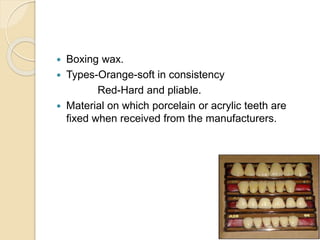
 Boxing wax.
 Types-Orange-soft in consistency
Red-Hard and pliable.
 Material on which porcelain or acrylic teeth are
fixed when received from the manufacturers.
BLOCK OUT WAX
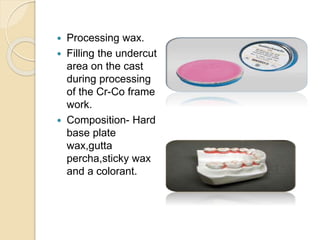
 Processing wax.
 Filling the undercut
area on the cast
during processing
of the Cr-Co frame
work.
 Composition- Hard
base plate
wax,gutta
percha,sticky wax
and a colorant.
TYPES OF BLOCK OUTS
 Paralleled block out
 Shaped block out
 Arbitrary block out
 Relief
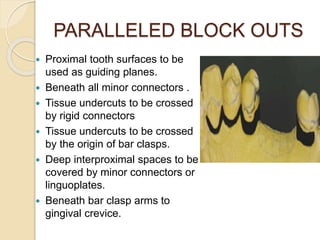
PARALLELED BLOCK OUTS
 Proximal tooth surfaces to be
used as guiding planes.
 Beneath all minor connectors .
 Tissue undercuts to be crossed
by rigid connectors
 Tissue undercuts to be crossed
by the origin of bar clasps.
 Deep interproximal spaces to be
covered by minor connectors or
linguoplates.
 Beneath bar clasp arms to
gingival crevice.
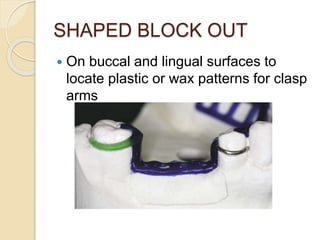
SHAPED BLOCK OUT
 On buccal and lingual surfaces to
locate plastic or wax patterns for clasp
arms
ARBITRARY BLOCK OUT
 Areas not directly involved in the frame work
fabrication.
 All gingival crevices .
 Gross tissue undercuts situated below areas
involved in the design of denture framework
 Tissue undercuts distal to the cast framework.
RELIEF
 Beneath framework extensions onto ridge areas for
attachment of resin bases.
 Areas in which major connectors will contact thin
tissue, such as hard areas so frequently found on
lingual or mandibular ridges and elevated palatal
raphes.
 Beneath lingual bar connectors or the bar portion
of the linguoplates when indicated.
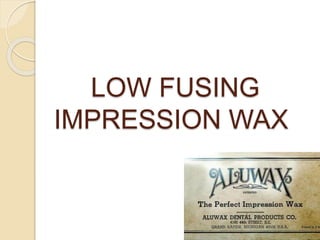
LOW FUSING
IMPRESSION WAX
 COMPOSITION
Spermaceti waxes, synthetic waxes
 PROPERTIES
1. The melting point must be low enough to make the application to the
compound “ snap” impression an easy and safe procedure.
2. It must have a “ flow” such that it will accurately copy minute detail
under a moderate pressure.
3. This “flow” must be accomplished at body temperature.
4. It should have a minimum shrinkage when removed from the mouth
to room temperature.
5. It must have such body that it will set at room temperature, limiting
distortion to a minimum.
6. It must give a smooth accurate impression.
7. It must be of such a texture that several coats may be painted one on
another without leaving lines of demarcation.
*Dirksen LC. Composition and properties of a wax for lower impressions. J. Am. Dent.
Assoc. 1939 Feb 1;26(2):270-4
 PROPERTIES AND INDICATIONS
 Reline and rebase dentures
 ADVANTAGES AND DISADVANTAGES
 Boxing is not required and separators are not
necessary while pouring the cast
 Easily distorted
MOUTH
TEMPERATURE
WAXES
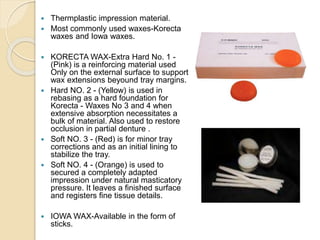
 Thermplastic impression material.
 Most commonly used waxes-Korecta
waxes and Iowa waxes.
 KORECTA WAX-Extra Hard No. 1 -
(Pink) is a reinforcing material used
Only on the external surface to support
wax extensions beyound tray margins.
 Hard NO. 2 - (Yellow) is used in
rebasing as a hard foundation for
Korecta - Waxes No 3 and 4 when
extensive absorption necessitates a
bulk of material. Also used to restore
occlusion in partial denture .
 Soft NO. 3 - (Red) is for minor tray
corrections and as an initial lining to
stabilize the tray.
 Soft NO. 4 - (Orange) is used to
secured a completely adapted
impression under natural masticatory
pressure. It leaves a finished surface
and registers fine tissue details.
 IOWA WAX-Available in the form of
sticks.
USES-
 Recording functional or supporting form of
edentulous ridge.
 Relining
 Correct borders of impression made of more rigid
materials to establish more optimum contact at
denture borders.
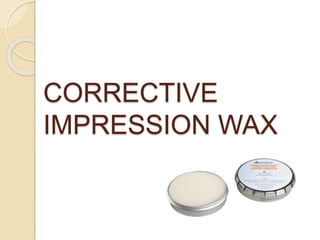
CORRECTIVE
IMPRESSION WAX
 Wax in combination with resins of low melting point
can be used in corrective impression technique in
partial and complete denture prosthesis.
 The peculiarity of impression wax is that they flow
at mouth temperature.(100% flow at 37C)
 Availability : sheets or cakes
 Composition-Paraffin,ceresin,bees wax and may
contain metal particles.
 Used to restore the selected region in the
edentulous patients to reproduce the details of
mucous membrane.
 Its main disadvantage is that it is distorted during
remove from the undercut areas.
BITE
REGISTRATION
WAX
 Used to record the relationship between the upper
and lower teeth.
 Composition- beeswax/paraffin/ceresin,aluminium
or copper particles.
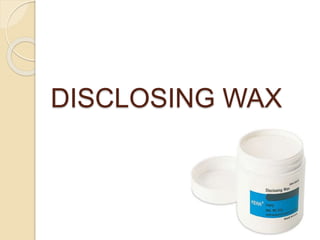
DISCLOSING WAX
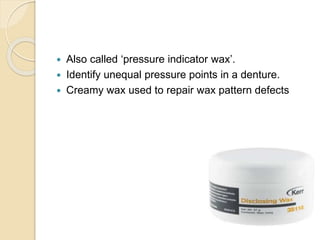
 Also called ‘pressure indicator wax’.
 Identify unequal pressure points in a denture.
 Creamy wax used to repair wax pattern defects
WAXING
INSTRUMENTATION
Waxing instruments can be categorized by Intent of
their design
 Wax addition
 Carving or burnishing
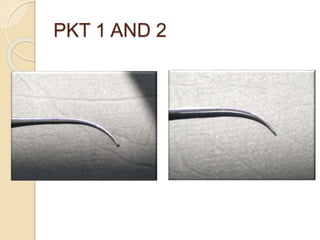
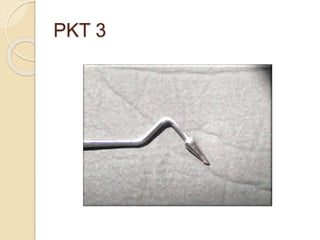
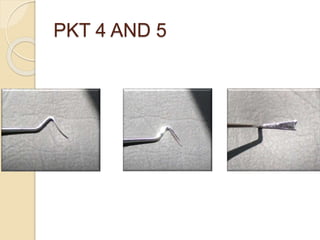
PKT INSTRUMENTS
Dr. Peter K Thomas introduced hand instruments for
waxing procedures.
Among the popular instruments are PKT’s from no 1--
5
 PKT No 1 : large increments of wax
 PKT No 2 : small additions of wax
 PKT No 3 : burnish and carve occlusal surface
 PKT No 4 : designed as an all purpose carver
 PKT No 5 : to refine triangular ridges and occlusal
grooves
PKT 1 AND 2
PKT 3
PKT 4 AND 5
ELECTRIC WAXING UNITS
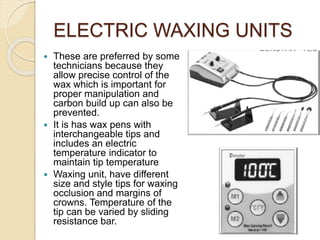
 These are preferred by some
technicians because they
allow precise control of the
wax which is important for
proper manipulation and
carbon build up can also be
prevented.
 It is has wax pens with
interchangeable tips and
includes an electric
temperature indicator to
maintain tip temperature
 Waxing unit, have different
size and style tips for waxing
occlusion and margins of
crowns. Temperature of the
tip can be varied by sliding
resistance bar.
ADVANCES
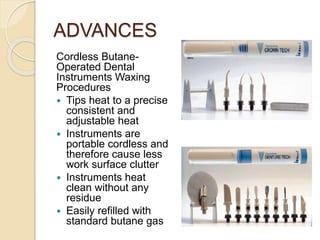
Cordless Butane-
Operated Dental
Instruments Waxing
Procedures
 Tips heat to a precise
consistent and
adjustable heat
 Instruments are
portable cordless and
therefore cause less
work surface clutter
 Instruments heat
clean without any
residue
 Easily refilled with
standard butane gas
RECENT ADVANCES
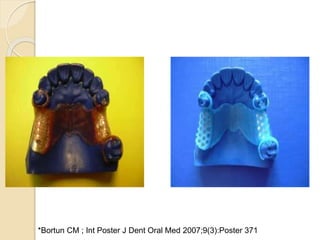
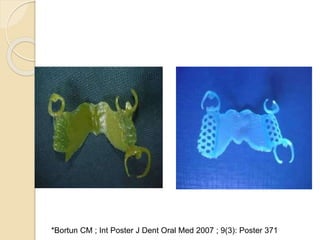
LIGHT CURING WAXES
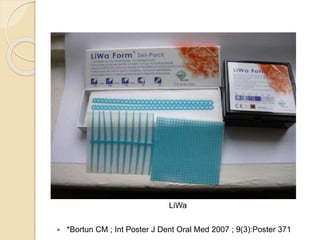
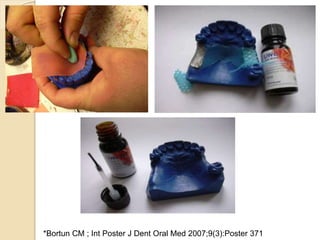
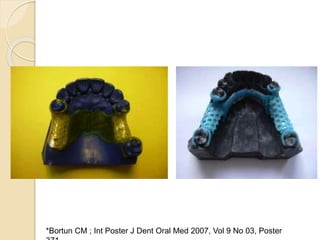
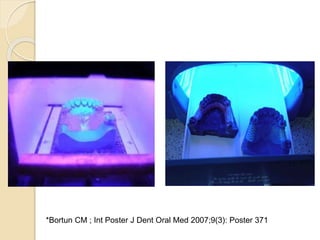
 Wax patterns of the metallic frameworks of the removable partial dentures
can be made directly on the cast, using waxes like: Ti-Light or LiWa (light
curing waxes)
 ADVANTAGES
 Eliminates duplicating techniques for working models and saves time
 Used for all types of metal works, crowns, bridges, implants
 After modeling these waxes can be cured by any standard lab UV or
halogen light
 More precise than conventional methods
 Less distortion
 DISADVANTAGES
 Sticky and difficult to use
 Great elasticity
 Cracks and fractures
*Bortun CM ; Int Poster J Dent Oral Med 2007;9(3):Poster 371
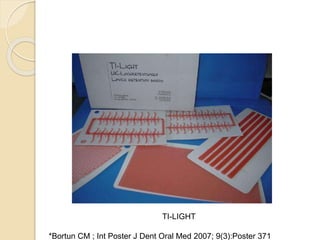
TI-LIGHT
*Bortun CM ; Int Poster J Dent Oral Med 2007; 9(3):Poster 371
 *Bortun CM ; Int Poster J Dent Oral Med 2007 ; 9(3):Poster 371
LiWa
*Bortun CM ; Int Poster J Dent Oral Med 2007;9(3):Poster 371
*Bortun CM ; Int Poster J Dent Oral Med 2007, Vol 9 No 03, Poster
*Bortun CM ; Int Poster J Dent Oral Med 2007;9(3): Poster 371
*Bortun CM ; Int Poster J Dent Oral Med 2007;9(3):Poster 371
*Bortun CM ; Int Poster J Dent Oral Med 2007 ; 9(3): Poster 371
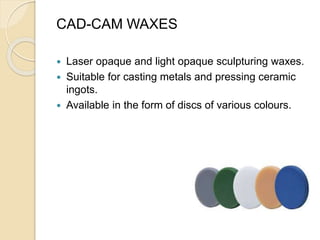
CAD-CAM WAXES
 Laser opaque and light opaque sculpturing waxes.
 Suitable for casting metals and pressing ceramic
ingots.
 Available in the form of discs of various colours.
Fit of pressed crowns fabricated from two CAD-CAM wax
pattern process plans: A comparative in vitro study
Shamseddine L, Mortada R, Rifai K, Chidiac JJ. J.
Prosthet. Dent 2017;118(1):49-54.
 The aim of the study is to assess the marginal and
internal fit of subtractive milled wax pattern or a pattern
from the micro-stereolithography additive process to
produce lithium disilicate crowns.
 Ten silicone impressions were made for a prepared
canine tooth. Each die received 2 lithium disilicate (IPS
e.max) copings, 1 from milled wax blocks and 1 from
additive wax. The replica technique was used to
measure the fit by scanning electron microscopy
at ×80 magnification.
 No significant difference was found between the fit of
the 2 techniques. The mean values of axial and
occlusal median values were 10 and 5 to 6 times
greater than machine’s nominal values.
WAX ARTICULATING PAPER
 To detect high points after tooth preparation or during crown
insertion.
 COMPOSITION-Waxes, oils and pigments, a hydrophobic
mixture which repels saliva.
 Supplied in the form of sin strips and horse shoe shaped sheets.
DISADVANTAGES
 Easily ruined by saliva
 Thick
 Relatively inflexible base material
 To over come this,
Additional emulsifier which gives these films certain bonding
properties on moist occlusal surfaces.
Wetting agents like lecithin is added to articulating paper coating.
*Sharma A, Rahul GR, Poduval ST, Shetty K, Gupta B, Rajora V. History of materials
used for recording static and dynamic occlusal contact marks: A literature review. J
Clin Exp Dent2013;5(1):p48-53
REVIEW OF LITERATURE
 Effect of Different Paraffin’s and
Microcrystalline Waxes on the Mechanical
Properties of Base Plate Dental Waxes
Zbigniew R, Agnieszka NT, Joanna W, Danuta N ; Saudi
J. Oral.Dent 2017; 2(7):180-86
 AIM-To investigate the influence of different paraffin’s
and microcrystalline waxes on the properties of base
plate waxes.
 Five new compositions (S1-S5) were compared to
four commercial products like base plates from
Modelling wax, Modelling wax, Modellierwachs rosa
standard, Modelling wax Ceradent.
 CONCLUSION-From clinical point of view, it is not
recommended to heat and re-melt the base plate
waxes for long time in wax warmer especially at
higher temperatures.
 Surface roughness and internal porosity of
partial removable dental prosthesis
frameworks fabricated from conventional
wax and light-polymerized patterns:
A comparative study
Swelem AA, Abdelnabi MH, Al-Dharrab AA,
AbdelMaguid HF. J Prosthet Dent 2014 ;111(4):335-41
 AIM- To investigate the influence of the material,
of conventional wax patterns, and the recently
introduced light-polymerized patterns on the
initial surface roughness and internal porosity of the
cobalt-chromium castings of partial
removable dental prostheses.
 Twenty-eight identical partial removable dental
prosthesis frameworks were fabricated on a cast of
a maxillary Kennedy Class III modification 1
partially edentulous patient. Fourteen frameworks
were fabricated from each pattern material
 CONCLUSION-The surface roughness and internal
porosity of frameworks fabricated from
conventional wax and Liwa patterns were
comparable, with no significant differences
between the 2 pattern materials.
 A Comparative Evaluation Of Marginal
Discrepancies Of Patterns Made With Casting
Wax, Autopolymerized Pattern Resin And Light
Polymerized Casting Wax- An In Vitro Study.
Omkar , Wadkar PA; Indian J Dent Sci 2016.
 AIM-To compare the marginal discrepancy of patterns
fabricated for full crown from Light polymerized casting
wax ,Dental casting wax and Autopolymerized acrylic
resin pattern material on standardized dies.
 Three pattern materials were studied Light
polymerized casting wax (LiWA Blue), Dental casting
wax (S-U WAX-A, Schuler Dental) and
Autopolymerized acrylic resin pattern material (Pattern
Resin GC). Patterns were fabricated using bulk
techniques on stone dies made from addition silicone
impressions of full-crown master die.
 CONCLUSION-The marginal discrepancies of
patterns fabricated from Light polymerized casting
waxes were less as compared to Dental casting
waxes but it was almost equivalent to
Autopolymerized pattern resin.
 Effect of storage time and framework
design on the accuracy of maxillary cobalt-
chromium cast removable partial dentures.
Viswambaran M ,Sundaram RK.Contemp Clin Dent
2015;6(4):471-76
 AIM-This in vitro study was carried out to find out
the effect of storage time and major connector
design on the accuracy of cobalt-chromium cast
removable partial dentures (RPDs).
 Inaccuracies in the fit of palatal major connectors
may be related to distortion of the wax pattern due
to prolonged storage time and faulty major
connector design.
 The influence of wax pattern storage time and the
accuracy of the fit palatal major connector designs
on the master die were compared.
 CONCLUSION-It is recommended that the wax
patterns for RPD to be invested immediately on
completion of the wax procedure. The selection of
a major connector design is crucial for an accurate
fit of RPD.
CONCLUSION
 Although dental waxes are not used as final
restorations in dentistry, they are crucial to the
success of many dental restorations.
 Few procedures in dentistry like forming an inlay
pattern, registration of occlusal bite relationships,
boxing an impression & other processing steps,
each requires a specially formulated wax. These
examples display how the tasks these waxes
perform & therefore their properties, vary greatly.
REFERENCES
 Craig RG,Powers JM.Restorative dental materials.11th edition.St
Louis:Mosby;2002
 Anusavice KJ.Philips’ sciences of dental sciences.11th edition.St
Louis:Elsevier;2003
 Mc Cabe JF Walls AWG.Applied dental materials.9Th
edition.Oxford:Blackwell publishing ltd;2008
 Manappallil JJ.Basic dental sciences.3rd edition.New
Delhi:Jaypee brothers medical publishers; 2010
 Mahalakshmi S.Materials used in dentistry.1st
edition.Harayana:Wolters Kluwer health(India);2013
 Carr AB,McGivney GP,Brown DT.McCraken’s removable partial
prosthodontics.11th edition.St Louis:Elsevier;2005
 Using of light-curing "waxes" in the removable partial denture
technology. Bortun CM ; Int Poster J Dent Oral Med 2007;
9(3):Poster 371
 Dirksen LC. Composition and properties of a wax for lower
impressions. J. Am. Dent. Assoc. 1939 Feb 1;26(2):270-4
 Comparative evaluation of conventional and accelerated
castings on marginal fit and surface roughness.Jadhav VD,
Motwani BK, Shinde J, Adhapure P. Contemp Clin Dent
2017;8(3):405-10.
 Sharma A, Rahul GR, Poduval ST, Shetty K, Gupta B, Rajora
V. History of materials used for recording static and dynamic
occlusal contact marks: A literature review. J Clin Exp
Dent2013;5(1):p48-53
 Dirksen LC. Composition and properties of a wax for lower
impressions. J. Am. Dent. Assoc. 1939 Feb 1;26(2):270-4
 Effect of Different Paraffin’s and Microcrystalline Waxes on the
Mechanical Properties of Base Plate Dental Waxes .Zbigniew
R, Agnieszka NT, Joanna W, Danuta N ; Saudi J. Oral.Dent
2017;2(7):180-86
 Surface roughness and internal porosity of partial removable
dental prosthesis frameworks fabricated from conventional
wax and light-polymerized patterns: A comparative
study.Swelem AA, Abdelnabi MH, Al-Dharrab AA,
AbdelMaguid HF. J Prosthet Dent 2014 ;111(4):335-41
 Effect of storage time and framework design on the accuracy
of maxillary cobalt-chromium cast removable partial
dentures.Viswambaran M ,Sundaram RK.Contemp Clin Dent
2015;6(4):471-76
 Fit of pressed crowns fabricated from two CAD-CAM wax
pattern process plans: A comparative in vitro
study.Shamseddine L, Mortada R, Rifai K, Chidiac JJ. J.
Prosthet. Dent 2017;118(1):49-54.
Dental waxes

Dental waxes

  • 1.
  • 2.
    CONTENTS  INTRODUCTION  HISTORY DEFINITION  CLASSIFICATION  COMPONENTS  CHARACTERISTICS OF WAXES  IDEAL REQUIREMENTS  PROPERTIES  TYPES OF WAXES  WAXING INSTRUMENTATION  RECENT ADVANCES  REVIEW OF LITERATURE  CONCLUSION  REFERENCES
  • 3.
    INTRODUCTION  Waxes arethermoplastic materials which are solids at room temperature but melt without decomposition to form mobile liquids.  The word "wax" is derived from the old English "weax" for the honeycomb of the bee- hive.
  • 4.
     Dental waxesare combinations of various types of waxes compounded to provide desired physical properties for its use in both clinic and laboratories.
  • 5.
    HISTORY  Oldest wax-Bees wax around 3000 B.C  In Greek and Roman literature, different applications of waxes are described like sealing ships , as binder matrix, protective covering of art objects, tablets etc.  Egyptians used bees wax for mummification process
  • 6.
     1692- MatthaeusGottfried Purmann used waxes for impression making.  1906-Lost wax technique by William H Taggart.  1935- First synthetic liquid paraffin was produced by Fischer – Tropsch procedure
  • 7.
    DEFINITION  One ofseveral esters of fatty acids with higher alcohols, usually monohydric alcohols. Dental waxes are combinations of various types of waxes compounded to provide desired physical properties (GPT-9)  A low molecular weight ester of fatty acids with monohydrate alcohol derived from natural and synthetic components such as petroleum derivatives that softens to a plastic state at a relatively low temperature. (Philips’ sciences of dental materials)
  • 8.
    CLASSIFICATION ACCORDING TO ORIGIN  MINERAL PLANT  INSECT  ANIMAL ACCORDING TO USE *Craig RG,Powers JM.Restorative dental materials.11th edition.St
  • 9.
    COMPONENTS *Craig RG,Powers JM.Restorativedental materials.11th edition.St
  • 10.
    MINERAL WAXES PARAFFIN WAX Carl Reichenbach- Identified paraffin in 1830.  Is a common name for a group of alkane hydrocarbons with the general formula CnH2n+2
  • 11.
     Source-Distillation ofhigh boiling fractions of petroleum.  MAJOR COMPONENT OF MOST OF THE DENTAL WAXES  Melting range-40to 70C Disadvantages  Flakes easily when trimmed  Does not achieve smooth glossy surface  Volumetric contraction – 11% - 15%
  • 12.
    MICROCRYSTALLINE  Type ofwax produced by de- oiling petrolatum, as part of the petroleum refining process  Microcrystalline wax contains a higher percentage of isoparaffinic (branched) hydrocarbons and naphthenic hydrocarbons.  Chemically they are branched chain hydrocarbons with 41 to 50 carbon atoms and melting range of 60 to 90C. Microcrystalline waxes have much less volumetric change during solidification than paraffin waxes
  • 13.
    USES  Modify thesoftening and melting ranges of wax blends.  Reduce stresses that occur on cooling.
  • 14.
    BARNSDAHL  Microcrystalline wax usedto increase the melting range and hardness and reduce the flow of paraffin waxes  Melting range – 70- 74 degree Celsius
  • 15.
    OZOKERITE(EARTH WAX)  Microcrystalline structurewith needles and crystals. Straight & branched chain hydrocarbons, contains 5-15% of oils.  Improves physical characteristics of paraffin.  Ozokerite varies from a very soft wax to a black mass as hard as gypsum  Melting range 54 degree celsius
  • 16.
    CERESIN  A mineralwax, consists of a group of straight and branched hydrocarbons. They are white or yellow in color, odorless, and amorphous (non- crystalline).  They improve processing and the surface finish of molded goods.
  • 17.
    MONTAN  Obtained byextraction from various lignites  Montan waxes are hard, brittle, and lustrous; they blend well with other waxes, and therefore are often substituted for plant waxes to improve the hardness and melting range of paraffin waxes.  Melting temperature of 72°C- 92°C.
  • 18.
    PLANT WAXES CARNAUBA  Straight-chain hydrocarbon containing esters, alcohols, acids.  This hard yellow- brown wax comes from the Carnauba palm tree (Copernicea Cerifera)
  • 19.
     These waxespossess the outstanding quality of increasing the melting range and hardness of paraffin waxes.  Melting range – 84-91degree  Blended with paraffin wax to decrease the flow at mouth temperature and produce glossy surface
  • 20.
    OURICURY  Ouricury waxis a brown-colored wax obtained from the leaves of a Brazilian feather palm Syagrus coronata by scraping the leaf surface.  The physical properties of ouricury wax resemble carnauba wax, so it can be used as a substitute where light color is not required.  Melting range is 81-84 °C.
  • 21.
    CANDELILLA  Wax derivedfrom the leaves of the small candelilla shrub native to northern Mexico and the southwestern United States  They harden paraffin waxes but are not so effective for increasing the melting range.  Melting range 68-75degree Celsius.
  • 22.
    JAPAN WAX syn: Japantallow; sumach wax  Japan wax is a pale- yellow, waxy, water- insoluble solid with a gummy feel, obtained from the berries of certain sumacs native to Japan and China, such as Japanese sumac tree and Japanese wax tree. It is mainly fats.  Mixture of fatty acids  Japan wax may be mixed with paraffin to improve tackiness and emulsifying ability  Tough , Malleable & Sticky.  Melts at 51degree
  • 23.
    COCOA BUTTER  Brittleat room temp.  Completely fat and chiefly composed of glycerides of stearic palmitic , oleic, lauric and lower fattyacids.  Not true waxes
  • 24.
    INSECT WAXES BEES WAX A low melting wax obtained from honey comb and used as an ingredient of many dental impression wax. (GPT-9)  Its the primary insect wax used in dentistry. Beeswax is a natural wax produced in the bee hive of honey bees of the genus Apis.  Chemically it is a complex mixture of esters plus saturated and unsaturated hydrocarbons
  • 25.
     It isa brittle material at room temperature but becomes plastic at body temperature.  Beeswax has a high melting point range, of 62 to 64 degree C  It is used to modify the properties of paraffin waxes, and is the main component in sticky wax.  It is less crystalline more amorphous.  It is added to many waxes because of its desirable flow properties at oral temperature.
  • 26.
    ANIMAL WAXES SPERMACETI  Wax,obtained from the sperm whale are mainly ester waxes.  A pearly white, fatty substance obtained from the cavities of the head of the sperm whale.  Upon cooling, the wax separates out  The wax is then remelted and washed with a weak carbonate solution before being cast into molds for setting into blocks. It has a softening range of 40 to 44° C. and is easily emulsified with water.  Spermaceti wax has been used as a coating in the manufacture of dental floss
  • 27.
    SYNTHETIC WAXES  Complexorganic compounds of varied chemical composition. Polymers of ethylene glycols.  They show high degree of refinement, in contrast with the contamination that is common in natural wax.  Few are also prepared by reaction with natural waxes  Carefully prepared under controlled conditions to give standardized reliable results
  • 28.
     Limited compatibilitywith other waxes.  Melting temperature from 37degree C – 63degreeC.  Function as plasticizers and toughen films of wax.  Have specific melting points and are blended with natural waxes.
  • 29.
    ADDITIVES  Synthetic resins- such as polyethylene and vinyl resins of various types, may be added to paraffin waxes to improve their toughness, film- forming characteristics, and melting ranges.  Fats - may be used to increase the melting range and hardness of compounded wax  Gums - Used as a thickening agent
  • 30.
    IDEAL REQUIREMENTS  Easyto mould when softened and NOT tear or flake  Capable of being melted and solidified a number of times without change in properties  No residue to be left after lost wax technique  Should have low thermal contraction  Correct flow properties.  Good colour contrast with oral tissues  Easy to carve without chipping  Should fracture rather than deform upon removal from cavity in case of an undercut
  • 31.
  • 32.
    THERMAL PROPERTIES  SOLID-SOLIDTRANSITION TEMPERATURE:  Temperature at which a sharp increase in coefficient of thermal expansion which occurs indicating increased molecular mobility.  Also called softening temperature or glass transition temperature.
  • 33.
     In waxes,at this temperature, transition from a stable crystal lattice (orthorhombic) to hexagonal form occurs which is present below the melting point of wax and thus it allows the wax to be manipulated easily without flaking or tearing.  Wax is soft (not melted) at this temperature.
  • 34.
    CO-EFFICIENT OF THERMALEXPANSION  Higher C.O.T.E than any other dental material  Value: 350x10-6/˚C  This will cause the wax to expand on heating and appreciably shrink on cooling from solidification temp to room temperature.  On heating, may expand 0.7% when temp is increased 20 ˚C  On cooling from 37˚C to 25 ˚C , a linear shrinkage of 0.35% occurs  May cause distortion of wax patterns
  • 35.
  • 36.
    MELTING RANGE:  Becausewaxes may contain several types of molecules, each having a range of molecular weights, they have melting ranges rather than melting points  Paraffin: 40-70 ˚C  Microcrystalline: 60-90 ˚C  Bees wax: 65-70 ˚C THERMAL CONDUCTIVITY: Low thermal conductivity
  • 37.
    MELTING RANGES *Craig RG,PowersJM.Restorative dental materials.11th edition.St Louis:Mosby;2002.p429,430.
  • 38.
    MECHANICAL PROPERTIES  Lowcompressive strength  Low modulus of elasticity RHEOLOGICAL PROPERTIES Flow:  The property of flow results from the slippage of molecules over each other. Waxes show deformation when subjected to constant load for a period of time.  Amount of flow depends upon:  Temperature of the wax  the force bringing about the deformation  the time the force is applied
  • 39.
     Waxes willhave a low flow below solid-solid transition temperature. Flow greatly increases as the melting point of the wax is approached  It is important for inlay wax that is to be used in a DIRECT technique.  A large flow about 5˚C above mouth temperature so that good details of cavity can be attained  A negligible flow at 37 ˚C so that no distortion occurs upon removal of wax pattern from oral cavity
  • 40.
    FLOW *Craig RG,Powers JM.Restorativedental materials.11th edition.St
  • 41.
    INTERNAL STRESSES  Waxeshave low thermal conductivity making it difficult to achieve uniform heating.  If a wax is adapted to shape without adequate heating to above Tg temperature, considerable stresses will develop in the wax.  If then the wax is warmed, relief of stresses will occur resulting in distortion or warpage of wax pattern.
  • 42.
    DUCTILITY  It isthe ability of a material to be plastically deformed  it is indicated by plastic strain.  The ductility of a material represents its ability to be drawn into wire under a force of tension.  It is a property related to the workability of a material in the mouth (It is related to burnishability of margins of pattern or casting).  Wide melting ranges – greater ductility. e.g. : Microcrystalline mineral waxes.
  • 43.
    MODULUS OF ELASTICITY *CraigRG,Powers JM.Restorative dental materials.11th edition.St
  • 44.
  • 45.
     ADA specification– no 4  Type of pattern wax  Various colours (Blue, green, purple)  Available in sticks, cakes, blocks  USES: Preparation of wax pattern for cast metal restorations like inlays, onlays, crowns, bridges TYPES:  Type I (soft) For indirect technique  Type II (Hard/Medium) For direct technique
  • 46.
     COMPOSITION:  Paraffinwax: 60%  Carnauba wax: 20%  Ceresin wax: 10%  Bees wax: 5%  Gum Dammar: 5%
  • 47.
    PROPERTIES OF INLAYWAXES  When softened wax should be uniform.  Colour should contrast with the die material.  No Flakiness or similar surface roughness when wax is bent & moulded after softening.  Should Vaporize completely during burnout (5000 C).  Wax should not pull or chip during carving.  Wax pattern should be completely rigid & dimensionally stable
  • 48.
    FLOW – Accordingto ADA Specification no. 4,  At 45 C -- Both Type I & II should have a flow b/w 70 to 90 %.  At 37 C -- Type I should not flow more than 1 %.  At 30 C -- Type II should not flow more than 1 %. THERMAL PROPERTIES – THERMAL CONDUCTIVITY :  Low.  Takes time to heat the wax uniformly.
  • 49.
    COEFFICIENT OF THERMAL EXPANSION:  High.  Thermal changes are higher than any other materials.  Average linear CTE – 250 TO 350× 10−6/° C  Linear expansion of 0.6 % when heated from 25 to 370 C is permitted for Type I waxes.This property is more significant in Direct Technique  Other Factors that influence the Coefficient of Thermal Expansion are –  Temperature of the Die.  Method used for applying pressure to the wax.
  • 50.
    WAX DISTORTION – Most serious problem in Inlay wax.  It is due to Release of Stresses in pattern due to  Contraction on cooling.  Occluded gas bubbles.  Change of shape of wax during moulding.  From Manipulation, Carving, Pooling & Removal.
  • 51.
    CAUSES OF DISTORTION:  If wax is not at uniform temp. when inserted in the cavity.  If wax is not held under uniform pressure during cooling.  If wax is added in an area of deficiency. TO AVOID DISTORTION OF WAXES :  Minimal carving & change in temperature.  Minimal Storage of pattern.  Use warm instrument for carving.  Store it in a Fridge if necessary.
  • 52.
    Comparative evaluation ofconventional and accelerated castings on marginal fit and surface roughness. Jadhav VD, Motwani BK, Shinde J, Adhapure P. Contemp Clin Dent 2017;8(3):405-410.  The aim of this study was to evaluate the marginal fit and surface roughness of complete cast crowns made by a conventional and an accelerated casting technique.  This study was divided into three parts. In Part I, the marginal fit of full metal crowns made by both casting techniques in the vertical direction was checked, in Part II, the fit of sectional metal crowns in the horizontal direction made by both casting techniques was checked, and in Part III, the surface roughness of disc- shaped metal plate specimens made by both casting techniques was checked.
  • 53.
     Conclusions: Acceleratedcasting technique showed quite satisfactory results, but the conventional technique was superior in terms of marginal fit and surface roughness.
  • 54.
    MANIPULATION OF INLAY WAXES DIRECTTECHNIQUE :  Softened the stick of wax over the flame.  Inserted into the cavity & held under finger pressure.  Allow to cool gradually at mouth temperature.  Withdraw the wax pattern carefully.
  • 55.
    *Mahalakshmi S.Materials usedin dentistry.1st edition.Harayana:Wolters Kluwer health(India);2013.p490
  • 56.
    INDIRECT TECHNIQUE : Patternis prepared over a lubricated die. If molten wax used, very little stresses occur METHODS OF INDIRECT TECHNIQUE  Dipping Method – In full crowns.  Die is dipped in hot liquid wax.  Softening In Warm Water – Not recommended.  Adding in Layers – Using spatula or brush.
  • 57.
    Mahalakshmi S.Materials usedin dentistry.1st edition.Harayana:Wolters Kluwer health(India);2013.p490
  • 58.
    Mahalakshmi S.Materials usedin dentistry.1st edition.Harayana:Wolters Kluwer health(India);2013.p491
  • 59.
     METHODS OFSOFTENING WAX  Water Bath  Flame of Bunsen burner  Infrared lamp  Wax annealer
  • 60.
    BUNSEN BURNER  Inorder to achieve even heating, the wax should be held in the warm rising air above the flame and not in the flame itself.  If the surface becomes shiny it indicates that the wax is becoming too hot and the outer layers are beginning to melt. WARM WATER  Advantages: More regular softening  Disadvantages: May leach out some constituents ,small quantities of water may become incorporated causing an alteration in the properties.
  • 61.
    INFRA RED LAMP- 250 W  Method of softening ,used in standardization testing of waxes  Distance of the wax from the lamp must be carefully controlled in order to cause softening but not melting. WAX ANNEALER  Ideal method for softening wax  Thermostatically controlled oven - constant temp.  The annealer is most useful for inlay waxes.
  • 62.
     Analog WaxHeater : Dental Lab Equipment is a high quality wax pot and ideal for all dental applications. Its temperature controlled heating system gives you a broad temperature range of 70°F to 237°F (21°C to 112°C). In addition, this wax pot features an insulated thermoplastic housing which remains cool while wax stays hot.
  • 63.
  • 65.
    METHOD OF CARVING/USAGEOF INSTRUMENTS Wax is added by heating the instrument in the bunsen flame, touching it to the wax, and quickly reheating its shank in the flame. Wax flow away from the hottest part of the instrument so that if the shank is heated, a bead of wax will flow off the tip, However if the tip is heated, the wax will flow up the shank of the instrument (to the considerable annoyance of inexperienced operators).  Wax carvers should be kept sharp and never heated.  When carving wax light pressure should be used to obtain the desired smooth surface.  Burnishing is an alternative to carving for obtaining a smooth wax pattern of the desired contour. Digital manipulation-when working uni manually all 10 fingers must be coordinated to perform their respective tasks-less force is transmitted from finger
  • 66.
  • 67.
     The patternfor the metallic framework of removable partial dentures and other similar structures is fabricated from casting waxes.  These waxes are available in the form of sheets, usually of 28- and 30-gauge (0.40 and 0.32 mm) thickness, ready-made shapes and in bulk
  • 68.
    Classification (According toUS Federal Specification No. 140).  Class I : 28 gauge, pink ,Flow of about 10 % at 35C˚ Easily adaptable at 40 to 45C˚  Class II :30 gauge, green ,Minimum flow of 60 % at 38C˚ ,adapts well to the surface ,not brittle on cooling  Class III: readymade shapes, blue Will burnout at 500C˚ leaving no carbon residue ,Supplied As Sheets 0.40 and 0.32 mm thickness. CLASS 1 CLASS 11
  • 69.
    PROPERTIES  Highly ductile. Maximum flow at 35C is 10% AND Minimum flow is60% at 38C.  Pliable and is readily adaptable at 40C-45C.  Vapourizes at 500C,leaving no residue. USES  To make patterns of the metallic frameworks for removable partial denture.
  • 70.
  • 71.
     It isa type of pattern wax.  Supplied as : Sheets of pink or red colour.  Dimensions-8.5cm wide,15cm long,1.5mm thick
  • 72.
     COMPOSITION  Paraffinor ceresin -80.0%  Beeswax- 12.0%  Carnauba -2.5%  Natural or synthetic resins- 3.0%  Microcrystalline- 2.5%.
  • 73.
    IDEAL REQUIREMENTS  Capableof holding porcelain or acrylic teeth in position both in normal room temperature and mouth temperature.  Softened sheets should cohere readily  Not be flaky or adhering to fingers.  Not cause irritation of oral tissues.  Easy to trim with sharp instruments at 23C  Produce smooth surface after gentle flaming.  No residue on porcelain or plastic teeth during processing.  Colour should not separate or impregnate plaster during processing.
  • 74.
     CLASSIFICATION (ADASP. NO. 122)  Type I soft — for building veneers  Type II hard — to use in mouths in normal climates  Type III extra-hard — for use in tropical climates  The hardness is based on the amount of flow the wax shows at 45C (113F).
  • 75.
    USES  To makeocclusal rims  Register vertical dimension  Hold artificial teeth to base plate.  Contour the denture after teeth is set.  Impression tray extensions  Custom tray spacers.  Orthodontic appliance pattern  To check occlusal clearance after tooth preparation.  Also used to check the various articulating relations in the mouth and to transfer them to mechanical articulators.
  • 76.
  • 77.
     It isa type of processing wax.  It is sticky when melted, with a max 5 %flow at 30 Cº and 90 % at 43 Cº .  It adheres closely to the surfaces when applied to it.  If movement occurs the wax tends to fracture than distort.  At room temperature the wax is brittle and breaks easily
  • 78.
    COMPOSITION  Yellow beeswax: 60%  Resin: 17%  Gum dammar: 17% PROPERTIES  Supplied as hexagonal strips of various colours,often yellow.  Brittle at room temperature and assumes thick liquid consistency when heated.  Does not have more than 0.2% residue on burnout and not more than 0.5% shrinkage from 43C to 28C
  • 79.
    Uses  It isused to align fractured parts of acrylic dentures .  It is used to align fixed partial denture units before soldering .  It is used to seal a plaster splint to the stone cast during porcelain firing.
  • 80.
  • 81.
     Processing wax.  Supplied as : It is available in the form of sticks and sheets. Orange or dark red in colour. In orthodontics, periphery wax is white in colour  Flow at 37.5Cº- min. 65 % and max. 80% .  Pliable and tacky at 21-24Cº
  • 82.
     Uses:  Itcan be used to alter the stock tray extensions .  The height of the tray can be increased ,posterior extensions can be increased .  The palatal vault depth can be increased.  May be used on the lingual portion of a bridge pontic to stabilize it while a labial plaster splint is poured
  • 83.
    *Craig RG,Powers JM.Restorativedental materials.11th edition.St
  • 84.
  • 85.
     Processing wax. USES: Beading wax is adapted around the impression borders to create the land area of the cast  Boxing wax is used to build up vertical walls around the impression in order to pour the gypsum product to make a cast base.  Supplied as :  Boxing wax as sheets.  beading wax as strips.
  • 86.
     PROPERTIES  Pliableat 21C and retains shape at 35C  ADVANTAGES 1. Preserves the extensions and landmarks. 2. Controls the thickness of the borders. 3. Controls the form and thickness of the base of the cast. 4. Conserves the artificial stone.
  • 88.
  • 89.
     Boxing wax. Types-Orange-soft in consistency Red-Hard and pliable.  Material on which porcelain or acrylic teeth are fixed when received from the manufacturers.
  • 90.
  • 91.
     Processing wax. Filling the undercut area on the cast during processing of the Cr-Co frame work.  Composition- Hard base plate wax,gutta percha,sticky wax and a colorant.
  • 92.
    TYPES OF BLOCKOUTS  Paralleled block out  Shaped block out  Arbitrary block out  Relief
  • 93.
    PARALLELED BLOCK OUTS Proximal tooth surfaces to be used as guiding planes.  Beneath all minor connectors .  Tissue undercuts to be crossed by rigid connectors  Tissue undercuts to be crossed by the origin of bar clasps.  Deep interproximal spaces to be covered by minor connectors or linguoplates.  Beneath bar clasp arms to gingival crevice.
  • 94.
    SHAPED BLOCK OUT On buccal and lingual surfaces to locate plastic or wax patterns for clasp arms
  • 95.
    ARBITRARY BLOCK OUT Areas not directly involved in the frame work fabrication.  All gingival crevices .  Gross tissue undercuts situated below areas involved in the design of denture framework  Tissue undercuts distal to the cast framework.
  • 96.
    RELIEF  Beneath frameworkextensions onto ridge areas for attachment of resin bases.  Areas in which major connectors will contact thin tissue, such as hard areas so frequently found on lingual or mandibular ridges and elevated palatal raphes.  Beneath lingual bar connectors or the bar portion of the linguoplates when indicated.
  • 97.
  • 98.
     COMPOSITION Spermaceti waxes,synthetic waxes  PROPERTIES 1. The melting point must be low enough to make the application to the compound “ snap” impression an easy and safe procedure. 2. It must have a “ flow” such that it will accurately copy minute detail under a moderate pressure. 3. This “flow” must be accomplished at body temperature. 4. It should have a minimum shrinkage when removed from the mouth to room temperature. 5. It must have such body that it will set at room temperature, limiting distortion to a minimum. 6. It must give a smooth accurate impression. 7. It must be of such a texture that several coats may be painted one on another without leaving lines of demarcation. *Dirksen LC. Composition and properties of a wax for lower impressions. J. Am. Dent. Assoc. 1939 Feb 1;26(2):270-4
  • 99.
     PROPERTIES ANDINDICATIONS  Reline and rebase dentures  ADVANTAGES AND DISADVANTAGES  Boxing is not required and separators are not necessary while pouring the cast  Easily distorted
  • 100.
  • 101.
     Thermplastic impressionmaterial.  Most commonly used waxes-Korecta waxes and Iowa waxes.  KORECTA WAX-Extra Hard No. 1 - (Pink) is a reinforcing material used Only on the external surface to support wax extensions beyound tray margins.  Hard NO. 2 - (Yellow) is used in rebasing as a hard foundation for Korecta - Waxes No 3 and 4 when extensive absorption necessitates a bulk of material. Also used to restore occlusion in partial denture .  Soft NO. 3 - (Red) is for minor tray corrections and as an initial lining to stabilize the tray.  Soft NO. 4 - (Orange) is used to secured a completely adapted impression under natural masticatory pressure. It leaves a finished surface and registers fine tissue details.  IOWA WAX-Available in the form of sticks.
  • 102.
    USES-  Recording functionalor supporting form of edentulous ridge.  Relining  Correct borders of impression made of more rigid materials to establish more optimum contact at denture borders.
  • 103.
  • 104.
     Wax incombination with resins of low melting point can be used in corrective impression technique in partial and complete denture prosthesis.  The peculiarity of impression wax is that they flow at mouth temperature.(100% flow at 37C)  Availability : sheets or cakes  Composition-Paraffin,ceresin,bees wax and may contain metal particles.  Used to restore the selected region in the edentulous patients to reproduce the details of mucous membrane.  Its main disadvantage is that it is distorted during remove from the undercut areas.
  • 105.
  • 106.
     Used torecord the relationship between the upper and lower teeth.  Composition- beeswax/paraffin/ceresin,aluminium or copper particles.
  • 108.
  • 109.
     Also called‘pressure indicator wax’.  Identify unequal pressure points in a denture.  Creamy wax used to repair wax pattern defects
  • 110.
    WAXING INSTRUMENTATION Waxing instruments canbe categorized by Intent of their design  Wax addition  Carving or burnishing
  • 111.
    PKT INSTRUMENTS Dr. PeterK Thomas introduced hand instruments for waxing procedures. Among the popular instruments are PKT’s from no 1-- 5  PKT No 1 : large increments of wax  PKT No 2 : small additions of wax  PKT No 3 : burnish and carve occlusal surface  PKT No 4 : designed as an all purpose carver  PKT No 5 : to refine triangular ridges and occlusal grooves
  • 112.
  • 113.
  • 114.
  • 115.
    ELECTRIC WAXING UNITS These are preferred by some technicians because they allow precise control of the wax which is important for proper manipulation and carbon build up can also be prevented.  It is has wax pens with interchangeable tips and includes an electric temperature indicator to maintain tip temperature  Waxing unit, have different size and style tips for waxing occlusion and margins of crowns. Temperature of the tip can be varied by sliding resistance bar.
  • 116.
    ADVANCES Cordless Butane- Operated Dental InstrumentsWaxing Procedures  Tips heat to a precise consistent and adjustable heat  Instruments are portable cordless and therefore cause less work surface clutter  Instruments heat clean without any residue  Easily refilled with standard butane gas
  • 117.
    RECENT ADVANCES LIGHT CURINGWAXES  Wax patterns of the metallic frameworks of the removable partial dentures can be made directly on the cast, using waxes like: Ti-Light or LiWa (light curing waxes)  ADVANTAGES  Eliminates duplicating techniques for working models and saves time  Used for all types of metal works, crowns, bridges, implants  After modeling these waxes can be cured by any standard lab UV or halogen light  More precise than conventional methods  Less distortion  DISADVANTAGES  Sticky and difficult to use  Great elasticity  Cracks and fractures *Bortun CM ; Int Poster J Dent Oral Med 2007;9(3):Poster 371
  • 118.
    TI-LIGHT *Bortun CM ;Int Poster J Dent Oral Med 2007; 9(3):Poster 371
  • 119.
     *Bortun CM; Int Poster J Dent Oral Med 2007 ; 9(3):Poster 371 LiWa
  • 120.
    *Bortun CM ;Int Poster J Dent Oral Med 2007;9(3):Poster 371
  • 121.
    *Bortun CM ;Int Poster J Dent Oral Med 2007, Vol 9 No 03, Poster
  • 122.
    *Bortun CM ;Int Poster J Dent Oral Med 2007;9(3): Poster 371
  • 123.
    *Bortun CM ;Int Poster J Dent Oral Med 2007;9(3):Poster 371
  • 124.
    *Bortun CM ;Int Poster J Dent Oral Med 2007 ; 9(3): Poster 371
  • 125.
    CAD-CAM WAXES  Laseropaque and light opaque sculpturing waxes.  Suitable for casting metals and pressing ceramic ingots.  Available in the form of discs of various colours.
  • 126.
    Fit of pressedcrowns fabricated from two CAD-CAM wax pattern process plans: A comparative in vitro study Shamseddine L, Mortada R, Rifai K, Chidiac JJ. J. Prosthet. Dent 2017;118(1):49-54.  The aim of the study is to assess the marginal and internal fit of subtractive milled wax pattern or a pattern from the micro-stereolithography additive process to produce lithium disilicate crowns.  Ten silicone impressions were made for a prepared canine tooth. Each die received 2 lithium disilicate (IPS e.max) copings, 1 from milled wax blocks and 1 from additive wax. The replica technique was used to measure the fit by scanning electron microscopy at ×80 magnification.  No significant difference was found between the fit of the 2 techniques. The mean values of axial and occlusal median values were 10 and 5 to 6 times greater than machine’s nominal values.
  • 127.
    WAX ARTICULATING PAPER To detect high points after tooth preparation or during crown insertion.  COMPOSITION-Waxes, oils and pigments, a hydrophobic mixture which repels saliva.  Supplied in the form of sin strips and horse shoe shaped sheets. DISADVANTAGES  Easily ruined by saliva  Thick  Relatively inflexible base material  To over come this, Additional emulsifier which gives these films certain bonding properties on moist occlusal surfaces. Wetting agents like lecithin is added to articulating paper coating. *Sharma A, Rahul GR, Poduval ST, Shetty K, Gupta B, Rajora V. History of materials used for recording static and dynamic occlusal contact marks: A literature review. J Clin Exp Dent2013;5(1):p48-53
  • 128.
  • 129.
     Effect ofDifferent Paraffin’s and Microcrystalline Waxes on the Mechanical Properties of Base Plate Dental Waxes Zbigniew R, Agnieszka NT, Joanna W, Danuta N ; Saudi J. Oral.Dent 2017; 2(7):180-86  AIM-To investigate the influence of different paraffin’s and microcrystalline waxes on the properties of base plate waxes.  Five new compositions (S1-S5) were compared to four commercial products like base plates from Modelling wax, Modelling wax, Modellierwachs rosa standard, Modelling wax Ceradent.  CONCLUSION-From clinical point of view, it is not recommended to heat and re-melt the base plate waxes for long time in wax warmer especially at higher temperatures.
  • 130.
     Surface roughnessand internal porosity of partial removable dental prosthesis frameworks fabricated from conventional wax and light-polymerized patterns: A comparative study Swelem AA, Abdelnabi MH, Al-Dharrab AA, AbdelMaguid HF. J Prosthet Dent 2014 ;111(4):335-41  AIM- To investigate the influence of the material, of conventional wax patterns, and the recently introduced light-polymerized patterns on the initial surface roughness and internal porosity of the cobalt-chromium castings of partial removable dental prostheses.
  • 131.
     Twenty-eight identicalpartial removable dental prosthesis frameworks were fabricated on a cast of a maxillary Kennedy Class III modification 1 partially edentulous patient. Fourteen frameworks were fabricated from each pattern material  CONCLUSION-The surface roughness and internal porosity of frameworks fabricated from conventional wax and Liwa patterns were comparable, with no significant differences between the 2 pattern materials.
  • 132.
     A ComparativeEvaluation Of Marginal Discrepancies Of Patterns Made With Casting Wax, Autopolymerized Pattern Resin And Light Polymerized Casting Wax- An In Vitro Study. Omkar , Wadkar PA; Indian J Dent Sci 2016.  AIM-To compare the marginal discrepancy of patterns fabricated for full crown from Light polymerized casting wax ,Dental casting wax and Autopolymerized acrylic resin pattern material on standardized dies.  Three pattern materials were studied Light polymerized casting wax (LiWA Blue), Dental casting wax (S-U WAX-A, Schuler Dental) and Autopolymerized acrylic resin pattern material (Pattern Resin GC). Patterns were fabricated using bulk techniques on stone dies made from addition silicone impressions of full-crown master die.
  • 133.
     CONCLUSION-The marginaldiscrepancies of patterns fabricated from Light polymerized casting waxes were less as compared to Dental casting waxes but it was almost equivalent to Autopolymerized pattern resin.
  • 134.
     Effect ofstorage time and framework design on the accuracy of maxillary cobalt- chromium cast removable partial dentures. Viswambaran M ,Sundaram RK.Contemp Clin Dent 2015;6(4):471-76  AIM-This in vitro study was carried out to find out the effect of storage time and major connector design on the accuracy of cobalt-chromium cast removable partial dentures (RPDs).  Inaccuracies in the fit of palatal major connectors may be related to distortion of the wax pattern due to prolonged storage time and faulty major connector design.  The influence of wax pattern storage time and the accuracy of the fit palatal major connector designs on the master die were compared.
  • 135.
     CONCLUSION-It isrecommended that the wax patterns for RPD to be invested immediately on completion of the wax procedure. The selection of a major connector design is crucial for an accurate fit of RPD.
  • 136.
    CONCLUSION  Although dentalwaxes are not used as final restorations in dentistry, they are crucial to the success of many dental restorations.  Few procedures in dentistry like forming an inlay pattern, registration of occlusal bite relationships, boxing an impression & other processing steps, each requires a specially formulated wax. These examples display how the tasks these waxes perform & therefore their properties, vary greatly.
  • 137.
    REFERENCES  Craig RG,PowersJM.Restorative dental materials.11th edition.St Louis:Mosby;2002  Anusavice KJ.Philips’ sciences of dental sciences.11th edition.St Louis:Elsevier;2003  Mc Cabe JF Walls AWG.Applied dental materials.9Th edition.Oxford:Blackwell publishing ltd;2008  Manappallil JJ.Basic dental sciences.3rd edition.New Delhi:Jaypee brothers medical publishers; 2010  Mahalakshmi S.Materials used in dentistry.1st edition.Harayana:Wolters Kluwer health(India);2013  Carr AB,McGivney GP,Brown DT.McCraken’s removable partial prosthodontics.11th edition.St Louis:Elsevier;2005  Using of light-curing "waxes" in the removable partial denture technology. Bortun CM ; Int Poster J Dent Oral Med 2007; 9(3):Poster 371  Dirksen LC. Composition and properties of a wax for lower impressions. J. Am. Dent. Assoc. 1939 Feb 1;26(2):270-4  Comparative evaluation of conventional and accelerated castings on marginal fit and surface roughness.Jadhav VD, Motwani BK, Shinde J, Adhapure P. Contemp Clin Dent 2017;8(3):405-10.
  • 138.
     Sharma A,Rahul GR, Poduval ST, Shetty K, Gupta B, Rajora V. History of materials used for recording static and dynamic occlusal contact marks: A literature review. J Clin Exp Dent2013;5(1):p48-53  Dirksen LC. Composition and properties of a wax for lower impressions. J. Am. Dent. Assoc. 1939 Feb 1;26(2):270-4  Effect of Different Paraffin’s and Microcrystalline Waxes on the Mechanical Properties of Base Plate Dental Waxes .Zbigniew R, Agnieszka NT, Joanna W, Danuta N ; Saudi J. Oral.Dent 2017;2(7):180-86  Surface roughness and internal porosity of partial removable dental prosthesis frameworks fabricated from conventional wax and light-polymerized patterns: A comparative study.Swelem AA, Abdelnabi MH, Al-Dharrab AA, AbdelMaguid HF. J Prosthet Dent 2014 ;111(4):335-41  Effect of storage time and framework design on the accuracy of maxillary cobalt-chromium cast removable partial dentures.Viswambaran M ,Sundaram RK.Contemp Clin Dent 2015;6(4):471-76  Fit of pressed crowns fabricated from two CAD-CAM wax pattern process plans: A comparative in vitro study.Shamseddine L, Mortada R, Rifai K, Chidiac JJ. J. Prosthet. Dent 2017;118(1):49-54.

Editor's Notes

  • #7 1692 for orthodontic purposes 1906 for casting procedures
  • #36 As wax is heated, a significant expansion occurs but may not be linear with the increase in temperature. As the wax cools, contrction occurs but not reversibly. Thus a wax pattern that goes through a heating-cooling cycle may have diensions different from wat it had originally.
  • #37 Dental waxes have a melting range, a range of temperatures at which each component of the wax will start to soften and then flow. The components with lower melting points will soften first; then, as the temperature is increased, more components will soften and the wax will eventually flow. Because wax is unstable, the operator must be careful to prevent its distortion. Controlling the temperature of the wax allows operator control of the viscosity of the wax. In many cases, the operator does not want the wax to flow but only soften. A flame source is needed if a flowable state is desired
  • #39 Flow is the chnge in shape under an applied force
  • #55 PUT PIC FROM MAHAK
  • #57 PUT PICS FROM MAHAK
  • #64 READ ABT LOST WAX TECHNIQUE NAD EXPLAIN
  • #66 READ MORE
  • #82  PERIPHERY WAX \ROPE WAX PLIABLE ENOUGH AT ROOM TEMPERATURE WITHOUT HEATING
  • #110 The wax is painted onto tissue surface of the denture and placed in patient’s mouth under pressure, the wax flows out from the pressure points andthese points can be trimmed off
  • #113 LARGE AND SMALL INCREMENTS, Wax addition instruments Wax is added by heating the instrument in the bunsen burner, touching it to the wax and quickly reheating its shank in the flame. Wax flows away from the hottest part of the instrument A bead of wax flows the tip.
  • #114 Burnishers for refining the occlusal anatomy of the wax pattern It used as an alternative for carving These instruments are lightly warmed and brushed over occlusal surface to form the desired anatomy
  • #115 Wax Carvers These instruments Should be kept sharp and never heated
  • #118 DISADVANTAGE Light-curing waxes are sticky (to casts and instruments) and difficult to use. Therefore they need precision in profiles applying. Even the wax patterns seem to have a great elasticity, their removing from the cast have to be made with great patience, in not producing materials cracks or fractures . DISADVANTAGE Light-curing waxes are sticky (to casts and instruments) and difficult to use. Therefore they need precision in profiles applying. Even the wax patterns seem to have a great elasticity, their removing from the cast have to be made with great patience, in not producing materials cracks or fractures .
  • #121 Waxing up directly on the cast with light curing material
  • #122 Wax up on the cast before light curing
  • #123 The wax pattern was light- cured five minutes in a light-curing equipment
  • #124 After light-curing the wax pattern "Ti Light" turns his colour from pink to yellow, Fig. 5. After light-curing the wax pattern - while "LiWa" wax pattern remains with the same colour
  • #125 Final waxpattern
  • #126 Color coding depends on hardness