
In vitro Bioequivalence Study of
Glimepiride Using Bio relevant
Medium.
Indroduction
• two pharmaceutical products are bioequivalent if they are
pharmaceutically equivalent and their bioavailability (rate
and extent of availability) after administration in the same
molar dose are similar to such a degree that their effects, with
respect to both efficacy and safety, can be expected to be
essentially the same.
• -Drug products in identical dosage forms that contain the
same active ingredient
-the same salt or ester
• -same dosage form
-identical in strength or concentration.
-may differ in characteristics such as shape, scoring
configuration release mechanisms, packaging , excipients.
-when applicable , must meet the same content uniformity,
disintegration times, and dissolution rates.
Aim Of The Work
The aim of project work
 To evaluate the dissolution rate of Glimepiride ein
different biorelevant medium.
 To compare the bioequvalence of local generic
Glimepiride with the innovator Glimepiride brand.
 To predict the effect of presence of food in GI tract in
the dissolution of Glimepiride.
 To recommend the ideal medication process of the drug.
Drug Profile
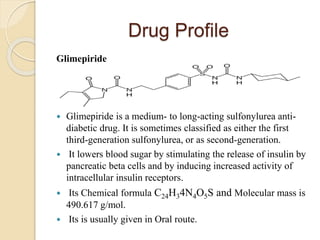
Glimepiride
 Glimepiride is a medium- to long-acting sulfonylurea anti-
diabetic drug. It is sometimes classified as either the first
third-generation sulfonylurea, or as second-generation.
 It lowers blood sugar by stimulating the release of insulin by
pancreatic beta cells and by inducing increased activity of
intracellular insulin receptors.
 Its Chemical formula C24H34N4O5S and Molecular mass is
490.617 g/mol.
 Its is usually given in Oral route.
Design Of Study
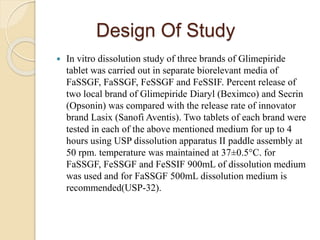
 In vitro dissolution study of three brands of Glimepiride
tablet was carried out in separate biorelevant media of
FaSSGF, FaSSGF, FeSSGF and FeSSIF. Percent release of
two local brand of Glimepiride Diaryl (Beximco) and Secrin
(Opsonin) was compared with the release rate of innovator
brand Lasix (Sanofi Aventis). Two tablets of each brand were
tested in each of the above mentioned medium for up to 4
hours using USP dissolution apparatus II paddle assembly at
50 rpm. temperature was maintained at 37±0.5°C. for
FaSSGF, FeSSGF and FeSSIF 900mL of dissolution medium
was used and for FaSSGF 500mL dissolution medium is
recommended(USP-32).
Composition of Dissolution
Medium
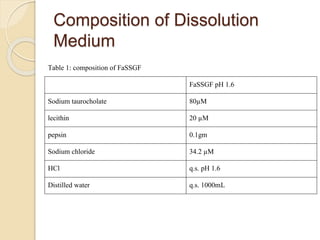
Table 1: composition of FaSSGF
FaSSGF pH 1.6
Sodium taurocholate 80µM
lecithin 20 µM
pepsin 0.1gm
Sodium chloride 34.2 µM
HCl q.s. pH 1.6
Distilled water q.s. 1000mL
Composition of Dissolution
Medium
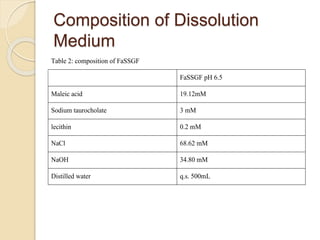
Table 2: composition of FaSSGF
FaSSGF pH 6.5
Maleic acid 19.12mM
Sodium taurocholate 3 mM
lecithin 0.2 mM
NaCl 68.62 mM
NaOH 34.80 mM
Distilled water q.s. 500mL
Composition of Dissolution
Medium
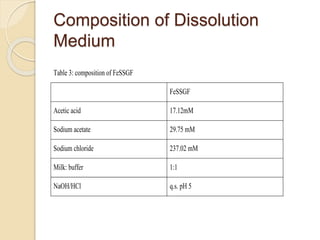
Table 3: composition of FeSSGF
FeSSGF
Acetic acid 17.12mM
Sodium acetate 29.75 mM
Sodium chloride 237.02 mM
Milk: buffer 1:1
NaOH/HCl q.s. pH 5
Composition of Dissolution
Medium
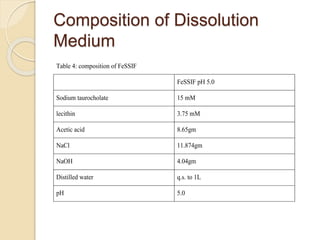
Table 4: composition of FeSSIF
FeSSIF pH 5.0
Sodium taurocholate 15 mM
lecithin 3.75 mM
Acetic acid 8.65gm
NaCl 11.874gm
NaOH 4.04gm
Distilled water q.s. to 1L
pH 5.0
In vitro Glimepiride release
study
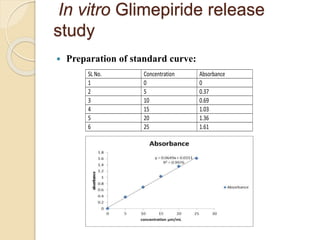
 Preparation of standard curve:
SL No. Concentration Absorbance
1 0 0
2 5 0.37
3 10 0.69
4 15 1.03
5 20 1.36
6 25 1.61
In vitro Glimepiride release
study
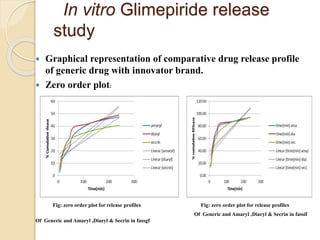
 Graphical representation of comparative drug release profile
of generic drug with innovator brand.
 Zero order plot:
Fig: zero order plot for release profiles Fig: zero order plot for release profiles
Of Generic and Amaryl ,Diaryl & Secrin in fassif
Of Generic and Amaryl ,Diaryl & Secrin in fassgf
In vitro Glimepiride release
study
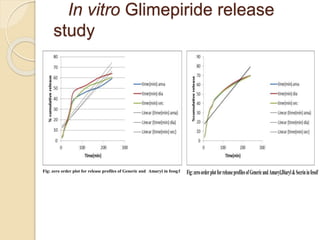
Fig: zero order plot for release profiles of Generic and Amaryl in fessgf Fig:zeroorderplotforreleaseprofilesofGenericandAmaryl,Diaryl&Secrininfessif
In vitro Glimepiride release
study
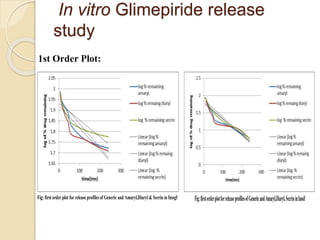
1st Order Plot:
Fig: first order plot for release profiles of Generic and Amaryl,Diaryl & Secrin in fassgf
In vitro Glimepiride release
study
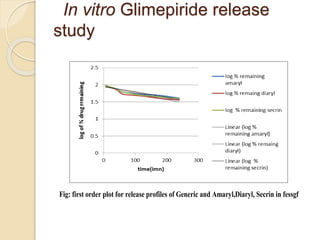
Fig: first order plot for release profiles of Generic and Amaryl,Diaryl, Secrin in fessgf
In vitro Glimepiride release
study
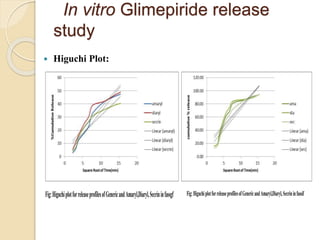
 Higuchi Plot:
Fig:HiguchiplotforreleaseprofilesofGenericandAmaryl,Diaryl,Secrininfassgf Fig:HiguchiplotforreleaseprofilesofGenericandAmaryl,Diaryl,Secrininfassif
In vitro Glimepiride release
study
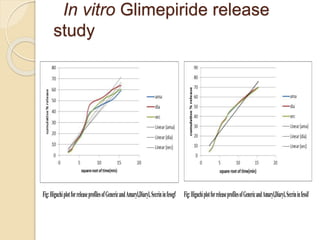
Fig:HiguchiplotforreleaseprofilesofGenericandAmaryl,Diaryl,Secrininfessgf Fig:HiguchiplotforreleaseprofilesofGenericandAmaryl,Diaryl,Secrininfessif
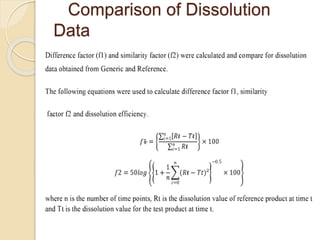
Comparison of Dissolution
Data
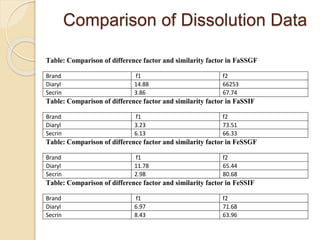
Comparison of Dissolution Data
Table: Comparison of difference factor and similarity factor in FaSSGF
Brand f1 f2
Diaryl 14.88 66253
Secrin 3.86 67.74
Table: Comparison of difference factor and similarity factor in FaSSIF
Brand f1 f2
Diaryl 3.23 73.51
Secrin 6.13 66.33
Table: Comparison of difference factor and similarity factor in FeSSGF
Brand f1 f2
Diaryl 11.78 65.44
Secrin 2.98 80.68
Table: Comparison of difference factor and similarity factor in FeSSIF
Brand f1 f2
Diaryl 6.97 71.68
Secrin 8.43 63.96
Conclusion
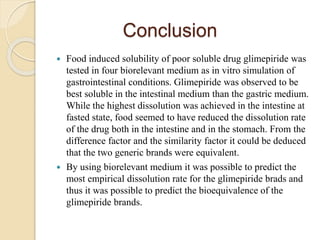
 Food induced solubility of poor soluble drug glimepiride was
tested in four biorelevant medium as in vitro simulation of
gastrointestinal conditions. Glimepiride was observed to be
best soluble in the intestinal medium than the gastric medium.
While the highest dissolution was achieved in the intestine at
fasted state, food seemed to have reduced the dissolution rate
of the drug both in the intestine and in the stomach. From the
difference factor and the similarity factor it could be deduced
that the two generic brands were equivalent.
 By using biorelevant medium it was possible to predict the
most empirical dissolution rate for the glimepiride brads and
thus it was possible to predict the bioequivalence of the
glimepiride brands.
Reference
1. Food and Drug Administration. Guidance for Industry: Waiver of in vivo
bioavailability and bioequivalence studies for immediate-release solid oral dosage forms
based on a Biopharmaceutics Classification System. Food and Drug Administation;
Rockville, MD: 2000. Retrieved from www.fda.gov/cder/guidance/index.htm.
2. Amidon GL, Lennernäs H, Shah VP, Crison JR. A theoretical basis for a
biopharmaceutics drug classification: the correlation of in vitro drug product dissolution
and in vivo bioavailability. Pharm Res. 1995;12:413–420.
3. Wu C-Y, Benet LZ. Predicting drug disposition via application of BCS:
transport/absorption/elimination interplay and development of a Biopharmaceutics Drug
Disposition Classification System. Pharm Res. 2005;22:11–23.
4. Broccatelli FF, Cruciani G, Benet LZ, Oprea TI. BDDCS class prediction for new
molecular entities. Mol Pharmaceut. 2012;9:570–580.
5. Chen ML, Amidon GL, Benet LZ, Lennernas H, Yu LX. The BCS, BDDCS, and
regulatory guidances. Pharm Res. 2011;28:1774–1778.
6. Yan Y, Faustino PJ, Volpe DA, Lyon RC, Yu LX. Biopharmaceutics classification of
selected beta-blockers: Solubility and permeability class membership. Mol Pharmaceut.
2007;4:608–614.
7. Chen ML, Yu L. The use of drug metabolism for prediction of intestinal permeability.
Mol Pharmaceut. 2009;6:74–81.
THANK
YOU

Presentation1

  • 1.
    In vitro BioequivalenceStudy of Glimepiride Using Bio relevant Medium.
  • 2.
    Indroduction • two pharmaceuticalproducts are bioequivalent if they are pharmaceutically equivalent and their bioavailability (rate and extent of availability) after administration in the same molar dose are similar to such a degree that their effects, with respect to both efficacy and safety, can be expected to be essentially the same. • -Drug products in identical dosage forms that contain the same active ingredient -the same salt or ester • -same dosage form -identical in strength or concentration. -may differ in characteristics such as shape, scoring configuration release mechanisms, packaging , excipients. -when applicable , must meet the same content uniformity, disintegration times, and dissolution rates.
  • 3.
    Aim Of TheWork The aim of project work  To evaluate the dissolution rate of Glimepiride ein different biorelevant medium.  To compare the bioequvalence of local generic Glimepiride with the innovator Glimepiride brand.  To predict the effect of presence of food in GI tract in the dissolution of Glimepiride.  To recommend the ideal medication process of the drug.
  • 4.
    Drug Profile Glimepiride  Glimepirideis a medium- to long-acting sulfonylurea anti- diabetic drug. It is sometimes classified as either the first third-generation sulfonylurea, or as second-generation.  It lowers blood sugar by stimulating the release of insulin by pancreatic beta cells and by inducing increased activity of intracellular insulin receptors.  Its Chemical formula C24H34N4O5S and Molecular mass is 490.617 g/mol.  Its is usually given in Oral route.
  • 5.
    Design Of Study In vitro dissolution study of three brands of Glimepiride tablet was carried out in separate biorelevant media of FaSSGF, FaSSGF, FeSSGF and FeSSIF. Percent release of two local brand of Glimepiride Diaryl (Beximco) and Secrin (Opsonin) was compared with the release rate of innovator brand Lasix (Sanofi Aventis). Two tablets of each brand were tested in each of the above mentioned medium for up to 4 hours using USP dissolution apparatus II paddle assembly at 50 rpm. temperature was maintained at 37±0.5°C. for FaSSGF, FeSSGF and FeSSIF 900mL of dissolution medium was used and for FaSSGF 500mL dissolution medium is recommended(USP-32).
  • 6.
    Composition of Dissolution Medium Table1: composition of FaSSGF FaSSGF pH 1.6 Sodium taurocholate 80µM lecithin 20 µM pepsin 0.1gm Sodium chloride 34.2 µM HCl q.s. pH 1.6 Distilled water q.s. 1000mL
  • 7.
    Composition of Dissolution Medium Table2: composition of FaSSGF FaSSGF pH 6.5 Maleic acid 19.12mM Sodium taurocholate 3 mM lecithin 0.2 mM NaCl 68.62 mM NaOH 34.80 mM Distilled water q.s. 500mL
  • 8.
    Composition of Dissolution Medium Table3: composition of FeSSGF FeSSGF Acetic acid 17.12mM Sodium acetate 29.75 mM Sodium chloride 237.02 mM Milk: buffer 1:1 NaOH/HCl q.s. pH 5
  • 9.
    Composition of Dissolution Medium Table4: composition of FeSSIF FeSSIF pH 5.0 Sodium taurocholate 15 mM lecithin 3.75 mM Acetic acid 8.65gm NaCl 11.874gm NaOH 4.04gm Distilled water q.s. to 1L pH 5.0
  • 10.
    In vitro Glimepiriderelease study  Preparation of standard curve: SL No. Concentration Absorbance 1 0 0 2 5 0.37 3 10 0.69 4 15 1.03 5 20 1.36 6 25 1.61
  • 11.
    In vitro Glimepiriderelease study  Graphical representation of comparative drug release profile of generic drug with innovator brand.  Zero order plot: Fig: zero order plot for release profiles Fig: zero order plot for release profiles Of Generic and Amaryl ,Diaryl & Secrin in fassif Of Generic and Amaryl ,Diaryl & Secrin in fassgf
  • 12.
    In vitro Glimepiriderelease study Fig: zero order plot for release profiles of Generic and Amaryl in fessgf Fig:zeroorderplotforreleaseprofilesofGenericandAmaryl,Diaryl&Secrininfessif
  • 13.
    In vitro Glimepiriderelease study 1st Order Plot: Fig: first order plot for release profiles of Generic and Amaryl,Diaryl & Secrin in fassgf
  • 14.
    In vitro Glimepiriderelease study Fig: first order plot for release profiles of Generic and Amaryl,Diaryl, Secrin in fessgf
  • 15.
    In vitro Glimepiriderelease study  Higuchi Plot: Fig:HiguchiplotforreleaseprofilesofGenericandAmaryl,Diaryl,Secrininfassgf Fig:HiguchiplotforreleaseprofilesofGenericandAmaryl,Diaryl,Secrininfassif
  • 16.
    In vitro Glimepiriderelease study Fig:HiguchiplotforreleaseprofilesofGenericandAmaryl,Diaryl,Secrininfessgf Fig:HiguchiplotforreleaseprofilesofGenericandAmaryl,Diaryl,Secrininfessif
  • 17.
  • 18.
    Comparison of DissolutionData Table: Comparison of difference factor and similarity factor in FaSSGF Brand f1 f2 Diaryl 14.88 66253 Secrin 3.86 67.74 Table: Comparison of difference factor and similarity factor in FaSSIF Brand f1 f2 Diaryl 3.23 73.51 Secrin 6.13 66.33 Table: Comparison of difference factor and similarity factor in FeSSGF Brand f1 f2 Diaryl 11.78 65.44 Secrin 2.98 80.68 Table: Comparison of difference factor and similarity factor in FeSSIF Brand f1 f2 Diaryl 6.97 71.68 Secrin 8.43 63.96
  • 19.
    Conclusion  Food inducedsolubility of poor soluble drug glimepiride was tested in four biorelevant medium as in vitro simulation of gastrointestinal conditions. Glimepiride was observed to be best soluble in the intestinal medium than the gastric medium. While the highest dissolution was achieved in the intestine at fasted state, food seemed to have reduced the dissolution rate of the drug both in the intestine and in the stomach. From the difference factor and the similarity factor it could be deduced that the two generic brands were equivalent.  By using biorelevant medium it was possible to predict the most empirical dissolution rate for the glimepiride brads and thus it was possible to predict the bioequivalence of the glimepiride brands.
  • 20.
    Reference 1. Food andDrug Administration. Guidance for Industry: Waiver of in vivo bioavailability and bioequivalence studies for immediate-release solid oral dosage forms based on a Biopharmaceutics Classification System. Food and Drug Administation; Rockville, MD: 2000. Retrieved from www.fda.gov/cder/guidance/index.htm. 2. Amidon GL, Lennernäs H, Shah VP, Crison JR. A theoretical basis for a biopharmaceutics drug classification: the correlation of in vitro drug product dissolution and in vivo bioavailability. Pharm Res. 1995;12:413–420. 3. Wu C-Y, Benet LZ. Predicting drug disposition via application of BCS: transport/absorption/elimination interplay and development of a Biopharmaceutics Drug Disposition Classification System. Pharm Res. 2005;22:11–23. 4. Broccatelli FF, Cruciani G, Benet LZ, Oprea TI. BDDCS class prediction for new molecular entities. Mol Pharmaceut. 2012;9:570–580. 5. Chen ML, Amidon GL, Benet LZ, Lennernas H, Yu LX. The BCS, BDDCS, and regulatory guidances. Pharm Res. 2011;28:1774–1778. 6. Yan Y, Faustino PJ, Volpe DA, Lyon RC, Yu LX. Biopharmaceutics classification of selected beta-blockers: Solubility and permeability class membership. Mol Pharmaceut. 2007;4:608–614. 7. Chen ML, Yu L. The use of drug metabolism for prediction of intestinal permeability. Mol Pharmaceut. 2009;6:74–81.
  • 21.