Human Turbinate Mesenchymal Stromal Cells as a Potential Option for
Cartilage Tissue Engineering
Se Hwan Hwang1†, Sung Won Kim1†, Su Young Kim2, Sun Hwa Park1, Hun-Jun Lee2,
Mi Young Choi1, Hea Jin Oh1, Se Hyeun Kim1, Jong Won Rhie3, and Dong Il Sun1*
1Department of Otolaryngology-Head and Neck Surgery, The Catholic University of Korea, College of Medicine, Seoul, Korea
2Department of Pathology, The Catholic University of Korea, College of Medicine, Seoul, Korea
3Department of Plastic Surgery, The Catholic University of Korea, College of Medicine, Seoul, Korea
Introduction
Evaluated the effects of co-culture with human septal chondrocytes (hSCs) on the chondroinduction of hTMSCs.
The efficiency of co-culture with hSCs were analyzed histologically by toluidine blue O staining.
Mesenchymal stem cell surface markers was assessed by fluorescence-activated cell sorting.
Cartilage-specific gene expression and matrix production were evaluated quantitatively by real-time PCR and Western blotting
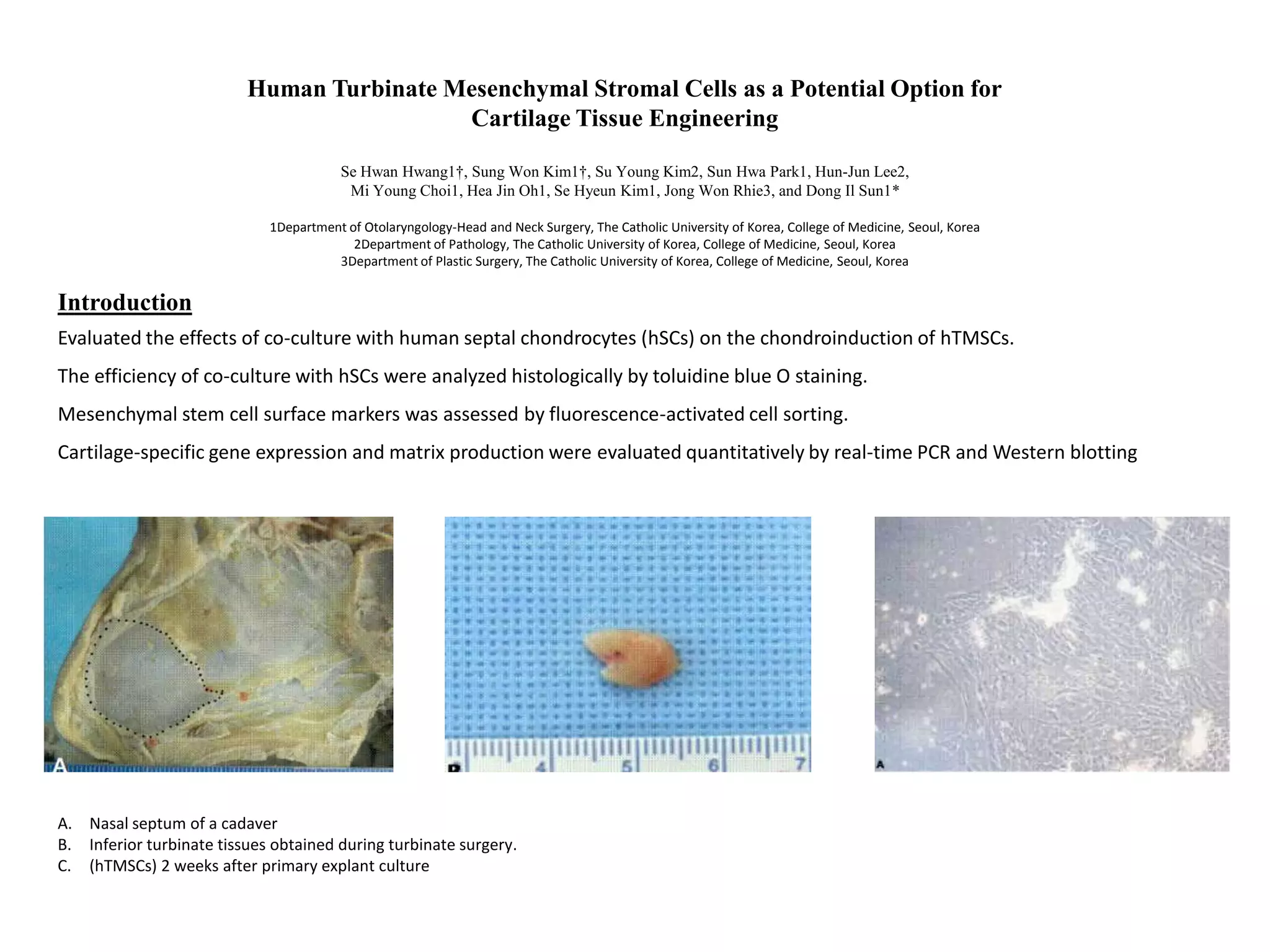
A. Nasal septum of a cadaver
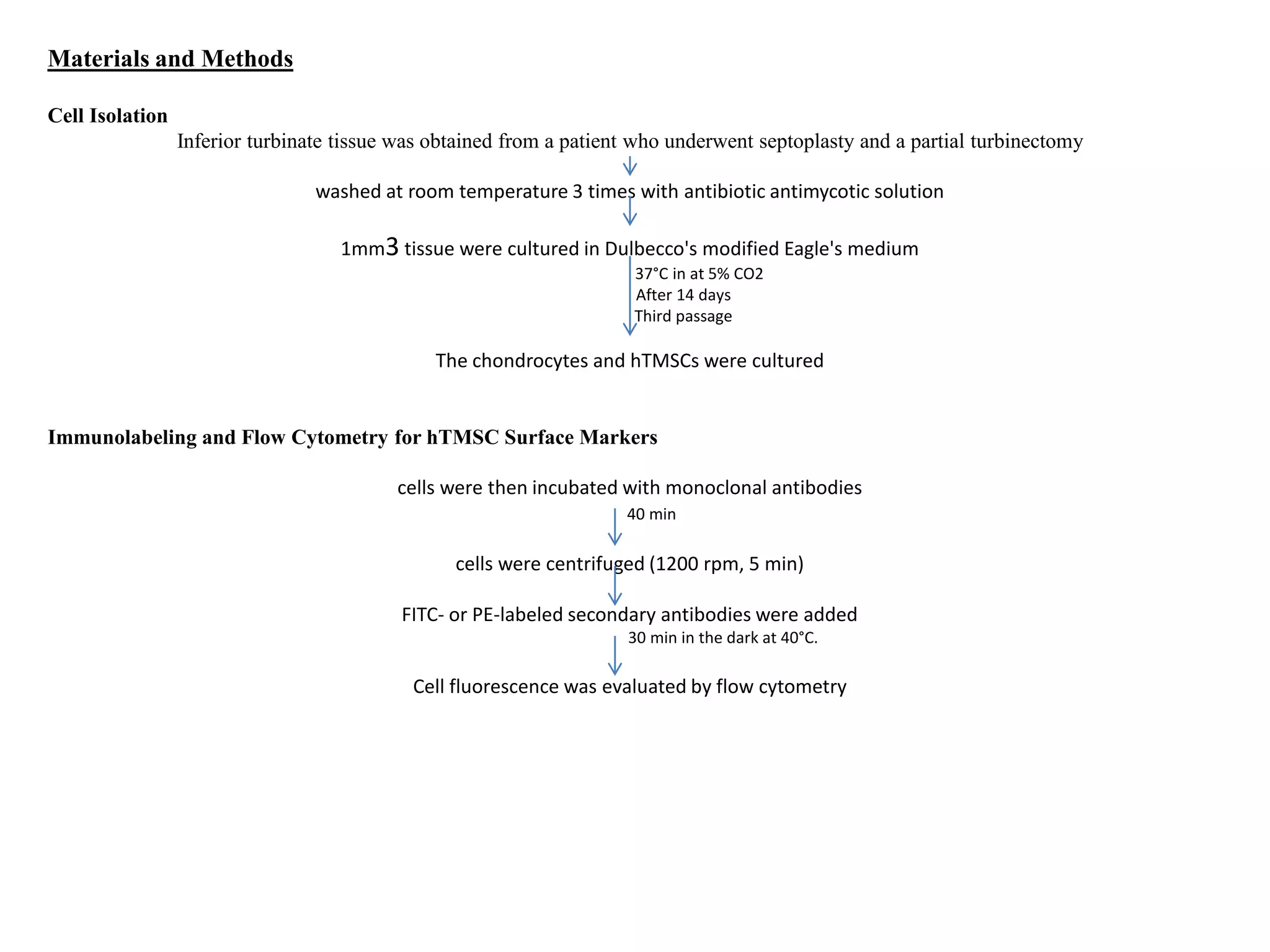
B. Inferior turbinate tissues obtained during turbinate surgery.
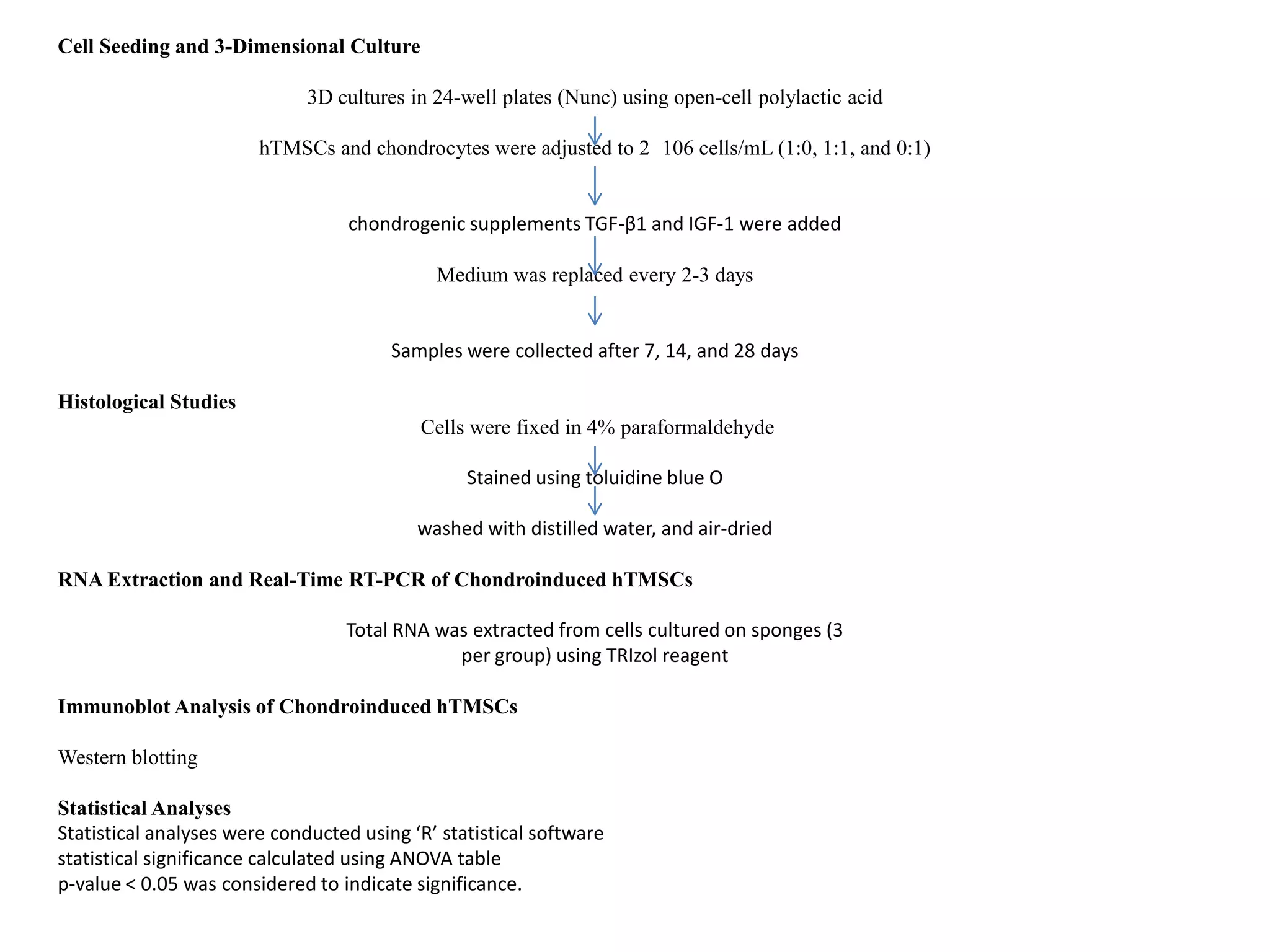
C. (hTMSCs) 2 weeks after primary explant culture
Materials and Methods
Cell Isolation
Inferior turbinate tissue was obtained from a patient who underwent septoplasty and a partial turbinectomy
washed at room temperature 3 times with antibiotic antimycotic solution
1mm3 tissue were cultured in Dulbecco's modified Eagle's medium
37°C in at 5% CO2
After 14 days
Third passage
The chondrocytes and hTMSCs were cultured
Immunolabeling and Flow Cytometry for hTMSC Surface Markers
cells were then incubated with monoclonal antibodies
40 min
cells were centrifuged (1200 rpm, 5 min)
FITC- or PE-labeled secondary antibodies were added
30 min in the dark at 40°C.
Cell fluorescence was evaluated by flow cytometry
Cell Seeding and 3-Dimensional Culture
3D cultures in 24-well plates (Nunc) using open-cell polylactic acid
hTMSCs and chondrocytes were adjusted to 2 106 cells/mL (1:0, 1:1, and 0:1)
chondrogenic supplements TGF-β1 and IGF-1 were added
Medium was replaced every 2-3 days
Samples were collected after 7, 14, and 28 days
Histological Studies
Cells were fixed in 4% paraformaldehyde
Stained using toluidine blue O
washed with distilled water, and air-dried
RNA Extraction and Real-Time RT-PCR of Chondroinduced hTMSCs
Total RNA was extracted from cells cultured on sponges (3
per group) using TRIzol reagent
Immunoblot Analysis of Chondroinduced hTMSCs
Western blotting
Statistical Analyses
Statistical analyses were conducted using ‘R’ statistical software
statistical significance calculated using ANOVA table
p-value < 0.05 was considered to indicate significance.
Results and discussion
• Flow cytometric analysis reveled expression of several MSC markers, HLA antigens, and
hematopoietic stem cell markers.
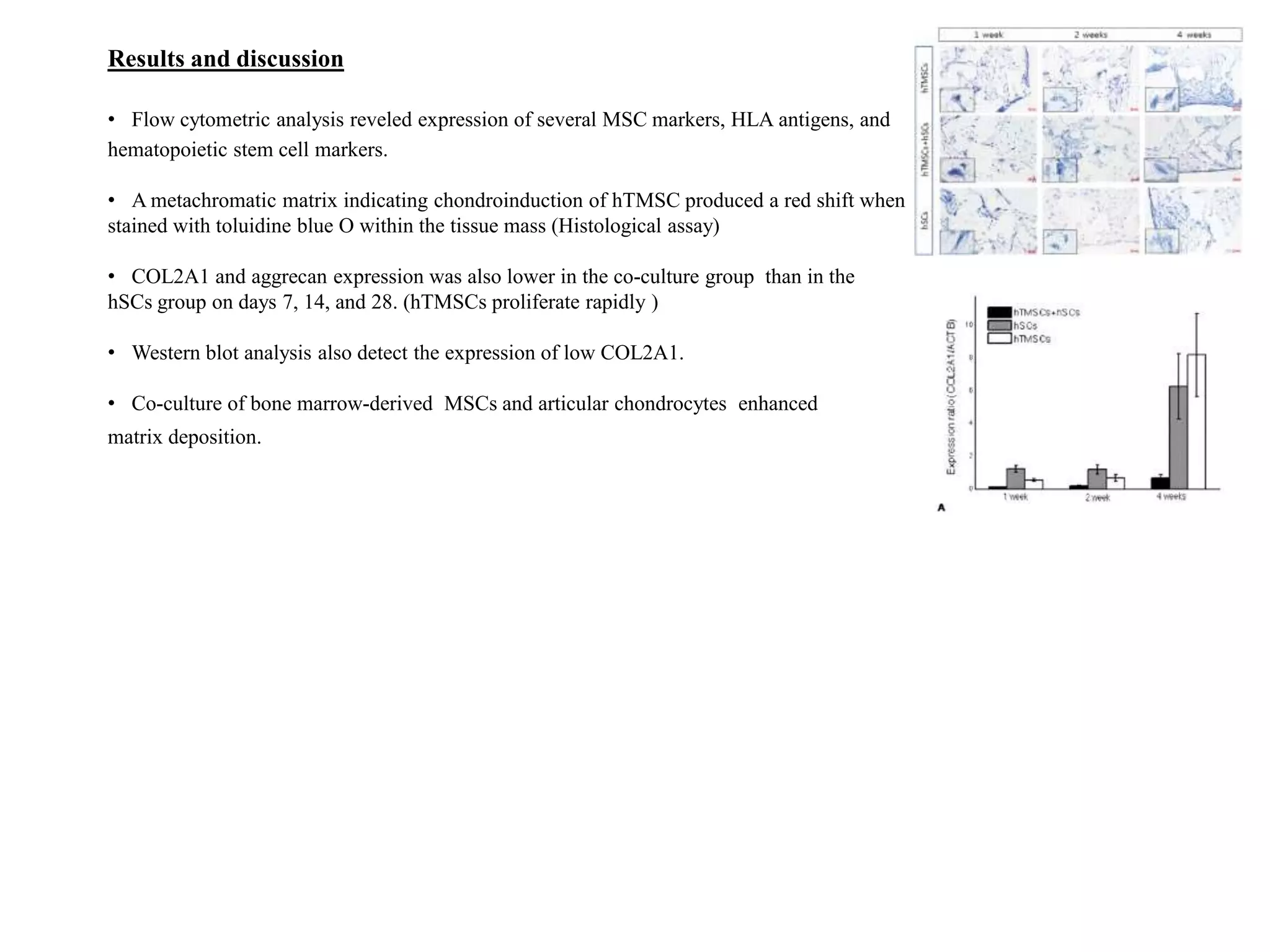
• A metachromatic matrix indicating chondroinduction of hTMSC produced a red shift when
stained with toluidine blue O within the tissue mass (Histological assay)
• COL2A1 and aggrecan expression was also lower in the co-culture group than in the
hSCs group on days 7, 14, and 28. (hTMSCs proliferate rapidly )
• Western blot analysis also detect the expression of low COL2A1.
• Co-culture of bone marrow-derived MSCs and articular chondrocytes enhanced
matrix deposition.

Presentation1

  • 1.
    Human Turbinate MesenchymalStromal Cells as a Potential Option for Cartilage Tissue Engineering Se Hwan Hwang1†, Sung Won Kim1†, Su Young Kim2, Sun Hwa Park1, Hun-Jun Lee2, Mi Young Choi1, Hea Jin Oh1, Se Hyeun Kim1, Jong Won Rhie3, and Dong Il Sun1* 1Department of Otolaryngology-Head and Neck Surgery, The Catholic University of Korea, College of Medicine, Seoul, Korea 2Department of Pathology, The Catholic University of Korea, College of Medicine, Seoul, Korea 3Department of Plastic Surgery, The Catholic University of Korea, College of Medicine, Seoul, Korea Introduction Evaluated the effects of co-culture with human septal chondrocytes (hSCs) on the chondroinduction of hTMSCs. The efficiency of co-culture with hSCs were analyzed histologically by toluidine blue O staining. Mesenchymal stem cell surface markers was assessed by fluorescence-activated cell sorting. Cartilage-specific gene expression and matrix production were evaluated quantitatively by real-time PCR and Western blotting A. Nasal septum of a cadaver B. Inferior turbinate tissues obtained during turbinate surgery. C. (hTMSCs) 2 weeks after primary explant culture
  • 2.
    Materials and Methods CellIsolation Inferior turbinate tissue was obtained from a patient who underwent septoplasty and a partial turbinectomy washed at room temperature 3 times with antibiotic antimycotic solution 1mm3 tissue were cultured in Dulbecco's modified Eagle's medium 37°C in at 5% CO2 After 14 days Third passage The chondrocytes and hTMSCs were cultured Immunolabeling and Flow Cytometry for hTMSC Surface Markers cells were then incubated with monoclonal antibodies 40 min cells were centrifuged (1200 rpm, 5 min) FITC- or PE-labeled secondary antibodies were added 30 min in the dark at 40°C. Cell fluorescence was evaluated by flow cytometry
  • 3.
    Cell Seeding and3-Dimensional Culture 3D cultures in 24-well plates (Nunc) using open-cell polylactic acid hTMSCs and chondrocytes were adjusted to 2 106 cells/mL (1:0, 1:1, and 0:1) chondrogenic supplements TGF-β1 and IGF-1 were added Medium was replaced every 2-3 days Samples were collected after 7, 14, and 28 days Histological Studies Cells were fixed in 4% paraformaldehyde Stained using toluidine blue O washed with distilled water, and air-dried RNA Extraction and Real-Time RT-PCR of Chondroinduced hTMSCs Total RNA was extracted from cells cultured on sponges (3 per group) using TRIzol reagent Immunoblot Analysis of Chondroinduced hTMSCs Western blotting Statistical Analyses Statistical analyses were conducted using ‘R’ statistical software statistical significance calculated using ANOVA table p-value < 0.05 was considered to indicate significance.
  • 4.
    Results and discussion •Flow cytometric analysis reveled expression of several MSC markers, HLA antigens, and hematopoietic stem cell markers. • A metachromatic matrix indicating chondroinduction of hTMSC produced a red shift when stained with toluidine blue O within the tissue mass (Histological assay) • COL2A1 and aggrecan expression was also lower in the co-culture group than in the hSCs group on days 7, 14, and 28. (hTMSCs proliferate rapidly ) • Western blot analysis also detect the expression of low COL2A1. • Co-culture of bone marrow-derived MSCs and articular chondrocytes enhanced matrix deposition.