1. INTRODUCTION
     1.1. HISTORY OF CEMENT
  The word “cement” derived from "caementum" in Latin meaning hewn stone chips and
  then started to be used in the meaning of “binder”. The date of the first reinforced concrete
  building is 1852 but yet the use of binding agents in the construction of buildings dates
  back to very old times. The first material used as binding agent is lime. Although there are
  no precise findings, it is possible to say that the binding property of lime was discovered in
  the early period of human history, in 2000s B.C. Examples of the use of lime as a
  construction material have been encountered in different regions of the Ancient Egypt,
  Cyprus, Crete and Mesopotamia. The Ancient Greeks and Romans used lime as a
  hydraulic binder. Architect Vitruvius (70-25 B.C.), in his 10-volume book "On
  Architecture", mentions the hydraulic properties of pozzolana and lime and even gives a
  mixing ratio that can be used in the buildings to be constructed by rivers and seas.
  Research results prove that the plaster used in the construction of Çatalhöyük houses in
  Anatolia dates back to 7000 years ago.


  Throughout the history, many different binding agents symbolizing the civilization of that
  period were used in the Egyptian Pyramids and the Great Wall of China and in the castles
  built at different times. Later on, nearly 2000 years ago, the Romans mixed hydrated lime
  with volcanic ashes and afterwards with dusts obtained from fired brick and thus started to
  use a hydraulic binder having properties similar to those of today‟s cement. On the other
  hand, the Ancient Greeks prepared mortar by mixing the volcanic tuffs on Santorini Island
  with lime or with some sort of hydraulic lime they obtained from argillaceous limestone.


  The Ancient Greeks and Romans discovered the hydraulic property of lime and pozzolona
  mixtures and used such mixtures but did not have the knowledge to explain lime
  acquisition or pozzolanic reactions in terms of chemistry. For instance, Pliny (Roman
  scholar Gaius Plinius) writes that it is inexplicable why "the lime obtained by burning
  stone in fire re-flames when it comes into contact with water." However, in the 18th
  century, a significant development occurred in the quality and usage of binding agents.
  John Smeaton, who was charged with rebuilding Eddystone Lighthouse in 1756, is known
  to be the first person to comprehend the chemical properties of lime. The following
  development is the acquisition of a binder known as "Roman Cement" by Joseph Parker.
In 1824, Joseph Aspdin, a stonemason in Leeds-England, obtained a binding agent by
firing and then grinding the mixture of fine-grain clay and limestone. Joseph Aspdin added
water and sand to that product and thus enabled it to harden in time and then saw that the
resulting material resembled the building stones obtained from England‟s Portland Island.
So, on 21.10.1824, he took out a patent for that binder under the name of "Portland
Cement". Even though that binder was improved greatly in the following years, the name
"Portland" remained the same.


As a matter of fact, the binder produced by Joseph Aspdin could not have all properties of
today‟s Portland Cement due to the fact that it was not fired at temperatures high enough
during production. Nonetheless, it was found out that Wakefield Arms, which is still
standing next to Kirkgate Station in England, was built with the binder produced by Joseph
Aspdin. The process of firing at high temperatures and then grinding raw materials was
realized by an Englisman called Isaac Johnson (1845).


It was seen that, in Anatolia, natural pozzolanic active materials mixed with magnesian
lime were used in the preparation of mortar in Hittite cities and in particular in the ancient
cities located in Çorum, Tokat and Malatya.


Apart from that, examples such as the use of common lime and basaltic pozzolanic matter
in the historical ruins of the Assyrians in the Southeastern Anatolia point out that cement
was used in Anatolia before the Greeks and Romans. In the ancient cities of Teos- İzmir,
Ephesus- İzmir, Aphrodisias-Aydın, Kinidos- Muğla, cement and mortar were also
encountered following wide contact with ancient Anatolian civilizations.


Although cement production and sales commenced in 1878 in the world, cement sector
was introduced to Turkey primarily in 1912 with private sector‟s initiative. The 34-year
delay in question results from insufficient hydraulic lime production and the fact that those
years coincided with the fall of the Ottoman Empire.


The first cement production plant in the world was founded in 1848 in England. The first
German Cement Standard was created in 1860. And, the establishment of the American
Concrete Institut and the creation of the first American Regulations coincide with 1913.
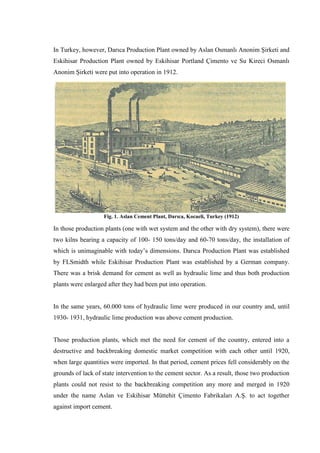
In Turkey, however, Darıca Production Plant owned by Aslan Osmanlı Anonim Şirketi and
Eskihisar Production Plant owned by Eskihisar Portland Çimento ve Su Kireci Osmanlı
Anonim Şirketi were put into operation in 1912.


                   Fig. 1. Aslan Cement Plant, Darıca, Kocaeli, Turkey (1912)

In those production plants (one with wet system and the other with dry system), there were
two kilns bearing a capacity of 100- 150 tons/day and 60-70 tons/day, the installation of
which is unimaginable with today‟s dimensions. Darıca Production Plant was established
by FLSmidth while Eskihisar Production Plant was established by a German company.
There was a brisk demand for cement as well as hydraulic lime and thus both production
plants were enlarged after they had been put into operation.


In the same years, 60.000 tons of hydraulic lime were produced in our country and, until
1930- 1931, hydraulic lime production was above cement production.


Those production plants, which met the need for cement of the country, entered into a
destructive and backbreaking domestic market competition with each other until 1920,
when large quantities were imported. In that period, cement prices fell considerably on the
grounds of lack of state intervention to the cement sector. As a result, those two production
plants could not resist to the backbreaking competition any more and merged in 1920
under the name Aslan ve Eskihisar Müttehit Çimento Fabrikaları A.Ş. to act together
against import cement.
1.2. ABOUT GÖLTAŞ GÖLLER BÖLGESİ ÇİMENTO SAN. VE TİC. A.Ş.
       1.2.1. COMPANY
Göltaş Göller Bölgesi Çimento Sanayi ve Ticaret Anonim Şirketi was founded at Isparta in
1969 as the first private sector cement factory having 600.000 tons/year capacity and 60
Million TL capital by the participation of 2.000 shareholders. The establishment purpose of
the factory is to produce cement for Isparta, Burdur, Antalya and partially Denizli and to
perform marketing and delivery in these regions.


The Company commenced operations by completing of the investments in 1973. The
location where Göltaş Çimento has been established is extremely rich in terms of raw
material. Limestone and clay deposits which are the raw materials of Clinker Production
are existed in the factory area.


Since 1973 increasing profitability of the Company continued until 1979 where electricity
and fuel-oil shortage reached to maximum level. The Company made its first exportation
in 1981, while domestic cement demand entered in stationery state and became more
profitable due to domestic sales. A new investment was started for converting from fuel-oil
system to coal system in 1983. When the investment has been concluded at the end of 1984
the fuel was converted to coal and it provided a great economy in comparison with fuel-oil
system. Increasing of capacity, renovation and modernization investments were
commenced after 1984. The first part of the capacity increasing works was concluded in
1986. As result of these investments cement production and sales increased significantly.


Investment of the second clinker line (Bonn Line) was started in 1987. When it was
commissioned on 27 June1992 our capacity increased to 4.000 tons per day from 2.200
tons per day. The second investment was costed 35 million Dollars.


The Company passed to the registered capital system by the permission of Capital Markets
Board dated 01 December 1994 and numbered 1227. Necessary permits were received
from Capital Markets Board and other necessary associations regarding the Company in
order to be traded at the stock exchange and all par value stocks at the amount of
33.600.000.000.- were sold by seven-fold value and as of 06 March 1995, 13% of
company shares started to trade at the İstanbul Stock exchange.
The Company made its second public offering in 1997. The capital of the company was
increased from 254.1 Billion TL to 600 Billion TL; and par value stocks of the company
corresponding to 15.3% of the capital equivalent to 98.1 Billion TL were sold to abroad by
27.5 fold value at 2.524 Trillion. As of 19 August 1997 they had started to be dealted in
Istanbul Stock Exchange.


The capital that was 600 Billion in 1998 was increased to 3,6 Trillion TL and 7,2 Trillion
TL in 2002.


       1.2.2. PRODUCTS
Cement types were determined in accordance with the the requirements in region and raw
material sources.Seven types cement have been produced in the factory. They are;
       TS EN 197-1 CEM II/B-M (P-LL) 32,5 N
       TS EN 197-1 CEM II/A-M (P-LL) 42,5 R
       TS EN 197-1 CEM II/A-M (P-LL) 42,5 N
       TS EN 197-1 CEM I 42,5 R
       TS EN 197-1 CEM I 42,5 N
       TS 10157 SDÇ 42,5 R (Sulphate Resistant Cement)


TS EN 197-1 CEM II/B-M (P-LL) 32,5 N: Total Additive in the CEM II/B-M (P-LL) 32.5
N cement, is between 21 - 35%.CEM II/B-M (P-LL) 32.5 N cement is used for general
purposes. It can be used in mass concrete applications such as foundations, retaining walls
and dams. It is a good connector in terms of chemical endurability.


TS EN 197-1 CEM II/A-M (P-LL) 42,5 R-       TS EN 197-1 CEM II/A-M (P-LL) 42,5 N:
Total additive in CEM II/A-M (P-LL) 42.5 R and CEM II/A-M (P-LL) 42.5 N cements are
between 6 - 20%.CEM II/A-M (P-LL) 42.5 R and CEM II/A-M (P-LL) 42.5 N cements are
used for general purposes. They can be used in mass concrete applications such as
foundations, retaining walls and dams. They are good connectors in terms of chemical
endurability.


TS EN 197-1 CEM I 42,5 R - TS EN 197-1 CEM I 42,5 N: CEM I 42,5 R andCEM I 42,5
Ncements are produced by grounding of clinker at the rate of 96% and 4% limestone in the
mills approximately. The limestone that is added during grounding process is for
adjustment of the setting period. Final resistance is obtained at the end of 28 days
regarding Portland Cements. Increasing of the resistance after this period is too few and
slow.This cements are used when high resistance concrete is required or for manufacturing
of concrete that has high strength resistance initially. Prefabricate, prestressed concretes
are suitable for tunnel form applications, which are very common at work of arts and
collective housing constructions.


TS 10157 SDÇ 42,5 R (Sulphate Resistant Cement): This cement is manufactured by
grounding of specially produced clinker with limestone in the mill. The rate of C3A
(tricalcium aluminat) should be maximum 5% and the amount of C4Af + 2C3A should be
makximum 25% in the cement. This production that requires intensive labor and technique
from preparation of the raw material to kilning them in the kiln privately therefore it is
made by less number factories in our country.This cement shows resistance against cement
sulphate waters; therefore it is used at harbors, waste water systems, dams, underground
water pipes, foundations, sewers, irrigation canals and treatment plants. It is appropriate
cement for using at the structures that require resistancy against chemical effects such as
sea water and sulphate environments.


       1.2.3. PRODUCTION UNITS AND CAPACITY
Two Pieces Rotating Kiln:
1st 2.200 Tons/Day Clinker
2nd 4.000 Tons/Day Clinker


Three Pieces Raw Material Crusher:
1st Raw Material Crusher 350 Tons/Hour
2nd Raw Material Crusher 450 Tons/Hour
One Piece Pozzolanas Crusher 150 Tons/Hour


Three Pieces Raw Meal Mill:
1st Raw Meal Mill with Horizontal Ball 160 Tons/Hour
2nd Raw Meal Mill with Vertical Roller 130 Tons/Hour
3rd Raw Meal Mill with Vertical Roller 175 Tons/Hour
One Piece Coal Crusher:100 Tons/Hour


  Two Pieces Coal Mill:
  1st Line Coal Mill with Vertical Vals 18 Tons/Hour
  2nd Line Coal Mill with Horizontal Ball 18 Tons/Hour


  Four Pieces Cement Mill:
  1st Mill with pre-crusher, ball and separator 65 Tons/Hour
  2nd Mill with pre-crusher, ball and separator 65 Tons/Hour
  3rd Mill with ball and separator 70 Tons/Hour
  4th Mill with ball and separator 140 Tons/Hour


  Pozzolanas Drying Two Pieces Trommel (with spare): 100 Tons/Hour


  Packaging Unit:
  4 pieces 2.500 Tons Bunker/Silo
  1 Pieces 10.000 Tons Bunker/Silo
  8 Pieces Rotary Weigh-Bridge 800 Tons/Hour
  5 Pieces Bulk Cement Line 500 Tons/Hour
  7 Pieces Big-Bag Filing Facility
  - 3.000 Tons/Day for CEM I 42,5 R
  - 1.500 Tons/Day for CEM II/A-M (P-LL) 42,5 R Sling-Bag
  - 3.750 Tons/Day for CEM I 42,5 R


2. MANUFACTURING
  Fundamentally, cement is defined as a hydraulic binding agent which is obtained as the
  mixture of natural limestone and clay is heated at a high temperature and then ground.
  Hydraulic binding agents create a hard mass as a result of reacting with water and then do
  not dissolve in water but retain or increase their hardness and strength.


  Like other binding agents, cements are comprised of alkaline elements such as CaO and
  MgO and hydraulic elements such as SiO2, Al2O3 and Fe2O3. The rates of alkaline and
  hydraulic elements determine the quality of binding agents.
Fig. 2. The basic components of the cement production process


   2.1. RAW MATERIALS
       2.1.1. LIMESTONE
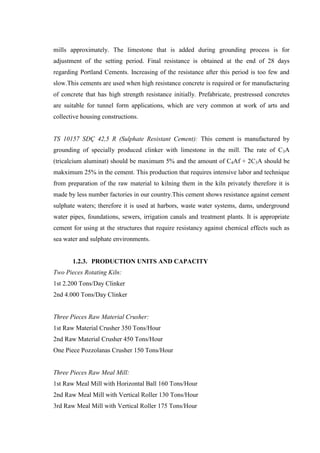
                                          Limestone requirement of the factory has been
                                          provided by factory‟s limestone quarries, which are
                                          about 3 kms away. Minerals that contain rich
                                          minerals (includes minimum 90% CaCO3 in its
                                          chemical composition) in terms of tertial aged lime
                                          are called as limestonea (calcerous) and they are
                                          indicated as CaCO3. For producing of clinker, all
                                          geological types CaCO3 is suitable. The purest types
           Fig. 3. Limestone
                                          of limestone are Calcite and Aragonite. Limestone
and chalk are the most common types. Marble is the type of calcite that has visible crystal
grainy structure.


The hardness of the calcerous is 3 and specific gravity is 2,5-2,7 gr/cm3. Limestone
deposits occur as travertine by the effect of underground waters, and by the effect of
chemical, organic and mechanic precipatition of the sea-water and fresh waters. It can be
seen at yellow, brown and black colors because of subsidiary various substances and
compounds taking part in its structure.Close location of the limestone deposits that have
been used as raw material of cement, easy operation of the quarry, having low humidity
and homogeneous characteristics are the most important factors that affect production
costs.


Rock units that have existed around the Göltaş Çimento A.Ş. are at the time interval
between upper cretaceous and oligocene. The rock units at the environment are forme by
carbonated rocks and detrital sedimentaries. Upper cretaceous aged carbonated rock mass
has been separated in two different units as Söbüdağ Limestone and Senirce Limestone.
The Limestone that is required by Göltaş Çimento A.Ş., is supplied from Söbüdağ
Limestone Quarry that displays wide expansion in the south of the factory area. The
operated limestone area has been limited by the Göltaş fault from the North. The width of
the hydrothermal separation zone that has developed alongside of the fault, changes
between 150 and 250 meters. Hydrothermal solutions and gasses that have increased
alongside of the Göltaş Fault, which is a deep originated fault, have affected the compound
and structure of the limestones, which exist at the close locations to the fault.
         2.1.2. CLAY
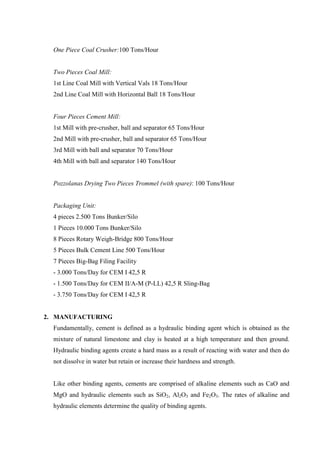
                                      Limestone that has silica, clayish materials and iron
                                      oxide is called Marn. Since it has existed on a vast
                                      scale on the earth, it is the most common used material
                                      in terms of cement production.


                                      In terms of geological point of view, Marn is a
                                     sedimentary rock that occurred as the result of the
            Fig. 4. Clay
                                     precipitation of CaCO3 and Clayish substances at the
same time. In terms of formation it is sedimentary completely, had diagenesis, and exists
usually as regular bedded. Marn formation mainly occurs at the quiet environments where
tectonic and orogenic movements have calmed down. Color of the Marn changes from
yellow to grayish black depends on the clayis materials.


In comparison with calcerous, Marn can be educted easily because of being softer and
energy consumption of crushing and grounding becomes lower as well.


Marn deposits that exist around the Göltaş Çimento A.Ş. have located in Eocene aged
Kayıköy formation. The marn deposit that exists at the environment is observed as a
stratigraphic scale, which can be monitored horizontally within the Kayıköy Formation.
The marn that has been required by Göltaş Çimento A.Ş. is supplied from marn quarries
that exist approximately 3 km away in the northwest of the factory area.


       2.1.3. IRON ORE
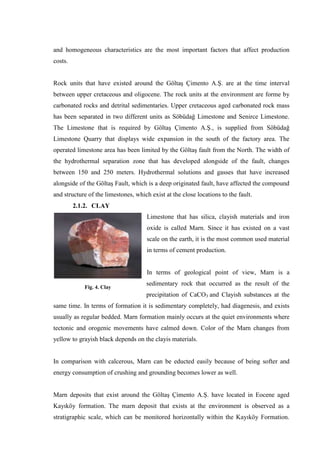
                                    Iron Ore exists in the nature mostly as hematite. The
                                    color of hematite is red and is used in cement factory.
                                    The mole weight is 150.68 and its density is 4,9-5,3
                                    gr/cm3. Determination       of the     melting point    is
                                    impossible; because the Fe2O3 that is heated under the
                                    atmospheric    conditions    dissolved    and    becomes
          Fig. 5. Iron ore          magnetic together with oxygen. The color of the ore in
amorphous conditions is reddish. Iron ore is procured by purchasing from producer
companies.


       2.1.4. BAUXITE
Bauxite is an aluminum ore and has occurred from oxides and contains hydration water. It
exists mainly at the hot regions. It occurs from decomposition of the aluminum silicate
rocks such as granite, gneiss by aerifying. Its structure is flabby and earthy. Its color is
usally white and because of iron oxide admixtures it is brownish or reddish. The hardness
degree is 1-3 and its density is 2,5-3,0 gr/cm3.Buxite that is occurred by SiO2, Al2O3, Fe2O3
ve H2O virtually, can have (~%3) TiO2 in small quantities.Bauxite ore is procured by
purchasing from producer companies.


       2.1.5. AXUILIARY MATERIALS AND ADDITIVES
Gypsum (CaSO4.2H2O):Gypsum is seen between the sedimentary masses, which were
precipitated at the dry, semi-dry climate regions in the ancient geological eras. It exists in
the nature as massive mass, as well as mixed with bitumen, clay, limestone and iron oxide.
Since it is a precipitated sedimentary mass mineral, it isn‟t dissolved in acides easily. It‟s
hardness is 2,0 - 2,4 and specific gravity is 2,2 - 2,4 gr/cm3. Gypsum is expressed by the
(CaSO4.2H2O) chemical formula and by losing some of its water at 120 0C and
hydrates.Addition to the clinker between 3-5% is to control starting and ending of the
cement freezing. Both minority and majority of the amount of limestone has role in terms
of accelerating of the freezing period. Therefors it is essential addition of it at specific
rates.Gypsum ore is procured by purchasing from producer companies.
Pozzolanas:According to TS 25, pozzolanas is a kind of volcanic rock that does not have
hydraulic connective attributes, however can constitute connective substances when it is
mixed with other substances such as tinny grounded limestone or cement and provides
chemical resistance to cement, where it is added.Pozzolanas constitutes the most important
section of the natural pozzuolanas those are used as additive in cement and known as
trachyte andesitic tuff.

Pozzolanas requirement of plant has been supplied from its own quarries at Dereboğazı,
which is about 25 km away. There are trias, jura, cretaceous aged volcanites at the working
area and close environment. The substance that will be used as additive should have high
pozzolanic activity and low SO3 amount.According to chemical experiments and
pozzolanic activity experiment that will be performed in accordance with TS 25 it is
decided, whether pozzolanas will be used as additive.

    2.2. RAW MATERIALS PREPARATION

Raw materials preparation starts with extraction of the main components, which are
limestone and clay. The main raw materials come from natural rocks existing in the
quarries. They are supplied to crushers and then transferred to storage. Other (corrective)
materials such as iron ore, bauxite,gypsum or pozzolanas are added with a varying
percentage to reach the optimum chemical composition of each type of cement.

        2.2.1. QUARRY

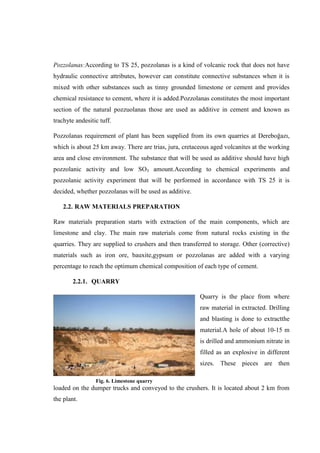
                                                        Quarry is the place from where
                                                        raw material in extracted. Drilling
                                                        and blasting is done to extractthe
                                                        material.A hole of about 10-15 m
                                                        is drilled and ammonium nitrate in
                                                        filled as an explosive in different
                                                        sizes. These pieces are then

                 Fig. 6. Limestone quarry
loaded on the dumper trucks and conveyod to the crushers. It is located about 2 km from
the plant.
2.2.2. CRUSHER

                                           Raw   material    such   as   limestone,   clay    and
                                           pozzolanas dumped into hoppers by dump trucks
                                           and enteredinto a hammer crusher through an apron
                                           feeder. Insidehammer crusher there are hammers
                                           each having aweight of 100-102 kg. They rotate at a
                                           speed of 1200-1300 rpm and is capable of crushing

       Fig. 7. Hammer crusher
feed of very large sizes.

   2.3. GRINDING AND HOMOGENIZATION

The grinding process takes place in a raw mill to reduce the particle size of the components
to a typical value of 10-15 % residue on a 90 μm sieve. There are three raw mill in the
plant, a ball mill and two vertical roller mills. The output of the grinding process – called
„raw meal‟ – is transferred to a homogenization silo before the clinker manufacturing
process.
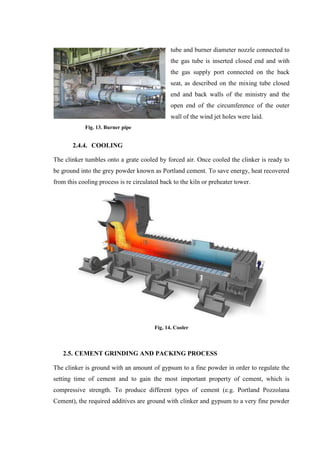
       2.3.1. BALL MILL

                                                                             Ball Mill grinds
                                                                             material           by
                                                                             rotating a cylinder
                                                                             with            steel
                                                                             grinding        balls,
                                                                             causing the balls
                                                                             to fall back into
                                                                             the cylinder and
                                                                             onto the material
                                                                             to be ground. The
                                                                             rotation is usually
                                                                             between 4 to 20
                       Fig. 8. Ball mill
                                                            revolutions per minute, depending
upon the diameter of the mill. The larger the diameter, the slower the rotation. If the
peripheral speed of the mill is too great, it begins to act like a centrifuge and the balls do
not fall back, but stay on the perimeter of the mill.The point where the mill becomes a
centrifuge is called the "Critical Speed", and ball mills usually operate at 65% to 75% of
the critical speed.


Ball Mills are generally used to grind material 1/4 inch and finer, down to the particle size
of 20 to 75 microns. To achieve a reasonable efficiency with ball mills, they must be
operated in a closed system, with oversize material continuously being recirculated back
into the mill to be reduced.

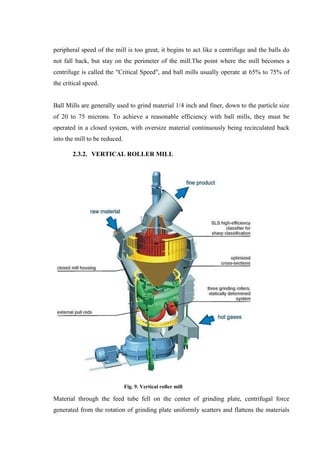
        2.3.2. VERTICAL ROLLER MILL


                               Fig. 9. Vertical roller mill

Material through the feed tube fell on the center of grinding plate, centrifugal force
generated from the rotation of grinding plate uniformly scatters and flattens the materials
outwards the surrounding area of grinding plate, to forms a certain thick layer of materials
bed, the material was crushed by number of rollers at the same time. Driven by the
continuous centrifugal force to keep the materials moving to the outer edge of the grinding
plate, the materials off the grinding plate rising with the hot air which enter from wind ring
into the mill, through the mill shell into the middle of the separator, in this course materials
and hot gas do a fully heat exchange, and the water quickly evaporates. Separator controls
the output size of finished product, greater than the specified size are separated and fall
back to the plate, while meet the fineness requirements are brought through the separator
into the finished product warehouse.

        2.3.3. HOMOGENIZATION SILO

The silo bottom of the CF (Controlled Flow) silo is divided into seven identical hexagonal
sectors, each of which hasits centre outlet covered by a pressure relief cone made of steel.
Each of the hexagonal sectors issubdivided into six triangular segments all equipped with
open aeration boxes. Raw meal extractionfollows a sequence where three segments
positioned at three different outlets are aerated at a time. Fromthe outlets it is conveyed at
different rates to the central mixing tank installed below the silo. The aerationsequence is
cyclic in a way that all the 42 segments will be activated once within about 15 minutes.


Fig. 10. Homogenization silo


    2.4. THE CLINKER MANUFACTURING PROCESS

The clinker manufacturing process starts with the extraction of the raw meal from the
homogenization silo to insure that the raw meal is stable and homogenized in order to
produce consistent clinker quality. The preheating of the material takes place in pre-heater
cyclones fitted with a pre-calciner fired with coal. The calcinations of the material begin
during this stage, changing its phase to the oxide phase for each component to be ready for
the burning process. The burning phase takes place in a rotary kiln. The clinker
temperature in the kiln burning zone has to reach 1,500°C and then it is cooled in a cooler
by air which decreases the temperature.

       2.4.1. PRE-HEATER

Rawmeal is the feed material for the high temperature process in the kiln system.
"Preheating" is the first part of this system. A pre-heater is a series of vertical cyclones. As
the raw meal is passed down through these cyclones it comes into contact with the swirling
hot kiln exhaust gases moving in the opposite direction and as a result heat is transferred
from the gas to material. This pre-heats the material before it enters the kiln so that the
necessary chemical reactions will occur more quickly and efficiently. By retaining energy
                                       from the exhaust gases, energy is saved. Depending
                                       on the raw material moisture, a kiln may have 3 to 6
                                       stages of cyclones with increasing heat recovery with
                                       each extra stage.


                                       The calciner is a combustion chamber at the bottom
                                       of the preheater above the kiln back-end. Up to 65%
                                       of the total energy needs of the kiln system can be
                                       supplied to the calciner. Calciners allow for shorter
                                       rotary kilns and for the use of lower grade alternative
                                       fuels. Calcination is the decomposition of CaCO3 to
                                       CaO, which releases CO2. These process emissions
         Fig. 11. Pre-heater
                                       comprise 60% of the total emission from a cement
kiln. The combustion of the fuel generates the rest.

       2.4.2. KILN

Raw meal, more accurately termed "hot meal" at this stage then enters the rotary kiln. The
kiln is the world's largest piece of industrial equipment. Fuel is fired directly into the rotary
kiln and ash, as with the calciner, is absorbed into the material being processed. As the kiln
rotates at about 3-5 revolutions per minute, the material slides and tumbles down through
progressively hotter zones towards the flame. Coal, pet coke, natural gas and more
increasingly alternative fuels such as plastic, solvents, waste oil or meat and bone meal are
burned to feed the flame which can reach as high as 2000oC.
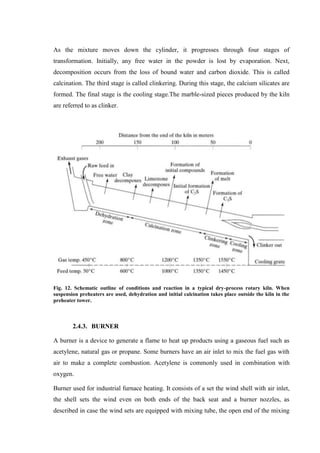
As the mixture moves down the cylinder, it progresses through four stages of
transformation. Initially, any free water in the powder is lost by evaporation. Next,
decomposition occurs from the loss of bound water and carbon dioxide. This is called
calcination. The third stage is called clinkering. During this stage, the calcium silicates are
formed. The final stage is the cooling stage.The marble-sized pieces produced by the kiln
are referred to as clinker.


Fig. 12. Schematic outline of conditions and reaction in a typical dry-process rotary kiln. When
suspension preheaters are used, dehydration and initial calcination takes place outside the kiln in the
preheater tower.


        2.4.3. BURNER

A burner is a device to generate a flame to heat up products using a gaseous fuel such as
acetylene, natural gas or propane. Some burners have an air inlet to mix the fuel gas with
air to make a complete combustion. Acetylene is commonly used in combination with
oxygen.

Burner used for industrial furnace heating. It consists of a set the wind shell with air inlet,
the shell sets the wind even on both ends of the back seat and a burner nozzles, as
described in case the wind sets are equipped with mixing tube, the open end of the mixing
tube and burner diameter nozzle connected to
                                               the gas tube is inserted closed end and with
                                               the gas supply port connected on the back
                                               seat, as described on the mixing tube closed
                                               end and back walls of the ministry and the
                                               open end of the circumference of the outer
                                               wall of the wind jet holes were laid.
            Fig. 13. Burner pipe


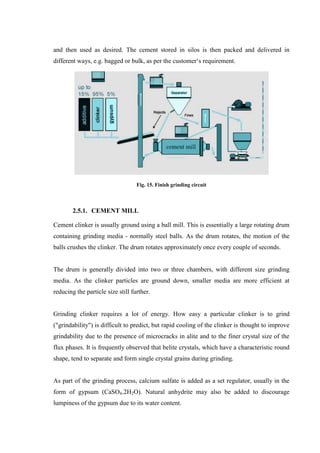
       2.4.4. COOLING

The clinker tumbles onto a grate cooled by forced air. Once cooled the clinker is ready to
be ground into the grey powder known as Portland cement. To save energy, heat recovered
from this cooling process is re circulated back to the kiln or preheater tower.


                                        Fig. 14. Cooler


   2.5. CEMENT GRINDING AND PACKING PROCESS

The clinker is ground with an amount of gypsum to a fine powder in order to regulate the
setting time of cement and to gain the most important property of cement, which is
compressive strength. To produce different types of cement (e.g. Portland Pozzolana
Cement), the required additives are ground with clinker and gypsum to a very fine powder
and then used as desired. The cement stored in silos is then packed and delivered in
different ways, e.g. bagged or bulk, as per the customer„s requirement.


                                   Fig. 15. Finish grinding circuit


        2.5.1. CEMENT MILL

Cement clinker is usually ground using a ball mill. This is essentially a large rotating drum
containing grinding media - normally steel balls. As the drum rotates, the motion of the
balls crushes the clinker. The drum rotates approximately once every couple of seconds.


The drum is generally divided into two or three chambers, with different size grinding
media. As the clinker particles are ground down, smaller media are more efficient at
reducing the particle size still further.


Grinding clinker requires a lot of energy. How easy a particular clinker is to grind
("grindability") is difficult to predict, but rapid cooling of the clinker is thought to improve
grindability due to the presence of microcracks in alite and to the finer crystal size of the
flux phases. It is frequently observed that belite crystals, which have a characteristic round
shape, tend to separate and form single crystal grains during grinding.


As part of the grinding process, calcium sulfate is added as a set regulator, usually in the
form of gypsum (CaSO4.2H2O). Natural anhydrite may also be added to discourage
lumpiness of the gypsum due to its water content.
Since the clinker gets hot in the mill due to the heat generated by grinding, gypsum can be
partly dehydrated. It then forms hemihydrate, or plaster of Paris - 2CaSO4.H2O. On further
heating, hemihydrate dehydrates further to a form of calcium sulfate known as soluble
anhydrite (~CaSO4). This has a similar solubility in water to hemihydrate, which in turn
has a higher solubility than either gypsum or natural anhydrite.


Cement mills need to be cooled to limit the temperature rise of the cement. This is done by
a mixture of both air-cooling and water-cooling, including spraying water inside the mill.


The relative proportions and different solubilities of these various types of calcium sulfate
are of importance in controlling the rate the rate of C3A hydration and consequently of
cement set retardation. Problems associated with setting and strength characteristics of
concrete can often be traced to changes in the quantity of gypsum and hemihydrate, or with
variations in cooling rate of the clinker in the kiln and subsequent changes in the
proportions or size of the C3A crystals.


For set regulation, the most important feature of aluminate is not necessarily the absolute
amount present, but the amount of surface which is available to water for reaction. This
will be governed by many factors, such as the surface area of the cement, the grinding
characteristics of the different phases and also the size of the aluminate crystals. Over-large
crystals can lead to erratic setting characteristics.


                                       Fig. 16. Cement mill
2.5.2. PACKAGING AND SHIPMENT

The cement is stored in silos before being delivered in bulk using tanker trucks or
packaged into 25 – 35kg bags and stacked on pallets. Varrious means of transport may be
used according to the local infrastructure and topography.

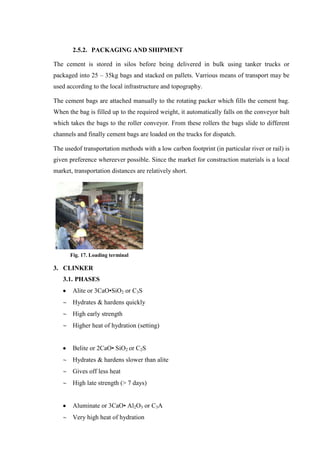
The cement bags are attached manually to the rotating packer which fills the cement bag.
When the bag is filled up to the required weight, it automatically falls on the conveyor balt
which takes the bags to the roller conveyor. From these rollers the bags slide to different
channels and finally cement bags are loaded on the trucks for dispatch.

The usedof transportation methods with a low carbon footprint (in particular river or rail) is
given preference whereever possible. Since the market for constraction materials is a local
market, transportation distances are relatively short.


      Fig. 17. Loading terminal

3. CLINKER
   3.1. PHASES
       Alite or 3CaO•SiO2 or C3S
       Hydrates & hardens quickly
       High early strength
       Higher heat of hydration (setting)


       Belite or 2CaO• SiO2 or C2S
       Hydrates & hardens slower than alite
       Gives off less heat
       High late strength (> 7 days)


       Aluminate or 3CaO• Al2O3 or C3A
       Very high heat of hydration
Some contribution to early strength
       Low C3A for sulfate resistance


       Ferrite or 4CaO• Al2O3 • Fe2O3 or C4AF
       Little contribution to strength
       Lowers clinkering temperature
       Controls the color of cement


   3.2. REACTIONS IN THE KILN

The reactions which take place in the kiln can be considered under three broad headings:

       Decomposition of raw materials - reactions at temperatures up to about 1300oC.
       Alite formation and other reactions at 1300oC-1450oC in the burning zone.
       Cooling of the clinker.
       3.2.1. DECOMPOSITION OF RAW MATERIALS

This includes:

       Water evaporation in the raw feed, if any.
Loss of carbon dioxide from the limestone (ie: calcining).
         Decomposition of the siliceous and aluminosilicate fractions of the feed.
         Formation of a sulfate melt phase.

The decomposition products react with lime to form intermediate compounds which in turn
form other compounds as clinkering proceeds.

  i.     Water Evaporation

In wet-process kilns, and their derivatives, water must first be driven off. In a wet-process
kiln, calcining takes place after the water has been driven off, about a third of the way
down the kiln. In the more modern pre-calciner kilns, the feed is calcined prior to entering
the kiln.


  i.     Calcining

In isolation, decarbonation of calcium carbonate at 1 atmosphere takes place at 894 C. This
temperature is reduced to 500oC-6000C if the reaction takes place in contact with quartz or
the decomposition products of clay minerals, which react with the calcium oxide as it
forms.


In a wet-process or preheater system without a pre-calciner, most of the calcination takes
place in the rotary kiln within a moving mass of feed. This situation is not ideal for
calcination because heat transfer has to take place through a large mass of material and
CO2 has to escape outwards as heat moves inwards.


A pre-calciner calcines the raw material much more efficiently than a wet-process kiln.
Raw meal is dispersed in the hot gas and calcination takes place in seconds, rather than the
half an hour or so inside a kiln at the same temperature.

 ii.     Formation Of Early And Intermediate Compounds

During calcination, the lime produced starts to react with other components of the raw
feed. The initial silicate product is belite. Some calcium aluminate and ferrite phases also
start to form.
A number of phases are formed in the clinker feed before the burning zone proper is
reached. These intermediate phases dissociate in the burning zone and are not therefore
found in clinker but assist in forming the final clinker minerals.


 iii.   Sulfate Melt Phase

At intermediate temperatures, sulfates combined with calcium and alkalis form a liquid
phase. This is separate from the aluminate and aluminoferrite-based liquid formed in the
burning zone - the two liquids are immiscible.


As with the main liquid phase, the sulfate liquid phase contributes to ion mobility and
promotes combination.

        3.2.2. ALITE FORMATION AND OTHER REACTIONS

In the burning zone, above about 1300oC, reactions take place quickly. The clinker is in the
burning zone for perhaps 10-20 minutes but in this time a lot happens:

        The proportion of clinker liquid increases and nodules form.
        Intermediate phases dissociate to form liquid and belite.
        Belite reacts with free lime to form alite.
        Some volatile phases evaporate.


   i.   Clinker Liquid And Nodule Formation

Above about 1300oC the proportion of liquid starts to increase - by 1450oC, perhaps 20-
30% of the mix is liquid. The liquid forms from melting ferrite and aluminate phases and
some belite. The liquid content is more than the sum of the aluminate and ferrite phases in
the cooled clinker because of the dissolved lime and silica.


The additional liquid causes coalescence of clinker particles, leading to the formation of
nodules.

 ii.    Dissociation Of Intermediate Phases

The intermediate phases dissociate to form mainly aluminate phase, which then becomes
part of the liquid, and belite.

 iii.   Alite Formation
Alite forms by the transition of some of the belite to alite and also directly from free lime
and silica to alite. These reactions occur rapidly once the clinker temperature is above
about 1400oC.

 iv.     Evaporation Of Volatiles

Volatile phases in the cement kiln are principally alkali sulfates, with a much smaller
proportion of alkali chlorides. As the part-burned feed approaches the burning zone, these
volatile phases are in liquid form and a proportion volatilizes, the remainder passing out of
the kiln in the clinker as inclusions within the pores.


The volatilized material passes back down the kiln, where it condenses on the relatively
cool incoming feed. It again becomes part of the sulfate melt phase, promoting reactions,
and is once again carried within the clinker towards the burning zone.


This recirculating load of alkali and sulfate can occasionally become excessively high.
Large quantities of condensing volatiles can then cause blockages in the kiln or in the
preheater as the condensed liquid sticks feed particles together, forming accretions.

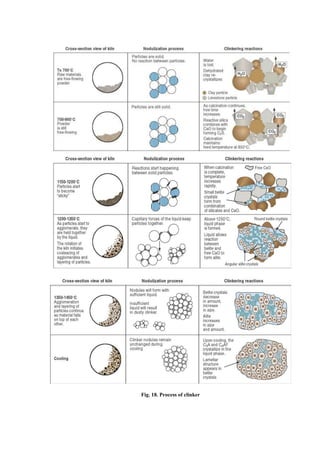
         3.2.3. COOLING OF THE CLINKER

As the clinker cools, the main liquid phase crystallizes to form aluminate phase, ferrite and
a little belite.


Fast cooling of clinker is advantageous - it makes for more hydraulically-reactive silicates
and lots of small, intergrown, aluminate and ferrite crystals.


Slow cooling gives less hydraulically-reactive silicates and produces coarse crystals of
aluminate and ferrite - over-large aluminate crystals can lead to erratic cement setting
characteristics. Very slow cooling allows alite to decompose to belite and free lime.
Fig. 18. Process of clinker
3.3. COMPOSITIONAL PARAMETERS

Parameters based on the oxide composition are very useful in describing clinker
characteristics. The following parameters are widely used (chemical formulae represent
weight percentages).

        3.3.1. LIME SATURATION FACTOR (LSF)

The LSF is a ratio of CaO to the other three main oxides. Applied to clinker, it is calculated
as:


LSF=CaO/(2.8SiO2 + 1.2Al2O3 + 0.65Fe2O3)


Often, this is referred to as a percentage and therefore multiplied by 100.


The LSF controls the ratio of alite to belite in the clinker. A clinker with a higher LSF will
have a higher proportion of alite to belite than will a clinker with a low LSF.


Typical LSF values in modern clinkers are 0.92-0.98, or 92%-98%.


Values above 1.0 indicate that free lime is likely to be present in the clinker. This is
because, in principle, at LSF=1.0 all the free lime should have combined with belite to
form alite. If the LSF is higher than 1.0, the surplus free lime has nothing with which to
combine and will remain as free lime.


In practice, the mixing of raw materials is never perfect and there are always regions
within the clinker where the LSF is locally a little above, or a little below, the target for the
clinker as a whole. This means that there is almost always some residual free lime, even
where the LSF is considerably below 1.0. It also means that to convert virtually all the
belite to alite, an LSF slightly above 1.0 is needed.


The LSF calculation can also be applied to portland cement containing clinker and gypsum
if (0.7 x SO3) is subtracted from the CaO content. (NB: This calculation (ie: 0.7 x SO3)
does not account for sulfate present as clinker sulfate in the form of potassium and sodium
sulfates and this will introduce a slight error. More particularly, it does not account for fine
limestone or other material such as slag or fly ash in the cement. If these materials are
present, calculation of the original clinker LSF becomes more complex. Limestone can be
quantified by measuring the CO2 content and the formula adjusted accordingly, but if slag
or fly ash are present, calculation of the original clinker LSF may not be conveniently
practicable.)

        3.3.2. SILICA RATIO (SR)

The silica ratio is defined as:


SR = SiO2/(Al2O3 + Fe2O3)


A high silica ratio means that more calcium silicates are present in the clinker and less
aluminate and ferrite. SR is typically between 2.0 and 3.0.


The silica ratio is sometimes called the „silica modulus‟.

        3.3.3. ALUMINA RATIO (AR)

The alumina ratio is defined as:


AR=(Al2O3/(Fe2O3)


This determines the potential relative proportions of aluminate and ferrite phase in the
clinker.


An increase in clinker AR (also sometimes written as A/F) means there will be
proportionally more aluminate and less ferrite in the clinker. In ordinary Portland cement
clinker, the AR is usually between 1 and 4.


The above three parameters are those most commonly used. A fourth, the 'Lime
Combination Factor' (LCF) is the same as the LSF parameter, but with the clinker free lime
content subtracted from the total CaO content. With an LCF=1.0, therefore, the maximum
amount of silica is present as C3S.

    3.4. COMBINABILITY OF MIXES

The ease of combination ("combinability", or "burnability") are about how easily the raw
materials react with each other to produce the clinker minerals.
Clinker composition is evidently one of the key factors which determine cement quality.
Composition is controlled mainly by suitable blending of raw materials, but there are
limitations to what can be achieved.


Before considering these limitations, a summary of the clinkering process, and of the role
of the liquid phase, may be useful.


The essential reactions in making portland cement are the calcination of limestone to
produce lime (calcium oxide) and the combination of this lime with silica to make belite
and, especially, alite.


During clinkering, the clinker contains solid phases and a liquid phase. The bulk of the
clinker remains as a solid. At the highest temperatures reached by the clinker, perhaps only
about 25% of the clinker is a liquid. The solid phases are mainly alite, belite and free lime.


The liquid is vital in that it acts a flux, promoting reactions by ion transfer; without the
liquid phase, combinability would be poor and it would be very difficult to make cement.


The liquid phase is composed largely of oxides of calcium, iron and aluminium, with some
silicon and other minor elements. As the clinker leaves the kiln and cools, crystals of
aluminate and ferrite form from the liquid.

        3.4.1. COMBINATION

The combinability of a raw mix will depend largely on:

        The fineness of the raw materials - fine material will evidently react more readily
        than will coarser material, so finer material makes for better combinability.
        Lime Saturation Factor - higher LSF mixes are more difficult to combine than are
        lower LSF mixes, so a higher LSF makes for poorer combinability.
        Silica Ratio - mixes of higher SR are more difficult to combine because there is less
        liquid flux present, so a higher SR makes for poorer combinability.
        Alumina Ratio - mixes of AR approximately equal to 1.4 will be easier to burn than
        if the AR is higher or lower. This is because at an AR of about 1.4, there is more
        clinker liquid at a lower temperature and combinability is optimised. (Minor
        constituents such as MgO can alter this optimum AR).
The intrinsic reactivity of the raw materials - some types of silica, for example, will
        react more easily than will others.

Ideally, a cement producer would like to control all three clinker compositional parameters,
LSF, SR and AR. That would define the approximate proportions of the four main minerals
in the clinker.

        3.4.2. BLENDING AND PROPORTIONING

Suppose the cement producer has a source of limestone and a source of clay and that he
knows the chemical composition of each.


He can blend the limestone and clay in the correct proportions to give whatever value for
LSF he likes, say 98%. However, the SR and AR will then be fixed by whatever the
composition of the raw materials determines them to be. Although there will probably be
some SiO2, Al2O3 and Fe2O3 in the limestone, these oxides will be mainly contributed by
the clay. In this example, therefore, it is the clay composition which will largely determine
SR and AR.


In general terms, two types of raw material, such as limestone and clay, can be
proportioned to fix any one parameter only, say the LSF.


To fix x parameters, x+1 materials of suitable composition are needed, so to control all
three parameters, LSF, SR and AR, a cement works needs to blend four different materials
of suitable composition. On a coal-fired works, the composition of the coal ash also needs
to be allowed for, since the ash falls onto the part-reacted feed and combines with it.


In practice, a works may have 5 or 6 raw materials in order to control composition.


Alite is the clinker mineral that contributes most to strength in concrete, especially earlier
strengths. Therefore, where high early strengths are important, the cement producer may
want to maximise the alite content; it might appear logical that he would want all the
silicates to be present as alite, with no belite present in the clinker. This may be so but
often it isn't quite that simple.
3.4.3. OPTIMUM BURNING REGIME

For a given mix, there will be an optimum burning regime. Under-burning will not
combine most of the lime to make alite. However, over-burned clinker is likely to contain
silicates that are less hydraulically reactive - they react more slowly with water. Harder
burning, at a higher temperature or a longer period of time or both, may therefore combine
more free lime but at the expense of silicate reactivity.


If the manufacturer tries to increase the alite content too far, he may produce a clinker that
has more alite, but less-reactive alite. Overall, the clinker may produce better strengths
with a slightly lower proportion of more reactive alite.

       3.4.4. EFFECT OF COAL ASH

Where coal is the fuel for the kiln, the raw mix composition has also to take into account
the effect of coal ash, as much of the ash will become incorporated into the clinker. The
quantity of ash is enough to have a significant effect on clinker composition - ash may
represent perhaps 2%-3%, or more, of the clinker.

cement internship report

  • 1.
    1. INTRODUCTION 1.1. HISTORY OF CEMENT The word “cement” derived from "caementum" in Latin meaning hewn stone chips and then started to be used in the meaning of “binder”. The date of the first reinforced concrete building is 1852 but yet the use of binding agents in the construction of buildings dates back to very old times. The first material used as binding agent is lime. Although there are no precise findings, it is possible to say that the binding property of lime was discovered in the early period of human history, in 2000s B.C. Examples of the use of lime as a construction material have been encountered in different regions of the Ancient Egypt, Cyprus, Crete and Mesopotamia. The Ancient Greeks and Romans used lime as a hydraulic binder. Architect Vitruvius (70-25 B.C.), in his 10-volume book "On Architecture", mentions the hydraulic properties of pozzolana and lime and even gives a mixing ratio that can be used in the buildings to be constructed by rivers and seas. Research results prove that the plaster used in the construction of Çatalhöyük houses in Anatolia dates back to 7000 years ago. Throughout the history, many different binding agents symbolizing the civilization of that period were used in the Egyptian Pyramids and the Great Wall of China and in the castles built at different times. Later on, nearly 2000 years ago, the Romans mixed hydrated lime with volcanic ashes and afterwards with dusts obtained from fired brick and thus started to use a hydraulic binder having properties similar to those of today‟s cement. On the other hand, the Ancient Greeks prepared mortar by mixing the volcanic tuffs on Santorini Island with lime or with some sort of hydraulic lime they obtained from argillaceous limestone. The Ancient Greeks and Romans discovered the hydraulic property of lime and pozzolona mixtures and used such mixtures but did not have the knowledge to explain lime acquisition or pozzolanic reactions in terms of chemistry. For instance, Pliny (Roman scholar Gaius Plinius) writes that it is inexplicable why "the lime obtained by burning stone in fire re-flames when it comes into contact with water." However, in the 18th century, a significant development occurred in the quality and usage of binding agents. John Smeaton, who was charged with rebuilding Eddystone Lighthouse in 1756, is known to be the first person to comprehend the chemical properties of lime. The following development is the acquisition of a binder known as "Roman Cement" by Joseph Parker.
  • 2.
    In 1824, JosephAspdin, a stonemason in Leeds-England, obtained a binding agent by firing and then grinding the mixture of fine-grain clay and limestone. Joseph Aspdin added water and sand to that product and thus enabled it to harden in time and then saw that the resulting material resembled the building stones obtained from England‟s Portland Island. So, on 21.10.1824, he took out a patent for that binder under the name of "Portland Cement". Even though that binder was improved greatly in the following years, the name "Portland" remained the same. As a matter of fact, the binder produced by Joseph Aspdin could not have all properties of today‟s Portland Cement due to the fact that it was not fired at temperatures high enough during production. Nonetheless, it was found out that Wakefield Arms, which is still standing next to Kirkgate Station in England, was built with the binder produced by Joseph Aspdin. The process of firing at high temperatures and then grinding raw materials was realized by an Englisman called Isaac Johnson (1845). It was seen that, in Anatolia, natural pozzolanic active materials mixed with magnesian lime were used in the preparation of mortar in Hittite cities and in particular in the ancient cities located in Çorum, Tokat and Malatya. Apart from that, examples such as the use of common lime and basaltic pozzolanic matter in the historical ruins of the Assyrians in the Southeastern Anatolia point out that cement was used in Anatolia before the Greeks and Romans. In the ancient cities of Teos- İzmir, Ephesus- İzmir, Aphrodisias-Aydın, Kinidos- Muğla, cement and mortar were also encountered following wide contact with ancient Anatolian civilizations. Although cement production and sales commenced in 1878 in the world, cement sector was introduced to Turkey primarily in 1912 with private sector‟s initiative. The 34-year delay in question results from insufficient hydraulic lime production and the fact that those years coincided with the fall of the Ottoman Empire. The first cement production plant in the world was founded in 1848 in England. The first German Cement Standard was created in 1860. And, the establishment of the American Concrete Institut and the creation of the first American Regulations coincide with 1913.
  • 3.
    In Turkey, however,Darıca Production Plant owned by Aslan Osmanlı Anonim Şirketi and Eskihisar Production Plant owned by Eskihisar Portland Çimento ve Su Kireci Osmanlı Anonim Şirketi were put into operation in 1912. Fig. 1. Aslan Cement Plant, Darıca, Kocaeli, Turkey (1912) In those production plants (one with wet system and the other with dry system), there were two kilns bearing a capacity of 100- 150 tons/day and 60-70 tons/day, the installation of which is unimaginable with today‟s dimensions. Darıca Production Plant was established by FLSmidth while Eskihisar Production Plant was established by a German company. There was a brisk demand for cement as well as hydraulic lime and thus both production plants were enlarged after they had been put into operation. In the same years, 60.000 tons of hydraulic lime were produced in our country and, until 1930- 1931, hydraulic lime production was above cement production. Those production plants, which met the need for cement of the country, entered into a destructive and backbreaking domestic market competition with each other until 1920, when large quantities were imported. In that period, cement prices fell considerably on the grounds of lack of state intervention to the cement sector. As a result, those two production plants could not resist to the backbreaking competition any more and merged in 1920 under the name Aslan ve Eskihisar Müttehit Çimento Fabrikaları A.Ş. to act together against import cement.
  • 4.
    1.2. ABOUT GÖLTAŞGÖLLER BÖLGESİ ÇİMENTO SAN. VE TİC. A.Ş. 1.2.1. COMPANY Göltaş Göller Bölgesi Çimento Sanayi ve Ticaret Anonim Şirketi was founded at Isparta in 1969 as the first private sector cement factory having 600.000 tons/year capacity and 60 Million TL capital by the participation of 2.000 shareholders. The establishment purpose of the factory is to produce cement for Isparta, Burdur, Antalya and partially Denizli and to perform marketing and delivery in these regions. The Company commenced operations by completing of the investments in 1973. The location where Göltaş Çimento has been established is extremely rich in terms of raw material. Limestone and clay deposits which are the raw materials of Clinker Production are existed in the factory area. Since 1973 increasing profitability of the Company continued until 1979 where electricity and fuel-oil shortage reached to maximum level. The Company made its first exportation in 1981, while domestic cement demand entered in stationery state and became more profitable due to domestic sales. A new investment was started for converting from fuel-oil system to coal system in 1983. When the investment has been concluded at the end of 1984 the fuel was converted to coal and it provided a great economy in comparison with fuel-oil system. Increasing of capacity, renovation and modernization investments were commenced after 1984. The first part of the capacity increasing works was concluded in 1986. As result of these investments cement production and sales increased significantly. Investment of the second clinker line (Bonn Line) was started in 1987. When it was commissioned on 27 June1992 our capacity increased to 4.000 tons per day from 2.200 tons per day. The second investment was costed 35 million Dollars. The Company passed to the registered capital system by the permission of Capital Markets Board dated 01 December 1994 and numbered 1227. Necessary permits were received from Capital Markets Board and other necessary associations regarding the Company in order to be traded at the stock exchange and all par value stocks at the amount of 33.600.000.000.- were sold by seven-fold value and as of 06 March 1995, 13% of company shares started to trade at the İstanbul Stock exchange.
  • 5.
    The Company madeits second public offering in 1997. The capital of the company was increased from 254.1 Billion TL to 600 Billion TL; and par value stocks of the company corresponding to 15.3% of the capital equivalent to 98.1 Billion TL were sold to abroad by 27.5 fold value at 2.524 Trillion. As of 19 August 1997 they had started to be dealted in Istanbul Stock Exchange. The capital that was 600 Billion in 1998 was increased to 3,6 Trillion TL and 7,2 Trillion TL in 2002. 1.2.2. PRODUCTS Cement types were determined in accordance with the the requirements in region and raw material sources.Seven types cement have been produced in the factory. They are; TS EN 197-1 CEM II/B-M (P-LL) 32,5 N TS EN 197-1 CEM II/A-M (P-LL) 42,5 R TS EN 197-1 CEM II/A-M (P-LL) 42,5 N TS EN 197-1 CEM I 42,5 R TS EN 197-1 CEM I 42,5 N TS 10157 SDÇ 42,5 R (Sulphate Resistant Cement) TS EN 197-1 CEM II/B-M (P-LL) 32,5 N: Total Additive in the CEM II/B-M (P-LL) 32.5 N cement, is between 21 - 35%.CEM II/B-M (P-LL) 32.5 N cement is used for general purposes. It can be used in mass concrete applications such as foundations, retaining walls and dams. It is a good connector in terms of chemical endurability. TS EN 197-1 CEM II/A-M (P-LL) 42,5 R- TS EN 197-1 CEM II/A-M (P-LL) 42,5 N: Total additive in CEM II/A-M (P-LL) 42.5 R and CEM II/A-M (P-LL) 42.5 N cements are between 6 - 20%.CEM II/A-M (P-LL) 42.5 R and CEM II/A-M (P-LL) 42.5 N cements are used for general purposes. They can be used in mass concrete applications such as foundations, retaining walls and dams. They are good connectors in terms of chemical endurability. TS EN 197-1 CEM I 42,5 R - TS EN 197-1 CEM I 42,5 N: CEM I 42,5 R andCEM I 42,5 Ncements are produced by grounding of clinker at the rate of 96% and 4% limestone in the
  • 6.
    mills approximately. Thelimestone that is added during grounding process is for adjustment of the setting period. Final resistance is obtained at the end of 28 days regarding Portland Cements. Increasing of the resistance after this period is too few and slow.This cements are used when high resistance concrete is required or for manufacturing of concrete that has high strength resistance initially. Prefabricate, prestressed concretes are suitable for tunnel form applications, which are very common at work of arts and collective housing constructions. TS 10157 SDÇ 42,5 R (Sulphate Resistant Cement): This cement is manufactured by grounding of specially produced clinker with limestone in the mill. The rate of C3A (tricalcium aluminat) should be maximum 5% and the amount of C4Af + 2C3A should be makximum 25% in the cement. This production that requires intensive labor and technique from preparation of the raw material to kilning them in the kiln privately therefore it is made by less number factories in our country.This cement shows resistance against cement sulphate waters; therefore it is used at harbors, waste water systems, dams, underground water pipes, foundations, sewers, irrigation canals and treatment plants. It is appropriate cement for using at the structures that require resistancy against chemical effects such as sea water and sulphate environments. 1.2.3. PRODUCTION UNITS AND CAPACITY Two Pieces Rotating Kiln: 1st 2.200 Tons/Day Clinker 2nd 4.000 Tons/Day Clinker Three Pieces Raw Material Crusher: 1st Raw Material Crusher 350 Tons/Hour 2nd Raw Material Crusher 450 Tons/Hour One Piece Pozzolanas Crusher 150 Tons/Hour Three Pieces Raw Meal Mill: 1st Raw Meal Mill with Horizontal Ball 160 Tons/Hour 2nd Raw Meal Mill with Vertical Roller 130 Tons/Hour 3rd Raw Meal Mill with Vertical Roller 175 Tons/Hour
  • 7.
    One Piece CoalCrusher:100 Tons/Hour Two Pieces Coal Mill: 1st Line Coal Mill with Vertical Vals 18 Tons/Hour 2nd Line Coal Mill with Horizontal Ball 18 Tons/Hour Four Pieces Cement Mill: 1st Mill with pre-crusher, ball and separator 65 Tons/Hour 2nd Mill with pre-crusher, ball and separator 65 Tons/Hour 3rd Mill with ball and separator 70 Tons/Hour 4th Mill with ball and separator 140 Tons/Hour Pozzolanas Drying Two Pieces Trommel (with spare): 100 Tons/Hour Packaging Unit: 4 pieces 2.500 Tons Bunker/Silo 1 Pieces 10.000 Tons Bunker/Silo 8 Pieces Rotary Weigh-Bridge 800 Tons/Hour 5 Pieces Bulk Cement Line 500 Tons/Hour 7 Pieces Big-Bag Filing Facility - 3.000 Tons/Day for CEM I 42,5 R - 1.500 Tons/Day for CEM II/A-M (P-LL) 42,5 R Sling-Bag - 3.750 Tons/Day for CEM I 42,5 R 2. MANUFACTURING Fundamentally, cement is defined as a hydraulic binding agent which is obtained as the mixture of natural limestone and clay is heated at a high temperature and then ground. Hydraulic binding agents create a hard mass as a result of reacting with water and then do not dissolve in water but retain or increase their hardness and strength. Like other binding agents, cements are comprised of alkaline elements such as CaO and MgO and hydraulic elements such as SiO2, Al2O3 and Fe2O3. The rates of alkaline and hydraulic elements determine the quality of binding agents.
  • 8.
    Fig. 2. Thebasic components of the cement production process 2.1. RAW MATERIALS 2.1.1. LIMESTONE Limestone requirement of the factory has been provided by factory‟s limestone quarries, which are about 3 kms away. Minerals that contain rich minerals (includes minimum 90% CaCO3 in its chemical composition) in terms of tertial aged lime are called as limestonea (calcerous) and they are indicated as CaCO3. For producing of clinker, all geological types CaCO3 is suitable. The purest types Fig. 3. Limestone of limestone are Calcite and Aragonite. Limestone and chalk are the most common types. Marble is the type of calcite that has visible crystal grainy structure. The hardness of the calcerous is 3 and specific gravity is 2,5-2,7 gr/cm3. Limestone deposits occur as travertine by the effect of underground waters, and by the effect of chemical, organic and mechanic precipatition of the sea-water and fresh waters. It can be seen at yellow, brown and black colors because of subsidiary various substances and compounds taking part in its structure.Close location of the limestone deposits that have been used as raw material of cement, easy operation of the quarry, having low humidity
  • 9.
    and homogeneous characteristicsare the most important factors that affect production costs. Rock units that have existed around the Göltaş Çimento A.Ş. are at the time interval between upper cretaceous and oligocene. The rock units at the environment are forme by carbonated rocks and detrital sedimentaries. Upper cretaceous aged carbonated rock mass has been separated in two different units as Söbüdağ Limestone and Senirce Limestone. The Limestone that is required by Göltaş Çimento A.Ş., is supplied from Söbüdağ Limestone Quarry that displays wide expansion in the south of the factory area. The operated limestone area has been limited by the Göltaş fault from the North. The width of the hydrothermal separation zone that has developed alongside of the fault, changes between 150 and 250 meters. Hydrothermal solutions and gasses that have increased alongside of the Göltaş Fault, which is a deep originated fault, have affected the compound and structure of the limestones, which exist at the close locations to the fault. 2.1.2. CLAY Limestone that has silica, clayish materials and iron oxide is called Marn. Since it has existed on a vast scale on the earth, it is the most common used material in terms of cement production. In terms of geological point of view, Marn is a sedimentary rock that occurred as the result of the Fig. 4. Clay precipitation of CaCO3 and Clayish substances at the same time. In terms of formation it is sedimentary completely, had diagenesis, and exists usually as regular bedded. Marn formation mainly occurs at the quiet environments where tectonic and orogenic movements have calmed down. Color of the Marn changes from yellow to grayish black depends on the clayis materials. In comparison with calcerous, Marn can be educted easily because of being softer and energy consumption of crushing and grounding becomes lower as well. Marn deposits that exist around the Göltaş Çimento A.Ş. have located in Eocene aged Kayıköy formation. The marn deposit that exists at the environment is observed as a stratigraphic scale, which can be monitored horizontally within the Kayıköy Formation.
  • 10.
    The marn thathas been required by Göltaş Çimento A.Ş. is supplied from marn quarries that exist approximately 3 km away in the northwest of the factory area. 2.1.3. IRON ORE Iron Ore exists in the nature mostly as hematite. The color of hematite is red and is used in cement factory. The mole weight is 150.68 and its density is 4,9-5,3 gr/cm3. Determination of the melting point is impossible; because the Fe2O3 that is heated under the atmospheric conditions dissolved and becomes Fig. 5. Iron ore magnetic together with oxygen. The color of the ore in amorphous conditions is reddish. Iron ore is procured by purchasing from producer companies. 2.1.4. BAUXITE Bauxite is an aluminum ore and has occurred from oxides and contains hydration water. It exists mainly at the hot regions. It occurs from decomposition of the aluminum silicate rocks such as granite, gneiss by aerifying. Its structure is flabby and earthy. Its color is usally white and because of iron oxide admixtures it is brownish or reddish. The hardness degree is 1-3 and its density is 2,5-3,0 gr/cm3.Buxite that is occurred by SiO2, Al2O3, Fe2O3 ve H2O virtually, can have (~%3) TiO2 in small quantities.Bauxite ore is procured by purchasing from producer companies. 2.1.5. AXUILIARY MATERIALS AND ADDITIVES Gypsum (CaSO4.2H2O):Gypsum is seen between the sedimentary masses, which were precipitated at the dry, semi-dry climate regions in the ancient geological eras. It exists in the nature as massive mass, as well as mixed with bitumen, clay, limestone and iron oxide. Since it is a precipitated sedimentary mass mineral, it isn‟t dissolved in acides easily. It‟s hardness is 2,0 - 2,4 and specific gravity is 2,2 - 2,4 gr/cm3. Gypsum is expressed by the (CaSO4.2H2O) chemical formula and by losing some of its water at 120 0C and hydrates.Addition to the clinker between 3-5% is to control starting and ending of the cement freezing. Both minority and majority of the amount of limestone has role in terms of accelerating of the freezing period. Therefors it is essential addition of it at specific rates.Gypsum ore is procured by purchasing from producer companies.
  • 11.
    Pozzolanas:According to TS25, pozzolanas is a kind of volcanic rock that does not have hydraulic connective attributes, however can constitute connective substances when it is mixed with other substances such as tinny grounded limestone or cement and provides chemical resistance to cement, where it is added.Pozzolanas constitutes the most important section of the natural pozzuolanas those are used as additive in cement and known as trachyte andesitic tuff. Pozzolanas requirement of plant has been supplied from its own quarries at Dereboğazı, which is about 25 km away. There are trias, jura, cretaceous aged volcanites at the working area and close environment. The substance that will be used as additive should have high pozzolanic activity and low SO3 amount.According to chemical experiments and pozzolanic activity experiment that will be performed in accordance with TS 25 it is decided, whether pozzolanas will be used as additive. 2.2. RAW MATERIALS PREPARATION Raw materials preparation starts with extraction of the main components, which are limestone and clay. The main raw materials come from natural rocks existing in the quarries. They are supplied to crushers and then transferred to storage. Other (corrective) materials such as iron ore, bauxite,gypsum or pozzolanas are added with a varying percentage to reach the optimum chemical composition of each type of cement. 2.2.1. QUARRY Quarry is the place from where raw material in extracted. Drilling and blasting is done to extractthe material.A hole of about 10-15 m is drilled and ammonium nitrate in filled as an explosive in different sizes. These pieces are then Fig. 6. Limestone quarry loaded on the dumper trucks and conveyod to the crushers. It is located about 2 km from the plant.
  • 12.
    2.2.2. CRUSHER Raw material such as limestone, clay and pozzolanas dumped into hoppers by dump trucks and enteredinto a hammer crusher through an apron feeder. Insidehammer crusher there are hammers each having aweight of 100-102 kg. They rotate at a speed of 1200-1300 rpm and is capable of crushing Fig. 7. Hammer crusher feed of very large sizes. 2.3. GRINDING AND HOMOGENIZATION The grinding process takes place in a raw mill to reduce the particle size of the components to a typical value of 10-15 % residue on a 90 μm sieve. There are three raw mill in the plant, a ball mill and two vertical roller mills. The output of the grinding process – called „raw meal‟ – is transferred to a homogenization silo before the clinker manufacturing process. 2.3.1. BALL MILL Ball Mill grinds material by rotating a cylinder with steel grinding balls, causing the balls to fall back into the cylinder and onto the material to be ground. The rotation is usually between 4 to 20 Fig. 8. Ball mill revolutions per minute, depending upon the diameter of the mill. The larger the diameter, the slower the rotation. If the
  • 13.
    peripheral speed ofthe mill is too great, it begins to act like a centrifuge and the balls do not fall back, but stay on the perimeter of the mill.The point where the mill becomes a centrifuge is called the "Critical Speed", and ball mills usually operate at 65% to 75% of the critical speed. Ball Mills are generally used to grind material 1/4 inch and finer, down to the particle size of 20 to 75 microns. To achieve a reasonable efficiency with ball mills, they must be operated in a closed system, with oversize material continuously being recirculated back into the mill to be reduced. 2.3.2. VERTICAL ROLLER MILL Fig. 9. Vertical roller mill Material through the feed tube fell on the center of grinding plate, centrifugal force generated from the rotation of grinding plate uniformly scatters and flattens the materials
  • 14.
    outwards the surroundingarea of grinding plate, to forms a certain thick layer of materials bed, the material was crushed by number of rollers at the same time. Driven by the continuous centrifugal force to keep the materials moving to the outer edge of the grinding plate, the materials off the grinding plate rising with the hot air which enter from wind ring into the mill, through the mill shell into the middle of the separator, in this course materials and hot gas do a fully heat exchange, and the water quickly evaporates. Separator controls the output size of finished product, greater than the specified size are separated and fall back to the plate, while meet the fineness requirements are brought through the separator into the finished product warehouse. 2.3.3. HOMOGENIZATION SILO The silo bottom of the CF (Controlled Flow) silo is divided into seven identical hexagonal sectors, each of which hasits centre outlet covered by a pressure relief cone made of steel. Each of the hexagonal sectors issubdivided into six triangular segments all equipped with open aeration boxes. Raw meal extractionfollows a sequence where three segments positioned at three different outlets are aerated at a time. Fromthe outlets it is conveyed at different rates to the central mixing tank installed below the silo. The aerationsequence is cyclic in a way that all the 42 segments will be activated once within about 15 minutes. Fig. 10. Homogenization silo 2.4. THE CLINKER MANUFACTURING PROCESS The clinker manufacturing process starts with the extraction of the raw meal from the homogenization silo to insure that the raw meal is stable and homogenized in order to produce consistent clinker quality. The preheating of the material takes place in pre-heater cyclones fitted with a pre-calciner fired with coal. The calcinations of the material begin
  • 15.
    during this stage,changing its phase to the oxide phase for each component to be ready for the burning process. The burning phase takes place in a rotary kiln. The clinker temperature in the kiln burning zone has to reach 1,500°C and then it is cooled in a cooler by air which decreases the temperature. 2.4.1. PRE-HEATER Rawmeal is the feed material for the high temperature process in the kiln system. "Preheating" is the first part of this system. A pre-heater is a series of vertical cyclones. As the raw meal is passed down through these cyclones it comes into contact with the swirling hot kiln exhaust gases moving in the opposite direction and as a result heat is transferred from the gas to material. This pre-heats the material before it enters the kiln so that the necessary chemical reactions will occur more quickly and efficiently. By retaining energy from the exhaust gases, energy is saved. Depending on the raw material moisture, a kiln may have 3 to 6 stages of cyclones with increasing heat recovery with each extra stage. The calciner is a combustion chamber at the bottom of the preheater above the kiln back-end. Up to 65% of the total energy needs of the kiln system can be supplied to the calciner. Calciners allow for shorter rotary kilns and for the use of lower grade alternative fuels. Calcination is the decomposition of CaCO3 to CaO, which releases CO2. These process emissions Fig. 11. Pre-heater comprise 60% of the total emission from a cement kiln. The combustion of the fuel generates the rest. 2.4.2. KILN Raw meal, more accurately termed "hot meal" at this stage then enters the rotary kiln. The kiln is the world's largest piece of industrial equipment. Fuel is fired directly into the rotary kiln and ash, as with the calciner, is absorbed into the material being processed. As the kiln rotates at about 3-5 revolutions per minute, the material slides and tumbles down through progressively hotter zones towards the flame. Coal, pet coke, natural gas and more increasingly alternative fuels such as plastic, solvents, waste oil or meat and bone meal are burned to feed the flame which can reach as high as 2000oC.
  • 16.
    As the mixturemoves down the cylinder, it progresses through four stages of transformation. Initially, any free water in the powder is lost by evaporation. Next, decomposition occurs from the loss of bound water and carbon dioxide. This is called calcination. The third stage is called clinkering. During this stage, the calcium silicates are formed. The final stage is the cooling stage.The marble-sized pieces produced by the kiln are referred to as clinker. Fig. 12. Schematic outline of conditions and reaction in a typical dry-process rotary kiln. When suspension preheaters are used, dehydration and initial calcination takes place outside the kiln in the preheater tower. 2.4.3. BURNER A burner is a device to generate a flame to heat up products using a gaseous fuel such as acetylene, natural gas or propane. Some burners have an air inlet to mix the fuel gas with air to make a complete combustion. Acetylene is commonly used in combination with oxygen. Burner used for industrial furnace heating. It consists of a set the wind shell with air inlet, the shell sets the wind even on both ends of the back seat and a burner nozzles, as described in case the wind sets are equipped with mixing tube, the open end of the mixing
  • 17.
    tube and burnerdiameter nozzle connected to the gas tube is inserted closed end and with the gas supply port connected on the back seat, as described on the mixing tube closed end and back walls of the ministry and the open end of the circumference of the outer wall of the wind jet holes were laid. Fig. 13. Burner pipe 2.4.4. COOLING The clinker tumbles onto a grate cooled by forced air. Once cooled the clinker is ready to be ground into the grey powder known as Portland cement. To save energy, heat recovered from this cooling process is re circulated back to the kiln or preheater tower. Fig. 14. Cooler 2.5. CEMENT GRINDING AND PACKING PROCESS The clinker is ground with an amount of gypsum to a fine powder in order to regulate the setting time of cement and to gain the most important property of cement, which is compressive strength. To produce different types of cement (e.g. Portland Pozzolana Cement), the required additives are ground with clinker and gypsum to a very fine powder
  • 18.
    and then usedas desired. The cement stored in silos is then packed and delivered in different ways, e.g. bagged or bulk, as per the customer„s requirement. Fig. 15. Finish grinding circuit 2.5.1. CEMENT MILL Cement clinker is usually ground using a ball mill. This is essentially a large rotating drum containing grinding media - normally steel balls. As the drum rotates, the motion of the balls crushes the clinker. The drum rotates approximately once every couple of seconds. The drum is generally divided into two or three chambers, with different size grinding media. As the clinker particles are ground down, smaller media are more efficient at reducing the particle size still further. Grinding clinker requires a lot of energy. How easy a particular clinker is to grind ("grindability") is difficult to predict, but rapid cooling of the clinker is thought to improve grindability due to the presence of microcracks in alite and to the finer crystal size of the flux phases. It is frequently observed that belite crystals, which have a characteristic round shape, tend to separate and form single crystal grains during grinding. As part of the grinding process, calcium sulfate is added as a set regulator, usually in the form of gypsum (CaSO4.2H2O). Natural anhydrite may also be added to discourage lumpiness of the gypsum due to its water content.
  • 19.
    Since the clinkergets hot in the mill due to the heat generated by grinding, gypsum can be partly dehydrated. It then forms hemihydrate, or plaster of Paris - 2CaSO4.H2O. On further heating, hemihydrate dehydrates further to a form of calcium sulfate known as soluble anhydrite (~CaSO4). This has a similar solubility in water to hemihydrate, which in turn has a higher solubility than either gypsum or natural anhydrite. Cement mills need to be cooled to limit the temperature rise of the cement. This is done by a mixture of both air-cooling and water-cooling, including spraying water inside the mill. The relative proportions and different solubilities of these various types of calcium sulfate are of importance in controlling the rate the rate of C3A hydration and consequently of cement set retardation. Problems associated with setting and strength characteristics of concrete can often be traced to changes in the quantity of gypsum and hemihydrate, or with variations in cooling rate of the clinker in the kiln and subsequent changes in the proportions or size of the C3A crystals. For set regulation, the most important feature of aluminate is not necessarily the absolute amount present, but the amount of surface which is available to water for reaction. This will be governed by many factors, such as the surface area of the cement, the grinding characteristics of the different phases and also the size of the aluminate crystals. Over-large crystals can lead to erratic setting characteristics. Fig. 16. Cement mill
  • 20.
    2.5.2. PACKAGING ANDSHIPMENT The cement is stored in silos before being delivered in bulk using tanker trucks or packaged into 25 – 35kg bags and stacked on pallets. Varrious means of transport may be used according to the local infrastructure and topography. The cement bags are attached manually to the rotating packer which fills the cement bag. When the bag is filled up to the required weight, it automatically falls on the conveyor balt which takes the bags to the roller conveyor. From these rollers the bags slide to different channels and finally cement bags are loaded on the trucks for dispatch. The usedof transportation methods with a low carbon footprint (in particular river or rail) is given preference whereever possible. Since the market for constraction materials is a local market, transportation distances are relatively short. Fig. 17. Loading terminal 3. CLINKER 3.1. PHASES Alite or 3CaO•SiO2 or C3S Hydrates & hardens quickly High early strength Higher heat of hydration (setting) Belite or 2CaO• SiO2 or C2S Hydrates & hardens slower than alite Gives off less heat High late strength (> 7 days) Aluminate or 3CaO• Al2O3 or C3A Very high heat of hydration
  • 21.
    Some contribution toearly strength Low C3A for sulfate resistance Ferrite or 4CaO• Al2O3 • Fe2O3 or C4AF Little contribution to strength Lowers clinkering temperature Controls the color of cement 3.2. REACTIONS IN THE KILN The reactions which take place in the kiln can be considered under three broad headings: Decomposition of raw materials - reactions at temperatures up to about 1300oC. Alite formation and other reactions at 1300oC-1450oC in the burning zone. Cooling of the clinker. 3.2.1. DECOMPOSITION OF RAW MATERIALS This includes: Water evaporation in the raw feed, if any.
  • 22.
    Loss of carbondioxide from the limestone (ie: calcining). Decomposition of the siliceous and aluminosilicate fractions of the feed. Formation of a sulfate melt phase. The decomposition products react with lime to form intermediate compounds which in turn form other compounds as clinkering proceeds. i. Water Evaporation In wet-process kilns, and their derivatives, water must first be driven off. In a wet-process kiln, calcining takes place after the water has been driven off, about a third of the way down the kiln. In the more modern pre-calciner kilns, the feed is calcined prior to entering the kiln. i. Calcining In isolation, decarbonation of calcium carbonate at 1 atmosphere takes place at 894 C. This temperature is reduced to 500oC-6000C if the reaction takes place in contact with quartz or the decomposition products of clay minerals, which react with the calcium oxide as it forms. In a wet-process or preheater system without a pre-calciner, most of the calcination takes place in the rotary kiln within a moving mass of feed. This situation is not ideal for calcination because heat transfer has to take place through a large mass of material and CO2 has to escape outwards as heat moves inwards. A pre-calciner calcines the raw material much more efficiently than a wet-process kiln. Raw meal is dispersed in the hot gas and calcination takes place in seconds, rather than the half an hour or so inside a kiln at the same temperature. ii. Formation Of Early And Intermediate Compounds During calcination, the lime produced starts to react with other components of the raw feed. The initial silicate product is belite. Some calcium aluminate and ferrite phases also start to form.
  • 23.
    A number ofphases are formed in the clinker feed before the burning zone proper is reached. These intermediate phases dissociate in the burning zone and are not therefore found in clinker but assist in forming the final clinker minerals. iii. Sulfate Melt Phase At intermediate temperatures, sulfates combined with calcium and alkalis form a liquid phase. This is separate from the aluminate and aluminoferrite-based liquid formed in the burning zone - the two liquids are immiscible. As with the main liquid phase, the sulfate liquid phase contributes to ion mobility and promotes combination. 3.2.2. ALITE FORMATION AND OTHER REACTIONS In the burning zone, above about 1300oC, reactions take place quickly. The clinker is in the burning zone for perhaps 10-20 minutes but in this time a lot happens: The proportion of clinker liquid increases and nodules form. Intermediate phases dissociate to form liquid and belite. Belite reacts with free lime to form alite. Some volatile phases evaporate. i. Clinker Liquid And Nodule Formation Above about 1300oC the proportion of liquid starts to increase - by 1450oC, perhaps 20- 30% of the mix is liquid. The liquid forms from melting ferrite and aluminate phases and some belite. The liquid content is more than the sum of the aluminate and ferrite phases in the cooled clinker because of the dissolved lime and silica. The additional liquid causes coalescence of clinker particles, leading to the formation of nodules. ii. Dissociation Of Intermediate Phases The intermediate phases dissociate to form mainly aluminate phase, which then becomes part of the liquid, and belite. iii. Alite Formation
  • 24.
    Alite forms bythe transition of some of the belite to alite and also directly from free lime and silica to alite. These reactions occur rapidly once the clinker temperature is above about 1400oC. iv. Evaporation Of Volatiles Volatile phases in the cement kiln are principally alkali sulfates, with a much smaller proportion of alkali chlorides. As the part-burned feed approaches the burning zone, these volatile phases are in liquid form and a proportion volatilizes, the remainder passing out of the kiln in the clinker as inclusions within the pores. The volatilized material passes back down the kiln, where it condenses on the relatively cool incoming feed. It again becomes part of the sulfate melt phase, promoting reactions, and is once again carried within the clinker towards the burning zone. This recirculating load of alkali and sulfate can occasionally become excessively high. Large quantities of condensing volatiles can then cause blockages in the kiln or in the preheater as the condensed liquid sticks feed particles together, forming accretions. 3.2.3. COOLING OF THE CLINKER As the clinker cools, the main liquid phase crystallizes to form aluminate phase, ferrite and a little belite. Fast cooling of clinker is advantageous - it makes for more hydraulically-reactive silicates and lots of small, intergrown, aluminate and ferrite crystals. Slow cooling gives less hydraulically-reactive silicates and produces coarse crystals of aluminate and ferrite - over-large aluminate crystals can lead to erratic cement setting characteristics. Very slow cooling allows alite to decompose to belite and free lime.
  • 25.
    Fig. 18. Processof clinker
  • 26.
    3.3. COMPOSITIONAL PARAMETERS Parametersbased on the oxide composition are very useful in describing clinker characteristics. The following parameters are widely used (chemical formulae represent weight percentages). 3.3.1. LIME SATURATION FACTOR (LSF) The LSF is a ratio of CaO to the other three main oxides. Applied to clinker, it is calculated as: LSF=CaO/(2.8SiO2 + 1.2Al2O3 + 0.65Fe2O3) Often, this is referred to as a percentage and therefore multiplied by 100. The LSF controls the ratio of alite to belite in the clinker. A clinker with a higher LSF will have a higher proportion of alite to belite than will a clinker with a low LSF. Typical LSF values in modern clinkers are 0.92-0.98, or 92%-98%. Values above 1.0 indicate that free lime is likely to be present in the clinker. This is because, in principle, at LSF=1.0 all the free lime should have combined with belite to form alite. If the LSF is higher than 1.0, the surplus free lime has nothing with which to combine and will remain as free lime. In practice, the mixing of raw materials is never perfect and there are always regions within the clinker where the LSF is locally a little above, or a little below, the target for the clinker as a whole. This means that there is almost always some residual free lime, even where the LSF is considerably below 1.0. It also means that to convert virtually all the belite to alite, an LSF slightly above 1.0 is needed. The LSF calculation can also be applied to portland cement containing clinker and gypsum if (0.7 x SO3) is subtracted from the CaO content. (NB: This calculation (ie: 0.7 x SO3) does not account for sulfate present as clinker sulfate in the form of potassium and sodium sulfates and this will introduce a slight error. More particularly, it does not account for fine limestone or other material such as slag or fly ash in the cement. If these materials are
  • 27.
    present, calculation ofthe original clinker LSF becomes more complex. Limestone can be quantified by measuring the CO2 content and the formula adjusted accordingly, but if slag or fly ash are present, calculation of the original clinker LSF may not be conveniently practicable.) 3.3.2. SILICA RATIO (SR) The silica ratio is defined as: SR = SiO2/(Al2O3 + Fe2O3) A high silica ratio means that more calcium silicates are present in the clinker and less aluminate and ferrite. SR is typically between 2.0 and 3.0. The silica ratio is sometimes called the „silica modulus‟. 3.3.3. ALUMINA RATIO (AR) The alumina ratio is defined as: AR=(Al2O3/(Fe2O3) This determines the potential relative proportions of aluminate and ferrite phase in the clinker. An increase in clinker AR (also sometimes written as A/F) means there will be proportionally more aluminate and less ferrite in the clinker. In ordinary Portland cement clinker, the AR is usually between 1 and 4. The above three parameters are those most commonly used. A fourth, the 'Lime Combination Factor' (LCF) is the same as the LSF parameter, but with the clinker free lime content subtracted from the total CaO content. With an LCF=1.0, therefore, the maximum amount of silica is present as C3S. 3.4. COMBINABILITY OF MIXES The ease of combination ("combinability", or "burnability") are about how easily the raw materials react with each other to produce the clinker minerals.
  • 28.
    Clinker composition isevidently one of the key factors which determine cement quality. Composition is controlled mainly by suitable blending of raw materials, but there are limitations to what can be achieved. Before considering these limitations, a summary of the clinkering process, and of the role of the liquid phase, may be useful. The essential reactions in making portland cement are the calcination of limestone to produce lime (calcium oxide) and the combination of this lime with silica to make belite and, especially, alite. During clinkering, the clinker contains solid phases and a liquid phase. The bulk of the clinker remains as a solid. At the highest temperatures reached by the clinker, perhaps only about 25% of the clinker is a liquid. The solid phases are mainly alite, belite and free lime. The liquid is vital in that it acts a flux, promoting reactions by ion transfer; without the liquid phase, combinability would be poor and it would be very difficult to make cement. The liquid phase is composed largely of oxides of calcium, iron and aluminium, with some silicon and other minor elements. As the clinker leaves the kiln and cools, crystals of aluminate and ferrite form from the liquid. 3.4.1. COMBINATION The combinability of a raw mix will depend largely on: The fineness of the raw materials - fine material will evidently react more readily than will coarser material, so finer material makes for better combinability. Lime Saturation Factor - higher LSF mixes are more difficult to combine than are lower LSF mixes, so a higher LSF makes for poorer combinability. Silica Ratio - mixes of higher SR are more difficult to combine because there is less liquid flux present, so a higher SR makes for poorer combinability. Alumina Ratio - mixes of AR approximately equal to 1.4 will be easier to burn than if the AR is higher or lower. This is because at an AR of about 1.4, there is more clinker liquid at a lower temperature and combinability is optimised. (Minor constituents such as MgO can alter this optimum AR).
  • 29.
    The intrinsic reactivityof the raw materials - some types of silica, for example, will react more easily than will others. Ideally, a cement producer would like to control all three clinker compositional parameters, LSF, SR and AR. That would define the approximate proportions of the four main minerals in the clinker. 3.4.2. BLENDING AND PROPORTIONING Suppose the cement producer has a source of limestone and a source of clay and that he knows the chemical composition of each. He can blend the limestone and clay in the correct proportions to give whatever value for LSF he likes, say 98%. However, the SR and AR will then be fixed by whatever the composition of the raw materials determines them to be. Although there will probably be some SiO2, Al2O3 and Fe2O3 in the limestone, these oxides will be mainly contributed by the clay. In this example, therefore, it is the clay composition which will largely determine SR and AR. In general terms, two types of raw material, such as limestone and clay, can be proportioned to fix any one parameter only, say the LSF. To fix x parameters, x+1 materials of suitable composition are needed, so to control all three parameters, LSF, SR and AR, a cement works needs to blend four different materials of suitable composition. On a coal-fired works, the composition of the coal ash also needs to be allowed for, since the ash falls onto the part-reacted feed and combines with it. In practice, a works may have 5 or 6 raw materials in order to control composition. Alite is the clinker mineral that contributes most to strength in concrete, especially earlier strengths. Therefore, where high early strengths are important, the cement producer may want to maximise the alite content; it might appear logical that he would want all the silicates to be present as alite, with no belite present in the clinker. This may be so but often it isn't quite that simple.
  • 30.
    3.4.3. OPTIMUM BURNINGREGIME For a given mix, there will be an optimum burning regime. Under-burning will not combine most of the lime to make alite. However, over-burned clinker is likely to contain silicates that are less hydraulically reactive - they react more slowly with water. Harder burning, at a higher temperature or a longer period of time or both, may therefore combine more free lime but at the expense of silicate reactivity. If the manufacturer tries to increase the alite content too far, he may produce a clinker that has more alite, but less-reactive alite. Overall, the clinker may produce better strengths with a slightly lower proportion of more reactive alite. 3.4.4. EFFECT OF COAL ASH Where coal is the fuel for the kiln, the raw mix composition has also to take into account the effect of coal ash, as much of the ash will become incorporated into the clinker. The quantity of ash is enough to have a significant effect on clinker composition - ash may represent perhaps 2%-3%, or more, of the clinker.