
Coal Sampling & Preparation
KMPCL
BY
P.S. DESHMUKH
COAL SAMPLING
IS:436-1964
Part 1 SAMPLING OF COAL
Section 1 Manual Sampling
(Revised)
Section 2 Mechanical Sampling 1976
Reaffirmed 2000
Section 1 Manual sampling
 Original Issue – 1953 (Tentative Standard)
 Adopted By ISI – 1964(20th July 1964 )
 After extensive Investigations & experienced
gained in 11 Years on Indian Coals.
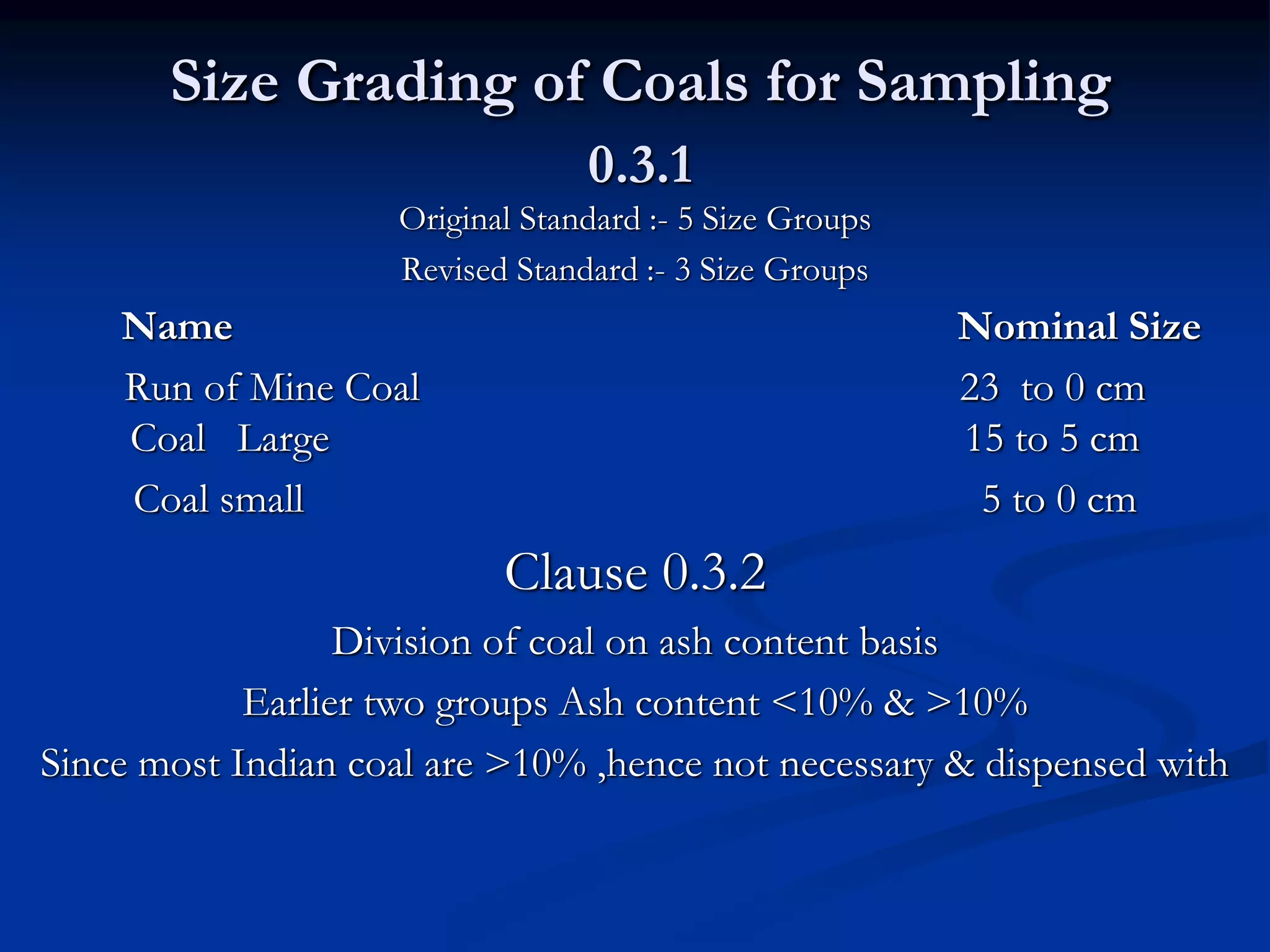
Size Grading of Coals for Sampling
0.3.1
Original Standard :- 5 Size Groups
Revised Standard :- 3 Size Groups
Name Nominal Size
Run of Mine Coal 23 to 0 cm
Coal Large 15 to 5 cm
Coal small 5 to 0 cm
Clause 0.3.2
Division of coal on ash content basis
Earlier two groups Ash content <10% & >10%
Since most Indian coal are >10% ,hence not necessary & dispensed with
Sampling Rationale clause 0.3.3
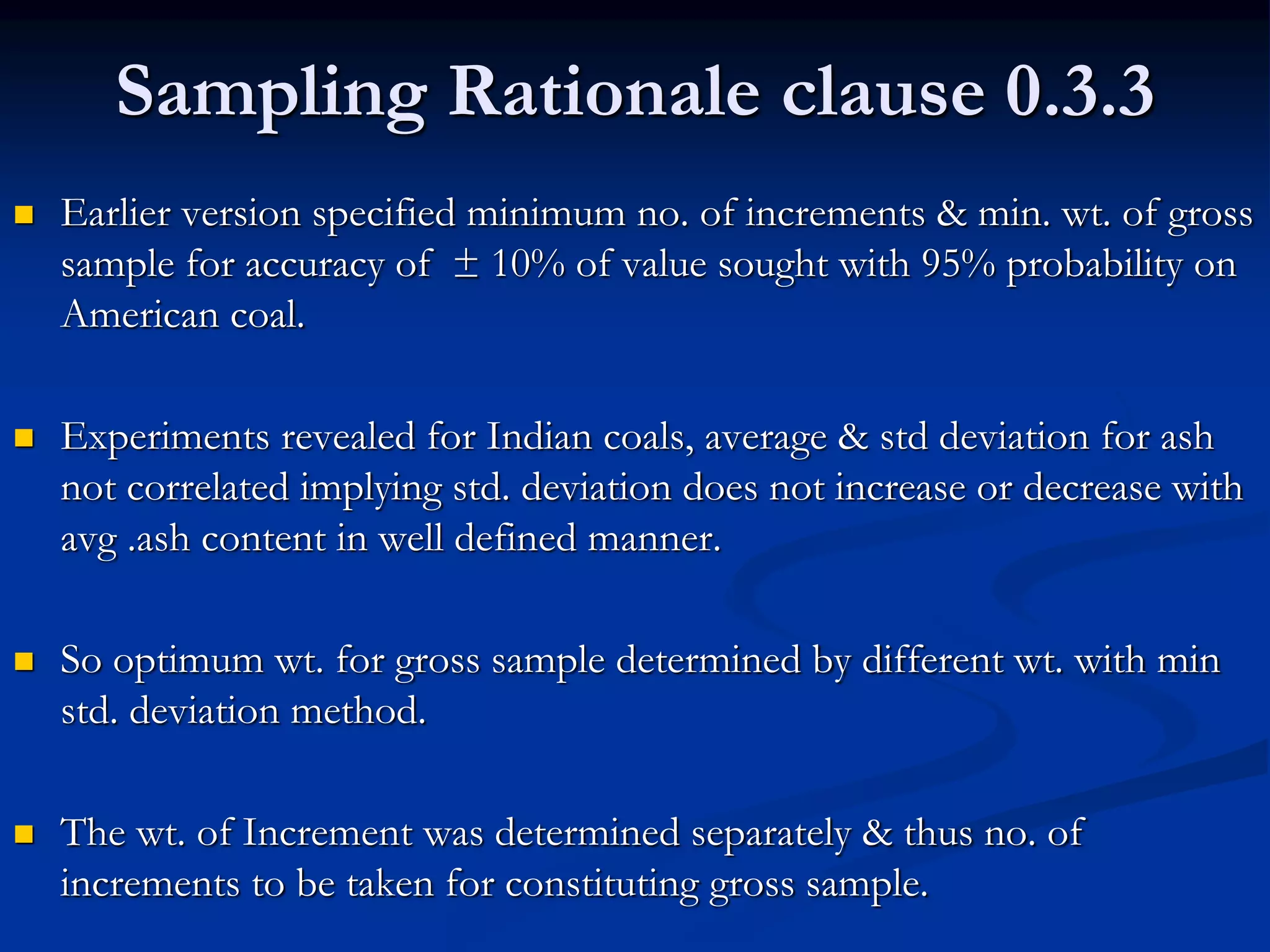
 Earlier version specified minimum no. of increments & min. wt. of gross
sample for accuracy of ± 10% of value sought with 95% probability on
American coal.
 Experiments revealed for Indian coals, average & std deviation for ash
not correlated implying std. deviation does not increase or decrease with
avg .ash content in well defined manner.
 So optimum wt. for gross sample determined by different wt. with min
std. deviation method.
 The wt. of Increment was determined separately & thus no. of
increments to be taken for constituting gross sample.
Clause 0.3.4
 Sampling procedure in earlier version had no
provision of checking expected accuracy of +-10% of
value sought with 95% probability.
 This checking is essential to know errors due to
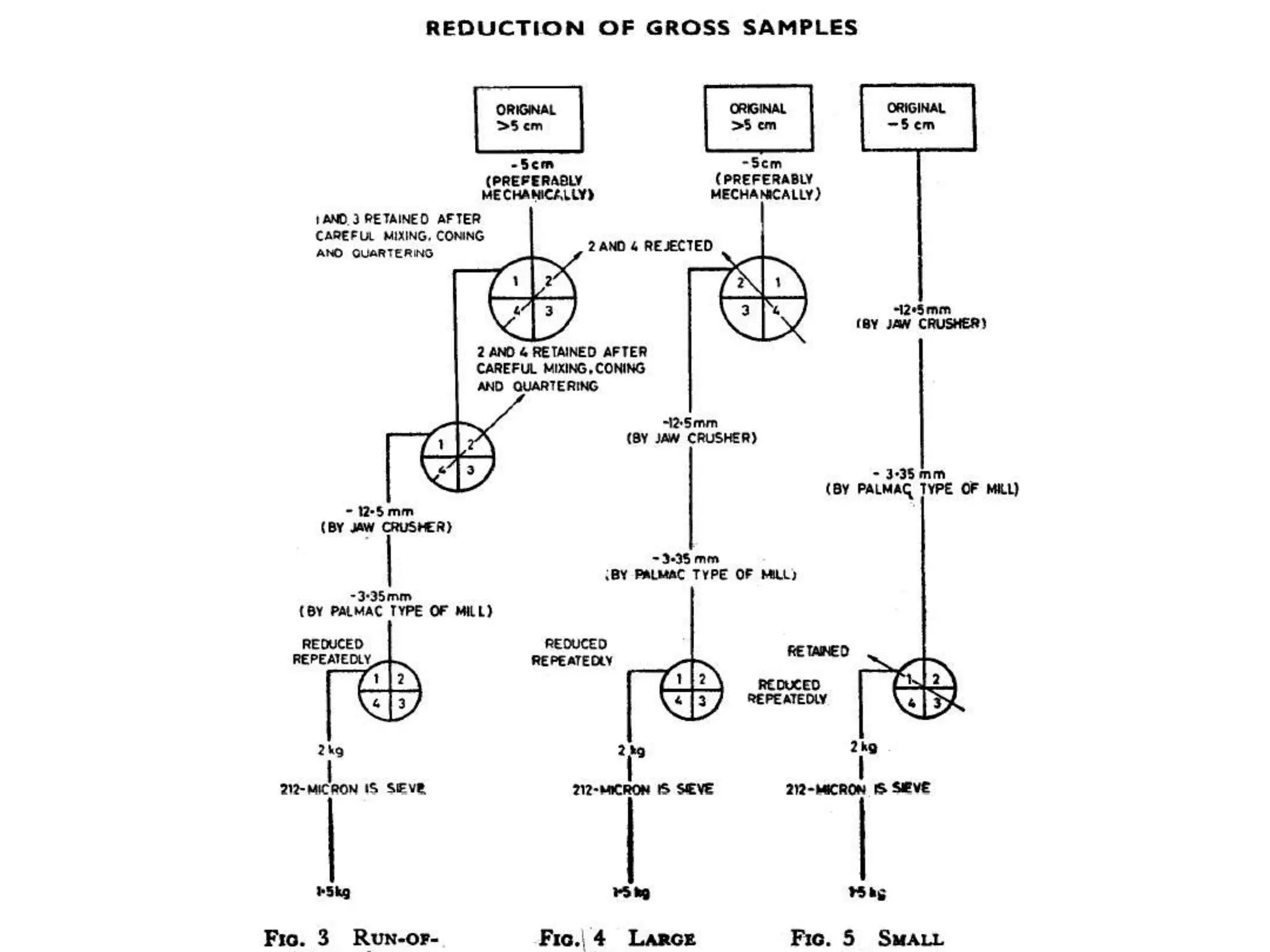
uncertainties at various stages of reduction of gross
sample.
 Testing of more than 1 gross sample desirable to
know estimate of sampling error .
Clause 0.3.4.1
 This standard recommends the division of lot in to
number of sub lots(Table 1) depending on weight of
the lot & then drawing a representative gross sample
from each of sub lots separately.
 The gross sample after suitable reduction are to be
tested individually for determination of important
characteristics of coal & composite for others.
 Standard says about valid interpretation of test results
to evaluate the avg. level of quality & extent of
variation in the average for a lot with 95% confidence.
Clause 0.3.4.2
 For obtaining reliable conclusion – Recommended to collect
sample when in motion ,from conveyors or loading
unloading. Procedure 3,4,5 to be followed.
 Sample from stationary source like stock pile /wagons, if
desired ,procedure 6,7,8 may be followed .It may be
mentioned that representativeness of sample drawn &
reliability of conclusion is not likely to be assured .
 Distribution of Ash % varies more in Indian coals, hence
more sub lots, to be sampled & analyzed for Moisture , Ash
,VM , FC etc.
Clause 2.0 Terminology
 Lot – The quantity of coal offered for disposal at one time
e.g.-rake wise .
 Sub lot- The quantity of coal in each groups in to which lot
is divided for the purpose of sampling .
 Increment –The quantity of coal taken by single operation
of the sampling implement.
 Gross Sample- Quantity of coal obtained by aggregating all
increments from same sub lot.
 Composite Sample for the lot-Mixing together equal
quantities of lab sample representing sub lots.
 Lab Sample- Quantity after reduction of gross sample by a
specified procedure for lab testing.
Terminology Clause 2
 Moisture sample- for determination of total moisture .
 Sample division – The process whereby a part of
sample is retained & remainder is rejected.
 Sample reduction – The process of crushing or
grinding the sample to reduce the particle size &
mixing and sample dividing in successive stages.
(Part 1 /sec 1) Sampling from conveyors
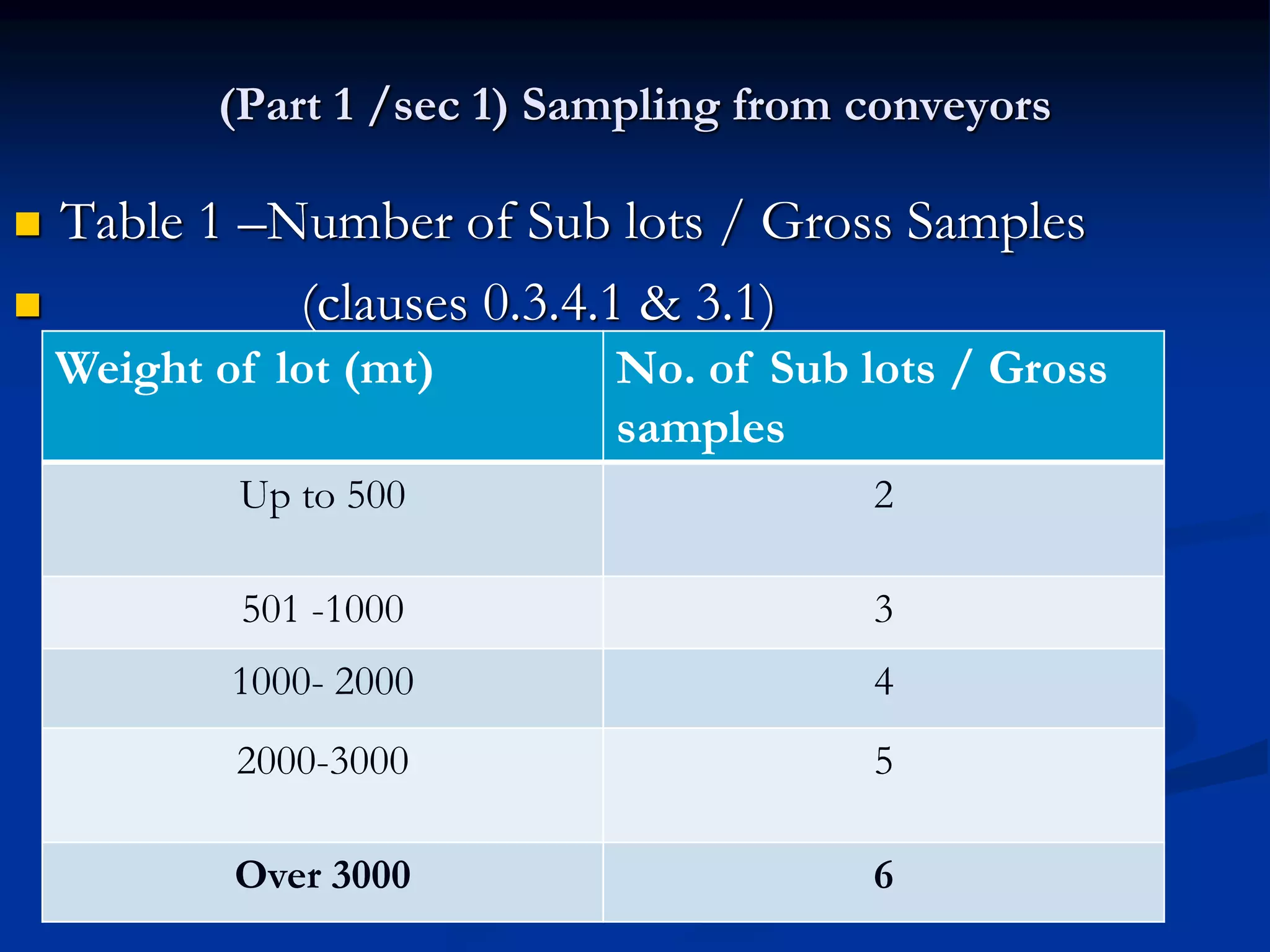
 Table 1 –Number of Sub lots / Gross Samples
 (clauses 0.3.4.1 & 3.1)
Weight of lot (mt) No. of Sub lots / Gross
samples
Up to 500 2
501 -1000 3
1000- 2000 4
2000-3000 5
Over 3000 6
( Part1 / Sec 1) Sampling from conveyors
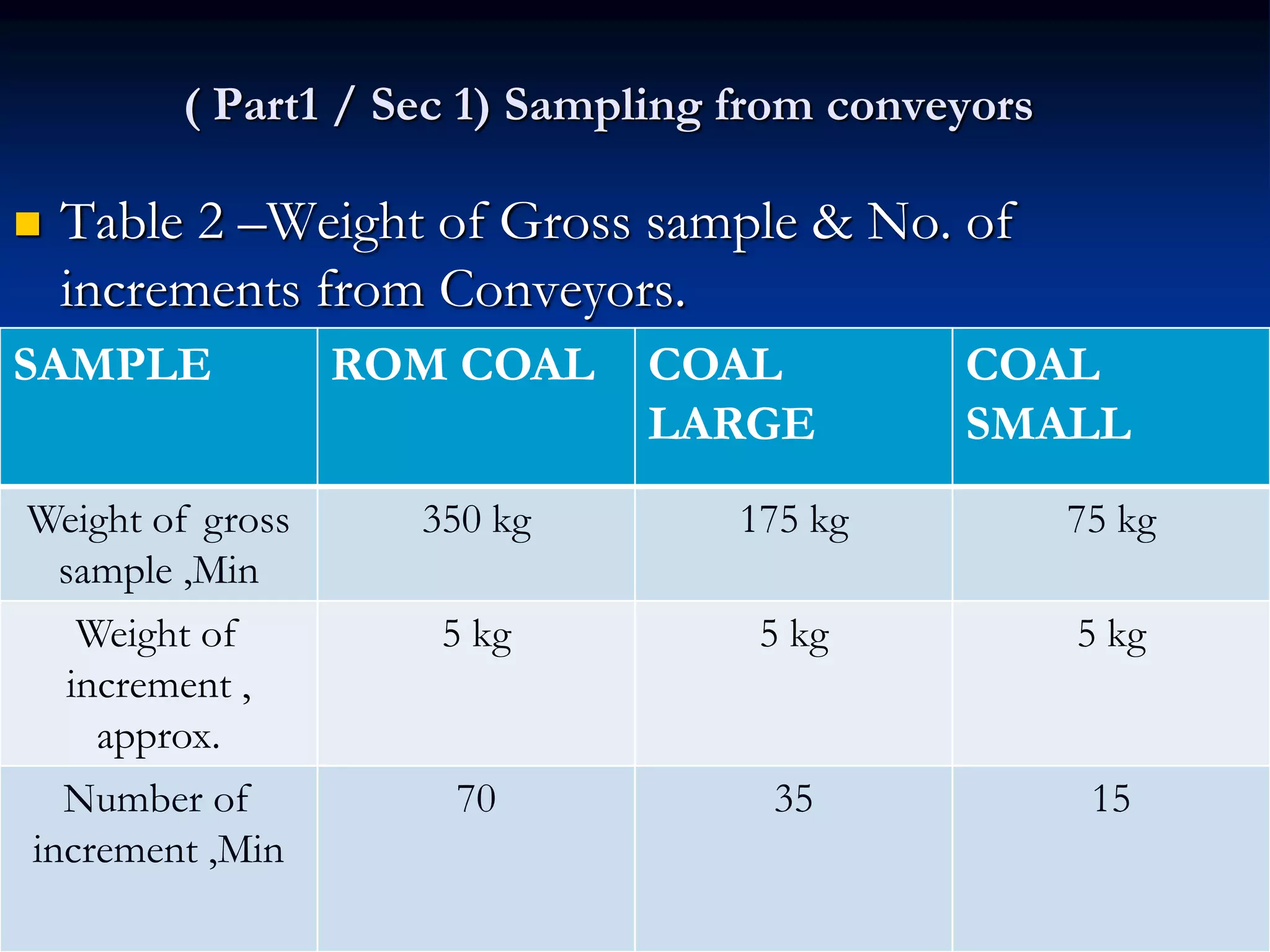
 Table 2 –Weight of Gross sample & No. of
increments from Conveyors.
SAMPLE ROM COAL COAL
LARGE
COAL
SMALL
Weight of gross
sample ,Min
350 kg 175 kg 75 kg
Weight of
increment ,
approx.
5 kg 5 kg 5 kg
Number of
increment ,Min
70 35 15
(Part 1 /section 1) Sampling from Wagons
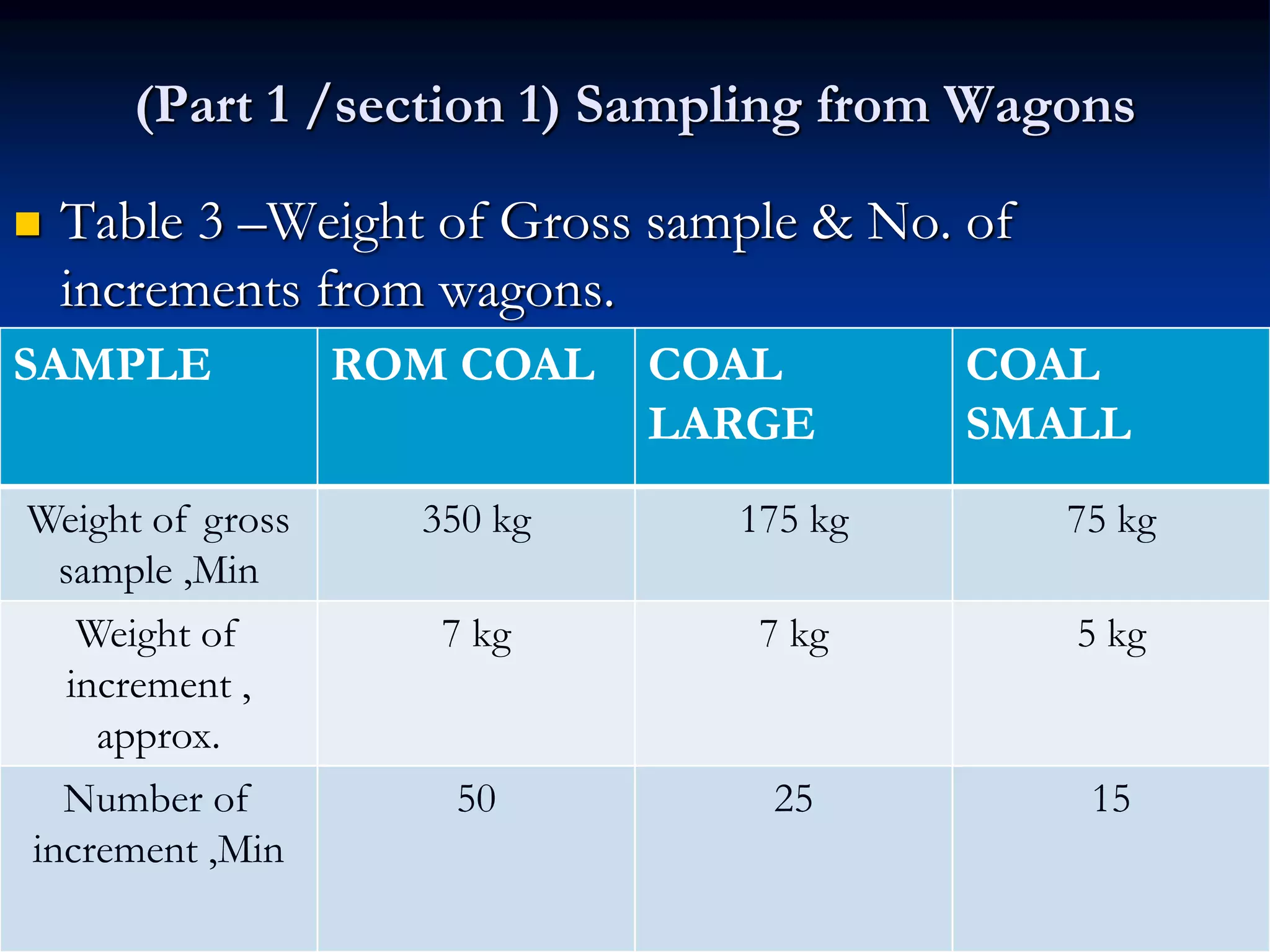
 Table 3 –Weight of Gross sample & No. of
increments from wagons.
SAMPLE ROM COAL COAL
LARGE
COAL
SMALL
Weight of gross
sample ,Min
350 kg 175 kg 75 kg
Weight of
increment ,
approx.
7 kg 7 kg 5 kg
Number of
increment ,Min
50 25 15
Manual sampling from conveyors clause 3
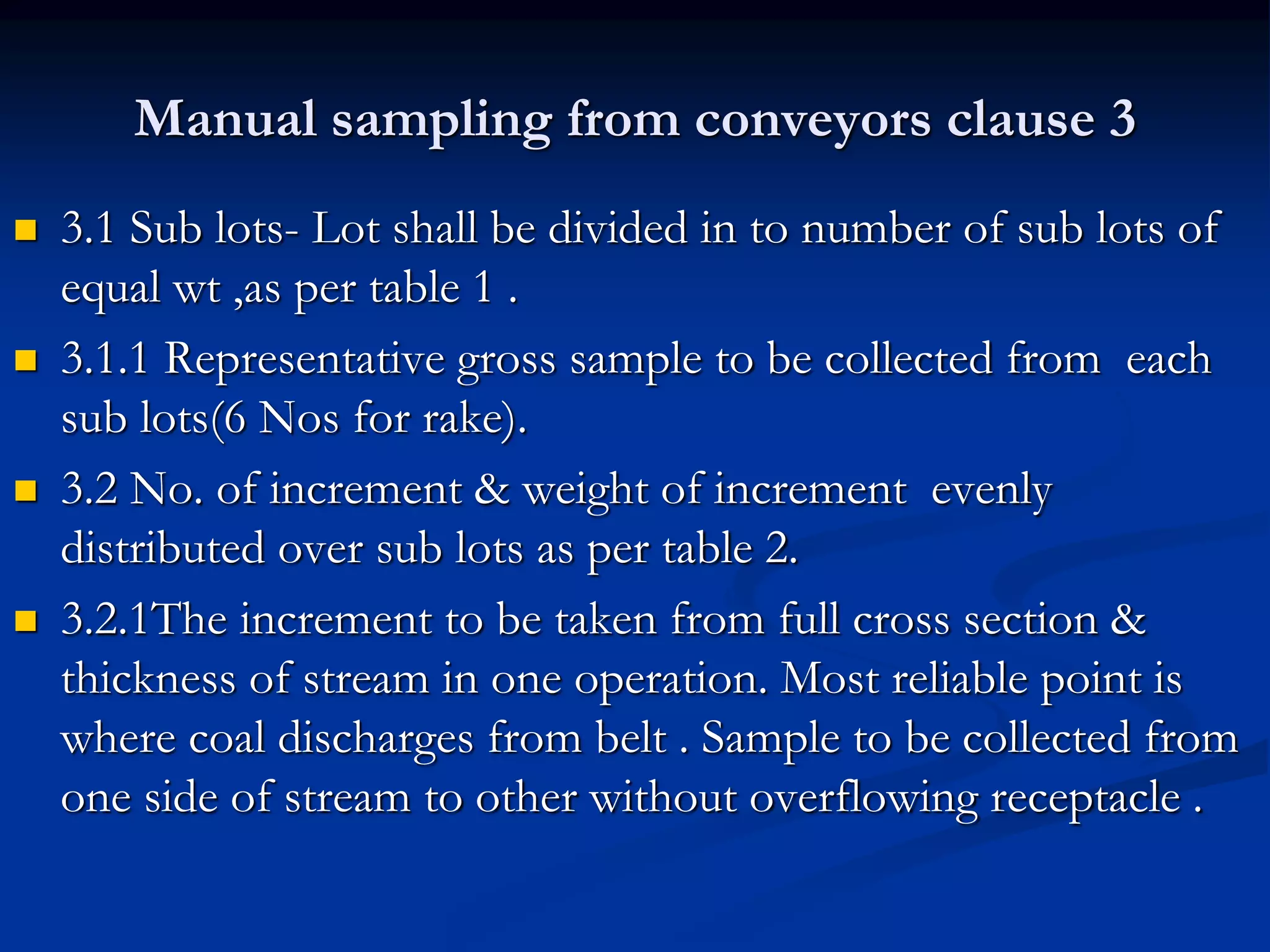
 3.1 Sub lots- Lot shall be divided in to number of sub lots of
equal wt ,as per table 1 .
 3.1.1 Representative gross sample to be collected from each
sub lots(6 Nos for rake).
 3.2 No. of increment & weight of increment evenly
distributed over sub lots as per table 2.
 3.2.1The increment to be taken from full cross section &
thickness of stream in one operation. Most reliable point is
where coal discharges from belt . Sample to be collected from
one side of stream to other without overflowing receptacle .
Manual sampling from conveyors
 3.2.1 If sample cannot be collected in one increment without
overflowing, stream should be sampled systematically by
taking material from all portions.
 3.2.2 Sample to be collected from moving belt itself if not
possible to collect from point of discharge .Increment to be
collected from center & left & right side of belt along the
same width. Scoop should sweep the bottom of conveyor to
collect small material also .
 3.2.3 If belt can be stopped periodically ,increments may be
collected from whole cross section by sweeping whole coal of
between suitable frame placed across belt. Frame should
cover full width of belt..
Manual sampling from conveyors
 3.2.4 If automatic samplers are available ,they may be
utilized for drawing increment from conveyors belt.
The setting of such machines shall be carefully
adjusted to ensure whole thickness .
 Material collected from all increment in sub lot shall
be mixed together to from gross sample.
IS : 436 (Part 1/Section 2)-1976
Reaffirmed 2000
 PART 1 –SAMPLING OF COAL
 SECTION 2– MECHANICAL SAMPLING
IS :436 Part 1/Sec -2 (Mech .
Sampling)
 MECHANICAL SAMPLING SYSTEM
 Most favourable situation for sampling is when whole coal is
exposed during conveying on belt so all part of coal get equal
chance to be included in sample.
 Reference Method :-Sampling from stopped belt is most
satisfactory way of ensuring that sample is free from bias.
 When belt cannot be stopped, sample from the cross section
of moving stream are collected, to ensure that each increment
is representative of the cross section.
 Most mech. Sampling system work on above principle.
Requirements of Mech. Sampling
System
 Design of system should be guided by type of coal test
requirement ration to be performed by the system
,desired precision of test result & absence of
significant bias.
 Cross checking of results can be done by comparing
with manual sampling by skilled personnel.
 Due consideration should be given for safety of
operators.
 Human surveillance should be available during auto
sample operation.
Design criteria of auto sampler
 The mechanical installation should take care of
 Spillage of sample material.
 Possibility of sample clogging the equipment .
 Possible impedance in the flow of the sample material
through equipment.
 Retention of the residual material.
 Introduction of the materials other than the sample .
Working of Mechanical Samplers
 Primary Sampler :- The apparatus which cuts & collect
the increments from the main flow can be of various
types .
 Automatically operated bucket moving in uniform
speed in to falling coal stream at adjusted interval of
time.
 Primary sample taken is prepared by crushing &
dividing in 3-4 stages.
 Final sample is dried & ground to 212 micron size for
analysis.
SAMPLING EQUIPMENT
 Auto .sampling machine eliminates the subjective
influence of sampler .
 Machines should have their performance tested against
reference method before put to actual use.
 A composite mechanical sampling equipment have
Sample collection & sample preparation facility.
Automatic Samplers
 Desirable to use sampler which cuts through full width of a
falling stream of coal.
 Alternate method is to scoop the sample from moving
conveyor belt.
 Important:- Sampler properly adjusted to belt curvature across
width to collect fine particles which settles to bottom of belt
during motion.
 Cutter should not cause turbulence while sweeping pushing
large coal pieces & rejecting same ,hence its speed to be
carefully adjusted to avoid taking biased sample.
Sampling from Moving Belt
 Scrapper Arm type sampler :- operate by sweeping of
increment across the width of conveyor belt.
 Mass of increment depends on load on belt & width
of scrapper.
 Automatic operation based on equal interval of time
 Or after specified mass of coal have passed by belt
weighing machine.
Sample Preparation Equipment
 Size Reduction Apparatus :- Mills High speed
desirable .
 Sample Mixing Apparatus :-paddle mixer ,drum mixer
,double cone mixer.
 Sample dividing apparatus :- Mostly rotary type in
which a receive is placed on turntable so as to
intercept falling stream of coal once in each
revolution.
METHODS OF COLLECTING SAMPLES
 LOT :- Each consignment should be treated lot &
should not be mixed with previous subsequent
supplies .When coal source is same & moved
continuously than lot can be based on time /day .
 SUB LOTS :- Division of lot in to number of sub lots
of equal mass as per table 1.Size of sub lots should be
reasonably large to facilitate mechanical sampling .
 No of Increments :- Limitations in terms of fast rate
of discharge ,large increment size & minimum time
interval between 2 consecutive increments. Table 2
Increments
 Mass of the Increments :- Should not be less than 10
kg for both washed & unwashed. Ensure that they
have almost uniform mass.
 A measure of uniformity of mass is CV which is
defined as the % of std. deviation relative to mean
value of mass.
 For routine sampling purpose ,increments are uniform
if the CV of their mass is <=20%. It is essential to
check uniformity of mass periodically by weighing at
least 20 consecutive increments.
Schematics of Auto Sampler
Primary Sampler
Rotary Sample Divider
Final Sample Collector
Primary feeder
Primary Crusher
Qty. Reduction
(1:10)
Secondary feeder
Secondary Crusher
Qty. Reduction (1:10)
Primary Sampler
 Primary Sampler Type –Sweeping Type scrapper arm
 Feed Size -300 mm ,
 Sample opening size- 450 mm
 Sampling frequency – 20 times/hour
 Sampling times per hour(scoop/hr) - 20 max
 Sampling amount (kg/scoop) - 83 max
 Sampling amount per hour (kg/hr) -1660 max
Primary Feeder, Crusher & Sample Divider
 Crusher type - Ring hammer type (two-level)
 Crusher output - 10t/h
 Driving mode -Belt-driving
 Max feed size -300 mm
 Output size after crushing – 50 mm
 Ratio of Sample Division = 1 : 10
Secondary Feeder & Crusher
 Crusher type - Ring hammer type (two-level)
 Crusher output -5t/h
 Driving mode -Belt-driving
 Max feed size - 50 mm
 Discharge size after crushing -12.5 mm
Sample Divider & Collector
 Ratio of Sample Division -- 1 : 10
 Sample divider --- Vertical Rotary Sample Divider
 Collector type ---Rotary type
 Sample bottle -- 6 nos.
 Sample bottle capacity -- 16 kg each
Auto Sampler –
• Auto sampler draws sample from moving conveyor
belt as per clause no. 4.2.2
• Type – Scraper arm type sampler ( Fig 4 page 9)
• Collection of sample to reduction of gross sample up
to -12.5 mm.
• TM sample taken from the final sample collected in
bottle after proper mixing.
•Remaining sample is pass through 3.35 mm and
then by coning and quartering 1.5 kg laboratory
sample is made.
•Above 2 kg laboratory sample is ground to pass
212 micron sieve for analysis of proximate, GCV,
Sulfur etc.
•The whole process is fully automatic up to -12.5
mm & there is no manual intervention.
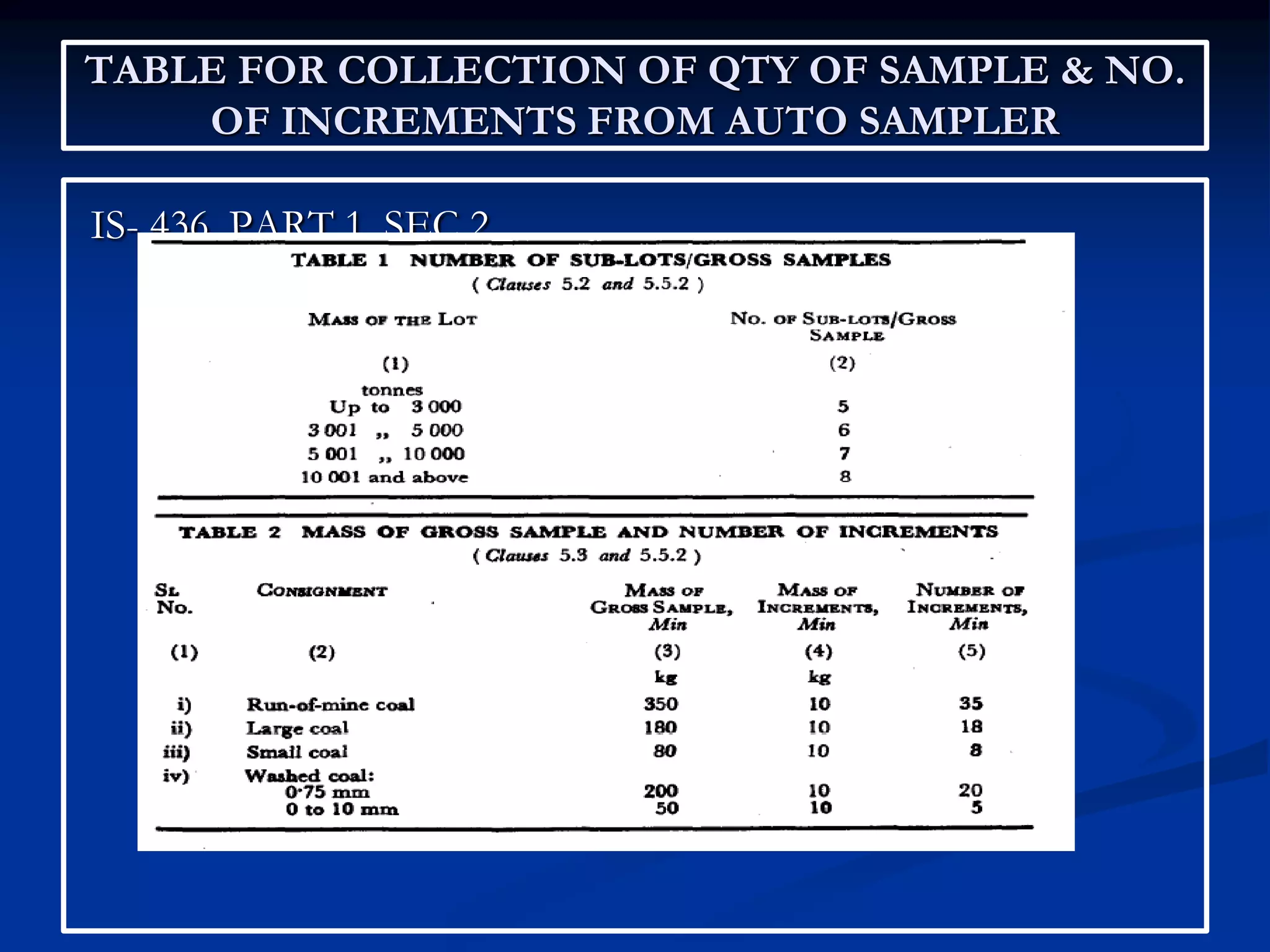
TABLE FOR COLLECTION OF QTY OF SAMPLE & NO.
OF INCREMENTS FROM AUTO SAMPLER
IS- 436, PART 1, SEC 2.
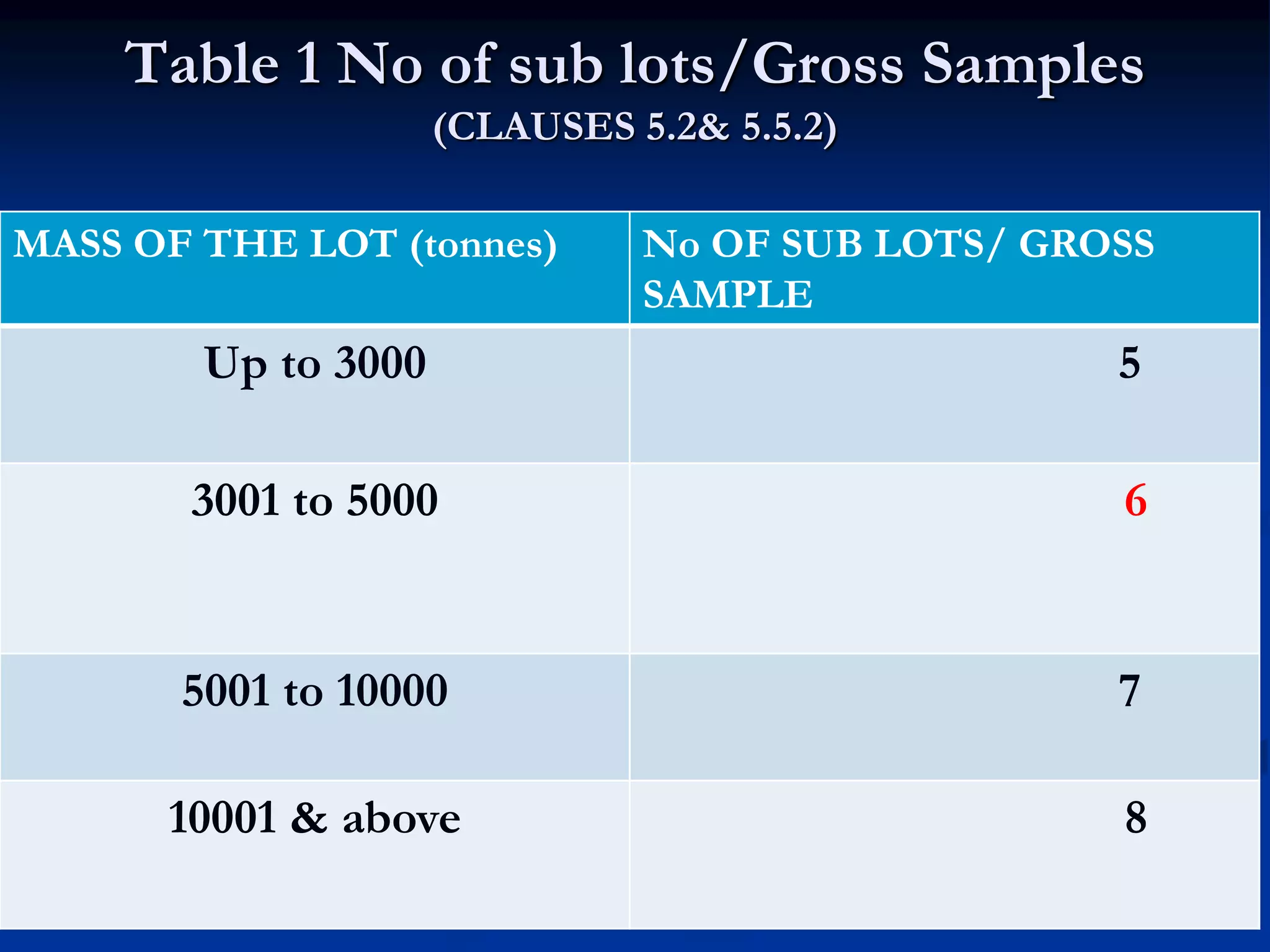
Table 1 No of sub lots/Gross Samples
(CLAUSES 5.2& 5.5.2)
MASS OF THE LOT (tonnes) No OF SUB LOTS/ GROSS
SAMPLE
Up to 3000 5
3001 to 5000 6
5001 to 10000 7
10001 & above 8
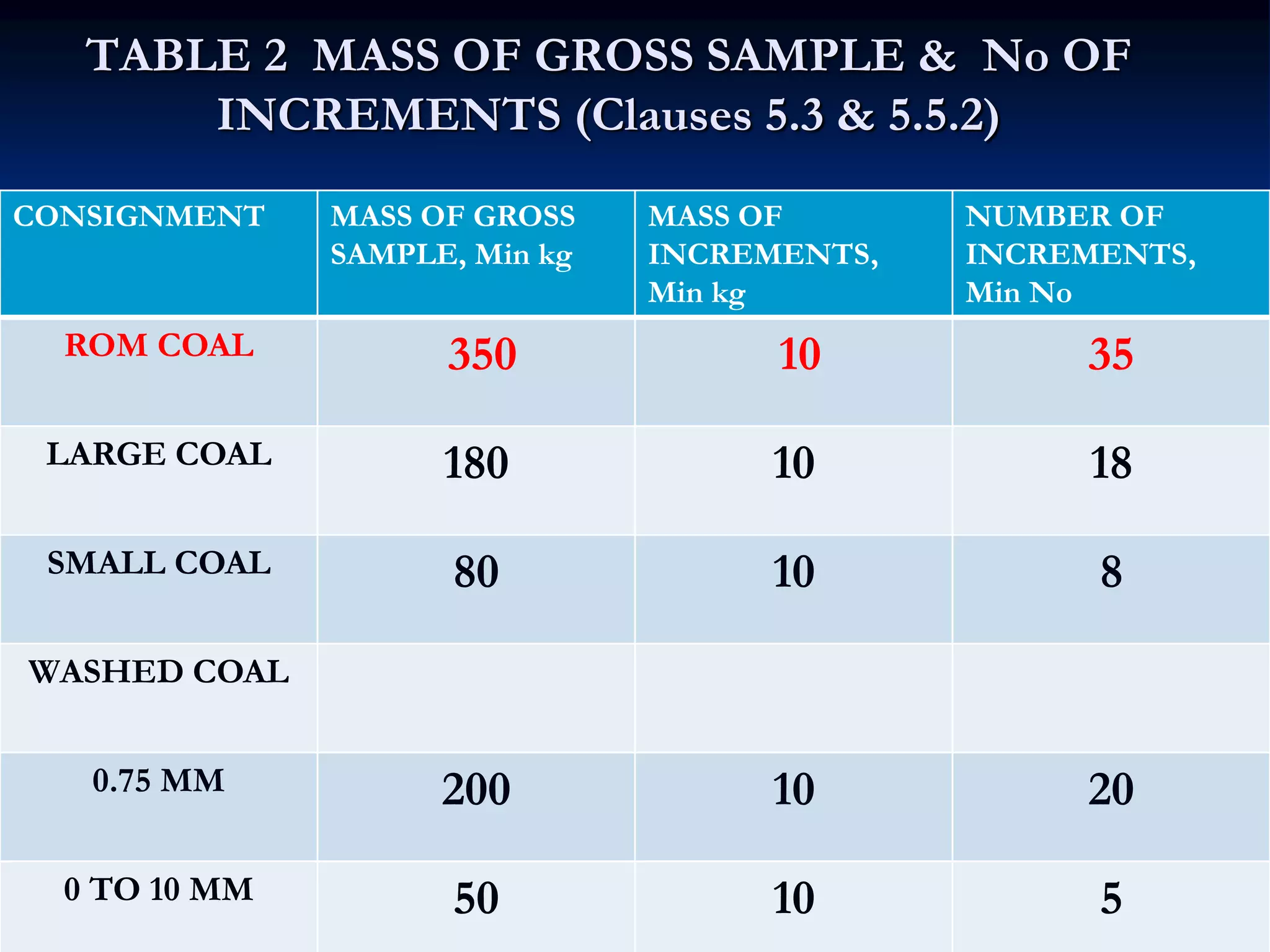
TABLE 2 MASS OF GROSS SAMPLE & No OF
INCREMENTS (Clauses 5.3 & 5.5.2)
CONSIGNMENT MASS OF GROSS
SAMPLE, Min kg
MASS OF
INCREMENTS,
Min kg
NUMBER OF
INCREMENTS,
Min No
ROM COAL 350 10 35
LARGE COAL 180 10 18
SMALL COAL 80 10 8
WASHED COAL
0.75 MM 200 10 20
0 TO 10 MM 50 10 5
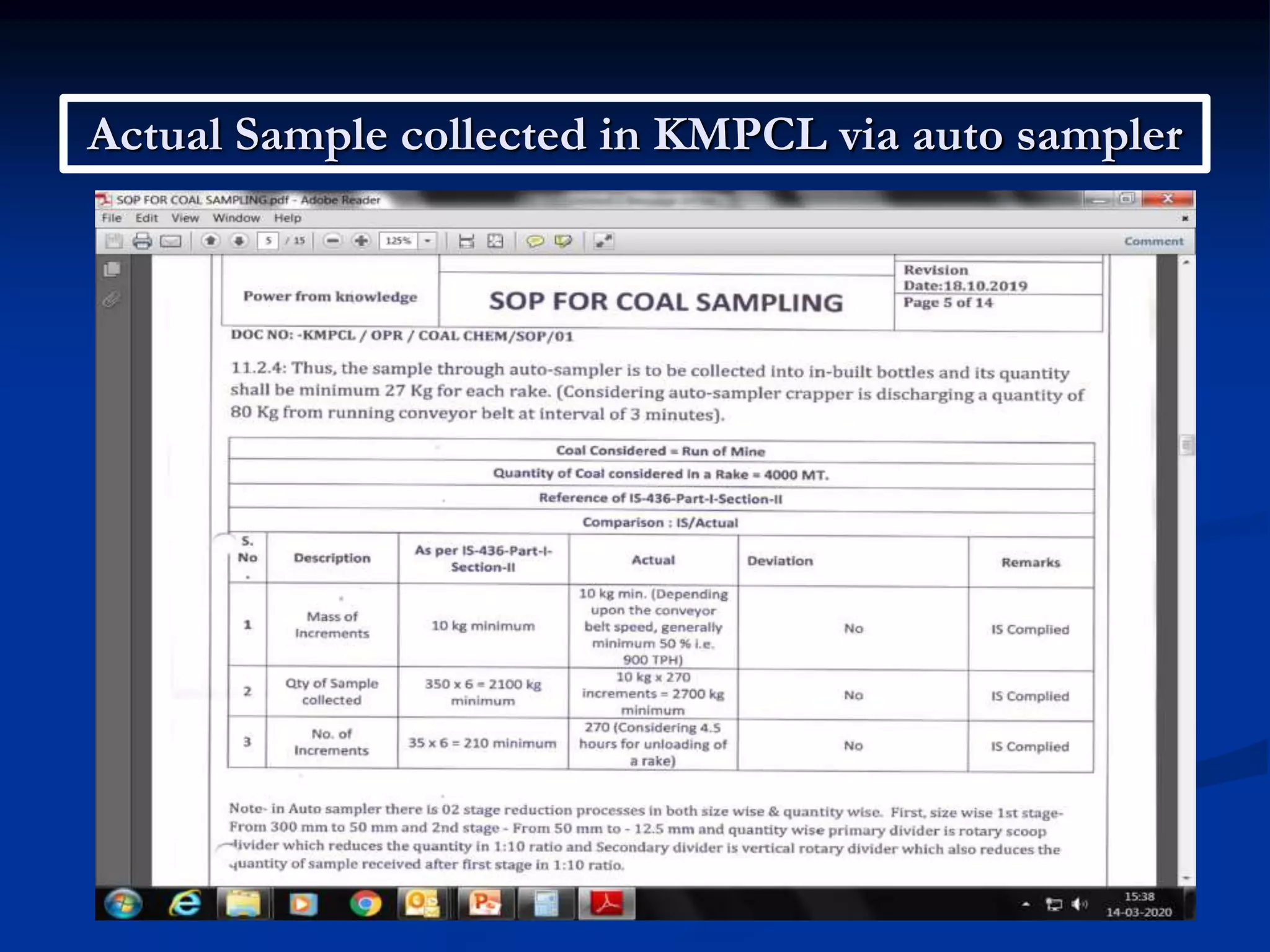
Actual Sample collected in KMPCL via auto sampler
REVIEW OF SOP FOR COAL SAMPLING
S.No. Description As per IS-
436-part-I
section -II
Actual Deviation Remarks
1 Mass of
Increments
10 kg
minimum
30 kg min No IS complied
2 Mass of
sample
collected
350 x 6
=2100 kg
minimum
30 kg x 90
increments
=2700 kg
minimum
No IS complied
3 No. of
Increments
35 x 6 = 210
minimum
90
increment in
4.5 hours
Yes .43 %
only respect
to BIS
NOT
COMPLIED
REMARKS:- No of increments not complied with BIS standard due to system
constraint of minimum 3 minutes setting of scooping frequency instead of 1.14
minute as per IS standard . However Quantity of sample is collected more than
desired .
METHOD OF COLLECTING SAMPLE
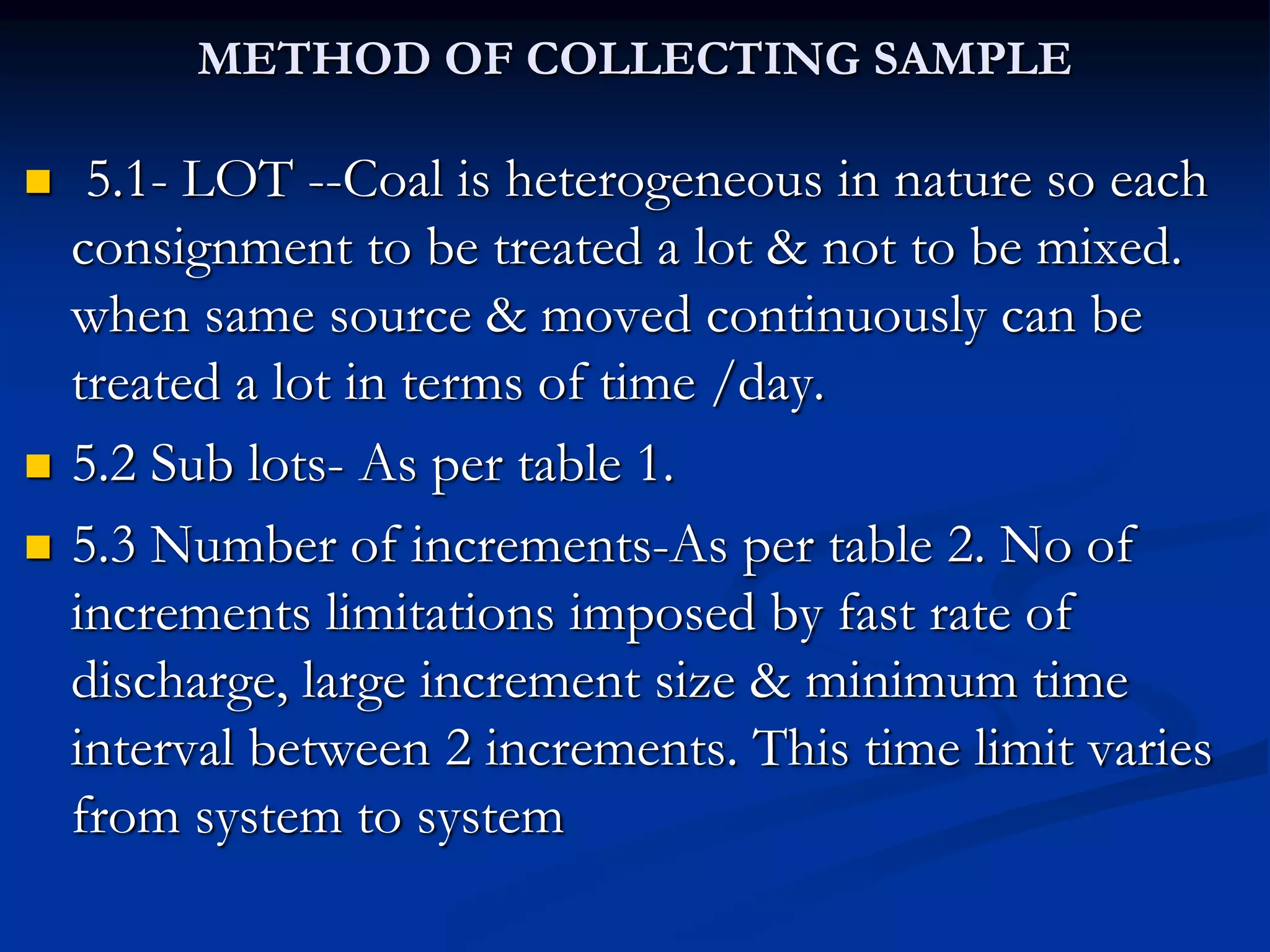
 5.1- LOT --Coal is heterogeneous in nature so each
consignment to be treated a lot & not to be mixed.
when same source & moved continuously can be
treated a lot in terms of time /day.
 5.2 Sub lots- As per table 1.
 5.3 Number of increments-As per table 2. No of
increments limitations imposed by fast rate of
discharge, large increment size & minimum time
interval between 2 increments. This time limit varies
from system to system
Collection of Increments by Mechanical samplers 5.5

Example of time basis sampling 5.5.3
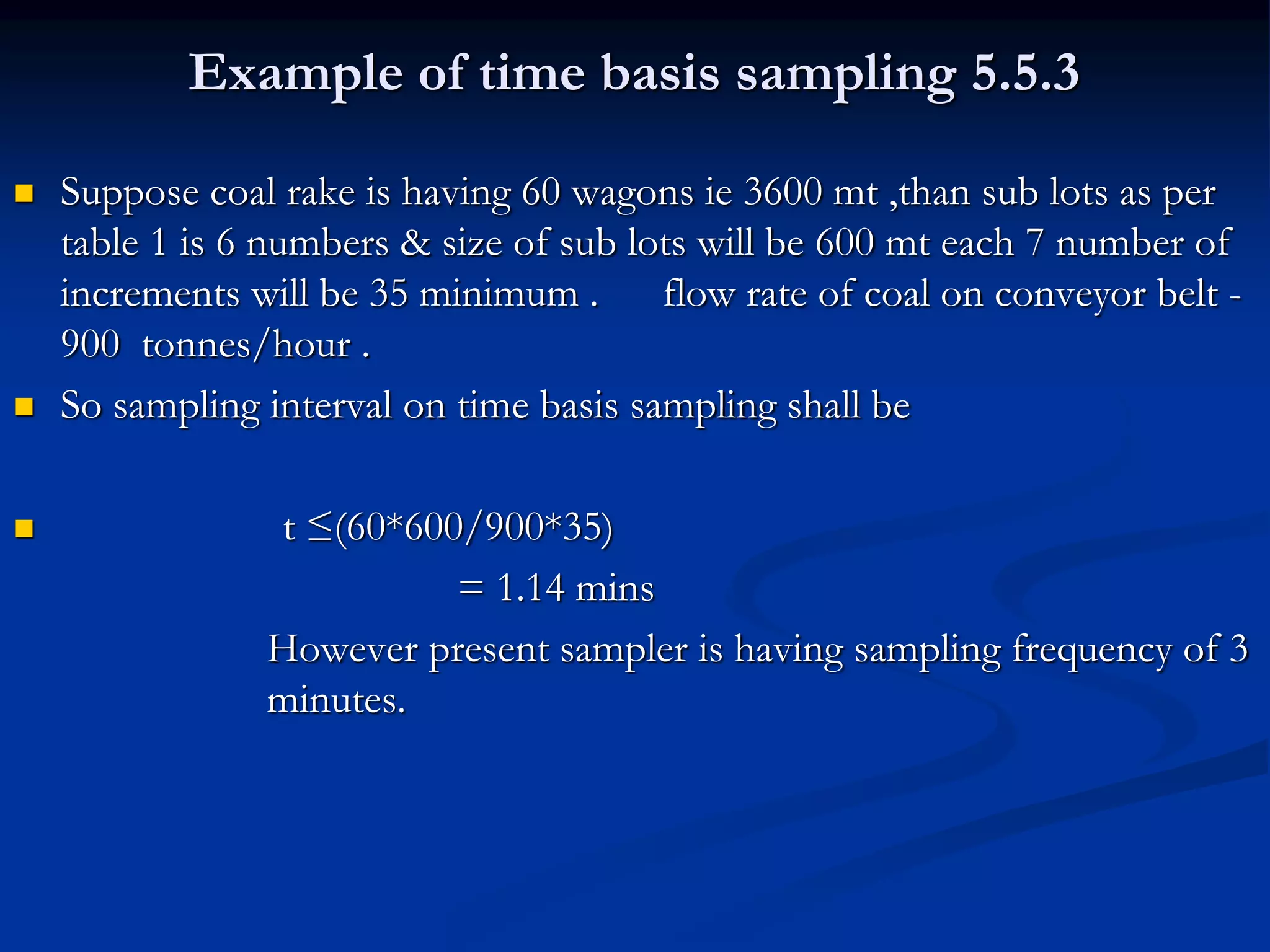
 Suppose coal rake is having 60 wagons ie 3600 mt ,than sub lots as per
table 1 is 6 numbers & size of sub lots will be 600 mt each 7 number of
increments will be 35 minimum . flow rate of coal on conveyor belt -
900 tonnes/hour .
 So sampling interval on time basis sampling shall be
 t ≤(60*600/900*35)
= 1.14 mins
However present sampler is having sampling frequency of 3
minutes.
Time basis sampling 5.5.4
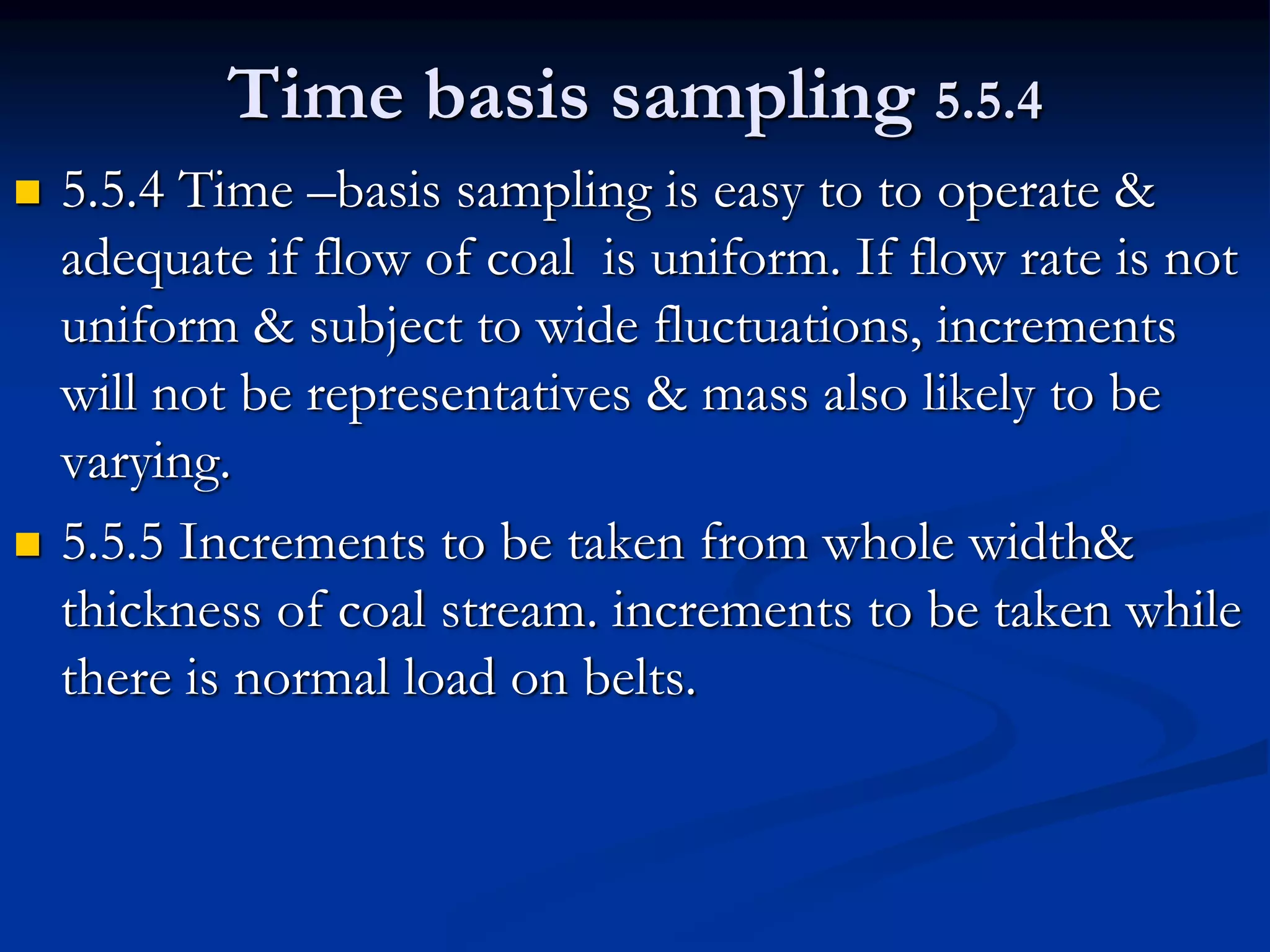
 5.5.4 Time –basis sampling is easy to to operate &
adequate if flow of coal is uniform. If flow rate is not
uniform & subject to wide fluctuations, increments
will not be representatives & mass also likely to be
varying.
 5.5.5 Increments to be taken from whole width&
thickness of coal stream. increments to be taken while
there is normal load on belts.
Sample Preparation 6.
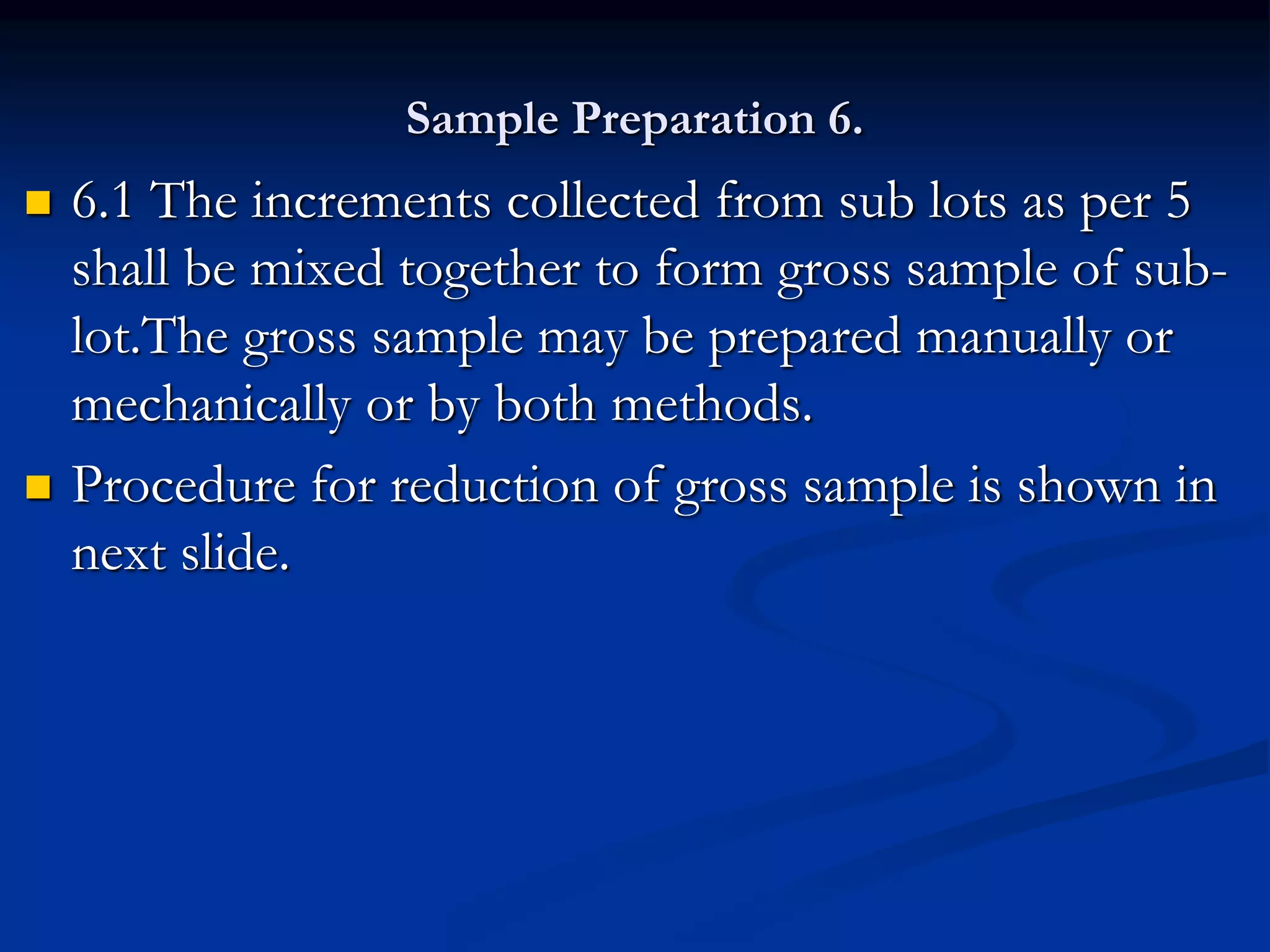
 6.1 The increments collected from sub lots as per 5
shall be mixed together to form gross sample of sub-
lot.The gross sample may be prepared manually or
mechanically or by both methods.
 Procedure for reduction of gross sample is shown in
next slide.
Flow Chart of Coal Preparation
SCRAPER ARM TYPE SAMPLER- IS 436, PART 1,
SEC 2
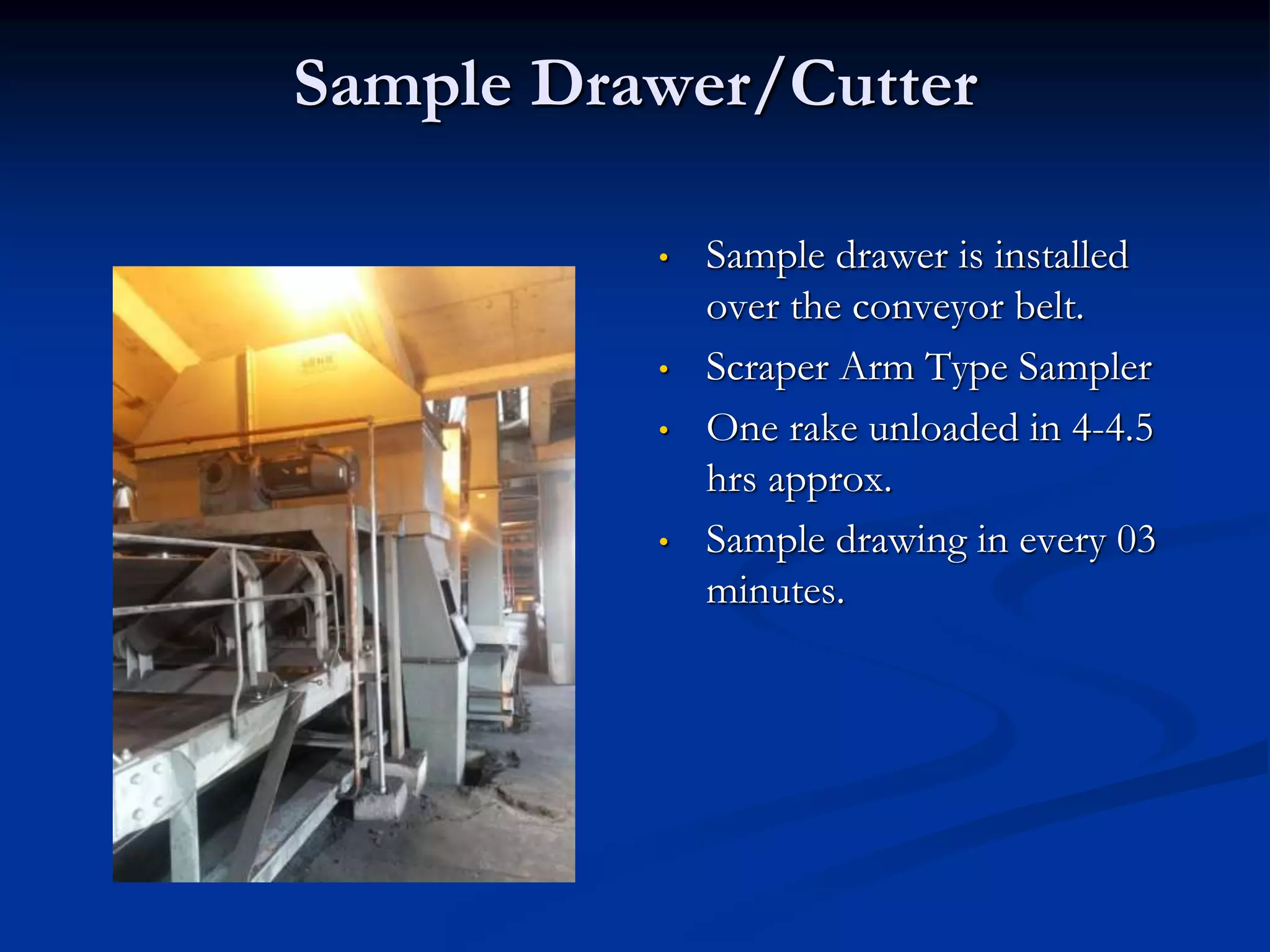
Sample Drawer/Cutter
• Sample drawer is installed
over the conveyor belt.
• Scraper Arm Type Sampler
• One rake unloaded in 4-4.5
hrs approx.
• Sample drawing in every 03
minutes.
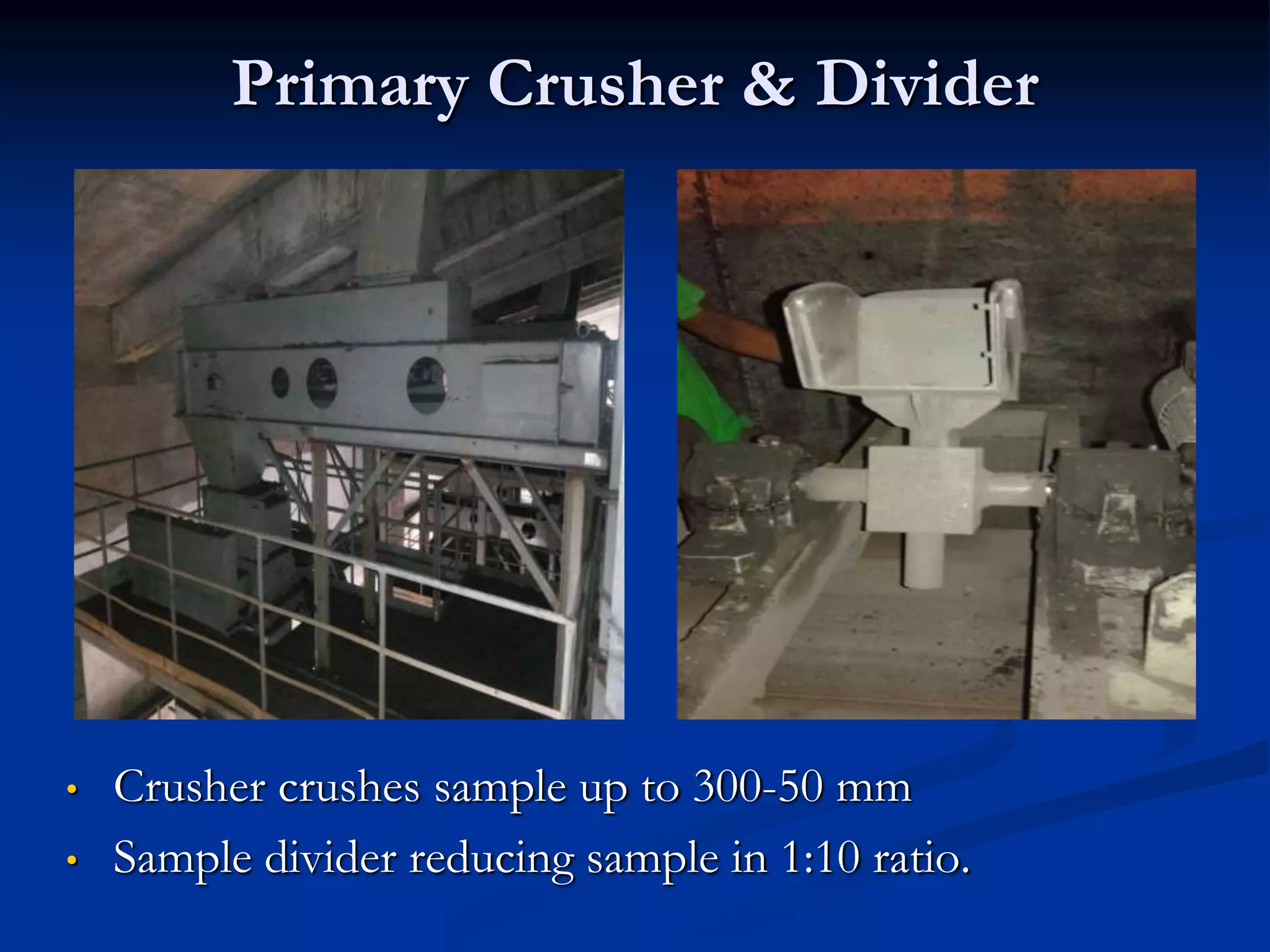
Primary Crusher & Divider
• Crusher crushes sample up to 300-50 mm
• Sample divider reducing sample in 1:10 ratio.
Secondary Feeder & Crusher
• Crusher crushes sample
up to 50 to -12.5 mm
Secondary Sampler Divider
• Rotary Sample divider
reducing sample in 1:10
ratio.
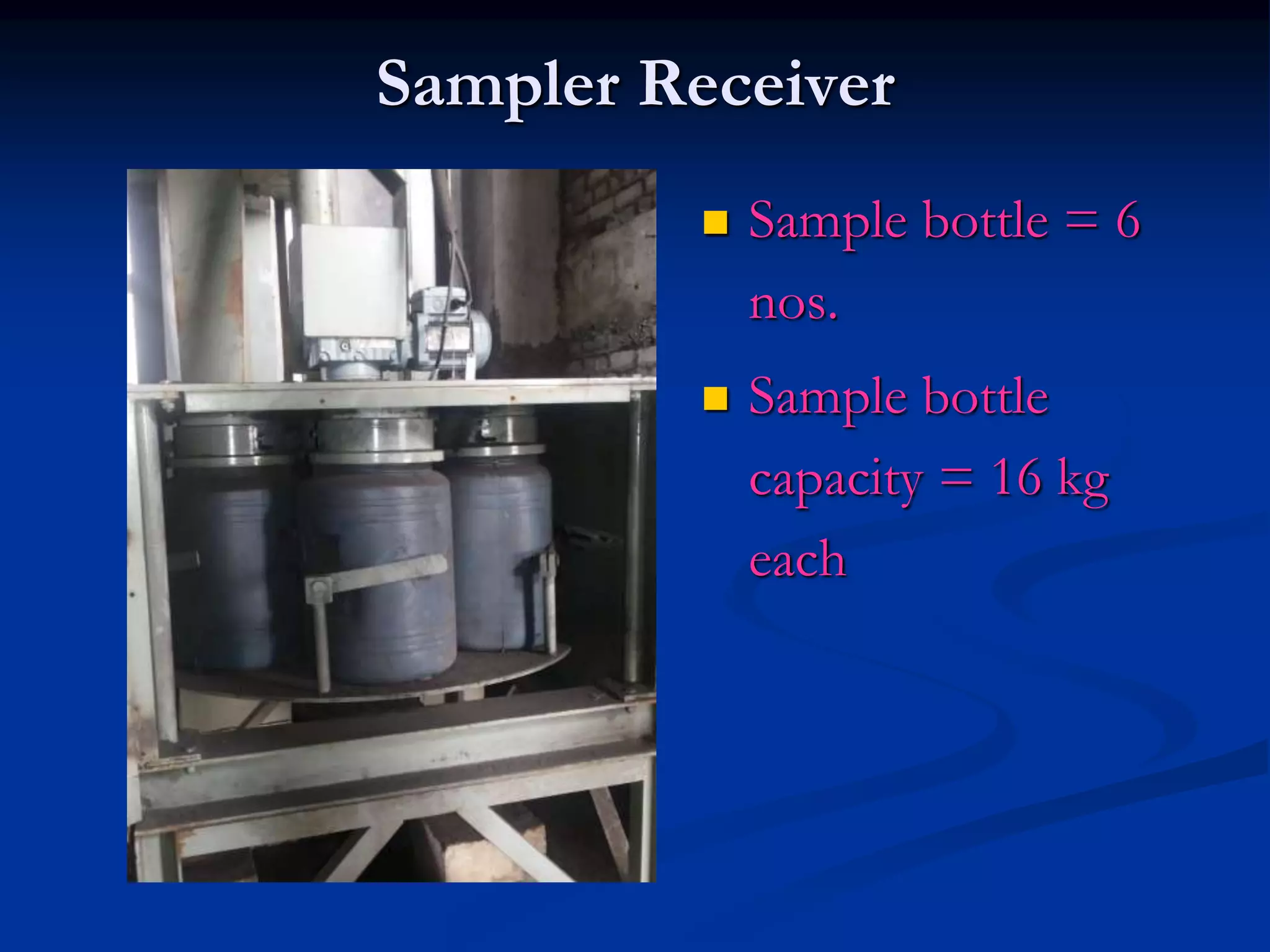
Sampler Receiver
 Sample bottle = 6
nos.
 Sample bottle
capacity = 16 kg
each
Elevator
* Reduced and rejected
sample returned through
the elevator to the main
conveyor belt.
Sealing of sample box chamber
 KMPCL shift chemist
seal the auto sampler box
and open after
completion of rake in
front of supplier’s
representative and take it
for preparation.
 Rake sample received minimum 27 kg in -12.5 mm size
though auto sampler after automatically crushing and
reducing of sample.
 TM sample 1-2 kg first of all taken from the above sample
after proper mixing of received total sample.
 Rest of the sample pass through crusher in lab to get output
in -3.35 mm size.
 After that qty of sample reduced up to 1.5 kg by quartering
and coning, for laboratory analysis.
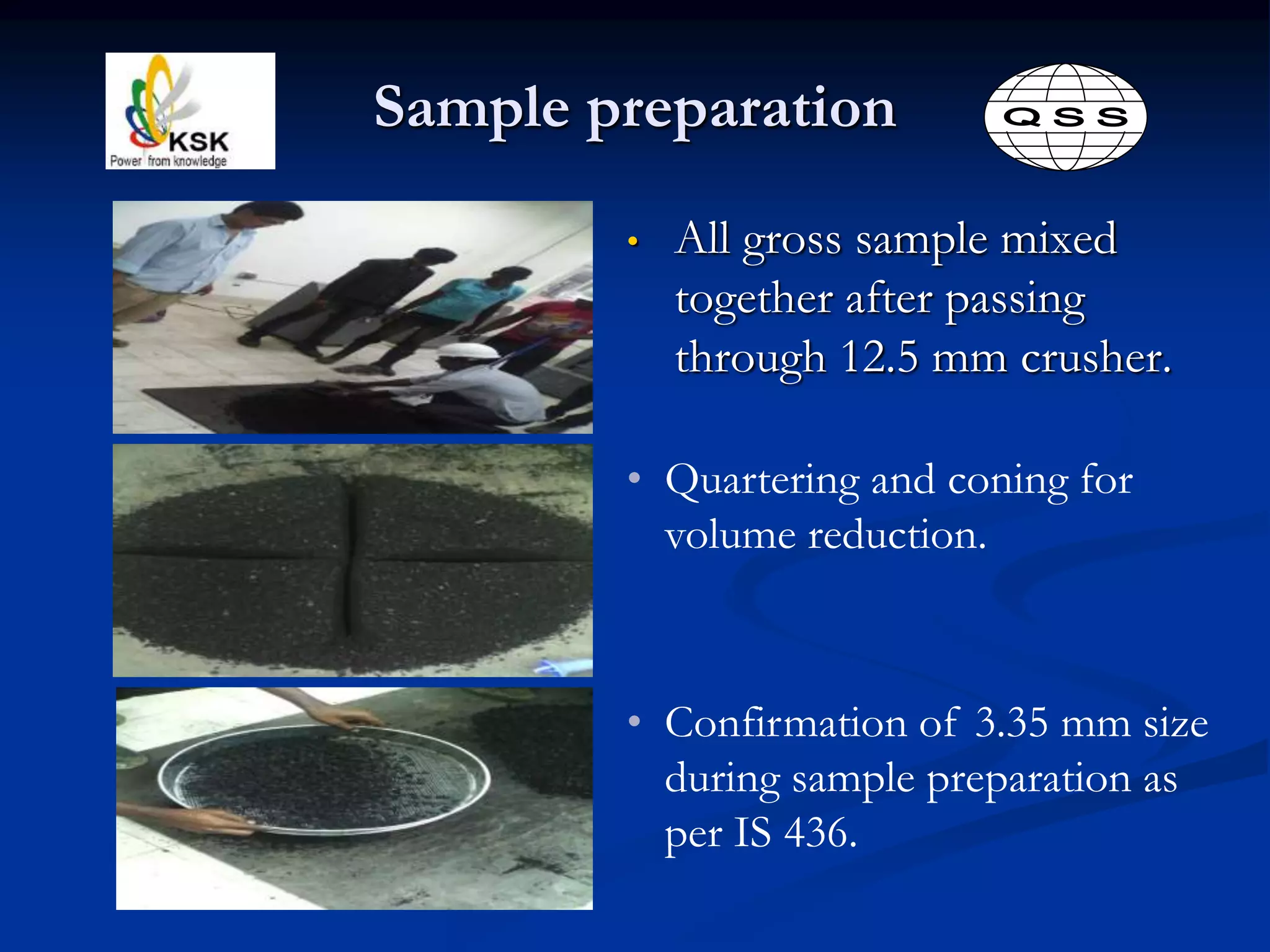
Sample preparation
• All gross sample mixed
together after passing
through 12.5 mm crusher.
• Quartering and coning for
volume reduction.
• Confirmation of 3.35 mm size
during sample preparation as
per IS 436.
 1.5 kg laboratory sample received by rake/road
mode pulverized to get -212 micron size.
 Above sample packed in 04 packets, 01 for analysis
and rest of the packets kept as referee sample.
Conclusion
Auto samplers- installed for coal as received & coal as fired
are working satisfactory ,however they have limitation & don’t
meet sampling frequency (number of increments ) criteria as
per IS norms.
Auto samplers are operating at 3 minutes frequency instead of
1.14 minutes for 900 tph flow .
Auto Samplers have provision for getting 6 gross samples from
6 sub lots required for full rake of around 3600 capacity .
12.1 Presently all gross sample are mixed to form one
composite sample & analyzed to give one result only as
characteristics of lot.
Conclusion
 Its recommended to follow norm of sub lots /gross
sample as per table 1& prepare lab sample for analysis.
 Analysis of all lab sample for important criteria like
moisture & ash & find out average value & range.
 Average value & range to be reported which will be
more accurate
 Range is the difference between the maxium &
minimum value of the test results.
Flow Chart of Coal Preparation
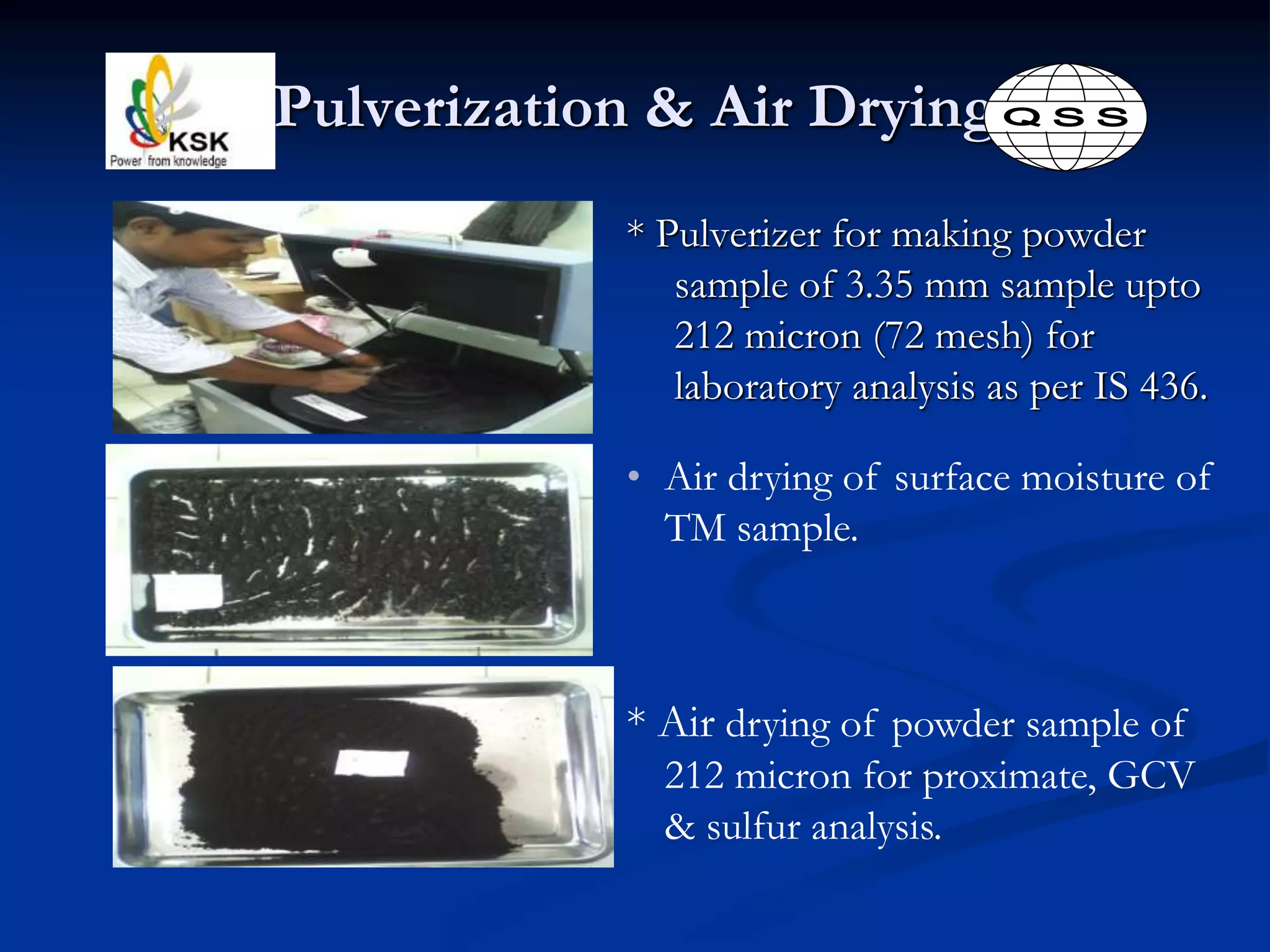
Pulverization & Air Drying
* Pulverizer for making powder
sample of 3.35 mm sample upto
212 micron (72 mesh) for
laboratory analysis as per IS 436.
• Air drying of surface moisture of
TM sample.
* Air drying of powder sample of
212 micron for proximate, GCV
& sulfur analysis.
THANKS

Coal quality sampling &; preparation as per indian standard

  • 1.
    Coal Sampling &Preparation KMPCL BY P.S. DESHMUKH
  • 2.
    COAL SAMPLING IS:436-1964 Part 1SAMPLING OF COAL Section 1 Manual Sampling (Revised) Section 2 Mechanical Sampling 1976 Reaffirmed 2000
  • 3.
    Section 1 Manualsampling  Original Issue – 1953 (Tentative Standard)  Adopted By ISI – 1964(20th July 1964 )  After extensive Investigations & experienced gained in 11 Years on Indian Coals.
  • 4.
    Size Grading ofCoals for Sampling 0.3.1 Original Standard :- 5 Size Groups Revised Standard :- 3 Size Groups Name Nominal Size Run of Mine Coal 23 to 0 cm Coal Large 15 to 5 cm Coal small 5 to 0 cm Clause 0.3.2 Division of coal on ash content basis Earlier two groups Ash content <10% & >10% Since most Indian coal are >10% ,hence not necessary & dispensed with
  • 5.
    Sampling Rationale clause0.3.3  Earlier version specified minimum no. of increments & min. wt. of gross sample for accuracy of ± 10% of value sought with 95% probability on American coal.  Experiments revealed for Indian coals, average & std deviation for ash not correlated implying std. deviation does not increase or decrease with avg .ash content in well defined manner.  So optimum wt. for gross sample determined by different wt. with min std. deviation method.  The wt. of Increment was determined separately & thus no. of increments to be taken for constituting gross sample.
  • 6.
    Clause 0.3.4  Samplingprocedure in earlier version had no provision of checking expected accuracy of +-10% of value sought with 95% probability.  This checking is essential to know errors due to uncertainties at various stages of reduction of gross sample.  Testing of more than 1 gross sample desirable to know estimate of sampling error .
  • 7.
    Clause 0.3.4.1  Thisstandard recommends the division of lot in to number of sub lots(Table 1) depending on weight of the lot & then drawing a representative gross sample from each of sub lots separately.  The gross sample after suitable reduction are to be tested individually for determination of important characteristics of coal & composite for others.  Standard says about valid interpretation of test results to evaluate the avg. level of quality & extent of variation in the average for a lot with 95% confidence.
  • 8.
    Clause 0.3.4.2  Forobtaining reliable conclusion – Recommended to collect sample when in motion ,from conveyors or loading unloading. Procedure 3,4,5 to be followed.  Sample from stationary source like stock pile /wagons, if desired ,procedure 6,7,8 may be followed .It may be mentioned that representativeness of sample drawn & reliability of conclusion is not likely to be assured .  Distribution of Ash % varies more in Indian coals, hence more sub lots, to be sampled & analyzed for Moisture , Ash ,VM , FC etc.
  • 9.
    Clause 2.0 Terminology Lot – The quantity of coal offered for disposal at one time e.g.-rake wise .  Sub lot- The quantity of coal in each groups in to which lot is divided for the purpose of sampling .  Increment –The quantity of coal taken by single operation of the sampling implement.  Gross Sample- Quantity of coal obtained by aggregating all increments from same sub lot.  Composite Sample for the lot-Mixing together equal quantities of lab sample representing sub lots.  Lab Sample- Quantity after reduction of gross sample by a specified procedure for lab testing.
  • 10.
    Terminology Clause 2 Moisture sample- for determination of total moisture .  Sample division – The process whereby a part of sample is retained & remainder is rejected.  Sample reduction – The process of crushing or grinding the sample to reduce the particle size & mixing and sample dividing in successive stages.
  • 11.
    (Part 1 /sec1) Sampling from conveyors  Table 1 –Number of Sub lots / Gross Samples  (clauses 0.3.4.1 & 3.1) Weight of lot (mt) No. of Sub lots / Gross samples Up to 500 2 501 -1000 3 1000- 2000 4 2000-3000 5 Over 3000 6
  • 12.
    ( Part1 /Sec 1) Sampling from conveyors  Table 2 –Weight of Gross sample & No. of increments from Conveyors. SAMPLE ROM COAL COAL LARGE COAL SMALL Weight of gross sample ,Min 350 kg 175 kg 75 kg Weight of increment , approx. 5 kg 5 kg 5 kg Number of increment ,Min 70 35 15
  • 13.
    (Part 1 /section1) Sampling from Wagons  Table 3 –Weight of Gross sample & No. of increments from wagons. SAMPLE ROM COAL COAL LARGE COAL SMALL Weight of gross sample ,Min 350 kg 175 kg 75 kg Weight of increment , approx. 7 kg 7 kg 5 kg Number of increment ,Min 50 25 15
  • 14.
    Manual sampling fromconveyors clause 3  3.1 Sub lots- Lot shall be divided in to number of sub lots of equal wt ,as per table 1 .  3.1.1 Representative gross sample to be collected from each sub lots(6 Nos for rake).  3.2 No. of increment & weight of increment evenly distributed over sub lots as per table 2.  3.2.1The increment to be taken from full cross section & thickness of stream in one operation. Most reliable point is where coal discharges from belt . Sample to be collected from one side of stream to other without overflowing receptacle .
  • 15.
    Manual sampling fromconveyors  3.2.1 If sample cannot be collected in one increment without overflowing, stream should be sampled systematically by taking material from all portions.  3.2.2 Sample to be collected from moving belt itself if not possible to collect from point of discharge .Increment to be collected from center & left & right side of belt along the same width. Scoop should sweep the bottom of conveyor to collect small material also .  3.2.3 If belt can be stopped periodically ,increments may be collected from whole cross section by sweeping whole coal of between suitable frame placed across belt. Frame should cover full width of belt..
  • 16.
    Manual sampling fromconveyors  3.2.4 If automatic samplers are available ,they may be utilized for drawing increment from conveyors belt. The setting of such machines shall be carefully adjusted to ensure whole thickness .  Material collected from all increment in sub lot shall be mixed together to from gross sample.
  • 17.
    IS : 436(Part 1/Section 2)-1976 Reaffirmed 2000  PART 1 –SAMPLING OF COAL  SECTION 2– MECHANICAL SAMPLING
  • 18.
    IS :436 Part1/Sec -2 (Mech . Sampling)  MECHANICAL SAMPLING SYSTEM  Most favourable situation for sampling is when whole coal is exposed during conveying on belt so all part of coal get equal chance to be included in sample.  Reference Method :-Sampling from stopped belt is most satisfactory way of ensuring that sample is free from bias.  When belt cannot be stopped, sample from the cross section of moving stream are collected, to ensure that each increment is representative of the cross section.  Most mech. Sampling system work on above principle.
  • 19.
    Requirements of Mech.Sampling System  Design of system should be guided by type of coal test requirement ration to be performed by the system ,desired precision of test result & absence of significant bias.  Cross checking of results can be done by comparing with manual sampling by skilled personnel.  Due consideration should be given for safety of operators.  Human surveillance should be available during auto sample operation.
  • 20.
    Design criteria ofauto sampler  The mechanical installation should take care of  Spillage of sample material.  Possibility of sample clogging the equipment .  Possible impedance in the flow of the sample material through equipment.  Retention of the residual material.  Introduction of the materials other than the sample .
  • 21.
    Working of MechanicalSamplers  Primary Sampler :- The apparatus which cuts & collect the increments from the main flow can be of various types .  Automatically operated bucket moving in uniform speed in to falling coal stream at adjusted interval of time.  Primary sample taken is prepared by crushing & dividing in 3-4 stages.  Final sample is dried & ground to 212 micron size for analysis.
  • 22.
    SAMPLING EQUIPMENT  Auto.sampling machine eliminates the subjective influence of sampler .  Machines should have their performance tested against reference method before put to actual use.  A composite mechanical sampling equipment have Sample collection & sample preparation facility.
  • 23.
    Automatic Samplers  Desirableto use sampler which cuts through full width of a falling stream of coal.  Alternate method is to scoop the sample from moving conveyor belt.  Important:- Sampler properly adjusted to belt curvature across width to collect fine particles which settles to bottom of belt during motion.  Cutter should not cause turbulence while sweeping pushing large coal pieces & rejecting same ,hence its speed to be carefully adjusted to avoid taking biased sample.
  • 24.
    Sampling from MovingBelt  Scrapper Arm type sampler :- operate by sweeping of increment across the width of conveyor belt.  Mass of increment depends on load on belt & width of scrapper.  Automatic operation based on equal interval of time  Or after specified mass of coal have passed by belt weighing machine.
  • 25.
    Sample Preparation Equipment Size Reduction Apparatus :- Mills High speed desirable .  Sample Mixing Apparatus :-paddle mixer ,drum mixer ,double cone mixer.  Sample dividing apparatus :- Mostly rotary type in which a receive is placed on turntable so as to intercept falling stream of coal once in each revolution.
  • 26.
    METHODS OF COLLECTINGSAMPLES  LOT :- Each consignment should be treated lot & should not be mixed with previous subsequent supplies .When coal source is same & moved continuously than lot can be based on time /day .  SUB LOTS :- Division of lot in to number of sub lots of equal mass as per table 1.Size of sub lots should be reasonably large to facilitate mechanical sampling .  No of Increments :- Limitations in terms of fast rate of discharge ,large increment size & minimum time interval between 2 consecutive increments. Table 2
  • 27.
    Increments  Mass ofthe Increments :- Should not be less than 10 kg for both washed & unwashed. Ensure that they have almost uniform mass.  A measure of uniformity of mass is CV which is defined as the % of std. deviation relative to mean value of mass.  For routine sampling purpose ,increments are uniform if the CV of their mass is <=20%. It is essential to check uniformity of mass periodically by weighing at least 20 consecutive increments.
  • 28.
    Schematics of AutoSampler Primary Sampler Rotary Sample Divider Final Sample Collector Primary feeder Primary Crusher Qty. Reduction (1:10) Secondary feeder Secondary Crusher Qty. Reduction (1:10)
  • 29.
    Primary Sampler  PrimarySampler Type –Sweeping Type scrapper arm  Feed Size -300 mm ,  Sample opening size- 450 mm  Sampling frequency – 20 times/hour  Sampling times per hour(scoop/hr) - 20 max  Sampling amount (kg/scoop) - 83 max  Sampling amount per hour (kg/hr) -1660 max
  • 30.
    Primary Feeder, Crusher& Sample Divider  Crusher type - Ring hammer type (two-level)  Crusher output - 10t/h  Driving mode -Belt-driving  Max feed size -300 mm  Output size after crushing – 50 mm  Ratio of Sample Division = 1 : 10
  • 31.
    Secondary Feeder &Crusher  Crusher type - Ring hammer type (two-level)  Crusher output -5t/h  Driving mode -Belt-driving  Max feed size - 50 mm  Discharge size after crushing -12.5 mm
  • 32.
    Sample Divider &Collector  Ratio of Sample Division -- 1 : 10  Sample divider --- Vertical Rotary Sample Divider  Collector type ---Rotary type  Sample bottle -- 6 nos.  Sample bottle capacity -- 16 kg each
  • 33.
    Auto Sampler – •Auto sampler draws sample from moving conveyor belt as per clause no. 4.2.2 • Type – Scraper arm type sampler ( Fig 4 page 9) • Collection of sample to reduction of gross sample up to -12.5 mm. • TM sample taken from the final sample collected in bottle after proper mixing.
  • 34.
    •Remaining sample ispass through 3.35 mm and then by coning and quartering 1.5 kg laboratory sample is made. •Above 2 kg laboratory sample is ground to pass 212 micron sieve for analysis of proximate, GCV, Sulfur etc. •The whole process is fully automatic up to -12.5 mm & there is no manual intervention.
  • 35.
    TABLE FOR COLLECTIONOF QTY OF SAMPLE & NO. OF INCREMENTS FROM AUTO SAMPLER IS- 436, PART 1, SEC 2.
  • 36.
    Table 1 Noof sub lots/Gross Samples (CLAUSES 5.2& 5.5.2) MASS OF THE LOT (tonnes) No OF SUB LOTS/ GROSS SAMPLE Up to 3000 5 3001 to 5000 6 5001 to 10000 7 10001 & above 8
  • 37.
    TABLE 2 MASSOF GROSS SAMPLE & No OF INCREMENTS (Clauses 5.3 & 5.5.2) CONSIGNMENT MASS OF GROSS SAMPLE, Min kg MASS OF INCREMENTS, Min kg NUMBER OF INCREMENTS, Min No ROM COAL 350 10 35 LARGE COAL 180 10 18 SMALL COAL 80 10 8 WASHED COAL 0.75 MM 200 10 20 0 TO 10 MM 50 10 5
  • 38.
    Actual Sample collectedin KMPCL via auto sampler
  • 39.
    REVIEW OF SOPFOR COAL SAMPLING S.No. Description As per IS- 436-part-I section -II Actual Deviation Remarks 1 Mass of Increments 10 kg minimum 30 kg min No IS complied 2 Mass of sample collected 350 x 6 =2100 kg minimum 30 kg x 90 increments =2700 kg minimum No IS complied 3 No. of Increments 35 x 6 = 210 minimum 90 increment in 4.5 hours Yes .43 % only respect to BIS NOT COMPLIED REMARKS:- No of increments not complied with BIS standard due to system constraint of minimum 3 minutes setting of scooping frequency instead of 1.14 minute as per IS standard . However Quantity of sample is collected more than desired .
  • 40.
    METHOD OF COLLECTINGSAMPLE  5.1- LOT --Coal is heterogeneous in nature so each consignment to be treated a lot & not to be mixed. when same source & moved continuously can be treated a lot in terms of time /day.  5.2 Sub lots- As per table 1.  5.3 Number of increments-As per table 2. No of increments limitations imposed by fast rate of discharge, large increment size & minimum time interval between 2 increments. This time limit varies from system to system
  • 41.
    Collection of Incrementsby Mechanical samplers 5.5 
  • 42.
    Example of timebasis sampling 5.5.3  Suppose coal rake is having 60 wagons ie 3600 mt ,than sub lots as per table 1 is 6 numbers & size of sub lots will be 600 mt each 7 number of increments will be 35 minimum . flow rate of coal on conveyor belt - 900 tonnes/hour .  So sampling interval on time basis sampling shall be  t ≤(60*600/900*35) = 1.14 mins However present sampler is having sampling frequency of 3 minutes.
  • 43.
    Time basis sampling5.5.4  5.5.4 Time –basis sampling is easy to to operate & adequate if flow of coal is uniform. If flow rate is not uniform & subject to wide fluctuations, increments will not be representatives & mass also likely to be varying.  5.5.5 Increments to be taken from whole width& thickness of coal stream. increments to be taken while there is normal load on belts.
  • 44.
    Sample Preparation 6. 6.1 The increments collected from sub lots as per 5 shall be mixed together to form gross sample of sub- lot.The gross sample may be prepared manually or mechanically or by both methods.  Procedure for reduction of gross sample is shown in next slide.
  • 45.
    Flow Chart ofCoal Preparation
  • 46.
    SCRAPER ARM TYPESAMPLER- IS 436, PART 1, SEC 2
  • 47.
    Sample Drawer/Cutter • Sampledrawer is installed over the conveyor belt. • Scraper Arm Type Sampler • One rake unloaded in 4-4.5 hrs approx. • Sample drawing in every 03 minutes.
  • 48.
    Primary Crusher &Divider • Crusher crushes sample up to 300-50 mm • Sample divider reducing sample in 1:10 ratio.
  • 49.
    Secondary Feeder &Crusher • Crusher crushes sample up to 50 to -12.5 mm
  • 50.
    Secondary Sampler Divider •Rotary Sample divider reducing sample in 1:10 ratio.
  • 51.
    Sampler Receiver  Samplebottle = 6 nos.  Sample bottle capacity = 16 kg each
  • 52.
    Elevator * Reduced andrejected sample returned through the elevator to the main conveyor belt.
  • 53.
    Sealing of samplebox chamber  KMPCL shift chemist seal the auto sampler box and open after completion of rake in front of supplier’s representative and take it for preparation.
  • 54.
     Rake samplereceived minimum 27 kg in -12.5 mm size though auto sampler after automatically crushing and reducing of sample.  TM sample 1-2 kg first of all taken from the above sample after proper mixing of received total sample.  Rest of the sample pass through crusher in lab to get output in -3.35 mm size.  After that qty of sample reduced up to 1.5 kg by quartering and coning, for laboratory analysis.
  • 55.
    Sample preparation • Allgross sample mixed together after passing through 12.5 mm crusher. • Quartering and coning for volume reduction. • Confirmation of 3.35 mm size during sample preparation as per IS 436.
  • 56.
     1.5 kglaboratory sample received by rake/road mode pulverized to get -212 micron size.  Above sample packed in 04 packets, 01 for analysis and rest of the packets kept as referee sample.
  • 57.
    Conclusion Auto samplers- installedfor coal as received & coal as fired are working satisfactory ,however they have limitation & don’t meet sampling frequency (number of increments ) criteria as per IS norms. Auto samplers are operating at 3 minutes frequency instead of 1.14 minutes for 900 tph flow . Auto Samplers have provision for getting 6 gross samples from 6 sub lots required for full rake of around 3600 capacity . 12.1 Presently all gross sample are mixed to form one composite sample & analyzed to give one result only as characteristics of lot.
  • 58.
    Conclusion  Its recommendedto follow norm of sub lots /gross sample as per table 1& prepare lab sample for analysis.  Analysis of all lab sample for important criteria like moisture & ash & find out average value & range.  Average value & range to be reported which will be more accurate  Range is the difference between the maxium & minimum value of the test results.
  • 59.
    Flow Chart ofCoal Preparation
  • 60.
    Pulverization & AirDrying * Pulverizer for making powder sample of 3.35 mm sample upto 212 micron (72 mesh) for laboratory analysis as per IS 436. • Air drying of surface moisture of TM sample. * Air drying of powder sample of 212 micron for proximate, GCV & sulfur analysis.
  • 63.

Editor's Notes

  • #5 Earlier version had <10% & >!0% ash content grade .As Indian coal More than 10% Ash, so removed. For accuracy of + -10%of value with 95% probability , it is recommended to test more than 1 gross sample to estimate sampling error ,so revised standards recommends division of lots to sub lots depending on weight of lot & drawing representative sample from sub lot separately.Gross sample after suitable reduction to be tested for individually for imp characterstics & compositely for others.