 Presentator
Sara Yousaf
15142456-013

Outline
Preparation
Structure of presentation
Visual aids and slides
Practice and delivery
Planning (Y & what)(who and where)
. (propose ) (audience )
Structure Opening
Today we will learn all about
presentation.

 few seconds to convince audience
 I will not waste your time
 I know who u are
 I know my subject
 give outline of presentation
What is Presentation?
• A presentation is the process of presenting
a topic to an audience.
 Presentation is also a mean of
communication such as talking to a
group, addressing a meeting, or briefing a
team.
• Something such as lecture or speech that is
set for an audience.
Presentation
It is focused on specific topic and
specific people.
Has a specific time & specific place.
Preparing And Writing
Presentation
 Preparing a Presentation: is the
single most important part of making a
successful presentation.
 You should dedicate as much time to
it as possible avoiding short-cuts.
Confidence
 Confidence is not something that can be
learned like a set of rules; confidence is
a state of mind.
 Positive thinking,
 Practice
 training,
 Knowledge
 and talking to other people. All are
useful ways to help improve or boost
your confidence level.
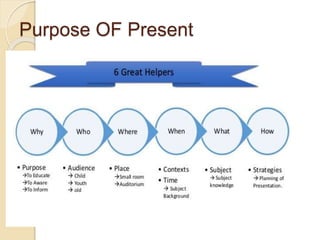
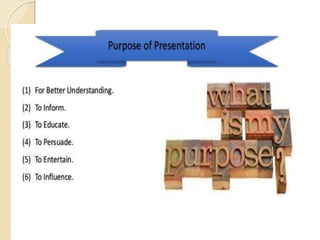
Purpose OF Present
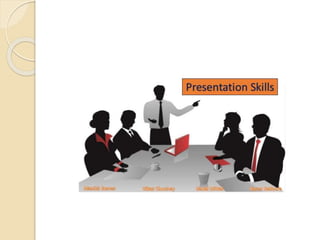
Skills
Why communication skills are important?
To get the job
To do your job well
To build up your confidence
Good
c communication
means
Good job.
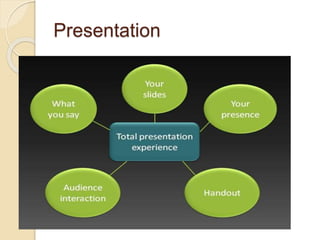
Presentation
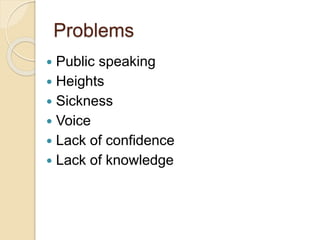
Problems
 Public speaking
 Heights
 Sickness
 Voice
 Lack of confidence
 Lack of knowledge
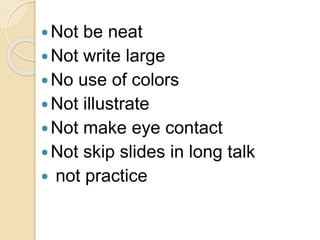
Not be neat
Not write large
No use of colors
Not illustrate
Not make eye contact
Not skip slides in long talk
 not practice
 Speaking skills
Understandable speech
Simplicity
According to situation
According to audience
Expressions
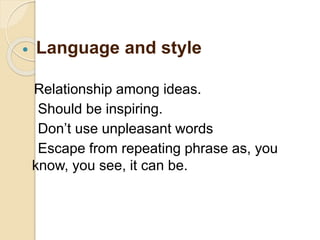
 Language and style
Relationship among ideas.
Should be inspiring.
Don’t use unpleasant words
Escape from repeating phrase as, you
know, you see, it can be.
Types of attention getters
 Rhetoric questions
 A thinking questions (not actually
answered).
 It is used to gain the audience attention.
 Examples
 Can a fish drown?
 Who in this room would like their family
or friends to die from a drunk driving
accident?
A presentation can be
given in many ways like
Graphs
Charts
Video
Audio
Multimedia
 The Objective:-
 We have been asked to speak to a
group of people. First, we should ask
our self 'why?' What is the purpose of
the presentation, what is the objective.
 Why we are making our presentation?
Bear in mind what we want to
achieve?
The Audience:
Our audience will have a variety of different
experiences, interests and levels of
knowledge.
 how much our audience already know about
our topic?
 how can we link new material to things
they might already understand?
 The size of the group or audience expected.
 The age range retired or teenagers.
 Gender will the audience be male or female?
 Do they know something about our subject
already or will it be totally new to them
The place:-
 The place:-It is important to have as
much advance information as possible
about the place where you are going to
speak.
 we need to know:
 The size of the room.
 The seating arrangements
 The availability of equipment, e.g.,
microphone, overhead projector, flip
chart, computer equipment.
 The availability of power points
 The position of the light
switches. Check if we need someone
to help if we are using audio/visual
equipment and need to turn off the
lights.
 The likelihood of outside distractions,
e.g., noise from another room
The time:-
 Often there will be no flexibility in the time of day that a
presentation is made.
 If we do have a choice of when to give your presentation -
consider the following points:
 Morning:
 The morning is the best time to speak because people are
generally at their most alert. However, late morning may
start to present problems as people begin to feel hungry
and think about lunch.
 Afternoon:
 Early afternoon is not an ideal time to make presentations
since after lunch people often feel sleepy. Mid afternoon
is a good time, whereas at the end of the afternoon people
may start to worry about getting home, the traffic or
collecting children from school.
Length of Talk:-
 Always find out how long we have to
talk and check if this includes or
excludes time for questions
 It is important to remember that
people find it difficult to maintain
concentration for long periods of time,
and this is a good reason for making a
presentation short, well-structured and
interesting.
 we should structure our presentation with
an introduction, the main message or
content, and a conclusion.
 we should also aim to write a story that
has maximum impact and one which
conveys your message in a way that is
easily understood by the target
audience.
 The structure and content of our
presentation will be unique to us and
only we can decide on the best way to
present our messages.
 Our presentation should have three
main elements: the introduction,
middle and conclusions.
 Why Are Presentation Skills Important?
Most people will agree that presentation
skills are important. But ask them to explain
"Why?" and they are stumped. These folks
might mumble something unintelligible and
proudly declare "Because - everybody
knows that it is".
I've been studying and teaching
presentation skills for over a decade so I've
had the opportunity to think about this
question.
 First, let's clarify the statement "Presentation
skills are important".
 What we really mean is, "Effective presentation
skills are important".
 "Presentation skills" is not a black and
white(a very clear choice that causes no confusi
on When you're flying a plane, it's black and whit
e- you can't be wrong, you have got to be right. )
off/on switch. It is a rainbow of colors.
Everybody has presentation skills.
 Some are better than others.
 The primary goal is for your presentation skills to be better
than your competition, whoever and whatever that is.
 The secondary goal is for your presentations to get better
with every presentation that you deliver.
The primary goal is for your presentation
skills to be better than your competition,
whoever and whatever that is.
 The secondary goal is for your
presentations to get better with every
presentation that you deliver.
 So whenever you read "presentation
skills are important" think "better
presentations are critically important.
Importance of good presentation
 It helps to improve your confidence in front
of crowd.
 It helps at the time of job interviews.
 It also help to improve your English
speaking skills.
 It also help to develop skills in power point
presentation, writing a speech or a report.
Structure closing
Must have a clear end to
talk
Brief and simple summary
of main points
 best conclusion
Refrence
 Good talk motivate the audience
to investigate further.
 Give links for more information
 http://www.uog.edu.pk/study
 University of Gujrat
Thank you Prepared By Sara Yousaf

Presentation Rules

  • 1.
  • 2.
    Outline Preparation Structure of presentation Visualaids and slides Practice and delivery Planning (Y & what)(who and where) . (propose ) (audience )
  • 3.
    Structure Opening Today wewill learn all about presentation.  few seconds to convince audience  I will not waste your time  I know who u are  I know my subject  give outline of presentation
  • 4.
    What is Presentation? •A presentation is the process of presenting a topic to an audience.  Presentation is also a mean of communication such as talking to a group, addressing a meeting, or briefing a team. • Something such as lecture or speech that is set for an audience.
  • 5.
  • 6.
    It is focusedon specific topic and specific people. Has a specific time & specific place.
  • 8.
    Preparing And Writing Presentation Preparing a Presentation: is the single most important part of making a successful presentation.  You should dedicate as much time to it as possible avoiding short-cuts.
  • 9.
    Confidence  Confidence isnot something that can be learned like a set of rules; confidence is a state of mind.  Positive thinking,  Practice  training,  Knowledge  and talking to other people. All are useful ways to help improve or boost your confidence level.
  • 10.
  • 11.
    Skills Why communication skillsare important? To get the job To do your job well To build up your confidence Good c communication means Good job.
  • 13.
  • 14.
    Problems  Public speaking Heights  Sickness  Voice  Lack of confidence  Lack of knowledge
  • 15.
    Not be neat Notwrite large No use of colors Not illustrate Not make eye contact Not skip slides in long talk  not practice
  • 16.
     Speaking skills Understandablespeech Simplicity According to situation According to audience Expressions
  • 17.
     Language andstyle Relationship among ideas. Should be inspiring. Don’t use unpleasant words Escape from repeating phrase as, you know, you see, it can be.
  • 19.
    Types of attentiongetters  Rhetoric questions  A thinking questions (not actually answered).  It is used to gain the audience attention.  Examples  Can a fish drown?  Who in this room would like their family or friends to die from a drunk driving accident?
  • 20.
    A presentation canbe given in many ways like Graphs Charts Video Audio Multimedia
  • 24.
     The Objective:- We have been asked to speak to a group of people. First, we should ask our self 'why?' What is the purpose of the presentation, what is the objective.  Why we are making our presentation? Bear in mind what we want to achieve?
  • 26.
    The Audience: Our audiencewill have a variety of different experiences, interests and levels of knowledge.  how much our audience already know about our topic?  how can we link new material to things they might already understand?  The size of the group or audience expected.  The age range retired or teenagers.  Gender will the audience be male or female?  Do they know something about our subject already or will it be totally new to them
  • 27.
    The place:-  Theplace:-It is important to have as much advance information as possible about the place where you are going to speak.  we need to know:  The size of the room.  The seating arrangements  The availability of equipment, e.g., microphone, overhead projector, flip chart, computer equipment.  The availability of power points
  • 28.
     The positionof the light switches. Check if we need someone to help if we are using audio/visual equipment and need to turn off the lights.  The likelihood of outside distractions, e.g., noise from another room
  • 29.
    The time:-  Oftenthere will be no flexibility in the time of day that a presentation is made.  If we do have a choice of when to give your presentation - consider the following points:  Morning:  The morning is the best time to speak because people are generally at their most alert. However, late morning may start to present problems as people begin to feel hungry and think about lunch.  Afternoon:  Early afternoon is not an ideal time to make presentations since after lunch people often feel sleepy. Mid afternoon is a good time, whereas at the end of the afternoon people may start to worry about getting home, the traffic or collecting children from school.
  • 30.
    Length of Talk:- Always find out how long we have to talk and check if this includes or excludes time for questions  It is important to remember that people find it difficult to maintain concentration for long periods of time, and this is a good reason for making a presentation short, well-structured and interesting.
  • 31.
     we shouldstructure our presentation with an introduction, the main message or content, and a conclusion.  we should also aim to write a story that has maximum impact and one which conveys your message in a way that is easily understood by the target audience.  The structure and content of our presentation will be unique to us and only we can decide on the best way to present our messages.
  • 32.
     Our presentationshould have three main elements: the introduction, middle and conclusions.
  • 33.
     Why ArePresentation Skills Important? Most people will agree that presentation skills are important. But ask them to explain "Why?" and they are stumped. These folks might mumble something unintelligible and proudly declare "Because - everybody knows that it is". I've been studying and teaching presentation skills for over a decade so I've had the opportunity to think about this question.
  • 34.
     First, let'sclarify the statement "Presentation skills are important".  What we really mean is, "Effective presentation skills are important".  "Presentation skills" is not a black and white(a very clear choice that causes no confusi on When you're flying a plane, it's black and whit e- you can't be wrong, you have got to be right. ) off/on switch. It is a rainbow of colors. Everybody has presentation skills.  Some are better than others.  The primary goal is for your presentation skills to be better than your competition, whoever and whatever that is.  The secondary goal is for your presentations to get better with every presentation that you deliver.
  • 35.
    The primary goalis for your presentation skills to be better than your competition, whoever and whatever that is.  The secondary goal is for your presentations to get better with every presentation that you deliver.  So whenever you read "presentation skills are important" think "better presentations are critically important.
  • 36.
    Importance of goodpresentation  It helps to improve your confidence in front of crowd.  It helps at the time of job interviews.  It also help to improve your English speaking skills.  It also help to develop skills in power point presentation, writing a speech or a report.
  • 37.
    Structure closing Must havea clear end to talk Brief and simple summary of main points  best conclusion
  • 38.
    Refrence  Good talkmotivate the audience to investigate further.  Give links for more information  http://www.uog.edu.pk/study  University of Gujrat
  • 39.