Informative Speaking
 A speech to inform shares information with others
to enhance their knowledge or understanding of
the concept and ideas presented.
 When you inform someone, you assume the role
of a teacher by defining, illustrating, clarifying, or
elaborating on a topic.
Goals of Informative Speaking
 Speak to enhance understanding
 When speaking to enhance understanding, you must
first make sure you are using words that your listeners
will interpret in the same way as you do.
 Speak to maintain interest
 If audience members feel they will benefit from your
speech in some way, your speech will interest them.
 And an interesting speech commands attention as well
as respect
Goals of Informative Speaking
 Speak to be remembered
 One day after hearing a presentation, most audience
members will remember only about half of what they
were told.
 And they will recall only 25% two weeks later.
 Your job as an informative speaker is to improve on
those statistics.
Types of Informative Speeches
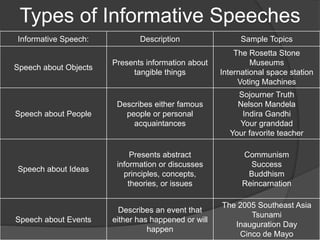
Informative Speech: Description Sample Topics
Speech about Objects
Presents information about
tangible things
The Rosetta Stone
Museums
International space station
Voting Machines
Speech about People
Describes either famous
people or personal
acquaintances
Sojourner Truth
Nelson Mandela
Indira Gandhi
Your granddad
Your favorite teacher
Speech about Ideas
Presents abstract
information or discusses
principles, concepts,
theories, or issues
Communism
Success
Buddhism
Reincarnation
Speech about Events
Describes an event that
either has happened or will
happen
The 2005 Southeast Asia
Tsunami
Inauguration Day
Cinco de Mayo
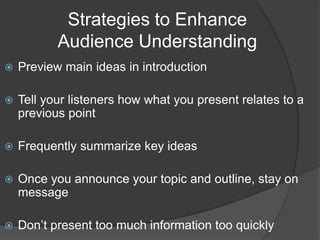
Strategies to Enhance
Audience Understanding
 Preview main ideas in introduction
 Tell your listeners how what you present relates to a
previous point
 Frequently summarize key ideas
 Once you announce your topic and outline, stay on
message
 Don’t present too much information too quickly
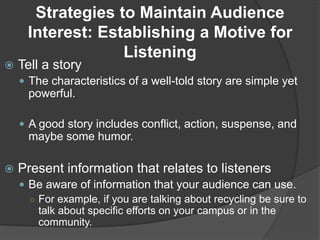
Strategies to Maintain Audience
Interest: Establishing a Motive for
Listening
 Tell a story
 The characteristics of a well-told story are simple yet
powerful.
 A good story includes conflict, action, suspense, and
maybe some humor.
 Present information that relates to listeners
 Be aware of information that your audience can use.
○ For example, if you are talking about recycling be sure to
talk about specific efforts on your campus or in the
community.
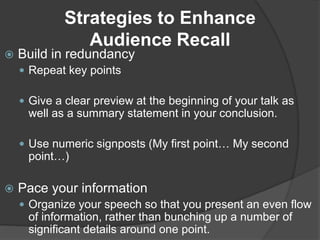
Strategies to Enhance
Audience Recall
 Build in redundancy
 Repeat key points
 Give a clear preview at the beginning of your talk as
well as a summary statement in your conclusion.
 Use numeric signposts (My first point… My second
point…)
 Pace your information
 Organize your speech so that you present an even flow
of information, rather than bunching up a number of
significant details around one point.
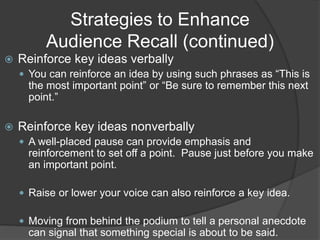
Strategies to Enhance
Audience Recall (continued)
 Reinforce key ideas verbally
 You can reinforce an idea by using such phrases as “This is
the most important point” or “Be sure to remember this next
point.”
 Reinforce key ideas nonverbally
 A well-placed pause can provide emphasis and
reinforcement to set off a point. Pause just before you make
an important point.
 Raise or lower your voice can also reinforce a key idea.
 Moving from behind the podium to tell a personal anecdote
can signal that something special is about to be said.
Ethics Question
Even during times of intense personal crisis – for
example, following the death of a family member –
the press relentlessly pursues celebrities to try to
elicit impromptu statements.
Is this an ethical practice?
Does the public’s right to know justify the invasion
of privacy?

Informative Speaking

  • 2.
    Informative Speaking  Aspeech to inform shares information with others to enhance their knowledge or understanding of the concept and ideas presented.  When you inform someone, you assume the role of a teacher by defining, illustrating, clarifying, or elaborating on a topic.
  • 3.
    Goals of InformativeSpeaking  Speak to enhance understanding  When speaking to enhance understanding, you must first make sure you are using words that your listeners will interpret in the same way as you do.  Speak to maintain interest  If audience members feel they will benefit from your speech in some way, your speech will interest them.  And an interesting speech commands attention as well as respect
  • 4.
    Goals of InformativeSpeaking  Speak to be remembered  One day after hearing a presentation, most audience members will remember only about half of what they were told.  And they will recall only 25% two weeks later.  Your job as an informative speaker is to improve on those statistics.
  • 5.
    Types of InformativeSpeeches Informative Speech: Description Sample Topics Speech about Objects Presents information about tangible things The Rosetta Stone Museums International space station Voting Machines Speech about People Describes either famous people or personal acquaintances Sojourner Truth Nelson Mandela Indira Gandhi Your granddad Your favorite teacher Speech about Ideas Presents abstract information or discusses principles, concepts, theories, or issues Communism Success Buddhism Reincarnation Speech about Events Describes an event that either has happened or will happen The 2005 Southeast Asia Tsunami Inauguration Day Cinco de Mayo
  • 6.
    Strategies to Enhance AudienceUnderstanding  Preview main ideas in introduction  Tell your listeners how what you present relates to a previous point  Frequently summarize key ideas  Once you announce your topic and outline, stay on message  Don’t present too much information too quickly
  • 7.
    Strategies to MaintainAudience Interest: Establishing a Motive for Listening  Tell a story  The characteristics of a well-told story are simple yet powerful.  A good story includes conflict, action, suspense, and maybe some humor.  Present information that relates to listeners  Be aware of information that your audience can use. ○ For example, if you are talking about recycling be sure to talk about specific efforts on your campus or in the community.
  • 8.
    Strategies to Enhance AudienceRecall  Build in redundancy  Repeat key points  Give a clear preview at the beginning of your talk as well as a summary statement in your conclusion.  Use numeric signposts (My first point… My second point…)  Pace your information  Organize your speech so that you present an even flow of information, rather than bunching up a number of significant details around one point.
  • 9.
    Strategies to Enhance AudienceRecall (continued)  Reinforce key ideas verbally  You can reinforce an idea by using such phrases as “This is the most important point” or “Be sure to remember this next point.”  Reinforce key ideas nonverbally  A well-placed pause can provide emphasis and reinforcement to set off a point. Pause just before you make an important point.  Raise or lower your voice can also reinforce a key idea.  Moving from behind the podium to tell a personal anecdote can signal that something special is about to be said.
  • 10.
    Ethics Question Even duringtimes of intense personal crisis – for example, following the death of a family member – the press relentlessly pursues celebrities to try to elicit impromptu statements. Is this an ethical practice? Does the public’s right to know justify the invasion of privacy?