Presentation
Skills
By Kristina Tipps
8/16/2013 1
Think about…
• What makes a bad presentation?
• What makes a good presentation?
• What makes an outstanding presentation?
3/5/2014
Footer Text 2
The 4 Ps
1. Plan
2. Prepare
3. Practice
4. Present
3/5/2014
Footer Text 3
Presentation Skills
• Why do we need to know how to present
information?
• Public speaking is commonly feared by many
people.
• It can be a nerve-racking experience, but anxiety
can be minimized.
• Skills to be a good presenter can be developed
with preparation and practice.
*Preparation is key*
4
Presentation Skills:
Plan
• Preparation (planning) is the first step in giving a
successful presentation.
• Aspects:
oPurpose
oAudience
oStructure
5
Presentation Skills:
Plan
I want (who) to (what) (when, where, how) because
(why)
• Ex: I want Macy’s to purchase my company’s
sunglass line for the upcoming summer season
because it is a high quality designer line and
represents Macy’s fashion trends.
• Gives your presentation a focus, the things to think
about during preparation.
3/5/2014
Footer Text 6
Presentation Skills:
Plan
• Ask yourself:
o Who is your audience?
o What do you want to present? (content,
material)
o Why do you want to present this? (purpose)
o Where do you want to present? (place)
o How do you want to present this? (ppt, other
technology, etc.)
7
Presentation Skills:
Plan
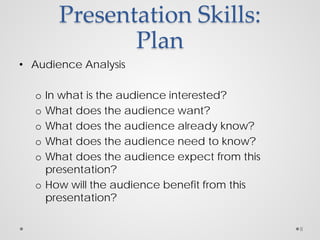
• Audience Analysis
o In what is the audience interested?
o What does the audience want?
o What does the audience already know?
o What does the audience need to know?
o What does the audience expect from this
presentation?
o How will the audience benefit from this
presentation?
8
Presentation Skills:
Plan
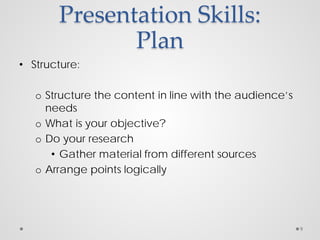
• Structure:
o Structure the content in line with the audience’s
needs
o What is your objective?
o Do your research
• Gather material from different sources
o Arrange points logically
9
Presentation Skills:
Plan
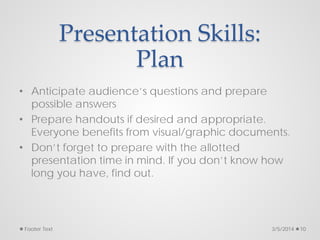
• Anticipate audience’s questions and prepare
possible answers
• Prepare handouts if desired and appropriate.
Everyone benefits from visual/graphic documents.
• Don’t forget to prepare with the allotted
presentation time in mind. If you don’t know how
long you have, find out.
3/5/2014
Footer Text 10
Presentation Skills:
Plan
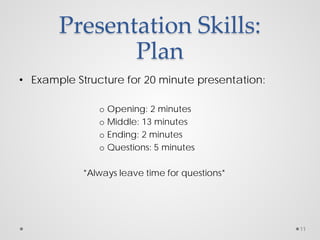
• Example Structure for 20 minute presentation:
o Opening: 2 minutes
o Middle: 13 minutes
o Ending: 2 minutes
o Questions: 5 minutes
*Always leave time for questions*
11
Presentation Skills:
Prepare
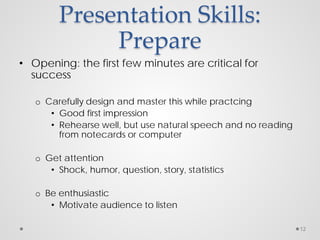
• Opening: the first few minutes are critical for
success
o Carefully design and master this while practcing
• Good first impression
• Rehearse well, but use natural speech and no reading
from notecards or computer
o Get attention
• Shock, humor, question, story, statistics
o Be enthusiastic
• Motivate audience to listen
12
Presentation Skills:
Prepare
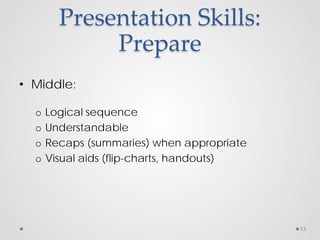
• Middle:
o Logical sequence
o Understandable
o Recaps (summaries) when appropriate
o Visual aids (flip-charts, handouts)
13
Presentation Skills:
Prepare
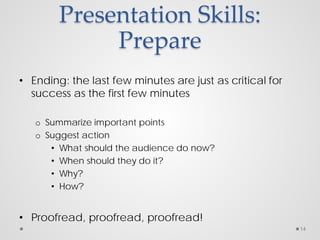
• Ending: the last few minutes are just as critical for
success as the first few minutes
o Summarize important points
o Suggest action
• What should the audience do now?
• When should they do it?
• Why?
• How?
• Proofread, proofread, proofread!
14
Presentation Skills:
Prepare
Visual Aids
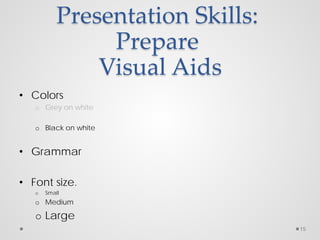
• Colors
o Grey on white
o Black on white
• Grammar
• Font size.
o Small
o Medium
o Large
15
Presentation Skills:
Practice
Nonverbal Communication
• Be active
o Move around rather than stand stiffly in one spot
• Controlled gestures
o Hand movements
o Playing with hair
• Where to keep hands?
o Not in pockets
o Occupy hands with notes or a pointer. Nervousness tends to show in our
hand gestures.
• Eye contact
o Look around from person to person while glancing at notes or
presentation
o Don’t stare
• Face audience
16
Presentation Skills:
Practice
Verbal Communication
• Speak naturally, not too quickly or too slowly
o Clear, audible
• Variations in tone and pitch of voice
• Talk to the audience, not just in front of them
• No jargon
• No ambiguous or complicated language
• Question your audience throughout to facilitate
group involvement and garner attention
17
Presentation Skills:
Practice
Audience
• Be aware of audience’s nonverbal and verbal
communications
o If people are bored or confused, their body language will show it.
o Adjust based on what you see.
• Engage audience
o Questions, activities
• Handle questions to the best of your ability
o You are not expected to know everything
o Anticipate questions and have answers ready
o Sometimes questions allow you to highlight a point you want to make
18
Presentation Skills:
Present
How to Channel Nervous Energy into Positivity
• Prepare thoroughly
• Breath deeply and slowly (activity)
o concentrate on delivering your message to your audience
• Use gestures and facial expressions as a way of
converting nervous fear to positive enthusiasm.
o Enthusiasm is a positive form of nervous energy.
19
Presentation Skills:
Present
3/5/2014 20
Footer Text
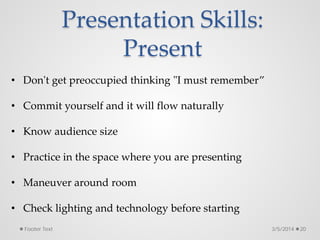
• Don't get preoccupied thinking "I must remember”
• Commit yourself and it will flow naturally
• Know audience size
• Practice in the space where you are presenting
• Maneuver around room
• Check lighting and technology before starting
Presentation Skills:
Present
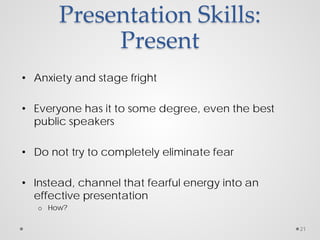
• Anxiety and stage fright
• Everyone has it to some degree, even the best
public speakers
• Do not try to completely eliminate fear
• Instead, channel that fearful energy into an
effective presentation
o How?
21
Presentation Skills
Question & Answer
22
Presentation Skills
Thank you for coming!
23

Presentation_Skills.pdf

  • 1.
  • 2.
    Think about… • Whatmakes a bad presentation? • What makes a good presentation? • What makes an outstanding presentation? 3/5/2014 Footer Text 2
  • 3.
    The 4 Ps 1.Plan 2. Prepare 3. Practice 4. Present 3/5/2014 Footer Text 3
  • 4.
    Presentation Skills • Whydo we need to know how to present information? • Public speaking is commonly feared by many people. • It can be a nerve-racking experience, but anxiety can be minimized. • Skills to be a good presenter can be developed with preparation and practice. *Preparation is key* 4
  • 5.
    Presentation Skills: Plan • Preparation(planning) is the first step in giving a successful presentation. • Aspects: oPurpose oAudience oStructure 5
  • 6.
    Presentation Skills: Plan I want(who) to (what) (when, where, how) because (why) • Ex: I want Macy’s to purchase my company’s sunglass line for the upcoming summer season because it is a high quality designer line and represents Macy’s fashion trends. • Gives your presentation a focus, the things to think about during preparation. 3/5/2014 Footer Text 6
  • 7.
    Presentation Skills: Plan • Askyourself: o Who is your audience? o What do you want to present? (content, material) o Why do you want to present this? (purpose) o Where do you want to present? (place) o How do you want to present this? (ppt, other technology, etc.) 7
  • 8.
    Presentation Skills: Plan • AudienceAnalysis o In what is the audience interested? o What does the audience want? o What does the audience already know? o What does the audience need to know? o What does the audience expect from this presentation? o How will the audience benefit from this presentation? 8
  • 9.
    Presentation Skills: Plan • Structure: oStructure the content in line with the audience’s needs o What is your objective? o Do your research • Gather material from different sources o Arrange points logically 9
  • 10.
    Presentation Skills: Plan • Anticipateaudience’s questions and prepare possible answers • Prepare handouts if desired and appropriate. Everyone benefits from visual/graphic documents. • Don’t forget to prepare with the allotted presentation time in mind. If you don’t know how long you have, find out. 3/5/2014 Footer Text 10
  • 11.
    Presentation Skills: Plan • ExampleStructure for 20 minute presentation: o Opening: 2 minutes o Middle: 13 minutes o Ending: 2 minutes o Questions: 5 minutes *Always leave time for questions* 11
  • 12.
    Presentation Skills: Prepare • Opening:the first few minutes are critical for success o Carefully design and master this while practcing • Good first impression • Rehearse well, but use natural speech and no reading from notecards or computer o Get attention • Shock, humor, question, story, statistics o Be enthusiastic • Motivate audience to listen 12
  • 13.
    Presentation Skills: Prepare • Middle: oLogical sequence o Understandable o Recaps (summaries) when appropriate o Visual aids (flip-charts, handouts) 13
  • 14.
    Presentation Skills: Prepare • Ending:the last few minutes are just as critical for success as the first few minutes o Summarize important points o Suggest action • What should the audience do now? • When should they do it? • Why? • How? • Proofread, proofread, proofread! 14
  • 15.
    Presentation Skills: Prepare Visual Aids •Colors o Grey on white o Black on white • Grammar • Font size. o Small o Medium o Large 15
  • 16.
    Presentation Skills: Practice Nonverbal Communication •Be active o Move around rather than stand stiffly in one spot • Controlled gestures o Hand movements o Playing with hair • Where to keep hands? o Not in pockets o Occupy hands with notes or a pointer. Nervousness tends to show in our hand gestures. • Eye contact o Look around from person to person while glancing at notes or presentation o Don’t stare • Face audience 16
  • 17.
    Presentation Skills: Practice Verbal Communication •Speak naturally, not too quickly or too slowly o Clear, audible • Variations in tone and pitch of voice • Talk to the audience, not just in front of them • No jargon • No ambiguous or complicated language • Question your audience throughout to facilitate group involvement and garner attention 17
  • 18.
    Presentation Skills: Practice Audience • Beaware of audience’s nonverbal and verbal communications o If people are bored or confused, their body language will show it. o Adjust based on what you see. • Engage audience o Questions, activities • Handle questions to the best of your ability o You are not expected to know everything o Anticipate questions and have answers ready o Sometimes questions allow you to highlight a point you want to make 18
  • 19.
    Presentation Skills: Present How toChannel Nervous Energy into Positivity • Prepare thoroughly • Breath deeply and slowly (activity) o concentrate on delivering your message to your audience • Use gestures and facial expressions as a way of converting nervous fear to positive enthusiasm. o Enthusiasm is a positive form of nervous energy. 19
  • 20.
    Presentation Skills: Present 3/5/2014 20 FooterText • Don't get preoccupied thinking "I must remember” • Commit yourself and it will flow naturally • Know audience size • Practice in the space where you are presenting • Maneuver around room • Check lighting and technology before starting
  • 21.
    Presentation Skills: Present • Anxietyand stage fright • Everyone has it to some degree, even the best public speakers • Do not try to completely eliminate fear • Instead, channel that fearful energy into an effective presentation o How? 21
  • 22.
  • 23.