PRESENTED BY:-
Md. Danish
Md. Tanweer
Tapesh
Sujit
Neeti
Neha
Mehmooda
Concept of Tourism

 The Concept of Tourism has been derived from the
  Latin word “TOMOS” & Hebrew word “TORAH” .

 Tourism in reality is not an industry but an activity. It
  is defined as an activity that takes place when people
  move to some other place for leisure or for business
  and stay at least for 24 hours.
What is a Tourism Industry?

•A Tourism Industry may be defined as a
group or cluster of small firms which deals in
providing attractive and affordable holiday
packages to its customers, either within a
state, country or at international level.

•Examples:- Cox & King, Thomas Cook, SOTC,
Incredible India!.
OVERVIEW
 Its boom time for India’s tourism and hospitality
  sector.
 A 5,000 year history , culture ,religion and alternative
  medicine fascinate both budget and luxury travelers
  alike.
 The focus of the industries on the “Atithi Devo
  Bhavah”campaign, targeted at the inbound foreign
  tourists in the country. Translated literally this means
  “Guest is God”.
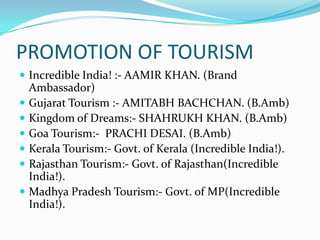
PROMOTION OF TOURISM
 Incredible India! :- AAMIR KHAN. (Brand
    Ambassador)
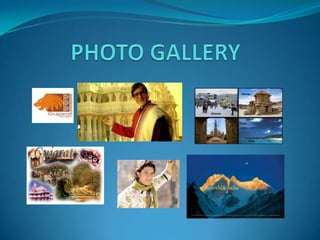
   Gujarat Tourism :- AMITABH BACHCHAN. (B.Amb)
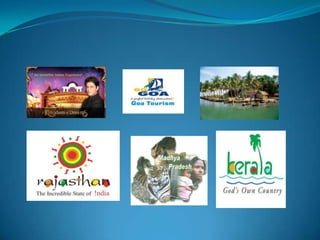
   Kingdom of Dreams:- SHAHRUKH KHAN. (B.Amb)
   Goa Tourism:- PRACHI DESAI. (B.Amb)
   Kerala Tourism:- Govt. of Kerala (Incredible India!).
   Rajasthan Tourism:- Govt. of Rajasthan(Incredible
    India!).
   Madhya Pradesh Tourism:- Govt. of MP(Incredible
    India!).
Government Initiatives

 Incredible India – Under this program the govt
  create promotes India through various integrated
  marketing programs.
 Atithie Devo Bhava – Under this program the govt
  create awareness among Indian people who come in
  contact with the tourist.
 Various Infrastructure building initiatives.
 Encourage religious tourism.
•A Business Environment comprises both the
Internal & External Factors which affect the
overall smooth running of any firm, Industry
or a large Business Organization.
INTERNAL FACTORS
  Internal factors are those which are controllable and
      exists within the boundary of the business.

  They depict the:


 1. Strength
 2. Weakness
EXTERNAL FACTORS
 External factors are those which are uncontrollable and lie
    beyond the boundary of an Organization. They depict the
    Opportunities & Threat.
   It includes the following:-
•   POLITICAL Factors.
•   ECONOMIC Factors.
•   SOCIAL Factors.
•   TECHNOLOGICAL Factors.
•   LEGAL Factors.
•   ENVIRONMENTAL Factors.
•As far as Tourism Industry is concerned, it is also
affected by both; the Internal & External factors i.e
its Business Environment.


•In order to judge the Internal factors of a Tourism
Industry, a SWOT analysis has to be performed by
each and every Tourism Industry respectively.
STRENGTHS
•Pleasant Weather .


•Ideal Geographical location.


•Good Image of the Company.


•Good Hospitality.
•Lack of proper Marketing & Advertisement.


•Dependency on Third Party.


•Lack of adequate Infrastructural support.


•Funds constraining the development of region.
•The concept of holiday is gaining popularity in India
among various classes of people.

•Increased disposable incomes of the Indian middle
class.

•Adventure sports & trekking.

•Eco-tourism is gaining popularity.
•Stiff Competition among various Tourism
Industry.

•Environmental factors also impose a threat.


•Exploration of new tourist spots and hubs.
POLITICAL FACTORS

•It includes political harmony and good execution of
law & order within the state or country.

•Promotion of tourism by the govt. , issues related to
rules & regulations of the state or the country.

•Tax Benefits & discounts provided to the various
tourism industry operating therein.
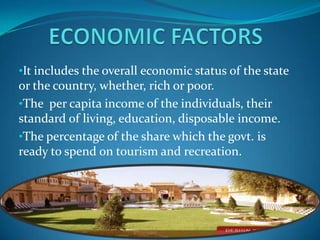
•It includes the overall economic status of the state
or the country, whether, rich or poor.
•The per capita income of the individuals, their
standard of living, education, disposable income.
•The percentage of the share which the govt. is
ready to spend on tourism and recreation.
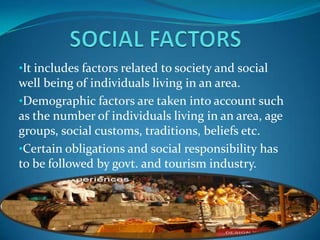
•It includes factors related to society and social
well being of individuals living in an area.
•Demographic factors are taken into account such
as the number of individuals living in an area, age
groups, social customs, traditions, beliefs etc.
•Certain obligations and social responsibility has
to be followed by govt. and tourism industry.
•It lay emphasis on the use of complex and
sophisticated technology in order to promote and
market tourism industry.

•The use of mass media, internet, magazines and
presentations so as to advertise the company.

•Providing customers with easy payment facility via
online and use of credit cards and wi-fi facility on the
go, easy recharge of mobile phones etc.
•It includes those factors which have to be followed
strictly by law (both; the customer & the tourism
department).

•Issues related to conservation of Environmental
laws and regulations, issue of tourist visas to
international customers, holding of license by the
tourism company , rules & regulations etc.
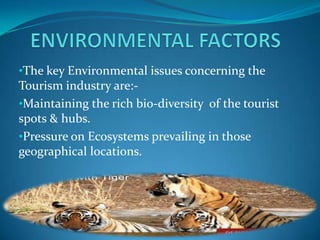
•The key Environmental issues concerning the
Tourism industry are:-
•Maintaining the rich bio-diversity of the tourist
spots & hubs.
•Pressure on Ecosystems prevailing in those
geographical locations.
SCOPE OF TOURISM
 Tourism in India is the largest service industry, with a
  contribution of 6.23% to the National GDP and 8.78% of
  the total employment in India.
 India witnesses more than 17.9 million annual foreign
  tourist arrivals and 740 million domestic tourism visits. The
  tourism industry in India generated about 100 US$ billion
  in 2008 and that is expected to increase to US$275.5 billion
  by 2018 at a 9.4% annual growth rate.

 In the year 2010, 17.9 million foreign tourists visited India.
  Majority of foreign tourists come from USA and UK.
 According to World Travel and Tourism Council,
 India will be a tourism hotspot from 2009–
 2018, having the highest 10-year growth
 potential. The Travel & Tourism Competitiveness
 Report 2007 ranked tourism in India 6th in terms of
 price competitiveness and 39th in terms of safety and
 security. Despite short- and medium-term setbacks,
 such as shortage of hotel rooms, tourism revenues are
 expected to surge by 42% from 2007 to 2017.
Presentation on tourism industry

Presentation on tourism industry

  • 1.
    PRESENTED BY:- Md. Danish Md.Tanweer Tapesh Sujit Neeti Neha Mehmooda
  • 2.
    Concept of Tourism The Concept of Tourism has been derived from the Latin word “TOMOS” & Hebrew word “TORAH” .  Tourism in reality is not an industry but an activity. It is defined as an activity that takes place when people move to some other place for leisure or for business and stay at least for 24 hours.
  • 3.
    What is aTourism Industry? •A Tourism Industry may be defined as a group or cluster of small firms which deals in providing attractive and affordable holiday packages to its customers, either within a state, country or at international level. •Examples:- Cox & King, Thomas Cook, SOTC, Incredible India!.
  • 4.
    OVERVIEW  Its boomtime for India’s tourism and hospitality sector.  A 5,000 year history , culture ,religion and alternative medicine fascinate both budget and luxury travelers alike.  The focus of the industries on the “Atithi Devo Bhavah”campaign, targeted at the inbound foreign tourists in the country. Translated literally this means “Guest is God”.
  • 5.
    PROMOTION OF TOURISM Incredible India! :- AAMIR KHAN. (Brand Ambassador)  Gujarat Tourism :- AMITABH BACHCHAN. (B.Amb)  Kingdom of Dreams:- SHAHRUKH KHAN. (B.Amb)  Goa Tourism:- PRACHI DESAI. (B.Amb)  Kerala Tourism:- Govt. of Kerala (Incredible India!).  Rajasthan Tourism:- Govt. of Rajasthan(Incredible India!).  Madhya Pradesh Tourism:- Govt. of MP(Incredible India!).
  • 8.
    Government Initiatives  IncredibleIndia – Under this program the govt create promotes India through various integrated marketing programs.  Atithie Devo Bhava – Under this program the govt create awareness among Indian people who come in contact with the tourist.  Various Infrastructure building initiatives.  Encourage religious tourism.
  • 9.
    •A Business Environmentcomprises both the Internal & External Factors which affect the overall smooth running of any firm, Industry or a large Business Organization.
  • 10.
    INTERNAL FACTORS Internal factors are those which are controllable and exists within the boundary of the business.  They depict the: 1. Strength 2. Weakness
  • 11.
    EXTERNAL FACTORS  Externalfactors are those which are uncontrollable and lie beyond the boundary of an Organization. They depict the Opportunities & Threat.  It includes the following:- • POLITICAL Factors. • ECONOMIC Factors. • SOCIAL Factors. • TECHNOLOGICAL Factors. • LEGAL Factors. • ENVIRONMENTAL Factors.
  • 12.
    •As far asTourism Industry is concerned, it is also affected by both; the Internal & External factors i.e its Business Environment. •In order to judge the Internal factors of a Tourism Industry, a SWOT analysis has to be performed by each and every Tourism Industry respectively.
  • 13.
    STRENGTHS •Pleasant Weather . •IdealGeographical location. •Good Image of the Company. •Good Hospitality.
  • 14.
    •Lack of properMarketing & Advertisement. •Dependency on Third Party. •Lack of adequate Infrastructural support. •Funds constraining the development of region.
  • 15.
    •The concept ofholiday is gaining popularity in India among various classes of people. •Increased disposable incomes of the Indian middle class. •Adventure sports & trekking. •Eco-tourism is gaining popularity.
  • 16.
    •Stiff Competition amongvarious Tourism Industry. •Environmental factors also impose a threat. •Exploration of new tourist spots and hubs.
  • 17.
    POLITICAL FACTORS •It includespolitical harmony and good execution of law & order within the state or country. •Promotion of tourism by the govt. , issues related to rules & regulations of the state or the country. •Tax Benefits & discounts provided to the various tourism industry operating therein.
  • 18.
    •It includes theoverall economic status of the state or the country, whether, rich or poor. •The per capita income of the individuals, their standard of living, education, disposable income. •The percentage of the share which the govt. is ready to spend on tourism and recreation.
  • 19.
    •It includes factorsrelated to society and social well being of individuals living in an area. •Demographic factors are taken into account such as the number of individuals living in an area, age groups, social customs, traditions, beliefs etc. •Certain obligations and social responsibility has to be followed by govt. and tourism industry.
  • 20.
    •It lay emphasison the use of complex and sophisticated technology in order to promote and market tourism industry. •The use of mass media, internet, magazines and presentations so as to advertise the company. •Providing customers with easy payment facility via online and use of credit cards and wi-fi facility on the go, easy recharge of mobile phones etc.
  • 21.
    •It includes thosefactors which have to be followed strictly by law (both; the customer & the tourism department). •Issues related to conservation of Environmental laws and regulations, issue of tourist visas to international customers, holding of license by the tourism company , rules & regulations etc.
  • 22.
    •The key Environmentalissues concerning the Tourism industry are:- •Maintaining the rich bio-diversity of the tourist spots & hubs. •Pressure on Ecosystems prevailing in those geographical locations.
  • 23.
    SCOPE OF TOURISM Tourism in India is the largest service industry, with a contribution of 6.23% to the National GDP and 8.78% of the total employment in India.  India witnesses more than 17.9 million annual foreign tourist arrivals and 740 million domestic tourism visits. The tourism industry in India generated about 100 US$ billion in 2008 and that is expected to increase to US$275.5 billion by 2018 at a 9.4% annual growth rate.  In the year 2010, 17.9 million foreign tourists visited India. Majority of foreign tourists come from USA and UK.
  • 24.
     According toWorld Travel and Tourism Council, India will be a tourism hotspot from 2009– 2018, having the highest 10-year growth potential. The Travel & Tourism Competitiveness Report 2007 ranked tourism in India 6th in terms of price competitiveness and 39th in terms of safety and security. Despite short- and medium-term setbacks, such as shortage of hotel rooms, tourism revenues are expected to surge by 42% from 2007 to 2017.