E -Tourism
Presentation by:
Anuj Bhattacharya
Assistant Professor – School of Hospitality &Tourism
The ICFAI University, Sikkim
What isTourism?
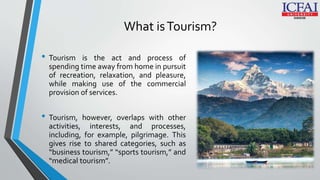
• Tourism is the act and process of
spending time away from home in pursuit
of recreation, relaxation, and pleasure,
while making use of the commercial
provision of services.
• Tourism, however, overlaps with other
activities, interests, and processes,
including, for example, pilgrimage. This
gives rise to shared categories, such as
“business tourism,” “sports tourism,” and
“medical tourism”.
InformationTechnology
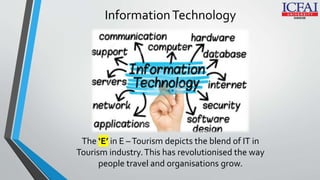
The ‘E’ in E –Tourism depicts the blend of IT in
Tourism industry.This has revolutionised the way
people travel and organisations grow.
The definition of E –Tourism
E – tourism is the digitisation of all the processes and value
chains in the tourism, travel, hospitality and catering
industries that enable organisations to maximise their
efficiency and effectiveness.
(Buhalis 2003)
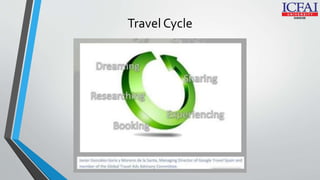
Travel Cycle
Role of E –Tourism
• Ease in booking.
• Better destination planning decisions.
• Easy Payments.
• Lowering of Costs.
• Well organised distribution.
• Employee empowerment.
• Enhanced market penetration.
Benefits of E –Tourism
End User
• RealTime details.
• More communication
channels.
• Easy reservations.
• See before you go mode.
• Sharing of travel experiences
online.
• More flexibility.
Organisations
• Branding and Promotion.
• Success stories bring more
attention.
• Exposure of Small Businesses.
• Loyalty Programmes.
• Profit maximisation.
• Brand Enforcement.
• Better customer retention.
Technologies in E –Tourism
• The Internet.
• Electronic payment systems.
• Mobile phones.
• C.R.S.
• G.D.S.
• Virtual Reality.
• Online Word of Mouth.
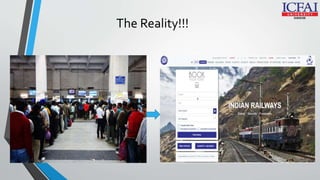
The Reality!!!
Portals and G.D.S.
Importance of E –Tourism in N.E. India
• Better connectivity of Host and Guest.
• More visibility to the Homestays.
• Employment generation.
• More entrepreneurs.
• More exposure to the offbeat and virgin locations.
• Overall development of economy at local and national level.
anujbhattacharya@iusikkim.edu.in
M: 8170072187 / 7001214949

E - tourism

  • 1.
    E -Tourism Presentation by: AnujBhattacharya Assistant Professor – School of Hospitality &Tourism The ICFAI University, Sikkim
  • 2.
    What isTourism? • Tourismis the act and process of spending time away from home in pursuit of recreation, relaxation, and pleasure, while making use of the commercial provision of services. • Tourism, however, overlaps with other activities, interests, and processes, including, for example, pilgrimage. This gives rise to shared categories, such as “business tourism,” “sports tourism,” and “medical tourism”.
  • 3.
    InformationTechnology The ‘E’ inE –Tourism depicts the blend of IT in Tourism industry.This has revolutionised the way people travel and organisations grow.
  • 4.
    The definition ofE –Tourism E – tourism is the digitisation of all the processes and value chains in the tourism, travel, hospitality and catering industries that enable organisations to maximise their efficiency and effectiveness. (Buhalis 2003)
  • 5.
  • 6.
    Role of E–Tourism • Ease in booking. • Better destination planning decisions. • Easy Payments. • Lowering of Costs. • Well organised distribution. • Employee empowerment. • Enhanced market penetration.
  • 7.
    Benefits of E–Tourism End User • RealTime details. • More communication channels. • Easy reservations. • See before you go mode. • Sharing of travel experiences online. • More flexibility. Organisations • Branding and Promotion. • Success stories bring more attention. • Exposure of Small Businesses. • Loyalty Programmes. • Profit maximisation. • Brand Enforcement. • Better customer retention.
  • 9.
    Technologies in E–Tourism • The Internet. • Electronic payment systems. • Mobile phones. • C.R.S. • G.D.S. • Virtual Reality. • Online Word of Mouth.
  • 10.
  • 12.
  • 13.
    Importance of E–Tourism in N.E. India • Better connectivity of Host and Guest. • More visibility to the Homestays. • Employment generation. • More entrepreneurs. • More exposure to the offbeat and virgin locations. • Overall development of economy at local and national level.
  • 14.