INDUSTRY IMMERSION PROJECT
1. Maximum pages for the project:- 25 Pages
2. Index for Project
a. Introduction to the sector
b. Porters 5 forces model of the sector
c. PESTEL Analysis of the sector
d. Value Chain of the sector
e. Top 5 companies of the sectors
f. Financial Analysis
i. Balance sheet analysis
ii. Ratio Analysis
g. Conclusion
3. Title Page for the project is as follows:-
Tourism Sector
Industry Immersion Project
Priyam R. Talpade
PGDM 2015-2017
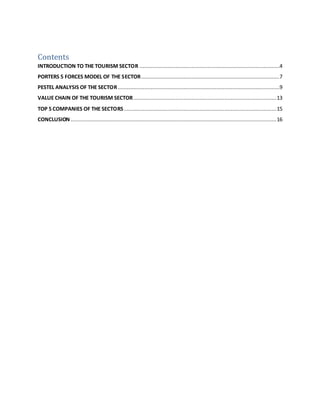
Contents
INTRODUCTION TO THE TOURISM SECTOR .........................................................................................4
PORTERS 5 FORCES MODEL OF THE SECTOR........................................................................................7
PESTEL ANALYSIS OF THE SECTOR.......................................................................................................9
VALUE CHAIN OF THE TOURISM SECTOR...........................................................................................13
TOP 5 COMPANIES OF THE SECTORS.................................................................................................15
CONCLUSION ...................................................................................................................................16
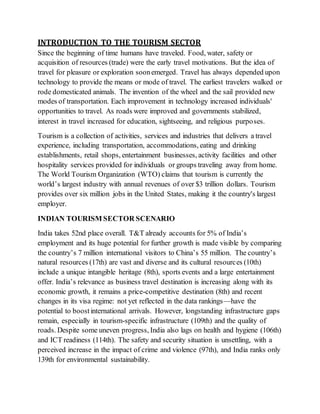
INTRODUCTION TO THE TOURISM SECTOR
Since the beginning of time humans have traveled. Food, water, safety or
acquisition of resources (trade) were the early travel motivations. But the idea of
travel for pleasure or exploration soonemerged. Travel has always depended upon
technology to provide the means or mode of travel. The earliest travelers walked or
rode domesticated animals. The invention of the wheel and the sail provided new
modes of transportation. Each improvement in technology increased individuals'
opportunities to travel. As roads were improved and governments stabilized,
interest in travel increased for education, sightseeing, and religious purposes.
Tourism is a collection of activities, services and industries that delivers a travel
experience, including transportation, accommodations, eating and drinking
establishments, retail shops, entertainment businesses, activity facilities and other
hospitality services provided for individuals or groups traveling away from home.
The World Tourism Organization (WTO) claims that tourism is currently the
world’s largest industry with annual revenues of over $3 trillion dollars. Tourism
provides over six million jobs in the United States, making it the country's largest
employer.
INDIAN TOURISM SECTOR SCENARIO
India takes 52nd place overall. T&T already accounts for 5% of India’s
employment and its huge potential for further growth is made visible by comparing
the country’s 7 million international visitors to China’s 55 million. The country’s
natural resources (17th) are vast and diverse and its cultural resources (10th)
include a unique intangible heritage (8th), sports events and a large entertainment
offer. India’s relevance as business travel destination is increasing along with its
economic growth, it remains a price-competitive destination (8th) and recent
changes in its visa regime: not yet reflected in the data rankings—have the
potential to boostinternational arrivals. However, longstanding infrastructure gaps
remain, especially in tourism-specific infrastructure (109th) and the quality of
roads. Despite some uneven progress, India also lags on health and hygiene (106th)
and ICT readiness (114th). The safety and security situation is unsettling, with a
perceived increase in the impact of crime and violence (97th), and India ranks only
139th for environmental sustainability.
MarketSize
India’s rising middle class and increasing disposable incomes has continued to
supportthe growth of domestic and outbound tourism. Total outbound trips
increased by 8.7 per cent to 19.9 million in 2015. Inbound tourist volume grew at a
Compound Annual Growth Rate (CAGR) of 6.8 per cent during 2010-15.
The number of Foreign Tourist Arrivals (FTAs) has grown at a CAGR of 3.7 per
cent to 5.29 lakh year-on-year in May 2016. Foreign Exchange Earnings (FEEs)
during the month of May 2016 grew at a rate of 8.2 per cent year-on-year to Rs
10,285 crore (US$ 1.52 billion).
The number of tourists arriving on e-Tourist Visa during June 2016 reached a total
of 36,982 tourists registering a year-on-year growth of 137.7 per cent.
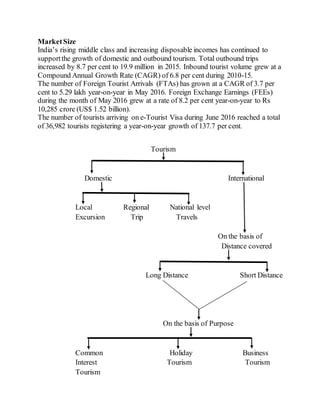
Tourism
Domestic International
Local Regional National level
Excursion Trip Travels
On the basis of
Distance covered
Long Distance Short Distance
On the basis of Purpose
Common Holiday Business
Interest Tourism Tourism
Tourism
Domestic Tourism:
It is concerned with travelling within the country. It does not need a passportand
visa or conversion of one currency into another. Domestic tourism has greater
scopein countries of large dimensions such as India as compared to smaller
countries. From a geographical viewpoint, domestic tourism may range from local
excursion, regional trips to national level travels.
On the basis of purposeof tour or the motives of tourists, tourism is of three types,
viz., (a) common interest tourism, (b) holiday tourism and (c) business tourism. In
case of common interest tourism, the purposeof visiting and the visited persons in
common.
Visiting friends and relatives in this type puts very low pressure on the provision of
tourist facilities at the destination. Holiday tourism is the most popular type. A fine
weather favorable for sightseeing, touring, recreation and going round different
cultural sites are sought after by incoming tourists of this category.
Business tourists travel to boosttheir business, attend trade fairs and conferences
pertaining to commerce or professions. They combine business with recreation
using same facilities as provided for holiday tourists.
International Tourism:
An international tourist crosses the boundaries of many countries, uses different
currencies, faces different languages and meets different types of people. Usually
international tourism involves longer distances although crossing small countries
or travelling in the neighborhood of international borders may involve short
distances.
TouristAttraction
Attractions are the primary motivation for traveling. They may be a primary
destination such as Ladak or secondary destination which are interesting places to
visit on the way to your primary destination. Attractions usually focus on natural
resources, culture, ethnicity or entertainment.
PORTERS 5 FORCES MODEL OF THE SECTOR
THREAT OF EXISTING RIVALRY
 Organized players would barely have 40-50% of market place.
 Most of organized players are present in metros and mini metros
 As the growth of tourism industry is growing faster the threat of existing
rivalry is Medium to High
Threat of
Existing
Rivalry
Threat of
new
entrance
Bargaining
Power of
Buyers
Threat of
Substitutes
Bargaining
Power of
Suppliers
THREAT OF NEW ENTRANCE
 Threats of new entrance in tourism industry in Medium to High
 Major determinants of the market environment can be changed by new
entrants.
 Online channels are growing rapidly.
 Government regulations
BARGAINING POWER OF BUYERS
 Bargaining Power of buyers is Medium to High
 Switching Costfor buyers is not high as brand loyalty is low
 Better facilities are available in other countries
 Luxury segments are brand conscious to and willing to pay a premium for
great experience and service quality
BARGAINING POWER OF SUPPLIERS
 Power of suppliers in Indian tourism industry includes airlines, hotels,
transportations, travel agency etc.
 The bargaining power depends on the productwhich are supplied by
suppliers. Thus bargaining power is Medium to Low
PESTEL ANALYSIS OF THE SECTOR
POLITICAL FACTOR
In India, one can never over-look the political factors which influence each and
every industry existing in the country. Like it or not, the political interference has
to be present everywhere. Given below are a few of the political factors with
respect to the tourism industry:
 TERRORISM& SECURITY: Terrorism has an adverse effect on the growth
and progress of any country. Terrorism has also bad effect on the tourism
industry if India. It is the big political problem to the governing party of the
country. With the rise in terrorism the growth of tourism industry in the
disturbed parts of country has been at slew rate. The states like Jammu and
Kashmir, Assam etc. have a bad tourism output, which intern effects the
country's growth.
The govt. of India is taking steps in regard to tackle the terrorism by
providing more security to the tourists who are visiting such terrorist prone
areas.
 POLITICAL INSTABILITY: Political instability also has effect on tourism
industry. Sometimes frequent change of parties at state or central level have
an impact on tourism policies and upliftment of tourist sites, as the different
parties have different approachto tourist industry.
 INFRASTRUCTURE:Infrastructure development depends mainly upon the
government or ruling political party. There has been a great infrastructure
development from last 20 years in India. The better infrastructure has
attracted more and more tourist in India.
 RELATIONS WITH NEIGHBOURING COUNTRIES:Relationship with
the adjoining countries have also a direct relationship with the tourism
industry. The political relationship of India with most of adjoining countries
is good, but the tourist from near countries are not frequently visiting the
country.
 LACK OF INTERNATIONAL REPRESENTATION: One of problem that
is because of political factor is the lack of international representation of the
country. Indian government does not give much preference to representation
of country internationally becauseof which tourism rate does not increase by
any surplus amount. Countries like Malaysia are representing their country
internationally which is giving boosttheir tourism.
ECONOMICALFACTOR
The Tourism sectorof Indian economy is at present experiencing a huge growth.
The Tourism sectorof Indian economy has become one of the major industrial
sectors under the Indian economy. India's foreign exchange earnings from the
tourism sectorare likely to reach US $26 billion in 2015 from the current level of
about $20 billion.
 GDP (GROSS DOMESTIC PRODUCT):Gross domestic productalso plays
major part in the upliftment of tourism industry. The contribution of travel
and tourism to the country's GDP is rise by 7.5 per cent to Rs 2, 34,145 crore
2015 year. Better growth of GDP has helped to attract more and more
tourist. The tourism will also help to raise the GDP of India as if more and
more tourist arrive they will spend more money which inturn raise the GDP
of country.
 RISE IN NATIONAL INCOME: The Indian tourism is one of the major
contributors in increasing national income and improving the economic
conditions of India. US $ 295.7 billion were generated in year 2015 alone
from tourism industry and it has increased upto 30% from previous year
2014.
 BETTER ECONOMIC CONDITIONS: If we talk about the Indian tourism
industry, the rise in the output is not only because if the foreign tourists but
the domestic tourism has also been spreading its wings and adding much
more to tourism industry. As the economic conditions has been getting better
from last decadeand so people are now spending much on tours and
travelling.
SOCIAL FACTOR
Social factors have more or less a significant impact on Indian tourism industry.
Some of the social factors that I have analyzed, that effect tourism industry of India
are:
 DEMOGRAPHIC CHANGES: Demographic trends describe the changes in
demographics in a population over time. In India majority of the population
is of the young people, who are willing to spend and to visit different parts
of the country, thus one of this social factor has helped in development of
tourism industry majority of population i.e, 50% is under the age of 23
years.
 VAST CULTURE: As we all know that the India is country of various
religion and has oldest culture. India is often called subcontinent. The Indian
culture drives more and more foreigners to visit the country. The is so much
vastness in Indian culture and demographics that the tourists find it better to
visit country like India as compared to any other country as they find various
and vast cultures in India.
 HEALTHIER LIFESTYLE: India provides trends to the healthier lifestyle,
one of the biggest example is of YOGA. Most of the foreign tourist also visit
India because of this purposeas they find new and better ways that could
keep them healthy in their day to day lifestyle.
 LANGUAGE: The Indian population is also good at speaking English
language, so this factor plays an indirect part in the upliftment of the tourism
industry. The foreigners do not find it much difficult to convey themselves
to the people.
 MEDICAL TOURISM: Medical tourism has emerged in India from 1995,
the medical industry is driving more and more foreigners to come to India
for their treatment. India is cheap at medical procedures and technologically
advanced than the other countries. Around 1.5 lacs of tourist visited India
just for medical purposes, which generated $300 million alone .Thus this one
technological factor is attracting more and more crowd to India.
TECHNOLOGICALFACTOR
Technology always plays a vital role in any sector, so it has also played its part in
tourism industry. Some of the major technological factors that affect the industry if
tourism are as under:
 IT SECTOR:IT sectoris one of the sectorin which India is getting
advanced day by day. It is driving more and more foreign nationals and
tourist to our country as its providing some job opportunity to them, which
in turn makes rise in growth of the tourism sector. There are many IT parks
in India and many IT hubs which techno savvy people from abroad visit to
learn new things.
ENVIRONMENTALFACTOR
Environment is the main part of our lives that affect us directly. Environment
analysis is necessary for tourism industry as it’s dependent on environment.
Environment factor that has impact on tourism industry of India are:
 GO GREEN IDEOLOGY: Go green ideology is one of the major steps taken
by our government for the preservation of environment. This ideology states
that more and more trees should be planted and less consumption of fuel
should be done. This affects tourism industry directly as better environment
will drive more crowd to the country.
 GLOBAL WARMING: Global warming is one of the issues of concern of
the whole world. Global warming is effecting the tourism of India as glaciers
of Himalaya and the various hill stations in the Jammu and Kashmir and in
Himachal Pradesh are facing trouble because of global warming as the
temperature and weather conditions are changing their dramatically.
 SAVE TIGERS INITIATIVE: Tiger saving initiatives are also taking a pace,
because royal Bengal tiger is world famous. People come from different
countries to visit the national parks like KAZIRANGA etc, the tigers are the
main attraction to the tourists, so government is taking initiative to save
tigers.
LEGAL FACTOR
Legal factors of any country have an impact on its tourism. Various laws and acts
have direct relationship with the rise and fall in the rate of tourism. Some of the
legal factors that have impact on our tourism industry are given as under:
 TAX EXEMPTION: The scheme and laws like tax exemption help to
develop the tourism industry. The tax exemption laws like, 50% of profit
derived by travel agents and tours operators will only be taxed. Such legal
schemes are helping a lot in betterment of tourism.
 INCREDIBLE INDIA: One of the aggressive advertisement campaign by
tourism department is the INCREDIBLE INDIA, it is a advertisement
scheme for which the government pays the money. Many banners and
advertisement on various channels are shown, by this the ministry of tourism
tries to show various great places which can be visited in India.
 LOW SPENDERS: Apart from the above stated schemes one of the legal
drawbacks is that Indian government does not spend much on the
development and upliftment of tourism because of which tourism industry is
not getting the utmost best channel for performing the best.
 FARES: Government also provides the facilities of the partly low fare to the
foreigners in the railways as well as in other services to show the kind
treatment and hospitality to the foreigners, this will generate the word of
mouth publicity of the tourism industry which inturn is the positive sign of
legal factors.
VALUE CHAIN OF THE TOURISM SECTOR
Identified the following correspondencesthe supporting activities & primary
activities in the tourism company:
SUPPORT ACTIVITIES:
 Infrastructure includes secretarial and accounting
 Human resource management includes recruitment, selection, hiring,
training and staff development agency regarding work with customers,
motivating them and so on; they are of particular importance because for
tourism, the human factor is predominant.
 Technological development is linked to the tourism productdesign and
design technology travel
 Supplies include agency relationships with suppliers.
PRIMARY ACTIVITIES:
 Inbound Logistics includes the activities of receiving, collecting and
analyzing the bids received from the tourism service providers or tour
operators.
 Operations include the design and preparation of the tourism product, hire
cars with or without drivers, plane and bus ticket reservation, end health
insurance and the Green Paper, providing tourist information.
 Outbound logistics involves gathering tourism products developed by the
company (or coming from tour operators)and their distribution to partner
agencies and correspondents.
 Marketing and sales means studying the local tourist market, promote
products and services included in the offer and sale of the tourism product.
 After-sales services consist in evaluating post-sale includes the following
activities: the drafting questionnaires, conducting surveys, customer file
management, monitoring of sales, management complaints from clients.
 Value chain for tourism companies I identified the activities can be
outsourced by the firm, i.e. those activities that need to be improved. The
activities can be outsourced by the companies whose costdisadvantage or
those activities that do not contribute to the differentiation of the tourism
productattributes. On the other hand, the companies needs to improve its
own activities that can bring savings or activities that generate tourism
productattributes perceived as unique by customers.
TOP 5 COMPANIES OF THE SECTORS
1. Cox & Kings Ltd
The first most popular travel company in India is Cox and Kings Ltd. The
company has been present in the country for a while now and it is first choice of a
customer who wants to booktheir tour and packages.
 Travel Packages: Duniya Dekho, Flexi Hol, Bharat Dekho, Luxury
Escapades, Summer holidays, Rail Europe Holidays, Instant Travel Packages
etc
 Head Office: Mumbai, Maharashtra
 Website: www.coxandkings.com
2. India Tourism Development CorporationLtd (ITDC)
The second travel company that we would like to include in our list is India
Tourism Development Corporation Ltd. It is a public sectorcompany founded in
year 1966. Company has 76 crores in equities.
 Travel Packages: Travel across the country and bookhotels at cheap rates.
Book Ashoka Hotels.
 Head Office: New Delhi, India
 Website: www.theashokgroup.com
3. Thomas Cook Ltd
The third company is Thomas CookLtd and it is a private owned enterprise. It
offers various packages in the country and around the world. It is an UK based
travelling company with a branch in India.
 Travel Packages: Asia Group Tours, India Holidays, Personalized holidays,
Europe Group Tour etc
 Head Office: Mumbai, India
 Website: www.thomascook.in
4. Make My Trip
The fourth travelling company in our list is Make My Trip. This an online
company where you can bookyour travel. It is India number one web portal
founded in year 2000.
 Travel Packages: Forhoneymoon, adventure, beach, off beat, shopping to
Europe, Singapore, and Thailand
 Head Office: Gurgaon, Haryana, India
 Website: www.makemytrip.com
5. SOTC Tours and Travel
The fifth traveling company is SOTC tours and travel. SOTC was acquired by
Kuoni travels in the year 1996.
 Travel Packages: Customized Holidays, Escorted group holidays, India
Holidays, Box holiday, Corporatetours etc
 Head Office: Mumbai, Maharashtra
 Website: www.sotc.in
CONCLUSION
Indian tourism industry the travel and tourism sectorholds strategic importance in
the Indian economy providing several socio economic benefits. Provision of
employment, income and foreign exchange, development or expansion of other
industries such as agriculture, construction, handicrafts etc. are some of the
important economic benefits provided by the tourism sector. In addition,
investments in infrastructural facilities suchas transportation, accommodation and
other tourism related services lead to an overall development of infrastructure in
the economy.
INDUSTRYOVERVIEW IN SHORT
Size of the Industry
5 million annual foreign tourist arrivals and 562 million domestic tourism visits.
Output per annum
Increased 7 % per annum
Percentagein world market
6.5% share
MarketCapitalization
6.23% of GDP

Industry immersion Project

  • 1.
    INDUSTRY IMMERSION PROJECT 1.Maximum pages for the project:- 25 Pages 2. Index for Project a. Introduction to the sector b. Porters 5 forces model of the sector c. PESTEL Analysis of the sector d. Value Chain of the sector e. Top 5 companies of the sectors f. Financial Analysis i. Balance sheet analysis ii. Ratio Analysis g. Conclusion 3. Title Page for the project is as follows:-
  • 2.
    Tourism Sector Industry ImmersionProject Priyam R. Talpade PGDM 2015-2017
  • 3.
    Contents INTRODUCTION TO THETOURISM SECTOR .........................................................................................4 PORTERS 5 FORCES MODEL OF THE SECTOR........................................................................................7 PESTEL ANALYSIS OF THE SECTOR.......................................................................................................9 VALUE CHAIN OF THE TOURISM SECTOR...........................................................................................13 TOP 5 COMPANIES OF THE SECTORS.................................................................................................15 CONCLUSION ...................................................................................................................................16
  • 4.
    INTRODUCTION TO THETOURISM SECTOR Since the beginning of time humans have traveled. Food, water, safety or acquisition of resources (trade) were the early travel motivations. But the idea of travel for pleasure or exploration soonemerged. Travel has always depended upon technology to provide the means or mode of travel. The earliest travelers walked or rode domesticated animals. The invention of the wheel and the sail provided new modes of transportation. Each improvement in technology increased individuals' opportunities to travel. As roads were improved and governments stabilized, interest in travel increased for education, sightseeing, and religious purposes. Tourism is a collection of activities, services and industries that delivers a travel experience, including transportation, accommodations, eating and drinking establishments, retail shops, entertainment businesses, activity facilities and other hospitality services provided for individuals or groups traveling away from home. The World Tourism Organization (WTO) claims that tourism is currently the world’s largest industry with annual revenues of over $3 trillion dollars. Tourism provides over six million jobs in the United States, making it the country's largest employer. INDIAN TOURISM SECTOR SCENARIO India takes 52nd place overall. T&T already accounts for 5% of India’s employment and its huge potential for further growth is made visible by comparing the country’s 7 million international visitors to China’s 55 million. The country’s natural resources (17th) are vast and diverse and its cultural resources (10th) include a unique intangible heritage (8th), sports events and a large entertainment offer. India’s relevance as business travel destination is increasing along with its economic growth, it remains a price-competitive destination (8th) and recent changes in its visa regime: not yet reflected in the data rankings—have the potential to boostinternational arrivals. However, longstanding infrastructure gaps remain, especially in tourism-specific infrastructure (109th) and the quality of roads. Despite some uneven progress, India also lags on health and hygiene (106th) and ICT readiness (114th). The safety and security situation is unsettling, with a perceived increase in the impact of crime and violence (97th), and India ranks only 139th for environmental sustainability.
  • 5.
    MarketSize India’s rising middleclass and increasing disposable incomes has continued to supportthe growth of domestic and outbound tourism. Total outbound trips increased by 8.7 per cent to 19.9 million in 2015. Inbound tourist volume grew at a Compound Annual Growth Rate (CAGR) of 6.8 per cent during 2010-15. The number of Foreign Tourist Arrivals (FTAs) has grown at a CAGR of 3.7 per cent to 5.29 lakh year-on-year in May 2016. Foreign Exchange Earnings (FEEs) during the month of May 2016 grew at a rate of 8.2 per cent year-on-year to Rs 10,285 crore (US$ 1.52 billion). The number of tourists arriving on e-Tourist Visa during June 2016 reached a total of 36,982 tourists registering a year-on-year growth of 137.7 per cent. Tourism Domestic International Local Regional National level Excursion Trip Travels On the basis of Distance covered Long Distance Short Distance On the basis of Purpose Common Holiday Business Interest Tourism Tourism Tourism
  • 6.
    Domestic Tourism: It isconcerned with travelling within the country. It does not need a passportand visa or conversion of one currency into another. Domestic tourism has greater scopein countries of large dimensions such as India as compared to smaller countries. From a geographical viewpoint, domestic tourism may range from local excursion, regional trips to national level travels. On the basis of purposeof tour or the motives of tourists, tourism is of three types, viz., (a) common interest tourism, (b) holiday tourism and (c) business tourism. In case of common interest tourism, the purposeof visiting and the visited persons in common. Visiting friends and relatives in this type puts very low pressure on the provision of tourist facilities at the destination. Holiday tourism is the most popular type. A fine weather favorable for sightseeing, touring, recreation and going round different cultural sites are sought after by incoming tourists of this category. Business tourists travel to boosttheir business, attend trade fairs and conferences pertaining to commerce or professions. They combine business with recreation using same facilities as provided for holiday tourists. International Tourism: An international tourist crosses the boundaries of many countries, uses different currencies, faces different languages and meets different types of people. Usually international tourism involves longer distances although crossing small countries or travelling in the neighborhood of international borders may involve short distances.
  • 7.
    TouristAttraction Attractions are theprimary motivation for traveling. They may be a primary destination such as Ladak or secondary destination which are interesting places to visit on the way to your primary destination. Attractions usually focus on natural resources, culture, ethnicity or entertainment. PORTERS 5 FORCES MODEL OF THE SECTOR THREAT OF EXISTING RIVALRY  Organized players would barely have 40-50% of market place.  Most of organized players are present in metros and mini metros  As the growth of tourism industry is growing faster the threat of existing rivalry is Medium to High Threat of Existing Rivalry Threat of new entrance Bargaining Power of Buyers Threat of Substitutes Bargaining Power of Suppliers
  • 8.
    THREAT OF NEWENTRANCE  Threats of new entrance in tourism industry in Medium to High  Major determinants of the market environment can be changed by new entrants.  Online channels are growing rapidly.  Government regulations BARGAINING POWER OF BUYERS  Bargaining Power of buyers is Medium to High  Switching Costfor buyers is not high as brand loyalty is low  Better facilities are available in other countries  Luxury segments are brand conscious to and willing to pay a premium for great experience and service quality BARGAINING POWER OF SUPPLIERS  Power of suppliers in Indian tourism industry includes airlines, hotels, transportations, travel agency etc.  The bargaining power depends on the productwhich are supplied by suppliers. Thus bargaining power is Medium to Low
  • 9.
    PESTEL ANALYSIS OFTHE SECTOR POLITICAL FACTOR In India, one can never over-look the political factors which influence each and every industry existing in the country. Like it or not, the political interference has to be present everywhere. Given below are a few of the political factors with respect to the tourism industry:  TERRORISM& SECURITY: Terrorism has an adverse effect on the growth and progress of any country. Terrorism has also bad effect on the tourism industry if India. It is the big political problem to the governing party of the country. With the rise in terrorism the growth of tourism industry in the disturbed parts of country has been at slew rate. The states like Jammu and Kashmir, Assam etc. have a bad tourism output, which intern effects the country's growth. The govt. of India is taking steps in regard to tackle the terrorism by providing more security to the tourists who are visiting such terrorist prone areas.  POLITICAL INSTABILITY: Political instability also has effect on tourism industry. Sometimes frequent change of parties at state or central level have an impact on tourism policies and upliftment of tourist sites, as the different parties have different approachto tourist industry.  INFRASTRUCTURE:Infrastructure development depends mainly upon the government or ruling political party. There has been a great infrastructure development from last 20 years in India. The better infrastructure has attracted more and more tourist in India.  RELATIONS WITH NEIGHBOURING COUNTRIES:Relationship with the adjoining countries have also a direct relationship with the tourism industry. The political relationship of India with most of adjoining countries is good, but the tourist from near countries are not frequently visiting the country.  LACK OF INTERNATIONAL REPRESENTATION: One of problem that is because of political factor is the lack of international representation of the country. Indian government does not give much preference to representation of country internationally becauseof which tourism rate does not increase by
  • 10.
    any surplus amount.Countries like Malaysia are representing their country internationally which is giving boosttheir tourism. ECONOMICALFACTOR The Tourism sectorof Indian economy is at present experiencing a huge growth. The Tourism sectorof Indian economy has become one of the major industrial sectors under the Indian economy. India's foreign exchange earnings from the tourism sectorare likely to reach US $26 billion in 2015 from the current level of about $20 billion.  GDP (GROSS DOMESTIC PRODUCT):Gross domestic productalso plays major part in the upliftment of tourism industry. The contribution of travel and tourism to the country's GDP is rise by 7.5 per cent to Rs 2, 34,145 crore 2015 year. Better growth of GDP has helped to attract more and more tourist. The tourism will also help to raise the GDP of India as if more and more tourist arrive they will spend more money which inturn raise the GDP of country.  RISE IN NATIONAL INCOME: The Indian tourism is one of the major contributors in increasing national income and improving the economic conditions of India. US $ 295.7 billion were generated in year 2015 alone from tourism industry and it has increased upto 30% from previous year 2014.  BETTER ECONOMIC CONDITIONS: If we talk about the Indian tourism industry, the rise in the output is not only because if the foreign tourists but the domestic tourism has also been spreading its wings and adding much more to tourism industry. As the economic conditions has been getting better from last decadeand so people are now spending much on tours and travelling. SOCIAL FACTOR Social factors have more or less a significant impact on Indian tourism industry. Some of the social factors that I have analyzed, that effect tourism industry of India are:
  • 11.
     DEMOGRAPHIC CHANGES:Demographic trends describe the changes in demographics in a population over time. In India majority of the population is of the young people, who are willing to spend and to visit different parts of the country, thus one of this social factor has helped in development of tourism industry majority of population i.e, 50% is under the age of 23 years.  VAST CULTURE: As we all know that the India is country of various religion and has oldest culture. India is often called subcontinent. The Indian culture drives more and more foreigners to visit the country. The is so much vastness in Indian culture and demographics that the tourists find it better to visit country like India as compared to any other country as they find various and vast cultures in India.  HEALTHIER LIFESTYLE: India provides trends to the healthier lifestyle, one of the biggest example is of YOGA. Most of the foreign tourist also visit India because of this purposeas they find new and better ways that could keep them healthy in their day to day lifestyle.  LANGUAGE: The Indian population is also good at speaking English language, so this factor plays an indirect part in the upliftment of the tourism industry. The foreigners do not find it much difficult to convey themselves to the people.  MEDICAL TOURISM: Medical tourism has emerged in India from 1995, the medical industry is driving more and more foreigners to come to India for their treatment. India is cheap at medical procedures and technologically advanced than the other countries. Around 1.5 lacs of tourist visited India just for medical purposes, which generated $300 million alone .Thus this one technological factor is attracting more and more crowd to India. TECHNOLOGICALFACTOR Technology always plays a vital role in any sector, so it has also played its part in tourism industry. Some of the major technological factors that affect the industry if tourism are as under:
  • 12.
     IT SECTOR:ITsectoris one of the sectorin which India is getting advanced day by day. It is driving more and more foreign nationals and tourist to our country as its providing some job opportunity to them, which in turn makes rise in growth of the tourism sector. There are many IT parks in India and many IT hubs which techno savvy people from abroad visit to learn new things. ENVIRONMENTALFACTOR Environment is the main part of our lives that affect us directly. Environment analysis is necessary for tourism industry as it’s dependent on environment. Environment factor that has impact on tourism industry of India are:  GO GREEN IDEOLOGY: Go green ideology is one of the major steps taken by our government for the preservation of environment. This ideology states that more and more trees should be planted and less consumption of fuel should be done. This affects tourism industry directly as better environment will drive more crowd to the country.  GLOBAL WARMING: Global warming is one of the issues of concern of the whole world. Global warming is effecting the tourism of India as glaciers of Himalaya and the various hill stations in the Jammu and Kashmir and in Himachal Pradesh are facing trouble because of global warming as the temperature and weather conditions are changing their dramatically.  SAVE TIGERS INITIATIVE: Tiger saving initiatives are also taking a pace, because royal Bengal tiger is world famous. People come from different countries to visit the national parks like KAZIRANGA etc, the tigers are the main attraction to the tourists, so government is taking initiative to save tigers. LEGAL FACTOR Legal factors of any country have an impact on its tourism. Various laws and acts have direct relationship with the rise and fall in the rate of tourism. Some of the legal factors that have impact on our tourism industry are given as under:
  • 13.
     TAX EXEMPTION:The scheme and laws like tax exemption help to develop the tourism industry. The tax exemption laws like, 50% of profit derived by travel agents and tours operators will only be taxed. Such legal schemes are helping a lot in betterment of tourism.  INCREDIBLE INDIA: One of the aggressive advertisement campaign by tourism department is the INCREDIBLE INDIA, it is a advertisement scheme for which the government pays the money. Many banners and advertisement on various channels are shown, by this the ministry of tourism tries to show various great places which can be visited in India.  LOW SPENDERS: Apart from the above stated schemes one of the legal drawbacks is that Indian government does not spend much on the development and upliftment of tourism because of which tourism industry is not getting the utmost best channel for performing the best.  FARES: Government also provides the facilities of the partly low fare to the foreigners in the railways as well as in other services to show the kind treatment and hospitality to the foreigners, this will generate the word of mouth publicity of the tourism industry which inturn is the positive sign of legal factors. VALUE CHAIN OF THE TOURISM SECTOR Identified the following correspondencesthe supporting activities & primary activities in the tourism company:
  • 14.
    SUPPORT ACTIVITIES:  Infrastructureincludes secretarial and accounting  Human resource management includes recruitment, selection, hiring, training and staff development agency regarding work with customers, motivating them and so on; they are of particular importance because for tourism, the human factor is predominant.  Technological development is linked to the tourism productdesign and design technology travel  Supplies include agency relationships with suppliers. PRIMARY ACTIVITIES:  Inbound Logistics includes the activities of receiving, collecting and analyzing the bids received from the tourism service providers or tour operators.  Operations include the design and preparation of the tourism product, hire cars with or without drivers, plane and bus ticket reservation, end health insurance and the Green Paper, providing tourist information.  Outbound logistics involves gathering tourism products developed by the company (or coming from tour operators)and their distribution to partner agencies and correspondents.  Marketing and sales means studying the local tourist market, promote products and services included in the offer and sale of the tourism product.  After-sales services consist in evaluating post-sale includes the following activities: the drafting questionnaires, conducting surveys, customer file management, monitoring of sales, management complaints from clients.  Value chain for tourism companies I identified the activities can be outsourced by the firm, i.e. those activities that need to be improved. The activities can be outsourced by the companies whose costdisadvantage or those activities that do not contribute to the differentiation of the tourism productattributes. On the other hand, the companies needs to improve its own activities that can bring savings or activities that generate tourism productattributes perceived as unique by customers.
  • 15.
    TOP 5 COMPANIESOF THE SECTORS 1. Cox & Kings Ltd The first most popular travel company in India is Cox and Kings Ltd. The company has been present in the country for a while now and it is first choice of a customer who wants to booktheir tour and packages.  Travel Packages: Duniya Dekho, Flexi Hol, Bharat Dekho, Luxury Escapades, Summer holidays, Rail Europe Holidays, Instant Travel Packages etc  Head Office: Mumbai, Maharashtra  Website: www.coxandkings.com 2. India Tourism Development CorporationLtd (ITDC) The second travel company that we would like to include in our list is India Tourism Development Corporation Ltd. It is a public sectorcompany founded in year 1966. Company has 76 crores in equities.  Travel Packages: Travel across the country and bookhotels at cheap rates. Book Ashoka Hotels.  Head Office: New Delhi, India  Website: www.theashokgroup.com 3. Thomas Cook Ltd The third company is Thomas CookLtd and it is a private owned enterprise. It offers various packages in the country and around the world. It is an UK based travelling company with a branch in India.
  • 16.
     Travel Packages:Asia Group Tours, India Holidays, Personalized holidays, Europe Group Tour etc  Head Office: Mumbai, India  Website: www.thomascook.in 4. Make My Trip The fourth travelling company in our list is Make My Trip. This an online company where you can bookyour travel. It is India number one web portal founded in year 2000.  Travel Packages: Forhoneymoon, adventure, beach, off beat, shopping to Europe, Singapore, and Thailand  Head Office: Gurgaon, Haryana, India  Website: www.makemytrip.com 5. SOTC Tours and Travel The fifth traveling company is SOTC tours and travel. SOTC was acquired by Kuoni travels in the year 1996.  Travel Packages: Customized Holidays, Escorted group holidays, India Holidays, Box holiday, Corporatetours etc  Head Office: Mumbai, Maharashtra  Website: www.sotc.in CONCLUSION Indian tourism industry the travel and tourism sectorholds strategic importance in the Indian economy providing several socio economic benefits. Provision of employment, income and foreign exchange, development or expansion of other industries such as agriculture, construction, handicrafts etc. are some of the important economic benefits provided by the tourism sector. In addition,
  • 17.
    investments in infrastructuralfacilities suchas transportation, accommodation and other tourism related services lead to an overall development of infrastructure in the economy. INDUSTRYOVERVIEW IN SHORT Size of the Industry 5 million annual foreign tourist arrivals and 562 million domestic tourism visits. Output per annum Increased 7 % per annum Percentagein world market 6.5% share MarketCapitalization 6.23% of GDP