Title:
IID STOCHASTIC ANALYSIS
OF PWM SIGNALS
GROUP MEMBERS:
AMER AZIZ 172203
SALMAN BASHIR 171228
CONTENTS
 To evaluate the basic stochastic characteristics
o Mean and Autocorrelation of PWM signals
o Power Spectral Density (PSD)
 Conversion of non stationary PWM signals into
simple wide sense stationary using different
sampling techniques
 For I.I.D uniformly distributed, the proposed
autocorrelation functions are tested with simulation
Beginning
INTRODUCTION
1
Presenter: Muhammad Salman Bashir
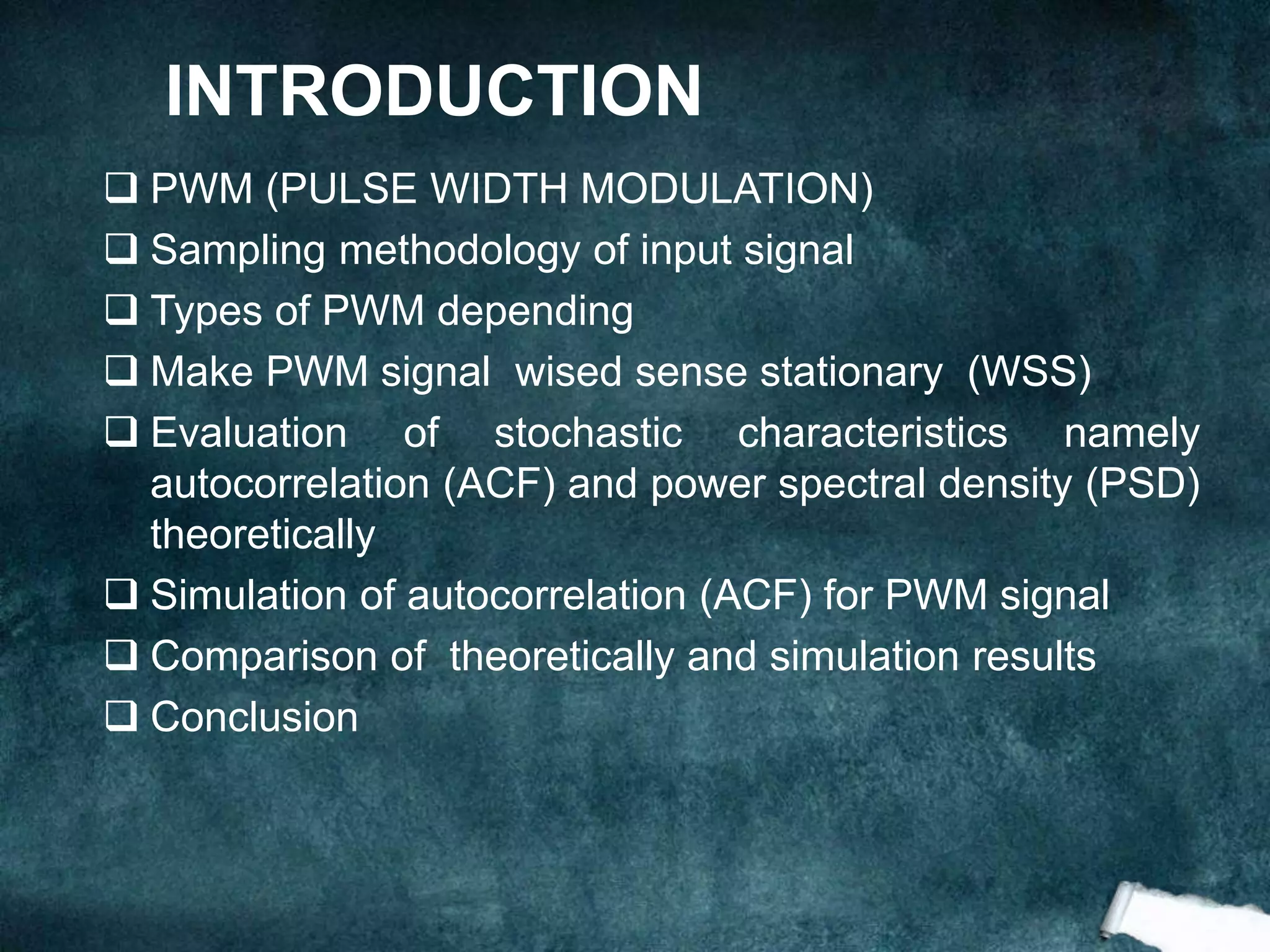
INTRODUCTION
 PWM (PULSE WIDTH MODULATION)
 Sampling methodology of input signal
 Types of PWM depending
 Make PWM signal wised sense stationary (WSS)
 Evaluation of stochastic characteristics namely
autocorrelation (ACF) and power spectral density (PSD)
theoretically
 Simulation of autocorrelation (ACF) for PWM signal
 Comparison of theoretically and simulation results
 Conclusion
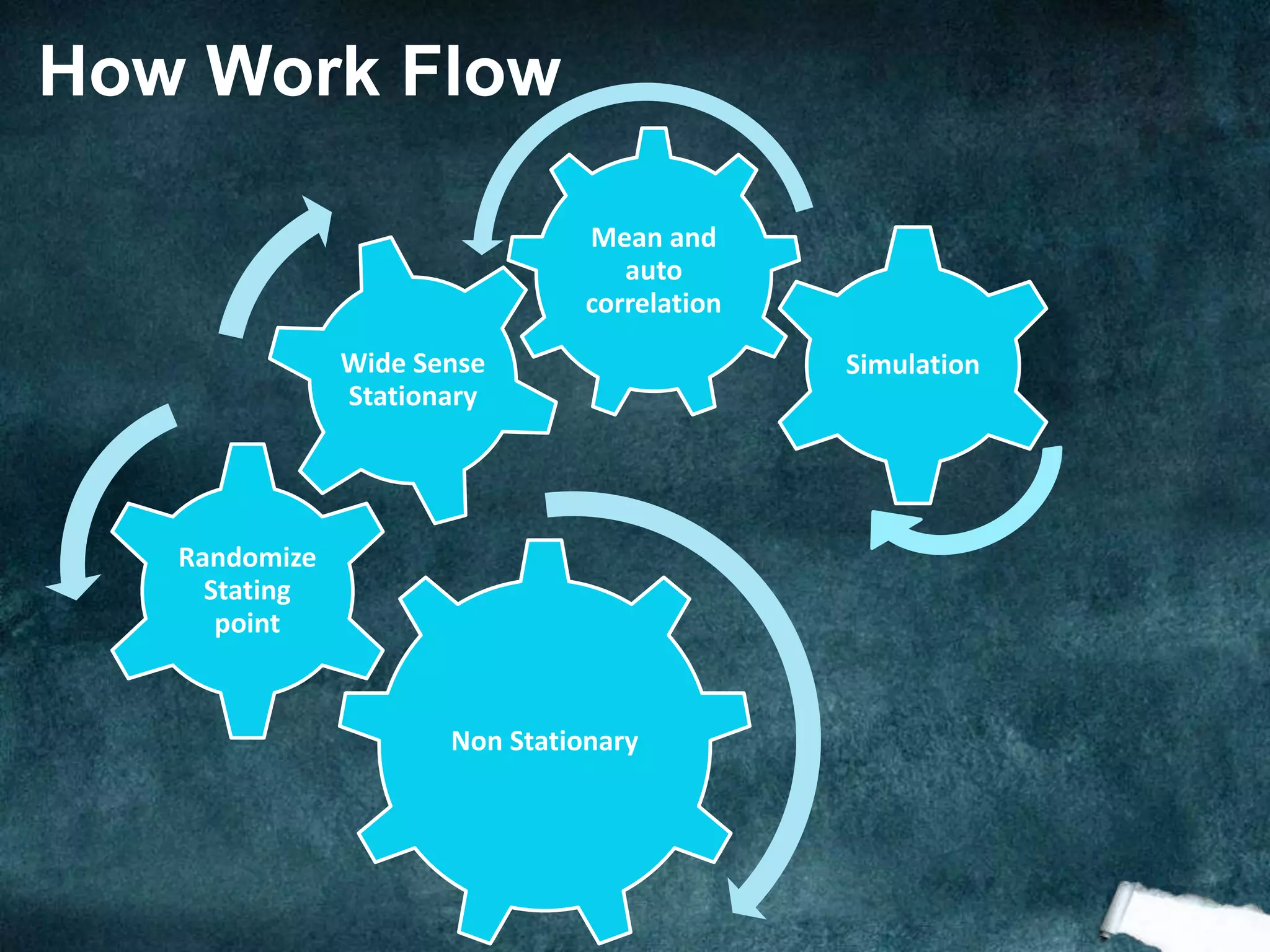
Non Stationary
Randomize
Stating
point
Wide Sense
Stationary
How Work Flow
Mean and
auto
correlation
Simulation
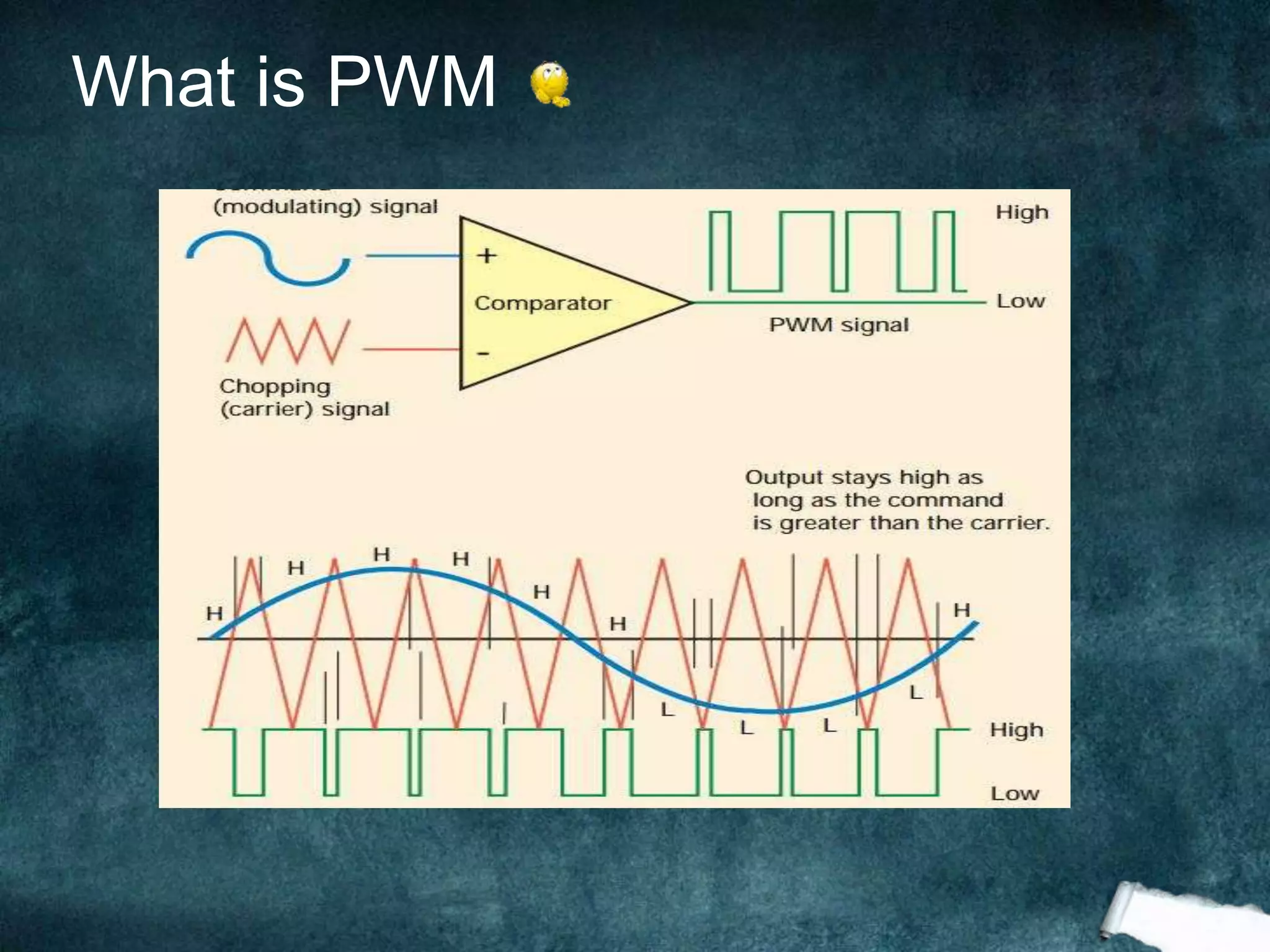
What is PWM
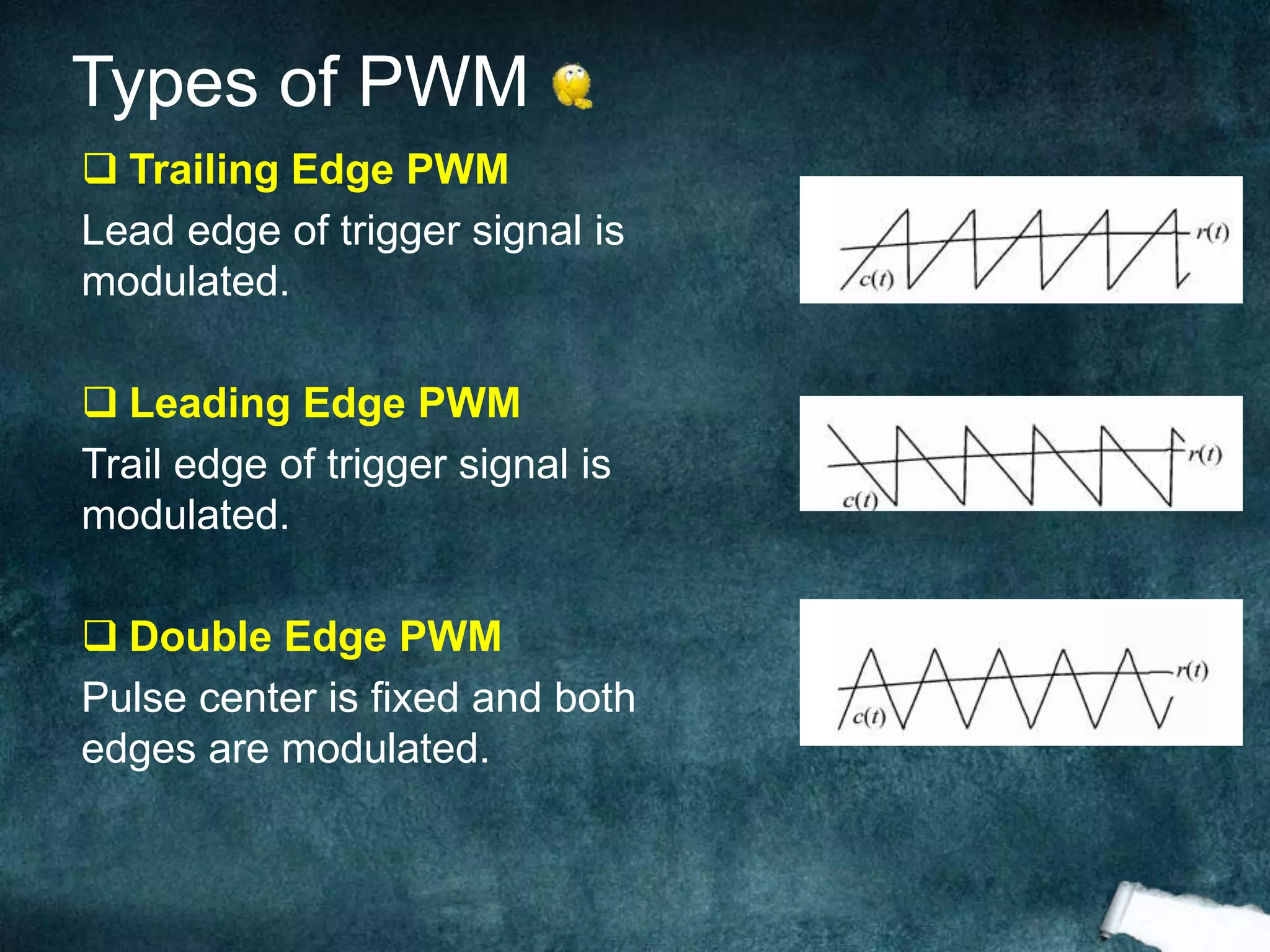
 Trailing Edge PWM
Lead edge of trigger signal is
modulated.
 Leading Edge PWM
Trail edge of trigger signal is
modulated.
 Double Edge PWM
Pulse center is fixed and both
edges are modulated.
Types of PWM
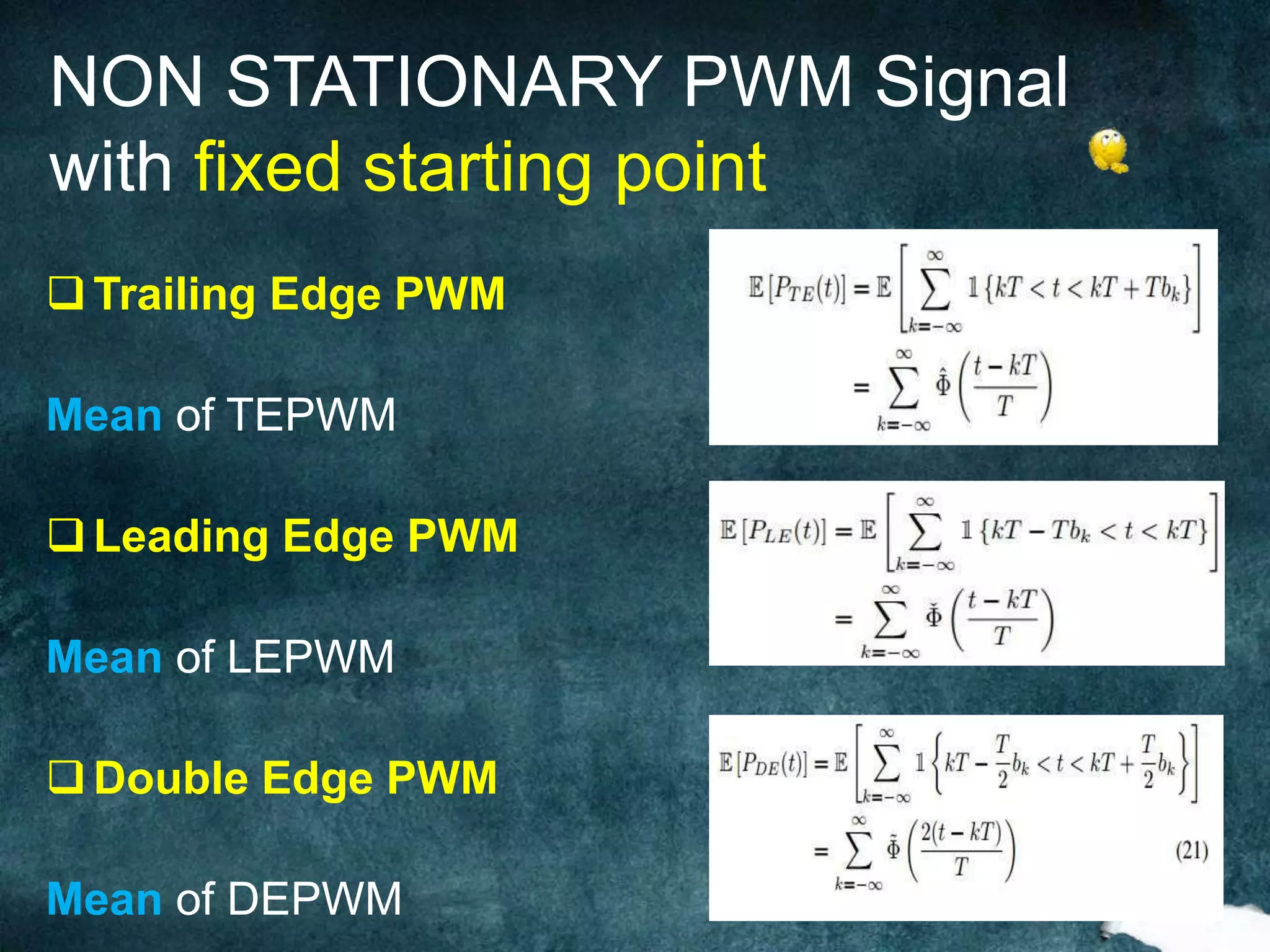
Trailing Edge PWM
Mean of TEPWM
Leading Edge PWM
Mean of LEPWM
Double Edge PWM
Mean of DEPWM
NON STATIONARY PWM Signal
with fixed starting point
Presenter: Amer Aziz
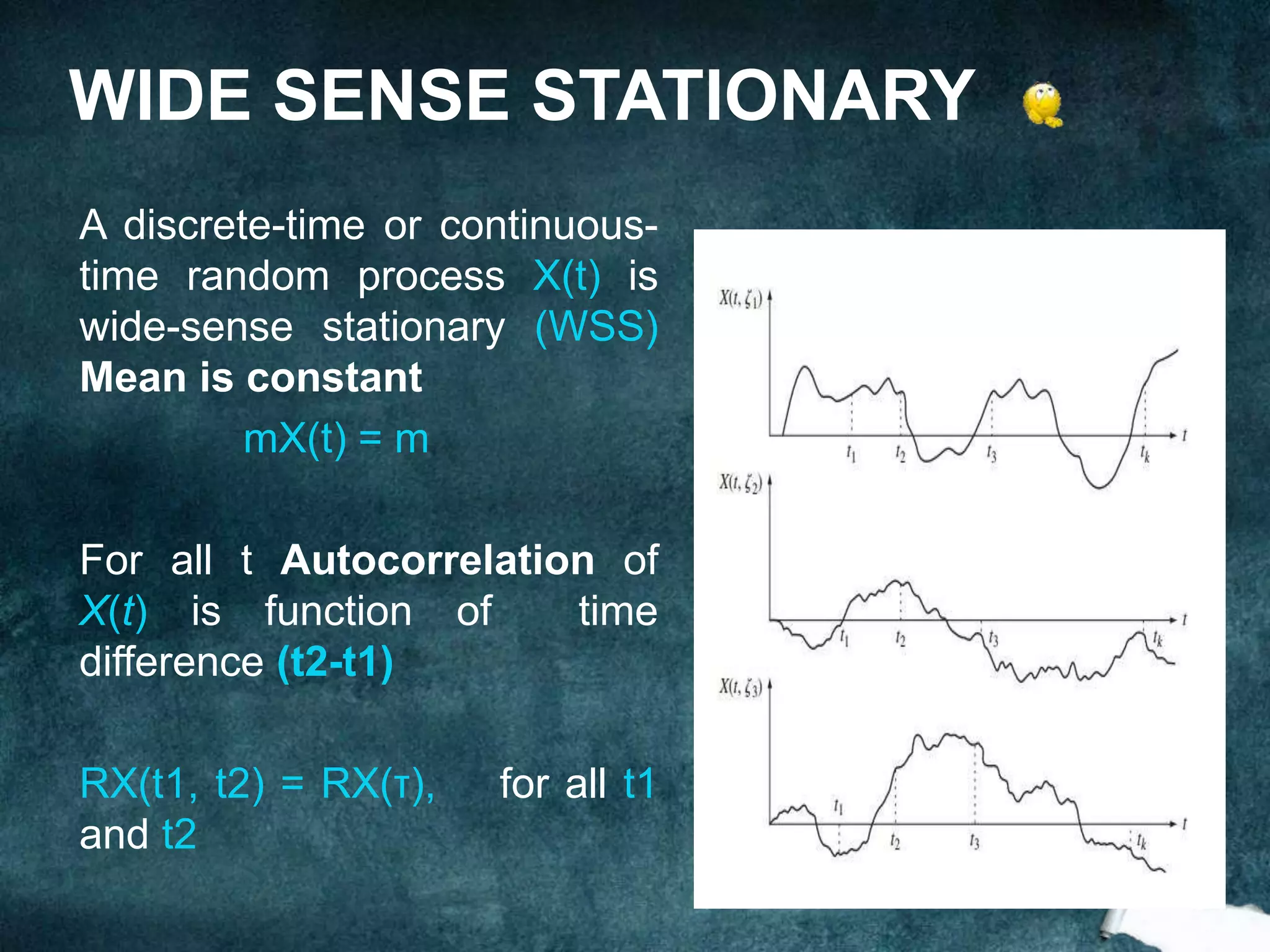
A discrete-time or continuous-
time random process X(t) is
wide-sense stationary (WSS)
Mean is constant
mX(t) = m
For all t Autocorrelation of
X(t) is function of time
difference (t2-t1)
RX(t1, t2) = RX(τ), for all t1
and t2
WIDE SENSE STATIONARY
 Randomizing starting point
by Φ, uniformly distributed
over [0,T]
 Limiting input signal
amplitude(bk) over sample
interval [0,1] uniformly and
using sampling methodology
WSS and IID PWM signal
 Trailing Edge PMW Mean is
constant Autocorrelation is
function of difference as
τ=t-s
CONVERSION IN WIDE SENSE
STATIONARY
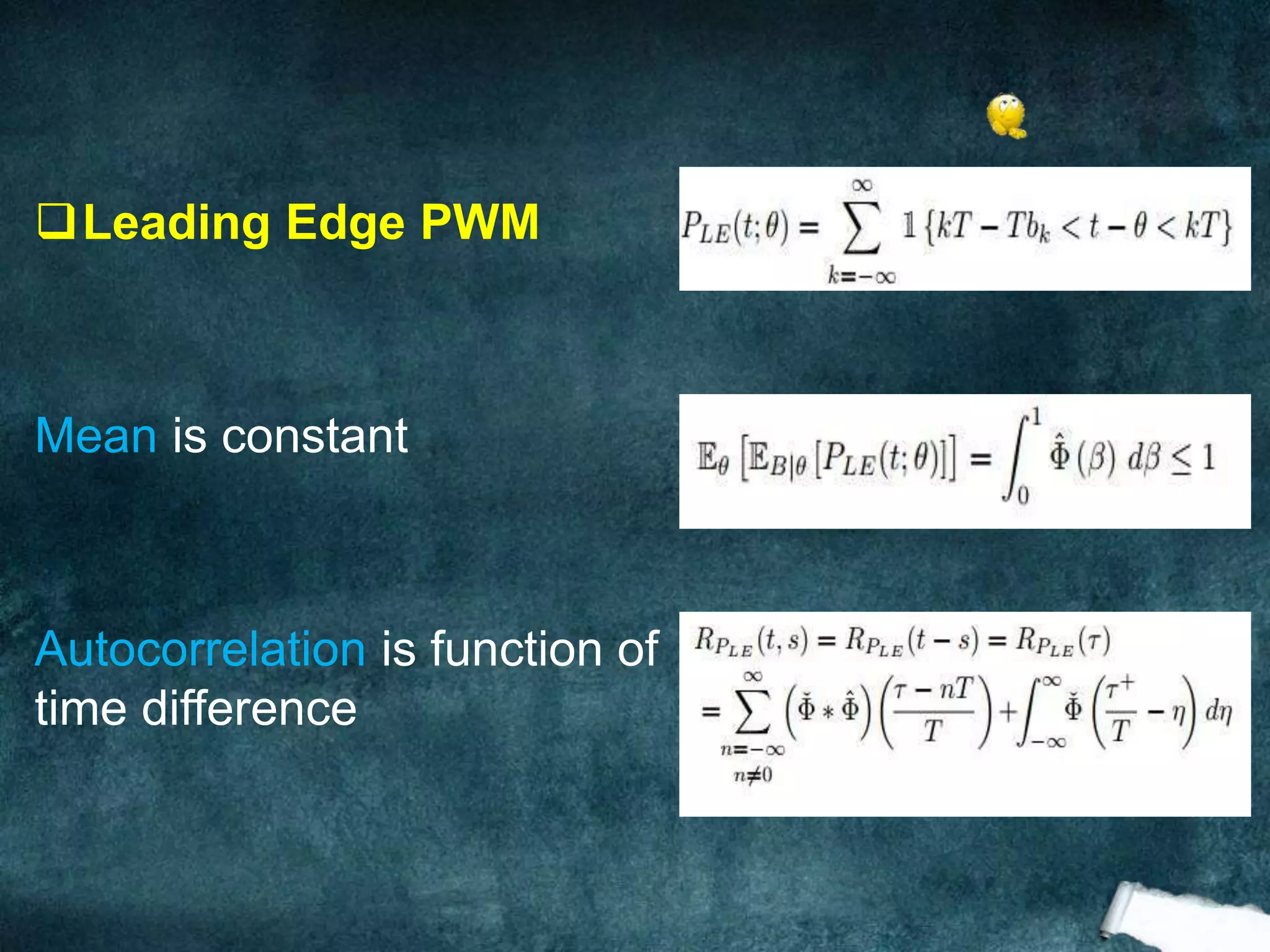
Leading Edge PWM
Mean is constant
Autocorrelation is function of
time difference
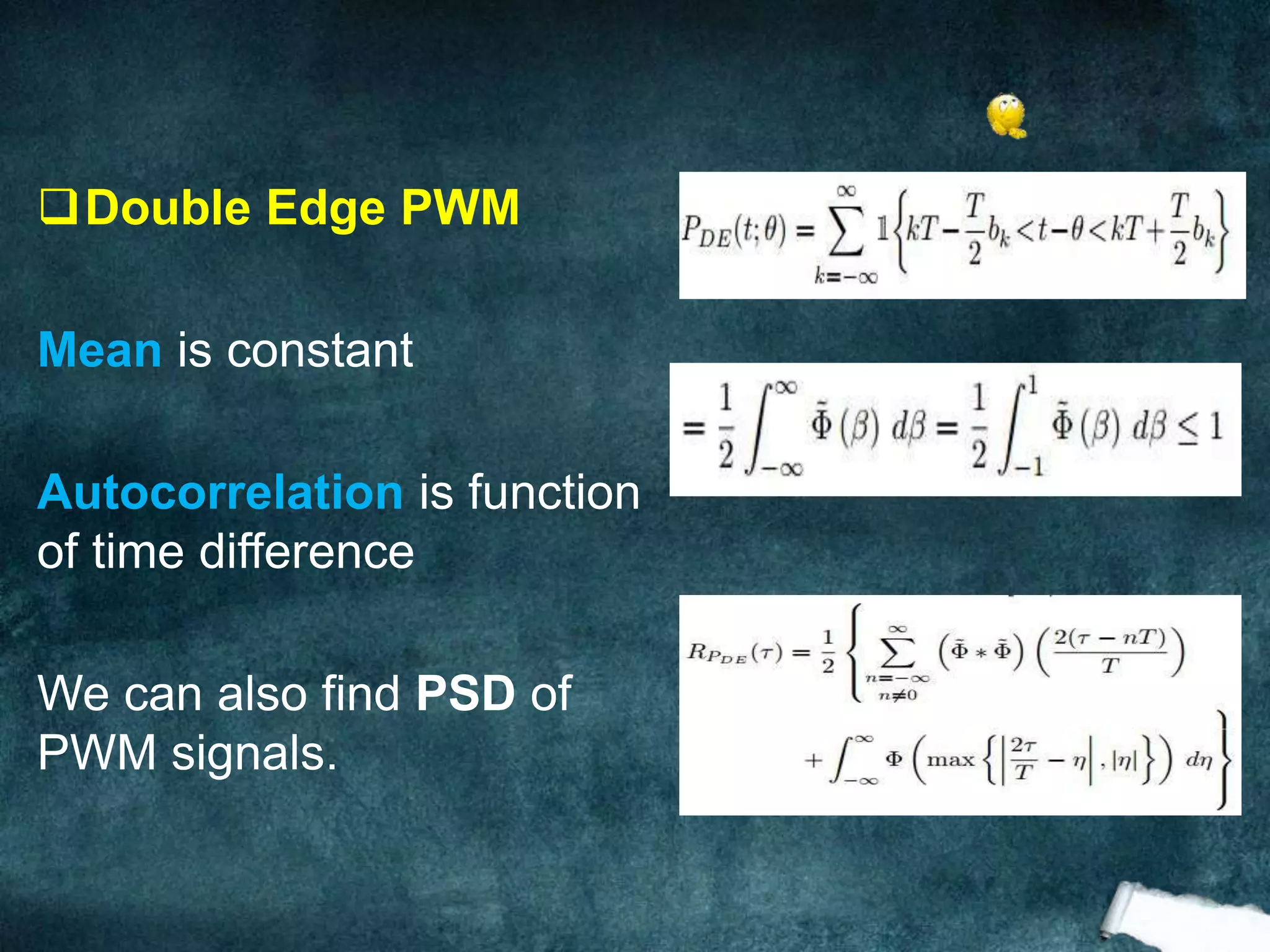
Double Edge PWM
Mean is constant
Autocorrelation is function
of time difference
We can also find PSD of
PWM signals.
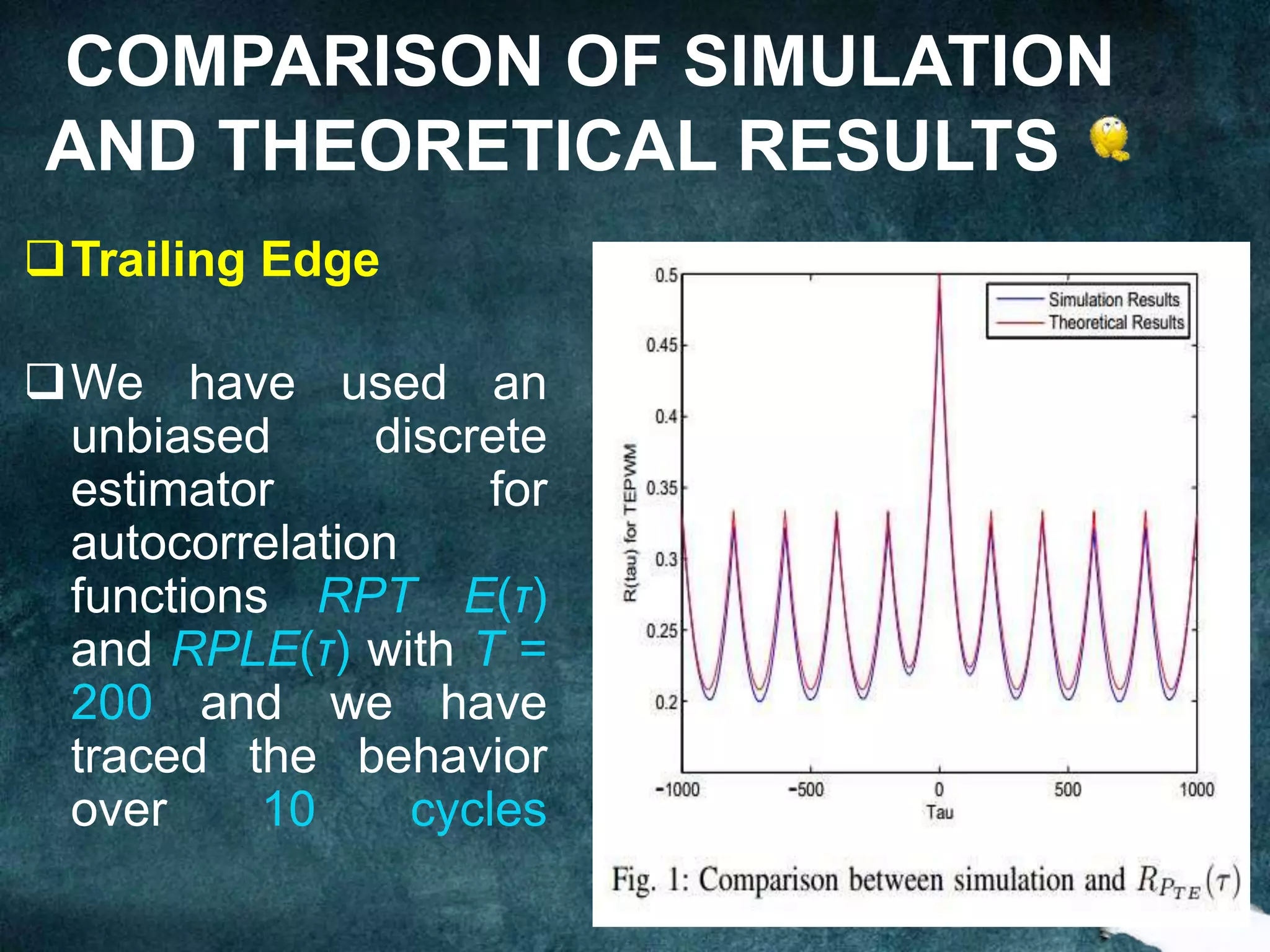
Trailing Edge
COMPARISON OF SIMULATION
AND THEORETICAL RESULTS
We have used an
unbiased discrete
estimator for
autocorrelation
functions RPT E(τ)
and RPLE(τ) with T =
200 and we have
traced the behavior
over 10 cycles
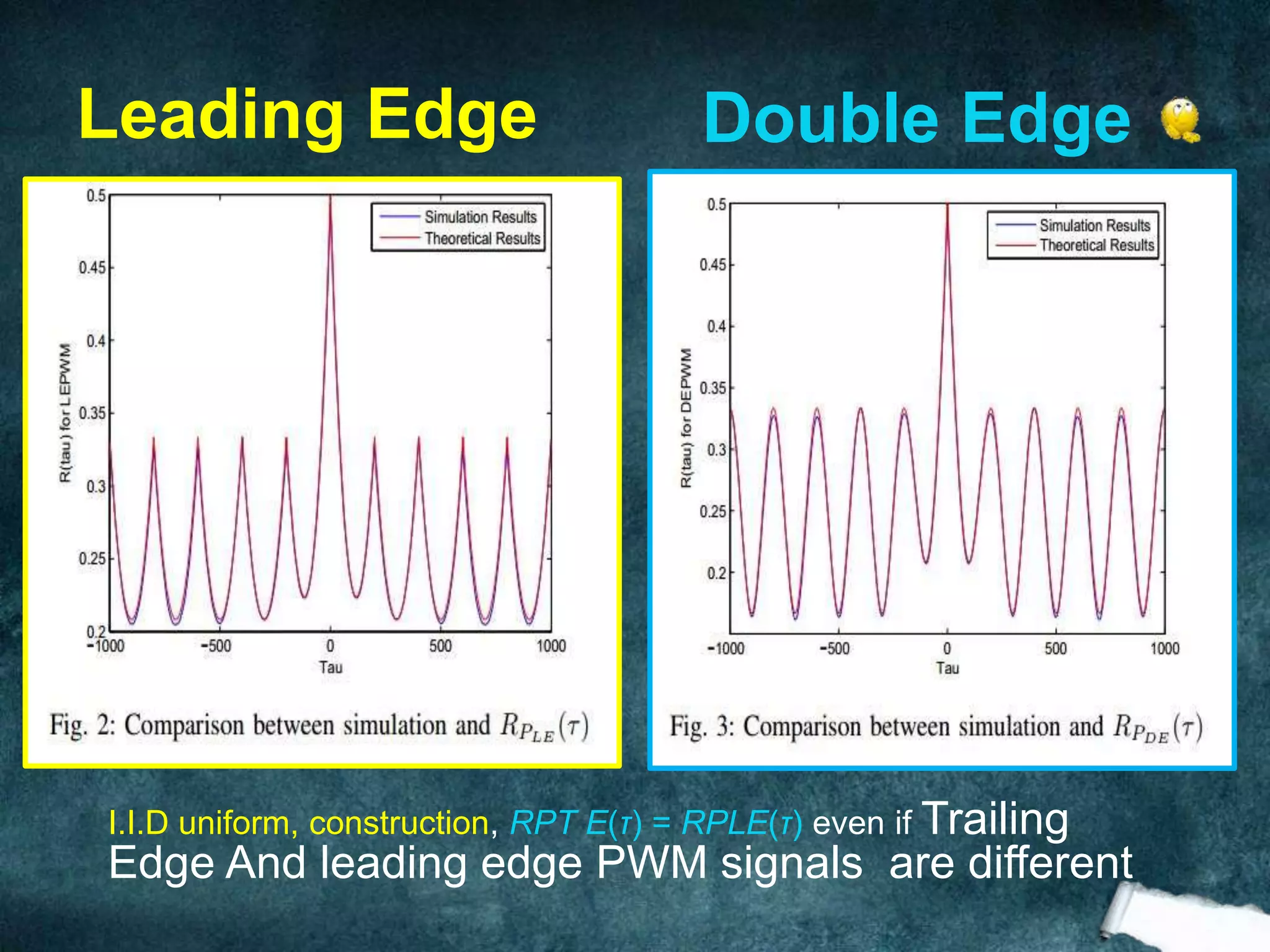
I.I.D uniform, construction, RPT E(τ) = RPLE(τ) even if Trailing
Edge And leading edge PWM signals are different
Leading Edge Double Edge
 PWM signal with a fixed starting point is not necessarily
wide sense stationary
 PWM signal with randomized starting point and I.I.D pulse
widths over a symbol interval is necessarily WSS
 Using the autocorrelation functions, derived the power
spectrum densities (PSD) easily
 For I.I.D. uniform distribution case, we have shown the
accuracy of our results with simulations.
CONCLUSION
presentation on research paper related to scotastic

presentation on research paper related to scotastic

  • 2.
    Title: IID STOCHASTIC ANALYSIS OFPWM SIGNALS GROUP MEMBERS: AMER AZIZ 172203 SALMAN BASHIR 171228
  • 3.
    CONTENTS  To evaluatethe basic stochastic characteristics o Mean and Autocorrelation of PWM signals o Power Spectral Density (PSD)  Conversion of non stationary PWM signals into simple wide sense stationary using different sampling techniques  For I.I.D uniformly distributed, the proposed autocorrelation functions are tested with simulation
  • 4.
  • 5.
    INTRODUCTION  PWM (PULSEWIDTH MODULATION)  Sampling methodology of input signal  Types of PWM depending  Make PWM signal wised sense stationary (WSS)  Evaluation of stochastic characteristics namely autocorrelation (ACF) and power spectral density (PSD) theoretically  Simulation of autocorrelation (ACF) for PWM signal  Comparison of theoretically and simulation results  Conclusion
  • 6.
    Non Stationary Randomize Stating point Wide Sense Stationary HowWork Flow Mean and auto correlation Simulation
  • 7.
  • 8.
     Trailing EdgePWM Lead edge of trigger signal is modulated.  Leading Edge PWM Trail edge of trigger signal is modulated.  Double Edge PWM Pulse center is fixed and both edges are modulated. Types of PWM
  • 9.
    Trailing Edge PWM Meanof TEPWM Leading Edge PWM Mean of LEPWM Double Edge PWM Mean of DEPWM NON STATIONARY PWM Signal with fixed starting point
  • 10.
  • 11.
    A discrete-time orcontinuous- time random process X(t) is wide-sense stationary (WSS) Mean is constant mX(t) = m For all t Autocorrelation of X(t) is function of time difference (t2-t1) RX(t1, t2) = RX(τ), for all t1 and t2 WIDE SENSE STATIONARY
  • 12.
     Randomizing startingpoint by Φ, uniformly distributed over [0,T]  Limiting input signal amplitude(bk) over sample interval [0,1] uniformly and using sampling methodology WSS and IID PWM signal  Trailing Edge PMW Mean is constant Autocorrelation is function of difference as τ=t-s CONVERSION IN WIDE SENSE STATIONARY
  • 13.
    Leading Edge PWM Meanis constant Autocorrelation is function of time difference
  • 14.
    Double Edge PWM Meanis constant Autocorrelation is function of time difference We can also find PSD of PWM signals.
  • 15.
    Trailing Edge COMPARISON OFSIMULATION AND THEORETICAL RESULTS We have used an unbiased discrete estimator for autocorrelation functions RPT E(τ) and RPLE(τ) with T = 200 and we have traced the behavior over 10 cycles
  • 16.
    I.I.D uniform, construction,RPT E(τ) = RPLE(τ) even if Trailing Edge And leading edge PWM signals are different Leading Edge Double Edge
  • 17.
     PWM signalwith a fixed starting point is not necessarily wide sense stationary  PWM signal with randomized starting point and I.I.D pulse widths over a symbol interval is necessarily WSS  Using the autocorrelation functions, derived the power spectrum densities (PSD) easily  For I.I.D. uniform distribution case, we have shown the accuracy of our results with simulations. CONCLUSION

Editor's Notes

  • #5 The second rule is: Spread ideas and move people.
  • #11 So there are the rules.