INSTITUTE OF MANAGEMENT STUDIES By : Piyush Joshi Shainesh dawar Rajendra kumar Vinod chinoniya Poonam kasde Mba (fa) II Sem
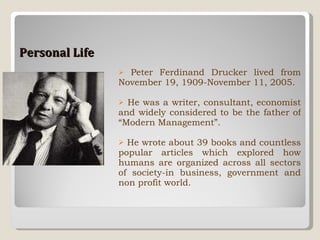
Personal Life Peter Ferdinand Drucker lived from November 19, 1909-November 11, 2005. He was a writer, consultant, economist and widely considered to be the father of “Modern Management”. He wrote about 39 books and countless popular articles which explored how humans are organized across all sectors of society-in business, government and non profit world.
Career After secondary school, Drucker moved to Hamburg, Germany and worked as a clerk-trainee for an export firm while enrolled in Hamburg University Law School. Drucker then traveled to Frankfurt where he worked as a financial writer. In 1931, he earned his doctorate in public law and international relations from the University of Frankfurt. He moved to London where he worked as a securities analyst for an insurance company, then an economist for a small bank. Drucker worked as a correspondent for British financial publications before becoming an economics professor at Sarah Lawrence College in Bronxville, New York. Later, he taught at Bennington College, in Vermont.
Contributions Drucker introduced the idea of decentralization-1940. He was the first to assert that workers should be treated as assets and not as liabilities to be eliminated . He originated the view of the corporation as a human community-1950. He argued for the importance of substance over style, for institutionalized practices over charismatic, cult leaders-1960. He wrote about the contribution of knowledge workers-1970. Drucker’s work at General Electric-1980.
Contributions made Drucker’s primary contribution is not a single idea, but rather an entire body of work that has one gigantic advantage: nearly all of it is essentially right. Drucker has an uncanny ability to develop insights about the workings of the social world, and to later be proved right by history
Some more insights from the oracle… Drucker and MBO A manager's primary task is to manage for results by translating corporate objectives into departmental, group and individual measures of performance.
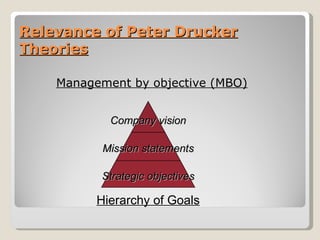
Relevance of Peter Drucker Theories Management by objective (MBO) Hierarchy of Goals Company vision Mission statements Strategic objectives
Drucker and Marketing His most famous book is “The Practice of Management,” published in 1954.  Three questions that every company seeking to establish a brand must ask itself:  “ What is our business?”  “ Who is our customer?”  “ What does our customer consider valuable?”
Three Roles of Management Managing a Business Managing Managers Managing Workers and Work
The Work of the Manager Set Objectives Organize Motivate and Communicate Measurement Develop People
5 Steps in Making Decisions Define the Problem Analyze the Problem Develop Alternative Solutions Find the Best Solution Implement the Decision
The Manager of Tomorrow Must manage by objectives Must take more risks and have a longer time frame Must be able to make strategic decisions Must be able to build an integrated team Must be able to communicate fast and clear Must see the business as whole Must relate to total environment
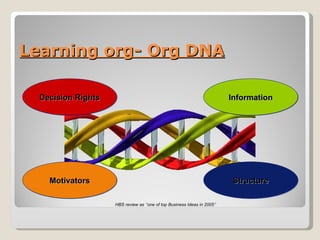
Learning org- Org DNA HBS review as ‘’one of top Business Ideas in 2005’’ Information Decision Rights Motivators Structure
Thank You

Peter drucker

  • 1.
    INSTITUTE OF MANAGEMENTSTUDIES By : Piyush Joshi Shainesh dawar Rajendra kumar Vinod chinoniya Poonam kasde Mba (fa) II Sem
  • 2.
    Personal Life PeterFerdinand Drucker lived from November 19, 1909-November 11, 2005. He was a writer, consultant, economist and widely considered to be the father of “Modern Management”. He wrote about 39 books and countless popular articles which explored how humans are organized across all sectors of society-in business, government and non profit world.
  • 3.
    Career After secondaryschool, Drucker moved to Hamburg, Germany and worked as a clerk-trainee for an export firm while enrolled in Hamburg University Law School. Drucker then traveled to Frankfurt where he worked as a financial writer. In 1931, he earned his doctorate in public law and international relations from the University of Frankfurt. He moved to London where he worked as a securities analyst for an insurance company, then an economist for a small bank. Drucker worked as a correspondent for British financial publications before becoming an economics professor at Sarah Lawrence College in Bronxville, New York. Later, he taught at Bennington College, in Vermont.
  • 4.
    Contributions Drucker introducedthe idea of decentralization-1940. He was the first to assert that workers should be treated as assets and not as liabilities to be eliminated . He originated the view of the corporation as a human community-1950. He argued for the importance of substance over style, for institutionalized practices over charismatic, cult leaders-1960. He wrote about the contribution of knowledge workers-1970. Drucker’s work at General Electric-1980.
  • 5.
    Contributions made Drucker’sprimary contribution is not a single idea, but rather an entire body of work that has one gigantic advantage: nearly all of it is essentially right. Drucker has an uncanny ability to develop insights about the workings of the social world, and to later be proved right by history
  • 6.
    Some more insightsfrom the oracle… Drucker and MBO A manager's primary task is to manage for results by translating corporate objectives into departmental, group and individual measures of performance.
  • 7.
    Relevance of PeterDrucker Theories Management by objective (MBO) Hierarchy of Goals Company vision Mission statements Strategic objectives
  • 8.
    Drucker and MarketingHis most famous book is “The Practice of Management,” published in 1954. Three questions that every company seeking to establish a brand must ask itself: “ What is our business?” “ Who is our customer?” “ What does our customer consider valuable?”
  • 9.
    Three Roles ofManagement Managing a Business Managing Managers Managing Workers and Work
  • 10.
    The Work ofthe Manager Set Objectives Organize Motivate and Communicate Measurement Develop People
  • 11.
    5 Steps inMaking Decisions Define the Problem Analyze the Problem Develop Alternative Solutions Find the Best Solution Implement the Decision
  • 12.
    The Manager ofTomorrow Must manage by objectives Must take more risks and have a longer time frame Must be able to make strategic decisions Must be able to build an integrated team Must be able to communicate fast and clear Must see the business as whole Must relate to total environment
  • 13.
    Learning org- OrgDNA HBS review as ‘’one of top Business Ideas in 2005’’ Information Decision Rights Motivators Structure
  • 14.