PRESENTATION ON NATIONAL MAPPING
ORGANIZATION AND SPATIAL DATA
INFRASTRUCTURE (SDI)
Submitted By:
Sarita Bhusal
Bishwa Bandhu oli
Sita Phuyal
Niraj Shah
Assignment:1
PRESENTATION OUTLINE
 Introduction
 Development
 Organogram
 Mission and Objectives
 Major activities and available data.
 Advantages
 Challenges
 Conclusion
 References
INTRODUCTION
 A National Mapping Organization(NMO) is an organization, usually publicly
owned, that produces topographic maps and geographic information of a country.
Some national mapping agencies also deal with cadastral matters.
In Nepal, Survey Department, which is only National Mapping Organization(NMO)
of country, under the Ministry of Land Management and Co-operative Poverty
Alleviation.
An Spatial Data Infrastructure (SDI) is the technology, policies, standards, human
resources, and related activities necessary to acquire, process, distribute, use,
maintain, and preserve spatial data.
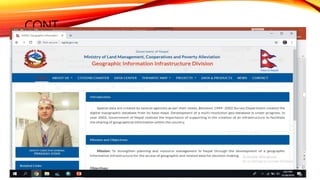
In Nepal National Geographic Information Infrastructure Division (NGIID) play the
main role as National Spatial Data Infrastructure Agency.
CO NT..
SDI IN NEPAL
In Nepal, SDI is being developed as a tool for national spatial data collection,
storage, processing and dissemination.
NSDI is the common portal to use Geo-spatial data in effective and efficient way
and link with other attribute database
NSDI helps to reduce duplication of efforts, avoid redundant expenditures and
eliminate corruption practices.
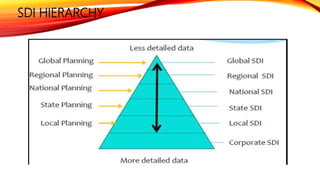
SDI HIERARCHY
HISTORY
NGIID
Spatial data are created by several agencies as per their needs. Between 1999-
2002 Survey Department created the digital topographic database from its base-
maps. Development of a multi-resolution geo-database is under progress. In year
2002, Government of Nepal realized the importance of supporting in the creation
of an infrastructure to facilitate the sharing of geographical information within the
country, then
Government of Nepal has initiated the National Geographical Information
Infrastructure Programme (NGIIP) for building NSDI since 2002. And now this
program has been changed into National Geographical Information Infrastructure
Division (NGIID).
ORGANOGRAM
Organizational Structure
Ministry of Land
Management,
Cooperatives and
Poverty Alleviation
SURVERY
DEPARTMENT
GEODETIC SURVEY
DIVISION
TOPOGRAPHICAL
SURVEY DIVISION
CADASTRAL SURVEY
DIVISION
NATIONAL
GEOGRAPHIC
INFORMATION
INFRASTUCTURE
DIVISION (NGIID)
SURVEY OFFICE
CONT..
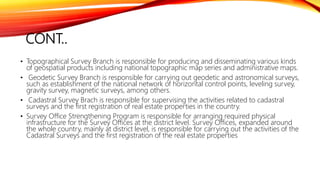
• Topographical Survey Branch is responsible for producing and disseminating various kinds
of geospatial products including national topographic map series and administrative maps.
• Geodetic Survey Branch is responsible for carrying out geodetic and astronomical surveys,
such as establishment of the national network of horizontal control points, leveling survey,
gravity survey, magnetic surveys, among others.
• Cadastral Survey Brach is responsible for supervising the activities related to cadastral
surveys and the first registration of real estate properties in the country.
• Survey Office Strengthening Program is responsible for arranging required physical
infrastructure for the Survey Offices at the district level. Survey Offices, expanded around
the whole country, mainly at district level, is responsible for carrying out the activities of the
Cadastral Surveys and the first registration of the real estate properties
CONT..
• National Geographic Information Infrastructure Project(NGIIP) was established as
an initiative for National Spatial Data Infrastructure (NSDI) in the country.
• In the present context, the primary focus is given to analyze and disseminate the
Census 2001 added spatial dimensions, which is a new concept in Nepal. This will
create awareness and the mechanism for data usage within other selected user
organizations.
CONT..
• Mission:
To strengthen planning and resource management in Nepal through the
development of a geographic information infrastructure for the access of
and related data for decision-making.
MISSION AND OBJECTIVES
OBJECTIVES
• The main objective of the division is to work as National Spatial Data Infrastructure Agency.
The sub-objectives are:
• To ensure easy access of geographical information.
• To discourage redundancy in creation of geographical information.
• To create environment for optimum use of geographical information.
• To coordinate between agencies creating and using geographical information.
• To develop and run national spatial data infrastructure clearinghouse and national
geoportal.
MAJOR ACTIVITIES AND AVAILABLE DATA
MAJOR ACTIVITIES
To provide the topographical maps at different scale with digital database which covers the
whole country.
To develop an NGII platform to facilitate data sharing among Survey Department, Central,
Bureau of Statistics and participating agencies.
To provide hard copy maps of district, ward boundary and map of Nepal with district
boundary and other administrative boundary.
To provides information about Geodetic Control Network of Nepal established by Survey
Department.
Provides maps, aerial photographs, geodetic data, and other related data required for
planning development, educational, administrative and research works by other agencies
in Nepal.
CONT..
AVAILABLE DATA
1. National Topographic Database, NTDB
NGIID made available the digital database of different scale.
I. Topographic Database at scales 1:25 000 and 1:50 000
II. Topographic Database at scales 1:100 000
III. Topographic Database at scales 1:250 000
IV. Topographic Database at scales 1:500 000
V. Topographic Database at scales 1:1 000 000
2. Administrative Boundary
1. Metropolitan City, sub-metropolitan City, Municipality and Rural Municipality with was level
administrative Boundary is now available from the division. it can also be downloaded from the
website.
3. Orthophoto
1. Hardcopy map
Orthophoto maps (hard copy maps)at scales 1:5 000 ( for core urban areas) and 1:10
000 (for sub urban areas) are also available.
CONT.
4. The population and Socio-Economic Atlas of Nepal
• This atlas has been prepared with the joint effort of Survey Department and Central
Bureau of Statistics of the Government of Nepal with the assistance of the European
Commission.
• Price:
• NRS 2,500.00( in Nepal)
• $ 200.00( outside Nepal)
5. Digital Soils & Terrain Database of Nepal version 1, 27 April 2004 (Rs. 2000.)
6. Geo referenced soft copy topographic base map
• The latest base maps prepared by Survey Department at scales 1:25 000 and 1:50
000 have been scanned and geo referenced and are available at the resolution of
200 dpi.
• Cost: Rs. 180. per sheet.
• And others many.
Helps to reduce the duplication of spatial data,
Support to access the data easily without any tedious,
Easy to sharing, use spatial data within many agency,
Easy to maintenance and improve the spatial data,
ADVANTAGES
CHALLENGES
Problem of communication.
Problem of format.
Problem of content and quality.
Problem of price and licenses.
 how to evolve to incorporate new technologies;
how to expand SDI concepts into the practices of business and smaller units of
government; .
There is lack of sufficient and adequately trained human resource to work with modern
technology.
CONCLUSION
• In conclusion we can say that,
• In order to address the above challenges
a standard national policy on SDI should be formulated and
adopted.
Should provide good communication facility.
Should have good cooperation and data shearing between
different organizations.
should be incorporate new technologies and sufficient
trained human resource to work with modern technology.
REFERENCE
• http://dos.gov.np/
• http://ngiid.gov.np/
Presentation on national mapping organization and spatial data infrastructure

Presentation on national mapping organization and spatial data infrastructure

  • 1.
    PRESENTATION ON NATIONALMAPPING ORGANIZATION AND SPATIAL DATA INFRASTRUCTURE (SDI) Submitted By: Sarita Bhusal Bishwa Bandhu oli Sita Phuyal Niraj Shah Assignment:1
  • 2.
    PRESENTATION OUTLINE  Introduction Development  Organogram  Mission and Objectives  Major activities and available data.  Advantages  Challenges  Conclusion  References
  • 3.
    INTRODUCTION  A NationalMapping Organization(NMO) is an organization, usually publicly owned, that produces topographic maps and geographic information of a country. Some national mapping agencies also deal with cadastral matters. In Nepal, Survey Department, which is only National Mapping Organization(NMO) of country, under the Ministry of Land Management and Co-operative Poverty Alleviation. An Spatial Data Infrastructure (SDI) is the technology, policies, standards, human resources, and related activities necessary to acquire, process, distribute, use, maintain, and preserve spatial data. In Nepal National Geographic Information Infrastructure Division (NGIID) play the main role as National Spatial Data Infrastructure Agency.
  • 4.
    CO NT.. SDI INNEPAL In Nepal, SDI is being developed as a tool for national spatial data collection, storage, processing and dissemination. NSDI is the common portal to use Geo-spatial data in effective and efficient way and link with other attribute database NSDI helps to reduce duplication of efforts, avoid redundant expenditures and eliminate corruption practices.
  • 5.
  • 6.
    HISTORY NGIID Spatial data arecreated by several agencies as per their needs. Between 1999- 2002 Survey Department created the digital topographic database from its base- maps. Development of a multi-resolution geo-database is under progress. In year 2002, Government of Nepal realized the importance of supporting in the creation of an infrastructure to facilitate the sharing of geographical information within the country, then Government of Nepal has initiated the National Geographical Information Infrastructure Programme (NGIIP) for building NSDI since 2002. And now this program has been changed into National Geographical Information Infrastructure Division (NGIID).
  • 7.
    ORGANOGRAM Organizational Structure Ministry ofLand Management, Cooperatives and Poverty Alleviation SURVERY DEPARTMENT GEODETIC SURVEY DIVISION TOPOGRAPHICAL SURVEY DIVISION CADASTRAL SURVEY DIVISION NATIONAL GEOGRAPHIC INFORMATION INFRASTUCTURE DIVISION (NGIID) SURVEY OFFICE
  • 8.
    CONT.. • Topographical SurveyBranch is responsible for producing and disseminating various kinds of geospatial products including national topographic map series and administrative maps. • Geodetic Survey Branch is responsible for carrying out geodetic and astronomical surveys, such as establishment of the national network of horizontal control points, leveling survey, gravity survey, magnetic surveys, among others. • Cadastral Survey Brach is responsible for supervising the activities related to cadastral surveys and the first registration of real estate properties in the country. • Survey Office Strengthening Program is responsible for arranging required physical infrastructure for the Survey Offices at the district level. Survey Offices, expanded around the whole country, mainly at district level, is responsible for carrying out the activities of the Cadastral Surveys and the first registration of the real estate properties
  • 9.
    CONT.. • National GeographicInformation Infrastructure Project(NGIIP) was established as an initiative for National Spatial Data Infrastructure (NSDI) in the country. • In the present context, the primary focus is given to analyze and disseminate the Census 2001 added spatial dimensions, which is a new concept in Nepal. This will create awareness and the mechanism for data usage within other selected user organizations.
  • 10.
  • 11.
    • Mission: To strengthenplanning and resource management in Nepal through the development of a geographic information infrastructure for the access of and related data for decision-making. MISSION AND OBJECTIVES
  • 12.
    OBJECTIVES • The mainobjective of the division is to work as National Spatial Data Infrastructure Agency. The sub-objectives are: • To ensure easy access of geographical information. • To discourage redundancy in creation of geographical information. • To create environment for optimum use of geographical information. • To coordinate between agencies creating and using geographical information. • To develop and run national spatial data infrastructure clearinghouse and national geoportal.
  • 13.
    MAJOR ACTIVITIES ANDAVAILABLE DATA MAJOR ACTIVITIES To provide the topographical maps at different scale with digital database which covers the whole country. To develop an NGII platform to facilitate data sharing among Survey Department, Central, Bureau of Statistics and participating agencies. To provide hard copy maps of district, ward boundary and map of Nepal with district boundary and other administrative boundary. To provides information about Geodetic Control Network of Nepal established by Survey Department. Provides maps, aerial photographs, geodetic data, and other related data required for planning development, educational, administrative and research works by other agencies in Nepal.
  • 14.
    CONT.. AVAILABLE DATA 1. NationalTopographic Database, NTDB NGIID made available the digital database of different scale. I. Topographic Database at scales 1:25 000 and 1:50 000 II. Topographic Database at scales 1:100 000 III. Topographic Database at scales 1:250 000 IV. Topographic Database at scales 1:500 000 V. Topographic Database at scales 1:1 000 000 2. Administrative Boundary 1. Metropolitan City, sub-metropolitan City, Municipality and Rural Municipality with was level administrative Boundary is now available from the division. it can also be downloaded from the website. 3. Orthophoto 1. Hardcopy map Orthophoto maps (hard copy maps)at scales 1:5 000 ( for core urban areas) and 1:10 000 (for sub urban areas) are also available.
  • 15.
    CONT. 4. The populationand Socio-Economic Atlas of Nepal • This atlas has been prepared with the joint effort of Survey Department and Central Bureau of Statistics of the Government of Nepal with the assistance of the European Commission. • Price: • NRS 2,500.00( in Nepal) • $ 200.00( outside Nepal) 5. Digital Soils & Terrain Database of Nepal version 1, 27 April 2004 (Rs. 2000.) 6. Geo referenced soft copy topographic base map • The latest base maps prepared by Survey Department at scales 1:25 000 and 1:50 000 have been scanned and geo referenced and are available at the resolution of 200 dpi. • Cost: Rs. 180. per sheet. • And others many.
  • 16.
    Helps to reducethe duplication of spatial data, Support to access the data easily without any tedious, Easy to sharing, use spatial data within many agency, Easy to maintenance and improve the spatial data, ADVANTAGES
  • 17.
    CHALLENGES Problem of communication. Problemof format. Problem of content and quality. Problem of price and licenses.  how to evolve to incorporate new technologies; how to expand SDI concepts into the practices of business and smaller units of government; . There is lack of sufficient and adequately trained human resource to work with modern technology.
  • 18.
    CONCLUSION • In conclusionwe can say that, • In order to address the above challenges a standard national policy on SDI should be formulated and adopted. Should provide good communication facility. Should have good cooperation and data shearing between different organizations. should be incorporate new technologies and sufficient trained human resource to work with modern technology.
  • 19.