International SDI Initiatives: 
Thinking Globally, Acting 
Locally 
Dr. David J. Coleman, President 
Global Spatial Data Infrastructure Association 
http://www.gsdi.org 
Pan Canadian SDI Summit 
Calgary 
18 September 2014
Key Subjects of 
Presentation 
Roots and Canada’s role in SDI 
Development 
SDI Initiatives at the International and 
Global Levels 
Lessons learned and challenges for the 
future
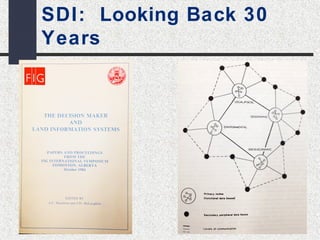
SDI: Looking Back 30 
Years
Spatial Data Infrastructure 
from http://www.gsdi.org 
Critical mass of processes, policies, 
standards, enabling technologies, 
mechanisms and key datasets 
required to make geospatial data readily 
available to the growing community of end-users.
Evolution of the “Driving 
Visions” 
1960s and 1970s: Vision of creating jurisdiction-wide large, 
centralized LIS and GIS “Data Banks” based on a common spatial 
referencing framework 
1980’s: Shift from large central databases to decentralized 
networks of systems 
SDI in the early 1990s: Recognizing and addressing 
technological, operational and institutional aspects of geospatial 
data collection, management, discovery and dissemination in a 
coordinated manner. 
SDI’s today: Supporting location-based services in the mass 
market and spatially enabled workflows in government & industry.
1st-Generation Spatial 
Data Infrastructure 
Programs 
Concept developed in late 1970’s and 
refined through 1980s and early 1990s 
Evolved from earlier systematic surveying 
& mapping programs 
Emphasis on data discovery & distribution 
Began in earnest in the US circa 1992 
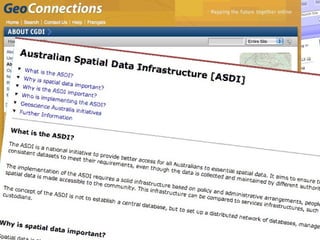
Followed quickly by Canada, Australia, the 
EEC, the UK and many others
SDI: Early Principles 
Data collected once and used many times 
Seamless databases across boundaries 
Recognition of both Basic Framework Data and 
Value Added Data 
Equitable sharing of SDI Costs, Services & 
Responsibilities 
(in some countries) Creation of value-added 
products & services in support of industry 
development From CGII Vision Report, Geoplan Consultants, Nov. 1996
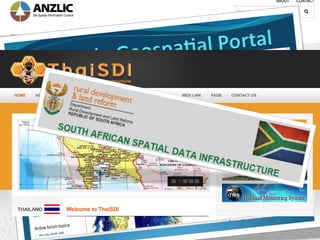
SDI Programs 
Worldwide 
5 key areas of early focus: 
 Framework data definition and development 
 Geospatial data discovery and download 
 Web mapping (sometimes from several different 
servers & integrated on your browser) 
 Cultivation of “communities of practice” 
 Definition and development of standards and 
standards-based products to enable the above
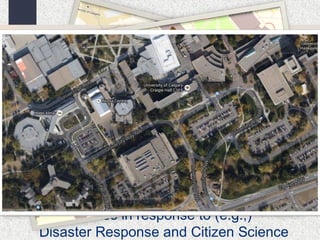
Non-Government “SDI” 
Commercial suppliers of online 
geospatial data and services (e.g., 
Google, DigitalGlobe, Bing, 
Nokia/Navteq, Esri and many others) 
Open source suppliers like 
OpenStreetMap 
NGOs providing crowdsourced detail 
and updates in response to (e.g.,) 
Disaster Response and Citizen Science
A Changing Marketplace 
Today… 
Corporate downsizing and reorientation of government 
programs 
Commoditization and “mass customization” of location-based 
services 
Challenges to traditional geomatics approaches and suppliers 
around the world 
Evolving expectations of users re: capability, performance, 
transparency, simplicity and reliability 
“Big Data” demands changing our views of how we manage, 
process, analyze and visualize data.
SDIs – The New 
Generation 
New Waves of geospatial data creation – both active 
and passive 
Increased operational use of geospatial data: sensor 
networks and geospatially-enabled workflows 
Increased strategic use of geospatial data by large 
public & private organizations to detect patterns and 
predict behaviour 
Widespread and growing expectations of high 
accuracy, currency of information and rapid response 
times
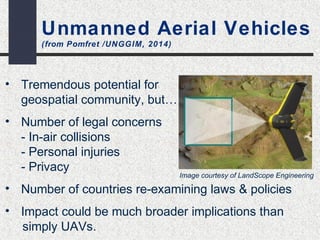
Unmanned Aerial Vehicles 
(from Pomfret /UNGGIM, 2014) 
• Tremendous potential for 
geospatial community, but… 
• Number of legal concerns 
- In-air collisions 
- Personal injuries 
- Privacy 
• Number of countries re-examining laws & policies 
• Impact could be much broader implications than 
simply UAVs. 
Image courtesy of LandScope Engineering
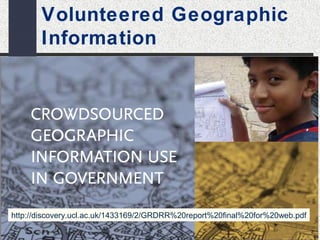
Volunteered Geographic 
Information 
http://discovery.ucl.ac.uk/1433169/2/GRDRR%20report%20final%20for%20web.pdf
Slide courtesy Google/Arabu [2013]
Managing the Data 
Resource 
By 2013, 
5 EXABYTES 
was created 
EVERY 10 
MINUTES 
From the 
beginning of 
recorded time until 
2003, we created 
5 EXABYTES 
of Textual Data 
In 2011, 
5 EXABYTES of 
all digital data 
was created 
EVERY TWO 
DAYS 
[Enriquez 2003/ Schmidt 2010/ Borne 2013]
Transnational and Global 
SDI Initiatives
International Standards: 
The glue holding SDIs 
together
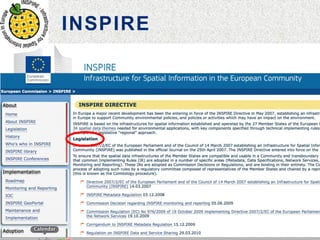
INSPIRE
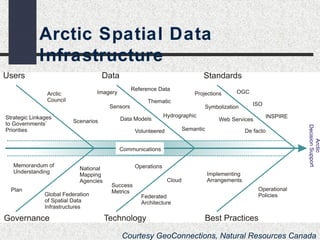
Arctic Spatial Data 
Infrastructure 
Courtesy GeoConnections, Natural Resources Canada
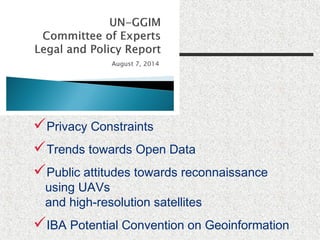
Privacy Constraints 
Trends towards Open Data 
Public attitudes towards reconnaissance 
using UAVs 
and high-resolution satellites 
IBA Potential Convention on Geoinformation
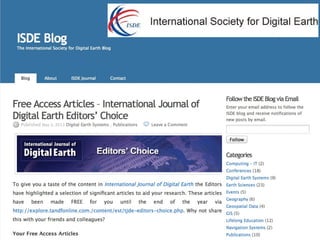
Global Initiative headquartered in China 
Influenced by 1986 Vision of a “Digital Earth” 
proposed by VP Al Gore and modified since. 
International Executive Committee 
Eight major “Digital Earth” international 
symposia held since 1999
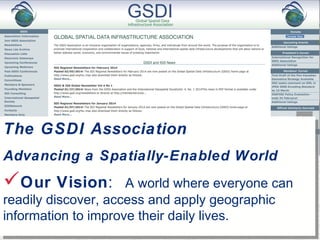
The GSDI Association 
Advancing a Spatially-Enabled World 
Our Vision: A world where everyone can 
readily discover, access and apply geographic 
information to improve their daily lives. 
The GSDI Association 
Advancing a Spatially-Enabled World 
Our Vision: A world where everyone can 
readily discover, access and apply geographic 
information to improve their daily lives.
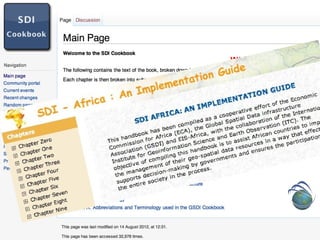
Wiki Version. 
PDF versions now 
available in 
English, Spanish, 
Chinese, Polish 
and Albanian
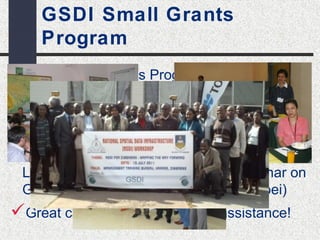
GSDI Small Grants 
Program 
GSDI Small Grants Program to support 
training & software (http://www.gsdi.org/sic1) 
Cooperating with URISA GIS Corps to 
provide services to some countries 
Cooperating with International Center for 
Land Policy Studies and Training Seminar on 
GIS &Land Management (Chinese Taipei) 
Great causes looking for more assistance!
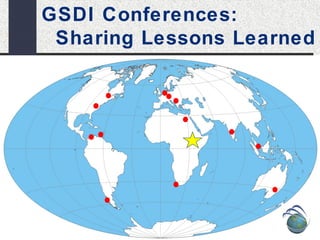
GSDI Conferences: 
Sharing Lessons Learned
SDI Lessons Learned and 
Key Accomplishments
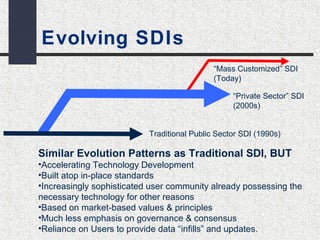
Evolving SDIs 
“Mass Customized” SDI 
(Today) 
“Private Sector” SDI 
(2000s) 
Traditional Public Sector SDI (1990s) 
Similar Evolution Patterns as Traditional SDI, BUT 
•Accelerating Technology Development 
•Built atop in-place standards 
•Increasingly sophisticated user community already possessing the 
necessary technology for other reasons 
•Based on market-based values & principles 
•Much less emphasis on governance & consensus 
•Reliance on Users to provide data “infills” and updates.
“Authoritative” SDI 
Programs 1995-2014: 
Looking Back… 
Public infrastructure indeed laid the framework 
for private sector initiatives, but… 
Mapping Emphasis and Library/Bookstore Metaphor 
limited the vision 
Emphasis on widespread, mass-market use of 
government mapping files has not taken hold. 
Mixed successes in government-government and 
government-industry partnerships 
Except in a few examples, did not predict the ultimate 
influence of integrated, real-time location-based 
services
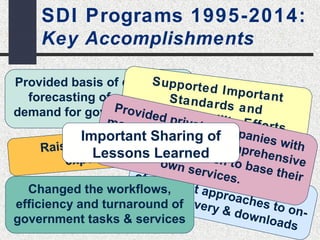
SDI Programs 1995-2014: 
Key Accomplishments 
Provided basis of defensible 
forecasting of customer 
demand for government data 
S uppo rt e d I mpor t a nt 
S t a nd a rd s a nd 
Provided I nt e r private o pe ra b companies ilit y E ffor t s 
with 
more consistent & comprehensive 
Important Sharing of 
Lessons Learned 
information on which to base their 
Raised levels of user 
Allowed own services. 
public comparison 
of different approaches to on-line 
discovery & downloads 
expectations 
Changed the workflows, 
efficiency and turnaround of 
government tasks & services
“Thinking Globally, Acting 
Locally” 
SDIs of all stripes still depend on people to start, 
grow and thrive: 
•Individual Champions who can create compelling arguments 
for their creation and continuation; 
•People willing to come together to change the ways in which 
they look at their work and how they approach problems; 
•People willing to realize the value of standards based 
solutions rather than “one-of” creations – to think in terms of 
programs rather than just individual projects or problems; 
•People with the confidence and resources to be able to 
share their expertise and experiences.
Useful Links 
CGRCT http://cgcrt.ca 
CGDI http://geoconnections.nrcan.gc.ca 
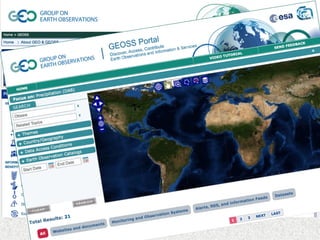
GEO http://www.earthobservations.org 
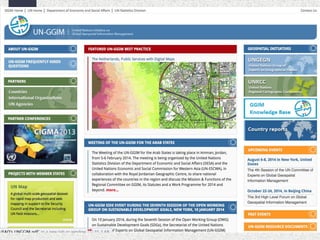
GGIM http://ggim.un.org 
INSPIRE http://inspire.jrc.ec.europa.eu/index.cfm 
ISDE http://www.digitalearth-isde.org 
FGDC http://www.fgdc.gov
For further information 
http://www.gsdi.org

David Coleman presentation at SDI Summit 2014, Calgary, Canada, 17-19 Sept 2014

  • 1.
    International SDI Initiatives: Thinking Globally, Acting Locally Dr. David J. Coleman, President Global Spatial Data Infrastructure Association http://www.gsdi.org Pan Canadian SDI Summit Calgary 18 September 2014
  • 2.
    Key Subjects of Presentation Roots and Canada’s role in SDI Development SDI Initiatives at the International and Global Levels Lessons learned and challenges for the future
  • 3.
  • 4.
    Spatial Data Infrastructure from http://www.gsdi.org Critical mass of processes, policies, standards, enabling technologies, mechanisms and key datasets required to make geospatial data readily available to the growing community of end-users.
  • 5.
    Evolution of the“Driving Visions” 1960s and 1970s: Vision of creating jurisdiction-wide large, centralized LIS and GIS “Data Banks” based on a common spatial referencing framework 1980’s: Shift from large central databases to decentralized networks of systems SDI in the early 1990s: Recognizing and addressing technological, operational and institutional aspects of geospatial data collection, management, discovery and dissemination in a coordinated manner. SDI’s today: Supporting location-based services in the mass market and spatially enabled workflows in government & industry.
  • 6.
    1st-Generation Spatial DataInfrastructure Programs Concept developed in late 1970’s and refined through 1980s and early 1990s Evolved from earlier systematic surveying & mapping programs Emphasis on data discovery & distribution Began in earnest in the US circa 1992 Followed quickly by Canada, Australia, the EEC, the UK and many others
  • 8.
    SDI: Early Principles Data collected once and used many times Seamless databases across boundaries Recognition of both Basic Framework Data and Value Added Data Equitable sharing of SDI Costs, Services & Responsibilities (in some countries) Creation of value-added products & services in support of industry development From CGII Vision Report, Geoplan Consultants, Nov. 1996
  • 9.
    SDI Programs Worldwide 5 key areas of early focus:  Framework data definition and development  Geospatial data discovery and download  Web mapping (sometimes from several different servers & integrated on your browser)  Cultivation of “communities of practice”  Definition and development of standards and standards-based products to enable the above
  • 11.
    Non-Government “SDI” Commercialsuppliers of online geospatial data and services (e.g., Google, DigitalGlobe, Bing, Nokia/Navteq, Esri and many others) Open source suppliers like OpenStreetMap NGOs providing crowdsourced detail and updates in response to (e.g.,) Disaster Response and Citizen Science
  • 12.
    A Changing Marketplace Today… Corporate downsizing and reorientation of government programs Commoditization and “mass customization” of location-based services Challenges to traditional geomatics approaches and suppliers around the world Evolving expectations of users re: capability, performance, transparency, simplicity and reliability “Big Data” demands changing our views of how we manage, process, analyze and visualize data.
  • 13.
    SDIs – TheNew Generation New Waves of geospatial data creation – both active and passive Increased operational use of geospatial data: sensor networks and geospatially-enabled workflows Increased strategic use of geospatial data by large public & private organizations to detect patterns and predict behaviour Widespread and growing expectations of high accuracy, currency of information and rapid response times
  • 14.
    Unmanned Aerial Vehicles (from Pomfret /UNGGIM, 2014) • Tremendous potential for geospatial community, but… • Number of legal concerns - In-air collisions - Personal injuries - Privacy • Number of countries re-examining laws & policies • Impact could be much broader implications than simply UAVs. Image courtesy of LandScope Engineering
  • 15.
    Volunteered Geographic Information http://discovery.ucl.ac.uk/1433169/2/GRDRR%20report%20final%20for%20web.pdf
  • 16.
  • 17.
    Managing the Data Resource By 2013, 5 EXABYTES was created EVERY 10 MINUTES From the beginning of recorded time until 2003, we created 5 EXABYTES of Textual Data In 2011, 5 EXABYTES of all digital data was created EVERY TWO DAYS [Enriquez 2003/ Schmidt 2010/ Borne 2013]
  • 19.
    Transnational and Global SDI Initiatives
  • 20.
    International Standards: Theglue holding SDIs together
  • 21.
  • 22.
    Arctic Spatial Data Infrastructure Courtesy GeoConnections, Natural Resources Canada
  • 27.
    Privacy Constraints Trendstowards Open Data Public attitudes towards reconnaissance using UAVs and high-resolution satellites IBA Potential Convention on Geoinformation
  • 28.
    Global Initiative headquarteredin China Influenced by 1986 Vision of a “Digital Earth” proposed by VP Al Gore and modified since. International Executive Committee Eight major “Digital Earth” international symposia held since 1999
  • 29.
    The GSDI Association Advancing a Spatially-Enabled World Our Vision: A world where everyone can readily discover, access and apply geographic information to improve their daily lives. The GSDI Association Advancing a Spatially-Enabled World Our Vision: A world where everyone can readily discover, access and apply geographic information to improve their daily lives.
  • 30.
    Wiki Version. PDFversions now available in English, Spanish, Chinese, Polish and Albanian
  • 31.
    GSDI Small Grants Program GSDI Small Grants Program to support training & software (http://www.gsdi.org/sic1) Cooperating with URISA GIS Corps to provide services to some countries Cooperating with International Center for Land Policy Studies and Training Seminar on GIS &Land Management (Chinese Taipei) Great causes looking for more assistance!
  • 32.
  • 33.
    SDI Lessons Learnedand Key Accomplishments
  • 34.
    Evolving SDIs “MassCustomized” SDI (Today) “Private Sector” SDI (2000s) Traditional Public Sector SDI (1990s) Similar Evolution Patterns as Traditional SDI, BUT •Accelerating Technology Development •Built atop in-place standards •Increasingly sophisticated user community already possessing the necessary technology for other reasons •Based on market-based values & principles •Much less emphasis on governance & consensus •Reliance on Users to provide data “infills” and updates.
  • 35.
    “Authoritative” SDI Programs1995-2014: Looking Back… Public infrastructure indeed laid the framework for private sector initiatives, but… Mapping Emphasis and Library/Bookstore Metaphor limited the vision Emphasis on widespread, mass-market use of government mapping files has not taken hold. Mixed successes in government-government and government-industry partnerships Except in a few examples, did not predict the ultimate influence of integrated, real-time location-based services
  • 36.
    SDI Programs 1995-2014: Key Accomplishments Provided basis of defensible forecasting of customer demand for government data S uppo rt e d I mpor t a nt S t a nd a rd s a nd Provided I nt e r private o pe ra b companies ilit y E ffor t s with more consistent & comprehensive Important Sharing of Lessons Learned information on which to base their Raised levels of user Allowed own services. public comparison of different approaches to on-line discovery & downloads expectations Changed the workflows, efficiency and turnaround of government tasks & services
  • 37.
    “Thinking Globally, Acting Locally” SDIs of all stripes still depend on people to start, grow and thrive: •Individual Champions who can create compelling arguments for their creation and continuation; •People willing to come together to change the ways in which they look at their work and how they approach problems; •People willing to realize the value of standards based solutions rather than “one-of” creations – to think in terms of programs rather than just individual projects or problems; •People with the confidence and resources to be able to share their expertise and experiences.
  • 38.
    Useful Links CGRCThttp://cgcrt.ca CGDI http://geoconnections.nrcan.gc.ca GEO http://www.earthobservations.org GGIM http://ggim.un.org INSPIRE http://inspire.jrc.ec.europa.eu/index.cfm ISDE http://www.digitalearth-isde.org FGDC http://www.fgdc.gov
  • 39.
    For further information http://www.gsdi.org

Editor's Notes

  • #23 The Arctic Spatial Data Infrastructure – Arctic SDI - is a pan-arctic geodata cooperation between the 8 National Mapping Agencies of Canada, Finland, Iceland, Norway, Russia, Sweden, USA and Denmark. Denmark also represents the Faroe Islands Home Rule and the Greenland Self-Government. The Arctic SDI shall to provide politicians, governments, scientists, private enterprises and citizens in the Arctic with access to geographically related arctic data, digital maps and tools. Vision: “An Arctic SDI – based on sustainable co-operation between mandated national mapping organisations – will provide for access to spatially related reliable information over the Arctic to facilitate monitoring and decision making”.
  • #31 One of GSDI’s earliest examples was the SDI Cookbook prepared collaboratively by multiple partners. While this is now available in multiple languages, we are pleased to see other organizations like UNECA and PC-IDEA improve on this with more extensive efforts tied to specific regions.
  • #32 Since its launch in 2003, the GSDI Small Grants Program has supported more than 100 projects across the globe. Historically, the program has been sponsored through a partnership between the GSDI Association, the U.S. Federal Geographic Data Committee, and the GISCorps of URISA. From the 2011-2012 Call for Proposals , 17 projects were supported beginning in 2012 and concluding in 2013. The full range of projects can be seen at http://www.gsdi.org/sic1 along with the final reports submitted by the beneficiaries. This is a great cause, and the Association is actively seeking new funding to support the program for 2013 and beyond. Through Societal Impacts Committee vice-Chair, Jeremy Shen (Chinese Taipei), GSDI was able to provide a free training opportunity for three candidates from Latin America to attend the International Center for Land Policy Studies and Training (ICLPST) training seminar on Geographical Information Systems and Land Management in Taipei in September 2012. The same opportunity was offered again in 2013, sponsoring another three members of IGS or GSDI to attend the 2013 training seminar.