National Spatial Data
Infrastructure
NSDI
SDI
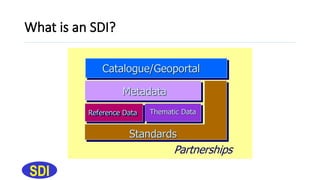
What is an SDI?
• “The SDI provides a basis for spatial data discovery, evaluation, and application for
users and providers within all levels of government, the commercial sector, the non-
profit sector, academia and by citizens in general.” The SDI Cookbook, http://www.gsdi.org,
• A spatial data infrastructure (SDI) is a data infrastructure implementing a framework
of geographic data, metadata, users and tools that are interactively connected in
order to use spatial data in an efficient and flexible way (Wikipedia)
• SDIs are defined as the technology, policies, standards, human resources, and related
activities necessary to acquire, process, distribute, use, maintain, and preserve spatial
data (Masser, 2005)
• National Spatial Data Infrastructure (NSDI) means the technology, policies, standards,
and human resources necessary to acquire, process, store, distribute, and improve
utilization of geospatial data (Executive Order 12906, 1994)
SDI
What is an SDI?
SDI
Like a road infrastructure
makes it possible to connect
different sites,
a spatial data infrastructure
makes it possible to connect
data located at different
sources
Data easily
discoverable
and accessible
to users
Facilitating
development
of new
applications
and services
What is an SDI?
SDI
SDI Hierarchy
SDI
SDI Hierarchy
SDI
SDIs are seen in many countries across the world as way to:
• Increase efficiency of
public administration by
sharing information and
processes
• Contribute to open
Public Sector
Information increasing
transparency in decision
making, and new
services, innovation,
and jobs
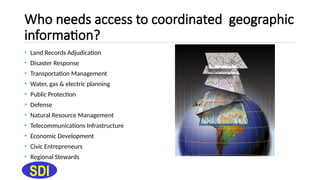
Who needs access to coordinated geographic
information?
SDI
• Land Records Adjudication
• Disaster Response
• Transportation Management
• Water, gas & electric planning
• Public Protection
• Defense
• Natural Resource Management
• Telecommunications Infrastructure
• Economic Development
• Civic Entrepreneurs
• Regional Stewards
Components of a Spatial Data Infrastructure
(SDI)
SDI
• Policies & Institutional Arrangements (governance, data privacy &
security, data sharing, cost recovery)
• People (training, professional development, cooperation, outreach)
• Data (digital base map, thematic, statistical, place names)
• Technology (hardware, software, networks, databases, technical
implementation plans)
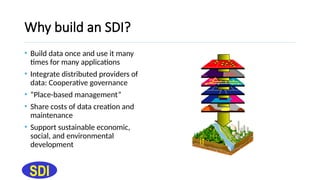
Why build an SDI?
SDI
• Build data once and use it many
times for many applications
• Integrate distributed providers of
data: Cooperative governance
• “Place-based management”
• Share costs of data creation and
maintenance
• Support sustainable economic,
social, and environmental
development
The outcomes of an NSDI
• The participant members (contributors and users) are known and can
interact
• Core and specialized map and data services are easily discoverable
and accessible
• Decision-makers and analysts have ready access to the right geo-
information for input to analytical and visual models – indicators,
models, trends, patterns
SDI
Benefits of an NSDI
• Development of a private sector involved with data sales and added
value
• A chance for communities of all sizes and capabilities to participate in
the knowledge economy
• A more informed voter/citizen
• Increased access to distributed geo-information through standards
SDI
Creating the motivation
• Development of an SDI should be a voluntary and have long-term
vision
• Government roles may require both incentives and directives
• Commercial and non-commercial participants should find SDI
appealing as a market
• The correct solution for NSDI must be defined by the community
SDI
Government Role in Infrastructure
• Promotes standards to enable compatible solutions
• We cannot imagine the fullest extent of how the NSDI will be
populated or what applications will live upon it!
SDI
overview of the pieces of the NSDI
SDI
 The first task is to inventory who has what data of what type
and quality
 A standardized form of metadata was published in June 1994
by the FGDC. An international standard now exists and will be
adopted by the US beginning in 2005
Metadata
Metadata...
• Provides documentation of existing internal geospatial data resources
within an organisation (inventory)
• Permits structured search and comparison of held spatial data by
others (catalog)
• Provides end-users with adequate information to take the data and
use it in an appropriate context (documentation)
SDI
Metadata Formats
• The FGDC Content Standard for Digital Geospatial Metadata (CSDGM,
1998) is expressed in XML for exchange and text and HTML for
presentation
• Participants in the Geospatial Data Clearinghouse offer other
metadata formats, including Dublin Core, ANZLIC, and expressions of
ISO 19115
• Any metadata format can be presented by requesting the HTML
format
SDI
Metadata...
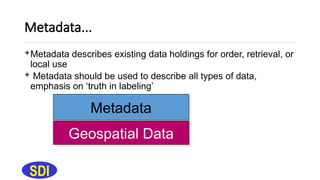
Metadata describes existing data holdings for order, retrieval, or
local use
 Metadata should be used to describe all types of data,
emphasis on ‘truth in labeling’
SDI
Metadata
Geospatial Data
Geodata & Framework
SDI
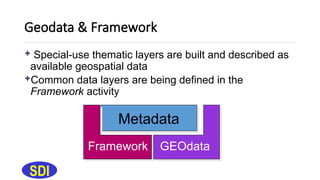
 Special-use thematic layers are built and described as
available geospatial data
Common data layers are being defined in the
Framework activity
Metadata
Framework GEOdata
Framework supports...
• Community development of sets of spatial features, feature
representation, and attribution to a lowest common denominator
• Participant collecting, converting, or associating information to
common Framework data standards with an encoding format to
facilitate exchange
• Multiple representations of real-world features at different scales and
times by feature identifier and generalization
SDI
Framework Data Standards
Each thematic content standard has an informative annex describing its
implementation as XML/GML Application Schemas using OGC Web
Feature Services
SDI
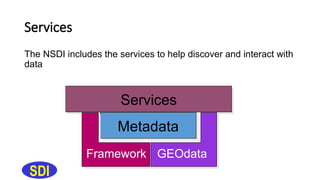
Services
The NSDI includes the services to help discover and interact with
data
SDI
Services
Metadata
Framework GEOdata
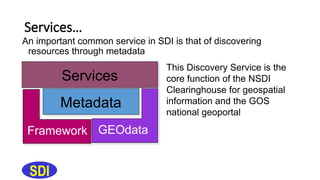
Services…
An important common service in SDI is that of discovering
resources through metadata
SDI
Services
Metadata
Framework GEOdata
This Discovery Service is the
core function of the NSDI
Clearinghouse for geospatial
information and the GOS
national geoportal
NSDI Clearinghouse Network and geodata.gov
portal (Discovery)
• Supports uniform, distributed search through a single user interface
to all domestic metadata collections to find data and maps
• A free advertising mechanism to provide world access to your
holdings under the principle of “truth-in-labeling”
• Search for spatial data through fields and full-text in the metadata and
categorical browsing
• Links through to full data access and online web mapping services,
where available
SDI
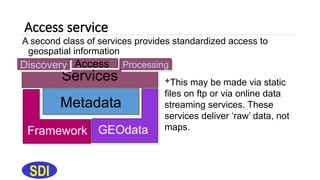
Access service
A second class of services provides standardized access to
geospatial information
SDI
Services
Metadata
Framework GEOdata
This may be made via static
files on ftp or via online data
streaming services. These
services deliver ‘raw’ data, not
maps.
Access Processing
Discovery
Data Access concepts
SDI
• Standardisation of data access implies several things:
• Definition of model used for the data to be exchanged
• Adoption of an exchange or encoding format
• Agreement on data access protocol(s)
• Organisations should strive to identify the mode(s) of operation to
simplify data exchange
Data Access Examples
• Administrative boundary data conforming to the GlobalMap data
model, packaged as Vector Product Format (VPF), made accessible
over ftp
• Panchromatic 10m, single-band, rectified imagery to a specific
coordinate reference system, packaged as GEOTIFF with LZW
compression, made accessible on CD-ROM
SDI
Processing service
SDI
Services
Metadata
Framework GEOdata
A third class of services
provides additional processing
on geospatial information
Access Processing
Discovery
Processing Services
 These include capabilities that extend and enhance the delivery of
data through processes applied to raw data:
 Web Mapping Services (OGC WMS)
 Symbolization (OGC SLD)
 Coordinate Transformation (OGC WCTS)
 Analysis or topologic overlay services
 Routing services
SDI
Geospatial Interoperability Reference Model
(GIRM)
• Voluntary technical participation in the NSDI is defined through the
GIRM
• The GIRM includes data standards, formats, protocols, and interface
specifications to maximize interoperability
• http://gai.fgdc.gov/girm/
SDI
Standards
SDI
 Standardization makes SDI work
 Standards touch every SDI activity
Standards include
specifications, formal
standards, and
documented
practices
FGDC Standards...
• Created by FGDC working groups and thematic subcommittees as
national standards, representing community consensus view of data
theme or common approach
• Submitted for 90-day public review
• Reviewed across disciplines for uniformity
• Published as US Federal Standards
• Standards by ISO, OGC, W3C and other standardization bodies are
used FIRST, if they exist!
• http://www.fgdc.gov/standards/standards.html
SDI
Roles of standards bodies
Partnerships extend our capabilities
SDI
How does OneStop Geoportal support NSDI?
• GOS has a timeline for implementation of NSDI components by all
partners
• Deploys a “one-stop” portal (National eoportal) for quick access to
community data, services, and related resources
• Standards are being developed with multi-sectoral stakeholders as
national (ANSI) standards, not FGDC ones
• Goals include measures of costs and savings through cost-sharing in
data acquisition, processing, and service of geospatial data
SDI

Introduction to Spatial Data Infrastructure

  • 1.
  • 2.
    What is anSDI? • “The SDI provides a basis for spatial data discovery, evaluation, and application for users and providers within all levels of government, the commercial sector, the non- profit sector, academia and by citizens in general.” The SDI Cookbook, http://www.gsdi.org, • A spatial data infrastructure (SDI) is a data infrastructure implementing a framework of geographic data, metadata, users and tools that are interactively connected in order to use spatial data in an efficient and flexible way (Wikipedia) • SDIs are defined as the technology, policies, standards, human resources, and related activities necessary to acquire, process, distribute, use, maintain, and preserve spatial data (Masser, 2005) • National Spatial Data Infrastructure (NSDI) means the technology, policies, standards, and human resources necessary to acquire, process, store, distribute, and improve utilization of geospatial data (Executive Order 12906, 1994) SDI
  • 3.
    What is anSDI? SDI Like a road infrastructure makes it possible to connect different sites, a spatial data infrastructure makes it possible to connect data located at different sources Data easily discoverable and accessible to users Facilitating development of new applications and services
  • 4.
    What is anSDI? SDI
  • 5.
  • 6.
    SDI Hierarchy SDI SDIs areseen in many countries across the world as way to: • Increase efficiency of public administration by sharing information and processes • Contribute to open Public Sector Information increasing transparency in decision making, and new services, innovation, and jobs
  • 7.
    Who needs accessto coordinated geographic information? SDI • Land Records Adjudication • Disaster Response • Transportation Management • Water, gas & electric planning • Public Protection • Defense • Natural Resource Management • Telecommunications Infrastructure • Economic Development • Civic Entrepreneurs • Regional Stewards
  • 8.
    Components of aSpatial Data Infrastructure (SDI) SDI • Policies & Institutional Arrangements (governance, data privacy & security, data sharing, cost recovery) • People (training, professional development, cooperation, outreach) • Data (digital base map, thematic, statistical, place names) • Technology (hardware, software, networks, databases, technical implementation plans)
  • 9.
    Why build anSDI? SDI • Build data once and use it many times for many applications • Integrate distributed providers of data: Cooperative governance • “Place-based management” • Share costs of data creation and maintenance • Support sustainable economic, social, and environmental development
  • 10.
    The outcomes ofan NSDI • The participant members (contributors and users) are known and can interact • Core and specialized map and data services are easily discoverable and accessible • Decision-makers and analysts have ready access to the right geo- information for input to analytical and visual models – indicators, models, trends, patterns SDI
  • 11.
    Benefits of anNSDI • Development of a private sector involved with data sales and added value • A chance for communities of all sizes and capabilities to participate in the knowledge economy • A more informed voter/citizen • Increased access to distributed geo-information through standards SDI
  • 12.
    Creating the motivation •Development of an SDI should be a voluntary and have long-term vision • Government roles may require both incentives and directives • Commercial and non-commercial participants should find SDI appealing as a market • The correct solution for NSDI must be defined by the community SDI
  • 13.
    Government Role inInfrastructure • Promotes standards to enable compatible solutions • We cannot imagine the fullest extent of how the NSDI will be populated or what applications will live upon it! SDI
  • 14.
    overview of thepieces of the NSDI SDI  The first task is to inventory who has what data of what type and quality  A standardized form of metadata was published in June 1994 by the FGDC. An international standard now exists and will be adopted by the US beginning in 2005 Metadata
  • 15.
    Metadata... • Provides documentationof existing internal geospatial data resources within an organisation (inventory) • Permits structured search and comparison of held spatial data by others (catalog) • Provides end-users with adequate information to take the data and use it in an appropriate context (documentation) SDI
  • 16.
    Metadata Formats • TheFGDC Content Standard for Digital Geospatial Metadata (CSDGM, 1998) is expressed in XML for exchange and text and HTML for presentation • Participants in the Geospatial Data Clearinghouse offer other metadata formats, including Dublin Core, ANZLIC, and expressions of ISO 19115 • Any metadata format can be presented by requesting the HTML format SDI
  • 17.
    Metadata... Metadata describes existingdata holdings for order, retrieval, or local use  Metadata should be used to describe all types of data, emphasis on ‘truth in labeling’ SDI Metadata Geospatial Data
  • 18.
    Geodata & Framework SDI Special-use thematic layers are built and described as available geospatial data Common data layers are being defined in the Framework activity Metadata Framework GEOdata
  • 19.
    Framework supports... • Communitydevelopment of sets of spatial features, feature representation, and attribution to a lowest common denominator • Participant collecting, converting, or associating information to common Framework data standards with an encoding format to facilitate exchange • Multiple representations of real-world features at different scales and times by feature identifier and generalization SDI
  • 20.
    Framework Data Standards Eachthematic content standard has an informative annex describing its implementation as XML/GML Application Schemas using OGC Web Feature Services SDI
  • 21.
    Services The NSDI includesthe services to help discover and interact with data SDI Services Metadata Framework GEOdata
  • 22.
    Services… An important commonservice in SDI is that of discovering resources through metadata SDI Services Metadata Framework GEOdata This Discovery Service is the core function of the NSDI Clearinghouse for geospatial information and the GOS national geoportal
  • 23.
    NSDI Clearinghouse Networkand geodata.gov portal (Discovery) • Supports uniform, distributed search through a single user interface to all domestic metadata collections to find data and maps • A free advertising mechanism to provide world access to your holdings under the principle of “truth-in-labeling” • Search for spatial data through fields and full-text in the metadata and categorical browsing • Links through to full data access and online web mapping services, where available SDI
  • 24.
    Access service A secondclass of services provides standardized access to geospatial information SDI Services Metadata Framework GEOdata This may be made via static files on ftp or via online data streaming services. These services deliver ‘raw’ data, not maps. Access Processing Discovery
  • 25.
    Data Access concepts SDI •Standardisation of data access implies several things: • Definition of model used for the data to be exchanged • Adoption of an exchange or encoding format • Agreement on data access protocol(s) • Organisations should strive to identify the mode(s) of operation to simplify data exchange
  • 26.
    Data Access Examples •Administrative boundary data conforming to the GlobalMap data model, packaged as Vector Product Format (VPF), made accessible over ftp • Panchromatic 10m, single-band, rectified imagery to a specific coordinate reference system, packaged as GEOTIFF with LZW compression, made accessible on CD-ROM SDI
  • 27.
    Processing service SDI Services Metadata Framework GEOdata Athird class of services provides additional processing on geospatial information Access Processing Discovery
  • 28.
    Processing Services  Theseinclude capabilities that extend and enhance the delivery of data through processes applied to raw data:  Web Mapping Services (OGC WMS)  Symbolization (OGC SLD)  Coordinate Transformation (OGC WCTS)  Analysis or topologic overlay services  Routing services SDI
  • 29.
    Geospatial Interoperability ReferenceModel (GIRM) • Voluntary technical participation in the NSDI is defined through the GIRM • The GIRM includes data standards, formats, protocols, and interface specifications to maximize interoperability • http://gai.fgdc.gov/girm/ SDI
  • 30.
    Standards SDI  Standardization makesSDI work  Standards touch every SDI activity Standards include specifications, formal standards, and documented practices
  • 31.
    FGDC Standards... • Createdby FGDC working groups and thematic subcommittees as national standards, representing community consensus view of data theme or common approach • Submitted for 90-day public review • Reviewed across disciplines for uniformity • Published as US Federal Standards • Standards by ISO, OGC, W3C and other standardization bodies are used FIRST, if they exist! • http://www.fgdc.gov/standards/standards.html SDI
  • 32.
  • 33.
    Partnerships extend ourcapabilities SDI
  • 34.
    How does OneStopGeoportal support NSDI? • GOS has a timeline for implementation of NSDI components by all partners • Deploys a “one-stop” portal (National eoportal) for quick access to community data, services, and related resources • Standards are being developed with multi-sectoral stakeholders as national (ANSI) standards, not FGDC ones • Goals include measures of costs and savings through cost-sharing in data acquisition, processing, and service of geospatial data SDI