
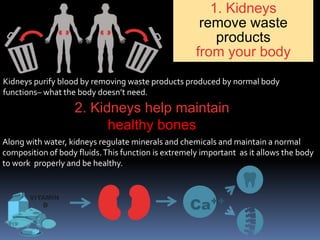








1. Kidneys
remove waste
products
from your body
2. Kidneys help maintain
healthy bones
Ca++
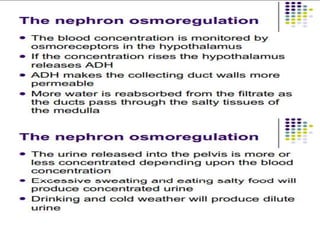
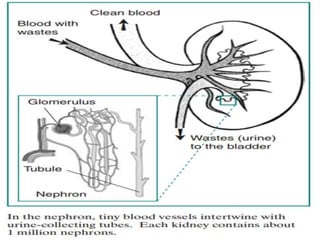
Kidneys purify blood by removing waste products produced by normal body
functions– what the body doesn’t need.
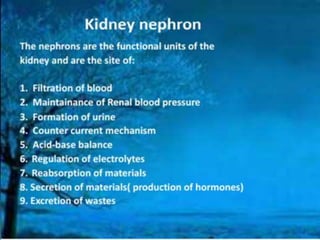
Along with water, kidneys regulate minerals and chemicals and maintain a normal
composition of body fluids.This function is extremely important as it allows the body
to work properly and be healthy.
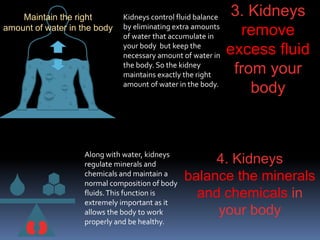
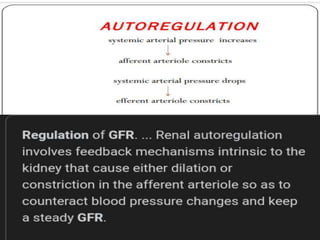
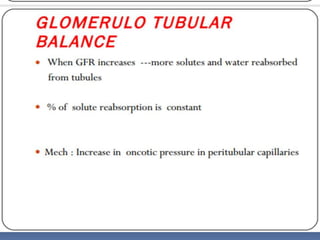
Maintain the right
amount of water in the body
3. Kidneys
remove
excess fluid
from your
body
4. Kidneys
balance the minerals
and chemicals in
your body
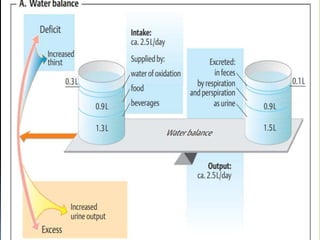
Kidneys control fluid balance
by eliminating extra amounts
of water that accumulate in
your body but keep the
necessary amount of water in
the body. So the kidney
maintains exactly the right
amount of water in the body.
Along with water, kidneys
regulate minerals and
chemicals and maintain a
normal composition of body
fluids.This function is
extremely important as it
allows the body to work
properly and be healthy.
5. Kidneys
control your
blood pressure
6. Kidneys
help the body
produce
red blood cells
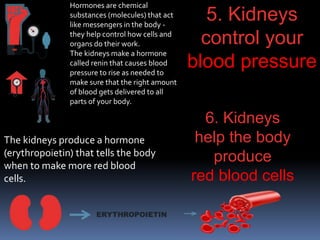
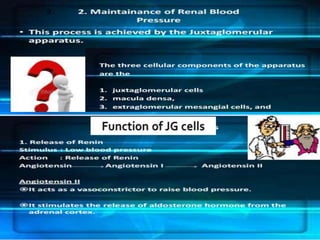
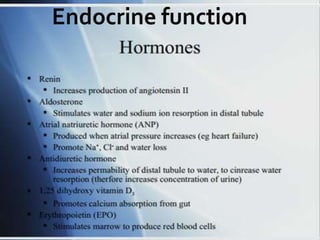
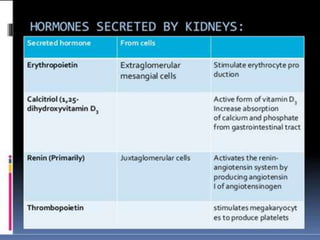
The kidneys produce a hormone
(erythropoietin) that tells the body
when to make more red blood
cells.
Hormones are chemical
substances (molecules) that act
like messengers in the body -
they help control how cells and
organs do their work.
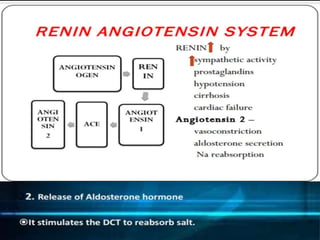
The kidneys make a hormone
called renin that causes blood
pressure to rise as needed to
make sure that the right amount
of blood gets delivered to all
parts of your body.
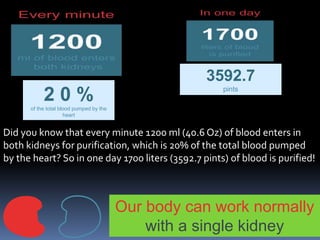
2 0 %of the total blood pumped by the
heart
3592.7
pints
Our body can work normally
with a single kidney
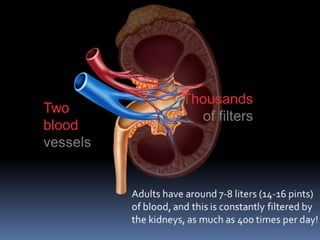
Did you know that every minute 1200 ml (40.6 Oz) of blood enters in
both kidneys for purification, which is 20% of the total blood pumped
by the heart? So in one day 1700 liters (3592.7 pints) of blood is purified!
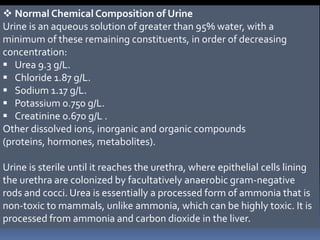
 Normal Chemical Composition of Urine
Urine is an aqueous solution of greater than 95% water, with a
minimum of these remaining constituents, in order of decreasing
concentration:
 Urea 9.3 g/L.
 Chloride 1.87 g/L.
 Sodium 1.17 g/L.
 Potassium 0.750 g/L.
 Creatinine 0.670 g/L .
Other dissolved ions, inorganic and organic compounds
(proteins, hormones, metabolites).
Urine is sterile until it reaches the urethra, where epithelial cells lining
the urethra are colonized by facultatively anaerobic gram-negative
rods and cocci. Urea is essentially a processed form of ammonia that is
non-toxic to mammals, unlike ammonia, which can be highly toxic. It is
processed from ammonia and carbon dioxide in the liver.
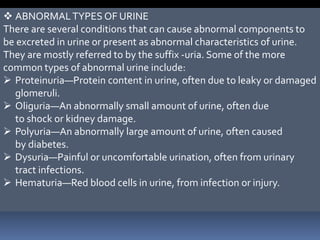
 ABNORMALTYPES OF URINE
There are several conditions that can cause abnormal components to
be excreted in urine or present as abnormal characteristics of urine.
They are mostly referred to by the suffix -uria. Some of the more
common types of abnormal urine include:
 Proteinuria—Protein content in urine, often due to leaky or damaged
glomeruli.
 Oliguria—An abnormally small amount of urine, often due
to shock or kidney damage.
 Polyuria—An abnormally large amount of urine, often caused
by diabetes.
 Dysuria—Painful or uncomfortable urination, often from urinary
tract infections.
 Hematuria—Red blood cells in urine, from infection or injury.
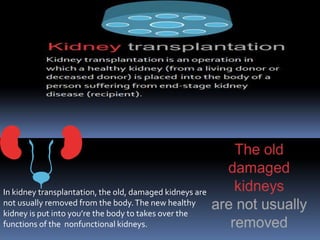
In kidney transplantation, the old, damaged kidneys are
not usually removed from the body.The new healthy
kidney is put into you’re the body to takes over the
functions of the nonfunctional kidneys.
 KIDNEY
 KIDNEY
 KIDNEY
 KIDNEY
 KIDNEY
 KIDNEY
 KIDNEY
 KIDNEY
 KIDNEY
 KIDNEY
 KIDNEY
 KIDNEY
 KIDNEY
 KIDNEY
 KIDNEY
 KIDNEY
 KIDNEY
 KIDNEY
 KIDNEY
 KIDNEY
 KIDNEY
 KIDNEY
 KIDNEY
 KIDNEY
 KIDNEY
 KIDNEY
 KIDNEY

KIDNEY

  • 12.
    1. Kidneys remove waste products fromyour body 2. Kidneys help maintain healthy bones Ca++ Kidneys purify blood by removing waste products produced by normal body functions– what the body doesn’t need. Along with water, kidneys regulate minerals and chemicals and maintain a normal composition of body fluids.This function is extremely important as it allows the body to work properly and be healthy.
  • 13.
    Maintain the right amountof water in the body 3. Kidneys remove excess fluid from your body 4. Kidneys balance the minerals and chemicals in your body Kidneys control fluid balance by eliminating extra amounts of water that accumulate in your body but keep the necessary amount of water in the body. So the kidney maintains exactly the right amount of water in the body. Along with water, kidneys regulate minerals and chemicals and maintain a normal composition of body fluids.This function is extremely important as it allows the body to work properly and be healthy.
  • 14.
    5. Kidneys control your bloodpressure 6. Kidneys help the body produce red blood cells The kidneys produce a hormone (erythropoietin) that tells the body when to make more red blood cells. Hormones are chemical substances (molecules) that act like messengers in the body - they help control how cells and organs do their work. The kidneys make a hormone called renin that causes blood pressure to rise as needed to make sure that the right amount of blood gets delivered to all parts of your body.
  • 15.
    2 0 %ofthe total blood pumped by the heart 3592.7 pints Our body can work normally with a single kidney Did you know that every minute 1200 ml (40.6 Oz) of blood enters in both kidneys for purification, which is 20% of the total blood pumped by the heart? So in one day 1700 liters (3592.7 pints) of blood is purified!
  • 47.
     Normal ChemicalComposition of Urine Urine is an aqueous solution of greater than 95% water, with a minimum of these remaining constituents, in order of decreasing concentration:  Urea 9.3 g/L.  Chloride 1.87 g/L.  Sodium 1.17 g/L.  Potassium 0.750 g/L.  Creatinine 0.670 g/L . Other dissolved ions, inorganic and organic compounds (proteins, hormones, metabolites). Urine is sterile until it reaches the urethra, where epithelial cells lining the urethra are colonized by facultatively anaerobic gram-negative rods and cocci. Urea is essentially a processed form of ammonia that is non-toxic to mammals, unlike ammonia, which can be highly toxic. It is processed from ammonia and carbon dioxide in the liver.
  • 48.
     ABNORMALTYPES OFURINE There are several conditions that can cause abnormal components to be excreted in urine or present as abnormal characteristics of urine. They are mostly referred to by the suffix -uria. Some of the more common types of abnormal urine include:  Proteinuria—Protein content in urine, often due to leaky or damaged glomeruli.  Oliguria—An abnormally small amount of urine, often due to shock or kidney damage.  Polyuria—An abnormally large amount of urine, often caused by diabetes.  Dysuria—Painful or uncomfortable urination, often from urinary tract infections.  Hematuria—Red blood cells in urine, from infection or injury.
  • 77.
    In kidney transplantation,the old, damaged kidneys are not usually removed from the body.The new healthy kidney is put into you’re the body to takes over the functions of the nonfunctional kidneys.